


5,00 €
Mehr erfahren.
- Herausgeber: Bookmundo
- Kategorie: Sachliteratur, Reportagen, Biografien
- Sprache: Englisch
After the hitchhiking journeys described in the book "Lonesome Streets Blues", the author found his place on Earth in a small Portuguese town. He landed there by responding to an advertisement from an "eccentric artist seeking a partner to run an antique shop and an illegal restaurant." Ten years later, he finds himself in Portugal again, and the circumstances are even more astonishing than before. "A few months later, I called one of the protagonists of my memoirs, Joachim, whom I met on the trail to Santiago. After reading a few passages, he asked, 'Daniel, did you have some kind of recorder when you talked to me? Do you have such a good memory? After all, this is repeated word for word!'" While the majority of events that unfolded after the author's return to Portugal proved to be genuinely unconventional and unexpected, this narrative also reflects the everyday, less thrilling life in the RV, the daily job and family relations. Nevertheless, the unique ability to shape one's life into a novel without embellishment is something extraordinary in today's times, when social media often present a story completely different from the reality. This one shows exactly how it was.
Das E-Book können Sie in Legimi-Apps oder einer beliebigen App lesen, die das folgende Format unterstützen:
Veröffentlichungsjahr: 2024
Ähnliche


















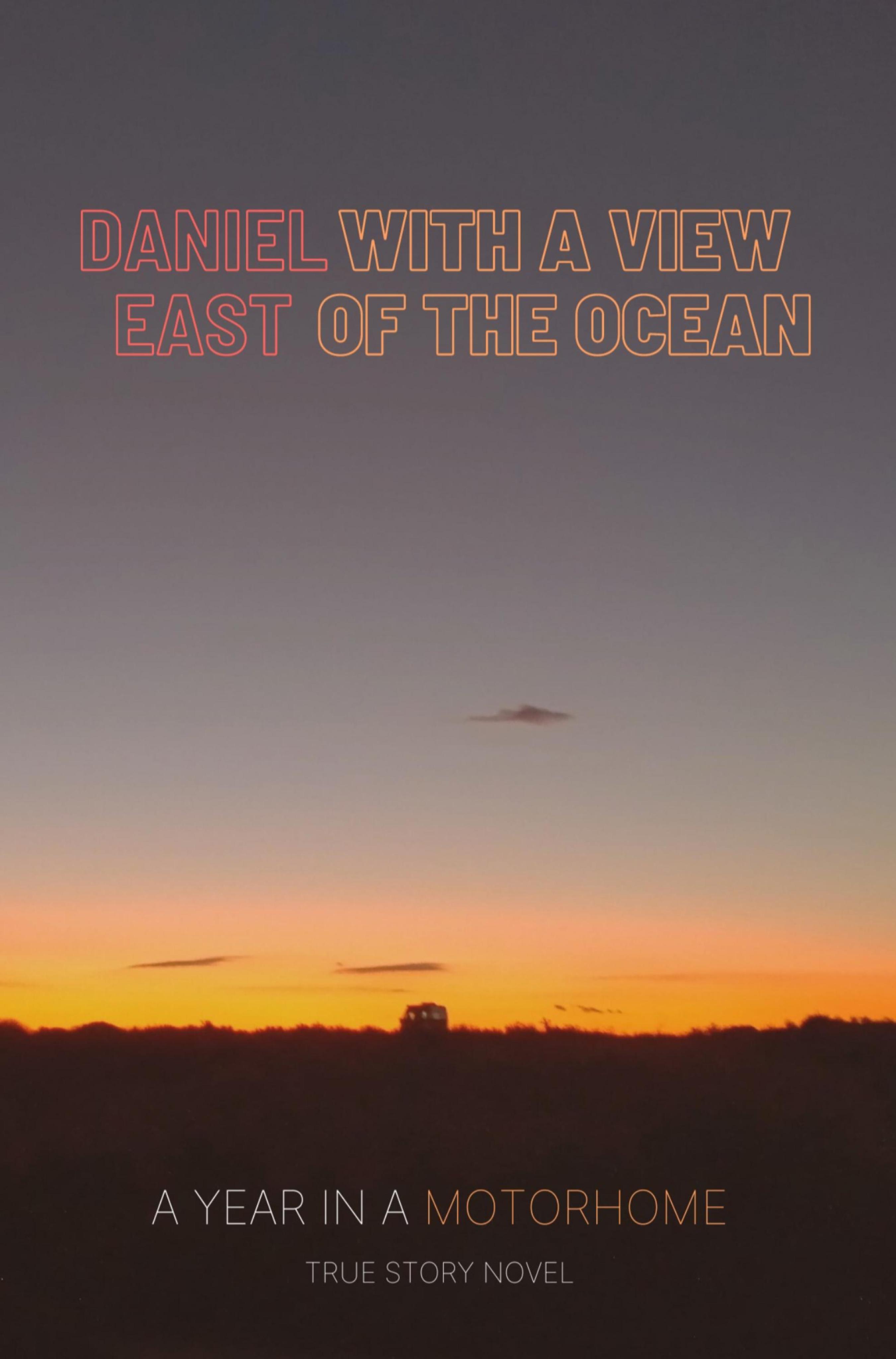
With a View of the Ocean
With a View of the Ocean
Daniel East
Cover design by @minimalistlandscapes
Polish Copyright © 2021 by Daniel East
English Translation Copyright © 2024 by Daniel EastAll rights reserved. No parts of this book may be reproduced without permission of the publisher or the author. For more information, contact the author at [email protected]
This publication is made possible by the Vanlife Community members: Al Lens, Melinda McFarland and Sarah Wanden.The book has been translated by the author, using neural machine translation systems. As the author is not a native English speaker and has never lived in an English-speaking country, he relied on the valuable suggestions of the above people, who kindly proofread it.ISBN: 978-9403723-87-7
Five minutes of life is an eternity.
—Víctor Jara “Te recuerdo Amanda”
Learn from the way the wild flowers grow. They do not work or spin.But I tell you that not even Solomon in all his splendor was clothed like one of them.
—Matthew, 6:28-29 (New American Bible)
Prologue
Here is the story that my friend told me. Its protagonist is Carlos, or Carlinhos as they called him. In the absence of cell phones during that era, people had to be called out. “That era” was in the year 1968 when Portugal was engaged in its colonial wars, and global youth were in rebellion against authority. In Portugal, still under dictatorship, one of the simplest forms of civil disobedience was desertion. My friend met Carlos on a train as they fled conscription into the army with a couple of peers, whose entry into adulthood coincided with this unfortunate moment of history. The essence of the story, however, is not politics but money, making certain figures noteworthy.
Carlinhos received a train ticket from his father, plus 400,000 escudos to sustain himself abroad for a while. Those 400,000 were equivalent to today’s 2,000 euros. Hard to say whether it is a large sum, but with a little luck, and the help of friends waiting for our hero in the Netherlands, it should be enough for a few months. Meanwhile, the entire group of fugitives had a meeting scheduled at a specific place in Lisbon. The problem was that Carlos forgot the address. The phones, as I mentioned, were not common, so he spent half the amount given by his father on a private plane from Lisbon to Faro to gather information once again. Mindful of how precious every minute was, Carlos took a cab from the airport and then returned to Lisbon on the rented plane. Since the flight consumed almost all the funds he had, he borrowed additionally from my friend’s father.
Soon, probably after many adventures and with an even more depleted budget, Carlinhos reached the Netherlands. What happened to the remaining money that he received for the trip? Let us discuss it step by step.
Carlinhos’ first major purchase was a motorcycle. He rode it a bit until he found his wallet was dangerously shrinking. A few days later, the motorcycle was sold, and our hero came up with the idea of financially redeeming himself by playing music in clubs. He needed an instrument for this, and he chose an electronic piano. It is worth mentioning that electric instruments of this type existed somewhat earlier, while electronic, otherwise known as synthesizers, were a new invention and a seasonal hit. If my friend’s memory is correct, and it was indeed an electronic instrument, it must have cost a considerable amount. Unluckily, it didn’t bring Carlos the expected success, so it had to be sold very quickly but this allowed him to recover some of the invested money. While Carlos’ hopes for a musical career faded irreversibly, the same cannot be said for his love of music, as evidenced by his next purchase, a gramophone. Nonetheless, Carlos, as a passionate and versatile individual, could not limit himself to just one field. Thus, as he became increasingly absorbed in the art of photography, he decided to get himself a camera. As we know, flaunting borrowed money isn’t morally justifiable, and not always feasible. Therefore, to acquire the camera, Carlos decided to part with the gramophone. The expensive Polaroid was his last big investment that my friend remembered. After that, their paths diverged. Carlinhos made these transactions within a span of two weeks. It is also remembered that during that time, he often used a bell, which in Dutch bars signaled the intention to buy a round of drinks for everyone at the bar.
My friend met Carlinhos again also in a train. It was many years later. Carlinhos already had a family and children, but he wasn’t very talkative about what he was currently involved in. He hinted at something related to real estate trade—buying, selling—those kinds of matters. Unfortunately, he didn’t specify what real estate he had in mind. With a high probability, it can be assumed that he meant his own.
Carlinhos was a deserter. He was also a bit of a mama’s boy—both a loser and a man who enjoyed life to the fullest. For me, first and foremost, he was an artist whose work will not leave any legacy behind.
So was my friend, Paulo.
Part One
But you’re growin’ religious, the older you get
You haven’t been saved but it could happen yet
—Robert Earl Keen “Lonely Feeling”
1
Ricesimmered in the pot, while I sipped green tea from a small bowl, surrounded by the hum of the road winding beneath the hillside. The boiling water and the distant cars blended into an almost uniform melody, occasionally interrupted by jingling coming from somewhere behind the fence. I was familiar with that melody from many other trips, but the bells were a novelty to me. I had hiked the beginning of the trail at night, and their distinctive sound accompanied me for the entire three miles from Oviedo up to the first drinking water tap. I assumed the locals hung feng shui bells to make fieldwork more enjoyable. That was my closest association. The night was a bit chilly, so before slipping into my sleeping bag, I put on a fleece-lined shirt and wrapped my feet in a jacket. By morning, both clothing items hung on the sides of my backpack as I continued my journey toward Santiago de Compostela. Only in the daylight did I notice the little bells on the necks of livestock.
The initial miles carried the scent of apple orchards, reminiscent of my great-grandmother’s farm. I had never lived in the countryside, but my family and I made occasional visits there. The surrounding pastures increasingly evoked childhood memories in me. In addition to the orchard, I recalled a small garden where I picked green peas from the pods. There was also a grocery store, where you walked about half a mile or a mile downhill and then returned uphill with the purchases. The farm was equipped with a wooden outhouse. It was impossible to get there without hearing the ominous barking of the dog. Each time, I shivered at the thought that he might break free from its chain and pounce on me, causing me to attend to my physiological needs prematurely. On the trail to Santiago, you could also hear dogs, but I stopped fearing them, having two bites to my credit from the years when I worked as a postman.
I don’t know what happened to the dog, the apples, the green peas, or whether the store still exists or turned into a modern supermarket because my great-grandmother moved out of the village. Every time she said goodbye, she would hold my hand for a few minutes, wishing me well, praising my then piety and my Sunday visits to church. Today, Grandma Vladya could be the most ardent supporter of my pilgrimage, although she would not entirely understand my motivations. She wholeheartedly believed in God and his commandments. My great-grandmother’s faith especially revealed its strength when, after moving, she watched her favorite soap opera, The Bold and the Beautiful on TV, and with every on-screen kiss she would cover her eyes.
The second great-grandmother lived in a town from the beginning. This marked the difference in her customs. To get to the field, she had to cross a busy bypass road, and on the other side of her little farm was a church. To get to the Mass, crossing the street was enough, and Grandma Polly usually did that without any trouble, but I don’t recall it being the highlight of her daily schedule. It was easier to find her at the shrine with a statue of Jesus, which she took care of. Even more than Jesus and the Holy Trinity, she cherished the Pope. She was a psycho fan. When John Paul II spoke on television, and my great-grandmother was at her daughter and son-in-law’s place, there had to be absolute silence. If anyone attempted to disturb it, the names of Jesus, his mother, and all the other saints would resonate throughout the room, with Mary Magdalene’s profession being most frequently invoked.[1]
Beneath Grandma’s armchair, there was always her wicker basket, where she kept an excellent alcohol-based remedy called Amol, effective for all sorts of aches and pains. She also kept money there, a good portion of which was allocated to Lego blocks for me and my brother. The armchair next to her was occupied by her son-in-law (my grandfather), and opposite the two of them was a TV set. The problem arose when the Pope was speaking on one channel and soccer championships were taking place simultaneously on another channel. I never thought that the Vatican and FIFA were institutions that could interfere with each other, but in my grandparents’ home, they waged a constant battle. It seemed that during the final matches, Grandpa was gaining an advantage, but at the preliminaries, Grandma and the Pope were winning. I was a stronger supporter of FIFA, since the speeches of John Paul II were long and monotonous, while a soccer match lasted only ninety minutes with a fifteen-minute break. Unless my grandpa negotiated to watch the halftime analysis, the Pope also spoke during those fifteen minutes.
These TV disputes likely led me to isolate myself in a room upon hearing of the Pope’s death many years later. I was watching Otto Preminger’s Anatomy of a Murder, while the rest of the world was in mourning. I never became a soccer fan either, and Grandma Polly didn’t live to see the death of John Paul, which allowed her to die happily. Both great-grandmothers passed away in the same year, and both were blessed with peaceful deaths after long and relatively peaceful lives.
The last religion I adhered to was a specific form of Christianity preached by the protagonist of The Grapes of Wrath, who claimed that God reveals himself in everything that surrounds us. Eventually, even Jim Casy’s sermons ceased to influence me. Many people, evading the question of whether they believe in God, say that the object of their faith is humanity. I have asked myself a different question, Why do we have to believe in something? Since then, I haven’t even shared that faith, I believed in nothing. This was by no means an expression of cynicism, but rather my skepticism toward all non-scientific and irrational concepts. Of the three virtues taught to me in religion classes,[2] I accepted hope and love, but not faith.
My last link with divine matters, however, became my grandfather. The object of his conflict with Grandma Polly was only the TV set, whereas, with her daughter, Grandma Pollyanna, they argued about almost every other thing. She would give him money and send him out for a beer to have some peace for a while, but this tactic created a vicious circle. Upon his return, Grandpa would irritate her even more. It always made me uncomfortable to think that Grandma Pollyanna wouldn’t shed a tear at Grandpa’s funeral. My suspicion that he would die before her proved accurate, yet something completely unforeseen happened regarding the funeral. On the day it was to be held, Grandma broke her arm. We visited the grave together only on All Saints’ Day.
I regretted most that I never had the chance to have a beer with Grandpa, since I tried it for the first time after his death. Nonetheless, I found another opportunity for it. Combining my passion for long walks and unconventional pastimes, one day I bought two cans and walked eight miles to the other end of the city, where the cemetery was located. I opened the beer at the grave, pouring every second sip onto the ground. Along the way, I even bought a candle, despite it being past eleven at night. Therefore, I lit the one and only candle in my life for the deceased, and I felt something akin to what the believers feel. Suddenly, amid the darkness, there was a loud bang, and the sky brightened up with colorful fireworks. It was New Year’s Eve, and I shared another beer with Grandpa.
2
I spent the first night of the pilgrimage in a field under a tree. In the morning, the whole area was empty. Then, after a tireless day-long trek, I lay down by the road after dusk. On the third day, I woke up late enough to meet other people on the trail. Several greeted me as I emerged half-asleep from my sleeping bag, and then, full of energy I passed them again on the track.
Almost every pilgrim had a booklet in which they collected stamps from roadside cafés, churches, and shelters to receive a certificate at the end of the journey. I obtained my first stamp by chance in Santander while waiting for the bus to Oviedo, which marked the beginning of my planned route. During that time, I visited the city’s cathedral, and a priest strolling down the side aisle asked if I needed a stamp. Previously, I had not even considered collecting them, but this kind gesture encouraged me to start. I decided to aim for at least two or three stamps per day, which would entitle me to a certificate. My second stamp was from a chapel, where someone left it in a box hanging by the door. In a hostel in Salas, I received the third stamp.
Somewhere near the town of Tineu, I kept pace with a sixty-five-year-old Korean who had been traveling for two months. We had seen each other earlier in a bar. I ate a sandwich, and he ordered a beer, trying to chat with the bartender using his newly learned words in Spanish. Whenever I meet someone from a foreign country, I try to recall a movie from there. In this case, it was easy because I had recently watched a Korean movie titled Burning. As a habit, if I like a movie, I familiarize myself with all the director’s filmography. That’s how I came across The Peppermint Candy, which became one of my favorites. The protagonist receives the candy from his beloved while serving in the army, and this event is the axis of the entire plot. The story unfolds over several decades.
“I remember this movie,” said my Korean companion. “It’s set during the military dictatorship we had at that time,” he added, then began explaining the nuances of recent Korean history. “But my favorite film is Spring, Summer, Fall, Winter…and Spring. Do you know it?”
“Sure!” I replied with satisfaction. “But when it comes to that director, I preferred Samaritan Girl.”
It turned out that the Korean did’nt know Samaritan Girl, which was strange to me. In my opinion, this is the aptest allegory of Christ’s suffering, perhaps even the best summary of the principles of the Christian religion. The film he mentioned could be similarly related to Buddhism.
For the next few minutes, our conversation veered slightly from the topic of religion and cinema. I learned one of the causes of air pollution in South Korea. Part of the smog is carried into the country by the Chinese who build factories on the eastern coast. I responded that I was hopeful about Xi Jinping’s declaration to solve the smog problem by 2030, but l never anticipated it happening in such a way. While the disposal of industrial waste in poorer countries has been a known thing for a long time, it was the first time I heard about this form of outsourcing atmospheric pollution.
“What does China say about it?” I asked.
“The Chinese pretend the problem doesn’t concern them. After all, the smog is in Korea, so Korea should deal with it.” We discussed ecology a bit more, concluding that the key to the survival of the world as we know it is to limit consumption.
On the way out of the forest to a clearing, we came across a group of three girls.
“Oh God, it’s a snake!” exclaimed one of them.
My companion approached her and found that it was indeed a snake. The protagonist of the commotion, however, disappeared into the grass, and we could pass safely. I didn’t even get a chance to see it.
“Don’t be afraid, girls,” said the Korean. “We’ll lead the way and in case we see another snake, I’ll walk first, and you,” he pointed at me, “second.”
“What are your names?
“Daniel,” I replied.
“Li,” replied the Korean.
“Oh, good to know your name,” I turned to Li. Then I explained the girls, “Somehow, for the whole hour, we didn’t introduce ourselves!”
They laughed.
“It’s not that important. Anyway, I’m Stephanie,” replied one of them and immediately asked, “Where are you from? I’m from Toronto.”
“I am from Poland. But I’ve been to Toronto! It wasn’t that long ago. I walked from the airport to the city center.”
“From Pearson Airport? There’s nothing on the way there!”
“I know, but I always prefer to walk and make sure,” I defended myself. “It was quite funny. Straight and then left. That’s all I had to remember to walk the entire way to my rental room.”
Actually, I wouldn’t have missed a lot if I had taken the bus, but what was I supposed to do alone in such a big city? To not feel out of place in new surroundings, I prefer to explore them piece by piece, and the best way to do that is to go from the airport to the center on foot. Over the past three years, I have walked quite a few paths from various airports to city centers, unaware of the damage my walks were causing to the natural environment. In the era of cheap airline tickets, I hit extraordinary bargains almost every month. A return ticket from Berlin to Toronto for 200 euros was just one of many. Even cheaper, for 150 euros, I flew from Amsterdam to Central America, and for less than a hundred, I managed to travel from Budapest to Kazakhstan. A bit pricier was the flight with five layovers to India costing 300 euros, but from Warsaw to the island of Mauritius the same amount covered the whole trip. 200 for the flight, 100 for food, and two nights of accommodation during a week-long walk along the southern coast. Those were truly crazy years. Many people traveled all over the world by plane in those times. Yet, not everyone treated it as a hobby.
This turn of events was made possible by my job. Unlike many travelers, I didn’t work remotely, but in an office. Thanks to the twelve-hour shifts I could accumulate a fair number of days off. Some, though a minority, saw these twelve hours as a curse, but I turned it into a way of life. Even Donald Tusk’s government, which wasn’t particularly sympathetic to the working class, inadvertently benefited my case. The law he introduced allowed the hours not worked in a given month to be carried over to the next. It was important that the monthly average, about 170 hours, matched every quarter. I worked four days in a row, had a two-day break, and then another four, meeting over half of the quota in a week and a half. I requested as many shifts as possible in one month to have longer periods off in the remaining two. My annual leave, decent earnings, and a minimalist approach to life, provided the opportunity for monthly travels. The only breaks I had from traveling were during the summer when tickets were most expensive, but then I could enjoy the sun in my city, usually covered in smog and clouds. This fun lasted until I quit my job. Till that point, I had visited almost seventy countries.
Canadian Stephanie also decided to quit her job and fly to Europe. She was accompanied by a German studying medicine in Romania and a Russian named Natalia. Natalia moved to Madrid after studying in St. Petersburg. There she continued her studies and got a job which she recently left.
“That’s great,” I say. “I resigned too, and I’ve been free since this month. Turns out the Santiago trail is made for people like us who want to take a month off.”
Arriving in the village of Campiello, we settled in a café connected to the albergue[3] and a mini market. In my case, it was a break before the onward journey. Li quickly went to look for a hostel, where he could pitch his tent in the courtyard. The girls, after long deliberations, decided to stay here as well. Natalia hesitated to go on and eventually joined me toward Borres. Along the way, we passed Li, who was already sitting at a table with a newly acquainted Korean woman. They waved goodbye to us. After that, I did not encounter any of these people again.
“In fact, I wanted to break free from the girls,” Natalia admitted. “We have been walking together for three days, and it’s nice meeting other people too.”
“I understand that feeling. Even though the girls were cool, I also value my freedom.”
I said goodbye to Natalia as she turned toward the shelter before Borres. Since it was still daylight, I continued my hike. I had heard about two paths that marked the end of the next stage of the trail. One led through the old pilgrim hospitals. It was more popular but also more challenging and a bit longer, covering a whopping ten miles. When I reached the fork, the clock showing eight o'clock made my choice easier. I opted for the second route, slightly less scenic, but leaving me with no more than six miles to go. Thanks to this, I was two days ahead of the schedule described in the guide. I slept that night by a small stream near the village of Pola de Allande.
On the third day, I saw the first rain. It was just a sprinkle but I took shelter at the entrance to an abandoned homestead with a view of the mountain range. The rain soon stopped and I moved on. Now and then, I passed pilgrims, calling out buen camino[4] to them. Since I was nearly three days ahead of the guidebook, I decided to rest in a beautifully located hotel by a dam in the mountain valley. When I entered and asked about the price, three men were sitting at the bar.
“He’s from Poland too,” the oldest of them spoke up in English, pointing to the one beside him.
“Oh, really?” I asked.
“Yes, I am Achim.”
“Nice to meet you.”
“Come, you can share a room with me. I’ll show you around and then you can pay.”
I left my belongings in the room, took a shower, and went for a beer with Achim.
“Unusual name,” I remarked.
“It’s a Silesian name, Joachim,” he said.
“I’m also from Silesia!” I replied with a smile on my face. “Well, I was born in Torun but spent most of my childhood in Silesia—elementary school, high school…”
“I’m actually from Opole, but I’ve been living in Germany for a long time.”
“And where do you live in Germany? I used to live in Westphalia.”
These coincidences made it easier for us to connect.
“No way, man! I’m in the same area. Paderborn.”
Joachim moved to Germany before 1988, and after a stay in a resettlement camp, began working as a lathe operator. Meanwhile, for seven months, I delivered packages for Hermes Group, not knowing a bit of German language.
“I only learned two sentences: ‘I have a package for you’ and ‘Please sign.’”
Joachim laughed.
“I gave up because we worked there from early morning until late evening, including Saturdays. But I brought enough money back to Poland for a car, my first-ever airplane ticket, and still had more than two thousand euros left.”
“Actually, I’ve just started traveling more. Over the past ten years, we saved up for home renovations and spent vacations in Poland. Last year, I went on a pilgrimage from Porto, and next year maybe I’ll take my wife.”
Several named routes led to Santiago, and among them, the Camino Portugués passed through Porto. Ours was called Camino Primitivo, as it was the first one undertaken by pilgrims. I chose it for its convenient flight connection and the possibility of completing it in two weeks. According to the plan, I was going to take a bus from Santiago to Porto, and from there, fly back to Poland.
Joachim mentioned that the previous evening he was in a hostel where a girl from Russia named Natalia stayed overnight.
“Unbelievable! I know Natalia. We met on the trail yesterday.”
“From Petersburg and living in Madrid?”
“Exactly!”
“That’s all I managed to understand, because I don’t know English, and not much Russian either…”
The coincidences multiplied as the conversation progressed.
“Along the way, however, I met a Polish woman,” Joachim continued, “who resigned from her job at a bank in a senior position and went on the Camino. Later, working in the Canary Islands, she got a tip that a hostel had become available. She’s been running it for two years now. You know, I’m straightforward, so I walk in and say, ‘Kate, let’s have a coffee.’ So we went for coffee, and chatted a bit in Polish.”
“Oh, really? Was that Texu hostel in Espina?”
“Yes.”
“Then I think I overheard you guys talking upstairs,” I replied.
“Seriously? Why didn’t you come in?”
“Oh, I didn’t want to disturb anyone. Just went in for a stamp, but I saw no one around, and since the stamp was on the table, I applied it myself.”
Joachim and I were sitting on the hotel terrace. The receptionist brought us twigs with small black fruits and said we could pick more if we wanted. They were very good but didn’t taste like either blueberries or blackcurrants.
“These are cherries. I have the same in my garden,” he enlightened me.
“Gosh, they’re delicious!”
Soon, a hefty man in a white apron and a chef’s hat appeared at the door and asked if we were going to eat. I looked at my watch; it was after eight o’clock. We agreed that it was high time for an evening meal and moved to the dining room inside. In the doorway, an older man, whom I had seen at the bar earlier, approached me.
“Could you help me, please? How do I explain to them to call the post office and ask them to transport my luggage to the nearest town?”
The hotel’s Wi-Fi wasn’t working, and his cellular could not connect to any network. After my brief discussion with the chef and the receptionist, they let him use their phone. The chef soon came over to the table and began reciting the menu. After extensive explanations I ordered a dish from the menu displayed above the counter. Joachim ordered the same. While waiting for the meal, we discussed the last strange coincidence that connected us on this journey.
“Listen, did you happen to see a hat on the way?” he asked.
“Yes, I did.”
“A blue one?”
“Exactly. Was it yours?”
“Yes, I lost it.”
“Gosh, I was hesitating to take it, but I thought in that case it probably would never find its owner again, so it’s better to leave it in its place. Maybe someone will come back for it.”
“Well, it’s not a big loss.”
The chef brought each of us a plate of fries and a fillet. Unfortunately, the filet, contrary to my assumptions, turned out to be meat, not fish. Just as we began to eat, Jim sat at the table next to us. It was the same old man who had asked for help with the phone earlier. When the chef returned, he once again looked at me with concern.
“Maybe you’d like what we’re having?” I suggested.
“Sure, that works,” he replied happily.
Joachim ordered more red wine and poured it evenly into glasses for everyone. Then he turned to me, glancing at the elderly man from the USA. “Ask him what he thinks about Trump.”
I translated the question into English, and we immediately heard the answer. “He should have been in prison a long time ago!”
Both claimed that if only Trump had disclosed his tax returns, his ties to Russia would have come to light. Meanwhile, despite a court order, he has been effectively refusing to make them public for several years.
“You know,” added Jim, “in the States the legal system allows such trials to drag on for years in case of refusal.”
“Or maybe you could ask,” interjected Joachim, “what made people elect such a man as president?”
Jim and I then began discussing how social media triggered a machine that artificially fueled fear of nonexistent or marginal issues, such as immigration from Mexico, or threats from Islam. Unfortunately, one of the inflated threats was real: the fear of further job loss for American workers and competition from China, which was devouring the country’s economy. Trump won because other popular politicians disregarded the problems of ordinary people. The reasons were similar to those that led to the victory of the ruling party in my country.
Jim was a thin guy wearing round glasses with thick lenses and a round, balding head to match their shape. He was seventy-one years old, so he wasn’t in a hurry. When he used the bartender’s phone at my request, the latter was surprised to learn that the backpack was to be transported only three miles away.
“You know, I walk slowly. I like to meditate and contemplate the landscape. It’s not good to walk too fast. Many things pass you by.”
It occurred to me that Jim could make a good career by running a blog or a YouTube channel. Slow walking would quickly become a new trend, like slow food and slow life. Nowadays, everyone is breaking records in being first. So why not savor the fact of being last? I was already three days ahead, Joachim was two, and Jim by the same measure would be several weeks behind—perfect material for a modern hipster.
My room was empty in the morning—Joachim had apparently moved on. I continued my conversation with Jim over breakfast. He had a compelling biography. Teaching at California universities, he witnessed the rise of Silicon Valley, and, to some extent, computer science became the focus of his professional work.
“It must have been a little more interesting if you followed all from the beginning. Now, I just think about how to detach myself from the computer.”
I also asked him if he had hiked the mountain trails running across the entire United States. He replied that he had only done sections. I recently started dreaming about a several-month trek through the Sierra Nevada and the Cascades after watching the movie The Wild and through the Appalachians after seeing A Walk in the Woods. There was also the Continental Divide Trail, yet I hadn’t seen a movie that would inspire me for that. To complete all three, known as the Triple Crown, I would need at least a year and a half off from work, although I think with my pace, I might have a chance to conquer them in a year.
Meanwhile, Jim had already fulfilled another one of my unrealized dreams. Namely, he once owned a large GMC camper.
“Eventually, I found out there was more work with it than driving. And they quickly stopped producing them when the oil crisis began in the seventies. Due to the crisis, we moved from California to Minneapolis.”
“Why Minneapolis?”
“In California, drugs were a problem, other things too, so we started looking for a new place to live. Minneapolis was said to be a good choice at the time, as a thriving urban center. That’s why we moved there. Well, soon enough, drugs arrived there as well.”
Jim said his son would like my lifestyle. He also likes to travel a lot.
“And what does he do for a living?”
“He’s a bartender at a nightclub. You know, with the strippers and all that stuff. He can pull in two hundred dollars a day in tips.”
Jim indeed quoted an amount close to that. It may have been as high as five hundred, but certainly not less than two.
“But he’s afraid to start a family and have children. He has seen too often people ruin their lives through various addictions, so he’s afraid the same would happen to them.”
“I think,” I said to Jim, “that children can be raised properly, but the worst things are unforeseen events like wars, crises, or the threat of nuclear weapons. That’s what I’m most afraid of when it comes to the future of my possible kids,” I commented.
I wanted to support my thought with a quote from Donald Rumsfeld, explaining that these are the things that “we don’t even know we don’t know.” This quote would best capture the essence of my concerns. Unfortunately, at this moment, it completely slipped my mind, and I won’t join the distinguished group of scientists who love to cite him in their books.[5]
Jim said he had recently enrolled in a course on Chinese landscape painting, which was his new hobby. He showed me a few sketches and I asked him to send me his drawing of a tree by email. After finishing the toast, Jim was getting ready to leave, while I went out to the terrace and sat there until eleven to give my legs a little rest.
Walking through the forest toward Grandas de Salime, I didn’t meet Jim. Perhaps he disappeared among the trees, engaging in meditation. I hoped that was the case, as it would best match the image of Jim preserved in my mind. As for me, I was not sure if the stench of fresh horse or cow manure scattered along the path would be conducive to gathering my thoughts. Thus, I preferred to activate my wonderful invention from China, a speaker with a flashlight and a power bank, and played the Grateful Dead album. By the fourth song, I came across a girl with a pink backpack, a pair of poles, and hair tied with a scarf.
“Natalia, how nice to see you again!”
It turned out to be one of the girls I met the day before yesterday. The one with whom I continued hiking when the other two fell exhausted. The same one Joachim saw at the shelter, but they couldn’t communicate due to language problems. We got along well and found plenty of common topics. During the long, all-day march, we concluded that Joachim was the only person we met whose reasons for undertaking the pilgrimage were related to religion. The girls Natalia was with earlier were atheists, and she was only searching for faith. She was after something akin to devotion, similar to the character of her favorite novel, Alyosha.
“That’s how I’ll name my son if I ever have one. Like one of the brothers Karamazov.”
“I haven’t managed to read that book,” I admitted. “I only know Notes from the Underground because Jack Kerouac, one of my favorite writers, often mentioned it.”
We spent the day talking about literature, movies, and art. Natalia explained to me that the brothers in Dostoevsky’s novel represent different attitudes toward nineteenth-century Russia, and no other book provides more insight into the country. She brought the Bible with her, but the initial chapters bored her, so she started reading Siddhartha by Herman Hesse instead. At least in this subject, I could chime in with a few words. “Siddhartha is also a religious story,” I noted. “I got a lot out of reading it when I was younger and interested in religion myself. Well, the subject is a different religion, but the meaning is similar.”
I promised to read The Brothers Karamazov. Such reading would probably bring me relief after Gustave Flaubert’s The Temptation of Saint Anthony, which I took on the trail, attempting to push through its pages without gaining even a vague idea of what the book was about. I wasn’t a fan of trendy fantasy novels, and it essentially didn’t differ much from them, except that it was not trendy.
When the topic of literature was exhausted, I asked Natalia about the girls, and she said that they got stuck a few villages behind us today. She didn’t see them on the way, but they exchanged messages.
“What pussies,” she added.
I then told her about Jim.
“Three miles, and without a backpack!? What a pussy.”
“But he’s seventy-one years old.”
“Well, then, a seventy-one-year-old pussy,” she concluded.
On the way, we encountered a group of cows that blocked our path. I squeezed through them, but they wouldn’t let Natalia pass.
“Excuse me, do I need a visa?” she asked, smiling.
The cows stood unmoved.
“Show them the pilgrim’s passport!” I shouted from the other side.
“Please, just let me pass.”
Finally, they moved aside, and she politely thanked them for allowing us to continue.
Natalia, considering she started today’s pilgrimage ahead of me, covered twenty-seven miles by evening—more than a marathon. We decided to stay overnight in the albergue in Fonsagrada, where Natalia rushed to the shower, while I searched for the internet connection. I immediately found Joachim on Facebook and added him to my friends. After a moment, he accepted the invitation. I messaged him, suspecting that he might be on the floor of the same shelter Natalia and I had just arrived at. Indeed, after receiving my message, he came downstairs, and we met in the kitchen. Joachim was getting ready for bed, but we managed at least to hug and chat for a few minutes.
“Say hello to Natalia,” he said.
“Maybe tomorrow we’ll meet for breakfast. Although I suppose you’ll set off much earlier than us, and you’ll be two towns ahead by the time we wake up.”
He laughed.
The next day Natalia and I were the last to roll out of bed. In the albergue’s vestibule, we found a Russian, Sasha, whom Natalia had connected with the previous evening. We had breakfast at a café and followed the yellow arrows on the walls of buildings, guiding us on the Way of St. James.
“I heard that Poland has the highest percentage of believers in all of Europe,” Sasha remarked. “Recently, that right-wing party won the elections there, didn’t they?”
“Yes,” I replied. “There are many believing Catholics, but still, fewer and fewer people go to church. Trends are similar to those worldwide. People voted for the right-wing party more for its social promises. And it must be acknowledged that some of these promises were fulfilled. Extending the retirement age, around 120 euros in support for families with children, that’s quite a lot for Polish conditions…” I started my argument.
“You know, it can’t be like that with retirement…” Sasha tried to interject.
“I understand what you mean. We live longer, so we should work longer to sustain the economy and the whole system, but on the other hand, I can’t imagine a 60-year-old guy reading small letters on a monitor and tapping on a keyboard at the speed of a teenager.”
“There are various options, you can start your own business.”
“I don’t know much about economics,” I replied, wanting to cut short what I deemed utopian deliberations. “But what I would like to add is that this party only restored the retirement age to what it was before. Previous governments that extended it had absolutely nothing to offer to ordinary working people. That’s why the current one came to power. It was simply in the interest of the majority.”
I didn’t even notice when our conversation shifted to politics, but soon we returned to the topic of religion. Sasha explained that he studied the Bible for a year at the university in Latvia. He introduced us to the problem of omitted books and inaccuracies in translations.
“Daniel, won’t your wife break up with you if she finds out we ended up discussing religion?” Natalia interrupted.
My wife, also named Natalia, has never shown interest in this subject. She perceived the Church as an oppressive institution, and attending Mass as a boring obligation imposed by her parents. I told Natalia yesterday how, before my recent trip to Rome, my wife had threatened to break up upon hearing that I deliberately went to the Vatican to see the Pope. Returning from Italy, I informed her that while I did not personally see the Pope, I heard people talk about his Sunday sermon on political corruption and that the sermon was very good, though I didn’t witness it firsthand. Similarly, she now promised a breakup if she sees me taking the Bible. Initially, I intended to do so, wanting to refresh my memory of the content of the four Gospels, but fortunately, the book was too large, and I couldn’t fit it into my carry-on luggage. I didn’t have time to download an electronic version in the right format, so I hoped that my wife would welcome me with open arms.
“No. I’ll say our conversations mainly revolved around drugs, sex, alcohol, and parties,” I replied to Natalia’s question.
She reacted with laughter.
“And that we talked about gays and lesbians, and feminism,” I added.
“And that we concluded that God is a woman.”
“Yes, a black woman.”
Another hour passed in discussions about the motivations each of us had for undertaking the St. James Trail. Sasha recently split up with his girlfriend and wanted to change jobs, while Natalia set out in search of some kind of mystical experience. I didn’t have a chance to express my thoughts on the matter, because something unexpected happened. The three of us had already covered over four miles, when I noticed a glove lying by the path, reminding me of Joachim’s hat story.
“Should we take it or not?” I asked.
“Maybe it’s better to leave it.”
Shortly afterward, I instinctively touched my backpack, wanting to make sure I had everything, and it turned out I lost my jacket. I usually rolled it up and attached it to the side
“Well, we have to part ways. It was my only protection against the rain,” I said.
Natalia called the café where we had been in the morning, but no one had seen the jacket. Then she made a call to the albergue where we stayed yesterday, but no one answered. She checked on the internet that it opened at one o’clock, and it was only eleven.
“Oh, well, I’ll follow the same way, ask people, and I’ll be back on site just when they open. Unless someone has already come across it.”
That was precisely what I did, but after meeting several pilgrims who had not seen the jacket, I decided to thumb a ride. Immediately as I stepped onto the road, a driver of a cement mixer stopped and gave me a lift to Fonsagrada. The albergue, as we suspected, was closed. I attached a note on the door stating that I would be back in two hours for the jacket, probably left by the bed or in the bathroom. In the meantime, I did some shopping, and since it was approaching lunchtime, I went to a bar for a cheese and egg sandwich. Spanish bars usually had a choice of three basic snacks, which could be ranked by size. The smallest option for a non-sweet breakfast was tostadas. It usually consisted of two toasts with tomato pulp and olive oil, or potatoes and eggs, the tortilla. The next size was the sandwich available in various versions. Wanting something even bigger, one would have to ask for a bocadillo.
Enjoying the sandwich, I was hoping that when I returned to the albergue, the note would be gone, and instead, the lady from the reception would be standing at the door, holding my jacket. I would have thanked her warmly and returned to the trail. That was what I most desired at that moment, and roughly that was how the events unfolded after I left the bar. The jacket was found, and I directed my steps toward the exit route from Fonsagrada. There was a gas station where I asked several people if they could give me a ride back. Unfortunately, most of them were turning around the corner. Due to that, I walked along the road, and after a few minutes, I was sitting in the passenger seat, heading to the point marked earlier on the map. The jacket adventure took me almost three hours, but I quickly reached the place where Sasha and Natalia were supposed to spend the night. I texted Natalia: I’m just coming up. Maybe you’ll walk with me to the next town? Don’t be a pussy! The answer didn’t come, so I waited for fifteen minutes in the shelter lobby, then threw the backpack on my shoulders and moved on. It turned out that Natalia was sleeping at that moment. Anyway, she lacked the strength to continue the journey that day.
For me, the pilgrimage was not only one of those things that are worth doing once in a lifetime, but also something like an intermission in the theater between two acts of a play, and in some countries, even in the cinema. I always look forward to it because it is a time to have coffee, take care of physiological needs, reflect, and discuss what has been seen so far. That was the role of my trek to Santiago. I finally left a good job where I spent almost six years, and a new stage of my life was beginning. I was thirty-three years old. Jesus died at this age, and I had probably another such period ahead of me. It was almost like experiencing the grace of resurrection without death and suffering. Most of us experience this grace, but perhaps the lack of suffering makes it so easy for us to overlook the significance of that moment.
3
On Friday, I didn’t encounter any pilgrims, except for cyclists. Unlike me, they slept in shelters rather than in a field or by the road. Thus, when I woke up, some were starting from the hostel in the previous town, while others were setting out from the next one. I was somewhere in between, so those behind me had little chance of catching up, and by evening I managed to catch up with those already ahead of me.
Many traverse this trail seeking human connections, but, in reality, it was created to establish a connection with God. None of us knows what God is. Even scientists cannot rule out its existence. They can only estimate the probability, which, according to most, is very low. Some, however, are able to reconcile their piety with science, explaining that these are simply two non-interpenetrating realms. Richard Feynman wrote that science indeed reveals much about the essence of phenomena but does little to help in interpreting their meaning. My view of religion hasn’t changed due to revelations experienced on the trail, but one experience may have brought me, at least intuitively, closer to knowing God.
As I left Café O Meson, recommended to me by Natalia via text, I poured the remnants of coffee and milk into a plastic water bottle. Then, I stamped the pilgrim’s passport on the counter and turned on the speaker. A song played about a man who looks at Earth alone from the surface of the Moon and cannot help but marvel at its beauty. With this melody, I reached a crossroads. Above the valley stretching out before me, a mountain range rose, covered in greenery and partly in mist. The whole scenery was truly monumental, akin to American landscapes Jerry Garcia sang about. I almost began to cry. I paused for a moment, taking in the view once again, took a deep breath, and continued ahead.
Around the bend, a group of Portuguese people stood gathered near a white van. They asked me if I wanted something to drink.
“No, I just had a drink.”
“How about something to eat?”
“Thank you, I think I’m full, but I wish you a pleasant journey!”
In Lugo, the trail passed through a narrow street where ladies tempted pilgrims for companionship. The trail may not have gone that way, but somehow I ended up in that area. Fortunately, my task was easier than Saint Anthony’s from Flaubert’s book, as their charms, to put it mildly, did not match the miracles he saw in his hallucinations. Despite that I hadn’t experienced the intimate company of a woman for almost a week, I managed to traverse this stretch of the trail without sinning even in my thoughts.
Soon after, I found myself in the village of O Burgo, where my phone had no Wi-Fi signal, and the map couldn’t pinpoint my exact location. Nevertheless, the bar was bustling. I sat down at the only free table, as the rest were occupied by groups of people sitting in fours. The bartender, an older slim man with a beard, served me coffee with milk and two grilled sandwiches with honey. The honey was placed next to them in a separate container.
“Don’t you want some Galician cheese?”
I replied that it wasn’t necessary, but he brought it on a small plate anyway and said to drizzle honey over it if I liked. Above me hung a TV showing news from Madrid, and from the table across, the mounted head of a wild animal stared at me from the wall. Over the bar, trophies were displayed, probably also from hunting. The bar, with its tin counter and wood-like upholstery, resembled those found in northern Portugal. Even the language spoken here was similar to Portuguese.
“How does the cheese taste? Good, right?”
I replied that it did.
The Camino Primitivo ended in the town of Melide, where the trail intersected with the most popular French route, evident from the crowded cafés, numerous souvenir shops, and pilgrim hostels. Forty-five miles remained to Santiago from this point.
I sat in the Ezequiel restaurant, where supposedly the best octopus was served. It was indeed delicious, but quite oily and almost twice as expensive as the price in the guidebook from two years ago. However, a single portion could easily feed two people. Feeling full, I took out a sealed plastic bag from my backpack, containing adhesive strips, and instead of them, put in a few pieces of octopus. I wrapped the bag in a napkin and placed it in another plastic bag, hoping it would come in handy for dinner. My food supplies, apart from couscous and pasta, were exhausted. I asked for the check. An older lady approached, whose voice and appearance did not indicate that she belonged to the bar staff, but she exchanged a few words with the waitress dressed in a pink uniform, so I handed her ten euros, of which she gave me fifty cents in return. I went to the restroom and then continued onmy way.
On the French route, I also didn’t see many pilgrims. In the afternoon, I almost always walked alone. Fourteen miles before the finish line, knowing that I wouldn’t reach the nearest public albergue by ten in the evening, I decided to have tea in a roadside café. I regretted not being a soccer fan because Spain was playing against Poland, and probably no one here was cheering the latter. In fact, Spain was winning three to zero by the end of the first half, so I should rather be glad for the lack of interest in soccer.
The only game I was slightly excited about was Real Madrid playing against Celta Vigo in the Spanish capital. Three years ago, we went there with two friends from work who had been a couple for some time. Seeing the stadium itself was Lucas’ dream, as he became a fan of the team in a very unusual way during his school years. Back then, kids were crazy about AC Milan, and half of his class wore jerseys in the colors of the Italian team. He asked his mom to buy him a jersey too. She agreed, but unknowingly made a little mistake. Instead of an AC Milan, she brought home a Real Madrid jersey. Since it fit when he tried it on, he began to take an interest in the history of the Spanish team, and that passion has remained to this day.
I sent Natalia a photo of pulpo a la polaca con calamares[6] that I prepared that day on the forest path, combining pasta with canned squid and leftovers of octopus. Then I brushed my teeth in the bathroom, and when the commercials started on TV, I headed toward Santa Irene. I received a message from Lucas that Poland conceded several more goals in the second half of today’s match, making me even happier that I wasn’t a fan. It was getting dark outside, and someone shouted from the window of an albergue that I was passing by, “Wow, are you still marching?”
“Yes, until the sun sets.”




