


Erhalten Sie Zugang zu diesem und mehr als 300000 Büchern ab EUR 5,99 monatlich.
- Herausgeber: The History Press
- Kategorie: Sachliteratur, Reportagen, Biografien
- Sprache: Englisch
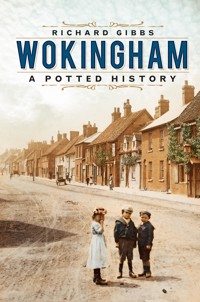
Wokingham sits on the edge of Windsor Great Forest. Originally settled by the Wocingas, an Anglo-Saxon tribe, the town grew steadily – but its early prosperity was cut short when half of the houses were destroyed during the English Civil War. Wokingham has hosted bull-baiting, highwaymen and a multitude of beer houses. The town's people have played their part in both world wars. Its rich history is interwoven with the history of England: a story of good times and bad, from the Beaker people to the Victorians to the present day. Wokingham is the quintessential English county town.
Sie lesen das E-Book in den Legimi-Apps auf:
Seitenzahl: 216
Veröffentlichungsjahr: 2020
Das E-Book (TTS) können Sie hören im Abo „Legimi Premium” in Legimi-Apps auf:
Ähnliche

















First published 2020
The History Press
97 St George’s Place, Cheltenham,
Gloucestershire, GL50 3QB
www.thehistorypress.co.uk
© Richard Gibbs, 2020
The right of Richard Gibbs to be identified as the Author of this work has been asserted in accordance with the Copyright, Designs and Patents Act 1988.
All rights reserved. No part of this book may be reprinted or reproduced or utilised in any form or by any electronic, mechanical or other means, now known or hereafter invented, including photocopying and recording, or in any information storage or retrieval system, without the permission in writing from the Publishers.
British Library Cataloguing in Publication Data.
A catalogue record for this book is available from the British Library.
ISBN 978 0 7509 9532 0
Typesetting and origination by The History Press
Printed and bound in Great Britain by TJ International Ltd.
eBook converted by Geethik Technologies
CONTENTS
Foreword
Introduction
1 From Earliest Times
2 Stagecoaches and Steam Trains
3 The Grander Houses of Wokingham
4 Crime and Punishment
5 Welfare and Education
6 Food, but Mainly Drink!
7 Wokingham at Play
8 Wokingham at Work
9 Wokingham at War
10 Wokingham at Prayer
11 In Living Memory
Appendices
A Simplified Timeline of the History of Wokingham
Listed Buildings and Monuments
Pubs and Inns of Wokingham
Ministers of All Saints Church
The Streets of Wokingham
Acknowledgements
FOREWORD
In 1990 Joan and Rosemary Lea published their book Wokingham: A Pictorial History and in 1995 Bob Wyatt issued Wokingham in Budding Books’ Britain in Old Photographs series. Although both books contain brief historical introductions, they are essentially records of Wokingham in the nineteenth and twentieth centuries as illustrated by pictures from these periods.
More recently, local historian Jim Bell has brought out A Short History of Wokingham, tailored to the needs of those who want a brief introduction to the town’s past.
Richard Gibbs’s aim has been different. Despite calling this A Potted History, his book is a wide-ranging conspectus of Wokingham from earliest times to the present day and he has very wisely chosen to present it thematically so that the various threads running through the story of the town can be examined one by one and not lost in general progress through the centuries.
This is not to say, however, that the individual is forgotten in favour of the overview. We are introduced to families of brewers and schoolteachers; an unusually gallant highwayman; local citizens who kindly left bequests to set up charities; a beautiful barmaid immortalised in verse; and the alderman who donated his swimming pool to the public. Bringing characters and events to life requires more than a dry recitation of facts and figures.
Richard Gibbs has risen splendidly to this challenge and has produced a thorough and much-needed account of what has driven the life and growth of Wokingham from its indistinct beginnings to the burgeoning market town it is today.
Peter MustChairman, The Wokingham SocietyWokingham, September 2019
INTRODUCTION
Oakingham (Wokingham). Pleasantly situated within the precincts of the forest, on the little brook called the Emme. The houses are generally built of brick and some of them make a handsome appearance, particularly that belonging to J. Roberts, Esq. lord of the one of the manors in the parish. Oakingham contains 298 houses and 1,380 inhabitants.
William Fordyce Mavor, 1813
Wokingham is located on the edge of Windsor Great Park, distanced from any large and dominating cities. It does not have a cathedral or a castle. It does not sit on any major highway or coastal harbour. It is a small market town, like hundreds of other market towns up and down the country. But this ordinariness should not be equated with a lack of history. The town has a story of its own to tell. A story of more than 1,000 years of history that is interwoven with the history of England; Wokingham reflects the quintessential English county town with its inhabitants and their dispositions, amusements and occupations.
Anyone who has lived in or visited Wokingham in the past few years has borne witness to the redevelopment of the town. Old landmarks, which can be obscured by the passage of time, can be lost entirely under the onslaught of rapid change. New arrivals to the town are less familiar with the stories and the legacies of the past. There is, therefore, the risk that the town’s heritage and history are devalued or forgotten in the headlong rush for the future. Many of the things that make Wokingham a wonderful place to live and work, such as its market town trappings, can be overlooked if you don’t know what to look for or where to look.
Wokingham does not have an up-to-date, unifying single coherent volume that describes the town’s history. This omission is at odds with the fact that there has been detailed and scholarly research on the town’s past by various local history groups and we do, in fact, possess a wonderful collection of booklets, articles and reports; Wokingham has been blessed with notable local historians from Arthur Heelas through to Ken Goatley and today’s luminaries such as Jim Bell.
To try and address this deficiency, Wokingham: A Potted History is a primer, a summarised history of Wokingham. It can provide an overview for the reader with a general interest in the town but can also serve as a foundation for someone wishing to gain a better understanding of its past.
As with any attempt to contain nearly 1,000 years of history within a single volume, some events have been left out and others dealt with in a cursory manner. Notwithstanding these caveats, A Potted History hopefully provides an insight into the story of a small town in southern England.
There is a large but not substantial library of books, booklets and leaflets that cover the history of Wokingham. These serve both as a reference source for this ‘potted history’, and a reading list for those who want more, and more detailed information. At the end of each chapter I have added a short, list of selected references.
1
FROM EARLIEST TIMES
From earliest times a forest has existed in the south-eastern part of Berkshire, with vast stretches of heather, bracken and gorse-covered hills and moors, a wild and unfrequented region wherein deer and wolves and wild boars roamed, and British tribes dwelt, making their earthworks on the hills, a refuge for themselves and their cattle from the ravages of enemies and wild animals.
Arthur Heelas, 1928
In the far reaches of time, warm shallow waters covered much of the area surrounding present-day Wokingham. Over aeons, the gradual accumulation of the shells of tiny sea creatures laid down a bedrock of chalk. Around 50 million years ago, sharks and turtles were swimming around the mangrove swamps of a primeval ocean that deposited on its departure a thick layer of bluish clay. Millennia passed, and the area became an estuary with extensive mudflats and sandbanks formed by the ebb and flow of its tidal waters. Today these geological features are recognised by the sandy clay known as Bagshot Sands. They are a boon to some gardeners, while others are left in the proverbial mud of London clay.
And then, in the more recent geological past, the Quaternary period, from around 2 million years to 12,000 years ago, the region saw intermittent occurrences of a warm climate and ice ages. Glacial ice pushed the proto-Thames southward, and the river would erode the underlying clay, scouring the landscape. The ice would retreat, and the river would change course again and, in the process, leave behind residual deposits of gravel.
It is on one of these residual outcrops of gravel, a river terrace, that the settlement of Wokingham was established.
The town of Wokingham sits on ground that is slightly higher than the surrounding area. Market Place rises to about 70m above sea level. A pedestrian walking up the hill from where the Emm Brook crosses the Finchampstead Road, at around 45m above sea level, to the town hall, will climb 25m in less than a kilometre.
Topographically, the area around Wokingham is mainly London clay, which is overlain by the sandy Bagshot Formation. The town itself can be thought of as an island, one that is not only higher than its surroundings but also drier given its planting on a gravel outcrop.
It would be pleasing to imagine Neanderthals or early hominids strutting across this landscape chasing woolly mammoths or fleeing from sabre-toothed tigers; however, this is unlikely to have been a regular occurrence as there are only traces and hints of very early inhabitants as a result of a limited number of Palaeolithic and Neolithic finds in the area.
Around 2500 BC, the Neolithic farmers who had inhabited the British Isles for three to four millennia gave way to the new arrivals from Europe known as the Beaker people. They brought with them from Europe the understanding and technology of combining copper and tin in the right measures to make them more durable bronze instruments and tools. The Bronze Age had arrived in the UK, albeit around five centuries later than it did in ancient Greece.
In the vicinity of Wokingham, there appears to have been a small but well-established population at this time. In Barkham there are clear indications of settlements, including a curious burnt mound, reminiscent of a sauna, whose purpose is unclear.
The Beaker people also brought with them a unique culture, one feature of which literally stood out of the landscape. Their ceremonial barrows typically included luxury grave items that demonstrated the sophistication of their craftsmanship. There are notable examples of Bronze Age barrows surrounding Wokingham in Bill Hill, Bracknell and Finchampstead.
The Bronze Age eventually gave way around 800 BC to the Iron Age. The landscape that had earlier seen the construction of barrows now saw the development of hill forts such as the one nearby in Swinley Forest. The Iron Age hill fort known incorrectly as Caesar’s Camp was probably established between 500 and 300 BC, and so pre-dated any Roman influence. The only tenuous justification for the misnaming of the site by local antiquaries is that at some time it is likely to have fallen under the rule of King Cunobeline of the Catuvellauni; Cymbeline, the hero of the eponymous Shakespeare play, had been raised in Rome and was a loyal ally to the Romans.
Three Iron Age furnaces have been discovered close to the town, at what was Folly Court on the Barkham Road. At Matthewsgreen archaeologists have found a late Iron Age farmstead dating from around 40 BC. In this period, Wokingham, along with much of Berkshire, was to all intents and purposes ‘the land of the Atrebates’. This Celtic tribe had fled the Roman advance in Gaul around 50 BC.
Julius Caesar invaded Britain in the winter of 55/54 BC. It was not until 43 BC that the country, or part of it, was effectively governed by the Romans and would remain under their control for the next 500 years or so, until their departure in AD 410.
The Devil’s Highway, the Roman road that passes through Finchampstead on its way to Silchester or Calleva Atrebatum, is also a testament to the Roman presence. Silchester was itself a former Iron Age fort of the Atrebates tribe. Perhaps more prosaically, as further evidence of Roman occupation, there is a hoard of coins that were found at Matthewsgreen and date from the Emperor Constantine AD 306–337. The coins had been hidden, possibly by some farmer fearing assault or robbery but whom tragedy or accident overtook, thus preventing his return.
Nevertheless, despite all the indications of activity around the embryonic town, there is no tangible evidence of any permanent settlement until the fifth or sixth centuries, and even for that, it is necessary to rely on the etymology of the name Wokingham.
Numerous tribes from northern Europe filled the ‘political vacuum’ that was created by the departure of the Romans. The Germanic Angles and Saxons controlled, within the next 100 years after the Romans departure, much of the territory that had been under the rule of Rome; the Jutes, from Denmark, occupied some smaller areas in the south. This latest wave of invaders, and would-be settlers, imposed their language and customs on the local inhabitants, in much the same way that the Romans had. The Germanic language spoken by the Angles would eventually develop into English.
The placement of Wokingham on the gravel rise, within a heavily wooded countryside and a freshwater stream nearby, can be thought of as a deliberate act by a local Anglo-Saxon tribe called Woccingas, headed by Wocca. The Woccingas lived around the Woking area, and growth in the population could have been the impetus to encourage some members to leave the homestead to establish a new hamlet or settlement for the tribe, hence Woking – ham. Other members of the tribe decided to move further west in search of better agricultural land and settled in Woke-field.
These were turbulent times; Aidan, an Irish monk, established a monastery on Lindisfarne, and it was here in 793 that the Viking invasion began. The whole country was subjected to frequent raids and attacks. In 871, Bagsecg and Halfdan Ragnarsson camped near Reading to take on the Saxon army of Æthelwulf, the Ealdorman of the shire, in an attempt to gain control of Wessex, which included most of Berkshire. The Danes beat the Saxons back, only to be themselves beaten by Æthelwulf, who had joined forces with King Æthelred and his brother, Alfred the Great. The Danes retreated. Except for this battle, there are no other notable instances of the Viking presence in and around Wokingham; for the next 500 years or so, the small Anglo-Saxon village, most likely no more than a collection of huts in the middle of the heavily wooded forest, was undisturbed.
And then, along came the Normans and their conquest of 1066.
A group of Vikings that had settled in northern France became known as the Normans, and, by the early eleventh century, ruled a great and powerful region, sanctioned by the French Crown.
Following the death of the ‘English’ King, Edward the Confessor, the Normans of France, led by William (the Conqueror), sailed across the Channel and claimed the throne of England, defeating the only other contender, Harold Godwinson, at the Battle of Hastings in 1066.
When William dismissed his mercenaries in 1070, nearly all returned to France. The number who settled and remained in England was relatively few. Richard the Lionheart, King of England, Duke of Normandy, spent less than six months in England after he ascended the throne. The Norman conquerors ruled predominantly from France; England simply acquired a new ruling class.
William was pragmatic and, having conquered the country, needed to get to grips with running it as well as sharing bits out to his trusty followers.
The Anglo-Saxon Chronicle, dating from the late ninth century, states that:
… at the midwinter [1085], was the king in Gloucester with his council … After this had the king a large meeting, and very deep consultation with his council, about this land; how it was occupied, and by what sort of men. Then sent he his men over all England into each shire; commissioning them to find out ‘How many hundreds of hides were in the shire, what land the king himself had, and what stock upon the land; or, what dues he ought to have by the year from the shire’.
The Domesday Book does not mention Wokingham. To put this anomaly into context, the smaller villages of Barkham, Swallowfield, Easthampstead, Finchampstead and Shinfield were all included in the survey. One explanation put forward for the omission is that, at this time, the area was included in the account of the Manor of Sonning. Roger the Priest was the Lord of the Manor as well as being the Bishop of Salisbury, and the Domesday entry for Sonning lists forty villagers, sixteen smallholders and one church. As these represented households the population is likely to have been five times larger. Having said that, by way of comparison, both Finchampstead and Swallowfield had thirty households and Barkham had ten. The listing for Sonning seems strangely deficient, or perhaps suggests that the hamlet of Wokingham was literally a couple of huts in the middle of the woods and not worth the reckoning.
Whatever the understanding or reasoning for the absence of the town from the Domesday Book, a century later, around 1190, All Saints Church was founded and dedicated by Hubert le Poore, Bishop of Salisbury.
Notwithstanding the significance of this documented event, there is some evidence that an older Chapel of Ease existed on the site.
Glebe lands are lands that the church can rent out and thus generate an income for the rectory. The Wokingham glebe lands lay to the north-west of All Saints Church. In the thirteenth century there was an ongoing dispute over the land that the church claimed, but which was being farmed by a certain Ralph the Red – Radulfus Ruffus. The church was paying rent to the Bishop of Salisbury, but received no income from it, hence their displeasure.
An enquiry was set up in 1217 by Dean Adam of Salisbury. The case was laid before Henry III’s itinerant justices. The chief justice was Richard le Poore, who was ably assisted by six justices as well as the attorney Bartholomew de Kernes. Needless to say, against such opposition, in 1219, Radulfus lost the case and surrendered the land but he was allowed the use of the land for his lifetime at the rent of five shillings per annum.
John Norden’s map of 1607 shows Wokingham, spelt Ockmgham, as a cluster of houses and streets around the market place. Roads or tracks lead out to Arborfield, Lodden Bridge and Easthampstead Park.
As part of the court case, it was pointed out that Stephen, who was the priest at Wokingham, had inherited the chaplaincy:
For the whole of his life, Alfred (Alerud) the priest held, together with the Chapel of Wokingham, the land which Ralph the Red now unjustly occupies; after Alfred, his son Robert held the chapel and the land for the whole of his life, and cleared of trees a great part of that land; then came Godfrey (Godefidus) the Deacon, Alfred’s son and Robert’s brother; after Godfrey married, his son John in whose time the chapel was dedicated by Hubert Bishop of Salisbury (c.1190); after John came Godfrey’s youngest son Stephen, who paid 40 shillings to Dean Jordan (c.1195). And so, from the time of Alfred until the time of Stephen, the land has always belonged to the chapel of Wokingham.
This convoluted family tree takes the dating of the chapel back as far as Alfred in roughly 1140, a few years before the chapel is mentioned in the Sarum Rolls of 1146. It is also clear that the priests of this chapel were not celibate, which adds weight to the argument that it is unlikely to have been established in the post-Conquest era – no self-respecting Norman overlord would establish a church and allow such carry-ons by the incumbent and obviously not celibate priest.
This provides a sound argument that the chapel most likely pre-dates the 1066 invasion. It is probable that the chapel was also associated with the monastery of Abbot Hedda in Woccingas’ territory, as mentioned in a papal bull of 708 by Pope Constantine.
When Hubert le Poore died, his brother Richard, formerly the Dean of Salisbury, became Bishop and decided around 1218 to abandon the Old Sarum Cathedral for a new one in his manor of Milford by the River Avon.
One way of making money in this period was the establishment of ‘new towns’. Such an initiative enabled the landowner to effectively provide the equivalent of a ‘tax break’ to the people (burgesses) who rented the plots of land (burgage). In this instance, ‘the tax breaks’ amounted to not being liable for feudal duties.
Richard decided to pay for the new cathedral by creating a ‘new town’ in his Manor of Sonning with the purchase of a market charter for Wokingham from the Crown in 1219. It is pure speculation that during the Radulfus Ruffus court case Richard had pondered what he could do with this quiet backwater. The charter was confirmed as permanent in 1227. The market was to be held ‘peaceably’ every Tuesday.
In subsequent years the market would be held in Market Place, but it is likely that originally it was located in the enclosed Rose Street.
Wokingham was now clearly on the map and to make it more attractive, and lucrative for Richard; he sought and was granted in 1258 by the Crown the privilege of holding two annual fairs. The first was to be held on the ‘vigil, feast and morrow’ of St Barnabas, namely 10, 11 and 12 June and the second on All Saints on 31 October and 1 and 2 November.
These markets and fairs ostensibly had legitimate commercial and religious purposes, but it would not take too much to imagine that they would also be an excuse for revelry, spiced up with drinking. The stipulation in the Charter of the markets being held ‘peaceably’ might indicate the concern of the authorities about things getting out of hand.
Street traders would be serving ‘fast food’ in the form of savouries and sweetmeats of various concoctions. There would be the inns selling cheap beer. The fairs themselves would attract buyers from London in search of the plump, fatted hens for which Wokingham was renowned. There could be street entertainers from Reading or Windsor plying their trade. Cash would be exchanging hands as poultry were sold, boots were bought.
The town must have prospered over the next few decades as in 1327, when Parliament granted a tax to the king of the ‘twentieth of the movable goods of every person in the realm, the clergy alone excluded’, fifty-seven names of Wokingham people appeared on the roll. Among them were Geoffrey atte Beche and John Matthew, of Matthewsgreen.
The town continued to grow. By the middle of the fourteenth century there was a bell foundry in Wokingham. Wealthy men were donating to worthy causes such as John Westende, who endowed eight almshouses in 1451, in Peach Street, just opposite The Ship Inn.
The medieval town was taking shape, and much of its general layout remains today.
John Norden’s map of 1607, although it is later than the medieval period, clearly shows the structure of the town before the subsequent expansion. The Market Place is discernible and both Rose Street and Peach Street can be identified. The Emm Brook is drawn, and the Barkham, Reading and Finchampstead Roads are all clearly visible; it can also be noticed that beyond this clustering of houses the surrounding countryside is sparsely populated, compared with today, with only smaller villages at Arborfield, for example.
Documents first mention Rose Street in 1289, originally Le Rothes, which can be interpreted as ‘the street in the clearing’. Rose Street is an example of an enclosed medieval street, although the Broad Street end was widened in the late nineteenth century to accommodate traffic. It lays claim to some of the oldest buildings in the town, dating from the fifteenth century, including the timber-framed and jettied Wealden hall house at Nos 16–18 that at the time of writing accommodates the Wokingham and District Association for the Elderly (WADE) charity shop.
The first reference to Shute End occurs in 1321; Shute End derives from an Anglo-Saxon phrase meaning ‘the land that stands out’. Peach Street or Le Peche Strete is mentioned in 1362 and is most likely named after the La Beche family. The Market Place and Broad Street were first noted in 1322. Finally, to complete the old town, there is Denmark Street (Don or Down Street), which is identified in documents dated 1407.
So, this is the design of Wokingham Old Town. In the early days of the town there were a few huts around a chapel of ease in the woods and then a street, of sorts, running westwards from All Saints Church. There were limited but productive allotments as well as a busy and hopefully peaceful market place. There was Beeches Manor House and some large halls. A narrow road went downhill towards the marshy Emm Brook and then out into the lightly wooded countryside.
Selected References
Ayres, D. (2001) ‘Wokingham’s Saxon Chapel – Fact or Fable?’ The Wokingham Historian, No. 11, 10–12.
Bell, J. (2008)St Paul’s Parish Church, Wokingham.
Berkshire Geoconservation Group (2019) Geology of Berkshire. Available at: https://berksgeoconservation.org.uk/geology.php [Accessed 27 May 2019].
British History Online (2015) A History of the County of Berkshire. Vol. 3, ed. P.H. Ditchfield and William Page (London, 1923) 225-236.. Available at: www.british-history.ac.uk/vch/berks/vol3/pp225-236 [Accessed 27 May 2019].
Coombs, T., Sharpe, J., Davies, H., Harrison, A., and Byard, A. (2018) ‘The Land of the Atrebates: In and around Roman Berkshire’, Berkshire Archaeological Journal, Vol. 83.
Nash Ford, D. (2001) Wokingham: ‘A Town of Bells & Bull-Baiting’. Royal Berkshire History. Available at: www.berkshirehistory.com/villages/wokingham.html [Accessed 27 May 2019].
Neave, J. (1997) The History of All Saints Church Wokingham.
The Domesday Book Online (1999) Available at: www.domesdaybook.co.uk/berkshire.html [Accessed 27 May 2019].




