


9,99 €
Mehr erfahren.
- Herausgeber: Titan Books
- Kategorie: Fantasy und Science-Fiction
- Serie: World of Warcraft
- Sprache: Englisch
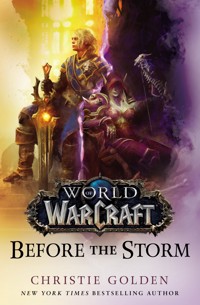
An all-new, official prequel novel to The Battle for Azeroth, Blizzard Entertainment's next expansion to the critically acclaimed World of Warcraft.In Before the Storm, Anduin Wrynn, king of Stormwind, and Sylvanas Windrunner, warchief of the Horde, are new to their positions of power, both ascending before they were truly prepared. As the Alliance and the Horde struggle to recover from the devastating war with the demonic Burning Legion, a terrible discovery will test both leaders, threatening to reignite the bitter enmity between their factions and shake the very foundations of the world of Azeroth.
Das E-Book können Sie in Legimi-Apps oder einer beliebigen App lesen, die das folgende Format unterstützen:
Seitenzahl: 454
Veröffentlichungsjahr: 2018
Ähnliche












Contents
Cover
Title Page
Copyright
Dedication
Prologue
Chapter One
Chapter Two
Chapter Three
Chapter Four
Chapter Five
Chapter Six
Chapter Seven
Chapter Eight
Chapter Nine
Chapter Ten
Chapter Eleven
Chapter Twelve
Chapter Thirteen
Chapter Fourteen
Chapter Fifteen
Chapter Sixteen
Chapter Seventeen
Chapter Eighteen
Chapter Nineteen
Chapter Twenty
Chapter Twenty-One
Chapter Twenty-Two
Chapter Twenty-Three
Chapter Twenty-Four
Chapter Twenty-Five
Chapter Twenty-Six
Chapter Twenty-Seven
Chapter Twenty-Eight
Chapter Twenty-Nine
Chapter Thirty
Chapter Thirty-One
Chapter Thirty-Two
Chapter Thirty-Three
Chapter Thirty-Four
Chapter Thirty-Five
Epilogue
Acknowledgments
About the Author
About the Type
World of Warcraft: Before the StormPrint edition ISBN: 9781785655012E-book edition ISBN: 9781785655029
Published by Titan BooksA division of Titan Publishing Group Ltd144 Southwark Street, London SE1 0UP
First edition: June 201810 9 8 7 6 5 4 3 2 1
This book is a work of fiction. Any references to historical events, real people, or real places are used fictitiously. Other names, characters, places, and events are products of the author’s imagination, and any resemblance to actual events or places or persons, living or dead, is entirely coincidental.
Copyright © 2018 by Blizzard Entertainment, Inc.All rights reserved.
No part of this publication may be reproduced, stored in a retrieval system, or transmitted, in any form or by any means without the prior written permission of the publisher, nor be otherwise circulated in any form of binding or cover other than that in which it is published and without a similar condition being imposed on the subsequent purchaser.
A CIP catalogue record for this title is available from the British Library.
Book design by Mary WirthCover design: Scott BielCover art: Bastien Lecouffe Deharmewww.blizzard.com
This book is dedicated to three who have championed it and striven to make it even better:
Tom Hoeler, my editor at Del Rey, Cate Gary, my editor a few steps away, here at Blizzard, and Alex Afrasiabi, creative director of World of Warcraft.
Thank you all so very much for your love for the characters and the world, for your attention to both little details and the big picture, for exploring this path with me, and for wanting to make Before the Storm the best book it could possibly be.
PROLOGUE
Silithus
ZIG KLACKWHISTLE STRAIGHTENED FROM WHERE he’d been kneeling for what felt like at least a decade, placing his big green hands on the small of his back and grimacing at the ensuing cascade of pops. He licked his dry lips and looked around, squinting against the blinding sunlight and mopping his bald head with a sweat-stiff kerchief. Here and there were tightly clustered swirling swarms of insects. And of course the sand, everywhere, and most of it probably going to end up inside his underclothes. Just as it had yesterday. And the day before.
Man, Silithus was an ugly place.
Its appearance had not been improved in the slightest by the gargantuan sword an angry titan had shoved into it.
The thing was massive. Ginormous. Colossal. All the grand and fancy and multisyllabic words goblins smarter than he could possibly throw at it. It had been plunged deep into the heart of the world, right here in scenic Silithus. The bright side, of course, was that the enormous artifact provided a great deal of what he and the other hundred or so goblins were searching for right this very moment.
“Jixil?” he said to his companion, who was analyzing a hovering rock with the Spect-o-Matic 4000.
“Yeah?” The other goblin peered at the reading, shook his head, and tried again.
“I hate this place.”
“Ya do? Huh. It speaks well of you.” Glaring at the piece of equipment, the smaller, squatter goblin smacked it soundly.
“Ha ha, very funny,” Kezzig grumbled. “No, I mean it.”
Jixil sighed, trudged to another rock, and began to scan it. “We all hate this place, Kezzig.”
“No, I really mean it. I’m not cut out for this environment. I used to work in Winterspring. I’m a snow-loving, snuggle-by-the-fire, holly-jolly kinda goblin.”
Jixil threw him a withering glance. “So what happened to bring you here instead of staying there, where you weren’t annoying me?”
Kezzig grimaced, rubbing the back of his neck. “Little Miss Lunnix Sprocketslip happened. See, I was working in her mining supply shop. I’d go out as a guide for the occasional visitor to our cozy little hamlet of Everlook. Lunny and I kinda . . . yeah.” He smiled nostalgically for a moment, then scowled. “Then she goes and gets her nose out of joint when she caught me hanging around Gogo.”
“Gogo,” Jixil repeated in a flat voice. “Gee. I wonder why Lunnix would get upset with you hanging around a girl named Gogo.”
“I know! Gimme a break. It gets cold up there. A guy has to snuggle by the fire now and then or he’ll freeze, am I right? Anyway, that place suddenly got hotter than here at midday.”
“We got nothing here,” Jixil said. He’d obviously stopped paying attention to Kezzig’s description of his Winterspring plight. Sighing, Kezzig picked up the huge pack of equipment, slung it easily over his shoulders, and lugged it over to where Jixil still was hoping for positive results. Kezzig let the bundle drop to the earth, and there came the sound of delicate pieces of equipment clanking perilously against one another.
“I hate sand,” he continued. “I hate the sun. And oh boy, do I really, really hate bugs. I hate the little bugs, because they like to crawl into your ears and up your nose. I hate the big bugs because, well, they’re big bugs. I mean, who doesn’t hate that? It’s kind of a universal hate. But my particular hate burns with the light of a thousand suns.”
“I thought you hated suns.”
“I do, but I—”
Jixil suddenly stiffened. His magenta eyes widened as he stared at his Spect-o-Matic.
“What I meant was—”
“Shut up, you idiot!” Jixil snapped. Now Kezzig was staring at the instrument, too.
It was going insane.
Its little needle flipped back and forth. The small light at the top flashed an urgent, excited red.
The two goblins looked at each other. “Do you know what this means?” Jixil said in a voice that trembled.
Kezzig’s lips curved in a grin that revealed almost all of his jagged yellow teeth. He curled one hand into a fist and smacked it firmly into the palm of the other.
“It means,” he said, “we get to eliminate the competition.”
CHAPTER ONE
Stormwind
RAIN FELL ON THE SOMBER THRONGS MAKING their way to Lion’s Rest as if even the sky wept for those who had sacrificed their lives to defeat the Burning Legion. Anduin Wrynn, king of Stormwind, stood a few steps back from the podium where he soon would be addressing mourners of all the Alliance races. He watched them silently as they arrived, moved to see them, loath to speak to them. He suspected that this service honoring the fallen would be the most difficult he had endured in his relatively short life not just for the other mourners but for himself; it would be held in the shadow of his father’s empty tomb.
Anduin had attended far, far too many ceremonies honoring the casualties of war. As he did each time—as, he believed, every good leader did—he hoped and prayed that this one would be the last.
But it never was.
Somehow there was always another enemy. Sometimes the enemy was new, a group springing up seemingly out of nowhere. Or something ancient and long-chained or buried, supposedly neutralized, rising after eons of silence to terrorize and destroy innocents. Other times the enemy was bleakly familiar but no less a threat for the intimacy of the knowledge.
How had his father met those challenges time after time? Anduin wondered. How had his grandfather? Now was a time of relative quiet, but the next enemy, the next challenge, doubtless would arrive all too soon.
It had not been all that long since Varian Wrynn’s death, but for the great man’s son it felt like a lifetime. Varian had fallen in the first real push of this latest war against the Legion, apparently slain as much by betrayal from a supposed ally, Sylvanas Windrunner, as by the monstrous, fel-fueled creatures vomited forth from the Twisting Nether. Another account, from someone Anduin trusted, contested that version, suggesting that Sylvanas had had no other choice. Anduin was not sure what to believe. Thoughts of the cunning and treacherous leader of the Horde made Anduin angry, as they always did. And, as always, he called on the Holy Light for calmness. It did not serve to harbor hatred in his heart even for such a deserving enemy. And it would not bring back his father. Anduin took comfort in knowing that the legendary warrior had died fighting and that his sacrifice had saved many lives.
And in that fraction of a second, Prince Anduin Wrynn had become king.
In many ways, Anduin had been preparing for this position all his life. Even so, he was keenly aware that in other, very important, ways, he hadn’t truly been ready. Maybe still wasn’t. His father had loomed so large not just in the eyes of his youthful son but in the eyes of Varian’s people—even in the eyes of his enemies.
Dubbed Lo’Gosh, or “ghost wolf,” for his ferocity in battle, Varian had been more than a powerful warrior superbly skilled at combat. He had been an extraordinary leader. In the first few weeks after his father’s shocking death, Anduin had done his best to comfort a grieving, stunned populace reeling from the loss, while denying himself a proper chance to mourn.
They grieved for the Wolf. Anduin grieved for the man.
And when he lay awake at night, unable to sleep, he would wonder just how many demons in the end it had taken to murder King Varian Wrynn.
Once he had voiced this thought to Genn Greymane, king of the fallen realm of Gilneas, who had stepped in to counsel the fledgling monarch. The old man had smiled even though sorrow haunted his eyes.
“All I can tell you, my boy, is that before they got to your father, he had single-handedly killed the largest fel reaver I ever saw, in order to save an airship full of retreating soldiers. I know for certain that Varian Wrynn made the Legion pay dearly for taking him.”
Anduin did not doubt that. It wasn’t enough, but it had to be.
Although there were plenty of armed guards in attendance, Anduin had put on no armor on this day when the dead were remembered. He was dressed in a white silk shirt, lambskin gloves, dark blue breeches, and a heavy formal coat trimmed in gold. His only weapon was an instrument of peace as much as war: the mace Fearbreaker, which he wore at his side. When he had gifted the young prince with it, the former dwarf king Magni Bronzebeard had said that Fearbreaker was a weapon that had known the taste of blood in some hands and had stanched blood in others.
Anduin wanted to meet and thank as many as he could among the bereaved today. He wished he could console everyone, but the cold truth was that such a thing was impossible. He took comfort in the certainty that the Light shone upon them all . . . even a tired young king.
He lifted his face, knowing the sun was behind the clouds and letting the gentle drops fall like a benediction. He recalled that it also had rained a few years ago during a similar ceremony honoring those who had made the final, greatest sacrifice in the campaign to halt the mighty Lich King.
Two whom Anduin loved had been in attendance then who were not here today. One, of course, was his father. The second was the woman he had fondly called Aunt Jaina: Lady Jaina Proudmoore. Once, the lady of Theramore and the prince of Stormwind had been in agreement regarding the desire for peace between the Alliance and the Horde.
And once there had been a Theramore.
But Jaina’s city had been destroyed by the Horde in the most horrific manner possible, and its bereft lady had never been able to ease the pain of that terrible moment fully. Anduin had watched her try repeatedly, only to have some fresh torment reinjure her wounded heart. Finally, unable to bear the thought of working alongside the Horde even against so dread a foe as the demonic Legion, Jaina had walked out on the Kirin Tor, which she led, on the blue dragon Kalecgos, whom she loved, and on Anduin, whom she had inspired his whole life.
“May I?” The voice was warm and kind, as was the woman who asked the question.
Anduin smiled down at High Priestess Laurena. She was asking if he wished her blessing. He nodded and inclined his head and felt the tightness in his chest ease and his soul settle. He then stood respectfully to the side while she spoke to the crowd, awaiting his own turn.
He had not been able to speak formally at his father’s memorial service. The grief had been too raw, too overwhelming. It had shifted shape in his heart over time, becoming less immediate but no less great, and so he had agreed to say a few words today.
Anduin stepped beside his father’s tomb. It was empty; what the Legion had done to Varian had ensured that his body could not be recovered. Anduin regarded the stone face on the tomb. It was a good likeness and a comfort to look upon. But even the skilled stonecrafters could not capture Varian’s fire, his quick temper, his easy laugh, his motion. In a way, Anduin was glad the tomb was empty; he would always, in his heart, see his father as alive and vibrant.
His mind went back to when he first had ventured to the place where his father had fallen. Where Shalamayne, gifted to Varian by the lady Jaina, had lain, dormant without Varian’s touch. Awaiting the touch of another to which it would respond.
The touch of the great warrior’s son.
As he held it, he had almost felt Varian’s presence. It was then, when Anduin truly accepted the duties of a king, that light had again begun to swirl in the sword—not the orange-red hue of the warrior but the warm, golden glow of the priest. At that moment, Anduin had begun to heal.
Genn Greymane would be the last person to call himself eloquent, but Anduin would never forget the words the older man had said: Your father’s actions were indeed heroic. They were his challenge to us, his people, to never let fear prevail . . . even at the very gates of hell.
Genn wisely had not said they were never to fear. They were only not to let it win.
I will not, Father. And Shalamayne knows that.
Anduin forced himself to return to the present. He nodded to Laurena, then turned to look at the crowd. The rain was slowing but hadn’t stopped, yet no one seemed inclined to leave. Anduin’s gaze swept over the widows and widowers, the childless parents, the orphans, and the veterans. He was proud of the soldiers who had died on the battlefield. He hoped their spirits would rest easily, knowing their loved ones were heroes, too.
Because there was no one assembled at Lion’s Rest today who had let fear prevail.
He spotted Greymane, hanging back beside a lamppost. Their eyes met, and the older man nodded a brief acknowledgment. Anduin allowed his gaze to roam over the faces, those he knew and those he did not. A little pandaren girl was struggling not to cry; he gave her a reassuring smile. She gulped and smiled back shakily.
“Like many of you, I know firsthand the pain of loss,” he said. His voice rang clear and strong, carrying to those who stood in the farthest rows. “You all know that my fath—”
He paused, clearing his throat, and continued. “King Varian Wrynn . . . fell during the first major battle at the Broken Isles, when the Legion invaded Azeroth yet again. He died to save his soldiers—the brave men and women who faced unspeakable horrors to protect us, our lands, our world. He knew that no one—not even a king—is more important than the Alliance. Each of you has lost your own king or queen. Your father or mother, brother or sister, son or daughter.
“And because he and so many others had the courage to make that sacrifice, we did the impossible.” Anduin looked from face to face, saw how hungry they were for comfort. “We defeated the Burning Legion. And now we honor those who sacrificed all. We honor them not by dying . . . but by living. By healing our wounds and helping others heal. By laughing and feeling the sun on our faces. By holding our loved ones close and letting them know every hour, every minute of every day, that they matter.”
The rain had stopped. The clouds began to clear, and bits of bright blue peeked through.
“Neither we nor our world escaped unscathed,” Anduin continued. “We are scarred. A defeated titan has pierced our beloved Azeroth with a terrible sword crafted from hatred made manifest, and we do not yet know what toll it will take. Places in our hearts will forever remain empty. But if you would serve one king who grieves with you today, if you would honor the memory of another king who died for you, then I urge you—live. For our lives, our joy, our world, these are the gifts of the fallen. And we must cherish them. For the Alliance!”
The crowd cheered, some through their tears. Now it was others’ turn to speak. Anduin stepped to the side, allowing them to come up and address the crowd. As he did so, his gaze flitted back to Greymane, and his heart sank.
Mathias Shaw, master of spies and head of Stormwind’s intelligence service, SI:7, stood beside the deposed king of Gilneas. And both men looked as grim as Anduin had ever seen them.
He was not overly fond of Shaw, though the spymaster had served Varian and now Anduin loyally and well. The king was intelligent enough to understand and value the service SI:7 agents performed for their kingdom. Indeed, he would never know exactly how many agents had lost their lives in this recent war. Unlike warriors, those who operated in the shadows lived, served, and died with few ever knowing of their deeds. No, it wasn’t the spymaster himself Anduin disliked. It was the need for men and women like him that he regretted.
Laurena had followed his gaze and stepped in without a word as Anduin nodded to Genn and Shaw, moving his head to indicate that they should speak away from the throngs of mourners who would not depart for some time. Some lingered, kneeling in prayer. Some would go home and continue to grieve in private. Others would go to taverns to remind themselves that they were still among the living and could yet enjoy food and drink and laughter. To celebrate life, as Anduin had urged them.
But a king’s tasks were never done.
The three men walked quietly behind the memorial. The clouds were almost gone, and the rays of the setting sun sparkled on the water of the harbor that spread out below.
Anduin went to the carved stone wall and placed his hands on it, breathing deeply of the sea air and listening to the cry of the gulls. Taking a moment to steady himself before hearing whatever dark words Shaw had to utter.
As soon as word of the great sword in Silithus had reached him, Anduin had ordered Shaw to investigate and report. He needed boots on the ground there, not the wild rumors that had been circulating. It sounded impossible, and terrifying, and the worst part of it was that it was all true. The final act of a corrupted being, the very last and most devastating blow struck in the war against the Legion, had all but obliterated much of Silithus. The only thing that had mitigated the scope of the disaster had been that mercifully, in his random, angry blow, Sargeras had not thrust the sword into a more populated part of the world than the nearly empty desert land. Had he struck here, in the Eastern Kingdoms, a continent away from Silithus . . . Anduin could not permit himself to go down that path. He would be grateful for what little he could be.
Shaw had hitherto sent missives with information. Anduin had not expected the man himself to return quite so soon.
“Tell me,” was all the king said.
“Goblins, sir. A whole mess of the unsavory creatures. It seems they began arriving within a day of—”
He broke off. No one had come up with a vocabulary to describe the sword that felt comfortable. “Of the sword-strike,” Mathias continued.
“That fast?” Anduin was startled. He kept his expression neutral as he continued to gaze out over the water. The ships and their crews look so small from here, he thought. Like toys. So breakable.
“That fast,” Shaw confirmed.
“Goblins aren’t the most charming, but they are cunning. And they do things for a reason,” Anduin said.
“And those reasons usually involve money.”
Only one group could gather and finance so many goblins so quickly: the Bilgewater Cartel, which had the support of the Horde. This had the oily fingerprints of the unctuous and morally deficient Jastor Gallywix all over it.
Anduin pressed his lips together for a moment before speaking. “So. The Horde has found something valuable in Silithus. What is it this time? Another ancient city to scavenge?”
“No, Your Majesty. They found . . . this.”
The king turned around. In Shaw’s palm was a dirty white handkerchief. Wordlessly, he unfolded it.
In the center was a small pebble of some golden substance. It looked like honey and ice, warm and inviting, yet also cool and comforting. And . . . it was glowing. Anduin eyed it skeptically. It was appealing, yes, but no more so than other gems. It didn’t look like anything to warrant a huge influx of goblins.
Anduin was confused, and he glanced over at Genn, an eyebrow raised in query. He knew little of spycraft, and Shaw, though well regarded by all, was still largely an enigma that Anduin was only beginning to decipher.
Genn nodded, acknowledging that Shaw’s gesture was odd and the object odder but indicating that however Shaw wished to proceed, Anduin could trust him. The king removed his glove and held out his hand.
The stone tumbled gently into Anduin’s palm.
And he gasped.
The heaviness of grief vanished as if it were physical armor that had been seized and yanked off. Weariness fled, replaced by surging, almost crackling energy and insight. Strategies raced through his head, each one of them sound and successful, each one of them engendering a shift in comprehension and ensuring a lasting peace that benefited every being on Azeroth.
Not only his mind but also his body seemed to ascend abruptly and shockingly, rocketing in an instant to whole new levels of strength, dexterity, and control. Anduin felt like he could not only climb mountains . . . he could move them. He could end war, channel the Light into every dark corner. He was exultant and also perfectly, wholly calm and completely certain as to how to channel this rushing river—no, tsunami—of energy and power. Not even the Light affected him as this . . . this did. The sensation was similar but less spiritual, more physical.
More alarming.
For a long moment, Anduin couldn’t speak, could only stare in wonder at the infinitely precious thing he cupped in his palm. At last he found his voice.
“What . . . what is this?” he managed.
“We don’t know.” Shaw’s voice was blunt.
What could be done with this! Anduin thought. How many could it heal? How many could it strengthen, soothe, invigorate, inspire?
How many could it kill?
The thought was a gut punch, and he felt the elation inspired by the gemstone retreat.
When he spoke again, Anduin’s voice was strong and determined. “It would seem the Horde does know . . . and we must find out more.” This could not be allowed to fall into the wrong hands.
Into Sylvanas’s hands . . .
So much power . . .
He closed his fingers carefully around the small nugget of limitless possibility and turned again to the west.
“Agreed,” Shaw replied. “We have eyes on it.”
They stood for a moment while Anduin considered his next words. He knew that both Shaw and Greymane—the latter uncharacteristically silent but looking on approvingly—were awaiting his orders, and he was grateful to have such staunch individuals in his service. A lesser man than Shaw would have pocketed this sample.
“Get your best people on it, Shaw. Pull them off other assignments if need be. We must learn more about this. I’ll be calling a meeting of my advisers shortly.” Anduin extended his hand for Shaw’s handkerchief and carefully rewrapped the small chunk of this unknown, unbelievable material. He tucked it into a pocket. The sensation was less intense, but he still could feel it.
Anduin already had intended to travel, to visit the lands of Stormwind’s allies. To thank them and help them recover from the ravages of war.
His schedule had just been accelerated drastically.
CHAPTER TWO
Orgrimmar
SYLVANAS WINDRUNNER, FORMER RANGER - GENERAL of Silvermoon, the Dark Lady of the Forsaken, and present warchief of the mighty Horde, had resented being told to come to Orgrimmar like a dog that needed to perform all its tricks. She had wanted to return to the Undercity. She missed its shadows, its dampness, its restful quietude. Rest in peace, she thought grimly, and felt the tug of an amused smile. It faded almost at once as she continued pacing impatiently in the small chamber behind the warchief ’s throne in Grommash Hold.
She paused, her sharp ears picking up the sound of familiar footsteps. The tanned hide that served as a nod to privacy was drawn aside, and the newcomer entered.
“You are late. Another quarter of an hour and I would have been forced to ride without my champion beside me.”
He bowed. “Forgive me, my queen. I have been about your business, and it took longer than expected.”
She was unarmed, but he carried a bow and bore a quiver full of arrows. The only human ever to become a ranger, he was a superlative marksman. It was one reason he was the best bodyguard Sylvanas could possibly have. There were other reasons, too, reasons that had their roots in the distant past, when the two had connected under a bright and beautiful sun and had fought for bright and beautiful things.
Death had claimed them both, human and elf alike. Little now was bright and beautiful, and much of the past they had shared had grown dim and hazy.
But not all of it.
Although Sylvanas had left behind most warmer emotions the moment she had risen from the dead as a banshee, anger somehow had retained its heat. But she felt it subside to embers now. She seldom stayed angry for long at Nathanos Marris, known now as Blightcaller. And he had indeed been about her business, visiting the Undercity, while she had been saddled with duties that had kept her here in Orgrimmar.
She wanted to reach for his hand but contented herself with smiling benevolently at him. “You are forgiven,” she said. “Now. Tell me of our home.”
Sylvanas expected a brief recitation of modest concerns, a reaffirmation of the Forsaken’s loyalty to their Dark Lady. Instead, Nathanos frowned. “The situation . . . is complicated, my queen.”
Her smile faded. What could possibly be “complicated” about it? The Undercity belonged to the Forsaken, and they were her people.
“Your presence has been sorely missed,” he said. “While many are proud that at last the Horde has a Forsaken as its warchief, there are some who feel that you have perchance forgotten those who have been more loyal to you than any other.”
She laughed sharply and without humor. “Baine and Saurfang and the others say I have not been giving them enough attention. My people say I have been giving them too much. Whatever I do, someone objects. How can anyone rule like this?” She shook her pale head. “A curse upon Vol’jin and his loa. I should have stayed in the shadows, where I could be effective without being interrogated.”
Where I could do as I truly wished.
She’d never wanted this. Not really. As she had told the troll Vol’jin before, during the trial of the late and greatly unlamented Garrosh Hellscream, she liked her power, her control, on the subtle side. But with quite literally his dying breath, Vol’jin, the Horde’s leader, had commanded that she do the opposite. He had claimed he had been granted a vision by the loa he honored.
You must step out of da shadows and lead.
You must be warchief.
Vol’jin had been someone she respected, although they had clashed on occasion. He lacked the abrasiveness that so often characterized orc leadership. And she had been genuinely sorry he had fallen—and not just because of the responsibility he had placed on her head.
She had opened her mouth to ask Nathanos to continue when she heard the thump-thump of a spear butt on the stone floor outside the small room. Sylvanas closed her eyes, trying to gather patience. “Enter,” she growled.
One of the Kor’kron, the elite orc guards of the hold, obeyed and stood at attention, his green face unreadable. “Warchief,” he said, “it is time. Your people await you.”
Your people. No. Her people were back in the Undercity, missing her and feeling slighted, unaware that she would like nothing more than to return and be among them once more.
“I will be out momentarily,” Sylvanas said, adding, in case the guard did not understand what was behind the words, “Leave us.”
The orc saluted and withdrew, letting the skin flap fall into place.
“We will continue this as we ride,” she told Nathanos. “And I have other things I wish to discuss with you as well.”
“As my queen wishes,” Nathanos replied.
* * *
A FEW YEARS EARLIER, Garrosh Hellscream had pushed to have a massive celebration in Orgrimmar to commemorate the end of the Northrend campaign. He wasn’t warchief—not then. There had been a parade of every veteran who wished to participate, their path strewn with imported pine boughs, and a gigantic feast awaited them at the end of the route.
It had been extravagant, and expensive, and Sylvanas had no intention of following in the footsteps of Hellscream, not just in this situation but in any. He had been arrogant, brutal, impulsive. His decision to attack Theramore with a devastating mana bomb had the softer races wrestling with their consciences, although the only thing that had truly troubled Sylvanas about it was the orc’s timing. Sylvanas had loathed him and had secretly conspired—regrettably without success—to kill him even after he had been arrested and charged with war crimes. When, inevitably, Garrosh had been killed, Sylvanas had been immensely pleased.
Varok Saurfang, the leader of the orcs, and Baine Bloodhoof, high chieftain of the tauren, had borne no love for Garrosh either. But they had pushed Sylvanas to make a public appearance in Orgrimmar and at least some kind of gesture to mark the end of the war. Brave members of this Horde you lead fought and died to make sure the Legion did not destroy this world, as the demons have so many others, the young bull had intoned. He had been but one step away from openly rebuking her.
Sylvanas recalled Saurfang’s thinly veiled . . . warning? Threat? You are the leader of all the Horde—orcs, tauren, trolls, blood elves, pandaren, goblins—as well as the Forsaken. You must never forget that, or else they might.
What I will not forget, orc, she thought, ire rising in her anew, are those words.
So now, instead of returning home and addressing the Forsaken’s concerns, Sylvanas sat astride one of her bony skeletal horses, waving to the throngs of celebrants who crowded the streets of Orgrimmar. The march—she had taken care that no one referred to it as a “parade”—officially began at the entrance to the Horde capital. On one side of the gargantuan gates were clusters of the blood elves and Forsaken who inhabited the city.
The blood elves were all dressed splendidly in their predictable colors of red and gold. At their head was Lor’themar Theron. He rode a red-plumed hawkstrider and met her gaze evenly.
Friends, they had been. Theron had served under a living Sylvanas when she was ranger-general of the high elves. They had been comrades in arms, much like the one who rode beside her as her champion. But whereas Nathanos, a mortal human in years past and now Forsaken, had kept his unswerving loyalty to her, Sylvanas knew that Theron’s was to his people.
People who had been just like her once.
They were just like her no more.
Theron inclined his head. He would serve, at least for the moment. Not one for speeches, Sylvanas merely nodded back and turned to the group of Forsaken.
They stood patiently, as always, and she was proud of them for that. But she could not show favoritism, not here. So she gave them the same greeting she had given Lor’themar and the sin’dorei, then nudged her steed to move through the gate. The blood elves and the Forsaken fell in line, riding behind so as not to crowd her. That had been her stipulation, and she had stood firm on it. She wanted to be able to snatch at least a few moments of privacy. There were things meant for her champion’s ears alone.
“Tell me more about the thoughts of my people,” she ordered.
“From their perspective,” the dark ranger resumed, “you were a fixture in the Undercity. You made them, you worked to prolong their existence, you were everything to them. Your ascension to warchief was so sudden, the threat so great and so immediate, that you left no one behind to care for them.”
Sylvanas nodded. She supposed she could understand that.
“You left a great hole. And holes in power tend to be filled.”
Her red eyes widened. Was he speaking of a coup? The queen’s mind flashed back a few years to the betrayal of Varimathras, a demon she had thought would obey her. He had joined with the ungrateful wretch Putress, a Forsaken apothecary who had created a plague against both the living and the undead and who had nearly killed Sylvanas herself. Retaking the Undercity had been a bloody endeavor. But no. Even as the thought occurred to her, she knew that her loyal champion would not be speaking in so casual a manner if something so terrible had happened.
Reading her expression perfectly, as he so often did, Nathanos hastened to reassure her. “All is calm there, my queen. But in the absence of a single powerful leader, the inhabitants of your city have formed a governing body to tend to the population’s needs.”
“Ah, I see. An interim organization. That is . . . not unreasonable.”
The warchief ’s path through the city would take her first through an alley lined with shops called the Drag and then to the Valley of Honor. The Drag had once been an apt name for the area, which had abutted a canyon wall in a less than savory part of the city before the Cataclysm. With that terrible event, the Drag, like so much of beleaguered Azeroth, had physically shifted. Like Sylvanas Windrunner herself, it had emerged from the shadows. Sunlight now illuminated the winding, hard-packed dirt of the streets. More reputable establishments, such as clothing shops and ink supply stores, seemed to be springing up as well.
“They are calling themselves the Desolate Council,” Nathanos continued.
“A rather self-pitying name,” Sylvanas murmured.
“Perhaps,” Nathanos agreed. “But it is a clear indicator of their feelings.” He glanced over at her as they rode. “My queen, there are rumors about things that you have done in this war. Some of those rumors are even true.”
“What kind of rumors?” she asked, perhaps too quickly. Sylvanas had plans upon plans, and wondered which of them had seeped into the realm of rumor among her people.
“Word has reached them of some of your more extreme efforts to continue their existence,” Nathanos said.
Ah. That. “I assume that word has also reached them that Genn Greymane destroyed their hope,” Sylvanas replied bitterly.
She had taken her flagship, the Windrunner, to Stormheim in the Broken Isles in search of more Val’kyr to resurrect the fallen. It was, thus far, the only way Sylvanas had found to create more Forsaken.
“I was almost able to enslave the great Eyir. She would have given me the Val’kyr for all eternity. None of my people would have ever died again.” She paused. “I would have saved them.”
“That . . . is the concern.”
“Do not dance around this, Nathanos. Speak plainly.”
“Not all of them desire for themselves what you desire for them, my queen. Many on the Desolate Council harbor deep reservations.” His face, still that of a dead man but better preserved because of an elaborate ritual she had ordered performed, twisted in a smile. “This is the peril you created when you gave them free will. They are now free to disagree.”
Her pale brows drew together in a terrible frown. “Do they want extinction, then?” she hissed, anger flaring brightly inside her. “Do they want to be rotting in the earth?”
“I do not know what they want,” Nathanos replied calmly. “They wish to speak with you, not with me.”
Sylvanas growled softly under her breath. Nathanos, ever patient, waited. He would obey her in all things, she knew. She could, right now, order a group of any combination of non-Forsaken Horde warriors to march on the Undercity and seize the members of this ungrateful council. But even as she had that satisfying thought, she knew it would be unwise. She needed to know more—much more—before she could act. She would prefer to dissuade Forsaken—any Forsaken— than destroy them.
“I . . . will consider their request. But for now I have something else I wish to discuss. We need to increase what is in the Horde’s coffers,” Sylvanas murmured quietly to her champion. “We will need the funds, and we will need them.”
She waved at a family of orcs. Both the male and the female bore battle scars, but they were smiling, and the child they lifted over their heads to see her warchief was plump and healthy-looking. Clearly, some of the Horde loved their warchief.
“I’m not sure I understand, my queen,” Nathanos said. “Of course, the Horde needs funds and its members.”
“It is not the members that concern me. It is the army. I have decided I will not dissolve it.”
He turned to look at her. “They think they’ve come home,” he said. “Is this not the case?”
“It is, for the moment,” she said. “Injuries need time to heal. Crops need to be planted. But soon I will call upon the brave fighters of the Horde for another battle. The one you and I have both longed for.”
Nathanos was silent. She did not take that for disagreement or disapproval. He was often silent. That he did not press her for more details meant that he understood what she wanted.
Stormwind.
CHAPTER THREE
Orgrimmar
THE PEACE-HUNGRY BOY-KING ANDUIN WRYNN had lost his father and by all accounts had taken it badly. There were rumors that he had recovered Shalamayne and was now fighting with cold steel as well as with the Light. Sylvanas was dubious. She had difficulty imagining the sensitive child doing such things. She had respected Varian. She had even liked him. And the specter of the Legion had been so dreadful that she had been willing to put aside the hatred that fueled her now as food and drink had fueled her in life.
But the Wolf was gone, and the young lion was still a cub, really, and the humans had taken tremendous losses. They were weak.
Vulnerable. Prey.
And Sylvanas was a hunter.
The Horde was tough. Strong. Battle-hardened. Its members would recover far more swiftly than the Alliance races. They would need less time for the things she had cited; crops, healing, a chance to pause and restore themselves. Soon enough, they would thirst for blood, and she would offer the red life-fluid of Stormwind’s humans, the oldest enemies of the Horde, to slake that thirst.
And in the bargain she would increase the population of the Forsaken. For all the humans who fell with their city would be reborn to serve her. Would that be so terrible, really? They would be with their loved ones for all time. They would not suffer the daggers of passion or loss any longer. They would need no sleep. They could pursue their interests in death as well as in life. There would at last be unity.
If the humans only understood how terribly life and all its attendant suffering dealt with them, Sylvanas thought, they would leap at the chance. The Forsaken understood . . . at least, she had thought they did, until the Desolate Council had inexplicably concluded otherwise.
Baine Bloodhoof, Varok Saurfang, Lor’themar Theron, and Jastor Gallywix would no doubt consider that Sylvanas had a certain interest in creating human corpses. They had not become leaders of their people by being stupid, after all. But they also would be fighting against the hated humans and claiming their shining white city, with its neighboring forested land and bountiful fields, for their own. They would not begrudge her the bodies, not when she handed them such a victory—one both practical and highly symbolic.
There was no longer a human hero to stand and rally the Alliance against them. No Anduin Lothar, who was slain by Orgrim Doomhammer, and no Llane or Varian Wrynn. The only one by those names was Anduin Wrynn, and he was nothing.
Sylvanas, Nathanos, and her entourage of veterans had gone all the way through the Valley of Honor and looped back, heading into the Valley of Wisdom. There Baine awaited her. He stood in full traditional tauren regalia, only his ears and tail moving as they flicked off the flies that buzzed in the summer air. Many of his braves were gathered around him. Mounted, Sylvanas was tall enough to look even the males in the eye, and she did so steadily. Baine stared calmly back.
Except for those pandaren who had chosen to ally with the Horde, Sylvanas had the least in common with the tauren. They were a deeply spiritual people, calm and steady. They craved the tranquillity of nature and honored ancient ways. Sylvanas once had understood those sentiments but no longer could relate to any of them.
What irked her the most about Baine was that despite the murder of his father and wrong upon wrong being heaped upon his horned head, the young bull still cherished peace above all pursuits: peace between races and in one’s own heart.
Baine’s honor obligated him to serve her, and he would not tarnish it. Not unless he was pushed to limits that Sylvanas still hadn’t reached.
He placed his hand on his broad chest, over his heart, and stamped his hoof in a tauren version of a salute. The braves followed suit, and the ground of Orgrimmar trembled ever so slightly. Then Sylvanas continued, and the tauren fell in line behind the cluster of Forsaken and Theron’s blood elves.
Still Nathanos remained silent. They followed the twining road toward the Valley of Spirits, the long-standing seat of the trolls. They were so proud of themselves, these “first” few races. Sylvanas believed that they never truly accepted the later races—the blood elves, the goblins, and her own people—as “true” Horde members. It amused her that, since the goblins had joined the Horde, they had oozed into the Valley of Spirits and had nearly ruined their allotted area.
Like the tauren, the trolls were among the first friends to the orcs. The orc leader Thrall had named the land Durotar for his father, Durotan. Orgrimmar was so named to honor an early warchief of the Horde, Orgrim Doomhammer. In fact, until Vol’jin, all warchiefs had been orcs. And until Sylvanas, they all had been members of the original founding races. And male.
Sylvanas had changed all that, and she was proud of it.
Like her, Vol’jin had left his people leaderless upon his ascension to warchief. The trolls stood today with no public face to represent them, save potentially Rokhan; at least the Forsaken had her in the role of warchief. Sylvanas reminded herself to appoint someone head of the trolls as swiftly as possible. Someone she could work with. Could control. The last thing she needed was for the trolls to choose someone who might want to challenge her position.
Although many today had greeted her with cheers and smiles, Sylvanas did not fool herself that she was universally beloved. She had led the Horde to a seemingly impossible victory, and for now, at least, it appeared that its members were solidly with her.
Good.
She nodded courteously to the trolls, then braced herself to meet the next group.
Sylvanas did not much care for goblins. Although her own sense of honor was somewhat fluid, she could appreciate honor in others. It was, like many things, an echo of something she once had heard. But the goblins were little better than squat, ugly money-grubbing parasites as far as she was concerned. Oh, they were intelligent. Sometimes dangerously so—to themselves and others. That they were creative and inventive there was no doubt. But she preferred the days when the only relationship one had with them was purely financial. Now they were full-fledged members of the Horde, and she had to pretend that they mattered.
They, of course, were not without their leader: the multi-chinned, waistband-straining green lump of greed that was Trade Prince Jastor Gallywix. He stood in the front of his motley gaggle of goblins, all of them grinning and showing their sharp yellow teeth. His spindly legs seemed already too tired to bear his frame, and he sported his favorite top hat and cane. At her approach, he bowed as deeply as his midsection would permit.
“Warchief,” he said in that unctuous voice, “I hope you might find some time for me later. I have something that might interest you a very great deal.”
No one else had dared try to insert their own agenda this day. Trust a goblin to do so. She frowned at him and opened her mouth to speak. Then she looked carefully at his expression.
Sylvanas had lived a very long life before Arthas Menethil had cut her down. And now she lived, after a fashion, again. She had spent much of that time looking into faces, judging the character behind them and the words that were spoken.
Gallywix often had that sort of hail-fellow-well-met artificial cheer that she so despised, but not today. There was no desperate push from him. He was . . . calm. He looked like a player who knew he was going to win. That he so boldly addressed her here, now, meant that he was serious about speaking with her. But his body language—he wasn’t hunching obsequiously but stood straight for perhaps the first time she’d ever seen—told her even more clearly that this was someone willing to walk away from the table without undue disappointment.
This time he meant it. He did have something that would interest her a very great deal.
“Speak with me at the feast,” she said.
“As my warchief commands,” the goblin said, and doffed his top hat to her.
Sylvanas turned away to complete the route.
“I do not trust that goblin.” Nathanos, who had remained so silent for so long, spoke with distaste.
“Nor do I,” Sylvanas replied. “But one thing goblins understand is profit. I can listen without promising anything.”
Nathanos nodded. “Of course, Warchief.”
The goblins and the trolls had fallen in line behind her. Gallywix was riding in a litter behind Sylvanas’s own guards. How he had finagled that position, she didn’t know. He met her gaze and grinned, giving her a thumbs-up and a wink. Sylvanas fought to keep her lip from curling in disgust. She already was regretting her decision to talk with Gallywix later, so she focused on something else.
“We do still agree, do we not?” she said to Nathanos. “Stormwind must fall, and the victims of the battle will become Forsaken.”
“All is as you would wish it, my queen,” he said, “but I do not think mine is the opinion with which you need to concern yourself. Have you broached this with the other leaders? They may have something to say about the idea. I do not think we have seen a peace more dearly bought, nor more appreciated. They may not want to upend the cart just yet.”
“While our enemies remain, peace is not victory.” Not when vulnerable prey yet remained to be hunted. And not when the continued existence of her Forsaken was so uncertain.
“For the warchief!” a tauren bellowed, his oversized lungs enabling the cry to carry far.
“Warchief! Warchief! Warchief!”
The long “victory march” was nearing its end. Now Sylvanas approached Grommash Hold. Only one more leader awaited her—one to whom she gave grudging respect.
Varok Saurfang was intelligent, strong, fierce, and, like Baine, loyal. But there was something in the orc’s eyes that always put her on alert when she gazed into them. The knowledge that if she misstepped too badly, he might well challenge, or even outright oppose, her.
That look was in his eyes now as he stepped forward. He met Sylvanas stare for stare, not breaking eye contact even as he executed a brief bow and stepped aside to let her pass before he fell in line behind her.
As all the others would do.
Warchief Sylvanas dismounted and entered Grommash Hold with her head held high.
Nathanos was concerned that the other leaders wouldn’t support her plan.
I will tell them what they will do . . . when the time is right.
* * *
A HEAVY, ROUGH-HEWN WOODEN table and benches had been brought into Grommash Hold. A celebratory feast would be served for the leaders of each group and a select few of their guards or companions. Sylvanas herself would sit at the head of the table, as befitted her position.
Now, as Sylvanas regarded her tablemates, she reflected that none of them had family of any sort. Her champion was the closest thing to a formal consort or even companion present. And their relationship was complicated, even to themselves.
Each of the races had been encouraged to present a ritual celebrating victory or honoring its veterans. Sylvanas was willing to indulge this request; it would appease many, and the funds for such an event would come not from Horde coffers but from those of each race. The idea had been suggested by Baine, of course, whose people had practiced such rituals as part of their culture for . . . well, as long as there had been tauren, Sylvanas assumed.
The trolls, too, had agreed to participate, as well as the Horde’s pandaren. They had a unique position among the Horde in that they were a collection of individuals who felt a connection to the Horde’s ideals. Their leader, and their land, was far away, but they had proven their worth to the Horde. They had nodded their furry round heads at the prospect of presenting a ritual, promising beauty and spectacle to uplift the spirits. Sylvanas had smiled pleasantly and told them that such would be welcomed.
Sylvanas recalled that once, Quel’Thalas used to host magnificent, bright, shining ceremonies with mock battles and pomp and pageantry. But in more recent times the former high elves, wrestling with betrayal and addiction, had turned much grimmer. Quel’Thalas was recovering, and the blood elves still loved their luxuries and comforts, but they now found such ostentatious displays distasteful in the light of so much unrelenting tragedy for their people. Their contribution, Theron had told her, would be brief and to the point. They were bitter now. Bitter as the Forsaken still were; Sylvanas had flatly refused to participate in what she perceived as a waste of time and gold.
In this, the goblins were on her side. It was a darkly amusing thought.
She waited as several shaman of all races opened the ceremonies with a ritual. The tauren offered a re-creation of one of the great battles of the war. And finally, the pandaren stepped into the center of Grommash Hold. They wore silk outfits— tunics and breeches and dresses—in hues of jade green, sky blue, and nauseating pink. Sylvanas had to admit, for as large and soft and round as the pandaren appeared, they were startlingly graceful as they danced, tumbled, and staged mock battles.
Baine rose to close the events. Slowly, his gaze roamed the hall, taking in not just the leaders at the table but others who sat on rugs and hides on the hard-packed dirt floor.
“It is with both pain and pride that we gather here today,” he rumbled. “Pain, for many brave heroes of the Horde fell in honorable and terrible battle. Vol’jin, warchief of the Horde, led the vanguard against the Legion. He fought with courage. He fought for the Horde.”
“For the Horde,” came the solemn murmur. Baine turned to look at something. Sylvanas followed his gaze and saw Vol’jin’s weapons and ritual mask hanging in a place of honor. Others, too, bowed their heads. Sylvanas inclined her own.




