


Erhalten Sie Zugang zu diesem und mehr als 300000 Büchern ab EUR 5,99 monatlich.
- Herausgeber: Books on Demand
- Kategorie: Sachliteratur, Reportagen, Biografien
- Sprache: Englisch
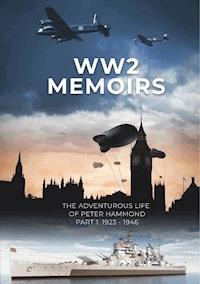
In Part 1 of his memoires Peter Hammond describes the growing pre-WW2 tension in day to day life in England, his time in London as a fire-watcher during the German bombing raids, his adventures as a "head-ache" operator listening to enemy communications in the Royal Navy and being stationed in post-war Germany as a naval intelligence officer interrogating Soviet spies. Peter Hammond, born 1923 in Rotterdam, moved to England at the age of 11 after his father died. At 16 he left home to start an apprenticeship in London and during the nights he was on fire-watch duty to extinguish the blazes caused by German bombs. He then joined the Royal Navy and was stationed on several ships as a "head-ache" operator. Speaking Dutch, he quickly learned German and decoded transmissions from enemy vessels attacking the Royal fleet. After the war he was posted to Cuxhaven and describes the desperation of the beaten German people and the search for Soviet spies in the occupied country.
Sie lesen das E-Book in den Legimi-Apps auf:
Seitenzahl: 568
Veröffentlichungsjahr: 2018
Das E-Book (TTS) können Sie hören im Abo „Legimi Premium” in Legimi-Apps auf:
Ähnliche



















For India, Peter and Charlotte
Index
Prologue
Rotterdam (December 1923 – Summer 1930)
The Hague (Summer 1930 – Summer 1935)
Worthing (Summer 1935 – 1st September 1940)
City of London (2nd September 1940 – 17th August 1942)
The Royal Navy
Skegness – 1 (18th August – 24th September 1942)
Portsmouth – Vernon, RNH Haslar, Skegness 2 (25th September 1942 – 04th February 1943)
Southmead – 1 (05th February – 18th April 1943)
HMS Limbourne (18th April – 12th July 1943)
HMS Talybont (12th July – Mid-November 1943)
RNH Stonehouse, Barrow Gurney, Chatham, Plymouth (the Eden) (Mid-November 1943 – 30th May 1944)
HMS Javelin (31st May – 28th August 1944)
HMS Wivern (29th August – 29th September 1944)
Southmead 2 (30th September 1944 – 12th June 1945)
Antwerp, Wilhelmshaven (14th June – 14th July 1945)
Cuxhaven (14th July 1945 – 04th December 1946)
Prologue
It was exactly five years and one month – to the minute – after the Armistice came into force ending the First World War, that I made my appearance as a head to be counted in calculating the world’s population. Following the advice of her doctor, my mother had decided I should make my entrance at the Roman Catholic run St. Francis Gasthuis in downtown Rotterdam, where she was allocated an immaculately clean but austere private room, with just a simple cross above the bed as a reminder of the pious nature of the Institution.
Much to my poor Mother’s consternation, I bided my time for eleven whole hours (probably checking that I’d got the address right), before finally making up my mind and going into the decisive phase of Exercise “Sovereign Entity”.
Once I had recovered from this unaccustomed exploit and was able to take stock of my new environment, I realised at once that I needed a drink; but before I was able to place an order the duty nurse uncouthly lifted me up by my feet an thumped me on my back, to see if I worked properly. This discourteous treatment caused my lungs to open up, to enable me to deliver a predictable vocal protest with appropriate vigour. My outburst, it was noted, was accompanied by a tell tale wheeze. Then, holding me up to the light, the nurse saw that I had a pronounced skin rash; and she also observed that my toes were deformed.
When the doctor eventually came to pay me his first visit, he confirmed the nurse’s diagnoses: I was found to have Asthma, Eczema and Rickets. Had I been a bird, I’d been thrown out of the nest. In the event I seemed to be good news for the medical profession and the pharmaceutical industry. (Which was just as well, as it was snowing in Rotterdam at the time!)
The World into which I was born was in the process of orbiting through the “Roaring Twenties”.
Grief over the appalling ravages of the First World War was making way for new, more immediate worries, as the countries of Western Europe struggled to recover from the calamitous economic depression of the post-war years.
Politically, the Imperial World Order had remained by and large intact and the great colonial powers still enjoyed the material benefits (not to mention the prestige) they derived from their overseas possessions. Only Germany felt aggrieved over the harsh treatment she had received on losing the War: the victorious Allies had confiscated her colonies and had imposed on her crippling War reparations. Western Europe looked across the Atlantic with thinly disguised envy at the trend setters in the “Land of Unlimited Opportunity”; and with apprehensive curiosity at the seemingly over-ambitious experiment taking place in Soviet Russia of establishing a Communist State, in which all men were supposed to be equal.
In Europe, as in America, the wonders of modern technology made it look as though a Utopia was just around the corner. Ever more people were experiencing the excitement of travel by motor vehicle, of being entertained and informed at home by wireless, of communicating by telephone; while passenger aircraft and airships made it possible for the privileged to travel over great distances at undreamt of speeds. Electric light and electric power were available to practically everyone at affordable rates. The cinema was competing with the theatre and the music hall in entertaining the masses; and on the dance floor couples romped and twisted to extravagant new rhythms.
This was the World in which I had landed towards the end of 1923.
Episode 1: Rotterdam
(December 1923 – Summer 1930)
Until I reached the age of 6 we lived in Rotterdam. Not surprisingly, my memory of this early period of my life is extremely sketchy. There are, however, one or two impressions from those early years that have left behind their indelible traces, although I am unable to place them in any accurate chronological order.
For instance, I well remember the patches of eczema all over my arms and legs itching so badly that I disregarded my parents' earnest exhortations to keep my hands off the tantalising rash; and, yielding to irresistible temptation, revelled in the immense relief and sheer physical bliss of scratching - until the patches once more degenerated into open sores; and the slow healing process had to begin all over again, with applications of ointment and renewed firm warnings not to touch it if it itched. It was a vicious circle - with the accent on vicious....
There was also the ever recurring recourse to the steam kettle, to try to ease my frequent spasms of Asthma. This was a copper coloured vessel, slightly larger than the normal household kettle, but with a spirit lamp in its base and a long, thin spout, at the end of which a small receptacle dangled from a hook, to catch the drops of condensation, as the column of steam purposefully billowed forth in my direction. I do not recall deriving any benefit from this treatment, but the doctor had recommended it, so there it was.
Due partly to my fragile state of health and partly due to the fact that we lived in a busy street near the centre of grimy Rotterdam, I never went out to play with other children and spent a lot of my time looking out of the window at the big, wide World go by. I soon became familiar with the five buses that regularly plied up and down our street. Each was different from the others in appearance and each produced its own, distinctive sound when rattling past our house. My parents believed I possessed supernatural powers when they discovered that I was able to tell them, without looking out of the window, the number displayed on each bus as it went by. They invited their friends to come up and test my extraordinary aptitude by getting them to stand at the window and ask me to identify passing buses from the back of the room.
Although I saw very little of my Father - he worked long hours throughout the week, including Saturdays and sometimes even on Sunday mornings - I could not imagine anyone having a more loving, a more handsome, a more perfect Father. I felt that if there was anything I really desperately wanted, he would arrange it. His gentle selfassurance inspired in me complete confidence in his ability and in his readiness to protect me from all harm.
My Father was proud of his British heritage and he made it his business to take us over to his beloved England as often as he could afford, which turned out to be every other year. The first such holidays I can remember go back to 1928 and took us to Niton near Ventnor on the southernmost tip of the Isle of Wight. I retain vague memories of our going down steps cut into rocks to a sandy beach in the company of my Mother's younger sister, my Auntie Phyl; and I remember hearing a "Puffing Billy" railway engine hoot early in the mornings.
Back in Rotterdam (probably when I was about 4) my parents announced one morning that I was to be taken for a drive in a car belonging to Mr Kaufmann, my Father's boss. What a lovely treat! I was really thrilled. A large, elegant, beautifully polished chauffeur-driven limousine duly appeared outside Graaf Florisstraat 75 and the three of us climbed aboard, my Father and Mother sinking into the sumptuous seats in the rear, while in front of them a fitted collapsible chair was unfolded for me. A glass panel separated us from the driver, who set the vehicle in motion, drove round a few blocks and then came to a halt in front of an ENT surgery. To my unsuspecting surprise we alighted and went inside, where my Mother promptly disappeared and my Father presented me to the surgeon. Before I knew what had hit me the surgeon sat me in his operating chair, got me to open my mouth, stuffed something in to keep it open and set about cutting out my tonsils with what looked to me like a knife and fork, without, as far as I can remember, any anaesthetic! I screamed, my Father tried to comfort me; and, I was told later, my Mother wept bitterly in the adjoining waiting room. After this traumatic experience we were driven back home in the limousine and I was put on a diet of "slops" (my Mother's delicious rice puddings) for several days.
On one occasion my parents took me on a brief holiday to a wooded area in the Dutch Province of Gelderland. While we were out walking among the trees the famed twelve-engined German "DO-X" airliner flew low over our heads. As it came closer and closer the roar of its engines became unbearable; and when it’s huge, black silhouette thundered right over us I was terrified it was going to swallow me up!
On 30th December, 1928 my Brother Bobby was born at our home in the Graaf Florisstraat. My Father was visibly overjoyed. He took the day off from work and repeatedly popped out of the flat to bring back large bouquets of gorgeous flowers. He telephoned the happy tidings to all and sundry and kept bursting into song with renderings of Wartime evergreens like "It's a long way to Tipperary", "Mademoiselle from Armentiers" and "John Brown's Body" and his version of the well known Verdi operatic aria "La Donna Mobile", to which, in moments of elation, he was given to singing the words "Ta-ra-ra boomdeeyay, where's Mrs Rossier?".
Before our Rotterdam episode came to an end I was placed briefly in a local Kindergarten, where it was no doubt hoped I'd get used to the company of other children. All I can remember of this horrifying experience is sitting, nervous and bewildered, in the midst of a room full of rough, loud and undisciplined Dutch brats whose language I was unable to understand, while the teacher, a colourless, flabby and totally ineffective woman, did nothing but shake her head and sigh pathetically at her complete inability to exercise any influence whatever over the rowdy rabble she was supposed to be supervising.
Episode 2: The Hague
(Summer 1930 – Summer 1935)
We moved from Rotterdam to The Hague in the summer of 1930, very much on my account. My parents felt I needed to get out into the fresh air and play with other children; and the proximity of the seaside and the sand dunes was thought likely to benefit my health. (Fortunately my little Brother Bobby had none of the unpleasant complaints with which I was afflicted: he merely had outbreaks of Nettlerash, which, while a bit itchy and unsightly, did not cause him any major discomfort).
We took up residence at van Diepenburchstraat 72, which was the bottom half of a terraced house, situated in a long row of identical, 3 storey houses.
Just behind the van Diepenburchstraat, across the Oostduinlaan, was the Waalsdorperweg, a broad thoroughfare dominated by a large, unconventionally shaped building. This was the "Vrije School", my first school. The school was surrounded by woods with tarred footpaths, where my Mother often used to take us for walks. This whole area was on the edge of the sand dunes that separated The Hague from Scheveningen and the North Sea.
The "Vrije School" (headmaster Mijnheer Stibbe) belonged to the network of Rudolf Steiner schools that had sprung up in various countries in the early 1900s, with a view to providing an alternative system of education, based on the principles of Anthroposophy (which I confess I have never taken the trouble to try to understand!) My parents sent me there in the belief that I would be given more individual attention and help than could be expected at a State school. After all, at home I had only learned to communicate in English and, not having mixed with other children, I had not had the opportunity of becoming familiar with the Dutch language.
I was placed in the Second Class, the appropriate class for my age. The class teacher was a Mevrouw Gerretsen, an unorthodox looking middle aged lady, who was ardently dedicated to spreading the Rudolf Steiner gospel. The day at the "Vrije School" began with prayers in the classroom, during which pupils were required to half-close their eyes, interlock their fingers and keep quiet while the class teacher mumbled words I seldom understood. I'm afraid I did not become spiritually involved in this mumbo-jumbo: I never managed to experience that feeling of being plugged in to God that I felt was expected of me. In fact, I used to feel rather silly, a bit of a sham, trying to half-close my eyes; and I was always relieved when prayers were over.
A subjet that was given much prominence at the "Vrije School" was Eurythmie: a sort of combination of Yoga, ballet and semaphore, which was conducted in the School gymnasium. Pupils were taught to portray the letters of the alphabet by means of gracious movements, each letter being represented by a distinctive attitude and position of the arms and legs. Breathing exercises and spiritual awareness were other aspects of Eurythmie instruction.
Foreign language lessons began at a very early stage in the School curriculum, when pupils were taught to sing songs and recite simple verses in English, French and German, without being made to bother about what the words meant. (I remember learning "Frère Jacques" and "Röslein auf der Heide"). The children used to make fun of the German teacher, a Herr Kwindt, who had a humourless, gushing manner. Mevrouw Gerretsen taught her class English and French.
Another unconventional subject taught in the early classes at the "Vrije School" was knitting. We were required to produce such works of art as (almost) square knitted kitchen cloths - to the drill: "insteken, omslaan, doorhalen, aflatenglijden", which translates as "stick (the knitting needle) in (to the previous stitch), fetch (the thread) around, bring it through and let it slide off (its original needle).
During school breaks, when the children swarmed out onto the playground, I used at first to assume a low profile and stay by myself near the School entrance door. For a long time I had no friends, probably because I was unable to converse freely in Dutch; and since I did not enjoy the robust physique of the other children, I was afraid of joining them in the rough and tumble of the playground. I was always relieved when the school bell signalled that the break was over.
Gradually my problems seemed to resolve themselves. I became friendly with a little girl of roughly my age named Annerietje Hofstede, who lived just down our street. My parents had bought me a magnificent scooter (in Dutch, a "Step") with pneumatic tires. With either Annerietje in front steering and I holding on to her and "stepping", or sometimes vice versa, the two of us spent much of our free time exploring the neighbourhood. In the process my Dutch improved; and so did my physical stamina.
Annerietje also attended the "Vrije School", where she was a year ahead of me. I believe it was in connection with one of our school projects that we set about becoming acquainted with the local cart horses! In those days it was customary for tradesmen to call regularly at private houses to sell their wares. Some, like the two bakers at either end of the van Diepenburchstraat, used handcarts or tricycles; but most other tradesmen came by with horse and cart. We made it our business to chat up the various tradesmen (the greengrocer, the milkman, the coal merchant, the ice merchant, etc.) about their horses and entered the following details in a small notebook we kept for the purpose: horse' name, its colouring, its nature (whether it was of friendly or nervous disposition); and, therefore, whether it was safe to feed or stroke it. We had learned at school that if a horse' ears were pointed forward it was nervous; if they were in line with its head it was happy; and if they were pressed back against its mane it was angry. We collected "statistics" on at least a dozen horses, towards which we then developed feelings of affection, respect or apprehension, depending on how approachable each horse was. For instance, Gerda, the ageing, grey, mottled horse belonging to the greengrocer was so good natured and gentle that we felt perfectly at ease leading it forward at the greengrocer's behest, as he moved from house to house. In contrast, Janus and Manus were two young and restless horses, which were made to move smartly at the crack of their master's whip; and we heeded warnings to keep a safe distance away from them.
It was at a cinema on het Plein that I was taken to see my first "movies". On the programme were two comedies: a film starring Harald Lloyd; and one featuring "Wat en Half-Wat". I didn't find either of them terribly amusing, but I was proud of having reached the age at which I was considered eligible to visit the cinema.
At this age little boys looked with utmost contempt upon grown-up young women who painted themselves with lipstick, eye liner, rouge and nail varnish and walked about on high heeled shoes smelling of perfume and powder. Such aberrations of normality were referred to as "Nuffen", the local breed, "Haagsche Nuffen", for some reason, meriting particular derision.
However, a breed of grown up for whom little boys felt much deferential respect was the uniformed Policeman, who was referred to behind his back as a "Bink". The plain clothes policeman, on the other hand, known as the "Stille Bink", was regarded as a kind of deadly virus. I almost suffered heart failure one day when I was surprised by a "Stille Bink" while trespassing in an empty workmen's hut, which I had entered by an open window. He must have realised I'd learned the lesson of my life, for, after giving me a stern warning, he let me go.
To go to work my Father used to leave the house at 0730 and catch bus route R to the Hollandsche Spoor Station, where he boarded the train for Rotterdam. He used to return home at 2030, after I had been put to bed. On some mornings I would accompany him on my scooter to the bus stop on the corner of Ruychrocklaan and Oostduinlaan. On one such occasion he lit a cigarette on leaving the house and threw the stub onto the pavement before boarding the bus. This stub, which was still glowing, somehow hypnotised me and, as the bus drove off, I picked it up to have my first ever puff of cigarette smoke - quite oblivious of my dumbfounded Father, who was looking in vain through the bus window for his son's customary farewell wave......
On Saturday evenings my Father used to return home from work early (I believe it was at 1800!) and would take my mother out "on the town". Our housemaid, Jo Pronk, would then stay on until about midnight to look after Bobby and me. Jo was the eldest of twelve brothers and sisters and on Saturday evenings her attractive sister Corrie often came to keep her company.
Some tradesmen who regularly called at our house evidently felt they could take certain liberties with our earnest and respectable Jo. One day, when she was otherwise occupied, my Mother went to answer the door bell. As she prepared to open the door she heard the prolonged gurgitating sound of a man about to expel the superfluous sputum from his throat. Then, as the door swung open, he completed the ritual and, with a tremendous burst of pent up breath, projected the unwanted matter over the garden gate, into the street. With the hearty remark: "Eindelijk is het er uit!" (at last that's got rid of that!) he swung round to face, not Jo, but, to his horror, my mother in person!
As I grew older my parents used periodically to pack me off on my own to spend Sundays with my Mother's closest friend, Florence Aldridge, whom I knew as "Auntie Florie". She lived with her adopted daughter Daphne (six years older than me) and their white cat Percy in an upstairs flat in the Moucheronstraat. To me the main attraction at Auntie Florie's was her Pianola - a piano which could be adapted to play tunes from scrolls of thick paper. These scrolls, which had patterns of holes punched into them, were mounted in a compartment of the piano above the keyboard, where they were made to rotate by means of foot pedals, which I used to take delight in operating.
At home my parents used to switch on the wireless at breakfast time, when it would provide innocuous background music, such as extracts from operettas and Strauss waltzes. In the evening we would tune in to Droitwich at 1820 to listen to the BBC's 6 o'clock news (Holland then being 20 minutes ahead of Greenwich Mean Time). The only other wireless programme I remember was English language instruction from Hilversum, presented by a humorous gentleman from across the North Sea called Mr Fry, who addressed his listeners as Mr and Mrs Luistervink.
I usually spent any pocket money I got on "Zoute Drop", which is salted liquorice, a delicacy only the Dutch seem able to appreciate. It is sold at Drogisterijen (Drug Stores), usually in the form of lozenges. In powder form it is known as "Zwart-Wit" (black-white); the black actually being brown liquorice powder and the white special salt.
As my interests developed I began collecting postage stamps, spent much of my time drawing horses, cars and buses and became fascinated by trains. My parents presented me with a basic model railway set; and added to it on my birthdays and at Christmas.
One of my favourite treats was to be allowed to go on my own by bus route R to the Hollandsche Spoor Station, buy a platform ticket and stand about for hours, watching the trains arrive and depart. Most of them were commonplace electric commuter trains; but once in a while a huge black monster of a steam locomotive, hissing and puffing, would come thundering into the station, hauling a long line of passenger coaches displaying signboards showing whence they had come and where they were going. In one direction nearly all trains either came from or were heading for Amsterdam; but in the opposite direction, after Rotterdam, they continued to such exciting destinations as the Hook of Holland or Vlissingen (Flushing), from where their passengers travelled on by ship to Harwich and thence to London and beyond. Other trains crossed the Dutch border into Belgium; and some even went as far afield as Paris. On rare occasions I'd see a particularly impressive train, consisting of a string of dark blue coaches with the words "Compagnie Internationale des Wagons-Lits et des Grands Express Europeens" engraved in gold over the windows. These trains were bound for the distant, exotic cities of Marseilles, Nice, Genoa and Rome!
In the early summer of 1933, as my third year at the "Vrije School" neared its completion, my teachers appeared to give up all hope of ever making any Anthroposophical impact on me! Whereas at the end of the two previous scholastic years I had received encouraging, lovingly written school reports, this time Mevrouw Gerretsen didn't pull any punches. In my report on the school year 1932/33 she expressed her unambiguous opinion that I had not been able to keep up with the standard of the rest of my class. This, she conceded, was due partly to my persistent difficulty with the Dutch language, but the main problem was my indolent nature and my mediocre ability. She went on to declare that my reading was hesitant, my writing messy, my Dutch spelling totally inadequate and that in Arithmetic I was slow in the uptake. To round off her devastating invective, she pronounced me to be an unsocial child who experienced difficulty in making friends, invariably sought his own company and seldom managed to find anything to say.
My Father did not even bother to initial this report. Within a matter of days my Mother and I were summoned to an interview with Mijnheer Richmond, headmaster of the dreaded Dutch State School, which was housed in a modern, bleak, utilitarian building. This school had a reputation of maintaining strict discipline and making pupils absorb knowledge by working hard under the threat of punishment. At our interview Richmond made no bones about his views: the days of the British Empire were numbered, he warned my Mother. Her son should not be led to believe that he could make the grade in life by brandishing a British passport. The new régimes in Germany and Italy were going to put Britain in its rightful place; and British citizens would, in future, be judged on their merits, like anyone else. If I was to be admitted to his school I would first need to take private lessons at home, to bring me up to the requisite educational standard.
Arrangements were made for a teacher from Richmond's school, a Mijnheer Kramer, to come to our house on several evenings a week to teach me Arithmetic (tables, adding, subtracting and dividing) and Spelling and Reading (of Dutch, of course). Kramer was a hard taskmaster and, after each tuition session, he gave me plenty of work to get on with in preparation for his next visit. With his swept back hair and bristling moustache he looked the typical schoolmaster. After a few weeks he was replaced by a Mijnheer de Boer, a tall, clean shaven, coldly supercilious individual, who was probably a good deal younger than Kramer. De Boer piled on the agony by introducing me to the "Vormsom": a kind of mental torture, consisting of multiplying two three-fugure numbers and then dividing the result by yet another three-figure number. How I loathed doing "vormsommen"! I spent hours and hours every evening trying to get them right.
I duly joined the State School in the van Nijenrodestraat at the start of the 1933 autumn term. At first I was placed in Mijnheer de Boer's 4th class; but it was soon decided it would be more realistic to move me down to the 3rd class, where the teacher was a Juffrouw Loopstra. Before being thus degraded I spent many an irate evening struggling with exasperating "vormsommen", which de Boer took delight in giving his class as a collective punishment, to be done at home, for making a noise while he was out of the classroom.
Juffrouw Loopstra must have been in her mid-thirties. She was of average height and had a well cushioned, yet energetic figure. Her Nordic facial features were expressive and generally good humoured; and she had a powerful, assertive voice. She walked with a purposeful, rather than with an elegant gait. As a teacher she was dynamic, authoritarian and extremely effective. She was at all times fully in control of her class; and she was respected by her pupils, who were chary about incurring her wrath; for she had no qualms about slapping a child's face if her displeasure was incurred; or sending an offender to stand shamefully in the corner of the classroom, to repent some misdeed. She appeared to be on friendly terms with Mijnheer de Boer, in whose company she often cycled to and from school.
As our class teacher, Juffrouw Loopstra, or "Lopie", as I called her behind her back, instructed us in all our school subjects, including Gymnastics and "Sloit", the latter being concerned with the making of boxes, lanterns and other simple objects from cardboard. There was no religious instruction at this school, although "Lopie" did periodically talk to us about moral principles. For instance, she told us we should not subject animals to loud music or other harsh sounds, as many animals had more sensitive ears than human beings. There was one lame girl in our class (named Betty Gongrijp), whose legs were enclosed in iron frames. One day, when she was absent from school, "Lopie" explained to us that, although we should be sensitive to this girl's terrible physical plight, we should treat her, as far as was possible, as a normal fellow-pupil and should under no circumstances let her feel we pitied her.
In Arithmetic "Lopie" taught us simple fractions with the aid of a few apples and a knife. By cutting up the apples she illustrated the relationships between halves, thirds, quarters, sixths, eighths, etc. Later she introduced us to decimals. In handwriting we were made to reproduce copy-plate texts with our finely pointed pen nibs. A smudge or an ink blot earned the perpetrator a hard slap on the cheek! History began with the invasions of the territory of the Netherlands by the "Germanen" and spanned the centuries up to the "Evangelie Predikers". In Geography we concentrated on the Netherlands and had to learn to rattle off by heart the names of the eleven Provinces in the correct order, from Groningen to Limburg; and likewise the Friesian islands from Texel to Rottumeroog. We were made familiar with the names of every town and village in the land and had to know the courses of rivers and canals, as well as the names of the many Polders, including those still on the drawing board. We learned of the construction of the massive dyke across the neck of the Zuider Zee, which was thus being transformed into a vast inland waterway known as the IJssel Meer. We were also taught the names of the countries of Europe and their capital cities. The Netherlands, Sweden and Switzerland, we were told, were just about the only civilized nations of Europe to have understood that it was barbaric to become involved in wars.
One morning "Lopie" arrived in the classroom grim faced, slammed down her handbag and announced: "Now children, you can forget everything I have taught you about spelling. The Government has decided to introduce new rules, that will do away with "SCH" when only the "S" is pronounced; and double vowels at the end of a consonant". Thus "Hollandsch" was to become "Hollands" and "Reekenen" spelled "Rekenen". "Lopie" (until then "Loopie") was manifestly not amused!
On "Lopie's" birthday, which fell on 11th January, her pupils would come to school early and decorate the classroom with streamers and bunting, so that when she arrived she was greeted in a suitably festive setting, to the massed children's voices singing "Lang zal zij leven".
Queen Wilhelmina's birthday was celebrated on 31st August with festive fervour: red, white and blue streamers and orange bunting decorated all the classrooms; and there was singing of the National Anthem (Wilhelmus van Nassauen) and other patriotic songs like "In de naam van Oranje, doe open de Poort" (Open the gate in the name of Orange)
At "Sinterklaas" (St Nicolas) on 6th December there would be great merriment as the whole school was marched out into the street to watch the arrival of the Saint on horseback, accompanied on foot by his African man servant "Zwarte Piet". These two legendary characters would bring with them large sacks filled with sweets, which they would scatter among the gathered children, causing a wild scramble. The notion that "Zwarte Piet" was on the lookout for naughty children to pack into his sack and cart off to distant Spain, sent shivers down the backs of some of the younger onlookers with parents who used the "Zwarte Piet" bogy as a ploy to induce obedience.
Before breaking up for Christmas "Lopie" distributed the lanterns her pupils had made during "Sloit" lessons and issued each child with a candle. The candels were then lit in the lanterns and the curtains were drawn. With the lanterns casting an intimate, festive glow in the darkened classroom "Lopie" would give a little talk on some subject of moral significance, such as to be thankful for one's blessings and to be generous to the less fortunate. It was a simple, touching little interlude, which "Lopie" conducted with seasonal warmth.
The impact on my morale of my new, vital, no nonsense school was such that I crept out of my shell of diffidence. I no longer felt an outsider among Dutch children. I had become one of them: I now thought in Dutch, I laughed in Dutch, I even swore in Dutch, to the chagrin of my Mother, whose knowledge of the language was too superficial to enable her to identify "non-U" words and expressions. (A Dutch lady on a visit to our house one day felt she had to tell my Mother that the language she heard me use was often more befitting to the gutter than to the drawing room!) My Asthma and my Eczema had all but disappeared; and I was now physically able to hold my own among boys of my age.
Among the residents of the van Diepenburchstraat my friends, playmates and acquaintances included:
The Hofstede family, who lived at number 64. When I left the "Vrije School", Annerietje and I drifted apart, as I found friends among my new school mates. In 1934 tragedy struck the Hofstede family, when Annerietje's Father committed suicide by throwing himself under a moving train near the Duindal level crossing.
Our ground floor next-door neighbours at number 66 were the Oldenbooms. Mevrouw Oldenboom became a close friend of my Mother's. She had adopted Guus, her husband's elder son from a previous marriage. Guus was four or five years older than me and his hobby was building model aircraft. It was his aim to become a KLM pilot. His younger brother, Gep, was about my age, but he only came to The Hague on periodic visits, as he normally lived elsewhere with his Mother. Mevrouw Oldenboom and her husband had a baby daughter of their own named Sonja.
Tonny van Boven, an only child, lived at number 102. He was in de Boer's class at the van Nijenrode School.
A girl in my class named Netty Schouten lived at number 106. Her best friend Adri van Aalst, who was also in my class, lived in the adjacent Utenbroekstraat at number 17. Both the Schouten and the van Aalst families were said to be supporters of the N.S.B., Mussert's Dutch National Socialist Party.
In the autumn of 1934 my Father had to enter hospital to undergo an abdominal operation. From the moment of entering the Hospital foyer I was intrigued by the all pervading odour of antiseptic sterility everywhere - even in the hospital lifts. Up in his room my Father told me he had an ulcer; and he drew me a pencilled sketch to show me its position in his intestines. It had to be cut out, he told me; and the resulting wound stitched up.
After his operation he looked feeble and pale; but a week or so later he was discharged and he came home to recuperate.
I was blissfully unaware of the horrible truth. As I learned later, my Mother was informed by the doctors that his operation had revealed that he was terminally ill with cancer of the liver. Before his operation he must have had a premonition that his life was at risk; for he wrote letters of farewell to his Mother, to my Mother, to my Brother and to me, letters we were given to read after he eventually died, some six months later.
During the final months of his life he was bed-ridden most of the time. He would get up occasionally to take us for short walks during the brief spells of respite he had from his abdominal pains. He even went to the office for a couple of days, but was unable to keep it up for longer.
In retrospect, it seems beyond belief that it did not occur to me that he might never recover.
One day, shortly before he died, I was sitting on the edge of his bed chatting to him, when he asked me whether I remembered certain happy times we had shared. When I replied that I could not recall the particular occasions he had mentioned, he told me that after he had gone I would treasure such memories. Tears shot into my eyes and I rushed out of his bedroom into the kitchen, where, amid sobs, I told my Mother of the frighteningly ominous remark he had just made. I cannot remember how my Mother coped with this crisis, but she must have reassured me there was no cause to worry; for I was able to regain my composure and my life continued as if the terrible innuendo that had so upset me had been nothing more than an unfortunate slip of the tongue.
As my Father's condition deteriorated his step-sister, my Auntie Mable, arrived from England to stay with us. Our family doctor, Dr Mees (a youthful looking Overseas Chinese) brought an older consultant along on his house visits. They administered pain-killing morphine injections. A nurse was engaged to keep vigil during the night. Despite all these indications pointing to the inevitable, I naïvely accepted the explanations given to me that my Father was again going through a bad period; but that he was in capable hands and would once more recover.
The terrible end came on Easter Sunday, 21st April, 1935.
Easter Sunday 1935 was a beautiful hot summer's day. In the early afternoon I set off on my scooter in the company of Hans Lippe. We headed for the level crossing over the electric railway line to Scheveningen to watch the trains; and then we carried on to the open air café at Duindal, where my parents often took us for walks on Sundays. Here we quenched our thirst with a refreshing glass of cool "Ranja" (orangeade). Later, on our way back, we were passed by lines of cars festooned with colourful garlands of tulips, hyacinths and daffodils, returning from Holland's famed bulbfields. One of these cars drew up beside me and I heard my name called out. It was the Kaufmann family, who enquired after my Father's health and handed me a large bunch of flowers for my parents.
When I reached home I was surprised to find Auntie Mable waiting for me in the front garden. She told me the doctors and a new nurse were attending my Father, who had become very ill. She said we should wait outside so as not to get in their way; and she led me quickly through the house into the back garden. As we passed my parents' bedroom I heard the heart-rending sound of my beloved Father gasping desperately for breath in what was unmistakably a frantic struggle to hang on to life. Why could the doctors not do anything to help him? Why could I not go in to see him? My mind went numb with anxiety and helplessness.
Mable tried to comfort me as we stood alone in the garden, unable to see the crucial drama taking place inside the house. After a while the nurse came out and, looking sorrowfully over in my direction, remarked: "arme jonge" (poor boy). My World fell apart. I knew now that my Father had finally lost his ultimate, agonizing fight; and that he was no longer alive.
When eventually my Mother emerged from the house, overcome with distress, she told me I could go inside and see my Father at rest. I did so and kissed his forehead as he lay there peacefully, his eyes closed for ever.
My little Brother Bobby, I was told, had been sent off to stay with Mevrouw Oldenboom, our former next door neighbour, who had recently moved to Scheveningen. He would be staying there until after the funeral; and was to be told that our Father had left on a long journey. He seemed to accept what he was told; and showed no sign of surprise or concern.
When my Father died aged just 44, my Mother was 36, I was 11½ and Bobby was 6½. The secure, comfortable and carefree life to which we were accustomed had ended abruptly. I had lost the loving warmth and protection of "the best Father in the World". My Mother was not only profoundly distressed in her tragic, untimely bereavement; she was also worried out of her mind on contemplating the material void she saw before her. In a moment of despair she told me she did not know where the next meal was going to come from. This added a new dimension to my feeling of abandonment in the face of a destiny that knew no mercy.
I was spared the agony of having to attend the funeral. I spent that day at Mevrouw Oldenboom's in Scheveningen. While Bobby was out playing with little Sonja, Mevrouw Oldenboom tried to comfort me indoors by telling me that she, too, had once lost someone very dear to her. The warmth of her sympathy towards me was something I would never forget; but, of course, nothing could possibly mitigate the pain of my boundless grief.
My heart-broken Mother now found herself confronted with a pressing need to map out her future, a future in which she was faced with the grim prospect of having to bring up her two young children single handed. Her financial position looked frighteningly bleak and insecure. Her Brother-in-Law Walter Simpson (Uncle Sim) and her close friend Florence Aldridge (Auntie Florie) rallied round to give her much appreciated practical advice and help; while Mevrouw Oldenboom gave her spiritual guidance in coping with her profound personal grief.
The material considerations my Mother now faced were: (a) that she had no entitlement to any kind of pension; and (b) she was the sole beneficiary of a life insurance policy my Father had taken out, which gave her a one-time-only lump sum of £1,000.
As we were British subjects and we no longer had any material reason to remain in Holland, my Mother thought it desirable to lay the foundations of our future lives in England. She sought out the South Coast resort of Worthing as seeming the most suitable location to move to, as her old friends the Thomsons lived there and could be relied upon to help her settle in to a new environment. Furthermore, the sea air in Worthing was likely to be beneficial in keeping my Asthma at bay.
Uncle Sim, whose wife Dolly had died just shortly before my Father, came to stay with us in The Hague. On his return home he was instrumental in purchasing, on my Mother's behalf, our future home at 82, Shandon Road in the Broadwater area of Worthing. The price my Mother paid for this house was £775.
We moved from The Hague to Worthing during the summer of 1935.
Episode 3: Worthing
(Summer 1935 – 1st September 1940)
Our move from The Hague to Worthing appears to have been accomplished without any noticeable hitch. Otherwise this major logistical operation would not have been so completely eradicated from my memory! My Mother's comment on the move (54 years later!): "I remember seeing the removal van with the name "Jones & Higgins, Peckham" outside our house in the van Diepenburchstraat loading our furniture and then driving off. The next I saw of it was outside 82, Shandon Road, when we took up residence there. We had lunch with the Thomsons and met our new neighbours, the Penleys, the Misters and the Withers. The Thomsons introduced us to the McKechnies".
Worthing (population 80,000 and situated 'twixt Sea and Downs) was especially renowned for harbouring large numbers of old people who had gone there to die, but who, once there, somehow seemed to go on living, just getting older and older. It claimed to be the healthiest resort on the South Coast with the greatest number of hours of sunshine in the country. Hence the epithet: "Sunny Worthing".
82, Shandon Road was at one end of a row of conventional, modern English red brick terraced houses, with two living rooms and a kitchen downstairs and 2½ bedrooms, a bathroom and a loo upstairs. There was also a second loo beside the veranda, which was accessible from the back garden only and which was freezing cold in winter; but then so was the rest of the house, except the rooms that were actually being heated at any given time. There was a cokefuelled boiler in the kitchen which heated the hot water system; and electric stoves in the living rooms, as my Mother did not like the mess created by open fires. Not surprisingly we had our meals in the kitchen and we normally only used our living room in the evenings to listen to the wireless. We had front and back gardens, which were joined by a narrow gravel pathway along the side of the house. There was a coal or coke shed just outside the kitchen door; and a general purpose shed at the bottom of the back garden, where there was also a vegetable patch leading to the rear garden gate.
To enable her to keep the proverbial wolf from the door my Mother let the front living room and the rear bedroom to a "paying guest", for whom she also cooked, cleaned and laundered. A genteel little old spinster named Miss Downe was the "guest" who stayed with us longest. My Mother charged her £2 a week.
As far as I was concerned, the move confronted me with something of a cultural shock. After my slow start in life I had just about caught up with my Dutch peers, with whom I was at last fully able to identify. On my arrival in England I found myself, at the age of 11½, having to communicate by means of the vocabulary of a child of 5, since I had never been to school or played with English children and had consequently missed that stage of my linguistic development.
My Mother accompanied me to my introductory interview with Mr Martin, the Headmaster of the Worthing Boys' High School, as a result of which I was admitted to Form 2B for the 1935 autumn term. (At the same time Bobby was placed in the Dominion Road Elementary School)
At school I found the régime very much more free and easy than it had been under the attentive eye of Juffrouw Loopstra. My initial difficulties with my English vocabulary and spelling did not seem to constitute any major impediment to my "swimming along" with the rest of the boys in my form. Once a week we were handed a report card (to be taken home and signed by parent or guardian), which indicated the marks (out of 10) we had scored in each subject; and, on the basis of the total number of marks achieved, our position in relation to other pupils in the form. At the end of my first week I was placed 16th out of 22. At the end of the second week I came third; and after the third week I was top of my form - a performance I sadly only repeated on one other occasion throughout my English school career!
Considering I had only completed the 4th class at my Dutch elementary school and had come top of the form just three weeks after walking into the second year at my new British secondary school, it occurred to me that I could now afford to relax!.....
There were, of course, a number of aspects of the British school system that were new to me. Boys were required to wear school uniform: at Worthing a green blazer displaying the school crest, grey flannel trousers and a school tie. On being admitted to the School each boy was placed in one of the four "Houses" into which the student body was divided. At Worthing the "Houses" bore the names of the early Nordic invaders of England and each "House" had its own distinctive colour, which was featured in a boy's school tie and which was worn when playing Rugby or at Physical Training. "Angles" wore red; "Saxons" dark blue; "Jutes" yellow; and "Vikings" light blue. The four "Houses" competed against eachother, not only at sports, but also by scoring points in academic work. Misbehaviour could cause a boy to loose a point, while a meritorious achievement could lead to his earning a point for his "House". So when buying sports clothing or a school tie it was necessary to stipulate which "House" colour was required. I was a "Saxon". There was a "carrot and stick" system of inducing boys to be decent chaps. This took the form of Red and Black Tickets, which the teaching staff were able to issue to boys they considered merited the attention of the Headmaster. A Red Ticket was designed to commend a pupil for a headmasterly pat on the back, with a possible allotment of a "House Point". The Black Ticket was issued to those who failed to respond to more restrained disciplinary measures and was apt to lead to a number of strokes of the cane on the palm of an offender's hand or across his buttocks.
There was also a Worthing Girls High School which was situated on South Farm Road, a road running parallel to Broadwater Road; but although it was close to the Boys School, it might just as well have been on another Planet! There were no organised joint activities involving the two schools; and until they reached courting age the boys had no inclination whatever to associate with their female counterparts!
At the beginning of every school term pupils elected their Form Captains and Vice Captains. Every morning, before lessons began, the whole school was required to attend Morning Assembly. Forms lined up and were then marched by their Form Captains into the Assembly Hall through the side doors. The teaching staff, in their gowns and led by the Headmaster in his gown and morterboard, then entered the Hall by the main door and assembled on the stage, facing the pupils. Roman Catholics were excluded from the initial part of the assembly ceremony, which began by the Headmaster saying a prayer and announcing the hymn to be sung. After the hymn the assembly mumbled the Lord's Prayer. Next the Catholics were marched in and joined their respective forms "on parade". The Headmaster then made any announcements he deemed necessary, such as the results of school sporting events, points won or lost by the school "Houses", instances of unworthy behaviour, etc. Finally, on the order to disband, the Captains marched their forms out of the hall and the academic day could begin. Occasionally one of the boys felt unwell while standing during Morning Assembly. (I did on two or three occasions, when I felt dizzy and went pale). One of the masters would then hurry off the stage and conduct the "casualty" out into the fresh air or to a seat in a nearby classroom.
Great importance was attached to school sports. I quite liked Rugby and, although I was not awfully good at it, I did once distinguish myself by being appointed Captain of the Overflow (i.e. the rabble not considered good enough for the "A" or "B" teams!). I was reasonably good at Athletics, being able to run and jump as well as most. Cricket, however, I positively loathed! I hated, especially in hot, sunny weather, having to wear the heavy white clothing, often with protective leg pads and gloves, which were de rigueur. I used to become bored stiff while "fielding" (standing about, often out of earshot of anyone else, waiting to catch and throw back a ball that some unfriendly soul might have the indelicacy to whack in my direction). I have never been any good at catching or throwing; and I was always scared stiff of being hit on the head (or anywhere else, for that matter!) by one of those hard and heavy leather cricket balls. On one occasion, while batting with undisguised reluctance, the Headmaster, who was lurking around, dashed up to me, held my hands firmly round the bat and guided me into taking a swipe at the next ball, to the command: "hit it boy, hit it!" In the intimacy of my innermost thoughts I consigned Martin and his rotten game of Cricket to the everlasting flames of Hell.
Having thus disposed of my Headmaster (who was popularly referred to as "the Beak"), it is perhaps appropriate I should make the odd observation about those members of his staff to whom I was exposed while at school in Worthing.
My first Form Master was "Johnny" Johnson, a nice enough man, but he had a voice that droned in a monotonous falsetto register which bored me to distraction. I believe he taught Maths and Physics, although I did not really pay much attention.
In later years my Maths master was Earnshaw, who had a touch of the tar brush in his features and drove a splendid old car with a long bonnet, of the kind that would nowadays be worth its weight in gold. He had a deep voice and always seemed very sleepy - which was rather infectious.
Max Fuller taught English and was one of the few masters able to convey to his pupils his enthusiasm for his subject. Although I was no good at memorizing texts, he taught me to appreciate some of the treasures of English literature, especially the works of Shakespeare and Longfellow.
My first French master was rather a pathetic character named Cooling, who was alleged to have suffered shell shock during the First World War. He tried desperately to "be nice", with the result that his pupils were unable to resist "ragging" him. This provoked him into a savage, but impotent frenzy. He would storm up and down the classroom in a convulsive rage, swiping at thin air as he threatened to "knock (evildoers') little blocks off". This was just what the mob wanted and they made sure they kept poor old Cooling's temper on the boil!
Later my form was taught French by "Peg-Leg" Strange, who presumably had a wooden leg. Although able to move about as nimbly as anyone, he did so with a truly extraordinary gait. His technique was to fling one leg forward with great vigour and then hobble after it with the other. He was an effective teacher with a friendly, interesting personality. It was "Peg-Leg" who advocated the "mirthless grin" in trying to pronounce the French vowel "u"; and an "elephant's trunk" to achieve the French "ou".
During my last school year "Larry" Littlewood was both my Form Master and French teacher. He liked to portray himself as a "man of the World". His theory was that "A"-stream boys were likely to become civil servants; "B"-stream boys businessmen; and "C"-stream boys either millionaires or social drop-outs.
The German master was "Andy" Anderson, a dedicated teacher with a "no nonsense" approach - probably the only way to teach this highly inflected language. (My knowledge of Dutch was, of course, a great help to me in learning German).
The Geography master was "Bunny Bates", a large man with a clear and lively style of presentation. As I was interested in his subject I found him good value.
The School's outstanding History master was another large and energetic man named Rae. He had a strong personality and a quick and fearsome temper; but, for better or for worse, I was spared being taught by him. I could never remember dates and I fear I would have fallen foul of this volatile, praiseworthy teacher.
My History master was a much more reserved and restrained man named Cochrane who, in his facial appearance, reminded me of my late Father. Although I liked Cochrane, he did not succeed in arousing in me a passion for History, a subject I eventually managed to discard from my curriculum.
The Chemistry master was Jenkins; but I gave up this subject at the first possible opportunity, due mainly to the obnoxious smells produced in the Chemistry laboratory.
A deaf little round man named Essex, but who for obvious reasons was nicknamed "Barrel", taught us Biology - another nasty, messy subject. On one occasion we had to bring a worm to school and dissect it: not my cuppatea!
The Art master was "Shag" Hazard, a disliked little thin man with a rough, uncouth voice and a foul, sarcastic temper. He did teach me perspectives though, for which I was duly grateful; but although I was relatively good at Art, I gave it up (to Hazard's dismay) in favour of Economics, which was taught by Cochrane.
The "Beak" took us for Music, which took the form of singing folk songs; and Religious Instruction, even though he professed to be an Agnostic! As I did not like the contorted language of the Bible and have always had an inbuilt aversion towards Religion due to its inherent "mumbojumbo", what our Beak had to tell us unfortunately went into one ear and out of the other.
Last, but not least: Mr. Scudamore, known as "Scuds", a tall, ageing man of upright stature, taught Woodwork; and, when I first joined the School, he took my form for Physical Training. He was the only member of the teaching staff not to have a university degree (or academic gown!) and he spoke with a pronounced Sussex accent. He saw it as his mission to propagate Yoga during Physical Training periods and used to keep us standing about for ages in the changing rooms, while he told us of his experiences in India, where he had evidently spent part of his life. Another hobbyhorse of his was Chess and how this game taught young people to develop their powers of concentration and judgment. I joined the Chess Club, which met once a week in the School library.
Now I have introduced those who inherited from Juffrouw Loopstra the disconcerting task of putting me through my schooling, I should like to revert to the broader aspects of my new environment in Worthing.
As I made new friends at school, I found myself being invited to birthday parties and other "social gatherings" of youngsters; and I soon overcame my feeling of linguistic inadequacy in fending for myself in English.
Probably one of the last instances of my "foreign" background surfacing was when a new boy who had arrived straight from the Canary Islands joined my Form. His name was Peter Wharton and his linguistic past was as Spanish as mine was Dutch. It was almost certainly because we felt we were slightly different from the "natives" that we struck up a close friendship and frequently visited one another's homes. Peter lived with two of his aunts who had come to Worthing from Argentina; while his Father lived elsewhere with his Mother and younger Sister. In early 1938 Peter left Worthing to go to a boarding school at Bembridge on the Isle of Wight; but we remained in contact by correspondence until we both joined the Forces in 1942.
Gerald Grainger, who also attended the High School, was one of my first close friends in Worthing. He had an elder




