


Erhalten Sie Zugang zu diesem und mehr als 300000 Büchern ab EUR 5,99 monatlich.
- Herausgeber: The History Press
- Kategorie: Sachliteratur, Reportagen, Biografien
- Sprache: Englisch
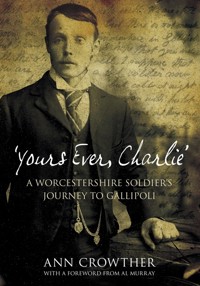
'Yours Ever, Charlie' is the fascinating account of Charles Crowther, one of many British men who volunteered to fight for king and country in the First World War. When Charles volunteered he was almost forty-three and devoted to his family; this book demonstrates how his and an entire generation's sense of duty to the nation overpowered their fears of fighting abroad and, for many, the possibility of never coming home. Charles' granddaughter explores his journey from the idyllic village of Wilden, Worcestershire, to the battlefields of France and then Gallipoli, where he was fatally wounded. Using the fluent, vivid and moving letters sent home to his family, together with the few replies that ever reached him, this book reflects upon Charles' ideals, the people who inspired him, and those whom he loved and was fighting to protect. Illustrated by rare photographs and original letters, and with a Foreword by Al Murray which provides an overview of the ill-fated Gallipoli campaign, this book is a poignant reminder of how beneath the staggering statistics of the First World War lie innumerable personal and tragic stories.
Sie lesen das E-Book in den Legimi-Apps auf:
Seitenzahl: 138
Veröffentlichungsjahr: 2010
Das E-Book (TTS) können Sie hören im Abo „Legimi Premium” in Legimi-Apps auf:
Ähnliche



















‘Yours Ever Charlie’
‘Yours Ever Charlie’
A WORCESTERSHIRE SOLDIER’S JOURNEY TO GALLIPOLI
ANN CROWTHER
DEDICATION
This book is dedicated to the memory of my father Wilfred (or Tim, as he was almost universally known), a little boy who had to grow up too fast and become the family breadwinner at the age of ten. To his eternal credit he waived his own dreams and set out to get the best possible education for his four younger siblings, three of whom went to grammar school. His oldest sister, Marjorie, was an outstanding school student and was only prevented from going to Cambridge (or any other university or college) by the sheer lack of money. She qualified as a teacher the hard way, working long years before she was able to qualify, yet she was held in great respect far and wide as an inspiration, and eventually had a spell as Acting Headmistress of Wilden School, where she spent almost all her working life.
First published 2010
The History Press The Mill, Brimscombe Port Stroud, Gloucestershire, GL5 2QGwww.thehistorypress.co.uk
This ebook edition first published in 2013
All rights reserved © Ann Crowther, 2010, 2013
The right of Ann Crowther to be identified as the Author of this work has been asserted in accordance with the Copyright, Designs and Patents Act 1988.
This ebook is copyright material and must not be copied, reproduced, transferred, distributed, leased, licensed or publicly performed or used in any way except as specifically permitted in writing by the publishers, as allowed under the terms and conditions under which it was purchased or as strictly permitted by applicable copyright law. Any unauthorised distribution or use of this text may be a direct infringement of the author’s and publisher’s rights, and those responsible may be liable in law accordingly.
EPUB ISBN 978 0 7509 5431 0
Original typesetting by The History Press
Contents
About the Author
Acknowledgements
Foreword by Al Murray
Introduction
Part One
Chapter One: Wilden
Chapter Two: Why?
Chapter Three: France
Chapter Four: Devon
Chapter Five: Gallipoli
Chapter Six: Malta
Part Two
Letters
Selected Scans of Letters
Postscript
List of Names
Bibliography
About the Author
Ann Crowther was born in rural Worcestershire in 1938, growing up in the little village of Wilden. From early schooldays her twin passions have been music and history, and these were pursued vigorously at Sheffield University where she read Modern Constitutional History and Comparative Government while spending far too much time on various musical activities! After a brief period teaching history, Ann has spent the years singing and teaching singing. She lives on Merseyside with her husband, Michael, and currently juggles a busy voice-coaching practice, a prizewinning youth chamber choir, a University of the Third Age choir, and a somewhat fair-weather passion for gardening. She has one son and a small grandson.
Acknowledgements
I have been most fortunate to have had friends around me who have both encouraged me and helped in the gathering of information and in putting my book together; in particular, Richard Walker gave me some very sound advice when I first began. Maggie Herbert has been tireless in rooting out possible photographs and archive material, while Nicola Guy of The History Press has been a huge support and patience personified. HarperCollins generously allowed me to use a map from their 2009 road atlas, which should be useful to those wanting to pinpoint the various small places which feature in the text. Richard Cory, grandson of Canon W.H. Cory, has been a mine of information and has given me access to several crucial photographs from his family archive; chatting to him has been a wonderful way of jogging the memory. Elizabeth Bramhall has done a great job in paring down some very complicated maps in order to give readers a clear idea of the locations where Charles fought. I am indebted to Nic Harvey for his generosity of spirit in sharing some of his own researches on Wilden’s past, and for his friendship. I am also indebted to Mike J. Bourne and Arthur Jones for many snippets of valuable information about Wilden and some of the people in this book.
Jean Talbot of the Kidderminster Carpet Museum Trust Archive Centre has been tremendously helpful and has dug out some very useful material; she has also been a patient sounding board for lines of research. Like so many of the people who have helped me, she and her colleagues are devoted volunteers. My grateful thanks go to Colonel John Lowles and his fellow volunteers at the Worcestershire Regiment Museum Trust. Colonel Lowles has set me right over numerous problems of military detail, and has given me access to Captain H. FitzM Stacke’s seminal account, The Worcestershire Regiment in the Great War. He also gave me permission to use three precious photographs of the Worcestershire Regiment in Gallipoli. The wonderful photographs of the Wilden Church windows come by courtesy of photographer and artist the late Ray Carpenter, my childhood friend and one-time Head Boy of Wilden Church Choir under Harry Oakes. Ray very generously made those and two of his paintings of Wilden available to me, and filled in some vital small details.
Lovely Al Murray produced his excellent foreword within a week of being asked, despite being at the beginning of a gruelling national tour (Al is godfather to Charles’ great-great-grandson). My grateful thanks go also to Tony Higginson of Pritchard’s Bookshop in Formby, on Merseyside. He has been my creative writing and world of publishing guru, my unofficial agent, my tower of strength and my friend. I owe a huge debt of gratitude to Earl Baldwin of Bewdley, great-grandson of Alfred Baldwin; he graciously allowed me the use of a drawing and two photographs from his family albums. One of the photographs is of my great-grandfather, William, and is the only verified one in existence, which none of my family had ever seen until now; this has been a real treasure trove! I am hugely appreciative of my cousin, Sue Gardner’s support; she has borne many hours of listening to my obsession, and has been my companion on many quests for information. Like me, she is Charles’ granddaughter. Finally, my undying thanks to my husband Mike, who has scanned letters, sharpened photographic images, proof-read, and generally made the work of this IT rookie rather more professional.
I very much hope that there will be a knock-on effect upon the Worcestershire Regiment Museum Trust, on Wilden Church, and on the Kidderminster Carpet Trust Archive Centre. All three are served by devoted volunteer staff without whom they would not survive.
Foreword
by Al Murray
The First World War is an event that, as it becomes more distant from us historically, becomes clearer to see, yet even harder to understand. That it was the catalytic event of the twentieth century and that we are still living with its consequences is without doubt. Debate about how it began, how the world was tipped into a chasm of unprecedented slaughter goes on; how politicians let go the reins of order and let loose chaos has been the subject of nearly a century of discussion, but at its heart lie many compelling mysteries. If it is true that the war was the greatest catastrophe to befall the world, why was it allowed to continue? If the war was Europe’s first great war fought by entire populations, fought by ordinary men, why did the ordinary men fight even as they died in unprecedented numbers? Maybe one way to answer this is to perhaps ask, as best we can, the ordinary men who fought in the First World War, by reading their letters and their diaries.
In some senses the First World War has also gone beyond being a merely historic event, it has become an iconic cultural episode. It lives in art, film and music, in national self-perception. The Battle of Gallipoli – which is where Charles Crowther was wounded – is, rightly, seen in Australia and New Zealand as a central, defining moment in their national history, being the first time that the Australia and New Zealand Army Corps – the Anzacs – had fought. It is also a key moment in Turkish national history. However, it is often overlooked that twice as many British soldiers as Anzacs were killed in the battle, and that at the time the landings in the Dardanelles were viewed by many as a daring and essential operation to speed up an Allied victory.
Conceived by Winston Churchill, the First Lord of the Admiralty, the landings at Gallipoli were intended to knock Germany’s ally, Turkey, out of the war by capturing Constantinople (now Istanbul) and secure a sea route to Russia. As the war had become static on the Western Front with both sides stalled and dug in, Churchill became convinced that the deadlock could be broken on the periphery and that Turkey’s enemies, Bulgaria and Greece, would be drawn into the war on the Allied side. The landings were delayed, giving the Turks time to prepare their defences. From April 1915 through to January 1916, the Allied troops clung onto their beachhead, the fighting fierce throughout, with the casualties amounting to around 42,000 Allied soldiers killed and another 97,000 wounded. The Turks lost even more. When the Allies withdrew from Gallipoli they did so in abject failure – Churchill’s political career was virtually ruined and Turkey remained on the German side.
That’s the broad picture, but for each of the men there was their personal, individual experience. Amidst the mind-boggling numbers from the First World War, it can be easy to forget each of these men, their family and their friends. This book is about one of these men, his family and his friends as he makes his own, ultimately tragic, journey through the war. It perhaps takes us closer to understanding why men went to war, what sustained them in unimaginably hard times, and how they thought they were doing the right thing.
Al Murray: comedian, historian and presenter of Al Murray’s Road to Berlin.
Introduction
The inspiration for this book sprang from the letters which my grandfather, Charles Crowther, wrote to my grandmother, Dora Kate, in the latter part of 1915 and January 1916, as he made the swift transition from a wounded, over-age soldier in a reserve battalion to a front-line infantryman in a replacement battalion fighting in Gallipoli. As I pored over the letters, which contain so many references to family, home and village life, I began to feel the need to expand my canvas; here was a chance to reveal the whole man and attempt to understand why loving family men like Charles actually volunteered to go to war in 1914.
Charles was the second of seven children in a close and devoted family. He was born in 1871, a year after his parents moved to the little Worcestershire village of Wilden, almost halfway between Kidderminster and Stourport-on-Severn. Before the move, generations of Crowthers had lived just across the Severn. His mother, Eliza, came from a Herefordshire family, the Lippetts, who farmed land near Leominster. At the age of twenty-one, Eliza went to work as a cook for an affluent Worcestershire farmer near the village of Shrawley. The farmer also employed a personable young groom called William Crowther. The two soon fell in love and were married some years later. William’s family lived in Shrawley and had connections with three of the other villages which circle the great house of Witley Court at Great Witley, namely Astley, Martley, and Pensax. It was a hugely fertile farming area, which provided a great deal of employment both in field and house.
Ambitious and hard-working young people like William and Eliza, doing their sort of jobs, were constantly in contact with merchants, rich farmers and industrialists who had good work opportunities to offer. Their big opportunity came around 1864, when they met Alfred Baldwin, a young man who was their own age. From that moment Eliza, William and Alfred were bound together for the rest of their lives, and soon they were to include Alfred’s wife, Louisa Macdonald, whom he married in 1866, at which point Eliza and William went to work for Alfred. William remained employed by the Baldwins for fifty-seven years, until he died in 1924. Ties of affection and mutual respect continued between Alfred’s son, Stanley (a future Prime Minister), and William’s children. Much later, William’s granddaughter, Marjorie, was an indefatigable constituency worker for Stanley during the latter part of his political career. William’s son, Charles, was a pall-bearer at Alfred’s funeral, and Charles’ son, Wilfred, was a pall-bearer at Stanley’s. Duty and readiness to be of service were driving forces in lives such as theirs.
Charles was fatally wounded at Gallipoli on 29 November 1915, just before the evacuation of British troops began. He was taken by sea to Malta where he was nursed in the Royal Naval Hospital at Bighi, above the village of Kalkara. By the beginning of February 1916, he was dead, leaving a widow and five small children, aged from five months to nine years old. He never saw the baby, Louisa. He was buried with full military honours in the Royal Naval Cemetery at Bighi.
Before he was sent to Gallipoli, Charles had already fought and been wounded in France early in 1915. For his efforts during that fateful year he received the 1914-15 Star, the Military Medal, the Distinguished Conduct Medal and the Silver War Badge. He was also ‘mentioned in dispatches.’ According to my father, nothing came of a proposed medal citation for bravery because all his immediate commanding officers were killed; I suspect that this is true of many reports of bravery. It has been very difficult to trace his movements in France; the Battle of Aubers Ridge where he was probably wounded was a catastrophe amid massive confusion, and his name does not appear on the Worcestershires’ list of wounded. I have had to make some guarded assumptions about what occurred.
I have always had a head full of family history. My father, Wilfred, never really came to terms with the death of the father he worshipped, and talked endlessly of him and of family and friends in the past. I remember as a child being hugely embarrassed on Remembrance Sundays when he would stand in church, crushing me to his side, weeping as Bill Calcott dipped the British Legion flag in front of the War Memorial plaque. How little the young understand! Later on, as a teenager, I came to find Remembrance Sunday services intensely moving and it was always a struggle to keep singing to the end of ‘O Valiant Hearts’. To my father it was always like yesterday, with vivid recollections. Thanks to him I have been able to build up a picture of Charles, my grandmother and their life. My father’s love for my grandmother was deep and sometimes almost reverential; I never once heard him refer to her as ‘Mother’. To him she was always Dora Kate. Dora Kate was indeed a very special and stately lady. One uncle (my mother’s much younger brother) remembers meeting her as a young boy and being ‘scared stiff’ of such a dignified person; she died when I was six, but I still have fleeting memories of a warm, loving grandmother with a big jar of mint imperials under her bed.
The most amazing thing about assembling this book has been the jigsaw effect as snippets of childhood memories and my father’s inexhaustible fund of family anecdotes slotted themselves into little gaps which I had not expected to fill. So many fragmented pieces of information, dormant in my head for most of my adult life, finally erupted and made sense. I think my father’s wide knowledge of family background was largely due to the amount of time he spent with his grandfather after the death of his father when he was nine. William’s duties were light by then, and he had plenty of time for Wilfred. Dora Kate’s brother-in-law, William Bourne, was also very influential, because Charles had been his best friend, and he loved to talk to Wilfred about him.




