


7,49 €
Mehr erfahren.
- Herausgeber: tredition
- Kategorie: Sachliteratur, Reportagen, Biografien
- Sprache: Englisch
In this autobiography, Dietrich Schaefer presents his life in two parts, both of which were closely connected to the Seven Seas and international seafaring. Beginning with the character-building escape from East Prussia during his childhood, then the difficult times as a refugee in post-war Germany, he uses humor and many scintillating tales to illustrate his career in the German shipping trade — from cabin boy to captain. He provides the reader with enthusiastic accounts of his travels throughout the world, to all continents and 118 countries. Tirelessly, he constantly tried to make contact with people to find out what they think and how they feel. His numerous excursions provide the reader with interesting facts about countries, the people, and their history. In this way he combines historical background and current day politics from the past six decades. In 1979, his time had finally arrived and he accomplished his often imagined dream of starting his own company. His astounding level of creativity as well as willingness of taking risks, which oftentimes resembled daring exploits, repeatedly resulted in his company finding itself on the edge of an abyss. It took a while until the company eventually became profitable, as well as incurring many debts along the way that had to be repaid. Much later, Dietrich Schaefer was inspired by a new business idea, which resulted in his company gaining international recognition within a few years. Ever since then, the company has been and still is a driving force in the shipping industry. Dietrich Schaefer's autobiography is much more than just an account of his life and his excursions will force readers to think. Perhaps it is difficult to imagine, but maybe one day there will be a world where no more wars are fought. It could have happened: A fiction where a bullet killed Adolf Hitler.
Das E-Book können Sie in Legimi-Apps oder einer beliebigen App lesen, die das folgende Format unterstützen:
Seitenzahl: 647
Veröffentlichungsjahr: 2015
Ähnliche


















Dietrich Schaefer
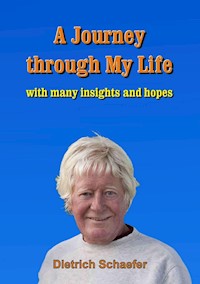
A Journey through My Life
with many insights and hopes
Copyright: © 2014 Dietrich Schaefer
Translation by: buchuebersetzer.webs.com
Cover Design: Erik Kinting
The work and all its parts are copyright protected. Any exploitation is prohibited without the consent of the publisher and the author. This is especially true for copies, electronically or otherwise, translations, dissemination, and making publicly available.
The German National Library lists this publication in The German National Bibliography Library; detailed bibliographic information may be found on the Internet at: http//dnb.d-nb.de
My dear Püppi,
I will never understand why you stood by my side for nearly four decades. With your sunny disposition and understanding, you turned even the darkest periods of my life into joyous times. I thank you for that.
The following pages are dedicated to my parents.
Table of Contents
Foreword
My First Life
January 1938 to October 1944: Carefree time in East Prussia
October 1944 to May 1945: The escape and the end of World War II
May 1945 to May 1955: Karlshof, Lübeck, School
May 1955 to July 1959: Maritime school, the PASSAT and other ships
1961, Officer’s license at the maritime school in Lübeck
1961-1964: 3rd and 2nd officer at HAPAG
1965 Maritime academy in Lübeck - master mariner certificate
August 1975 — the end of my seafaring time as 1st officer.
My second life
From Seaman to Businessman
1985 to 2004: Mine and Püppi’s wedding, as well as more successes
A special digression
Foreword
Please keep in mind I was not even seven years old when we had to abandon our property in October 1944. My sister was already a teenager that first year and my two older brothers were almost there. Therefore, the memories and feelings of my parents, my siblings, as well as mine, might differ slightly from one another.
During my early childhood years, Wofkas (a small hill) looked like a mid-size mountain, the nearby gently flowing Angerapa seemed like a raging river, my horse Ivan looked as big as the Trojan’s horse and many small homes appeared to be huge estates. With advancing age reality gained the upper hand.
The account of my journey is authentic, unembellished, and realistic, as well as reports of some wrong and rather costly, yet also correct and wonderful decisions that were simply part of my life. The interspersed digressions are real, yet the tale about Hitler is fictitious and merely a belated dream of mine, which, unfortunately, was never fulfilled.
Dietrich Schaefer
The most dangerous of all philosophies is of those people who have never seen the world.
Alexander von Humboldt
My First Life
January 1938 to October 1944: Carefree time in East Prussia
I actually recall the first years of my life in our beautiful home in East Prussia (now called Kaliningrad Oblast) quite well. Our property was located between Insterburg (now called Chernyakhovsk) and Gumbinnen (now in Russian Gusev).
Obviously I cannot remember my baptism since I was not even one-year-old at the time. Unbelievable, but this event that was special to my parents, my three older siblings and to the rest of the family, occurred 72 years ago. Looking back, I recall one or another situation during my life and I have come to the conclusion that I have led an interesting, eventful, and ultimately successful life, experiencing wonderful ups and terrible downs. For a long time now I have wondered whether I should put on paper my life’s journey, together with its detours and excursions. These have little to do with me, yet they interest me. So, I’ll give it a try — step by step.
My parents already had three children who turned out well: one daughter with the beautiful name Helene. She was and still is the big sister. Then there are my two brothers, Erich and Hans. So then I, Dietrich, the baby of the family, as everyone was so fond of saying, finally saw the immense and endless sky above East Prussia. By the way, my big sister still teases me, her youngest brother, about being the baby of the family at every opportunity, appropriate or not.
One summer, I think it was 1941, the great one had saved my still young life. It happened as follows: Near our property ran the Angerapa, a medium size river. Our family had a spot where we often walked during the summertime to go swimming and cool off. My siblings splashed and played in the river, which to me, being only about 1,000 days old, seemed mighty powerful. Yet I wanted to have fun too, so I cautiously walked on tiptoes into the water. Quite interestingly, to this day I have not managed to break this habit when going swimming. Perhaps other people fare the same? Since I did not care much for my older sibling’s exuberant and joyful way they splashed each other, I went in search of my own private spot. Without warning, I felt as if I was stepping onto a cloud and my feet sunk into a deep hole in the river’s bed. The water closed over me, but I still heard the shrill cry of my sister, who quickly grabbed hold and pulled me back to the embankment. Oh, Sis, I will never forget this. Quite naturally, my mother gave me a stern warning to never go exploring our swimming area by myself. “Yes, Mommy, I will never ever do it again,” I replied. Yet nowadays a youngster might say: “You should have kept better watch and then nothing would’ve happened.”
One time our parents were out socializing and therefore not at home for several hours. Eventually, Erich and Hans became bored. Those two, who may have been six or seven years old at the time, took an exploratory tour of our farm. There were stalls for cows, horses, pigs, and chickens, even a forge, as well as a barn for grain storage and straw. Naturally there was also our house and the so-called Insthäuser for the workers and their families. These blockhouses were divided into eight to ten apartments, which I would describe as the forerunner of today’s row houses. And then there were another one or two other small houses belonging to our farm.
My two brothers armed themselves with small pellet rifles in order to give the numerous rats hell that ran unchecked in the pigsty. Adjacent to the pigsty was a garage where our big Mercedes was parked. Due to the war back then, gasoline was in short supply for the civilian population, so my parents always drove our little Fiat.
The pigsty was an old wooden building filled with cobwebs. Mice and rats lived there together in harmony. From time to time, my father went rat hunting. I vaguely remember he was never successful at completely eradicating the rats, there were simply too many of them since the adults breed eagerly. They reproduced at such a pace that you basically could not keep up in sending those, in my opinion, repulsive creatures to the afterlife. Anyway, I have no explanation for it, perhaps my two brothers don’t either — but on that day everything was different. Those two waited and waited, yet not one rat showed up. What a disappointment that had been, after all, they had intended to outdo our father and put an end to the rat infestation.
So, after a long wait, Erich and Hans obviously felt discontent and boredom prevailed. They searched for something else to entertain them. Back then every boy had all sorts of interesting things in his pockets and it didn’t take long before Hans found a box of matches in his infinitely deep pockets. (They might have been from our last smoking party where we puffed cigarettes rolled from dried chestnut leaves). And what do you know — the cobwebs begged to be set aflame. Since it was unknown if they would actually burn, it obviously had to be tried. But then again, it is only normal for a person to gain experience, preferably sooner than later, otherwise they cannot progress. This is still true today. So, my brothers gained a new experience; cobwebs actually do burn. They assumed so, but of course an actual test was simply more fun. And so to their delight the cobwebs turned into a real fireworks display. The pigs squealed in all kinds of pitches and hopped frantically around their pens. We never knew whether they did so out of joy or fear of an unexpected barbecue.
Thank God my parents came home at that moment.
Forewarned by our big sister, they saw imminent doom. I don’t know whether the two arsonists received an actual beating or whether it was due to the smoke. There definitely were plenty of tears, which helped in conjunction with a few buckets of water, to extinguish the fire while it was still small. How does the saying go; all’s well that ends well.
Thus, two experiences could be noted that day: cobwebs actually burn and enough tears at the right moment in the right place spares the fire department.
I do not remember exactly how many rooms our farm house had, which really is not important, but it did have the so-called great room. It was only opened and used on special occasions with Christmas being the predominate one. Baptisms and birthdays – after all, there were four children – were also held there. From time to time company was also entertained there.
Yes, it was a special room that we, when it couldn’t be helped, crossed on tiptoes with a bad conscience. Granted, this sanctuary was never locked, but this room definitely exuded a special aura.
Once a year, Aunt Adda came for a visit. She was a seamstress, a nurse, a consoler, a listener, and a counselor for all situations and concerns. She was a great woman — yet she seemed ancient to us kids, although she was certainly no older than sixty. Most of the year she was on the road; she mainly came during summertime and helped us, especially with darning socks, mending linens, sewing on buttons, ironing, and many other household chores. She liked country life and we liked her. We were always miserable when she departed after only a few weeks.
I remember when she was outdoors, she always dabbed her teary eyes with a handkerchief. Back then, I thought she was crying, but it turned out that was not the case. She merely had dry eyes, so her tear ducts compensated by over-producing fluid. Unfortunately, it was too much. Her eyes were constantly teary, especially on cool windy days. Back then I did not understand, yet nowadays I suffer the same malady.
A beautiful, enormous apple tree occupied the garden. I still remember one crop of the many magnificent reddish apples with the beautiful name Cox Pomona. The next morning I discovered a beautiful, big red apple left up high in the pickedclean tree and I ran to my father to share my find with him, which only earned me a shake of his head. He did not believe me. Although I was not into gambling, I offered my father a bet, which he agreed to eagerly. Looking back, I don’t believe it was a coincidence. Perhaps it was an opportunity for my father to see how well his children paid attention.
“What’s the bet?” my father asked.
“Well, the forgotten apple,” was my immediate response — quite modest by today’s standards.
So, we walked to the tree in question and lo and behold, the apple was still where I had seen it. My father lost the bet. But the best part was; I was allowed to climb the tree and pick the apple myself. A Spanish bullfighter could not have been prouder.
East Prussian winters were incredibly harsh. They lasted quite a long time with lots of snow at extremely low temperatures, yet the air was generally dry and mostly clear. Management assigned a Polish mother and her son to live in one of the small houses I mentioned before. Her name was Luba and her son answered to the name Wofka. He might have been about fifteen years old at the time. Both were nice and hardworking people. Off to one side of our property, there was a slight slope, which looked steep to me, so of course sledding was on the program. The night before, Wofka prepared a woven basket by simply placing it in approximately ten inches of water so it could freeze. In the morning, he cut the basket from of the ice and what remained was a circular sled with a thick ice bottom.
He sat in the self-made sled as best as he could and started his descent. However, there was so much snow on the slope that it really didn’t work well. Nevertheless, he didn’t give up and tried and tried again. He obviously knew exactly what he was doing because he always used the same track and it eventually turned icy. Wofka sped down the slope at ever-increasing speeds. We four kids were amazed since it looked awfully risky. There also was no way to control the sled, causing him to spin like a top and laugh with delight. I know my older siblings never reached speeds like that on a proper sled. Unfortunately, I cannot remember if I took a ride on that spinning sled.
However, Helene was persuaded to take this little adventure. In my mind I still vividly see her braids whirling in the wind and her screams as she gained substantial momentum and a silly chicken tried to cross the icy track. Suddenly, feathers were flying everywhere. Blood splattered everywhere and turned the white snow crimson. Perhaps if back then we had established some traffic rules out in the country … the chicken might still be alive. The moral of the incident: Even simple things can provide fun, yet they can also quickly turn into a deadly weapon.
Since we lived on our farm far away from any villages – as well as cities – our parents had hired a private tutor for the older children. Her name was Schröder, Miss Schröder, as it was extremely important to her to be addressed in this manner.
I guess she was around fifty years old. In retrospect, I’m almost certain she insisted on being addressed as ‘miss’ in order to indicate she was still unmarried. Nowadays, a person would probably receive a surprised look, if not one filled with scorn, for daring to address a mature woman as ‘miss’. But, I believe the reactions of today’s women are quite logical.
Miss Schröder was a strict but fair teacher. To the chagrin of my siblings, she was a bit hasty when it came to using her littlestick, as she referred to it. She tried everything to turn them into Goethe, Einstein, Kant and Adam Ries. To what extent she was successful will be revealed in later life accounts.
One day, my parents were visited by a couple they had befriended. I believe they came from Gumbinnen, which is about seven miles away from our farm. Gumbinnen was a small district town with perhaps 30,000 inhabitants. The couple was invited for afternoon coffee, accompanied by idle chatter, or plachander, as we called it back then in East Prussia.
Everyone sat together relaxed, even we kids were present. Before the guests arrived, my mother inadvertently referred to the woman as a two-hundred-pound-charm in front of us kids.
Even though it might have been an exaggeration, she nevertheless was a handsome lady. While we were all sitting cozily together in a circle, my father said to Helene, “Perhaps you should go and sit next to Aunt Martha; be a little kind to her.” My sister glanced at Aunt Martha, then turned to my father and said, “Our aunt is too fat.” Each adult’s face froze simultaneously, yet we kids found this little incident quite funny and we giggled while covering our mouths with our hands. Their visit didn’t last much longer for suddenly Uncle and Aunt were in a hurry to head back home. To my knowledge, this outspoken statement resulted in their friendship becoming a few degrees cooler.
It is quite amazing the havoc children can cause simply by saying it like it is. Unintentional and without malice, they merely say what pops into their heads. Thinking about it nowadays, it certainly wouldn’t hurt if one or more adults spoke with a child’s honesty. Above all, this especially rings true for many politicians. Is it really so hard to be honest? In essence, is telling the truth so much harder than telling a lie? It sure looks that way; otherwise we would hear the truth much more frequently.
Back in the day, having a wish list for Santa Claus, or at least a few wishes, was already common practice. The great one wished for a doll, Erich wanted something technical – he received a small steam engine that he still has today – and my brother Hans – it was already suspected he would eventually join the military – wished for the above-mentioned pellet rifle.
I, the one who would take over the estate according to the East Prussian law of succession, wished for a doll carriage and of course a doll. I am sure you can imagine how pleased and proud I felt when Santa Claus actually fulfilled my wish. What my parents thought about this strange wish from their boy was never divulged and to my knowledge it never came up for discussion either. I have never heard anything about it.
However, they talked about my derailment years later, but never in a bad way. One thing I know for sure, I never made the acquaintance of a psychiatrist, also known as a soul doctor.
I had loads of fun pushing my baby around our farm at whatever speeds I could muster. Unfortunately, it is unknown whether my facial expression equaled that of a happy young mother. My parents allowed me to play mother and child because they suspected it was only a phase and that I would soon get back on the right track. And that is exactly what transpired. By summertime I was done playing that game. The boy healed without the consultation of a psychiatrist. Strange, back then nature healed such illnesses. If you asked my girlfriends in the past, the overall answer would be: “The boy is okay; he has always enjoyed playing with dolls.”
I don’t quite recall the exact number of horses on our farm, perhaps it was around twenty because farming without that many back then would have been unthinkable. They were faithful companions on any farm. Each of us kids called one horse from the herd our own. These were not lean riding horses, but ordinary plow horses. Mine was black with a white marking on its right hindquarter. Even though I was incredibly young during the early ‘40 s, I was allowed from time to time to ride my Ivan. Seeing the world from up high on Ivan was an awe-inspiring feeling. We kids always had lots of fun when we sat astride the broad backs of our horses and I am sure the horses enjoyed it too. We especially enjoyed the Sunday sleigh rides our family took during the winters over snow-covered fields and frozen ponds.
Hanne was the senior and quite elderly filly. Her only duty was the daily transportation of our milk to the next dairy, located only a few miles away from our farm. Hanne had been a faithful workhorse all her life and we even took care of her when she could no longer perform her duty. I hope the daily milk rides provided her with some joy in her golden years. On one occasion, I was actually allowed to take the reins and drive Hanne and the milk cart. It was so much fun, but unfortunately it didn’t last long because at one point I pulled the reins too hard to the right and the cart, milk cans, and I almost toppled over. Oops, little Dietrich, you were lucky. It would have been quite a spectacle if cart and all had actually tipped over and an entire day’s milk ended up all over the road.
I’ve always tried to get something positive from negative events when they occurred in my life. What do I mean by that? Well, this could have been a devastating event for our farm, but then again we could have been the owners of a milky way. I bet no one has seen that before. Anyway, whoever my guardian angel was, I thank him with all my heart.
In July, when it was time to harvest corn, every available hand was needed. Nowadays, huge combines do the entire job and each one only requires one operator. The mighty machines do three things; cut, thresh, and blow. By blow I mean they transfer the threshed grain into a trailer with compressed air.
Once the trailer is full, which occurs at regular intervals, a tractor tows it away. In the early ‘30s and ‘40s, grain was still cut with scythes, requiring quite a few men. Working the fields went on for days — starting each morning when the sun was barely visible on the eastern horizon and only ending when the sun set and its crimson sphere disappeared on the western horizon. It was grueling work.
But then again we boys had quite a few happy moments, such as when we captured little gray field mice hiding among the sheaves of corn, which we then threw under the women’s skirts. Oh, I tell you, hearing the women scream and the mice screech was a lot of fun.
Digression
Many people observe the sun rising every morning in the east and setting every evening in the west. How does this come about? Allow me a brief observation that I hope doesn’t come across as a lecture.
The sun is by far the largest celestial body within earth’s solar system. It is, as we all know, our heat, light, and energy source. It is a wonderful, life-giving body, which actually should be greeted each morning with a prayer of thanks — granted, even I don’t do it, but the sun definitely deserves it.
Like most celestial bodies, our earth is round as well. While it moves from the west to the east in 23 hours and 56 minutes, it rotates once on its own axis, which it has probably done since its creation. Let’s imagine that nature’s laws do not apply to earth any longer and it stops spinning. The speed earth rotates at is almost 1030 miles per hour when measured at the equator. This is an unimaginable speed, especially if you consider the speed of sound is 770 miles per hour when ambient air temperature is 68 degrees Fahrenheit. So, assuming the earth actually stopped rotating, we would be in for apocalyptic consequences. Here are two consequences: First, all bodies ofwater such as oceans, lakes and rivers would immediately inundate earth’s surface with unimaginable force and completely destroy it within seconds. Second, any buildings or cities, no matter how large or small, would also be completely destroyed. Cities and bridges would all be submerged and life on earth would be wiped out.
End of digression
Back in the ‘30s, progressive landowners already owned machines to cut grain. They were considered state-of-the-art at the time. The cut stalks were bundled into handy sheaves and heaped neatly in piles alongside the rows in the field so the stems and ears could dry. The drying process required a few days and then it was time to bring in the grain. Everyone was needed for this. It didn’t matter if they were young, old, male or female. All available carts with two hitched horses were used to bring in the grain. My horse Ivan was also one. Two seasonal helpers waited for the sheaves of grain to be thrown onto the cart by the ground staff with pitchforks. This was exhausting work, especially on hot summer days. Sheaf after sheaf landed on the cart and after it was fully loaded, it seemed to me as if the pile could reach the clouds. For further processing, the mountains of bundled sheaves left the fields to be threshed in the barn.
World War II began September 1939. First, Poland declared war against Nazi-Germany, and later France and England did the same. Then, in 1941, the invasion of Russia started. We lived through this time and even had at certain times troops stationed on our farm, resting on their way east. Naturally, we kids always found that time exciting. All those tanks, guns, trucks, and other military equipment greatly impressed us. The soldiers happily told exciting stories to anyone interested.
Perhaps they had already been to the Western Front or simply passed along accounts heard from comrades.
The great one was already eleven years old in 1943 and was more interested in good-looking young soldiers, preferably one among the ranks of officers. I guess young girls are like that, yet over time that interest hasn’t changed much. Of course we boys were more into technology and asked the soldiers to explain how this or that equipment worked. This period was incredibly trying for Miss Schröder as we rarely abided by the given school lunch break since we were more interested in hanging out with resting soldiers. Distressed, Miss Schröder went searching for her three truant students. It was quite an undertaking and she was often unsuccessful. This was because the soldiers enjoyed hiding us little rascals and then made fun of stern Miss Schröder, which my siblings and I found quite amusing. However, Miss Schröder didn’t quit searching.
Armed with her little stick, she eventually succeeded and punished us scamps for our misconduct. Since I was not yet of school age, I thankfully escaped this painful punishment.
Time passed and I believe it was during the summer of 1944 when my parents received orders to dig so-called anti-tank trenches diagonally across our fields. Shortly thereafter convoys of workers appeared in our fields all armed with picks and shovels so they could dig up the soil. The trenches were around ten feet wide as well as deep but tapered off towards the bottom. In retrospect, I understand how the advancing Russian tanks had no problem crossing those trenches. Those war machines were so huge the trenches looked downright puny, thus making it easy for the enemy to continue their march west. I cannot believe someone high up in command thought he could hold off the Russian army in this way?
The war moved ever closer. When the wind blew from the east we heard now and then the distant rumbling and thundering of the approaching front cannons. An important objective of the Russian army was to reach and conquer Königsberg, and respectively, Pillau, which was a nearly ice-free Baltic seaport. My father managed to acquire a radio so we could listen to the latest news, though generally sugarcoated with German propaganda, on all war fronts. Yet we could clearly deduce that the noose around Germany was becoming increasingly tighter.
Occasionally we even heard and saw Russian planes flying westward. Each day became more frightening, especially when every so often bombs hit our land, sometimes even as close as the Angerapa River. Not one of the adults had an explanation for the bombing; our location was certainly not strategic or an industrially important area. Maybe some pilots had forgotten to drop a few bombs on their target areas and disposed of them on their return flight east. Anyway, it became increasingly more uncomfortable. I still remember that sometimes we kids asked our father to wave at the planes so they would simply pass over our farm. Yet, when another bomb landed in the Angerapa, the already mentioned Luba waded bravely and devoutly into the water, made a pouch out of her apron and collected the already dead fish floating on the surface because the pressure ruptured their swim bladders when the bomb exploded.
October 19, 1944. We received orders to leave our farm within the next 24 hours. The time had come — we had to leave our home. Our mother had already at the age of twelve in 1917, fled from the Russian Army back during WWI. Back then, her family made it all the way to Pomerania where they had to stay for a few months before being allowed to return to their homeland. So, when we had to flee our home in 1944 that experience came in handy, yet obviously we did not know if we would ever make it back. My father had been an aviator during World War I in the Imperial Air Force, so in a sense he never had the experience of fleeing his home.
Digression
Here is a story that ended tragically for our family: In 1914, when our father was in the German Luftwaffe, he had a serious accident during an official riding lesson — he suffered a fractured skull, which resulted in recurring and increasing heart problems. However, our father’s condition improved over the years and he was able to continue his service in World War I. At that time, his doctors advised him to apply for early retirement since they believed his service-related induced heart condition would worsen with age. But my father refused to heed their advice since he had been financially stable and was concerned about the economy, thus he didn’t want to needlessly burden the taxpayer.
After having fled our home and arriving in Lübeck in 1945, there was talk about the economy again because our family of six, like many other families, was faring pretty miserably. During our stay in the Karlshof settlement, which was part of Lübeck, we were poorly accommodated in two rooms. My father was unemployed, suffered heart disease and was responsible for the family, yet seeing our situation steadily becoming worse only aggravated his condition. So, letters were written and sent to the former authorities, together with testimonies of former comrades and doctors, requesting retroactive pension due to the riding accident. It was denied on the grounds that no application had been handed in when it occurred. The last sentence my father wrote in a letter in 1951 to the pension office in Lübeck stated: “Please take into consideration that my earlier reluctance to accept a pension was because at that time I was able to provide for myself and did not want to further burden the state, especially considering we had just lost World War I.”
My personal opinion on that event: In this day and age, would anyone not apply to receive their pension once they qualify, even though they could still easily provide for themselves?
Unfortunately, the former and today’s way of being responsible for oneself are worlds apart.
End of digression
Being ordered to evacuate our house and farm no later than October 20th, 1944 was a hard blow for everyone who lived there. This included my family, Miss Schröder, our coachman Paul, two maids – one of them was Frieda Schmidke, the name of the other one escapes me – and all the many farm hands and their families. Our dog Biene (Bee in English), a German Wirehaired Pointer, also seemed to be slightly irritated. The farm hands’ families were responsible for themselves and not everyone was willing to leave the farm. I learned later most of them succumbed to a sad and rather speedy end. There had been talk of executions by firing squads, people raped and being dragged off to Siberia never to be heard from again.
It was decided to have one of our carts, which until a few weeks ago had still been used to haul grain, pulled by four horses. Unfortunately, my old Ivan was not among them. This cart was frantically loaded with everything my parents, my siblings and all other passengers found important. Furthermore, our large Mercedes-Benz was loaded with valuables such as silver, gold flatware, hunting weapons, our cash box and jewelry. The small two-seater Fiat was stuffed with this and that and then hitched to the cart with my mother steering.
Although my mother had a driver’s license, she never drove a car by herself, let alone sitting in one while hooked with a chain to a horse-drawn cart and towed.
My father had also thought about burying all expensive items; old tableware and various other items that seemed important to him and which could withstand the damp soil of our garden out back next to a large oak tree. Everything had been neatly packed and wrapped in oil-soaked sheets. That should be have been enough, after all, my parents believed we were coming back home soon. But as we presently know, their assumption was unfortunately wrong. Horses, cows, pigs, poultry and other domestic animals were released into the wild, which they were unable to cope with at first. Then we said goodbye to our farm hands and their families. I do not remember what happened to Luba and her son Wofka. Of course when the adults said their goodbyes, it was quite a scene. Even we kids felt that something was wrong and simply got carried away in the moment. Needless to say, we certainly didn’t perceive the seriousness of the situation as the adults did.
On October 20, around noon, we finally left our farm. We were quite a substantial formation and our caravan consisted of several vehicles, our big Mercedes with father and us four kids, then the actual cart followed guided by our coachman Paul along with the two maids and Miss Schröder. The small Fiat towed by the cart and which my mother steered brought up the rear. However, this set-up was but a mere snapshot because after a few miles my mother, entrusted with the Fiat, maneuvered it into a tree, which, unfortunately, was in her way. After a brief deliberation, it was decided to abandon the car on the roadside. That was the first setback. However, compared to losing our entire farm, this loss was relatively easy to endure. My mother simply hopped on the horse-drawn cart and our journey continued. Our goal was my uncle’s farm, my father’s brother, about ten miles from our farm.
Digression
Our father had three brothers. Two were killed during World War I — damn wars. How much unimaginable suffering have people all over the world endured because some war wasfought in their area! During the 20th century until present day in 2013, more than 200 armed conflicts have taken place all over the world, with about 120 countries involved, and some of them are still fighting. Fifty of those wars are still being fought today. What else needs to actually happen until mankind becomes reasonable? Suppose that perhaps 50% of the world’s population in 2013, which was just over seven billion, have warlike intentions. This comes out to a maximum of three and a half million. I am not saying these figures are accurate, but I want to point out that the vast majority of the world’s population wants to live in peace and feel safe. So, why do these people let themselves be used as cannon fodder? I would love to hear their answer. Now I imagine I am conducting a survey where I question all people on earth: “Are you for or against war.” Surely the answer will be obvious, just like the assumed figure above shows.
There are always people who send other people to war and let them die for their ideology. Above the round arch of Lübeck’s Holsten Gate, under which a former street led west toward the city, is a wonderful philosophical inscription. It is presently still displayed above the arch in large gold letters:
CONCORDIA DOMI, FORIS PAX
HARMONY WITHIN, PEACE WITHOUT
It is wishful thinking as well as a recommendation, both of which are quite imaginable. After WWII, the US proclaimed itself the police of the world and under the humanitarian pretext they intervened militarily whenever it was good for their own interests. Americans are delusional; they actually believe they are welcome all over the world. Actually the opposite is true — even if Mr. Obama, US president from 2008 until approximately 2016, recently said that Americans are loved all over the world. It is probably in a human being’snature to proselytize to others without any regard for loss and to disseminate his own opinion as the general belief, even if this can only be achieved by force.
For clarification: I am not talking about every American citizen (see the assumed 50%), I am referring to American foreign policy, which is a threat to humanity, that one day could very well end in disaster. It cannot be that so many countries – with the exception of Costa Rica and some other really small countries – constantly need to be improved according to their size. And it is certainly hard to understand that even the poorest countries have been improved, yet the people living there do so in poverty. There are also many countries receiving huge sums of foreign aid and it certainly looks as if the donor countries couldn’t care less what the money is used for. The donors might care where the money goes if it is perhaps used to buy weapons from industrialized countries. This never-ending practice has to end one day, preferably sooner than later, better yet today. Many of these countries repeatedly experience natural disasters such as flash floods, earthquakes, hurricanes, tsunamis and many other events where hundreds of thousands of people die. Again and again, huge sums are “begged for” all over the world since whatever respective government cannot provide for its people after disaster strikes, but then the received funds are used to buy weapons and as usual, no money is left to rebuild or to fight hunger in that country. In my opinion, this behavior must stop. An example: the UN could compel each country to establish reserves for just such emergencies or they can make a country pay a certain percentage of its gross national product into a common pot. What a nice thought; if only the United Nations had the power to enact this idea. But considering today’s existing power structure, it most likely will remain so for some time; only a good idea. However, if the UN could make certain payments a prerequisite so a country receiveshelp, perhaps it might be a reasonable approach.
It is no mystery why wars are always started. The reasons vary in nature. It might be that we humans are not as intelligent as we think. The unimaginable suffering caused by all the wars still does not seem to deter anyone from waging one. Examples are plentiful. Even Hitler was mistaken in his idea to form a thousand-year Reich with his large-scale war of conquest. It is well known what became of it.
End of digression
In this context, I remember how Miss Schröder – she was sitting on top the horse-drawn cart – abruptly cried out in despair and then whined teary-eyed that she had forgotten her picture of Hitler. The caravan, now shorter due to my mother’s encounter with the big oak tree, stopped to discuss her misfortune. My patient father unceremoniously offered to drive back to fetch the forgotten picture. What a grotesque situation that was. On one hand, there was the dramatic experience of having to leave our familiar surroundings and losing all our possessions as well as our house and farm and on the other hand, there was this ludicrous desire to save the picture of a failed dictator, not to mention the biggest criminal in the last century, from Soviet troops. When you talk to witnesses from that time, every single one of them had actually been against it. So, it begs the question … who voted for Hitler, considering everyone was against his agenda. However, it is true that Hitler came legally into power, or at least to some extent.
After a while, we caught up with the horse-drawn cart and my father handed over the picture to its happy owner. Miss Schröder enveloped the picture in her arms and pressed it fervently against her chest. Was she for real? Yet nowadays, I am convinced that Miss Schröder’s ardent gesture was how most citizens of the German Reich had felt. Anyway, Hitler’s picture made it possible for us kids and our father to see our farm again. I no longer recall the date or where Miss Schröder left our caravan.
October 1944 to May 1945: The escape and the end of World War II
We managed to reach our first goal that same day and saw our two cousins again, a boy and a girl we hadn’t seen in a long time. We had lots of fun playing with them again. Thinking back, I would say we had not really grasped the seriousness of the situation, not to mention what the consequences of losing the war would entail. We children were carefree and not troubled by what our parents worried about. Yet, that’s typical of children, which is also a good thing. In any case, it wasn’t the kids but the adults who tried everything to turn Germany into a pile of rubble, leaving behind an infinite number of dead and injured people. Yes, for us kids it was certainly an extraordinary and interesting commotion.
There had been repeated reports stating that the Russian troops were advancing rapidly in the west. Why? Well, because most had German troops bled to death and the rest felt exhausted as well as hopeless due to the many losses on the Eastern Front. Picking up bits and pieces from grown-up conversations, we kids realized that the situation was grim and that we had to move on again pretty soon.
I don’t quite recall how much longer we had stayed at my uncle’s farm, but thinking back now, I feel we actually stayed too long.
On the day we departed, we again heard a cry of despair, yet this time it came from our mother: “We have forgotten the bag with all our socks in it.” Without further ado, a horse was hitched to a wagon and my mother and the coachman headed off to retrieve the bag with everyone’s socks. It took them almost three hours to reach our farm. At the time it was already occupied by German troops – this time however, they were on their way back west, accompanied by thoughts that the war had probably been lost – compared to 1942 and 1943 when the German troops moved eastward, thinking they would win the war. What a grave mistake!
It had not taken long to find the bag of socks. When my mother went back outside, our farm rooster crossed her path and she immediately asked an officer whether it would be possible to kill the poultry-asset. The addressed officer didn’t hesitate long. He pulled out his gun, but – and this is hard to believe – he needed five shots to kill the bird. Now, we do not want to question whether the four missed shots were due to the rooster’s frantic attempts to escape or if they were due to the officer’s marksmanship. In any case, our ever-practical mother placed the rooster in a bag, hopped onto the wagon and headed back to my uncle’s farm.
However, now something else comes to mind; was the rooster killed so it wouldn’t have to live with Soviet soldiers and later on under communist dictatorship or was this bird meant to end up in our cooking pot instead of becoming a feast for the soldiers staying on our farm? It doesn’t matter; my mother did the right thing. And so, as it turned out, our mother was the last to see our farm.
Considering the hopeless course of the war, we should never have stopped and stayed in one place for long. Yet the little information we received still sounded positive and full of certainty of our victory. Needless to say, this was due to the fact that many official reports were based on falsities the supreme authorities passed on or no reports from the front had been received and all the talk was merely rumors. What other explanation is there? If the people had been told the truth, then we should have fled East Prussia three to four months earlier.
This would have saved many people from unimaginable suffering. But, back then it was even forbidden to leave the area and that ban was only lifted at the last moment. By that time, it was way too late for many and the Soviet army overran the people.
I cannot remember Dr. Joseph Göbbels’ speech, the acting Minister of Propaganda in Hitler’s Nazi regime, verbatim, but naturally I have read about it. On 02/18/1943 at the Berliner Sportpalast, he asked the masses, among other things: “Do you want total war?” When the thousands of attendees heard this question, they jumped up electrified, saluted in the Nazi fashion and screamed: “Yes, that’s we want!”, or something to that effect. This was followed by singing the German national anthem. Was this sad display actually the opinion of all German people? I definitely do not like to believe that it was true. Regardless, the question and the subsequent response made its way around the world. It was this question and the unanimous answer of the German people that was predominately on Allied troops’ minds.
Anyway, after some time we left my uncle’s farm and continued our escape west. Frequently, fighter planes passed overhead and tanks crossed our path. We also spotted plenty of dead or injured civilians and soldiers along some roads. This let us know we were traveling through areas that had already seen war. It definitely didn’t provide us with a good feeling.
I do not recall the exact locations where this took place, but I clearly remember the good friends we made in Pomerania, where we also stayed for quite a while.
Digression
It was an intense time. The Soviet troops, which we heard were responsible for the many atrocities taking place in the combat zones, were close behind us and in front of us was the hope to get as far west as fast as possible. One way or another, we always received news about the movement of the front line. Oftentimes, this was accompanied by detailed accounts of the Soviet soldiers’ nasty behavior in recovered areas or on German soil. However, I find all the plaintive noise back then uncalled for because who was responsible for starting World War II, certainly not the Poles, the Brits, the French, the Dutch, the Belgians, the Soviets, or the Americans, no, it was the GERMANS! In the early years, who shot civilians in occupied territories without blinking an eye, the Germans! Who murdered, or better said, gassed millions of Jews as well as other minority groups, the Germans! I do not mean to drag my people through the mud, but these are valid questions for which there exists only one corresponding answer to each. Today, almost 65 years after the end of World War II, many Germans still repeatedly complain about the endless bombing of German cities by the Allies. Why do they do that? If the Germans would have had the opportunity they would have done the same. Anyone believing the contrary is wrong and disregards the facts. The Luftwaffe made many attempts to transform English cities into ruins.
End of digression
The winter of 1944/1945 was bitterly cold and the car we four children and our father drove had no heater. We always canvassed the road far ahead and did everything so that the horse-drawn cart transporting my mother, Paul and Frieda – the second maid had left us by then – could make good time. At times, the roads were incredibly icy and snowdrifts made our progress even more difficult.
Our mother had taught us kids knitting, perhaps so we would have something to do and at the same time keep our fingers from freezing. I’ll never forget her instructions: “One right, one left, one drop.” This must surely be the simplest knitting pattern. Anyway, it didn’t take us long to get the hang of it.
Thinking back, it was definitely a good distraction and a way to stay warm.
When I think about my mother and the other two, not to mention our dog Biene, all sitting unprotected on top of the horse-drawn cart in the freezing cold, they certainly had much more to endure. As I said previously, we always drove far ahead so we could set up quarters at a prearranged place.
All of us were always fairly anxious when we arrived later at one of our stops than we had planned. In retrospect, I have great admiration for my mother: At the time of our escape she was around forty years old, and of course back then there were no mobile phones for monitoring or discussing current events (I only mention this for the younger generation who nowadays cannot live without their e-mail, cell phones, Internet, Facebook, and whatnot, just so they have an idea of how things were back then).
Once the war was over, I read many accounts about escapes from the east, as was well as watched movies and listened to the stories told by adults. Each of the refugees had made it on their own and each individual talked about their own personal experiences and problems. All accounts were similar, some more so than others. Only one aspect remained a constant … the fear of getting caught in between the fronts – because then there was no escape – either they would have been captured by the Soviets, starved, or froze to death. When I compare our caravan to all the others’ fates, we actually did quite well. It is still a mystery to me as to how our father always managed to procure fuel for the car. I’m almost convinced my father possessed some kind of open-sesame-letter from some authority and it was the reason we received plenty of help here and there. It might also explain why our car wasn’t confiscated by those in charge. I am still amazed by this. Furthermore, I now regard my father’s decision to not take the escape route over the frozen Vistula Lagoon and Baltic Sea as wise.
Thousands of refugees tried this route, some had carts like ours and some pushed a stroller, yet many suffered the terrible fate of drowning in the icy water. Someone estimated that 300,000 refugees died — and that number only applies to this one escape route.
I mentioned earlier that my mother had already fled once from the Russians in WWI when she had been ordered to leave her home, which became our family’s home after she married our father. The place we arrived at next was the same exact place my mother sought refuge as a child in 1917, and it’s where she stayed and waited until the war was over and she was allowed to return home. You always encounter strange situations in life. Anyway, my mother’s previous escape west ended here in Pomerania, however, this time it only provided a stopover for us. Who could have known that our entire escape would take 600 miles or so until we finally reached our end-destination in Lübeck.
Despite all types of secret weapons, word spread quickly that the war was probably lost or was actually lost already. We also heard about the carpet bombings of all the large cities, resulting in an infinite number of dead and injured.
Digression
Today, in 2013, when I visit those cities that had been bombed and compare them to pictures taken some 65 years ago, I have a hard time believing large parts of these cities were once rubble. Almost 70% of Cologne had been destroyed back then, as well as almost 54% of Hamburg, and Kiel, Lübeck, Bremen, and Dresden had not fared any better. It really seems miraculous to me, but the Germans accomplished great thingsduring the reconstruction of their country. Presently, I live in Hamburg and I find this big city to be one of the most beautiful in Germany. After the war had been lost, not to mention living through the terrible years, the Germans had not been robbed of their will to rebuild houses, infrastructure, and industry. On the contrary, they had hope again. Hope for a better life, hope for freedom, as well as hope for peace. In the years following the war, the term German ingenuity was invented and publicly announced worldwide. It was received in a positive way because the entire world was able to witness how a battered and demoralized population could pull themselves back up and rebuild their country. You could be cynical and look at it from a different perspective: The Germans had gained the necessary experience to organize reconstruction, should they lose the war, in the past. Still, I am convinced the rest of the world had to show the Germans some respect; who knows, perhaps they did so willingly. Yes, I know — the Marshall Plan. Granted, it was great and also necessary, but the will of the people to rebuild was nevertheless equally important. Add to this the concept of social market economy – meaning free enterprise – coupled with economic performance and assured social progress. Also, I am fairly sure it was not only West Germany, but also the rest of Europe that regarded reconstruction as a strong message to the Soviet Union in order to prevent communism from spreading to the eastern Atlantic. It was a pretty clever tactic by the US; after all, it ultimately protected them as well.
During the ‘50s and up to the ‘80s, the so-called Cold War between the East and the West had developed into a rather sensible relationship between NATO and the Warsaw Pact, yet it could have turned all of Europe quickly into a battlefield. There had been plenty of circumstances for such a development. Yet the Eastern Zone (East Germany), later the GDR, was left behind and ruled by the Soviet Union, just as the Federal Republic was ruled by the Allies (US, UK, France). But, therewas one big difference: West Germany was rebuilt and East Germany was dismantled. In East Germany, any still existing factories were disassembled, transported, and reassembled in the Soviet Union. Anything not nailed down or riveted in place disappeared into the USSR. And of course the GDR was not included in the Marshall Plan. Considering all the circumstances, not to mention living under communism, it never allowed the GDR to really overcome its postwar misery until its end in November 1989.
End of digression
We had another long stay in Western Pomerania, where friends of the family had a beautiful estate. I believe such a big estate house was called a manor back then. Nowadays, in my mind, I still clearly see the house, no, the entire estate, which resembled a castle, a venerable building surrounded by acres of woodland. Naturally we kids had many opportunities to play all types of interesting games. A beautiful lake also belonging to the estate was home to a variety of water birds. What a paradise. Our friends also wanted to bury valuables in the forest and we certainly wanted to help as much as possible. I remember some boxes were to be sunk into the lake’s bed.
In the spring of 1945 the lake was finally free of ice. Plants and trees took deep breaths and sprouted their greenery as they did every year. The frozen forest floor also thawed and our friends were then able to sink their valuables into the lake’s bed as well as bury some in the forest. The locations were all marked on diagrams. The entire process was quite exciting for us kids. Anyway, it was time for us to move on and so after a nice stretch in Zaren everyone became tense again. The next big milestone was supposed to be Lübeck. Along the way – I believe we had been on the road for about four days – we occasionally passed German soldiers, their vehicles, and antiaircraft guns and, as far as I remember, they didn’t look that organized any longer. You could assume only one thought was on their minds; please, just let me survive this somehow. Hitler shot himself on 04/30/1945, so the war is lost either way. This is the end.
Shortly before Selmsdorf, a town a few miles east of Lübeck, we suddenly heard the noise of propellers becoming increasingly louder in the far distance. An aircraft was approaching rapidly. I recall this incident thoroughly. The country road cut through a spruce forest where a German military convoy was camped as well as on the road. Father tried to somehow get us through, but unfortunately he failed and we became stuck in the middle of the convoy. What to do?
But before my parents had time to think, English aircrafts suddenly came in low and opened up with everything they had. Up until that moment, we had never been so close to the action. My parents grabbed us kids under our arms and scurried into the spruce forest while machine guns and cannons rattled incessantly. I do not remember if any German soldiers returned fire, but then again I didn’t know which weapon made what sound since I was still quite young.
Approximately 15 minutes later, an eerie silence took hold, but was repeatedly interrupted by soldiers yelling out commands as well as by the screams of the wounded. The attack was over. Our family, as well as Paul, Frieda and Biene, escaped without injury. Thankfully all of us survived the attack unhurt and in good health.
Slowly, step by step, we ventured back to our caravan. On the way, we encountered soldiers who were either dead, severely injured, or wailing and bawling like babies. Some of them even looked like children in uniforms. It was horrible. Then we saw flames in the distance, right where our caravan had been parked. When we moved closer we could see our Mercedes burning brightly, two of our four horses dead, and our cart riddled with bullet holes.
For us kids, the worst part was seeing the dead horses. Then our parents approached the burning car to retrieve our valuables. I had never ever seen my father cry except when he saw that sight. However, he quickly composed himself and scooped up everything out of the car he could grab. The silver, gold, hunting rifles, cashbox, and other valuables were saved.
My father risked his life performing this action because I suspect he had also packed ammunition. Who knows, perhaps it had already exploded. I don’t remember.
The hunting rifles were history and my father simply left them there. What else could he have done? On closer examination, my father noticed the cashbox contained only ashes. Now the realization set in that we were completely ruined financially. That dramatic day was May 6, 1945.
Digression
May 7, 1945. The war in Europe was finally over, thank God. Germany surrendered unconditionally. This was a dishonorable end to the war for the German Wehrmacht as well as for the general German population, but then again I also believe the Germans didn’t begin or conduct this war all that honorably. The biggest blemish was and remains the genocide of entire ethnic groups. Until that time I thought Germans were a cultured and civilized people, but the Holocaust was absolutely inexcusable. I was not surprised this turned the whole world away from Germany and that some other countries declared war on us during the last weeks of the war. Honestly, Germany didn’t deserve any better.
Unfortunately, wars have always been waged when people do not get along with each other, and that might never change. I imagine the Germans could have arrived at a more honorable truce if the Nazis had not fallen for this madness to criminally destroy an entire race. They were not completely successful, although millions fell victim to their systematic eradication.
Again and again, you read or hear that it was around six million. There will never be a correct accounting of all the victims. Be that as it may, it is now imperative future generations understand that if only one person is killed in such a way, is it without a doubt one too many. A country performing such deeds must be punished. This is my steadfast opinion. However, my opinion is that the Germans should gradually eliminate, generation by generation, the feeling of guilt. Today’s generation, as well as the next, cannot be held accountable, and certainly not the one after that because it was their great-grandparents who are to blame. Yet Germans must never forget and all future generations need to be enlightened about the atrocities that transpired in Nazi Germany.
Remembering, yes — holding accountable, no.
End of digression
I remember our caravan setting off for Lübeck the day after we experienced that catastrophe with only one two horse-drawn cart. We made it there the following day but my father had planned to push on through Lübeck and on to Kassel. Why, I don’t know. Unfortunately, it wasn’t possible since the only bridge, a bascule bridge, was in the raised position and guarded by British soldiers. Advancement was out of the question. The Brits simply prohibited anyone from going further west or south. So, we waited in front of the bridge, hoping it would eventually be lowered so people could cross. However, it wasn’t going to happen right away.




