


7,19 €
Mehr erfahren.
- Herausgeber: New Island
- Kategorie: Sachliteratur, Reportagen, Biografien
- Sprache: Englisch
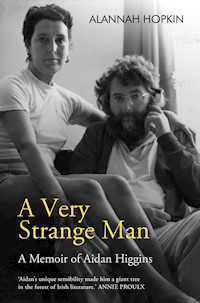
This is a love story, set in the Irish literary world between 1986 and 2015. When they were first introduced by the poet Derek Mahon, Alannah Hopkin was an arts journalist turned full-time writer and Aidan Higgins, twenty-three years her senior, was a literary stylist, often cited as the heir to Ireland's great Modernist tradition. They wrote steadily during their twenty-nine years together, but their careers could not have been more different: while Aidan focused on fiction and memoirs, Alannah prioritised work that paid the bills. This gave Aidan the most stable and productive years of his life. But as his eyesight failed and his memory began to fade, Alannah became his carer and had to fight to keep her own writing career alive. Drawing from diaries and notebooks, and correspondence with writers such as Samuel Beckett, Alice Munro and Harold Pinter, this is a unique record of a major Irish writer. From the joyful honeymoon years – filled with launches, festivals and visits to their Kinsale home by Richard Ford, Edna O'Brien and other literary legends – to the increasingly difficult years of Aidan's decline, Hopkin tells their story candidly and without commentary. She shows us how, in spite of all, they remained the best of friends, in love until Aidan's very last breath. A Very Strange Man is an exceptional piece of writing, objective and authoritative, personal, honest and moving.
Das E-Book können Sie in Legimi-Apps oder einer beliebigen App lesen, die das folgende Format unterstützen:
Veröffentlichungsjahr: 2021
Ähnliche


















OTHER BOOKS BY ALANNAH HOPKIN
Fiction and Short Stories
A Joke Goes a Long Way in the Country (1982)
The Out-haul (1985)
The Dogs of Inishere (2017)
Non-fiction
The Living Legend of St Patrick (1989)
Inside Cork: An Independent Guide (1992)
Eating Scenery: West Cork, the People and the Place (2008)
The Ship of Seven Murders: A True Story of Madness and Murder (2010; with Kathy Bunney)
On the Banks: Cork City in Poems and Songs (2016; editor)
A VERY STRANGE MAN
First published in 2021 by
New Island Books
Glenshesk House
10 Richview Office Park
Clonskeagh
Dublin D14 V8C4
Republic of Ireland
www.newisland.ie
Copyright © Alannah Hopkin, 2021
The right of Alannah Hopkin to be identified as the author of this work has been asserted in accordance with the provisions of the Copyright and Related Rights Act, 2000.
Print ISBN: 978-1-84840-793-0
eBook ISBN: 978-1-84840-794-7
All rights reserved. The material in this publication is protected by copyright law. Except as may be permitted by law, no part of the material may be reproduced (including by storage in a retrieval system) or transmitted in any form or by any means; adapted; rented or lent without the written permission of the copyright owners.
Samuel Beckett’s letter of 6 September 1951 to Aidan (Harry Ransom Center, University of Texas at Austin) on page 347 reproduced by kind permission of the Estate of Samuel Beckett c/o Rosica Colin Limited, London. Photographs are from the author’s collections, except where credited otherwise. All effort has been made to seek permission to reproduce images, quotes and text herein. Any breaches, omissions or errors should be made known to the publisher directly.
British Library Cataloguing in Publication Data. A CIP catalogue record for this book is available from the British Library.
New Island received financial assistance from The Arts Council (An Chomhairle Ealaíon), Dublin, Ireland.
New Island Books is a member of Publishing Ireland.
For Carl, Julien and ElwinIn memory of Aidan Higgins 3 March 1927-27 December 2015
Aidan Higgins is a very strange man.JOHN CALDER
I am consumed by memories and they form the life of me; stories that make up my life and lend it whatever veracity and purpose it may have.
AIDAN HIGGINS, Donkey’s Years
Long ago I was this, was that, twisting and turning, incredulous, baffled, believing nothing, believing all. Now I am, what? I feel frightened, sometimes, but may be just tired. I feel depressed quite often, but may be just hungry.
All but blind
In his chambered hole
Gropes for worms…
AIDAN HIGGINS, Scenes from a Receding Past
CONTENTS
Preface
PART I The Thunderbolt 1986–88
PART IIA Very Long Honeymoon 1989–98
PART III‘A Surly Fellow of Advanced Years’ 1999–2012
PART IVScenes from a Receding Life 2012–15
Afterword
Acknowledgements
Notes
PREFACE
This is a memoir of the years that I spent living with the writer Aidan Higgins. I did not want to write a biography, nor a work of literary criticism. I wanted to write the book that only I could write, an account of his life from the age of fifty-nine, when we first met, to his death twenty-nine years later.
Aidan was one of the great stylists of the late twentieth century, generally acknowledged as the true heir of James Joyce, Samuel Beckett and Flann O’Brien – a risk-taker, learned, jocular, bawdy, ironic, disdainful, unpredictable. He made up his own rules as a writer as he went along, abandoning the conventions of fiction for a multi-stranded form that combined autobiography, anecdote, letters, diaries, lists, quotations and essays in a whirlwind of words, the whole presided over by his authorial alter ego, Rory of the Hills. All his life he was obsessed by memory: ‘Is the memory of things better than the things themselves?’
My aim was to shed what light I could on the books and other pieces that he wrote while we were together, and to describe his working methods. I also wanted to record watching someone you love develop and live with dementia, in the hope that what I learnt from that experience might be useful to others.
I soon realised that I would need to read Aidan’s diaries and consult other papers of his that were now in the Harry Ransom Center at the University of Texas. Thanks to a fellowship from the Center’s Director, Stephen Enniss, I was
able to travel to Austin and do this. While we never read each other’s diaries and journals while he was alive, I felt that this was justified, as Aidan’s diaries are largely records of fact, rather than private thoughts, and some have in fact been published in full.
At certain points, to protect the privacy of other people, names have been changed. The course of the twenty-nine years that we spent together has at some points been simplified or otherwise altered in the interests of readability. This is not the place to look for hard facts, but I hope it does justice to a man who enriched my life immeasurably.
Alannah HopkinKinsale, Co. CorkNovember 2020
PART IThe Thunderbolt1986–88
Where to start? At the beginning, naturally, in 1986, with the thunderbolt – the coup de foudre.
I was thirty-seven, living near Kinsale, earning my living as a writer, sharing a house platonically with an amiable American piano technician and five cats. I had recently parted from Stan Gébler Davies, a fellow writer and journalist, originally the third member of our household, to whom I had, rather quaintly, been engaged. Somehow, in spite of the fireworks, we had remained good friends. I was happy with my work: having published two novels with Hamish Hamilton, I had recently signed a generous contract with another London publisher for a non-fiction book, and was supplementing my income by book reviewing. I enjoyed my independent life in the country, and did not miss London, where I had lived until 1982. I had a wide circle of friends in Kinsale, and several cousins, as it was my mother’s home town. I also had a couple of boyfriends, both Dubliners, who visited occasionally. After some turbulent times with a married poet (English), who broke my heart, and then with my chaotic on and off ‘fiancé’ Stan, who had an increasingly serious drink problem, I was glad not to be in love, to be footloose and fancy free, captain of my own ship.
My friend Derek Mahon had been awaiting the arrival of ‘Higgins’, his friend the novelist Aidan Higgins, for some weeks. After many years out of Ireland – London, South Africa, Berlin, Spain – Higgins was living in Wicklow. Seamus Heaney had told him that if he chose to return to live in Ireland he could be a founder member of an association of writers and artists called Aosdána, and the government would give him an annual income, a stipend known as the Cnuas, provided he dedicated himself full-time to writing. He was on the next plane, and after a quick visit to Dublin to seal the formalities and open a bank account, he headed for Wicklow, where his brother Colman was living.
Higgins was not happy in Wicklow. He was living three and a half miles from the town, and did not drive. His landlady, who had promised to be away most of the time, was instead in residence most of the time, making him feel awkward, crowded. He had no like-minded friends in the area apart from Colman and his wife Sylvia. Derek immediately solved his problem: he should move to Kinsale, a small town with twenty-three pubs and several resident writers, artists and other congenial, well-travelled companions. He gave Aidan my number, as someone who knew Kinsale well and might be able to help him find a cottage with a sea view at a reasonable rent. He rang me one evening. His voice was a pleasant surprise, what you would call an educated voice, more English than Irish, soft and gentle, a highbrow, ever so slightly superior voice, definitely the voice of a reader of The Times Literary Supplement, a man who would know a hawk from a handsaw.
Derek asked if I would help him to entertain Higgins, who was due any day. It was late October, but still dry and sunny. Kinsale looked gorgeous in its autumn colors, grey stone buildings against a blue sea. ‘He’s coming down by helicopter’ was the latest news from Derek, followed by
‘No sign of Higgins,’ and days later, ‘Still no sign of Higgins. And now they’ve cancelled the helicopter service.’ Another week went by. Stan rang to let me know he’d be back from London on Wednesday and invited me to dinner that night in the Captain’s Cabin. Minutes later Derek rang. Higgins was arriving on Wednesday, could I join them for dinner? I apologised, and said I’d see them on Thursday. We agreed to meet as usual in the pool at Actons Hotel around six o’clock.
I remember having wet hair after my swim, and being too impatient to dry it, suddenly curious to see what this Higgins looked like. Suppose, I thought idly, he turns out to be someone significant in my life, and his first view of me is of an otter-like wet head. I dismissed this uncharacteristic romantic thought from my thoroughly rational mind and headed for the bar.
And there he was, in a wine-red wool sweater, medium height and build, long reddish-brown hair, granny glasses, slightly stooped, engaged in close conversation with an enormous bear of a man called Sven. Derek must have made the introductions, I do not remember, but I do remember Sven’s handshake almost breaking my bones, while the touch of Higgins’ hand was like velvet. Neither Sven nor Higgins was entirely sober. Sven was a sea captain, Higgins told me in that extraordinary voice, who had killed a man at sea in the course of his duties.
Derek had chosen to dine at the Shipwreck, a new place just behind the hotel. He did not drink, so Higgins and I quickly agreed on a bottle of Rioja. The pizzas were the worst any of us had ever tasted, tomato gloop topped by processed cheese and ham. Derek knew Aidan and I both had strong opinions about the writer Malcolm Lowry. I listened to Aidan telling me the theory that his Canadian friend had about Lowry – that in Under the Volcano he had completely misunderstood the political situation in Mexico – and I liked the way he stood up for his friend’s insight when I contradicted it. Lowry’s fictional version of Mexican politics in 1937 is, in fact, totally accurate, and I had proved that in my MA dissertation. I liked the way he took me seriously, and didn’t flirt. Higgins ordered another bottle of Rioja, at which point Derek politely said good night and left.
We first kissed in the car park, and Aidan’s glasses fell apart. Mine often did the same, and I was able to retrieve the pieces and put them together. Aidan was struck dumb with admiration by my technical wizardry. I noticed that his eyes were hazel, exactly the same colour as mine. It was like looking into my own soul. The thunderbolt struck. I took his hand and led him to the car and drove the mile and a half home. We stayed in bed until the following afternoon, and did not see Derek again until the Saturday.
‘A nice pair,’ was his amused greeting, as we knocked contritely on his door. We had come to collect Aidan’s things. We were moving in together.
It all sounds so simple – fall in love, move in together. I remember the first few weeks with Aidan as a time of euphoria, but that is not what I find in my journal from the time.
Thursday, 19 November 1986
All this emotion. I should be happy, should I not, and instead I feel like bursting into tears of rage – because the house is such a mess and stinks of cat piss, not to mention the cold – because I’ve lost a day and a half’s work, and my whole hard-earned rhythm, because my concentration is absolutely shot – in short because I’ve met Aidan Higgins. An attack of cowardice perhaps, but also a long howl of ‘Do I need this?’ … Can I live without it?’ Certainly, get out quick is one reaction. The other is this terrible sense of things being pre-ordained, there is no escaping this fate … ideally he should go back to Wicklow while I finish the St Patrick book and get on with quiet, sane living. But I’m sure he can be quiet too, once he gets off this bender, and he seems to respect my need to work. Hell! I haven’t written a word of the book since last Friday. I have three weeks and a bit left before I go to visit my parents in London, thank God for London, it’ll calm me down.
Aidan’s Diary, 18 November 1986
Kinsale. Woke to raised voice, Mahon on phone to London. I left. Meet at Swedish Chef at midday. Pubs open at 10.30am. Into Armada. Mahon swimming at 7pm in new pool at hotel, meeting Alannah. Armada landlady English – London Irish. Child at bottle, I doze off before coal fire. Hours pass. Soup. Driven out by mixture of radio and TV news very loud. At hotel bar met Sven Jensen of Norwegian ship. Derek to pool – more bumping around than swimming due to smallness of pool he says. Bumperini. Sven a trout catcher. Watcher of fish. We are asked to move. Sitting when Derek returns. Then out of corner of eye, the femme fatale Alannah. Mixture of Hanne Vong and Nuala McAllister, old flames of yore. She had been swimming in the hotel swimming pool. I’d seen a photograph of her where she looked like an Italian lesbian (not that I have ever encountered one). The hair at the nape of her neck was damp; I thought she had something of the otter in her. She had the delicateness of a cat, something quiet and feline, the voice pitched low, no discernible Irish accent, certainly not Cork. Skin. Drinking red wine. Survives bone-crushing handshake from sailor Sven who wants to be marine biologist. Shipwreck wine bar for 8pm. Follow Alannah. Place run by Englishman Jeff and Galway wife. Music off. A kitten and a red setter by turf fire. Derek departs as others arrive. Three Spaniards, Angel and amigos. Banter in Spanish with Alannah. Buying lobsters for export. We drink at counter, Cuban cigars, out to car, undecided. Lens falls from left eye. Alannah fixes. Stay until 3am. Back to her place. House shared with 4 or 5 smelly cats and American piano tuner. Encountered already in Swedish Chef. Undressed her, she me. Say 4.00am. Long dalliance. Darkness.
The next morning, driving into Kinsale, I had a very strong flash of intuition about Aidan, which led to a firm resolution. I was not going to let him, or the affair, become the most important thing in the world. He was a new part of my life, but all the rest was still there too. I was much stronger than before. I had learnt how to live in the present, enjoying what I do now, without worrying about the future, long or short term. I was getting to know him better, and liking what I saw. But if he were to disappear, I would not be distraught or feel let down. We were just testing, that’s all, and very nice it was too. One step at a time.
A week later I moved out of the ramshackle house I’d been sharing with Tom Rourk and our five cats. It had started as a three-way rent share with Stan, whom we had evicted after a matter of days for being disruptive and uncooperative (less house-trained than the cats – they at least did not smoke slim panatellas in the bath). I felt shifty leaving Tom to pay the full rent after only a year, but it was a large house with four bedrooms, a short walk from the sea. I was sure he could find another housemate if he wanted to, and he was gracious about it. He kept my two cats for the time being, and I let him keep my furniture.
We were walking along Market Street a day later when it occurred to me to ask Aidan how old he was. I honestly had no idea. When he said ‘Fifty-nine,’ I thought at first that he was joking. ‘Don’t you mean forty-nine?’ In fact, he could have passed for thirty-nine. But it didn’t matter. If anybody had told me to think long and hard before getting involved with a man twenty-three years older than me, I would have told them to mind their own business. Aidan and I were obviously destined for each other, and what was a bit of an age difference in the face of true love? ‘Love is not love which alters when it alteration finds…’
Aidan and I found a simple apartment in town, two rooms, kitchen and bathroom under the eaves of a tall narrow house known as the Dutch House because of its front gable. It was across the road and up a bit from a ruined stone tower house, Desmond Castle, also known as ‘the French Prison’ since fifty-four prisoners had perished in a fire there during the Napoleonic wars. The front windows of the Dutch House looked up a hill lined with pollarded plane trees leading to a church called the Friary, while the south-facing back window had a distant view of the harbour. A side window in the kitchen let in the western light. We told the landlord’s wife, who was showing us around, that we’d take it. The rent was a very reasonable £340 a quarter, payable in advance – just under £25 a week. ‘What sort of a deposit would you like?’ Aidan asked. ‘A fiver will do.’
I worked on my book, known at that time as St Patrick and the Irish People, at a table in the bedroom, where I could close the door on the rest of the apartment. I had a large electric typewriter that hummed loudly, and the closed door also suited Aidan, who liked his silence. The typescript was due in mid-March. I had finished most of the research, and was now writing it up. Aidan nicknamed me the Great Patrician Scholar. I do not usually answer to nicknames, but I couldn’t resist that one.
Aidan gave notice to his landlady in Wicklow, and made a trip up by train to bring back his stuff. After more than two years living in Ireland, his ‘stuff’ consisted of two small suitcases of clothes, a manual typewriter and two cardboard boxes of books, notebooks and files. He travelled light, and left hardly a trace behind him. He was by nature tidy and unusually graceful, with small feet and hands. He moved around with the silence of a cat, and had the poise of a natural athlete. When young he had been a scratch golfer, and Captain of Cricket at Clongowes. After school he played for Phoenix, a well-respected Dublin cricket club. He often stood like a slip fielder, leaning slightly forward, hands cupped in anticipation. When he sat in an armchair with his legs crossed, reading, as he often did, he pointed the toe of his foot in an almost lady-like way. There is a portrait of his mother sitting reading outdoors in exactly the same posture.
In no time at all it seemed as if we had always lived together. There was an oddly continental feel to mornings in the Dutch House which began with a half-strangled cock crow that Aidan identified as a bantam cock. This was followed by tinny church bells and the cooing of pigeons. We enjoyed the ever-changing views over grey-slated rooftops to the harbour on one side, and the stone-built ruined castle keep on the other. We had to learn to negotiate the wooden roof beams, or eaves, one beside the cooker that made the kitchen feel like a ship’s galley, and others in the bathroom and sitting room. On rainy nights we liked to listen to the rain drumming on the roof as we lay in bed, both on our backs, like effigies of a knight and his lady on a medieval tomb, holding hands.
We were both by nature quiet, prone to long silences, and we both liked to read with great intensity. Neither of us wanted a television, and Aidan persuaded me to do without my bedside radio. He had a small one for rugby matches, but it was not up to music. If I wanted to, I could listen to cassettes on headphones. Both accustomed to living alone, we continued to keep to our own daily routines. I liked to go from bed to desk, with only a shower and a quick stand-up breakfast in between. Aidan was usually up before me, and would often leave his socks soaking in the hand basin, as if he had forgotten that I would be following him through the bathroom. I liked his high level of personal hygiene, but was puzzled that he did not remember that I would be using the bathroom next. Reluctant to set a precedent by washing his socks myself, I called out ‘Socks in the sink’ and waved my toothbrush at him. (Start as you intend to go on.) I had to go through the same routine several times before he remembered not to wash his socks until I’d finished with the bathroom.
Apart from the socks in the sink, he was highly domesticated. He insisted on sharing the cooking, and made a meal from scratch at least twice a week. This would either be spaghetti bolognese, pork chops or roast pork fillet. In Wicklow Town, where he did his weekly shopping, the butcher would greet him with a cry of ‘Here comes the pork fillet man.’ Together we kept the Dutch House clean and tidy. I assumed his awareness of the chores that needed doing and his willingness to pull his weight were the result of his years with his first wife Jill, and their three sons. He had continued living in the family flat long after the marriage was over, partly to help with the children: three boys, the youngest of whom was five in 1970 when they moved back to London from Spain.
He liked my habit of picking wild flowers on our walks and arranging them in vases around the house. We bought some dark varnish to smarten up the furniture, and some adhesive red gingham to brighten up the kitchen table and disguise the fridge.
Once I got to the desk, I stayed there for most of the day, working on the book, venturing out around five to buy food and wine, and maybe dropping into a pub on the way home for a sociable drink. The last post left Kinsale at 5 p.m., and if I was sending off a review I would often run into a fellow-writer at the post office, and go for a drink. Besides Stan Gébler Davies, the poet Robert Nye reviewed for The Times of London and The Scotsman. An American, Howard R. Simpson, reviewed for the Sacramento Bee, Derek Mahon reviewed for the Irish Times, among others, while the poet Desmond O’Grady and his writer and poet girlfriend Ellen Beardsley were also regulars at the post office.
Aidan had his own routines, often disappearing in the morning, and not reappearing until evening. Sometimes he’d be walking, getting to know the new territory, and sometimes he’d be amusing himself in one or other of the town’s twenty-three bars, or joining Derek, Tom Rourk and the blow-ins (as we call non-natives) who had coffee together in the Swedish Chef. There was Adrian Walker, an Englishman who had made a film about Antarctica that was narrated by Aidan’s hero, Orson Welles; Rourk was a notorious raconteur and lover of the outdoors, whose home town was Thoreau’s Concord; and Howard R. Simpson, a retired diplomat and military historian. The Spaniard, a spit and sawdust pub on the road to Summercove, was the lunchtime ‘office’ of Desmond O’Grady, a bibulous, well-travelled poet from Limerick.
Aidan had also made friends in a bar known as the Captain’s Cabin, a late-night drinking den in a back street behind Actons Hotel, known, jokingly, as ‘the bad part of town’. It was run by a colourful man orignally from Cornwall, Tom Menhennick, generally known as ‘Mad Tom’, and his beautiful but contrary wife, Miranda. It did not have a spirits licence or a beer licence, and was officially a restaurant. Mainly people bought wine by the bottle. Sometimes ribs or steaks were grilled over an open fire, but generally there was little food, and much drinking. Because it opened late, it was popular with staff from the town’s restaurants. Kinsale had more than half a dozen bistro-style restaurants, mainly run by owner-chefs, unusual in 1987. So the crowd in the Cabin, as it was known, tended to be well-travelled and cosmopolitan, exactly to Aidan’s taste. He enjoyed the banter between Tom and Miranda, June Pope’s lovely smile, and discovered a couple who had lived for a while in Nerja, where Aidan had lived in the 1960s. There were the Spanish lads who were trading in lobsters, a Breton fisherman, Jean Marie, who both caught and exported shrimp, and the big blonde, Pat O’Mahony, a larger-than-life character who lived a couple of doors away in a house called Foxwell (try pronouncing that in a Northumberland accent). Pat, like many people who gravitated to Kinsale, was a versatile worker. She could run a restaurant as chef, manager, waitress or all three, and she was also a hairdresser. A plain-spoken woman, she told Aidan his beard needed trimming and his hair was a disgrace. She would come over the next day at five.
‘How do you know where we live?’
‘Everyone knows where you live, darling. The love-birds of the Dutch House.’
She took me on too. I’ve always hated going to the hairdresser, so it was a treat to have someone come to the house, much more fun than the salon ritual, and also much cheaper. Every six weeks or so we were ‘tidied up’ by Pat at home, with the bonus of a full briefing on the latest town gossip over a glass of wine.
Aidan had been working on a new radio play, Assassin, based on the assassination of Archduke Franz Ferdinand in 1914 by Gavrilo Princip. Now the Abbey Theatre was showing interest in a stage version of the script, and he was corresponding with the Abbey’s director, Vincent Dowling, about this. He was also tinkering with a couple of stories.
There was a coin-operated payphone in the hall of the Dutch House which we shared with the occupants of the two other apartments – Stan Gébler Davies on the ground floor (Kinsale is a very small town) and a musician called Frank Buckley in the middle. Frank made wine, and a great waft of fermenting matter belched out of his front door whenever it opened. He had a piano in his apartment, and gave private lessons to beautiful young singers. On weekdays he taught music in the local school, and on Saturdays he conducted the music for weddings and on Sundays the church choir. No wonder he was usually seen running, briefcase in one hand, car keys in the other, coat tails flying out behind him as he made his way from one engagement to the other. Aidan noted in his diary at this time, ‘Buck leaping downstairs humming “Where the mountains of Mourne sweep down to the sea” after thirty minutes piano of same.’ Frank also composed, and there was always a pile of hand-written music manuscripts behind the front door, as if Haydn had been working on his symphony.
On Wednesday 3 December, soon after moving into the Dutch House, we began a Scrabble tournament. We played every evening around six, and Aidan kept a record in hardback school nature notebooks of every word played in every game. He won the first one by a respectable thirty-one points. We were well-matched, but I had the edge on him for vocabulary due to my interest in gardening, cooking, sailing and horses. We were competitive, but agreed not to become Scrabble bores and memorise lists of unusual two-letter words. Rather than consulting the official Scrabble-players’ dictionary, Chambers, our authority was my two-volume Shorter Oxford Dictionary, because it was what we had in the house. If a word was not found in the Shorter Oxford, it was not allowed. The game was usually over in an hour, but sometimes it could last longer, which tried my patience. Before meeting Aidan this time of day had been reading time. But Aidan obviously relished the ongoing Scrabble rivalry, so it seemed churlish to refuse. It was also a good way of continuing to get to know each other, as we competed for word-domination. What began as a casual pastime turned into a serious tournament, and Scrabble-time, 6 p.m., became a fixture in our daily routine.
Within days of starting the Scrabble tournament, we both had Scrabble nicknames. He had trounced me in a game by putting ‘squid’ on a double-letter score with the Q on a triple-letter tile, and I took to calling him ‘Squid’. I liked the familiarity of it, the way it made him mine. ‘Aidan’ in contrast seemed formal and remote, a little like his voice, someone older and perhaps wiser, whereas Squid cut him down to size, made him seem human.
I acquired the nickname Zinnia in a similar way, putting the letter Z on a triple-letter tile, and the whole thing on a double-word score. But Aidan challenged the validity of zinnia, claiming that it was a proper noun with a capital Z and therefore not allowed in Scrabble. It’s a flower, I protested, it’s the national flower of Mexico and it doesn’t have a capital letter, but still we had to look it up. If it was in the OED I would win tonight’s game of Scrabble.
I checked the OED: There it was: zinnia! I had won. He gave me many nicknames, but the only one that stuck was Zinnia, often shortened to Zin.
Aidan noted in his diary in December 1986: ‘They played the word-game called Scrabble. She put down Zinnia, he put down Squid. She put down quim, he put down swived. She: obligato, he: muzzle, she: atremble, he: susceptible, she: warm, he: somnolent.’
Early on Aidan and I had agreed not to use the ‘L’ word. We seldom referred to it, and when we did we preferred to use the ‘A’ word: amor. We were so obviously smitten with each other, there was really no need to break the spell by putting such strong feelings into the usual banal words – clichés, words already used with other people, scarred by past betrayals, words that for all their oath-like qualities do not belong to the moment which needs no saying. Words give no protection against the future, reducing the sublime to time-worn old phrases. Better the purity of silence. Show, don’t tell became the rule. Somehow it made everything more exciting, two almost-silent people taking each other totally on trust. We kept terrible hours, because we could, and often gave more importance to making love than to turning up at the desk. There were always weekends on which to catch up. We talked a lot in bed, probably more than anywhere else. There’s a terrible fear when something starts off so well, that it can only go downhill. But not us: AH + AH. Or AH².
Obviously destined for each other.
Talking in Bed
Early one morning, I named my ex-love, the last one that mattered. The English poet. Four years ago. Before Stan. I said he had pursued me with every trick in the book.
‘Every trick in the book?’ asked Aidan, solemnly. ‘I didn’t know there were such books. Books containing lists of tricks?’ It was the start of a long-running campaign to encourage me to stop using clichés, and to choose my words with more precision.
Aidan had named three other women. Three in the course of so many years. Elin, Nanna, Anastasia.
‘In retrospect, perhaps I’m susceptible. But nothing like this.’
Rain coming down sideways outside, gale howling for the duration. Roof threatening to lift off with the force of the storm. Never had there been anything like this.
He asked me to keep telling him that I was happy with him. Lo soy. Estoy muy contenta. He liked me to talk simple Spanish, and seemed to understand it. He had what he called ‘bar Spanish’. His favourite word was ‘Depende’, which cleverly gave the impression he knew a lot more Spanish than he actually did.
But ‘Roll with the punches,’ he kept saying.
(Will that help when they come, as come they must?)
He was worried about being so much older than me, but while I saw it as a long-term worry, and therefore not important at the moment, he saw it as an immediate problem. He said that I reminded him of a lot of people, meaning other women; did he remind me of anyone? Yes, I said firmly, with no hint that I would add anything to it. I think that he was nonplussed. Like the man who had used every trick in the book, Aidan had a full beard, glasses, dark brown hair and was a brilliant talker who made me laugh. Aidan was older than his predecessor, and his eyes were not as mad, but there was a definite resemblance, extending even to corduroy trousers, suede shoes and a Donegal tweed jacket.
Sometimes being of a certain age, thirty-seven, is no help at all. Falling in love was almost as incapacitating as it had been at nineteen, except that this time round you know it can suddenly turn bad, you learn to anticipate it, even in the midst of great happiness. As a prophylactic against dullness, I was determined not to become too close, not to share everything with the new beloved, to keep some secrets. Co-dependency is the enemy of romance, that much I knew. I told him I would never read his letters or his diaries, unless he wanted me to. He agreed to respect my written privacy too, and I asked him to extend it to all work-in-progress. I have a horror of people reading what I’ve written before it is properly finished.
*
I was hoping Aidan would like my work. That was the main thing. But when I took another look at my first novel, A Joke Goes a Long Way in the Country, I discovered that on the very first page the narrator has abandoned a book by Aidan Higgins on the floor beside her sofa: ‘The floor around her was littered with discarded books, Seamus Heaney, J. G. Farrell, Aidan Higgins, Bernard MacLaverty, Desmond Hogan, Julia O’Faolain, Jennifer Johnston, most of them resting face down, open at the page where she’d lost interest. She preferred to look at the burning turf and listen to the rain.’
I wrote in my journal at the time: ‘My fear is that all of a sudden he will hurt me, turn on me, not abandoning me like X did, but the same level of hurt in the end. Let’s face it (oh, horrible expression), I’m afraid he might dislike my writing, or refuse to take it seriously. Question is, do we get it over today, or do I let it drift on?’
Next day’s entry: ‘Aidan read A Joke – as far as page 67. Verdict: “Not interesting.”’
It was a cold verdict, it hurt, but I tried to preserve a professional façade. It was, truth to tell, very much a first novel, self-obsessed and rather pleased with its own effects. I had written it purely for myself, to see if I could, and to keep me busy on quiet weekends when I was living alone in Soho. What he said when pressed was ‘too many muletas, not enough piquetes’, i.e. too much cape work, and not enough thrusts to the core – the place where it hurts. I fought back of course, while half-agreeing. He also said that Alex (the main character) is not me. He said I am probably too nice to write a good novel – which I thought (a) showed how little he knew me and (b) was a very strange notion. I said, ‘I can be very nasty on occasion,’ and he said, ‘That’s the spirit,’ which I found patronising. He then added that I did not need praise and flattery – I had had too much of that. I needed to be told what’s wrong with my writing, not what is good.
Then he told me an anecdote from Lauren Bacall’s autobiography about a Broadway producer who always sent away impossibly bad playwrights loaded with praise – the script is wonderful, perfect, you’ll be hearing from me, etc., while those that he liked, who had promise, he utterly tore apart and sent off to rewrite, because he knew that would get good results.
He should have told me that story first. It would have hurt less.
As I thought it over, I could see that from my supporters all I ever got was praise, which really didn’t help. In fact in less than ten minutes Aidan had given me more constructive advice about my work than I had ever had so far.
Is it any wonder that I was falling in love with him?
One evening, after Scrabble, I was doodling with pen and paper, and discovered that Aidan’s name contained a perfect anagram: Diana Gishing. He was delighted with it, and immediately characterised her as a fastidious retired headmistress. He often used the name to sign letters to the editor, of a complaining nature. This appeared in Michael Viney’s column in the Irish Times on 2 June 1990:
An Eye on Nature
How many bluebottles will breed out of one dead mouse? The dead mouse cannot be reached inside the wall and bluebottles emerge at an average rate of, say, 80 a day, now a week old. How many maggots from the corpse and what rate of reproduction, and when does it end?
Diana Gishing, Kinsale, Co Cork
Michael Viney replied:
Very soon now. The eggs laid by one bluebottle vary according to food supply, but often weigh more in total than she does. They hatch within a day or two, the maggots grow a few days more, and the pupa releases the full-grown fly after that. Each female bluebottle now buzzing at the window will lead to several more generations during the summer.
The best I could come up with for Derek Mahon was a Dutchman, Mark de Hoen, not nearly as successful. Derek took to addressing the postcards he and Aidan often wrote to each other to Diana Gishing, and they were duly delivered.
In spite of dropping his name on the first page of my first novel, I had not even read Langrishe, Go Down (1966), Aidan’s best-known novel, before I met him. I had read a lukewarm review of Balcony of Europe (1972) many years ago, which classified it as a failure, opining that Aidan had spent too much time drinking in the bars of southern Spain, and not enough time editing his novel, which was far too long, and unfocused. As a result I had not felt the need to seek it out. Nor had I read his subseqent novel, Scenes from A Receding Past (1978), nor his most recent one, Bornholm Night-Ferry (1983).
Aidan had an unusual publishing history. He was first published by John Calder, to whom he had been recommended by Samuel Beckett. When lack of money forced his parents to sell the family home, Springfield, a Georgian house with stables and seventy-two acres in Celbridge, County Kildare, they had moved to a modest suburban house on the Burnaby Estate in Greystones, an upmarket estate popular with affluent Protestants in a seaside village on the railway line between Wicklow and Dublin. The family next door were typical – Gerald Beckett was a doctor working as Medical Officer for Wicklow County Council, a post based in Rathdrum, in the far south of the county. His wife, Peggy, a native of Sandymount in Dublin, wanted to live as close to the city as possible, and as a compromise they chose Greystones. Their son John and Aidan were the same age, and became good friends. John (later a musican and composer) was as passionate about music as Aidan was about reading and writing. John loaned Aidan four books; three of them made no impression at all on him, but the fourth, John’s cousin Samuel Beckett’s novel Murphy, ‘raised the hair on his head … It was the business’.1 When John’s mother Peggy found out how much he liked the book, she sent him to visit the composer Walter Beckett in Donnybrook, who gave him a copy of More Pricks than Kicks, discreetly wrapped in brown paper. Aidan wrote an admiring letter to Samuel, but John told him there was no use posting it, as Sam never answered letters. This time he did, but alas, Aidan was unable to decipher the handwriting. But Peggy managed to make it out: ‘Despair young, and never look back.’ It was the start of a long friendship, much of it conducted by letter. When Aidan’s first collection of stories was ready, Samuel Beckett recommended it to his publisher, John Calder, who immediately took it on.
During my last years in London I had been friendly with Gary Pulsifer, a young American, who was running John Calder’s office in Brewer Street. When it was closing time at the French pub, Gary and I and a few others would sometimes go back to the office with more wine to continue our conversation. I’d end up browsing the bookshelves, but I don’t remember ever seeing Aidan’s books there: Samuel Beckett, yes, and John Calder’s excellent book on his work; Raymond Queneau, Nathalie Sarraute, Alain Robbe-Grillet yes, but Aidan Higgins? Images of Africa? Felo de Se? Langrishe, Go Down? Balcony of Europe? Scenes from a Receding Past?No. I can’t say I noticed his name or his books.
When Aidan came back from Wicklow with his stuff he gave me a copy of Langrishe, Go Down, which would have to wait until I had more reading time, and a much shorter one, Images of Africa, a book of travel writing that appeared in John Calder’s Signature series of shorter works. My copy of Images of Africa has a hand-written dedication, For Zinnia, then the line drawing of a wine glass filled with a blob of red ink, which always accompanied his signature among family and friends, and the word ‘Aidan’.
I far preferred this slim volume to what I had glimpsed of Langrishe. I immediately loved the spareness and precision of his prose, and the fact that he had written a very short book about three years spent touring Africa with a puppet company, not the long boring tome that most aspiring writers would have produced. This is what Calder wrote for the dust jacket of Images: ‘A writer’s private thoughts – which are at once perceptive, detached and compassionate – are set down here at random to make a unique documentary. Individuals, sketched in the briefest of phrases, explode into life. A diary this may be but it has all the ingredients of a stylistic masterpiece.’
The epigraph is that chilling paragraph from Robinson Crusoe in which Friday and Robin discover the natives on the beach ‘eating the flesh of one of their prisoners’, while another bearded white man lies nearby, trussed up, waiting his turn. I read the opening paragraph of Aidan’s text, a chapter called ‘The Voyage’:
The plunge over the equator. Flying fish sink, porpoises rise, and evening after evening the sun goes down in formations of cloud, furnace-like, dramatic as anything in Doré’s illustrations to Dante. The approaches to a new continent. Such lovely leewardings! They must lead somewhere.
The hairs on the back of my neck rose up. For once a book lived up to its publisher’s claims. Now I understood why people praised Higgins as a stylist. Here indeed was a maestro. I noted in my journal ‘Read Images of Africa on Friday evening, a most beautiful book. Such economy, such strength, so much left out. So many beautiful scenes. For once the blurb got it right, “perceptive, detached and compassionate”.’
In fact, this extraordinary little book only came out because there was a printer’s strike in between the appearance of Aidan’s first collection of stories, Felo de Se, and Langrishe, Go Down, which created a two-year gap. As his publisher, Calder wanted to keep Aidan’s name before the reading public, so he asked if he had anything that would sit well among the slim volumes of the Signatures series. Aidan dug up an old notebook which became, pretty much word for word, Images of Africa.
Alannah’s Diary, 11 December 1986
Aidan read The Out-haul in one sitting, and talked to me at length about it yesterday. It was a hot-whiskey day, dark, with a high wind, so we walked to the Dock for three of them. It’s a good bar in winter, almost empty except for a few silent locals, the dark green Godin stove throwing out heat. He says I must change my angle of attack, watch the adverbs and adjectives – they are too cosying. He recommends using simple declarative sentences, paying more attention to the olfactory sense – only one smell mentioned in the whole novel, the smell while untacking the horses. Pay more attention to all the senses, write with all of them. Which means taking more notes. It was all said in the kindest possible way, he believes that I can write ten times better. He praised my poems, especially ‘The Gift of Woodcock’: they showed what I could do; the novel did not.
It would have been good if he had liked it, I cannot deny I am disappointed. And I am not quite sure he was reading it with an open mind, open to what I was doing in the novel, not what he thought I should be doing … But look, it’s only my second novel, he’s been writing so much longer than me. The age gap is not about him being 23 years older than me, it is that he has been working as a writer for 23 years longer than I have: I am still a novice by comparison. He is the best, and I must not get discouraged by comparisons.
There was much talk in the Dock about ‘our house’. The one we are going to buy together. It is so long since I’ve used the first person plural. There has been too much ‘I’ and not enough ‘we’ in my life over the past ten years. We want a big Godin stove which also heats radiators, and a small wood burning stove in each work room. We will spend January and February of each year in Spain. He is very confident of his ability to earn more money. He has a play, ‘Assassin’, which is being considered by the Abbey, but could still be produced as a radio play as well. He has a travel script that might make a film for Lindsay Anderson, and two collections coming out in London next year, travel writing and stories. ‘Keep sending it out in all media,’ he says, ‘And we shall have a house.’
How wonderful to know someone who is not broke!
Some three weeks after meeting Aidan, I went on a long-promised trip to London to spend Christmas with my parents. I would have preferred to stay with him in our new home, but I had promised to visit my parents, and could not let my increasingly frail mother down. Also I needed to do some work on St Patrick in the London Library. I took the copy of Langrishe, Go Down he had given me to London, and I read it in in my parents’ flat, with its familiar view across the River Thames to Battersea Park. It was a way of staying close to Aidan, though physically absent.
While it certainly had some extraordinarily vivid passages of writing – the masterly opening sequence of a queasy Helen on the Celbridge bus at twilight, for example – it was too traditional for my taste, with its intricately worked sentences, and leisurely narrative pace. I preferred writing that came fresh off the page, as if new-minted, writing that had no respect for literary conventions nor highbrow references – like the writing I had found in Images of Africa.
I remember being in a state of total euphoria for the whole of that trip, and I probably spoke of nothing but Aidan. When my father heard soon after I arrived that I had ‘met someone’ he immediately opened a bottle of champagne. I had Bizet’s Carmen, the full opera, on cassettes that I played constantly at full volume through the headphones of my Walkman:
L’amour est enfant de Bohème, il n’a jamais jamais connu de loi, si tu ne m’aime pas je t’aime, et si je t’aime PRENDS GARDE À TOI….
In the London Library that December, while taking a break from Patrician studies, I found a well-worn copy of Bornholm Night-Ferry, an epistolary novel published in 1983 based on Aidan’s affair with a Danish poet, and I was immediately enthralled. This was more like my sort of thing, a bold experiment in language, that was also a compelling love story. It was a bizarre experience, to be reading this vivid account of the man I had just fallen in love with, falling deeply in love with someone else. But the writing was so wonderful, so strong and so strange that nothing else mattered. The voice in the letters, written by an Irish novelist called Fitz, was essentially his own voice; there were none of the convoluted literary sentences that had spoilt Langrishe for me. And I could cope with my conflicted feelings, the natural inclination to jealousy when reading about someone else who had been in his life before me, because I knew that it did not matter any more: it was he and I who mattered now. We had agreed from the start that, meeting at the age we did, there was no point in retrospective jealousy. We had both lived lives before we met, been in love, married, had affairs, and in his case three children. Now we were starting again, starting anew.
Aidan’s Diary, 23 December 1986
Taken up with Anglo Irish lady Alannah Lee Hopkin born in Singapore, her Dad a doctor at the Fall, Changi internee. Wedded to Mexican photographer who wants to be architect. Lived in Mexico City for two years before marriage broke up, speaks fluent Spanish, good (fair) French. Published two novels, not proof against the mildew of the stock phrase. 37 years. An evening swimmer. Never (rarely) lachrymose. In appearance: a mixture of Oja Kodar and Tusse Silberg. Wears contact lenses. That look you get from myopic eyes.
I rang the Dutch House at lunchtime on Christmas Day, wishing I could be in Kinsale instead of cooking a turkey in my parents’ flat in Chelsea. Aidan answered. He and Derek had been for a walk on a cold, sunny day, and now they were having lunch together. What were they eating?
‘A fry.’
*
I got back from London on 3 January 1987. It was bitterly cold, but I insisted on a walk out to the lighthouse on the Old Head of Kinsale. This was a popular walk along the rough grass of an exposed headland, past a ruined de Courcey castle across increasingly high ground, to a narrow promontory, lashed by crosswinds, usually blowing west to east. At some points the grass, ungrazed for many years, was so springy that you could bounce on it, like a trampoline. If the wind was strong enough, you could lean into it with your full weight, and remain upright. The gulls and cliffs of the Old Head reminded Aidan of the Aran Isles, while the sea on either side recalled the long voyage out to South Africa on an ocean liner, sixteen days at sea, and the boredom of shipboard life. The walk to the lighthouse was a ritual, to be performed as soon as possible after getting home from London, to blow away the bad city air and ground myself again.
Aidan often told me about the long, Benzedrine-and-wine-fuelled walks he used to take in Andalucía, in the hills around Nerja with his friend Harry Calnek, a Canadian journalist, and other pals. He had a habit of talking about his friends, usually by surname only, as if I knew who they were, and I often had to ask for explanations – remind me again who Calnek is. Poole – was he the one your wife had an affair with? Who is Donal? John Deck? There was never any mention of a woman on these walks, and I suspected he thought women would not be up to it. I became competitive in my walking, and would never admit to being tired or wanting to turn back, to show that I was as good a walker as any man.
So I would not admit to finding the Old Head walk unusually cold and windy on that day, though perhaps it was. Aidan came down with a heavy cold that laid him low for ‘a fortnight’ as he always said, an approximation, I soon discovered, indicating a long period of time, not specifically ‘two weeks’. He had no hesitation in blaming the Old Head walk for his illness. ‘Then why haven’t I got a cold?’ I asked, and he had no answer. It was the start of his wariness of taking walks with me, and I have to admit the walks were sometimes challenging. But he was a strong, healthy man, surely he was well up to anything I could do?
After Christmas we continued to rent the Dutch House but moved for the rest of the winter, at my parents’ suggestion, to my mother’s house, their holiday home, beside the sea in a village a mile down the coast from Kinsale called Summercove. The house was on three floors, and had four bedrooms, which allowed us to spread ourselves out and have a work room each. In return, we paid the heating bills, and kept an eye out for storm damage. In the summer, or whenever my parents or other family members would want to use the house, we would retreat with our books and papers to the Dutch House.




