


Erhalten Sie Zugang zu diesem und mehr als 300000 Büchern ab EUR 5,99 monatlich.
- Herausgeber: The History Press
- Kategorie: Sachliteratur, Reportagen, Biografien
- Sprache: Englisch
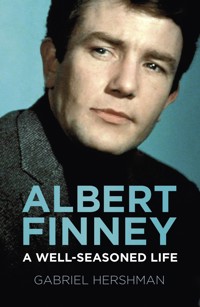
'Hershman has managed to gather a huge amount of information and distill it into a book that is not only respectful but full of insights into what makes this unstarriest of stars able to produce brilliant work without appearing to break a sweat.' - Kathryn Hughes, Mail on Sunday He was a Salford-born, homework-hating bookie's son who broke the social barriers of British film. He did his share of roistering, and yet outlived his contemporaries and dodged typecasting to become a five-time Oscar nominee and one of our most durable international stars. Bon vivant, perennial rebel, self-effacing character actor, charismatic charmer, mentor to a generation of working-class artists, a byword for professionalism, lover of horseflesh and female flesh – Albert Finney is all these things and more. Gabriel Hershman's colourful and riveting account of Finney's life and work, which draws on interviews with many of his directors and co-stars, examines how one of Britain's greatest actors built a glittering career without sacrificing his integrity.
Sie lesen das E-Book in den Legimi-Apps auf:
Seitenzahl: 583
Veröffentlichungsjahr: 2017
Das E-Book (TTS) können Sie hören im Abo „Legimi Premium” in Legimi-Apps auf:
Ähnliche


















First published 2017
This paperback edition published 2023
The History Press
97 St George’s Place, Cheltenham,
Gloucestershire, GL50 3QB
www.thehistorypress.co.uk
© Gabriel Hershman, 2017, 2023
The right of Gabriel Hershman to be identified as the Author of this work has been asserted in accordance with the Copyright, Designs and Patents Act 1988.
All rights reserved. No part of this book may be reprinted or reproduced or utilised in any form or by any electronic, mechanical or other means, now known or hereafter invented, including photocopying and recording, or in any information storage or retrieval system, without the permission in writing from the Publishers.
British Library Cataloguing in Publication Data.
A catalogue record for this book is available from the British Library.
ISBN 978 0 75098 187 3
Typesetting and origination by The History Press
Printed and bound in Great Britain by TJ Books Limited, Padstow, Cornwall.
eBook converted by Geethik Technologies
CONTENTS
Acknowledgements
Introduction
Prologue
1 Finding his Voice
2 The Young Great White Hope
3 Seizing the Moment
4 Arthur
5 Life Choices
6 Tomfoolery
7 Slow Motion
8 Audrey
9 Charlie
10 Anouk
11 Hell in Sloane Square
12 Classics in Concrete
13 Hall of Doubt
14 Losing his Head
15 Back in the Gym
16 Stop that Train!
17 Soused in Mexico
18 Baring Biko
19 Orphans
20 Finney in a Pinny
21 Digging Deep
22 A Walk on the Wilde Side
23 Having a Feeld Day
24 Art and Marriage
25 An Attractive Attorney
26 A Churchillian Triumph
27 Slowing Down
28 Reflections
Postscript
Bibliography
Notes
ACKNOWLEDGEMENTS
‘Is the Albert Hall named after Albert Finney?’ asked my young son, David, one day as I showed him a pop-up book of London’s attractions. Such a question, which came during a period of intensive foraging for Finney films and features, reminds an author that writing a book can be an isolating, even obsessional, undertaking. So it’s as well to salute one’s family for their patience and understanding. Thanks for your Finneybearance.
Albert Finney has always been publicity shy. When another biographer approached him in 1992, Finney replied that his past had a ‘hard top on it’ and that he had no wish to ‘drill it up to go over it all again’. I was therefore not surprised when Finney’s lawyer, Nigel Bennett, informed me that his client’s attitude had not changed. Indeed, Finney has apparently resisted many offers to co-operate on an authorised biography or write an autobiography.
Perhaps, I hope, Finney would have co-operated if he had known that my primary purpose was to pay him tribute. Those like me, who were fortunate enough to have seen his outstanding stage performances in The Biko Inquest, Orphans, Another Time and Art, will never forget them. (And this, naturally, excludes Finney’s triumphs in productions that predate me considerably.) These were also important theatrical events that demand to be commemorated, likewise his great screen work spanning more than five decades.
I am therefore particularly grateful to the following individuals for their assistance: Karen Allen, Peter Allis, Michael Attenborough, Graham Benson, Jon Blair, Nan Cibula-Jenkins, Jeannine Dominy, Mike Figgis, Julia Goodman, Bernard Hepton, Agnieszka Holland, Lyle Kessler, Suri Krishnamma, Annabel Leventon, Maureen Lipman, Peter Medak, Priscilla Morgan, John Quested, Kevin Rigdon, Ellen Ross, Robert Sallin, Carolyn Seymour, Jill Townsend and Amanda Waring as well as certain other people who preferred to remain anonymous.
I have also quoted from various newspaper articles and books that are cited in the text.
And, to answer your question, young David – of course it is!
INTRODUCTION
In the early sixties, Finney was the original ‘angry young man’, mentioned in dispatches alongside actors Richard Harris and Peter O’Toole and playwright John Osborne.
It all began with Arthur Seaton. His bitter, brawling, boozy factory worker from Saturday Night and Sunday Morning was seen as the anti-hero of the ‘new wave’. So convincing was Finney as Arthur, with his beefy build and scowling good looks, that he could have carved out a lucrative career playing rebels. Yet he baulked at the association, resented pigeonholing and trod his own path.
By the nineties, Finney was playing, in quick succession, and equally convincingly, an ineffectual schoolteacher and a repressed gay virgin. The transformations came easily to a performer more deserving of the label ‘natural-born actor’ than most. Yet they also reveal how Finney perceives his craft. He was always a character man, a versatile dramatic actor who considered the stage his real home. Hence he rejected a golden handcuffs movie contract that would have tied him down.
Finney didn’t want to be a conventional movie star or a ‘symbol’ of any kind. His role in Tom Jones bored him, he later said. But the film made him a dollar millionaire at 27 and gave him freedom to choose challenging roles. ‘Life is more important than art,’ he’d say, hence long sabbaticals, enabling self-appraisal and, yes, a bloody good time. He never felt guilty about having fun.
Yet Finney always worked hard when the mood took him, undertaking gruelling titanic parts at the National Theatre in the seventies – Hamlet, Tamburlaine and Macbeth – to sometimes grudging reviews. Some felt that classical verse was not his forte. Finney, however, brought a dynamism and masculine authority to these roles. He even played Shakespeare with a northern accent. In so doing, he paved the way for other regional actors to go to drama school and stand tall.
Finney could have succeeded Olivier as director of the National. Yet he wanted to be a strolling player. Hence he also spurned the popcorn-type movies, ones that would have given him even fatter pay cheques, for gritty character roles.
In the eighties, he gave several outstanding performances in Under the Volcano, Miller’s Crossing and, especially, The Dresser. And Lyle Kessler’s Orphans gave Finney his greatest stage performance – indeed one of the finest seen in the West End in recent years.
Finney received four Oscar nominations for leading actor in films: Tom Jones, Murder on the Orient Express, The Dresser and Under the Volcano. Capping these successes was a wonderful turn as a careworn, cynical lawyer opposite Julia Roberts in Erin Brockovich – and another Oscar nomination for best supporting actor. Yet Finney never cared much for awards. He has also declined a CBE and a knighthood, something that has endeared him to fans even more.
Finney, rather like Daniel Feeld in Karaoke screaming ‘no biography!’ on his deathbed, might not have wanted this book written. Yet Finney’s story is a salutary lesson for today’s ‘stars’ in how to keep balanced amid insane temptations. He has proved that it’s possible to control your own destiny, preserve your integrity, resist typecasting and have a good time without veering into self-destruction. He’s also a role model in terms of his behaviour on and off the set and his healthy disregard for others’ opinions: ‘You should never believe what people say about you – good, bad or indifferent.’
Finney might not have made it, as once seemed likely, into the list of Britain’s most bankable stars. But he has created a gallery of unforgettable eccentrics: the psychotic writer in Shoot the Moon, the desperate drunk of Under the Volcano, the demented policeman of The Playboys, the bumptious tyrant of A Rather English Marriage, the likeable lush of My Uncle Silas and – crowning it all – his endearingly human portrayal of Churchill.
In writing Finney’s biography, I was determined to analyse all his major performances. This, it seems to me, is a serious omission from other actors’ biographies. They seldom address acting. It was especially necessary for a performer like Finney, who has tackled so many demanding transformational parts. I believe that the biographer’s task is to analyse the work as well as the man. I have also tried to gauge the success, or otherwise, of the productions themselves. I hope that what follows does not read like some esoteric study of acting. This was far from my aim. But I do believe that biographies of serious artists must analyse art. And with such a relentlessly private individual as Finney – one whose life away from acting is guarded so jealously – my wish is that in some way the work illuminates the man. If this book reminds readers of some great classic productions and performances, featuring Finney and others, then that is a bonus.
The internet has opened up information to the public that was previously inaccessible. It’s not my intention here to retread too many known facts but rather to delve beneath them. If, for example, you want to know the population of Salford in the fifties you can find that out fairly easily and I have skimmed over some information that would be readily available elsewhere. Also I have dwelt longer over great plays and films than I have over the mediocre or even dire.
I have been surprised – if only because I was unaware of it beforehand – by Finney’s extraordinary personal popularity. Everyone speaks of Finney’s warmth, charm, generosity, joie de vivre and genuine interest in people. On set, he’d always be early and dead letter perfect. He’d learn the names of all the crew and small-part players. Everyone – cleaners, drivers, bar staff, waitresses and extras – adored him. Indeed, so loved is Finney in the business that an authorised biography would likely have triggered a queue of colleagues seeking to pay tribute. It was clear from everything I have read, and from interviewees’ comments, that the respect and affection for Finney is genuine. Merely for the sake of balance, and to avoid this becoming a hagiography that reads as though ‘our Albert’ is on the dais taking the salute from passing crowds, I have included the acerbic comments of the occasional critic, such as one-time collaborator Lindsay Anderson.
Finney’s life is not only the story of a homework-hating bookie’s son from Salford who became an international star. It is also about a versatile actor who played the game strictly on his own terms and managed to live as he chose. It is a story and a career that deserves to be reviewed.
Don’t let the bastards grind you down!
PROLOGUE
Summer 1965, Chichester. Finney is appearing in several National Theatre productions, including Much Ado about Nothing, Black Comedy and Anderson’s Last Goodnight. Canadian actor William B. Davis, now most famous as ‘The Smoking Man’, a regular fixture on the TV series The X-Files, is also in the company.
One night Finney invited Davis and his wife to dinner at Finney’s rented house near Chichester. Davis tells the story:
Rather than give us directions he suggested we follow his car in ours. His car was a chauffeur-driven Rolls-Royce – his insurance would not allow him to drive himself, not that he was a bad driver, he was too valuable an asset – while our car was a 13-year-old Aston Martin DB2 that might or might not last the short trip. When we had arrived the four of us had drinks in the living room – he had his current lady friend with him – before moving to the dining room table which was set for six. Before I could make a fool of myself by asking if there were more guests coming, the four of us were joined at the table by the chauffeur and the cook. The son of a bookie, Albert had not let his money betray his class.1
Spring 1986, London. Albert Finney, it is well known, likes to have dinner. Oh yes! It’s the night after the enormously successful premiere of Lyle Kessler’s new play Orphans in which Finney is playing the lead. Sixty people, actors, technicians, cleaners, box office cashiers and marketing assistants – indeed all the employees at London’s Hampstead Theatre – pile into a nearby Greek restaurant. The demand is so great that any extra hands are welcome. In the background, a red-faced figure, drenched in sweat and wearing an apron, is bringing plates in from the kitchen and helping to serve the diners. It’s our four-time Oscar nominee making sure that everything runs smoothly. This is no act from one of the finest practitioners in the business. Neither is it Finney picking up some tips in preparation for a role. It was behaviour that ran through his whole life. It’s just Albert being Albert. In the words of Hampstead Theatre’s (then) artistic director, Michael Attenborough, ‘He democratised every space he went into.’2
The Hampstead Theatre, nestled inconspicuously by Swiss Cottage underground station, was a portable, even quaint, cubbyhole. In those days you went in, arriving straight into the reception and bar, and a few steps took you to an intimate little auditorium that accommodated fewer than 200 bottoms. The foyer housed memorabilia and souvenirs from past productions. A scattering of famous names apart, it was hardly the place you’d expect to find an international star, someone once billed as the successor to Olivier.
I walked up from Regent’s Park, excited at the prospect of seeing one of my favourite actors so close to home. As I reached the theatre there was more activity than usual. The box office looked besieged. Suddenly a posh-looking car pulled up outside. A burly middle-aged man, clad in a suit, staggered out and started to stride or, rather, totter, up the pathway towards the back of the building. He clearly knew where he was going but he seemed so pissed I wondered if he would make it. I looked at the man more closely. Oh my God! It’s Finney!! And he’s drunk before a performance. Repeat – drunk. Triple exclamation mark.
I enter the theatre with trepidation. Orphans opens with Finney – as gangster/kidnap victim Harold – drunkenly recounting stories from his childhood. It was just as well that Finney was playing a drunk, I thought. So no one will notice that he really is out of it! I swear I could almost smell the booze on him from where I sat near the front row. It wasn’t that his speech was slurred as such. It was more the look of wide-eyed hysteria on his face as he told the kids about his time in the orphanage.
The next scene … it’s morning in the house in Philadelphia. Finney is gagged. He convinces Kevin Anderson, playing Phillip, to remove it. Suddenly Harold – alias Finney – is obviously, totally, completely sober. How is this possible? The man I had seen just a few minutes earlier, both outside the theatre and even in the early scenes, was paralytic. How could he sober up? Suddenly it all fell into place. I’d just been taken in by one of the greatest actors in the world … and something of a prankster.
1
FINDING HIS VOICE
I thought people from my background didn’t become actors. I thought actors were bred in special places – a stud farm in Mayfair.
Albert Finney.
When Finney celebrated his 9th birthday, his home city of Salford, within the metropolitan borough of Manchester, was ablaze with bonfires and fireworks. The festivities were not to commemorate his birthday. Even Finney was not so precocious as to be feted at the age of 9 – although given his subsequent achievements nothing would surprise me! It was, of course, to mark VE Day, the end of the Second World War, 8 May 1945, which fell the day before his birthday.
Finney recalled:
I’ve always found light magical and still find fireworks magical because it seems to me that in many ways they’re a bit like lives, about existence because the energy takes it somewhere and then it’s gone. I think in some ways our lives are like that. There’s hopefully a burst of something or an ascent in some way and, then, it’s over. That had a big effect on my life.
Such a major event would have had a major impact on a young boy. And of course, so would the image of Churchill – whom Finney would portray so memorably more than half a century later – giving the crowds in London a victory salute. For Finney, the war years in Salford were sometimes scary and bleak and the blaze of colour that day proved unforgettable.
Yet Finney, unlike many other stars from the provinces, never lamented those days. He has said he always viewed his childhood in Salford with great affection. And Finney is very much a Salford lad, not a Mancunian, a distinction he and other Salfordians are always keen to stress.
Perhaps the most famous Old Salfordian was the painter L.S. Lowry (1887‑1976), who lived and worked in Pendlebury for over forty years. Others include playwright Shelagh Delaney1 who wrote A Taste of Honey and the screenplay for Finney’s later film Charlie Bubbles. Actors Ben Kingsley and Robert Powell2 were also born in the area, as was music hall star Pat Kirkwood (1921–2007).
Seven decades have passed since Finney’s childhood. But he still counts several of his schoolmates – including artist Harold Riley and Derek Jackson – among his friends today. And he always loves going back. ‘It’s just part of you. It’s in the blood really,’ he’d say. Speaking in 1977, on one of his many visits home, he said his bond with Salford was still strong:
I didn’t feel a sense that I wanted to get away from Salford at all. And I’ve never felt that I’ve got away. I’ve never got waylaid in my profession or lost in it because I’ve felt very connected to the area … there’s something very practical and realistic about living in the area which is of great value.
The only reason he didn’t live in Salford at that time, said Finney, was that his work dictated that he spent more time in London.
Albert Finney was born on 9 May 1936, the son of Albert and Alice Finney (née Hobson). His two elder sisters, Marie and Rose, were ten and five years older than him, respectively. The family home was at 53 Romney Street, Pendleton, a two-up, two-down red-bricked terraced house in an insalubrious, highly industrialised area about 2 miles from Manchester city centre.
Albert’s father was a bookmaker. Although this was not, strictly speaking, legal, it was a nonetheless tolerated profession. Finney always referred to him as a ‘commission agent’. Before betting was officially made legal at the turn of the sixties, bets and transactions were made in someone’s house.
It would be safe to assume that Albert Senior was never really short of money. ‘But there is a slight false illusion about bookmakers,’ Finney said in 1962. ‘They’re not all tremendously wealthy and own great yachts … which my father doesn’t do.’ But the excitement of betting intoxicated Finney. Later, he even installed a ‘blower’ – a phone link with betting information and racing commentaries – at his home.
His father’s occupation was a constant theme for interviewers and tabloid hacks. It was almost as though it had some unsavoury connotation. He’d joke that even as a child he, Albert Junior, had acquired the sobriquet of ‘Honest Albert’. And Finney, although careful in major business dealings, has always been quick to put his hand in his pocket throughout his life.
The Finney home was damaged by German bombs in 1941 while 5-year-old Albert lay in an air-raid shelter. The family then moved to 5 Gore Crescent, Weaste, a semi-detached house with a garden in an altogether more upmarket part of Salford. Today, the street looks much as it probably did back in 1941. Albert would watch rugby league at the Willows ground. He went to Manchester United’s Old Trafford Stadium to see Salford Schoolboys play and became a lifelong United fan.
Finney later described his background to John Freeman, ‘I suppose [it was] a lower middle-class home. We were always comfortable … I had a marvellous childhood. I was always very happy. I remember it with great joy.’ Finney attended Tootal Drive Primary School. By the age of 9 he was appearing in school plays, starring in such memorable productions as Belle the Cat, in which he played the Mayor of Ratville. The young Albert also appeared in puppet shows. ‘I didn’t do the puppets, I did the voices – and I discovered I had an ability to mimic rather well,’ he later recalled. Even at the age of 5, Finney once told Melvyn Bragg, he had developed a gift for mimicry – imitating his teacher as he arrived home for tea.
When he was just 10, Alice even took Albert to a BBC audition in Manchester. In 1947, Albert passed the 11-plus exam3 to attend Salford Grammar School, the school now known as Buile Hill High School. Yet he was too lazy to do well academically:
I was in the top grade when I went to the grammar school but that didn’t last because I wouldn’t work. I hated homework. I thought it was an imposition on my childhood. I didn’t like school very much and wasn’t particularly interested. Much of my energy was spent trying to avoid schoolwork rather than doing it. And I also found myself doing school plays.
At 16, Albert took the minimum of five subjects and failed all but geography. He only passed geography because many of the questions were about Australia, where England’s cricket and rugby teams often competed. He was kept back to repeat the classes. The next year he failed them again – and physics as well! In the meantime he had played Henry IV and Falstaff in school plays as well as Emperor Jones in the Eugene O’Neill play of the same name.
His other main interest at school seemed to be sport. Albert proved a fine athlete, an excellent rugby player and cricketer. And Finney loved going to the cinema. A particular favourite, he recalled, was the Stanley Donen classic On the Town with Frank Sinatra and Gene Kelly. ‘I saw it four times in three days. I really wanted to believe you could sing in the streets of New York and not be told to keep off the grass.’
Though he failed all but one of his O level exams two years running, the talent Finney had shown acting in school plays caused headmaster Eric Simm to recommend he go to RADA. ‘There was no burning ambition to be an actor,’ Finney recalled. ‘I thought, this is fine, I enjoy it.’ But Finney later credited Simm with helping him to find his calling.4
So, warned by his father that ‘if anyone stops you on the street, say no’, 17-year-old Albert Finney left home for London. RADA,5 in London’s Bloomsbury, is the country’s most acclaimed drama school, so much so that even the least ‘arty’ of folk have heard of it. Recently, there has been a trend to address this venerable institution by its more (technically) correct title of the RADA to preserve its distinction. Not all RADA’s intake become stars. Yet a fair number become, if not stars, then at least minor household names. Once you gain a place you may not be guaranteed success, but you will be sufficiently respected to be considered a lifelong ‘luvvie’.
The year 1953, however, was Coronation year and the Finneys had trouble finding a room in London as Albert prepared for his audition. Mr Finney was leafing through a guidebook when he stumbled on a hotel called the Dorchester. They reckoned they could just about afford a few days there. Mrs Finney, who had come up with £37 – £10 of that in shillings rolled up in paper – sent Albert to ask what the rooms cost. It was £6.75 a night. So for dinner they sat in the lounge making do with crisps and nuts. By the third night the waiters had cottoned on and kept refilling the bowls for them. The Dorchester was, and still is, one of the grandest hotels in London, and was a home from home for the likes of Burton and Taylor. Two decades later, Finney, who liked to have dinner there, even moved in for a time when his second marriage to Anouk Aimée failed.
When Finney did his audition he managed to land the Lawrence Scholarship, one of a handful offered by RADA, which was then under the stewardship of Sir Kenneth Barnes. Two years into Finney’s course Sir Kenneth was succeeded by John Fernald. The aspiring actor who walked through the door at Bloomsbury was an ungainly 17-year-old with a broad Salford accent and a crew cut, emulating, he recalled, the American tennis player Vic Seixas, who had won Wimbledon that year. Most of the students at RADA were older than Finney, some by several years; many had already completed their national service.
No group of youngsters feels more insecure than first-day drama students. It’s not like freshers at university, preparing to knuckle down to a three-year English degree. For them it’s merely their knowledge under scrutiny. Acting, on the other hand, is uniquely holistic. You as a person are indivisible from your skill. Everything about you – your voice, face, posture, poise, presence, authority, forcefulness and sensitivity – is fair target. It’s no wonder that actors take rejection personally.
So we have young Albert Finney, just 17, away from home for the first time, in an atmosphere where acting was no longer just something to amuse himself and avoid homework but something requiring self-discipline and application. Finney had been a bit work-shy up to now, and young men tend to like playing around. If acting is just a way to attract attention and impress a few girls, it’s fun; but now he had to learn his craft seriously.
Finney’s time there was a vintage one. Some writers tend to overstate the star intake. Richard Harris was not at RADA, contrary to the opinion of certain biographers. But some of the greatest stars of British cinema of the sixties were. Peter O’Toole, four years older, was in the same class as Finney throughout and became a lifelong friend. He was the only one to outgun Finney in the fame stakes. O’Toole has said of this period:
Harris and Burton and Finney and all that mob, all my friends, we were disaffected by authority. There were too many people around with badges, and we were all determined to take life by the scruff of the bloody neck and live it … There was just this tremendous release of energy, this explosion of inhibited talent.
Frank Finlay, a decade older than Finney, and later a versatile Shakespearean actor and a well-known face on television, was also in the same class. So was Alan Bates, another ‘angry young man’ associated with the new wave, a performer of great range and sensitivity. John Stride was also there, a likeable face on the box and supporting player in films, with a personality similar to Finney: charming, forceful, authoritative but friendly (so much so that when I saw Stride as Alun Weaver in Kingsley Amis’s The Old Devils, I thought it could have been a great part for Finney). Roy Kinnear was another student, usually confined to playing, by his own admission, ‘short, fat, sweaty types’, but a gifted comic actor of rare timing.
RADA students Ronald Fraser and James Villiers, although not exact contemporaries of Finney, became legends in their own lunchtime. Both were particularly friendly with O’Toole and formed a trio known for their carousing. Villiers carved out a little niche for himself as upper-class buffoons. He was one of the first to call other actors ‘luvvie’. So perhaps we can blame him for the over-effusiveness that later became so lampooned.
Among Finney’s other contemporaries, John Vernon played villains in Point Blank and Brannigan. Derren Nesbitt, who arrived in 1955, often stole films from under leading men’s noses, usually as a sadist. (Nesbitt also won the coveted Kendal and Forbes-Robertson Shakespearean awards.) James Booth, most famous for playing Hookie in Zulu, was also there and should have had a glitzier career; he ended up writing screenplays and taking bit parts.
Peter Bowles was a friend of Finney’s who became a household name on British TV in To the Manor Born. Richard Briers6 also became better known on the small screen, especially in The Good Life. He had a gentle, soothing, lightly pitched upper-class bark, vaguely reminiscent of his cousin Terry-Thomas. Briers was also close to O’Toole; in old age they could be seen helping each other up the stairs of the Garrick.
Bryan Pringle,7 who looked at least ten years older than Finney when he appeared with him in Saturday Night and Sunday Morning, was also there, as were distinguished stage actors Brian Bedford, Keith Baxter and Gary Raymond. Even Ronald Allen, forever known as the suave David Hunter in the long-running British soap Crossroads, hit pay dirt. So did Nicholas Smith, a regular on the amusing comedy series Are You Being Served? Patrick Newell was another familiar face, in particular as roly-poly ‘mother’ in The Avengers.
Among the ladies were Virginia Maskell, who died in tragic circumstances in 1968,8 Gillian Martell, Valerie Singleton and Rosemary Leach. Fewer of the actresses became household names. Another student, Roy Maxwell, also from Salford Grammar School, believes some of them weren’t especially serious anyway: ‘Many of the younger Roedean College type females had no intention of going into the professional theatre but mummy and daddy thought they would benefit from the experience of RADA as a finishing school.’9 He then adds, somewhat mischievously, that ‘a fair number of them got a lot more experience than they had bargained for’. By 1955, however, some more famous ladies were making their entrance, notably Diana Rigg, Glenda Jackson and Siân Phillips and, the following year, Susannah York.
Such a great crop of actors fostered a competitive spirit. ‘[This] was quite good training, although not really what drama schools are meant to be about,’ Alan Bates said. ‘It got you quite used to the rat race of trying to get into the public show and trying to get jobs. I was the only one who was unemployed afterwards.’10
Finney, by his own account, started tentatively at RADA (Brian Bedford, in particular, recalled Finney’s ‘very flat north country accent’), yet he relished his independence, being let loose in London and responsible for himself. He had a fiver in his pocket and soon several girls were vying for his attention; they outnumbered boys by two to one.
In his first term, Finney said he felt ‘very unsophisticated, ungainly and clumsy and a bit uncouth’. Although he’d done plays at school, and been a keen cinemagoer, the nuts and bolt of stagecraft proved a hard grind. But he was always a keen observer. He later remembered being directed by an old Shakespearean actor named Ernest Milton. Finney recalled seeing Milton chase a tram, somewhat breathlessly, calling out, ‘Stop! Stop! You’re killing a genius!’ (Finney later used this incident for the famous train-stopping scene in The Dresser.)
It was only later in the first year that Finney started to feel comfortable:
In my third term it suddenly clicked, thanks to Wilfred Walter who was directing Twelfth Night. I was playing Toby Belch and when I asked him where I should stand he told me to stand wherever I liked as long as I felt relaxed. He didn’t mind untidy productions as long as his students were exploring the stage for themselves, and that gave me a tremendous release, a sense of being myself on the stage … you tend to be told how many steps to take by some of the teachers there. You’d got to control your breathing and use the pitch of your voice. But at the beginning of the third term it changed. I remember thinking almost deliberately. ‘I’m not going to go on at rehearsals saying the rest of the class is laughing at me. I’m going to say they’re learning from me.’ It was almost as deliberate a conceit as that. I realised that I had to take a positive step from feeling self-conscious with my classmates.11
By the end of the first year Finney was attracting positive attention. Peter O’Toole thought that Finney was special. He noted that his friend ‘buzzed with a confident energy’ when playing a scene from As You Like It.
Richard Briers described Finney and O’Toole as the undisputed stars of the intake. ‘I was in the same class with Peter O’Toole and Albert Finney, who didn’t need any lessons at all. I was painstakingly slow in my progress in comparison with them and as a result was always trying too hard,’ he recalled.
Elizabeth Rees-Williams, who later married Richard Harris, said, ‘when Peter or Albie were doing anything, we’d all go and watch’, and theatre director William Gaskill recalled that Finney and O’Toole had made a little name for themselves in the theatre world long before they graduated. But maybe some of this is with the benefit of hindsight, certainly John Stride and, later, Derren Nesbitt, received just as much recognition.
Perhaps we are not only talking of star quality and raw talent, although these were striking in both O’Toole and Finney, but also of sheer confidence, the kind of self-belief that says not only ‘I know where I’m going’ but ‘I’m going to make sure I’m noticed’. This was the key to Finney’s success.
And here the person best placed to observe Finney was his friend Peter Bowles with whom he shared a one-bedroom flat in London’s Hornsey Rise. There were three beds – one double, one single and a single folding one, Bowles recalled. ‘The agreement was that should either of us have a girl with us for the night, then that person would have the double bed and the other would unfold the zedbed and sleep in the kitchen.’ Bowles appreciated Finney’s no-nonsense attitude. One night they were discussing how to tackle Macbeth. Bowles started talking about motivation and demeanour:
‘How would you approach it, Albert?’ I asked.
‘I’d learn the fucking lines and walk on,’ said Finney.
That’s confidence – and from a boy of 18. You can’t beat it.
The lesson, concluded Bowles, was simple: ‘I realised many years later, after I’d acquired a certain amount of it, that confidence is almost 80 per cent of what’s needed for star quality, plus a bit of talent, of course.’12
Finney’s nonconformity showed in another incident recounted by Bowles:
My first experience of television casting was, in fact, at RADA … We had been asked by the Principal to come to RADA on this particular day in our ‘best’ clothes, with hair brushed and shoes shining, because the bosses of a new independent television company (Rediffusion, I think) were coming to cast the first closed-circuit TV play [ITV had not started at this time]. I think they may have used students from other drama schools, but we would play the leading parts; after all, we were the Royal Academy of Dramatic Arts.
‘Bollocks,’ said Albert that morning as he put on his usual holed jumper. ‘Fuck ’em,’ as he ran his fingers through his tousled hair. Albert never washed his hair as he believed nature’s oils cleaned it ‘like a dog’s’, he said. Albert still has a magnificent head of thick hair, whilst my once magnificent head of thick, wavy, well-washed hair has all but disappeared! I got togged up as best I could, as I was on that best behaviour scholarship. No ‘bollocks’ or ‘fuck ’ems’ allowed.
The bosses of the new TV company, who all seemed to be ex-Royal navy commanders, were to watch us enact scenes from As You Like It and I was playing Jaques. Poor Albert was only playing ‘a forester’. No wonder he said ‘fuck ’em,’ I thought. The scenes were to be played in a large rehearsal room and the distinguished guests sat on a raised stage at one end of the room.
The scenes ended.
‘Gather round, boys and girls,’ said the Principal. ‘Sit cross-legged here in front of our guests whilst they decide who they would like to cast in their play.’
It was to be She Stoops to Conquer. We were all very excited and I knew I had done the ‘All the world’s a stage’ speech rather well.
‘We would like to have that boy for a start,’ said one of the men, pointing towards a figure who had not joined us cross-legged, but had gone into a corner at the far end of the room, and was standing in the position of a dunce with his back towards us.
‘Albert, come here at once. What are you playing at?’
‘No, leave him where he is,’ said the ex-Naval Commander. ‘We want him to play the lead.’
I didn’t get a part of any kind. Well, that’s the mystique of star quality in an 18-year-old young man, who I think only had one line.
Bowles was a lifelong friend. And Finney was always generous to his pals. When Peter married in April 1961, Finney and Jimmy Villiers were the ushers. (Bryan Pringle was best man.) Finney gave Bowles a cheque for £250, equivalent to about £3,500 today. Bowles later said it served him in good stead because he had several months’ unemployment after his marriage. Finney, who was starring in Billy Liar at the time, arrived late to the wedding. The reception proved so enjoyable that Finney decided to feign illness and cancel his matinee, giving his understudy Trevor Bannister, later famous for Are You Being Served?, his break.
RADA students learnt movement, fencing and ballet but voice control and diction were pivotal. Staff could be carping. Keith Baxter recalled being told by voice teacher Mary Duff that his voice was ‘ugly’ and that he sounded ‘as if your mother dug coal with her fingernails’. Finney later told Roy Maxwell that the academy seemed to employ a deliberate ‘good cop, bad cop routine’, almost operating teachers alternately.
The students’ general impression, however, was that the academy had not moved on. Brian Bedford recalled:
We felt that RADA was a very old-fashioned organisation. It was tired and out of sync with the times. Maybe theatre was out of sync with the times. It wasn’t until Osborne wrote Look Back in Anger that working-class people were viewed as interesting theatrical subjects. And at the school we were taught that if we wanted to play leading men, we had to be six feet tall, aristocratic-looking and speak with an Oxford accent!
Yet Bedford also remembered that he and his fellow students were surprisingly self-assured. ‘[We were] all hell-bent on having the best possible time. We had this amazing confidence and I have no idea where it came from.’13
Gillian Martell noticed a brazen attitude from Finney – not arrogance as such, but an imposing swagger. ‘He did that great moody thing and would wander around with his head down. I remember asking him about it and he explained, “I go downstage with my head down, then I look up and give the audience my eyes.”’
That sounds rather Brandoesque. And indeed it would have been surprising if Dean and Brando were not role models for the students. Brian Bedford recalled seeing On the Waterfront several times with Finney. ‘To this day I still see the influence that Brando had on Albert in every performance,’ he said.
Finney also charmed the ladies. Yet much of it was just larking around. Valerie Singleton remembered a fun evening with Finney at a party in Chelsea. ‘He was quite boisterous but we didn’t make love,’ she recalled. ‘We just kissed passionately while rolling from side to side. We were on a pull-down sofa bed worryingly close to a fire, and I remember fearing that we might be set alight.’ (Strangely, or perhaps not given the passage of time, although Singleton later lived near Finney in Chelsea and they sometimes met in the newsagents, Finney would always introduce himself. He had clearly forgotten about the incident.)14 A bit of a lad, our Albert.
He was developing a reputation as a maverick, someone who could buck the system. Back then, all Brits did two years’ national service (the draft ended in 1960). All Finney’s contemporaries were conscripted; but not Albert. Rumour had it that he cleverly dodged it by feigning madness. It was probably an easy feat for someone of his talent. Apparently, he took to sitting on one of the rafters in a Nissen hut. He refused to eat anything and from time to time he fainted. Finney was duly discharged, avoiding the nuisance of a two-year stint away from the important things in life, like drinking and chasing girls, as well as acting.
It was a time of a great many parties. While at RADA, Olivelli’s Italianate café was a favourite, along with a local pub called the Gower Arms. Finney, later in life, acquired a reputation for enjoying what Brits call a ‘booze-up’. And so he did. But attempts to bracket Finney as a hellraiser, in the O’Toole/Harris vein, won’t wash. He was never as self-destructive. I can find no record of him throwing books at teachers or climbing down chimneys, let alone thumping people. It seems that Finney was a drinker, yes, but when he got drunk he did so in a civilised fashion.
Another key difference between Finney and O’Toole was in accent. O’Toole eradicated any trace of a regional background whereas Finney’s slightly flat northern accent stayed. It was to become his trademark. Clifford Turner, who later wrote a classic book on voice, taught Finney, O’Toole and Bates. Peter Bowles later recalled that his Nottinghamshire accent was knocked out of him at RADA. ‘When I came out, I didn’t know who I was,’ he says. ‘That, if anything, hampered my acting.’
Frank Finlay also recalled the irony of having to eradicate his local accent:
It was still the time when the reps were doing Who’s for Tennis? plays. So we spent days losing our north country accents. Yet within two years of my leaving they had a full-time voice coach teaching the students how to sound as if they came from up north.15
Meanwhile, Finney’s reputation was permeating around Bloomsbury. A young man from Hull named Tom Courtenay was studying English at University College London (UCL). Courtenay was interested in acting. He realised that UCL was near enough to RADA to keep an eye on the actors’ exploits. He also performed with the dramatics society. One evening, a RADA student came to see Courtenay in what he described as an ‘awful play’, The Duchess of Malfi:
Our director, Anita, had a friend who was a RADA student, name of Bill, who came to see her production. He was tall, handsome and laid back, with a soft Scottish accent, and he had a lot of authority because he didn’t gush. I was very pleased when he told me I would have no difficulty getting into RADA, even though he thought there would be plenty for the teachers to work on. I didn’t in the least mind being raw material. No point in going there otherwise. He went on: ‘There’s a wonderful boy at RADA at the moment. He’s very charismatic. Strangely enough, you have something in common with him. You’re not at all like him temperamentally and I can’t really say why you remind me of him. But you do. I suppose you could be his younger brother.’ Intrigued, I asked his name.
‘Finney. Albert Finney.’16
In February 1956, Finney appeared at the Vanbrugh Theatre in the first of a series of plays to be staged by RADA students as part of their training for professional productions. Fernald chose Ian Dallas’s The Face of Love, a modern-dress version of Troilus and Cressida. Finney played Troilus, Susan Westerby was Cressida, Peter Bowles was Hector and Keith Baxter was Philo. The Times said:
Mr Albert Finney and Miss Susan Westerby handle the parting of the lovers with a sincerity which draws out almost all that there is to be drawn from a beautifully written scene. Her voice control is surest in the softer passages, but Mr Finney is able to let himself go and still keep the tension unbroken.
Kenneth Tynan, then the up-and-coming theatre critic, exalted Finney, writing in the Observer that he was a ‘smouldering young Spencer Tracy … an actor who will soon disturb the dreams of Messrs. Burton and Scofield’.
Finney had one final commitment before he left. RADA staged a final, showpiece production, a matinee, before agents, friends, families, critics and judges.17 Finney and his peers gave their show at Her Majesty’s Theatre on 27 March 1956. Sitting in judgement were the playwright Clemence Dane and actors Margaret Leighton, Laurence Naismith and Eric Portman.
Students performed excerpts from various plays. Finney, as Petruchio, did scenes from The Taming of the Shrew opposite Liz Yeeles. Finney and Peter Bowles also appeared as longshore men in Eugene O’Neill’s The Long Voyage Home, in which Keith Baxter had the lead as a Swedish sailor. Students then reassembled at RADA to be told what prizes, if any, they had won.
Gillian Martell won the gold medal. Richard Briers was awarded the silver medal for what was described as an excellent comic performance in Moliere’s Sganarelle and Chekhov’s The Proposal. Briers also won the prize for best diction. Keith Baxter was awarded the bronze. Finney won the Emile Littler Award, for the student who had shown outstanding talent and aptitude for the professional theatre, for which he was given the princely sum of 25 guineas.
While still at RADA, Finney and Peter Bowles received letters from Philip Pearman at the Musical Corporation of America (MCA) inviting them to an interview at the talent agency’s offices in Piccadilly. Bowles tells what happened when the agent addressed Finney:
‘My dear,’ said Mr Pearman, the nicest of men. ‘First think for a moment of the poster: “Albert Finney as Hamlet.” It sounds as though a footballer is trying his foot at acting.’ [There was a famous footballer named Tom Finney playing at the time.] ‘I really think you ought to change your name, Albert,’ he said.
Finney, who nevertheless became one of Pearman’s clients, did no such thing. Later, Sam Spiegel, producer of Lawrence of Arabia, would urge the same. No way.
By the time of The Face of Love, Finney had already been wooed by Binkie Beaumont from London theatrical management company H.M. Tennent as well as by the Rank Organisation, the latter offering him a seven-year contract starting at £1,500 a year, rising to £10,000. What did Finney do? Why, he rejected both, in favour of £10 a week at a repertory company where he could perfect his craft. As always, Finney went his own way.
What did Finney want from acting? We have already noted his confidence. Did that mean he wanted to be a big star? Both he and O’Toole had the purpose and commitment necessary to be stars. Finney also had a huge advantage over his peers; he simply loved acting. Several years later, after the release of Saturday Night and Sunday Morning, Finney was still disclaiming ambition:
I don’t give a damn whether I’m a star or not. It’s splendid to have money because then you needn’t think about it, and that’s a great advantage. But I just want to have a go … to act, and to mean what I say, whether it’s said jokingly or seriously. If I should incidentally become a star – well, all right, I’ll be a star as well.18
Although unemployment among actors is commonplace, most RADA graduates found work when they left, thanks to Britain’s many repertory companies. O’Toole went to the Bristol Old Vic and Finney headed to the famous Birmingham Rep, whose alumni included Laurence Olivier, Ralph Richardson, Peggy Ashcroft, Stewart Granger, Paul Scofield, Cedric Hardwicke and Edith Evans. It was at the Rep that Finney, still only 20, first played big parts. The young Finney would give performances that theatregoers still talk about sixty years later.
2
THE YOUNG GREAT WHITE HOPE
And there was this one young man who came, and he was completely different from anybody else.
Pamela Howard.
Pamela Howard worked as a scenographer at Birmingham Rep. She said Finney was the first person she had met who wore jeans and a T-shirt and said ‘fuck’. She also noted that you couldn’t take your eyes off him even when he was a spear carrier. That’s star quality.
Bernard Hepton, later the director of Birmingham Rep, became the pivotal figure in Finney’s professional life. You wouldn’t notice Hepton in a crowd. He was like the late Fulton Mackay, an incisive player able to get under a character’s skin – an actor of unobtrusive brilliance. On-screen he is best known for playing Albert Foiret, the brave and austere hero of Secret Army, the series mercilessly parodied years later in ’Allo ’Allo! Hepton was ideal for the role. He always looked like he harboured a secret. He usually played second fiddle to the leading man, but what a tune he struck, whether as a cowardly villain in Get Carter or one of the more sensitive-looking ne’er-do-wells in Kingsley Amis’s The Old Devils.
Hepton had arrived at Birmingham in 1952 to take minor parts in Henry VI Part III. He was overjoyed:
I went and did these two little parts and I thought, ‘I’m here at last, and it is wonderful.’ It was a lovely little theatre. They called it ‘the little brown box’ in those days, and all the upholstery was brown leatherette. It was just delightful.
Such is the fame of Birmingham Rep – a building then based in Station Street, one now occupied by amateur companies – that it attracts visitors from all over the world who just want to savour the atmosphere. Sir Barry Jackson was the wealthy impresario behind Birmingham Rep. He used the fortune inherited from his father’s provisions firm to build a 440-seat auditorium, which opened officially in 1913. It was under Jackson’s stewardship that it acquired a reputation as a regional cultural capital, producing plays by Aristophanes, Shakespeare, Jonson, Wycherley, Goldsmith, Shaw and Schnitzler. It was a place where actors could hone their craft.
Professor Claire Cochrane, senior drama lecturer at Worcester University, has described Sir Barry as one of the most important theatrical entrepreneurs of the thirties and forties: ‘He was a shy man, and people described him as the quintessential English gentleman. He was highly educated, spoke several languages and he was very, very loyal to the avant-garde theatre.’
Jackson was also gay – hardly worth mentioning now, yet he had to be discreet about his conduct at a time when homosexuality was illegal. He, rather like Charles Laughton and Lindsay Anderson, probably had an eye for young male beauty that passed his way. Hepton offers his own take on Sir Barry:
It was his theatre. He built it himself out of his own pocket and it was his pride and joy. He was a gentleman, he was a scholar and he was a very talented man. I had never met anyone like him. To meet him, he was like a ramrod, very, very straight and he was always smoking cigarettes through these extraordinary holders that he used to make out of paper himself … he used to come to the theatre probably once a week, twice a month, not very often, but he was the reason why we were all there.
Hepton remembers that the theatre was:
Very sparse … the bottom foyer was not decorated at all, it was a place of work. I went back to unveil plaques to Sir Barry, and I went into the theatre, the first time I had walked in that place for an awful long time, and it was like a palace! There was carpet on the floor, concealed lighting, there was a bar. I thought, ‘Good Lord, if it had only been like this!’ But it wouldn’t have been the same.
Sir Barry might have been in overall charge, yet he gave his directors total autonomy. He never addressed actors about their performance. Hepton recalls Sir Barry passing a note to another director producing a play about Lincoln. Hepton was playing a southern gentleman. ‘Trousers on Hepton are too short!’ said the note.
The company, said Hepton, was very close:
We were all great, great friends and I’ve never known a company like that either before or since. That all traces back to Sir Barry and the great influence of this man. It is very hard to actually pin it down, what his influence was, but it was there and it was actually in the theatre.
Birmingham Rep had one distinct advantage over other similar companies; it was a monthly rep. Actor Paul Williamson said:
You had plenty of time to rehearse properly, to take a play apart and put it back together again. Whereas with weekly rep you just got the bloody thing on, in fortnightly rep sometimes you fell between the two stools because you just had time to take the play apart but not time to put it together again. Monthly rep was a luxury.
It was Hepton’s predecessor as director of productions, Douglas Seale, who had actually accepted Hepton into the company on Fernald’s recommendation. Hepton took over in 1957, although Seale continued to oversee the occasional play. And Hepton directed Finney’s first role in Julius Caesar. Birmingham Rep had a policy of putting on new plays alongside the classics. So Hepton was busy not only staging and directing plays but reading fresh material.
When Finney reached Birmingham, the rest of the company, which included Geoffrey Bayldon, were intrigued to see the newcomer whom Tynan had heralded. It was an inauspicious entrance. Finney was an hour late, looking distinctly nervous and wearing an old duffel coat. Yet the group’s verdict, on breaking for lunch, was unanimous. Finney was special. Before Finney’s arrival they had joked that he would have to change his surname. Now Hepton knew he was in the presence of no ordinary actor. ‘It was the only time that I saw someone cold and knew that he was going to be a star,’ he recalled.
Not all Finney’s roles were prominent, obviously, but, rather like Richard Burton, Finney compelled attention. Coincidentally, one of Finney’s early small roles was as the orphaned clerk Richard in The Lady’s Not for Burning, a part in which Burton had excelled. Finney had not only a handsome, forceful face but also hypnotic blue eyes. Even when he was scrubbing the floor, when he had his face to the audience one’s gaze fell on him.
In another play, a piece of Irish whimsy called Happy as Larry, Finney caught the notice of Michael Billington, later a distinguished theatre critic: ‘He was one of a chorus of dancing tailors, and there was something about this stocky, square-shouldered figure that instantly drew the eye. He was a 19-year-old fresh out of RADA. It was fascinating to see him mature with every production.’
Billington also remembers walking past Finney near the city’s train station:
What struck me was the confidence with which he held himself. It was that certain set of the shoulders. He didn’t so much as walk as swagger in a curious kind of way – call it, perhaps, saunter aggressively – as if he knew exactly who he was and was very, very sure of himself.
It helped that everyone liked ‘Albie’. Finney, with Hepton’s help, had moved from the rather downmarket Balsall Heath to Pakenham Road, Edgbaston, into the home of Winnie Banks, a housekeeper to a hostess known for her theatrical digs. Finney became friendly with Winnie and continued to visit long after he had become a major star. Coincidentally, or perhaps not, both Finney’s immediate successors as ‘juvenile lead’ at Birmingham Rep, first Ian Richardson and then Derek Jacobi, also stayed with Winnie. Jacobi later recalled that Finney had decorated his bedroom, ‘At one point I asked the landlady if I could change the wallpaper in the bedroom. She said, “No, no, no – Albert put that up’’.’1
Finney had also met the actress who was to become his first wife, Jane Wenham, at a party in Stratford-upon-Avon. Wenham, nine years older than Finney, had joined the Old Vic at the age of 17. She had won excellent notices in Grab Me a Gondola and was appearing in three important roles during the 1957 Stratford season – as Celia in As You Like It, as Calpurnia in Julius Caesar and as Iris in The Tempest. Finney soon moved into her flat in West Street, Stratford.
Meanwhile, Finney’s roles continued. The Lizard on the Rock ran for a month in the summer of 1957. Set in the Australian desert, it tells of a successful man reassessing the value of wealth and power. A critic wrote, ‘Albert Finney, Geoffrey Taylor and Colin George clearly differentiate the senator’s three sons.’
Douglas Seale was still officially the director at Birmingham when he cast Finney as Henry V. Seale had built his reputation on Shakespeare’s histories, notably the cycle of the three parts of Henry VI and Richard III. He was now trying his luck with Henry V. The production also featured a young Michael Blakemore, who was hoping to be cast as a member of the French court – the dauphin or the constable. Instead he played Exeter. He recalled that Finney’s appearance as Henry V was the first time he had seen an actor playing the part without make-up. Hepton was also in the chorus.
Henry V marked Finney’s breakthrough at Birmingham. Audrey Nightingale, in The Times, said he reminded her of Burton: ‘Always intelligent, moving after Agincourt, he [Finney] takes the stage with an engaging charm of youth … sturdy rather than royal … in the Burton tradition rather than the Olivier.’
In retrospect, Nightingale said, it was Finney’s performance in Be Good Sweet Maid, as a hardheaded young entrepreneur, that impressed her even more. Nightingale, writing in 1963, said, ‘Here was a hint of his future as Arthur Seaton, an incisive piece of work in which the charm was used deliberately as a veneer for a cool and egoistic calculation.’
Critic J.C. Trewin also liked Finney’s Henry V. Trewin said that Finney ‘failed in the Harfleur speech, a passage that demands the fullest drive’, but otherwise he was impressed:
Often in the theatre, Henry has been arrogant, self-righteous, the star of England shining like a gas jet. But Finney could remind us of a cricket captain able to keep our spirits up on a tricky third day. He might not have been a greyhound in the slips; he would have been an uncommonly safe cover-point. This Henry knew his people, and he had enough of the old Hal in him to turn to rough jesting in that moment of relief, the battle over.
The roles continued. In 2013, to mark the centenary of the Rep’s founding, audiences were asked to reminisce about the old theatre. Someone mentioned The Alchemist. One fan wrote:
We will never forget the young Albert Finney in Ben Jonson’s The Alchemist, probably late fifties, at the Old Rep in Station Street with the gas lighting on the stairs to the upper level. Newly arrived in Birmingham, it was one of our first visits.
It was during the run of The Alchemist that Finney married Jane Wenham – on 1 November 1957 at Holy Trinity Church in Stratford. Since Jane, like Finney, was due on stage that night, in her case in As You Like It, any honeymoon plans had to be postponed.
Finney’s biggest role at Birmingham was in Macbeth. Hepton took a gamble in offering the part to someone as young as Finney, but it paid off. It helped that Hepton had a clear idea about the play: ‘I took the witches to be the embodiment of that influence, so when they say to Macbeth, “you will be king”, it starts a process of evil.’ An announcement in The Times




