


Erhalten Sie Zugang zu diesem und mehr als 300000 Büchern ab EUR 5,99 monatlich.
- Herausgeber: The History Press
- Kategorie: Sachliteratur, Reportagen, Biografien
- Sprache: Englisch
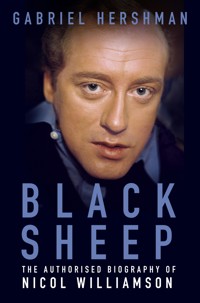
Once hailed by John Osborne as 'the greatest actor since Brando', latterly known as a ruined genius whose unpredictable, hellraising behaviour was legendary, Nicol Williamson always went his own way. Openly dismissive of 'technical' actors, or others who played The Bard as if 'their finger was up their arse', Williamson tore up the rule book to deliver a fast-talking canon of Shakespearean heroes, with portrayals marked by gut-wrenching passion. According to one co-star, Williamson was like a tornado on stage – 'he felt he was paddling for his life'. Fiercely uncompromising, choosy about the roles he accepted, contemptuous of the 'suits' who made money from artists, and a perfectionist who never accepted second best from himself or others, Nicol sometimes alienated those around him. But even his detractors still acknowledge his brilliance. After an extraordinary career on both stage and screen, Williamson was burnt out as an actor by the age of 60. Yet, as Gabriel Hershman explains in this authorised biography, a premature end was perhaps inevitable for an actor who always went the extra mile in every performance.
Sie lesen das E-Book in den Legimi-Apps auf:
Seitenzahl: 563
Veröffentlichungsjahr: 2018
Das E-Book (TTS) können Sie hören im Abo „Legimi Premium” in Legimi-Apps auf:
Ähnliche


















BLACKSHEEP
‘The achievements of those who work in the theatre are no more than writing on the sand. There may well be a vivid and important message for all to see, for a while, but by and by the tide comes in, and when it next goes out, that writing has disappeared.’
Sir Trevor Nunn
‘You always felt that he was searching for something more alive, daring and emotionally revealing than the average actor.’
Roland Jaquarello
‘All great artists have damaged childhoods but when you have a damaged childhood it breeds imagination. What would have happened if it hadn’t turned out like this?’
Tom Kempinski
‘Dad had many flaws, but he owned most of them rather well.’
Luke Williamson
‘No one would ever persuade me that there was ever a more powerful actor than he.’
Patrick Phillips QC
‘Other actors, including, for all his brilliance, George C. Scott, were earth-bound by comparison with Nicol. Nicol displayed magic all the way through, not just in the final performance but also in rehearsals.’
Tony Walton
‘He had an allergy to offices. He refused to see even the most grand of movie moguls in their offices, no matter how powerful they were, or what was at stake.’
Leslie Megahey
‘A dream to some, a nightmare to others ...’
As Merlin in Excalibur
BLACKSHEEP
THE AUTHORISED BIOGRAPHY OF
NICOL WILLIAMSON
GABRIEL HERSHMAN
For my mother, Jose, my father, Nathan, my wife, Dessi, andchildren, David and Natalie.
First published 2018
The History Press
The Mill, Brimscombe Port
Stroud, Gloucestershire, GL5 2QG
www.thehistorypress.co.uk
© Gabriel Hershman, 2018
The right of Gabriel Hershman to be identified as the Author of this work has been asserted in accordance with the Copyright, Designs and Patents Act 1988.
All rights reserved. No part of this book may be reprinted or reproduced or utilised in any form or by any electronic, mechanical or other means, now known or hereafter invented, including photocopying and recording, or in any information storage or retrieval system, without the permission in writing from the Publishers.
British Library Cataloguing in Publication Data.
A catalogue record for this book is available from the British Library.
ISBN 978 0 7509 8725 7
Typesetting and origination by The History Press
Printed and bound in Great Britain by TJ International Ltd
eBook converted by Geethik Technologies
CONTENTS
Foreword by Luke Williamson
Acknowledgements
Introduction
Prologue
1 Little Hills
2 Thaw Gets Nicked
3 Inadmissible Behaviour
4 Taking Film by Storm
5 Fun in the Sun
6 Caged Tiger
7 Nicol at Nixon’s
8 Writing on the Sand
9 Breaking Point
10 Battling Otto the Ogre
11 Inadmissible Love?
12 Vaulting Ambition
13 Banishing Olivier
14 Mountbatman
15 Anatomy of a Marriage
16 Madness on Broadway
17 From Pig to Jack
18 The Last Hurrah
19 Seamus the Squamous
20 The Stench of Death
Notes
Bibliography
Index
FOREWORD
BY LUKE WILLIAMSON
Consulting on this book has been a bittersweet experience for me. So many memories of a man who meant the world to me, without whom my life would have been so much greyer and so very different. A man whose absence I feel on a daily basis.
How can I possibly convey the feeling and essence of a person through words to others who have never met him? No matter what I say, it’s impossible to encompass Dad and distill him into a few paragraphs, I will always fall short.
He was funny and kind and brilliant and sad and angry, and the vagaries of existence swirled around him visibly like universal ingredients. He was magnetic and creative, he altered the dynamic of everything he was near.
Being close to Nicol was like being in the front seat of an exhilarating, terrifying rollercoaster. It could be more than you could bear, but you always came back for another ride.
There will be compliments given and axes ground, but in the end Dad lived his life exactly as he wished, and stood up for the principles he believed in. I will always be proud of him, and I will always miss him.
ACKNOWLEDGEMENTS
Writing a biography – and this is my third – is like a detective chasing a trail. Occasionally the trail runs cold. Sometimes a sliver of information becomes a major anecdote and triggers vivid memories. Interviewees sometimes claimed they had little to offer, and then proved painstakingly detailed in their recollections. It is clearly a lesson that all ‘leads’ are worth pursuing.
I am very grateful to the following who took time to comment on Nicol Williamson’s extraordinary life and career: Sally Alexander, Robert Bierman, Kate Binchy, Brian Blessed, Ingrid Boulting, Bruce Boxleitner, Rand Bridges, Elaine Bromka, Laura Cella, Brian Cox, Tony Croft, Sam Dastor, Ro Diamond, Sally Dietzler, Ray Dooley, Ron Fassler, Edward Fox, Tony Garnett, Peter Gill, John Goldstone, Sally Greene, Vivienne Griffiths, Daria Halprin, Anthony Heald, Lady Pamela Hicks, Tara Hugo (a particularly fastidious contributor), Luciano Iogna, Glenda Jackson, Roland Jaquarello (whose recollections of the great moments in Nicol’s stage performances were truly impressive), Tom Kempinski, Ted Kotcheff, Lionel Larner, Stephen Lyons, Leslie Megahey (who deserves my special thanks for his extremely generous contributions), Nicholas Meyer (who also kindly sent me The Baker Street Journal, a veritable mine of ‘Sherlockian’ information), Trevor Nunn (whose detailed recollections were especially invaluable regarding Nicol’s work on Coriolanus and Macbeth), Tony Osoba, David Parry, Julie Peasgood, Louise Penn, Michael Pennington, Natasha Pyne, David Rabe, Bob Rafelson, Keith Reddin, Shane Rimmer, Laila Robins, Tony Rowlands, Jeanne Ruskin, George Segal, Carolyn Seymour, Janet Suzman, Clive Swift, Philippa Urquhart, Marianne Velmans, Tony Walton, Dreya Weber and Saskia Wickham.
Special mention must go to Nicol’s first wife, Jill Townsend-Sorel, and Nicol’s son, Luke, without whose help this book would not have been possible. They both understood, and supported, my vision – the need to present a truthful, balanced portrait of a complex man, neither coffee-table saccharine nor a hatchet job.
I would also like to send my love and appreciation to my wife, Dessi, and children, David and Natalie, for their understanding and patience. You are my world!
And that’s my nickel’s worth ...
INTRODUCTION
‘The terrible-tempered tiger of the English stage, smiter of David Merrick, scourge of critics, accused assassin of Hamlet, carouser, brooder, pub-crawler and brawler.’
New York Times on Nicol Williamson
Nicol Williamson was the finest British stage actor of his generation. Yet today he’s semi-forgotten. If he is remembered at all, it’s rather for his temper and eccentricity. The press greeted his passing with prim, perfunctory obituaries but not really the respect such an outstanding actor deserved.
This was the man who had performed a one-man show at the White House, whose Hamlet was acclaimed as the finest since Gielgud’s, whom John Osborne had hailed as the greatest actor since Marlon Brando, whom Samuel Beckett had said was ‘touched by genius’, who had bested George C. Scott in Uncle Vanya, who had given what theatre director Roland Jaquarello had described as ‘the greatest ever performance in a modern play’ in Inadmissible Evidence.
Why did a few incidents of unprofessional (shall we say ‘inadmissible’?) conduct feature so prominently in Nicol’s obituaries? Biographers find that accounts of alleged bad behaviour are endlessly and wearisomely rehashed, copied and pasted from one (dubious) source. It becomes rather like a game of Chinese whispers until the details subtly change. Suddenly, a dressing room altercation becomes something more – ‘he threw David Merrick into the Hudson river, hands and feet bound ...’ etc. and totally, completely false.
Such outbursts in Nicol’s professional life, although not necessarily excusable, were comparatively rare. His physical ‘skirmishes’ probably constituted, cumulatively, a mere sixty seconds in a remarkable forty-year career. Yet they gained more coverage than his many achievements. I am not Nicol’s defence lawyer, but probably many of us would be embarrassed if examples of our occasional misbehaviour were endlessly dredged up. Perhaps it was understandable, therefore, that Nicol resented the press, rarely granted interviews and shunned publicity.
I prefer to remember Nicol not for his waywardness, but for his riveting performances. If there’s one role irrevocably associated with Nicol it was as Bill Maitland in Inadmissible Evidence. It was the first film I ever saw of his, one I found deeply affecting. Nicol repeated his portrayal on stage several times, becoming so much the definitive incarnation of Maitland that the first comments on any revival of Inadmissible Evidence usually lament his absence!
Nicol pioneered a new form of acting, power-driven, never pandering to the audience, offering total truthfulness and full exposure. He bore the burden of titanic stage roles, not just Macbeth, Hamlet, Coriolanus and Lear, but other tour-de-force parts in which he really was the whole show. His Maitland in Inadmissible Evidence was in every scene for almost three hours, likewise his Henry VIII in Rex; his Poprishchin in Diary of a Madman ran for almost two hours. As the Los Angeles Times wrote in 1969, Nicol seemed drawn to roles that presented ‘a marathon challenge to his ability to portray the darker human emotions’.
Sadly, Nicol never seemed professionally satisfied, possibly secretly resenting that true film stardom eluded him. Ultimately, he always went his own way. A character actor who disliked playing bad guys, a hellraiser who refused to be everyone’s favourite hellraiser – in the Ollie Reed manner. He would turn right if you told him he simply must turn left. He was not a team player. Inadmissible Evidence was virtually a one-man show; Jack was, of course, just that. In The Hobbit, his wonderful recording of the Tolkien classic, he played every part. He was like a lighthouse, compelling attention, drawing all towards him.
Theatrical biographies should, I believe, discuss acting in depth. As such, I have quoted extensively from a variety of critics. Also, as with other biographies, I have spent longer analysing Nicol’s most notable performances and less time on smaller parts. The internet has made it easier to access certain facts than before. My purpose here has not been to provide a mere factual résumé of Nicol’s life. Some of that information is available elsewhere, albeit not always reliable. Where I have uncovered inaccuracies I have, of course, noted them. But a biographer’s principal task, especially where the subject is as arresting as Nicol, is to analyse why his performances were so powerful. Hence, if there is an element of cutting to the chase, then mea culpa. Yet this, ironically, was Nicol’s style in acting too, rolling through routine dialogue and lingering over key moments.
I hope I have succeeded in illuminating the talent of this sadly neglected performer.
PROLOGUE
‘To thine own self be true, And it must follow, as the night the day, Thou canst not then be false to any man ...’
London, May 1994
Luke Williamson, then 21, was dining with his father at the exclusive Ivy restaurant in Covent Garden on the third night of Nicol’s one-man show Jack: A Night on the Town with John Barrymore. Also at the same table was producer Sally Greene and the director of Jack, Leslie Megahey. Nicol enjoyed dining out and always had a hearty appetite. But his appetite for being accosted by fellow diners varied. Such interruptions are, of course, an occupational hazard of the famous. Mere mortals feel somehow compelled to sashay over, compliment the celebrity and pick up an autographed wine bottle or, failing that, a serviette with an indecipherable scrawl.
Most stars are usually polite. The most acerbic responses I have traced are from Lee Marvin who greeted the inevitable opening salvo of ‘I do hate to interrupt you’ with ‘But you will’. Or Yootha Joyce who would reply, ‘So why do you do it, then?’
The celebrity to celebrity encounter is, on the other hand, usually a guaranteed shoo-in, ushering in mutual backslapping and that strange kinship that bonds the famous. Nobody, after all, wants anything.
Dining two tables away from Nicol in the Ivy that night were Mick Jagger and Jerry Hall.
‘I hope they don’t come over,’ Nicol told his son. He had never cared much for Jagger or his singing. Nicol was being admirably consistent. Many years earlier, while dining at a restaurant in Rhodes, also with his son, Luke, Nicol had found himself sitting near Jagger. On that occasion Nicol had studiously avoided eye contact. And now Nicol was doing just the same in the Ivy. Luke says that, personally, he loves the Rolling Stones but could just about gauge where his dad was coming from. ‘Jagger’s voice was perfect for the Stones but he’s no Freddie Mercury.’
According to Luke, Nicol was starting to enjoy his dinner when an outstretched palm suddenly blocked the route between utensil and mouth.
The palm in question, of course, belonged to Jagger. A long standoff ensues. Nicol does not look up. He just stares at the hand being proffered by the rock superstar. No words are spoken. Perhaps ‘superstar’ assumed that Nicol had already seen him? Or that he would recognise his hand? After some thirty seconds, Jagger decides to speak. ‘I heard you’re doing this play and that it’s going well. Congratulations!’ Nicol still says nothing and doesn’t look up.
Jagger, rather thrown, tries again. ‘Hi, I’m Mick.’ Long pause. ‘Mick Jagger.’
Another long pause. No response. So Jagger shuffles off, arm in arm with Hall.
Luke reflects, ‘You could say I almost met Mick Jagger. Twice.’
Nicol simply refused to play the game of celebrities.
1
LITTLE HILLS
‘I was always an outsider on the edge of the group.’
Nicol Williamson
It was an unlikely beginning for someone whom Laurence Olivier apparently viewed as his ‘closest challenger’ for the accolade of Britain’s greatest actor. Hamilton, 12 miles south-east of Glasgow, was hardly brimming with culture. John Calder, Scottish publisher and friend of Nicol’s, later wrote that ‘it is difficult to imagine him [Nicol] as a boy in that quiet little town where the main cultural event of the year is the Salvation Army’s Christmas carol concert’. People made their own entertainment in a place where, in the thirties, a rousing singsong in a pub was the nearest to organised entertainment.
The only other theatrical ‘name’ to come from Hamilton, born eighteen months before Nicol, was the hard-drinking actor Mark McManus, best known as Taggart – ‘the Clint of the Clyde’ – whose impassive, granite-like, yet slightly mournful expression seemed quintessentially Glaswegian.
It was often noted that Nicol had a touch of the Viking about him, a word frequently used to describe his Nordic air and appearance. The Williamsons were Clan Gunn, an old Highland clan associated with lands in north-eastern Scotland. They probably originated from Norway – original Norse seafarers – but they were avowedly proud Scots.1 Some of the clan had moved to America in the late nineteenth century and, according to Nicol’s first wife, Jill Townsend, President Woodrow Wilson2 was a distant relative. But all of the traceable relatives of Nicol’s father had lived in Scotland.
Nicol’s father, Hugh, was born on 30 June 1913. Hugh was later described by John McGrath (who became an important collaborator of Nicol’s) as ‘an imposing man, strong and gentle and very Scottish’. Jill Townsend remembered him similarly, ‘He was a giant of a man; he just had that power, a big heart, and respect for people.’ He was also a huge man physically with very broad shoulders and large hands, something Nicol inherited. He could always stem one of Nicol’s moods with a mild reproach.
Nicol’s mother, Mary Brown Hill (née Storrie), was born on 6 March 1914. Her father had been in a Scottish regiment during the First World War but was killed three weeks before the war ended. Jill speaks of her glowingly, as does Nicol’s son Luke, although his recollections are, inevitably, more second-hand because she died prematurely in 1975. Nicol credited Mary for his lifelong interest in music. ‘My mother had a wonderful singing voice, which has been a great influence on me,’ he once revealed.
Jill recalls Mary’s ‘dignified and very loving nature’ as well as her beautiful voice. When she visited Nicol’s parents they would all sing together in the car, especially songs by American star Ruth Etting.3 Mary was also artistic, occupying herself during the war by making little paintings on ceramics and delicate hand-painted plates and cups. Jill describes Hugh and Mary as ‘the best parents and grandparents in the world’ and everyone agrees that Nicol adored them both.
Hugh and Mary’s wedding early in 1936 was hardly glittering. ‘When they got married, they came out of the registry office with half a crown in their pockets,’ Nicol later recalled. ‘That was in the morning. Dad went back to work, in the local aluminium plant in the afternoon.’ Despite their straightened circumstances their marriage was very happy; Nicol described them as ‘lovebirds’.
Nicol was born Thomas Nicol Williamson, on 14 September 19364 at Beckford Lodge maternity hospital. Tradition had it that, in the Williamson family, boys were either called Hugh or Thomas Nicol. It appears that Nicol was the first in the family to use his middle name.
At the time of his birth registration his parents lived at 192 Quarry Street, Hamilton. When Nicol was 18 months old the family moved to Birmingham – to Hansons Bridge Road, Erdington – where Hugh worked as a labourer in a foundry.
A childhood friend of Nicol, and later an accomplished producer, Tony Garnett, who later collaborated with Nicol on The Resistible Rise of Arturo Ui, describes the atmosphere in his autobiography:
In the centre of England was Birmingham, restless and insecure beneath its sang froid; the city of a thousand trades and the centre of the twentieth century’s dominant technology, the internal combustion engine. Small workshops were everywhere, handed down from father to son, often since the late eighteenth century. In the suburbs and the surrounding small towns were the immense factories of the twentieth century, busy with anything the world market would buy, from motor cars in Longbridge to motorbikes in Small Heath, to chocolates in Bournville.5
Life in Birmingham was dull for Nicol. ‘I had the usual boring suburban childhood. I kept saying to myself. I’ve got to get out of here or I’ll die.’ Nicol compensated by reading a lot. ‘By the time I was five I knew all about the Macedonian phalanx and things like that. But when I was 12 or 13 I stopped reading – or at least I stopped amassing useless knowledge.’
The outbreak of war brought a momentous wrench. Birmingham was susceptible to bombing and so Nicol was sent back to Hamilton to live with his grandparents. It wasn’t until after the war, when Nicol returned to Birmingham, that he discovered he had a sister, Senga.
Luke Williamson recalls what his father told him about that period:
My grandfather and his brother worked at the Spitfire factory, building planes and bombers for the war. The house was only a couple of miles from the plant and also one of the air bases. They were constantly worried that they were going to be bombed by the Germans. Nicol was sent back to Scotland. But Senga, born at around the time Nicol went to stay with his grandparents, was too young to be away from her parents, so she stayed in Birmingham. Dad looked at that and believed that, for whatever reason, they loved Senga more and that’s very much something that as a child you can convince yourself of. And, of course, there’s no doubt that Senga was very much loved. Boys are generally told to ‘pick themselves up, dust themselves down’ – that sort of thing. His grandmother was ok but his grandfather was not fond of Nicol and gave him a very hard time. Nicol didn’t think anything less of Senga. Indeed he was protective and loving and supported her for some time.
Yet Nicol nursed a grudge about the period away. Jill Townsend believes that this was a traumatic event:
What happened to Nicol during the war had an awful effect on him ... the sense of being ‘thrown away’ when he was sent back to Scotland to his grandmother and aunties and the realisation after the war ended that his mother had given birth to a girl but she hadn’t been sent back to Scotland. The rage and unfairness of the world loomed over everything now.
Nicol also referred to the separation in a 1986 interview. ‘All that splitting up is ghastly. The good, solid family is the most solvent institution we have. If it splits up, the trauma stays with you forever. When a child asks, “Do you love me?” that’s a mask for a sense of rejection.’6
Nicol’s relationship with his parents was not troubled. Numerous accounts – from close friends and Jill, his first wife – attest to how close Nicol was to them both. Perhaps it was precisely because Nicol was so close to his parents that he always resented the separation. It’s like the child despatched to boarding school. If he gets on well with his parents, then he resents it even more. Nicol was very young when he was sent back to Scotland, probably too young to realise what was happening at the time; but retrospective bitterness can also count for a lot.
Nicol returned to Birmingham after the war. He later said that, by the age of 7, he had already decided to be an actor after listening to radio dramas:
I can never remember a time when I wanted to do anything else but be involved in the richness of language. And I was always around music. When I was 4, I hung around a piano player named Jimmy Duncan who played a wonderful version of In the Mood. ‘Play it again, Jimmy,’ I’d say. I could listen to it forever. All the family were singers. No one watched TV. On Saturday nights people would get together and sing. The memory of it recalls summer and autumn nights, the sound of a lawn mower in the distance, people making their own entertainment, telling jokes and stories. I’d be sent to my room, but I’d creep to the top of the stairs to listen. I’m a great lover of life and energy.
Nicol attended Birmingham’s Central Grammar School between 1947 and 1953, after passing the eleven-plus, which (for the uninitiated) is a kind of intelligence and general knowledge exam. One of Nicol’s school friends – and indeed lifelong friend – Tony Croft, reckons that about 5 per cent of children would have passed it.
Nicol did not enjoy school. Neither did Tony Garnett who later wrote, ‘Central Grammar was a rough school with, anomalously, a baronet for a head. Sir Rodney M.S. Pasley, Bart7, MA, tried – unsuccessfully – to run it on the lines of his own public school. There was rugby and prefects and caning. I hated it.’
Memories are always subjective. Another pupil in Nicol’s year remembers the staff differently and, writing on a noticeboard about Birmingham, adds an ironic postscript:
Having spent five happy years at Central Grammar School (1948–1953), I would like to add a few memories of my own to the above comments. Sir Rodney Pasley was the perfect headmaster, supported by an excellent staff, including Mr Merryman (Music), Mr Paddock (Maths), Mr Dixon (German), Mr ‘Caggy’ Carter (French), Mr ‘Pippy’ May (French), Mr Greatrex (Art), Mr Evans (History), Mr Heslop (Maths), Mr Weightman (PE), Mr Faulkner (English) and Mr Reader (English). In my form was Nicholas (later Nicol) Williamson who, despite an unpleasant demeanour, became a well-known film star playing mostly ‘baddies’ in a variety of films.8
Tony Croft was damning about the school’s facilities:
You would not be able to imagine the state of our post war school. It was 1913 vintage, bomb and shrapnel scarred, had no gym, library, canteen or any other facility considered normal in a school today. The only available playing field was several miles and two bus rides away. Boys were gathered from all corners of Birmingham so there was no common area factor, which actually wasn’t a bad thing as it meant each boy was confronted with others from diverse economic backgrounds.
Pupils sometimes have an inspirational adult figure, a teacher cum mentor. In Nicol’s case – who, despite an impressive physique, took little interest in sports – it was his English teacher, aptly named Tom Reader, who predicted success for Nicol as a classical actor. Reader remained a lifelong friend. Nicol dedicated his book, Ming’s Kingdom, to him. Tony Croft recalled, ‘Tom Reader was a fine teacher and Nicol would credit him for the encouragement which led him to be serious about an acting career ... He saw no reason why he couldn’t aspire to become a great actor and so he proved to be.’9
Tony Garnett also remembers Reader fondly:
He was the only teacher in that crap school I responded to. He simplified my writing style, cut out too many adjectives and made me express myself parsimoniously. I owe him a debt. Growing up in a home without a single book, indeed where books were thought of as a waste of time, he legitimised my love of them.
Garnett is less flattering about the other teachers:
Apart from Tom Reader, the staff were lazy. They made boring subjects unbearable and interesting subjects boring. After a couple of years, I decided to ignore them.
Nicol always kept in touch with Tom Reader:
One rainy day in 1963, when I was feeling miserable because of a bird, I got on a train and went to see him at his home in Staffs. We went out to a pub, but he insisted on buying the drinks, which meant beer when I was dying for vodka.
Reader made such an impact that three of his former pupils, Trevor Philips, Rob Woodford and Luke Prodromou, set up valued annual reunions. They call themselves ‘the chums’ after Reader’s nickname for his prodigies.
By the time Nicol was in his teens it was clear he had a budding thespian talent. School friend David Parry recalled Nicol’s earliest performances, ‘He played Marlowe’s Dr Faustus with mesmeric power when only 15. In a very unsympathetic school-hall setting, he captivated a sparse opening-night audience. So riveting was his performance that word went round and the three following performances were packed, with some unable to get in.’
The following review of Faustus, dated June 1952, was written by a senior boy who was editor of the school magazine:
The concert ended with a dramatic climax. T. N. Williamson took the title part in a scene from Dr Faustus by Christopher Marlowe. The presentation of this scene showing Faustus’s last minutes alive was excellent, and Williamson, with a depth of emotion, and skilful use of tone and timing, carried his audience with him in a way which would have done justice to many a more experienced actor. This performance was a fine note to end on, and the audience did not fail to respond to the efforts of Williamson, and to the effective production.
David Parry recalls that, at Easter school camp in Wales, he and Nicol did their best to entertain the group by staging a sketch he calls A Ventriloquist Act with a Difference. Nicol played a convincing dummy while Parry, the ventriloquist, sat on his knee.
The school has uncovered a poem by Nicol, dating from 1952, at one such camp at Bryntail in the Welsh hills:
An Elegy on a Country Residence
‘Llanidloes!’ came the croaking shout,
The school’s contingent tumbled out,
As through the station we did tramp.
To make our way up to the camp,
The wise ones hurried on ahead,
To get the comfortablest bed:
But not so smart, I lagged behind.
The long rough country lanes did wind.
Had this pilgrimage no end?
‘Left wheel ahead, another bend!’
Up to the ‘cucumbers’ we drew;
‘I’m dizzy, Dai, I’m telling you.’
‘The camp,’ a shout that made me smile,
It died, ‘three quarters of a mile
To go.’ I rallied and began to trot;
But by this time I’d had my lot.
The camp now loomed into my view,
A welcome sight, I’m telling you.
I slumped down to the Nissen floor.
– I’d got the bed beside the door!
I’d come in last the others laughed
To think that I’d be in the draught.
My bed and I were knocked about
Whenever anyone went out.
It scraped the floor with a frightful din,
Whenever anyone came in.
‘Fetch that’ ‘Take this’ ‘This should be sent’
And next the door, twas I who went.
That night I tried to close my ears,
And sleep in spite of yells and jeers;
And every night I was kept awake
By Nissen night-jar and camp corncrake.
Next day I drew no peaceful breath,
The camp-squad worked me near to death;
And dinner time was misery,
I thought the cook would poison me.
But still I dared not make complaint,
The mine-shaft threat was my restraint.
The second morning made me shiver,
I learned that we were for the river.
We scrambled down the slopes of Bryn
To the river and tumbled in.
We’re lucky no one has to quote,
Of swimming in that icy moat,
‘They went down to the river side
And there committed suicide.’
I took a breath, and with a leap,
Flung myself into the deep.
I sank immediately, alas!
And thought my end had come to pass,
‘Help! Help!’ was all my strangled shout,
And two tough fellows dragged me out.
Next a walk all strides and jumps,
It nearly wore my legs to stumps.
Then mountain races – these quite good,
Until I tumbled in the mud;
And as I found I’d sprained my wrist,
The base-ball match was one I missed.
We went to town before departing
To see the School’s Old Boys imparting
A beating to Llanidloes Town;
Our rugger team deserves a crown.
The last day came alas, alack,
We were leaving, going back
To Birmingham, back to the city,
I really thought it quite a pity.
The Easter camp’s had me perplexed,
But summer is for me the next;
We shall have a different cook
And warmer water in the brook;
There’ll be less mud and work to do,
And I have learned a thing or two,
I’ll choose a bed upon the floor
Rather than that next to the door.
(Nicol Williamson, 5s, 1952)10
Tony Croft sensed that Nicol enjoyed the spotlight, ‘We remember him as making the very most of any opportunity to act or display his ability to read lines and use his fine voice. The school (immediately postwar) was ill-equipped for stage productions but Nicol would make the most of whatever could be used.’
Tony Garnett also remembers Nicol’s acting talent, ‘He and I played all the leads. He was a brilliant mimic and his impersonations of various members of staff delighted the boys, if not the teachers when they caught him.’ Luke says his father told him that he always had a riposte if he was scolded. ‘Williamson, you will hang,’ one teacher told him after a bout of mischievousness. ‘Yes, in the National Gallery!’ young Nicol replied.
Garnett was in the ‘A’ stream while Nicol was in the ‘C’ stream, indicating that Nicol was perhaps not studying very hard. (According to David Parry, the initial ‘streaming’ at Central was for two years after which pupils were divided into different classes, mostly based on interest and ability in languages.) Garnett also recalls that Nicol was a loner, a description that would stick, ‘I was always an outsider on the edge of the group’, Nicol said of himself during this period.
Nicol was determined to be an actor even though Hugh expected him to become a metallurgist. In 1953, Nicol passed an audition to the Birmingham School of Speech Training and Dramatic Art. Nicol recalled his father simply said to him, ‘Good luck. I’ll be here if you need me.’
Nicol seldom spoke about his three years at the drama school and didn’t seem to value such institutions, ‘They can teach movement and voice production. All the rest of it is a finishing school for the daughters of rich executives,’ he told a journalist in 1969 – perhaps a remark that holds less true today. Nicol must have made a good impression, however, because he was chosen to play the lead in the students’ showcase open-air production of Euripides’s The Trojan Women. Two renowned exponents of Greek theatre and movement, Ruby Ginner and Irene Mawer, directed the piece. Also in the play, cast in the male role of Astyanax, was 7-year-old Christine Burn who became a continuity announcer.
In 1956 Nicol was lent to Birmingham Rep to play unpaid walk-ons. Albert Finney was already halfway through his first season as a professional. (Nicol and Finney – a brilliant contemporary to whom Nicol was often compared – never acted together. Finney had enjoyed a head start over Nicol, having successfully dodged National Service.)
Under the false impression that Easter Monday was a holiday for actors, Nicol missed a performance and was fired. The management gave him the option of playing one more night if he apologised to the cast. Yet Nicol preferred to leave instantly. ‘I told myself, I’m after that mountain, this little hill is nothing to trip over,’ he recalled.
Nicol then spent two years in Aldershot as a gunner in an airborne division. A forceful nature served him well. ‘Somebody once told me I was very good at what he called personality blackmail,’ he later told Kenneth Tynan.11 ‘The phrase means “play ball with me or I shall exude such a dislike of you that you will simply feel dreadful”.’
Yet Nicol was far from unpopular. Several fellow National Service recruits wrote to Nicol’s son, Luke, with happy memories. Dennis Buckland remembered Nicol as a great pal:
I was fortunate to be a friend and colleague of Nic Williamson, the young National Serviceman. Nic and I served in the 33rd Parachute Regiment RA. Nic would keep us guys quiet and entertained with his wonderful story-telling, piano-playing, and his endless practical jokes, and it was obvious to all of us that he was an exceptionally talented guy. It is well documented that Nicol Williamson was a great actor, but also Nic Williamson was a great guy to serve with as two young National Servicemen.
Carol Alexander also wrote to Luke:
[Nicol] and my husband Rob were in the army together as young men and became quite good friends. Rob played guitar and he and your dad used to ‘entertain’ at local pubs and made quite the team. Rob has never forgotten him and always followed his career with great interest and always admired his tremendous ability as an actor. Many wonderful memories and stories will live on in our family of Rob and Nicol’s army escapades.
Peter A. Murray also recalled his time with ‘big Nick Williamson, the ration storeman’ in the 33rd Paras. ‘He was just known as big Nick, a 6ft 4in friendly chap.’
Signing on with the Paras took some gumption. (‘And that is soooo Nicol because he had a fear of flying, so he joins the Parachute Regiment to try and overcome his fear. See the courage he had?’ notes his first wife, Jill.) Nicol did fourteen parachute jumps in total.
After his discharge Nicol wrote to the management of Dundee Rep which hired him to play a pirate in Sinbad the Sailor. Three months’ unemployment followed. He was about to audition for a job as a crooner when a telegram invited him to return to Dundee. Scotland’s fourth-largest city, on the north bank of the Firth of Tay, was home to a prestigious repertory company, founded in 1939, which had continued to perform weekly rep throughout the war years.
Nicol appeared in thirty-three productions during his seventeen months at Dundee, most of them staged by Anthony Page. It was a rich and varied training ground for actors. Among the company were Glenda Jackson, Edward Fox,12 Anna Way and Lillias Walker. Jackson remembered Nicol as formidable but distant, ‘He was an extraordinary person and actor but he was very hard to get to know as a person. He wasn’t particularly sociable.’
Nicol struck up a firmer friendship with Edward Fox even though they came from very different backgrounds. ‘It was always clear that Nicol possessed gigantic acting talent and indeed was immensely gifted,’ Fox recalls. ‘I was in many productions with him at Dundee and it seemed impossible for him to be anything other than remarkable and sometimes magnificent.’ Fox also remembers that Nicol ‘was fond of making gigantic-sized dramatic gestures, I think to amuse himself and us, his friends.’13
Local boy and, later, distinguished actor Brian Cox, ten years younger than Nicol, has vivid memories of Nicol’s time at Dundee:
Nicol was the first ‘live’ actor I ever met. Actually it was more of an invasion than a meeting. It was 1961. I was 15 years old. I was on my way to my first ever job interview at the Dundee Repertory Theatre in (aptly enough) Nicoll Street.14 The lady in the box office told me that I had to enter the theatre from the Stage Door in Rattray Street. As I mounted the narrow staircase to the main stage and auditorium I became aware of some kind of fracas on the landing above. I would have to cross this landing to get to where my meeting would be taking place. Suddenly I found myself in the middle of a fist fight between a rather effete red-faced bow-tied individual and a tall lean ‘viking’ blond. The language was the last thing I expected to hear in such an auspicious setting more in tune with the streets where I grew up. I immediately recognised the ‘Viking’ as the actor whom I had seen the week before at a school matinee of Love from a Stranger giving, even to this day, the scariest performance ever ... And here, before me, besting the brawl, was the very same actor. As I emerged out from under the brawl I was greeted by another thespian who was exceedingly amused at my bewildered and slightly terrified expression. ‘It’s alright, darling. They’re just a little over-excited after a night on the bevy and no sleep. Not to worry.’ This was the actor Gawn Grainger.15 And that was my introduction to Nicol.
Cox recalls an early example of Nicol’s irritation with noisy theatregoers and his ability to silence them. The most memorable incident would be at Stratford more than a decade later:
Even more scary and impressive was the way this actor quelled a rather rowdy audience of schoolkids by walking to the front of the stage and saying in the deadliest and quietest voice imaginable. ‘When yoooouu have all feeeenished ... I will continue ... But ... not ... unteel ... then.’ And he stood there and waited ... and waited. Until the noise in the auditorium diminished to nothing. From that point on, you could have heard a pin drop.
Cox says it was a privilege to watch Nicol for the next six months until Nicol left Dundee. He particularly recalls Nicol as Clive in Peter Shaffer’s Five Finger Exercise, as Peter Cloag in Marigold and as Jack Manningham in the Victorian melodrama Gaslight:
Nicol was exemplary in every role he played, showing an astonishing range well beyond his years. He for me, more than any actor of that generation, set ‘the bar’ of standard to be achieved as an actor. But also I will always remember his kindness and consideration towards me in my inaugural years at Dundee. For that I am eternally grateful.16
Repertory required actors to learn parts quickly, mount a production lasting no more than a couple of weeks, and then move on. Peter Gill, later a distinguished director, thinks that Anthony Page deserves special credit for staging so many complex, even controversial, plays – with actors frequently playing older parts. ‘Now the ice has been broken but in those days it was really something,’ he told me.
Reviews in The Stage show that Nicol did well at Dundee. Highlights of Nicol’s work included playing Sir Walter Blunt in King Henry IV, directed by Raymond Westwell. In Dickens’s Great Expectations, adapted by John Maxwell, and directed by Page (in which Edward Fox played Pip) it was noted that Nicol, as Joe Gargery, ‘provides humour and pathos’. Co-star Kate Binchy later recalled Nicol was ‘terribly good and touching and radiated kindness’ in the role.17
Nicol also played Harold ‘Mitch’ Mitchell in A Streetcar Named Desire, directed by Anthony Page. Lillias Walker played Blanche Dubois, Trevor Martin was Stanley Kowalski and Glenda Jackson was Eunice Hubbell.
In Victor Rozov’s In Search of Happiness, a rare translation of a Russian play – set in a Moscow residential block – The Stage wrote that ‘Nicol Williamson once again proves his worth to the Nicoll Street Company with his interpretation of Fyodor, the eldest son, full of frustrated ambition’.
Nicol also won good reviews when he appeared with Prunella Scales (most famous as the monstrous Sybil in Fawlty Towers) and Michael Culver (best known for Secret Army) in The Curious Savage, John Patrick’s comedy about a rich old widow. Kate Binchy remembers Nicol’s skilful improvisation in this play, fiddling around with a pack of cards in an ingenious way each time.
The Stage also praised Nicol’s performance in Dennis Driscoll’s ‘rib-tickling comedy’ Man for the Job. ‘Lillias Walker’s portrayal of the domineering Maggie with a heart of gold is delightful, and in Nicol Williamson and Gawn Grainger as Walter and Amos she has two wonderful foils.’
Nicol was already demonstrating his skill as a song and dance man. Dundee Rep staged a special variety show every Christmas. The Stage noted that ‘the outstanding personality is Nicol Williamson who plays the fox and shows that, if he had not chosen repertory, he might have done well in cabaret. His singing, dancing, wit and piano playing are entertainment in themselves’. In addition to being a great all-round entertainer, Nicol also had a wonderful sense of humour. Time and again, friends and colleagues, including everyone at Dundee Rep, recall the fun.
If Nicol is remembered for just one production at Dundee, however, it was for a modern version, written by John McGrath, of Chekhov’s The Seagull. McGrath’s play broadly followed the original but moved it to twentieth-century Scotland. A famous couple – a West End actress and an author – arrive in the Highlands for the summer. The actress’s son, Duncan (Nicol in a revamped depiction of Chekhov’s aspiring playwright Konstantin Tréplev) tries to fulfil his ambitions as a writer, encouraged by a stage-struck local girl, Shona, played by Kate Binchy.
Duncan is derided for his literary attempts despite his obvious ability. In the end he attempts suicide. ‘You must go to the edge,’ Nicol later told Kenneth Tynan. ‘You must look over the brink into the abyss.’ It seems that Nicol did just that. Nicol jumped into the River Tay. The cast had to follow him and extract him from the mud. Yet, as Kate Binchy recalls, although the incident happened during The Seagull, it was unconnected to the play. It’s one of those tales (wearisomely) embellished by the press. Nicol was in one of his bad moods – ‘volatile, disgusted and upset’ in Binchy’s words – but the water was only knee-deep and he was in no danger. More a drunken manifestation of irritation than, as the press had it, a suicide attempt.
Brian Cox has another explanation for Nicol’s behaviour:
Lindsay Anderson had come to see The Seagull. Lindsay was casting his film This Sporting Life.18 And I believe Nicol was interested in playing the central role. There was a first night party at the house of two of our main rep supporters, Syd and Sylvia Gillies. The house was on Osborne Terrace, a street in Dundee that runs down to the Tay. Lindsay, in his very ‘Lindsay-like’ fashion, apparently ignored Nicol. A lot of drink was taken and Nicol, in a fit of pique bravura, much to the alarm of all present, ran out of the house down to the Tay and jumped in. But, of course, the tide was out! Nicol ended up crotch-high in the muddy sand.
Binchy, by contrast, remembers an example of Nicol’s composure during The Seagull. It was a stage mishap that might have flummoxed another young actor. Yet Nicol handled it deftly:
In the play he’s supposed to come in and throw a dead seagull (which he’d supposedly shot) at me while I’m lying on the ‘lawn’. The props people were meant to have taken the seagull out of the freezer to allow it to thaw. This time they forgot. There was a crashing noise offstage while the seagull was retrieved. There was a huge pause before Nicol came on to the stage and chucked the seagull at me. It was covered in icicles and made a horrendous noise as it landed. Yet somehow Nicol and I managed to carry on, ad-libbing through the scene.
Peter Gill remembers seeing The Seagull and thinking that ‘the tall, rangy, blond-haired young man’ (Nicol) was ‘a revelation’.19The Stage commented that ‘as the sensitive Duncan, Nicol Williamson controls his role well, full of hope and fear’. The seagull made no comment.
Binchy cites the camaraderie and hijinks, fuelled by copious amounts of booze. Everyone was working hard but they found time to party. Women were banned from certain pubs – and licensing laws were stricter back then – but the company skirted this by either going to St Andrews or becoming honorary drinking members of a ship’s ‘mess’ on the River Tay. Binchy says that Nicol got on well with everyone. The company continued to meet post-Dundee, when they had all moved on, in most cases down to London.
Yet Binchy is not surprised that Nicol’s demons became a problem:
He could be very neurotic. I remember when we all went swimming in London, to a pool somewhere in Chelsea. He wasn’t comfortable in the water at all. We were urging him to try to get over it but at one point he thought he was going to drown. So we had to swim at either side of him and he grabbed hold of us. He later said there’d been a bad incident while he’d done National Service, where he’d been thrown into the water.
Binchy says it was clear that Nicol was an astonishingly gifted actor. The demands of repertory on a young actor (just 24 in Nicol’s case) were immense, ‘You don’t often get the feeling that someone so young could handle so many parts.’ She doesn’t disagree when I say that ‘Nicol was in a league of his own’ but draws a comparison with Albert Finney with whom she acted in The Party alongside Charles Laughton, ‘Albert was more “normal”, which in this context I don’t mean as a reflection on his talent. I just mean that he was more grounded than Nicol. Actors are often very nervous people below the surface and Nicol – wonderful actor though he was – was no exception.’
Anthony Page recalled Nicol as ‘being real in the midst of a lot of people who were obviously acting’. It was this bare-it-all vibrant quality that distinguished Nicol from his peers. His performances were freshly minted and spontaneous. If his characters were working-class and beaten down, then Nicol made you feel the despair, smell the grime and sweat. It was a gift that would propel him quickly to stardom.
2
THAW GETS NICKED
‘The chip on his shoulder was so vast it dug right down into a great inner cavern.’
Sarah Miles on Nicol Williamson
Nicol was now away from Dundee and transported to a bohemian life in London. 1962 was a breakthrough year for British ‘realist’ films. This Sporting Life, A Kind of Loving, The Loneliness of the Long Distance Runner, The Servant and Billy Liar – all these were either going into production or just about to be released. This crest of class-based movies bypassed Nicol who would not get his first leading movie role for another six years. Instead, he was to become a stage star with a fearsome reputation – the magnificently charismatic enfant terrible of the London theatre.
People might have assumed that Nicol was happy just treading the boards, but it simply appears that he wasn’t offered a substantial film role. It would have been different if Anderson had chosen Nicol to play Frank Machin. Instead he had to wait until The Bofors Gun before he played someone of similar intensity and rage.
Around this time Nicol met John Thaw who was to become his closest friend. Thaw was 20, having attended RADA when he was just 16 where he had to endure having his Manchester accent scrubbed out of him.
Thaw would later go on to enjoy spectacular TV success on Redcap, the iconic seventies series The Sweeney and, later, Inspector Morse, ironically provoking some envious glances from Nicol. Thaw was essentially a private, shy man, more reserved than Nicol and less flamboyant, but, like Nicol, he enjoyed a drink and they shared a similar sense of humour.
Nicol moved into John’s flat in Highbury, which he also shared with his old RADA buddy Tom Courtenay and set designer Terry Bicknell. By now Thaw was dating Sally Alexander, the young actress who became his first wife. Sally had met John while working as his Assistant Stage Master (ASM) and understudy when he appeared with Laurence Olivier in the play Semi-Detached at the Royal Court. Nicol would join John and Sally for supper and drinks in pubs near the theatre, in the Salisbury, in after-hours drinking clubs, or in Sally’s Kensington flat. Sally recalls that Nicol was a constant caller – frequently with Anthony Page. Visits continued after Nicol married Jill Townsend in 1971 and after John and Sally separated when John would go round with daughter Abigail.
Sally recalls their friendship:
John and Nicol were close friends for a while – they admired each other’s work, made each other laugh and they were both vivid mimics. They endlessly discussed plays, directors, work they were doing, or hoped to do, as well as other actors. There was always much laughter as they swapped stories, admired Hollywood films and comedians (especially Max Wall and Ken Dodd, favourites of John’s). Nicol sang and played the piano by ear. His hero then was Al Bowlly1 – he’d sing to anyone who would listen. John’s passion was classical music as well as jazz, Bach, Vivaldi, organ and cello concertos, but he indulged Nicol’s repertoire. Somewhere I have photos of us sitting on the sofa, Nicol looking as though he’s in mid-song! He would often sing rather than speak; especially after a few drinks. He was happiest at the piano.2
Nicol was cultivating a reputation for outrageous behaviour. When John married Sally in June 1964, shortly before Nicol’s huge success in Inadmissible Evidence, he performed a real party piece. Sheila Hancock later recounted the story in her book, presumably based on John’s account:
Nicol Williamson behaved, as was his wont, disgracefully at the wedding reception. Auntie Beat and the family watched aghast as he leaped into the pool in his underpants, took them off and squeezed them dry into the champagne glasses waiting to be served. Since his student days he had become even more of a melodramatic madman after a few – no, a lot – of bevvies ... John admired him profoundly and they were devoted friends. Drink could make Nicol cruel and dangerous but certainly outrageous.3
Sally says they were different personalities:
John was quieter, more internal, ran deep. He loved to be made to laugh, and to make others laugh, but was gentler in his humour than Nicol. There were several quarrels. Once John would not answer the door to Nicol. I was shocked. ‘The door is there to keep people out, Sally,’ he said. I asked him why he would not speak to Nicol. He – John – was intransigent, but not forever. Just for a while.
As for Nicol’s character and his impression on others, Sally says:
He could be wild, extravagant in speech and gesture. But he was tall and lanky and deep voiced, and loud, and thought he could charm – he could on occasion. My mother and sisters loved him. Singing, leaping on to the piano or into the swimming pool were par for the course for him.
Laughter united John and Nicol. Dining out was always a raucous occasion. Luke Williamson relates that his father told him that they were once in an exquisite Italian restaurant when Nicol delivered a splendidly timed quip that made John choke on his food. So much so that John doubled up against the wall and eventually had to go outside to clear his windpipe. As John staggered around trying to regain his breath, a posh Daimler pulled up and a guy emerged, dressed to the nines and wearing a tuxedo. Just at that moment John threw up over the pavement. Nicol ran out to check on John and witnessed the whole scene, ‘Stay away from the seafood linguini!’ Nicol told the immaculately attired diner.
Meanwhile, away from all the boozy camaraderie, Nicol’s stage career was starting to take off. In 1961, director Anthony Page persuaded William Gaskill to cast Nicol in That’s Us at the Royal Court, his debut at the theatre, and in Arden of Faversham.
Trevor Nunn, then a Cambridge student, was writing reviews for a magazine called Broadsheet. He caught Nicol in Arden of Faversham during its pre-London touring dates, one of which was in Cambridge. ‘I remember commending the actor Nicol Williamson who was playing a character called Shakebag, telling the student readership that here was a talent to watch, a star in the making.’4
Penny Taylor, who worked at Peter Crouch Associates, remembers Nicol turning up at the agency office in Soho Square at around this time, seeking representation, ‘He was very shy, very shambly. He had a giant grey overcoat on. Peter kept him waiting for an hour. He was very patient.’
Nicol appeared at the Royal Court in January 1962 in A Midsummer Night’s Dream. Kenneth Tynan, later to record his impressions of Nicol in a marathon essay, wrote that ‘without Colin Blakely’s blustering Ulster Bottom and the help provided by Nicol Williamson’s shame-faced Thisbe, the laughs would be few and crudely provoked’.
Of The Lark, a critic in The Times commented that ‘the best performances come from the most offbeat bits of casting – Nicol Williamson as Warwick’. The same critic also praised Nicol’s performance in Women Beware Women, Thomas Middleton’s Jacobean tragedy about a poor man wooing a rich woman.
Nicol also played Satin in Maxim Gorky’s play, The Lower Depths, in a Royal Shakespeare Company production with Julian Glover, Margaret Tyzack, Wilfrid Lawson and Prunella Scales in the cast. Lawson was to be a particular favourite of Nicol’s – the old actor was by then in the depths of alcoholism and his antics fuelled many a story.
In June 1963 Nicol appeared with Sarah Miles in Henry Livings’s Kelly’s Eye, a gritty northern two-hander, at the Royal Court. Miles, who has penned several volumes of memoirs, devotes a lot of space to Nicol in her account. Miles’s first impression was that Nicol was a bit too much:
He was the epitome of the angry young man. He was a tall bear of a man, with fine curly blond hair. I never managed to work out how much of him was a Scot and how much a northerner. The chip on his shoulder was so vast it dug right down into a great inner cavern. Rehearsals weren’t easy. Nicol, being such a powerful personality, repeatedly undermined the director’s authority. ‘He’s an arsehole,’5 was all he said.
The chemistry in the rehearsal hall grew worse and worse until Nicol began not to show up at all. This made me nervous because I hadn’t had much theatre experience. We both had whacking great parts and the first night was getting uncomfortably close. Sadly my character completely relied on Nicol’s. Such is a woman’s lot. Although I had a long journey ahead of me on preview night, I felt I’d done a fairly good job. I had a few friends in who thought so too. Henry Livings was delighted, and that gave me enormous encouragement. Nevertheless I wanted the first night out of the way so that I could relax into the character and start enjoying it. I was on my way in to see if Nicol had any notes for me when I saw him disappearing round the corner towards the stage door, arm in arm with Anthony Page – a clever young director. These two sneaking off together didn’t worry me at the time; I knew they had worked together and respected each other’s talent enormously.
On the following night, however, the final night, Nicol had a completely new character, doing completely strange business at completely different places all over the stage. I’d go to a particular spot to start a scene, only to spy Nicol on the opposite side of the stage, whittling some wretched piece of wood, for instance, or about some other business he’d never done before. What with my fear of crowds plus a full first-night audience to tame, I needed every ounce of courage to stop myself from wanting to bury not only my head, but my whole body in the sand dunes. How I got through it I don’t know. It was, without doubt, a most unfeeling thing to do to someone with so little experience. I closed my dressing room door and wept.
I didn’t bother to read all the reviews, having got the gist after the first few. They blamed the play more than either Nicol or me, but that wasn’t the point, which was that I’d lost respect for Nicol. Whatever greatness he may have been blessed with was no excuse for what he’d done.6
The reviews were actually complimentary. The Times said, ‘Nicol Williamson builds Kelly into a figure of Samson-like proportions whose long passages of lowering inertia and explosions into ruthless action carry massive authority.’ R.B. Marriott, writing in The Stage, judged that ‘Kelly’s character is very well drawn and the part is played with tremendous effect by Nicol Williamson’. Malcolm Rutherford in The Spectator said that Nicol had given ‘a superbly brooding performance’.
Also in the cast, as the narrator, was Arthur Lowe, later cast as Hudson in Inadmissible Evidence, who became Sarah’s shoulder to cry on, ‘I was terribly young and having quite a lot of difficulty with Nicol. It was a horrible situation but Arthur was very supportive of me,’ she recalled.7
Incredibly, despite this inauspicious start, Nicol and Sarah eventually became lovers. The trigger was an extraordinary, unforeseen ‘entrance’. Sarah had locked her magnificent Pyrenean mountain dog, Addo, in the dressing room. One night, her dresser had left the door open and the dog bolted out on to the stage. Somehow – and for the uninitiated it would seem impossible – they managed to integrate Addo into the proceedings. Miles recalled that once Nicol found out she hadn’t let her dog out on purpose, he grew warmer. She discovered an altogether more complex man:
He was a mysterious chap, such a mixture of contradiction, conflicting moods, emotions and talent. It was partly because he pretended not to give a damn about anything – although he did hugely underneath – and partly because he appealed to the snob in me that I found myself, reluctantly at first, drawn to him.
How does one charm a woman? By singing, of course! One evening Nicol took Sarah to the house of a friend who had a piano:




