


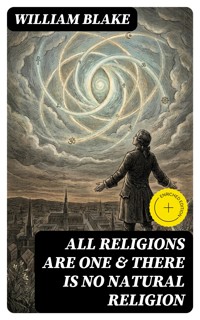
1,99 €
Niedrigster Preis in 30 Tagen: 1,99 €
Niedrigster Preis in 30 Tagen: 1,99 €
Mehr erfahren.
- Herausgeber: DigiCat
- Kategorie: Religion und Spiritualität
- Sprache: Englisch
In "All Religions Are One" and "There Is No Natural Religion," William Blake presents a provocative examination of spiritual truth beyond the constraints of institutional doctrine. The dual texts encapsulate Blake's visionary style, characterized by richly symbolic language and a deep exploration of the relationship between divine gnosis and human perception. By challenging the existing religious paradigms of his time, Blake seeks to illuminate a universal consciousness that transcends sectarian divides, positioning his work within the broader Romantic movement that emphasizes individual experience and the sublime. William Blake (1757-1827), an unorthodox poet and artist, was profoundly influenced by his own mystical experiences and the tumultuous intellectual climate of the late 18th century. His oeuvre reflects a quest for enlightenment that parallels the questions and anxieties of his era, illustrating the conflict between Enlightenment rationalism and the depths of spiritual insight. Blake's unique position as a visionary poet and engraver informed his belief in the interconnectedness of all spiritual paths, revealing an artist deeply concerned with the state of humanity's soul. This collection is a must-read for anyone interested in spirituality, philosophy, or literature, offering profound insights into the nature of belief and the human condition. Blake's work serves as a timeless invitation to explore beyond established doctrines, encouraging readers to find their own paths to spiritual enlightenment. In this enriched edition, we have carefully created added value for your reading experience: - A comprehensive Introduction outlines these selected works' unifying features, themes, or stylistic evolutions. - The Author Biography highlights personal milestones and literary influences that shape the entire body of writing. - A Historical Context section situates the works in their broader era—social currents, cultural trends, and key events that underpin their creation. - A concise Synopsis (Selection) offers an accessible overview of the included texts, helping readers navigate plotlines and main ideas without revealing critical twists. - A unified Analysis examines recurring motifs and stylistic hallmarks across the collection, tying the stories together while spotlighting the different work's strengths. - Reflection questions inspire deeper contemplation of the author's overarching message, inviting readers to draw connections among different texts and relate them to modern contexts. - Lastly, our hand‐picked Memorable Quotes distill pivotal lines and turning points, serving as touchstones for the collection's central themes.
Das E-Book können Sie in Legimi-Apps oder einer beliebigen App lesen, die das folgende Format unterstützen:
Veröffentlichungsjahr: 2022
Ähnliche


All Religions Are One & There Is No Natural Religion
Table of Contents
Introduction
This volume gathers William Blake’s paired illuminated tracts All Religions Are One and There Is No Natural Religion, both first produced in 1788, and presents them with the artist’s original illustrations. The scope is deliberately focused: brief, compressed works that inaugurate Blake’s lifelong project of uniting word and image through his unique method of printing. Bringing these books together underscores their reciprocal design and shared intellectual horizon. Each proposes, in concentrated form, the premises that underlie Blake’s later poetry and prophecies, offering readers an entry to his visionary aesthetics and to the philosophical commitments that sustained his art, religion, and critique of the dominant ideas of his century.
The texts represented here are not novels, plays, or conventional essays. They are sets of aphoristic propositions and arguments, engraved and illuminated as integral works of art. Their mode sits at the crossroads of philosophical tract, lyric brevity, emblem book, and artist’s manifesto. The plates combine flowing calligraphy, ornaments, and emblematic figures with short statements that proceed by definition, inference, and reversal. The result is a hybrid form in which the visual design does not merely illustrate the words but participates in reasoning, staging a reflective conversation between seeing and reading that cannot be separated without loss.
All Religions Are One is arranged as an Argument followed by seven Principles. Its premise is that the varieties of religious expression are rooted in a single human source: the living faculty of creative perception and expression. Rather than catalog traditions or argue history, Blake formulates a philosophical anthropology, insisting that religion, like art, arises from an inner power that seeks the infinite. The sequence advances by concise steps, inviting the reader to test each principle against experience. The work is brief, but its design encourages lingering, returning to the plates and their interplay of thought and ornament to feel the propositions gather resonance.
There Is No Natural Religion addresses the contested terrain of knowledge, faith, and the senses. Organized as an Argument, sets of numbered propositions, a Conclusion, and an Application, it challenges the notion that human understanding is limited to what can be registered by observation alone. The plates move through alternatives with deliberate economy, pressing the reader to examine what follows if mind and desire are confined by sensory data, and what follows if they are not. Surviving copies preserve variant sequences of the propositions, a reminder that Blake’s reasoning is dynamic and that illumination, for him, is a process rather than a static code.
As companion pieces, these works map the coordinates of Blake’s later achievement. They set forth, in germinal form, his conviction that imagination is the primary human reality and that religious life must be measured by the energies of perception and creative response. Read together, they display a double movement: one text affirming the unity underlying diverse religious forms, the other disputing the sufficiency of a purely natural or deistic account of belief. The pairing thus offers a concise orientation to Blake’s program and to the values that inform his subsequent illuminated books.
Across both tracts, several unifying themes appear. Blake opposes mere accumulation of facts to the enlargement of vision, arguing that perception is active and generative. He stresses the dignity and universality of the human form as the site of spiritual activity. He places limits and infinitude in continual tension, challenging readers to consider how desire, reason, and imagination cooperate. These themes are not delivered as doctrinal decrees but as provocations, each proposition short enough to memorize yet open enough to unfold. The result is a compact theology of creativity bound to an ethics of attention and freedom.
Stylistically, Blake’s hallmarks are already unmistakable. The aphoristic method condenses complex arguments into pointed turns, often arranged antithetically to expose hidden assumptions. The visual field amplifies this logic: ornaments curl around the text, figures lean or ascend, and the flow of hand-cut letters conveys urgency and care. The aesthetic is not ornamental excess but argumentative form, where decoration carries meaning and rhythm. The plates promote re-reading, as the eye discovers relations between line, color, and claim. From this marriage of graphic art and thought emerges a distinctive voice—prophetic yet intimate, systematic yet improvisatory.
The historical context of 1788 is crucial. Blake, a professional engraver in London, had devised a method of relief etching that allowed text and image to be printed from the same plate, enabling a personal mode of publication outside commercial norms. These early tracts appear at the turn from Enlightenment confidence in sense and reason toward Romantic explorations of imagination and inner life. Without rejecting inquiry, Blake presses beyond its prevailing boundaries, presenting a mode of thinking that includes, but is not confined to, empirical description. The books exemplify a new kind of authorship in which the artist is also printer, editor, and designer.
Reading these works is not a linear extraction of theses but a circular, meditative practice. The numbered propositions suggest logical progression, yet the images complicate and enrich that movement, encouraging pauses and reversals. The brevity invites comparison across plates and between the two tracts, so that ideas echo and transform. The Argument opens a path; the Principles and later sections test it against experience. The Conclusion and Application in There Is No Natural Religion return theory to life, asking how vision alters conduct. Approached patiently, the sequence becomes a workshop for training perception.
Within Blake’s oeuvre, these tracts anticipate methods and motifs that reappear in Songs of Innocence and of Experience and The Marriage of Heaven and Hell, among other illuminated books. They forecast his use of contraries as engines of truth, his resistance to reductive moralizing, and his commitment to a humane scale in which the individual imagination bears cosmic import. Recognizing their early date clarifies how coherent Blake’s project was from the outset: later works elaborate rather than replace these initiating insights, extending the reach of the same fundamental convictions.
The lasting significance of these writings lies in their articulation of a criticism of religion and reason that does not collapse into cynicism. They speak to readers across disciplines—literature, theology, philosophy, art history—because they perform, in material form, an argument for integrative knowledge. Their influence can be traced in the modern artist’s book, in visual poetry, and in critical debates about the nature of vision and belief. Yet their endurance is not only institutional. They remain vivid as acts of making, works in which thinking appears as a crafted, visible gesture.
The present collection offers a coherent encounter with Blake’s earliest illuminated thought, placing side by side two concise, companion declarations. Readers will find neither a manual nor a closed system, but an invitation to exercise the faculties these books prize. Move slowly, attend to the plates, and test the claims against your own experience. The reward is not merely understanding Blake but discovering, through his art, resources for perceiving more largely. In that sense, these small books are inexhaustible: they are beginnings—of Blake’s career and of a reader’s renewed attention to the powers of imagination.




