


0,00 €
Niedrigster Preis in 30 Tagen: 0,00 €
Niedrigster Preis in 30 Tagen: 0,00 €
Mehr erfahren.
- Herausgeber: DigiCat
- Kategorie: Poesie und Drama
- Sprache: Englisch
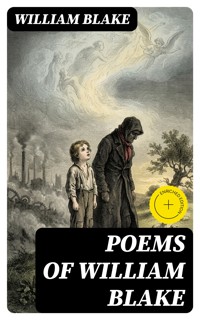
William Blake's "Poems of William Blake" presents a profound synthesis of visionary imagination and poetic craft, characterized by its richly symbolic language and innovative use of verse. The collection encompasses a diverse range of themes, from the innocence of childhood to the complexities of human experience, showcasing Blake's unique style that blends lyrical beauty with philosophical depth. His work reflects the tumultuous socio-political landscape of late 18th-century England, influenced by the Enlightenment, Romanticism, and the Industrial Revolution, as Blake engages with eternal questions of morality, spirituality, and the human condition. William Blake (1757-1827) was not only a poet but also a painter, engraver, and visionary thinker whose artistic endeavors were deeply intertwined with his beliefs. Growing up in the artistic milieu of London, Blake's radical views on religion and society informed his writings. A member of the pre-Romantic tradition, Blake's innovative approaches to form and content, along with his rejection of conventional artistic boundaries, led him to create a body of work that defies categorization and engages with both the personal and the universal. I highly recommend "Poems of William Blake" to readers seeking to explore the depths of human experience through the lens of imaginative poetry. This collection will resonate with those who appreciate rich symbolism and philosophical inquiry, inviting readers to reflect on the nature of existence and the power of the imagination. In this enriched edition, we have carefully created added value for your reading experience: - A comprehensive Introduction outlines these selected works' unifying features, themes, or stylistic evolutions. - The Author Biography highlights personal milestones and literary influences that shape the entire body of writing. - A Historical Context section situates the works in their broader era—social currents, cultural trends, and key events that underpin their creation. - A concise Synopsis (Selection) offers an accessible overview of the included texts, helping readers navigate plotlines and main ideas without revealing critical twists. - A unified Analysis examines recurring motifs and stylistic hallmarks across the collection, tying the stories together while spotlighting the different work's strengths. - Reflection questions inspire deeper contemplation of the author's overarching message, inviting readers to draw connections among different texts and relate them to modern contexts. - Lastly, our hand‐picked Memorable Quotes distill pivotal lines and turning points, serving as touchstones for the collection's central themes.
Das E-Book können Sie in Legimi-Apps oder einer beliebigen App lesen, die das folgende Format unterstützen:
Veröffentlichungsjahr: 2022
Ähnliche



Poems of William Blake
Table of Contents
Introduction
This volume gathers the poems of William Blake into a single authorial collection intended for sustained reading and study. It brings together the lyric sequences that first made his voice recognizable and the longer visionary works that define his ambition as a poet. The purpose is to present the poems as texts in one place, so that readers can trace ideas, images, and forms across Blake’s career without the practical barriers of consulting scattered sources. While the original works were issued in separate books, the present gathering emphasizes their shared imaginative field and invites comparative reading among works of different scale.
Blake wrote poems that range from brief songs and ballad-like stanzas to extended prophetic poems composed in a highly patterned verse. Within the larger works, passages of aphoristic prose or dramatic address sometimes appear, yet the focus throughout remains poetic expression. No novels, plays, letters, or diaries are included here; the collection centers on poetry as such. Readers will therefore encounter lyric pieces alongside long-form verse that unfolds as a mythic narrative. Recognizable titles within this arc include collections like Songs of Innocence and of Experience and the visionary books commonly referred to as prophecies, which expand lyric intensities into sustained structures.
Composed and published in late eighteenth- and early nineteenth-century London, Blake’s poems often first appeared as illuminated books that he designed, engraved, and printed himself. In those editions the verbal text is inseparable from elaborate visual motifs and page designs. Although this collection presents the poems as plain text, the underlying structures, voices, and images remain legible and compelling. Reading the poems together in this form foregrounds Blake’s verbal architecture: refrains and refracted symbols recur from sequence to sequence, allowing readers to hear how a line in a short song reverberates within the scale of a larger, engraved epic.
One persistent concern is the movement from sheltered innocence toward a more complex, often troubled experience of the world. Blake’s lyric sequences dramatize how perception changes as it meets suffering, injustice, desire, and work. The familiar contrast between naive vision and disenchanted recognition returns throughout the poetry, not as a simple opposition but as a dynamic in which contrary truths are held in tension. The poems ask what it would mean to preserve imaginative openness without denying historical reality. In pairing songs that speak in childlike voices with lyrics of stern insight, the work makes ethical attention inseparable from imaginative seeing.
Blake’s poetry is animated by a fierce moral critique of institutions that narrow human possibility. The poems address poverty, exploitation, and the disciplining of bodies and minds in a rapidly changing city. They consider how authority justifies itself, how belief can become coercion, and how political energies rise and fail. These concerns are framed not as newspaper commentary but as visionary diagnoses: figures, dreams, and symbolic cities embody pressures that historical readers would have recognized in their own streets. The poems ask what liberation might require and how inward freedom relates to outward change, joining ethical argument to imaginative form.
To carry this critique and aspiration, Blake developed a mythic framework populated by named personae who stand for powers of reason, imagination, rebellion, and community. In the longer poems, creative and constraining forces contend through these figures, expressing psychological and social drama in symbolic terms. Biblical language and imagery are reinterpreted within this newly forged system, not to reproduce inherited doctrine, but to imagine regeneration. The result is a poetic universe in which individual vision and collective history meet. The myth is not an escape from reality; it is a method for perceiving reality’s depths and making transformation thinkable.
Stylistically, Blake’s poems combine lucid diction with intricate patterning. Parallel structures, insistent rhythms, and recurring images generate a musical pressure that can seem both simple and inexhaustible. Capitalized abstractions move alongside tangible details, while compressed aphorisms break out from rolling prophetic lines. Many poems hinge on an emblem—an animal, a child, a city—that concentrates feeling into a single figure, then releases it through variation and counterstatement. The verse can sing, argue, chant, and prophesy, often within a single work. Throughout, an exacting attention to sound and cadence supports the poems’ claims about perception, conscience, and the work of imagination.
Reading across the collection reveals a network of echoes. Short lyrics prepare motifs that expand within the longer poems; conversely, the epics cast new light on the brevity and poise of the songs. Blake often writes in distinct voices—innocent, ironic, indignant, or visionary—so that tone becomes part of argument. Apparent simplicity may conceal an unsettling turn of perspective. The reader’s task is not to choose one voice over another, but to hear how they correct and complete each other. Approached in this way, the collection offers an apprenticeship in attention to contraries, to changes of register, and to formal invention.
The lasting significance of Blake’s poetry lies in its conviction that imagination is an active faculty capable of re-making perception and, through perception, life. This insistence has proved influential across literature and the arts, where his example of integrating craft, vision, and critique has inspired later movements. Critics and readers have returned to the poems to think about freedom, prophecy, labor, childhood, and the responsibilities of seeing. The work resists reduction to a single thesis: it asks to be read, re-read, and placed in conversation with its times and ours. Its energy continues to sharpen debate and enlarge sympathy.
Because many poems first appeared in engraved copies that vary in coloring and design, modern transcriptions can differ in details of presentation. Lineation, spelling, and punctuation in Blake’s work carry expressive weight, and readers should be attentive to how meaning turns on such features. While this collection presents the poetry in a uniform medium, it remains useful to remember the original conditions of production, where page, picture, and poem were conceived together. Awareness of that origin does not limit textual reading; it enriches it, encouraging sensitivity to structure, sequence, and the visual metaphors that the language often implies.
For orientation, readers new to Blake may find it helpful to begin with the shorter sequences, then move toward the grander prophetic architectures. The songs offer clear entrances into central concerns; the longer poems gather those concerns into narratives of struggle and renewal. As one progresses, recurring names and places become more legible, and the unity of the enterprise reveals itself. Yet the poems do not require specialized knowledge to speak: they address recognizable experiences—loss, wonder, anger, hope—through memorable forms. The collection is designed to support both first encounters and sustained study, accommodating multiple pathways through Blake’s achievement.
Gathered here as poems, William Blake’s work can be approached as a single unfolding project: to imagine a human form more generous, awake, and free. Bringing the lyrics and the prophecies into one accessible corpus allows readers to grasp the continuity of images and the evolution of Blake’s art. The result is not a museum of isolated pieces but a living conversation among voices, forms, and visions. The present collection aims to honor that conversation by making the texts available together, so that their urgency, strangeness, and beauty can be engaged anew by readers in search of a demanding pleasure.
Author Biography
William Blake (1757–1827) was an English poet, printmaker, and visionary artist whose work bridged the later Enlightenment and the rise of Romanticism. He is best known for his illuminated books, which combined verse, prose, engraving, and watercolor into unified artifacts of image and text. Working largely in London and outside institutional fashions, he pursued a lifelong project to articulate an imaginative counter-tradition to prevailing rationalism and commercial culture. Though his readership during his lifetime was small, his iconoclastic methods and audacious symbolic inventions would later be celebrated as foundational to modern conceptions of the artist as an independent, self-publishing creator.
Blake’s artistic formation began early through drawing and exposure to prints, then formalized with an apprenticeship to the engraver James Basire in his teens. Basire sent him to sketch medieval monuments in Westminster Abbey, an experience that sharpened Blake’s taste for Gothic line, visionary figures, and historical allegory. He later studied at the Royal Academy Schools, while reacting strongly against academic theories associated with Joshua Reynolds. Blake revered the Bible, classical and Renaissance masters, and writers such as Milton and Dante, and engaged intensely with contemporary mystical thought, including that of Emanuel Swedenborg, even as he departed from it in his own prophetic writings.
In the late 1780s Blake developed his distinctive method of relief etching, enabling him to print words and designs together and hand-color the pages, a process he called illuminated printing. The early sequence Songs of Innocence, later paired with Songs of Experience, offered distilled lyrics and emblematic images that juxtapose pastoral tenderness with social critique. Around the same period he produced The Marriage of Heaven and Hell, a satirical, aphoristic work that challenged conventional moral binaries, and visionary books such as Visions of the Daughters of Albion. America a Prophecy opened a series addressing contemporary upheavals through his emerging mythic vocabulary.




