


0,49 €
Niedrigster Preis in 30 Tagen: 1,99 €
Niedrigster Preis in 30 Tagen: 1,99 €
Mehr erfahren.
- Herausgeber: DigiCat
- Kategorie: Poesie und Drama
- Sprache: Englisch
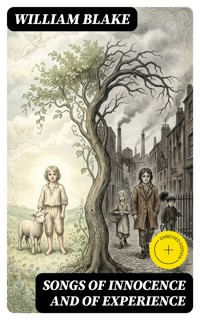
William Blake's 'Songs of Innocence and of Experience' is a profound exploration of the duality of human existence, meticulously structured in two contrasting sections that portray the innocent and the experienced facets of life. Utilizing a distinctive blend of lyrical poetry and stunning illustrations, Blake employs simple yet evocative language to convey deeper philosophical themes. The collection delves into the innocence of childhood, the joys of nature, and, conversely, the complexities and harsh realities of adulthood, serving as a reflection on the social injustices of the 18th century amidst the backdrop of the Industrial Revolution and Romantic literary movements. Blake, a visionary poet, artist, and engraver, was deeply influenced by his radical views on religion, society, and the human condition. His formative experiences in London, coupled with an affinity for mysticism and a desire to challenge conventional societal norms, shaped his creative output. Blake's unique perspective and unwavering commitment to his beliefs allowed him to craft a work that transcends time, addressing universal themes relevant to all generations. This seminal collection is a must-read for anyone interested in the interplay of innocence and experience, as well as the emotional and social intricacies of human life. Blake's ability to articulate profound truths through accessible verse invites readers to reflect on their own journeys, making this not just a literary work, but a transformative experience. In this enriched edition, we have carefully created added value for your reading experience: - A comprehensive Introduction outlines these selected works' unifying features, themes, or stylistic evolutions. - The Author Biography highlights personal milestones and literary influences that shape the entire body of writing. - A Historical Context section situates the works in their broader era—social currents, cultural trends, and key events that underpin their creation. - A concise Synopsis (Selection) offers an accessible overview of the included texts, helping readers navigate plotlines and main ideas without revealing critical twists. - A unified Analysis examines recurring motifs and stylistic hallmarks across the collection, tying the stories together while spotlighting the different work's strengths. - Reflection questions inspire deeper contemplation of the author's overarching message, inviting readers to draw connections among different texts and relate them to modern contexts. - Lastly, our hand‐picked Memorable Quotes distill pivotal lines and turning points, serving as touchstones for the collection's central themes.
Das E-Book können Sie in Legimi-Apps oder einer beliebigen App lesen, die das folgende Format unterstützen:
Veröffentlichungsjahr: 2022
Ähnliche


Songs of Innocence and of Experience
Table of Contents
Introduction
This collection gathers William Blake’s Songs of Innocence and Songs of Experience into the unified sequence he titled Songs of Innocence and of Experience: Showing the Two Contrary States of the Human Soul. It presents the poems alongside Blake’s own illustrations, honoring the original conception of an illuminated book in which text and image form a single artistic statement. The scope is comprehensive for this project: both cycles appear in full, enabling readers to encounter their cross-currents, echoes, and tensions. The purpose is to preserve the integrity of Blake’s vision and to offer a reading experience in which lyric, design, and idea work together without partition.
Blake first issued Songs of Innocence in 1789 and later produced Songs of Experience in 1794, subsequently combining them under the fuller title reproduced here. He devised and executed a method he called illuminated printing, by which he wrote, drew, and etched the plates, then printed and often hand-colored the pages. The ordering and selection of plates could vary among copies he produced. This edition follows the established two-part structure to reflect Blake’s deliberate counterpoint of moods, ideas, and voices, and includes the original illustrations as interpretive partners rather than decorative supplements.
The genre represented is lyric poetry, shaped as songs that draw on hymn, ballad, pastoral, lullaby, and brief meditative verse. The texts range from a few compact lines to multi-stanza pieces, and frequently adopt distinct speaking voices—child, guardian, prophet, wanderer. No essays, letters, or prose narratives appear here; instead, the visual component—the illuminated designs—forms a parallel art that frames and extends the poems. Readers thus encounter a hybrid artifact: a poetic sequence that is also a gallery of images, each plate an integral page-stage on which words and figures communicate, sometimes in harmony, sometimes in productive tension.
The guiding premise is the exploration of contrary states. Innocence is not naïveté alone, nor is experience mere cynicism; each is a condition of perception with its own insight and limitation. The two are set in dialogue rather than arranged as stages toward a final synthesis. Each half opens with an introduction that invites entry into its distinctive atmosphere: the one attuned to play and pastoral song, the other to prophetic urgency and a troubled world. Their conversation continues across the collection, so that recognition and challenge, faith and doubt, tenderness and severity continually answer one another.
Songs of Innocence gathers a chorus of childlike trust, familial intimacy, and communal celebration. Pieces such as The Shepherd, The Lamb, Spring, A Cradle Song, Infant Joy, and The Ecchoing Green dwell in an imagined pastoral of care, protection, and cyclical renewal. Yet Blake allows darker currents to surface: The Little Black Boy, The Chimney Sweeper, Holy Thursday, and The Little Boy Lost and The Little Boy Found frame innocence against social hierarchies, labor, and estrangement. The mood is luminous, the diction plain, the music inviting, but the vision is alert to vulnerability and to the pressures that threaten childhood and compassion.
Songs of Experience answers with disillusion and analytic clarity. Here, London maps a city of constraint and surveillance; The Garden of Love confronts institutional authority; The Human Abstract anatomizes the origins of certain virtues; A Poison Tree studies the growth of anger. The Tyger poses a burning question about creation and terror; Holy Thursday and The Chimney Sweeper return in altered lights; The Sick Rose, The Fly, and The Little Vagabond trace fragile lives in a fallen world. The tonal palette is harsher and more compressed, yet the songs remain lucid, measured, and incantatory, built to test the premises of innocence without abandoning lyric force.
Across the two parts, Blake constructs a lattice of mirrors and variations. Titles recur with differences—Nurse’s Song and Nurses Song, The Chimney Sweeper, Holy Thursday—so that readers may compare the same nominal subject across contrary states. Other sequences, such as The Little Girl Lost and The Little Girl Found, move through both halves, complicating any simple division. The Voice of the Ancient Bard hovers at the threshold between pastoral and prophecy. Even the presence of The School Boy in differing contexts reveals how education can be imagined as nurture or confinement. This architecture rewards reading in pairs, chains, and crisscrossings.
Blake’s style blends simplicity and subtlety. He favors short lines, clear syntax, and strong rhyme, drawing on folk and hymn traditions to achieve immediate musical appeal. Beneath this apparent ease lie paradox, irony, and symbolic density. Emblems—lamb, tyger, rose, garden, worm—carry layered meanings that shift as they move between innocence and experience. Personified abstractions and aphoristic turns collide with concrete, homely images. The voices are dramatically distinct yet interrelated, allowing Blake to render social scenes, inward meditations, and visionary pronouncements with an economy that invites rereading and re-seeing.
The visual designs are essential to understanding the poems. Blake integrates scrolling vines, radiant figures, architectural forms, and emblematic creatures around and within the text, guiding the eye through each plate. The colors—often delicately washed—modulate mood; margins teem with children at play, guardians at watch, or emblematic flora and fauna that echo the poem’s concerns. Sometimes image and verse affirm each other; at other times they complicate or question the verbal statement. The pages thus stage a dialogue among sight, sound, and sense, transforming the act of reading into an encounter with a living, illuminated surface.
The social and historical pressure of late eighteenth-century Britain courses through these songs. Charity schools, child labor, religious and civic institutions, and the burgeoning metropolis supply contexts for Blake’s figures. Yet the poems reach beyond reportage. They probe the psychology of innocence under strain and the ethical dilemmas of experience—how fear, desire, envy, and wrath take root and how institutions can both shelter and injure. By giving speech to children, guardians, and bards, Blake exposes the workings of conscience and the limits of sympathy, asking how a community might be imagined without sacrificing freedom or love.
The lasting significance of this work lies in its formal invention and moral imagination. Songs of Innocence and of Experience is a cornerstone of English Romanticism and a landmark in the history of the artist’s book. It has shaped discussions of lyric voice, visual-verbal art, and the social role of poetry. Its best-known pieces have entered common cultural reference, yet the collection gains power when read whole, as a structure of argument and feeling. Its contraries remain vital because they refuse closure, inviting new readers to negotiate their own balances between trust and critique, vision and reality.
Readers may approach these plates sequentially or in dialogue, pairing cognate poems across the two halves. Attend to recurrent images and words; listen for tonal shifts between consolation and challenge; let the illustrations inflect meaning without dictating it. This edition’s inclusion of Blake’s original designs preserves the artifact’s unity, presenting the poems as they were conceived: sung, seen, and thought together. In that spirit, the gathering here serves both as introduction and as full encounter, offering the two contrary states not as a riddle to be solved but as a living conversation to be carried forward.
Author Biography
William Blake (1757–1827) was an English poet, engraver, and painter whose visionary art and verse made him a singular figure in the age that preceded and shaped Romanticism. Working largely outside mainstream literary and academic institutions, he fused text and image through an experimental form he called illuminated printing. His best‑known achievement, gathered as Songs of Innocence and Songs of Experience, pairs lyric clarity with prophetic critique, exploring how childhood, society, and spirit intersect. Though his reputation during his lifetime was modest, Blake’s originality—combining radical artistry, moral intensity, and spiritual imagination—now stands as foundational for modern conceptions of the poet as both maker and seer.
Blake was born in London and showed early talent for drawing and verse. Apprenticed to the engraver James Basire, he learned the exacting craft of line engraving while sketching monuments and reliefs at Westminster Abbey, experiences that deepened his attachment to Gothic design and biblical symbolism. He later studied at the Royal Academy Schools, where he developed an independent aesthetic, skeptical of prevailing neoclassical ideals. His reading included the Bible and English poets such as Milton, and he was drawn to visionary and mystical thought circulating in eighteenth‑century London. This combination of artisanal training, literary engagement, and spiritual intensity shaped his path as a poet‑artist.
To realize his books on his own terms, Blake devised relief etching for words and images on copper plates, then printed and hand‑colored the pages, often with the assistance of his wife, Catherine, a collaborator in their studio. This process allowed him to publish Songs of Innocence (1789) and later issue the augmented Songs of Innocence and of Experience (1794), each copy varying in sequence and coloring. The result integrated poem, picture, and page design into a single expressive field. Because the books were produced in small numbers, their circulation was limited, but the method preserved Blake’s complete artistic control and conveyed meanings visually as well as verbally.
Songs of Innocence presents a world seen through tenderness, play, and trust—yet never wholly free from suffering. Poems like The Lamb, The Shepherd, Infant Joy, Laughing Song, and Ecchoing Green voice pastoral delight and communal harmony. A Cradle Song, Spring, The Blossom, and The Divine Image celebrate nurture, growth, and humane virtues. At the same time, The Little Black Boy and The Chimney Sweeper expose social inequities and child labor, while On Another’s Sorrow asks how pity and empathy might answer pain. Throughout, music‑like rhythms, refrains, and clear imagery invite readers into states of receptivity and compassion without denying the world’s flaws.
Songs of Experience answers and darkens that earlier vision, confronting oppression, hypocrisy, and inner division. The Tyger poses the terrifying grandeur of creation; London maps a city of constraint and grief. The Sick Rose, The Garden of Love, The Human Abstract, and A Poison Tree expose damaged desire, institutional repression, rationalized cruelty, and concealed anger. Companion pieces—including Holy Thursday, The Chimney Sweeper, and Nurses Song—reconsider innocence under social pressure. Other lyrics, such as My Pretty Rose Tree, Ah! Sun‑flower, The Lilly, The Fly, The Angel, Infant Sorrow, A Little Boy Lost, and A Little Girl Lost, test love, freedom, and conscience in a fallen world, often in brief, crystalline lines.
Blake’s art advances a poetics of contraries: innocence and experience are not simple stages but necessary tensions through which perception widens. He distrusted coercive power—whether political, economic, or ecclesiastical—and he resisted moral codes that stifle imagination, a stance audible in The Little Vagabond and visible across poems that give children a truth‑telling voice. The Voice of the Ancient Bard signals his prophetic ambition: to awaken readers from passivity toward visionary awareness. Text and image collaborate to teach this awakening; the plates’ pastoral garlands or darker tendrils echo each poem’s mood, so that seeing, like reading, becomes an act of interpretation.
Blake spent most of his life working in relative obscurity, supported by engraving commissions and a small circle of admirers. He died in 1827, his illuminated books still little known to the wider public. Over the later nineteenth and twentieth centuries, however, Songs of Innocence and Songs of Experience came to be recognized as central achievements of English literature and art. Their union of lyric brevity, graphic invention, and ethical urgency continues to influence poets, visual artists, educators, and composers. Today, pieces like The Lamb, The Tyger, London, and The Garden of Love remain staples in classrooms and culture, sustaining Blake’s living legacy.
Historical Context
William Blake’s Songs of Innocence and of Experience emerged from the late Georgian era, a period that straddled the Enlightenment and the beginnings of British Romanticism. Born in 1757 and active primarily in London, Blake worked at a moment when debates about reason, imagination, and human rights unsettled established institutions. Songs of Innocence first appeared in 1789, with Songs of Experience following in 1794; together they present “the two contrary states of the human soul.” The pastoral voices of Innocence, heard in pieces like The Lamb or The Ecchoing Green, confront the sharper social and spiritual critique of Experience, evident in poems such as London and The Human Abstract.
The collection’s format reflects Blake’s invention of relief etching around 1788, a technique he called “illuminated printing.” Text and designs were drawn in reverse on copper plates, etched with acid, printed, and then hand-colored with watercolor. This process allowed an intimate integration of word and image and gave Blake unusual independence from commercial printers. Trained as an engraver under James Basire and enrolled at the Royal Academy Schools from 1779, Blake fused artisan discipline with visionary ambition. The illuminated pages’ ornaments—vines, lambs, children, flames—frame the lyrics and inflect their meaning, anchoring the poems in a distinctive late eighteenth-century visual culture.
Blake’s decision to produce small, self-printed editions positioned him at the margins of the metropolitan book trade yet within the bustling, often contentious world of London print culture. Working from his homes in Soho and later Lambeth, he could revise sequences and coloring across copies, so Songs circulates as a living artifact rather than a single fixed text. This workshop model—Blake and his wife Catherine hand-coloring impressions—embodied a craft-based alternative to expanding industrial book manufacture. The arrangement of companion poems, such as The Divine Image with The Human Abstract, or Holy Thursday in both books, invites readers to weigh contradictory perspectives shaped by the era’s anxieties.
The poems arose amid revolutions and counter-revolutions. The American War of Independence (1775–1783) energized discussion of liberty across Britain, while the French Revolution (from 1789) split public opinion and redefined political vocabulary. British readers encountered sharply opposed arguments—Edmund Burke’s Reflections on the Revolution in France (1790) and Thomas Paine’s Rights of Man (1791–1792)—that reverberate through Blake’s concern with bondage and liberation. The songs’ pivots between pastoral ease and constricted city life, between childlike trust and institutional control, mirror this contested world of rights, duties, and governance, without tying themselves to a single party platform or topical pamphlet.
The political volatility of the 1790s also included state repression. The government prosecuted radicals, suspended habeas corpus in 1794, and after large protest meetings passed the “Two Acts” (1795) against seditious assemblies and treasonable speech. Spies and informers monitored societies such as the London Corresponding Society. Experience’s tone—heard in London’s “mind-forg’d manacles” and in the wary logic of The Human Abstract—reflects a culture of surveillance and constraint. A Poison Tree’s exploration of concealed anger resonates with a decade when public expression could carry heavy costs, and private grievances circulated through rumor, print, and the courts.
Industrialization altered the social landscape that Songs scrutinizes. Expanding factories, new time disciplines, and crowded apprenticeships reshaped childhood and labor. Child chimney sweepers, recruited from poor families, faced harsh, dangerous work despite the limited Chimney Sweepers Act of 1788. Blake’s paired Chimney Sweeper poems register both consolatory rhetoric and painful realities. More broadly, increasing mechanization and commercial rhythms inform poems attentive to lost play and stifled growth, as in The School Boy. The pastoral counterworld of Innocence—fields, lambs, spring—thus acquires historical bite, set against the era’s mills, workshops, and the commodification of youthful bodies and time.
Charity schooling and ritual spectacle offer another historical lens. In eighteenth-century London, thousands of children from charity schools annually processed to St Paul’s Cathedral for an Ascension Day service, commonly termed “Holy Thursday.” Supported by subscription and philanthropic societies, the event displayed benevolence and discipline on a grand scale. Blake’s two Holy Thursday poems weigh that spectacle: one renders the children as a living choir of lambs; the other queries whether such pageantry masks endemic poverty. These pieces engage the century’s philanthropic culture, which could relieve distress while also reinforcing hierarchies and expectations of obedience among the poor.
Debates over Atlantic slavery and abolition formed a powerful backdrop to Blake’s lifetime. The Society for Effecting the Abolition of the Slave Trade was founded in 1787; mass petitioning, publications by figures like Olaudah Equiano (1789), and Josiah Wedgwood’s emblem helped mobilize opinion. Parliament abolished the British transatlantic slave trade in 1807. The Little Black Boy participates in this ferment by imagining spiritual equality while acknowledging racialized suffering. The Divine Image’s universal virtues—Mercy, Pity, Peace, Love—resonate with abolitionist arguments that stressed a shared humanity, even as economic interests and imperial policy continued to sustain coerced labor for decades.
Rapid urbanization intensified social pressures that Songs records. London’s population exceeded one million by around 1800, with congested housing, polluted thoroughfares, and widening inequalities. War with France from 1793 brought taxation and inflation; dearth in the mid-1790s increased hardship. London portrays a city of regulated spaces—the “charter’d” streets and Thames—where institutions imprint bodies and voices. Poems like The Sick Rose and The Garden of Love register anxieties about hidden decay and the loss of open, communal space. Against this backdrop, pastoral lyrics such as Night or Spring offer a counter-imaginary of guardianship, cycles, and renewal that urban life seemed to erode.
Religious change shaped the moral climate of Blake’s England. The Evangelical revival, including Methodism under John Wesley, energized popular religion and philanthropy, while societies for moral reform and the Sunday School movement (from the 1780s) sought disciplined improvement. Blake, who read Emanuel Swedenborg and encountered the nascent New Church in London, later criticized institutional religion’s constraints. The Garden of Love and The Little Vagabond oppose lived joy to rigid worship, while Nurse’s Song contrasts free play with anxious surveillance. Earth’s Answer and the Introduction to Experience dramatize a cosmic quarrel about authority and liberation, echoing contemporary controversy over church power.
Eighteenth-century ideas of childhood provided a vocabulary for Blake’s Innocence. John Locke’s emphasis on experience and education and Jean-Jacques Rousseau’s celebration of natural growth encouraged a new tenderness toward children in art and letters. Cultural institutions like the Foundling Hospital (established 1739) had already made childhood a public cause. Poems such as A Cradle Song, Infant Joy, and The Little Boy Lost/The Little Boy Found present care, vulnerability, and rescue as central concerns. Yet Innocence does not sentimentalize indiscriminately; its shepherds and infants exist within social systems of apprenticeship, guardianship, and poverty that could alternately nurture or abandon.
Educational reform was intensely debated in Blake’s day. Beyond elite schools, large charity schools and, from the 1790s, monitorial systems associated with Andrew Bell and Joseph Lancaster promised mass instruction at low cost through pupil-teachers and drill. Critics worried about rote learning and harsh discipline. The School Boy laments the suppression of curiosity and the misalignment of pedagogy with season and growth; Nurse’s Song celebrates spontaneous play as formative. These poems register a historical turn toward standardized schooling while defending experiential, nature-centered learning, situating Blake within wider conversations on how to cultivate a moral, literate populace.
Natural philosophy and theology also permeate the collection. Newtonian science dominated intellectual life, while arguments from design underwrote natural theology well before William Paley’s famous articulation (1802). The Lamb frames creation as intimate and nurturing, whereas The Tyger imagines a maker at the forge—hammer, anvil, furnace—images familiar in an age of ironworks like the Carron Ironworks (founded 1759). This tension reflects competing eighteenth-century models of creation: benevolent order versus sublime power. Rather than resolve the debate, the two lyrics anchor Blake’s “contrary states,” asking how readers discern divinity amid beauty, terror, mechanism, and artifice.
Gender, sexuality, and domestic authority were structured by law and conduct literature. Coverture restricted married women’s legal identity, while sermons and manuals promoted chastity, obedience, and sensibility. Social anxieties about seduction, reputation, and jealousy find refracted expression in poems from Experience such as The Angel, My Pretty Rose Tree, Ah! Sun-flower, and The Lilly, where desire encounters constraint or idealization. The Little Girl Lost and The Little Girl Found, appearing in both books, shift from fearful narratives of exposure to possibilities of protection or recovery. Blake’s lyrics engage these eighteenth-century norms without endorsing either libertinism or punitive moralism.
Blake’s personae draw on prophetic and bardic traditions prominent in eighteenth-century Britain. Thomas Gray’s The Bard (1757) and James Macpherson’s popular—if contested—Ossianic epics cultivated fascination with ancient seers and national song. In Songs, the bardic voice appears explicitly: the Introduction to Experience summons “the Bard,” and The Voice of the Ancient Bard speaks from visionary testimony. Earth’s Answer stages an oracular dialogue with a bound Earth. These modes also reflect Blake’s immersion in the Hebrew Bible and prophetic rhetoric, situating his lyrics within a broader revival of antiquity and scriptural authority in the age’s poetics.
The collection engages Enlightenment moral discourse by pairing virtues with their social conditions. The Divine Image celebrates Mercy, Pity, Peace, and Love as universal; The Human Abstract counters that such virtues may grow from poverty, fear, and inequality. The Clod & the Pebble balances altruism against self-love, echoing contemporary debates from David Hume and Adam Smith about sympathy and interest. A Poison Tree explores how concealed resentment ripens into harm, aligning psychological insight with moral casuistry. Together, these pieces scrutinize the ethical vocabulary of the eighteenth century, asking how institutions and power shape private feeling and public virtue.
Blake’s visual language was equally historical. Trained as an engraver, he resisted the Royal Academy’s doctrine of “general nature” associated with Joshua Reynolds and privileged linear design derived from Gothic monuments and Renaissance masters like Michelangelo. His apprenticeship work drawing tombs in Westminster Abbey sharpened a precise, sculptural line that animates the Songs’ plates. Motifs of vines, flames, children at play, and angels guide the reader’s movement through each page. The illuminated format aligns the poems with older emblem traditions while exploiting new possibilities of color wash, ensuring that the historical world of the 1790s is filtered through deliberately archaic and visionary forms of seeing and reading. It was written in a time of great turmoil... a time of oppression and a time of hope. All across the earth, mighty forces of nature were bringing on a storm and all in the hands of mortal men. Alas, that mortal men could not see beyond the veil of parchment towards the infinite skies... but some could see. It was one of these men, William Blake who was as a mind forged in the fires of the heavens and born into the wickedness of London town who penned these poems with the blood of authentic spirit itself.
Synopsis (Selection)
Thresholds and Prophecy: Introductions, Earth's Answer, and The Voice of the Ancient Bard
These framing poems stage the passage between states: an inviting song of pastoral celebration opens Innocence, while the bardic summons of Experience calls a fallen world to awaken. Earth's Answer replies with the voice of nature resisting bondage, and The Voice of the Ancient Bard in each state urges readers toward visionary perception. Together they shift the tone from playful welcome to urgent prophecy, announcing the collection’s recurring contrast between trust and disillusion.
Holy Thursday (Innocence & Experience)
These paired pieces contrast a hymn-like view of ritual charity with a stark indictment of institutional power. The Innocence poem marvels at communal pageantry and seeming benevolence, while the Experience counterpart exposes systemic neglect and the hollowness of sanctioned compassion. Their dialogue crystallizes the book’s moral inquiry into religion, poverty, and social conscience.
The Chimney Sweeper (Innocence & Experience)
Both poems center on a child laborer, but the emotional arc shifts from visionary consolation to scathing protest. The Innocence version imagines redemption through dream and faith, whereas the Experience poem scrutinizes the complicity of church and parents. The pairing embodies the movement from inner hope to social critique.
Nurse's Song / Nurses Song (Innocence & Experience)
A caregiver’s voice frames childhood play as either a space of freedom or a site of repression. In Innocence, trust in natural rhythms blesses laughter and open fields; in Experience, suspicion and anxiety curdle care into control. The tonal reversal shows how fear transforms protection into constraint.
The School Boy (Innocence & Experience)
These poems weigh the vitality of learning in nature against the stifling effects of forced instruction. The Innocence piece voices a child’s springtime longing to grow unconfined, while the Experience counterpart hardens that complaint into a broader critique of systems that stunt imagination. Together they cast education as either cultivation or captivity.
The Little Girl Lost and The Little Girl Found (Innocence & Experience)
Across both states, these narrative lyrics follow a child’s passage through danger toward a surprising form of protection and recognition. In Innocence, wilderness and creaturely guardianship suggest nature’s hidden kindness; in Experience, the same titles inflect the fable with anxiety about desire, authority, and social judgment. The doubleness tests whether instinct can guide more faithfully than fear.
The Lamb (Innocence) and The Tyger (Experience)
This famous counterpoint presents creation under the signs of gentleness and dread. The Lamb offers childlike self-knowledge and benevolence as keys to understanding the maker, while The Tyger confronts the sublime intensity that also inhabits creation. Read together, they stage the mind’s struggle to reconcile beauty and terror, mercy and power.
Innocent Pastoral Joys (The Shepherd; Ecchoing Green; Spring; The Blossom; Laughing Song; A Cradle Song; Infant Joy; Night)
These lyrics gather scenes of communal play, familial tenderness, and nature’s cyclic care. Shepherding, blossoms, songs, and sleep frame a world where time is rhythmic and guardianship benign. The tone is musical and luminous, celebrating harmony while hinting at its fragility.
Compassion, Vision, and Identity (On Another's Sorrow; The Divine Image; The Little Black Boy; A Dream)
These poems affirm empathy as spiritual kinship and imagine identity shaped by love rather than hierarchy. They teach recognition of shared humanity and portray visionary guidance arriving through dreams and inner light. The voice is serene and didactic, inviting readers to practice charity as a sacred discipline.




