


0,49 €
Niedrigster Preis in 30 Tagen: 1,99 €
Niedrigster Preis in 30 Tagen: 1,99 €
Mehr erfahren.
- Herausgeber: DigiCat
- Kategorie: Poesie und Drama
- Sprache: Englisch
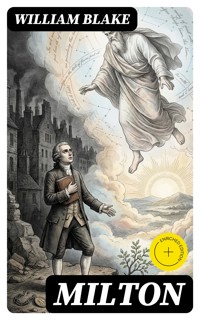
In "Milton," William Blake crafts an ambitious epic that melds his mystical visions with a profound exploration of the human condition and artistic inspiration. Written in the form of a poetic narrative, the text features rich symbolic imagery and innovative, sometimes perplexing, language that challenges conventional literary form. Blake invokes the figure of John Milton, presenting him as a symbolic representation of the poet's own struggle with the constraints of the material world and the quest for spiritual truth. The interwoven themes of redemption, creation, and duality are emblematic of Blake's larger body of work, positioning "Milton" within the context of the Romantic movement and the broader quest for individuality and enlightenment in the face of societal norms. William Blake, a visionary poet, painter, and printmaker, was driven by his unrelenting quest for understanding and the divine. Living in 18th-century England, a time marked by profound political and social upheaval, Blake's personal experiences and fervent beliefs influenced his artistic endeavors. His engagement with theology, mysticism, and his disdain for institutionalized religion permeate his work, culminating in the creation of "Milton," where he grapples with the complexities of creativity and the divine purpose behind artistic expression. "Milton" is a rewarding journey for readers seeking to navigate the intersections of art, spirituality, and morality. Blake's intricate blend of mythological and autobiographical elements encourages deep contemplation and dialogue. This book not only serves as a testament to Blake's genius but also invites readers to explore their own inner landscapes, making it a significant addition to any literary scholar's collection. In this enriched edition, we have carefully created added value for your reading experience: - A succinct Introduction situates the work's timeless appeal and themes. - The Synopsis outlines the central plot, highlighting key developments without spoiling critical twists. - A detailed Historical Context immerses you in the era's events and influences that shaped the writing. - An Author Biography reveals milestones in the author's life, illuminating the personal insights behind the text. - A thorough Analysis dissects symbols, motifs, and character arcs to unearth underlying meanings. - Reflection questions prompt you to engage personally with the work's messages, connecting them to modern life. - Hand‐picked Memorable Quotes shine a spotlight on moments of literary brilliance. - Interactive footnotes clarify unusual references, historical allusions, and archaic phrases for an effortless, more informed read.
Das E-Book können Sie in Legimi-Apps oder einer beliebigen App lesen, die das folgende Format unterstützen:
Veröffentlichungsjahr: 2022
Ähnliche



Milton
Table of Contents
Introduction
A dead laureate turns back from eternity to walk into a living poet’s imagination, where copper plates burn with images and words, where the nation’s myth is contested line by line, and where the most intimate struggle—between prophetic vision and inherited authority—becomes an epic journey across a visionary Britain whose landscapes are made of conscience, memory, and song, so that the work we inherit from the past can be remade without merely repeating it, and art can become the furnace in which both an author’s fame and a reader’s expectations are tried, tempered, and set alight anew.
Milton A Poem stands among William Blake’s great prophetic works as a classic because it renews the ambitions of epic for the modern imagination. Blake, poet, engraver, and radical visionary of the Romantic era, forged a hybrid art in which poetry, painting, and printmaking are inseparable. This poem’s boldness—its refusal to separate private vision from public concern—has kept it a touchstone for artists seeking forms equal to their convictions. It matters not merely as a historical curiosity but as a living challenge: a demonstration that epic scale can be achieved without abandoning lyric intensity or intellectual risk.
Composed and etched in the first decade of the nineteenth century, with the opening materials dated around 1804, Milton emerges from Blake’s mature period, when he worked largely outside commercial publishing and printed his own illuminated books. The political and cultural aftershocks of the revolutionary 1790s, together with debates about nation, religion, and the uses of art, provide its atmosphere. Blake’s studio practice—writing, drawing, and etching on the same copper plates—was not a later addition but the poem’s very condition of existence, allowing composition, revision, and design to proceed as a single imaginative act rather than separate, sequential tasks.
At its core the poem presents a visionary premise: the spirit of John Milton returns to confront the consequences of his legacy and to seek renewal through a descent into the world of a contemporary poet. This act of self-questioning sets in motion a quest that moves through a mythologized Britain and engages Blake’s own symbolic dramatis personae. Without recounting its developments, it is sufficient to say that the poem stages a dialogue across time about authorship, conscience, and the authority of imagination, inviting readers to witness the labor by which influence is transformed into responsibility.
Milton’s status as an illuminated manuscript is integral to its meaning. Blake’s relief etching allows text to flow within borders of vines, flames, and figures; hand coloring and wash enrich the plates with tonal atmospheres that help shape interpretation. The images do not merely illustrate; they converse with the verse, amplifying hints, anticipating turns, and punctuating meditative passages with visionary shocks. The result is a reading experience that is also a viewing experience, an art object whose material textures—letterforms, pigments, engraved lines—become part of the poem’s argument about how perception itself must be trained to see anew.
The poem’s classic stature rests as well on its audacious engagement with the English poetic tradition. Blake confronts the inheritance of epic not by imitating it but by retuning it to the registers of prophecy, personal crisis, and national imagination. The famous lyric that later became an English hymn originates in the preface to this work, a reminder that Milton’s energies radiate outward into cultural life. Yet the poem’s impact is not reducible to that lyric: it demonstrates how a long poem can address public history while remaining rigorously individual in voice and vision.
Blake’s influence on later writers often runs straight through Milton. Algernon Swinburne championed Blake’s prophetic genius; the Pre-Raphaelite circle found in his fusion of word and image a model for symbolist intensity; W. B. Yeats studied and edited Blake, adapting aspects of his visionary system to his own work; and twentieth-century poets such as Allen Ginsberg drew courage from Blake’s assertion that visionary experience belongs to poetry. Beyond verse, the poem’s integrated text-image practice helped seed the modern idea of the artist’s book, shaping how subsequent creators imagine the page as a total aesthetic field.
Thematically, Milton returns again and again to the question of artistic accountability. What does it mean to make a great work that shapes a nation’s conscience, and how does a later artist honor that gift without being shackled by it? The poem considers the bondage of error, the possibility of forgiveness, and the power of imaginative labor to heal divisions—within the self and within the body politic. It explores religious and philosophical tensions without dogma, proposing that genuine vision is both disciplined and liberating, a form of clarity that refuses the easy comfort of inherited formulas.
Formally, the poem is a daring composite. Structured in two books, it blends narrative with prophecy, meditation with invective, and visionary scene with aphoristic insight. Blake’s long-lined, flexible verse resists conventional meters while sustaining a musical cadence of exhortation and reflection. Biblical allusions mingle with references to English literary history; mythic figures from Blake’s own symbolic cosmos appear and reappear with thematic purpose. The overall effect is not of tidy sequence but of unfolding revelation, a design whose coherence is felt through recurrence of symbols, tonal contrasts, and visual motifs on the plates themselves.
Readers entering Milton need not master a technical glossary of Blakean terms to find their footing. The poem offers entry points through recurring images—gardens and furnaces, seeds and stars, doors and garments—that cue its meditations on perception and renewal. Familiar figures from Blake’s mythology, such as Los and Urizen, embody creative energy and constrictive reason, clarifying conflicts without reducing them to simple allegory. Attentive reading across text and image rewards patience: patterns surface, contrasts sharpen, and the poem’s argument grows legible as a drama of transformation enacted before the eyes.
This edition, presenting the illuminated manuscript with Blake’s original illustrations, restores the poem’s intended totality. Because Blake printed and colored copies by hand, surviving impressions vary in tint and emphasis, and high-quality reproductions convey these nuances more faithfully than typographic transcriptions alone. Seeing how a word curls into a flame, or how a figure’s gesture steers the eye across a stanza, clarifies relations of meaning that the poem posits between visual and verbal forms. In this way, the edition is not an ornament to the text but the proper stage on which the poem performs.
Milton endures because it speaks to present concerns with undiminished urgency: the ethics of influence, the uses of imagination in an age of crisis, the possibility of communal renewal without coercion. Its preface, later set to music, is often read as a challenge to complacency in an industrial and imperial society, and the poem itself teaches a more patient courage—the courage to revise one’s inheritance. In inviting readers to participate in that revision, Blake offers not a closed system but a living resource, a classic whose light is continually rekindled by new acts of attention.
Synopsis
Milton: A Poem is William Blake’s illuminated prophetic book, produced between roughly 1804 and 1811, in which words and images are printed together to form a single visionary argument. The work is presented in two books and opens with a charged preface that situates Blake’s art within contemporary political and cultural tensions while asserting the primacy of creative energy. The preface includes the short lyric later known as the hymn “Jerusalem,” signaling the poem’s national and spiritual stakes. Throughout, Blake’s pictures frame and punctuate the poetry, modeling how reading and seeing must cooperate to grasp his exploration of imagination, tradition, and moral responsibility.
The poem begins by invoking a vast mythic geography Blake had developed across his works: Eternity, Albion, and the furnaces of Los, the personified power of artistic imagination. Within this field, a prophetic summons resounds, challenging rigid systems of thought and urging renewal. Blake positions his own visionary stance as both witness and participant, situating the drama within the “Mundane Shell” of time and space yet oriented toward the Eternals. The opening establishes a central conflict between constricting rational law and generative creativity, as embodied by figures such as Urizen and Los, and prepares the way for a protagonist who must confront inherited errors.
John Milton, the seventeenth-century poet, is imagined in Eternity, troubled by the legacy of his earthly work and its reception. Hearing the prophetic call, Milton accepts a path of self-annihilation—a central Blakean concept of renouncing the isolated selfhood—to amend what he perceives as distortions bound up with moral law and literary authority. In Blake’s design, Milton must move beyond reputation to recover visionary integrity. This commitment sets him against Satan as a principle of selfhood and accusatory morality. The poem frames Milton’s decision not as historical reportage but as a mythic act, inviting readers to consider how tradition can be revised from within.
Milton’s descent through the Sea of Time and Space translates this decision into action. Passing cosmic boundaries and the “Mundane Shell,” he enters the poet-narrator, linking Blake’s own creative labor with Milton’s transformative quest. The union dramatizes how inspiration inhabits the artist, not as passive imitation but as a furnace of testing and remaking. Alongside this union, Blake depicts the Spectre, the reasoning shadow of the self, and the Emanation, the soul’s relational counterpart, to stage inner debates about conscience, desire, and artistic duty. The journey is interior and cosmological at once, with the images echoing the poem’s fluid shifts of scale and perspective.
As Milton advances, Blake maps visionary action onto the landscapes of Britain, treating familiar places as symbolic terrains of Albion’s divided psyche. The city of Golgonooza, built by Los, embodies creative community struggling against systems of constraint. Urizen’s architecture of law and abstraction confronts the energies of prophecy, while Satan appears less as a personal tempter than as an entrenched structure of accusation. Blake tests religious, political, and philosophical orthodoxies—including institutional religion and narrow empiricism—by counterposing them to living imagination. The text and plates collaborate to render these conflicts as simultaneously historical and timeless, personal and public.
Book the Second concentrates on Ololon, Milton’s emanative counterpart, who contemplates the implications of Milton’s vow. Her perspective deepens the poem’s inquiry into division and reunion, innocence and experience, contrition and courage. Ololon’s movement toward the temporal world explores how the feminine principle in Blake—often linked with relationship, receptivity, and error’s acknowledgment—must also achieve active understanding. Her descent mirrors Milton’s in form but not in motive, testing whether sympathy can be more than a reflection of will. By focusing on Ololon, Blake broadens the poem’s scope from individual reform to relational transformation.
The narrative gathers at Blake’s own dwelling and surroundings, where visionary and ordinary life interpenetrate. Milton’s presence within the poet intensifies disputes among Spectre, Emanation, and prophetic purpose, pressing questions about chastity, judgment, and poetic authority. Scenes of garden, field, and sky become stages for arguments on freedom and law, inspiration and labor. The illuminated designs amplify this atmosphere of threshold and upheaval, rendering figures amid winds, roots, and architectural frames that suggest both enclosure and opening. The poem aligns private domestic space with national and cosmic concerns, implying that renewal must be forged at every scale.
Blake drives toward a crisis that tests the possibility of forgiveness and the undoing of accusatory identity. The poem’s energies concentrate on whether self-annihilation can release creative fellowship without collapsing into negation, and whether divided forms—poet and emanation, artist and tradition—can find a right relation. Milton’s vow and Ololon’s response converge upon the demands of prophetic art: to confront error without perpetuating it, to resist coercive systems without founding new ones in their image. The resolution remains framed in visionary terms, keeping the focus on inward transformation rather than outward spectacle.
Milton: A Poem endures as a meditation on how artists inherit, wrestle with, and renew tradition. By binding text to image, Blake makes interpretation itself the subject, asking readers to engage imagination against passive reception. The work challenges strict moralism and reductive rationalism while refusing mere revolt for its own sake, proposing instead a disciplined creativity grounded in mutual recognition. Its preface’s cultural afterlife underscores the poem’s national resonance, yet the book remains fundamentally personal in scope. Blake’s fusion of myth and self-examination offers a lasting invitation to reimagine authority through humility, courage, and visionary labor.
Historical Context
William Blake composed Milton: A Poem in London and on the Sussex coast in the first decade of the nineteenth century, roughly 1804–1811. Britain was a constitutional monarchy with a state church, a powerful aristocracy, and a wartime economy dominated by conflict with revolutionary and Napoleonic France. London’s Royal Academy shaped artistic institutions, while a commercial print trade mediated what most people saw. The Church of England, dissenting congregations, and evangelical societies contended for moral authority. In this setting, Blake fashioned an illuminated book that combines text and image, staging a prophetic meditation on art, conscience, and nation within the pressures of war, censorship, and market taste.
The French Revolution (beginning 1789) and the subsequent wars with France defined British politics during Blake’s maturity. Initial enthusiasm among British reformers gave way to state repression after the Revolution’s radicalization. Government responses included the Treason Trials of 1794, suspension of habeas corpus at intervals, and the “Gagging Acts” of 1795 limiting public meetings and speech. Against this backdrop, Milton voices resistance to institutionalized fear and celebrates inspired vision over mere obedience. Its prophetic rhetoric, though not programmatic politics, echoes contemporary arguments about liberty and authority, suggesting that genuine renewal must begin in imaginative conscience rather than in party or court.
The American Revolution (1775–1783) earlier energized British debates about rights, representation, and empire. In late eighteenth-century London, writings by figures like Thomas Paine provoked prosecutions for sedition, while reform societies organized and were later suppressed. Blake, who admired ideals of liberty and detested coercion, worked in this climate of embattled reform. Milton’s famous preface—composed in the early 1800s—frames cultural struggle as a “mental fight,” addressing the nation’s moral condition rather than endorsing any faction. This language reflects post-revolutionary British anxieties: how to reconcile national power with personal freedom, and how to resist despotism without reproducing it in religion, culture, or law.




