


1,99 €
Niedrigster Preis in 30 Tagen: 1,99 €
Niedrigster Preis in 30 Tagen: 1,99 €
Mehr erfahren.
- Herausgeber: DigiCat
- Kategorie: Poesie und Drama
- Sprache: Englisch
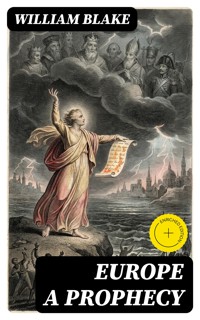
William Blake's 'Europe: A Prophecy' serves as a profound and richly symbolic exploration of the social and political upheavals characterizing late 18th-century Europe. This prophetic work employs a visionary style, characterized by vivid imagery and allegorical figures, to critique the prevailing powers, ideologies, and religious institutions. Blake navigates through themes of conflict, revolution, and regeneration, using a complex interplay of text and intricate illustrations to invoke a sense of urgency about the moral and spiritual awakening of humanity in the face of tyranny and oppression. Blake, an emblematic figure of the Romantic era, was not merely a poet but also a painter and printmaker whose intricate artistic vision informed his written works. Living during a time of intense sociopolitical transformation, including the Enlightenment and the French Revolution, Blake felt an acute disconnection from the established norms and beliefs of his time. His personal conviction in the importance of individualism and emotional truth greatly influenced the writing of 'Europe: A Prophecy,' adding layers of personal and societal critique. This text is a crucial read for those interested in the intersection of art and politics, as well as for enthusiasts of Blake's unique visionary aesthetic. 'Europe: A Prophecy' invites readers to engage deeply with its provocative themes, rewarding them with insights not only into Blake's mind but also into the tumultuous era from which these ideas emerged. In this enriched edition, we have carefully created added value for your reading experience: - A succinct Introduction situates the work's timeless appeal and themes. - The Synopsis outlines the central plot, highlighting key developments without spoiling critical twists. - A detailed Historical Context immerses you in the era's events and influences that shaped the writing. - An Author Biography reveals milestones in the author's life, illuminating the personal insights behind the text. - A thorough Analysis dissects symbols, motifs, and character arcs to unearth underlying meanings. - Reflection questions prompt you to engage personally with the work's messages, connecting them to modern life. - Hand‐picked Memorable Quotes shine a spotlight on moments of literary brilliance. - Interactive footnotes clarify unusual references, historical allusions, and archaic phrases for an effortless, more informed read.
Das E-Book können Sie in Legimi-Apps oder einer beliebigen App lesen, die das folgende Format unterstützen:
Veröffentlichungsjahr: 2022
Ähnliche




Europe A Prophecy
Table of Contents
Introduction
Rolling across storm-lit skies and restless streets, a visionary struggle unfolds between the compass-bearing rigor of law and the insurgent flame of imagination, a conflict that rattles empires, overturns sleep, and tests whether the human spirit will be numbered and measured into submission or blaze into forms yet uncharted; here, time bends under pressure, prophecy thickens the air, and images march with the music of the lines, urging readers to witness how authority hardens into idols while desire and vision crack the surfaces, spill into the margins, and demand a new map for Europe and for the mind.
Europe A Prophecy is an illuminated book created by the English poet, painter, and printmaker William Blake and first issued in 1794. Composed and printed by Blake in his London workshop, with the assistance of his wife Catherine, it belongs to his sequence often called the Continental Prophecies, which includes America A Prophecy and the later work The Song of Los. In this volume, Blake fuses lyric intensity with an epic, myth-making reach, presenting a personal cosmology that refracts eighteenth-century upheaval through symbolic figures and visionary landscapes while refusing the boundaries that separated genres, disciplines, and modes of perception.
The book holds classic status because it altered what a poem and a book could be. Instead of treating words as isolated marks, Blake binds language to image, color, and design, producing a reading experience that is at once musical, painterly, and dramatic. Its themes—political freedom, spiritual revolt, the critique of rigid systems, and the vindication of creative energy—remain as urgent now as they were in the 1790s. Europe A Prophecy influenced later poets and artists who sought visionary scope and formal daring, and it continues to shape how we imagine the possibilities of a page, a voice, and a prophetic imagination.
Blake composed Europe A Prophecy during the charged years following the American and French Revolutions, when arguments over liberty, authority, and rights animated public life across Britain and the continent. The early 1790s saw pamphlet wars, street agitation, and deepening anxieties about social change. Britain entered war with revolutionary France in 1793, and suspicion of dissent intensified. Against this backdrop, Blake crafted a symbolic history that speaks to the pressures of his time while refusing to be confined to topical commentary. The poem’s visionary mode converts contemporary turmoil into a mythic drama of spiritual and political energies.
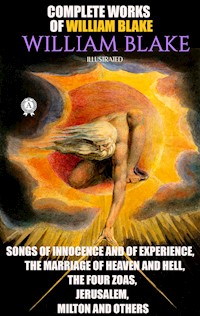
Form is meaning in Blake’s illuminated books, and Europe A Prophecy exemplifies his technical innovation. Using his relief-etching method, first developed in the late 1780s, he wrote and drew on copper plates, printed the pages by hand, and finished them with watercolor washes. The famous frontispiece often associated with this work, sometimes known as The Ancient of Days, has become one of Blake’s most widely reproduced images. In this edition, the original plates and hand-coloring serve not as ornament but as integral elements of the poem’s argument, guiding pace, emphasis, and emotional resonance across the unfolding sequence.
The central premise of Europe A Prophecy is a visionary survey of European history conceived as a contest between constrictive order and eruptive renewal. Blake stages this conflict within his mythic universe, where archetypal figures embody law, energy, imagination, and desire. The poem does not present a literal chronicle; rather, it distills historical pressure into scenes and voices that reveal how states of mind become social and political realities. Readers encounter a Europe poised between vigilance and sleep, between inherited formulas and untested futures, as the poem asks what powers rule the age and what counter-forces might awaken.
Within this framework unfold themes that have secured the book’s endurance. Blake challenges systems that seek to measure, classify, and restrict the human person, asserting the creative imagination as a liberating force. He probes how fear and desire are organized by institutions, how time is narrated to justify dominion, and how prophecy can expose those legitimizing stories. The poem wrestles with the possibilities and perils of revolution without reducing them to a single verdict. It explores the relations of body and spirit, vision and reason, and the risks of confusing moral restraint with life-denying repression.
Blake’s artistry resides not only in what he says but in how the illuminated format shapes meaning. Text curls within vines, surges beneath living forms, or settles amid spacious grounds; these placements direct the voice, punctuate arguments, and create echoes between stanzas and scenes. Color carries feeling—cool tones ushering reflection, warm ones heightening urgency—while repeated motifs provide a visual memory that binds the plates. The resulting synthesis anticipates modern multimodal art by insisting that reading is tactile and optical as well as verbal, and that understanding grows from the collaboration of senses.
The book’s influence radiates across centuries. Nineteenth-century admirers such as Algernon Swinburne championed Blake’s visionary independence, while the Pre-Raphaelite circle drew sustenance from his union of word and image. William Butler Yeats engaged deeply with Blake’s prophecies in his own pursuit of symbolic structures. In the twentieth century, poets such as Allen Ginsberg found in Blake a precedent for expansive, ecstatic utterance. Artists and book designers continue to study the plates as exemplars of integrated design, and the work informs contemporary graphic narrative, printmaking, and experimental poetics that refuse disciplinary borders.
Although Blake printed only a small number of copies and did not enjoy broad fame in his lifetime, later readers and scholars recognized the ambition and coherence of the prophetic books. Europe A Prophecy, once rare and marginal, became central to accounts of Romanticism and to theories of mythopoetic expression. Its images, especially the frontispiece, entered cultural circulation far beyond specialist circles. Modern facsimiles, high-resolution reproductions, and critical editions have made the work widely available, while museum exhibitions and academic studies have elaborated its historical contexts and artistic techniques without exhausting its imaginative power.
For readers approaching this illuminated manuscript, the best guide is attention. Follow the grain of the letters as they thread through branches and flames; notice how images anticipate or answer nearby stanzas; linger on the tonal shifts suggested by the color. The poem’s mythic names and episodes do not require prior knowledge of an elaborate system; they operate as charged emblems whose relations clarify as you read. This edition preserves the interplay of text and picture that Blake designed, allowing his arguments to unfold through placement, rhythm, and hue as much as through narrative sequence.
Europe A Prophecy remains contemporary because its questions do not close. What counts as lawful order, and when does law become a mask for fear? How can imagination resist the numbness induced by repetition, spectacle, and bureaucracy? In an era of contested borders, accelerated media, and recurring authoritarian temptations, Blake’s illuminated poem invites us to reimagine freedom as a practice of perception and making. Its pages testify that art can challenge systems not only by denouncing them but by inventing new forms of attention, and that is why this work continues to draw readers into its lasting light.
Synopsis
Europe A Prophecy is William Blake’s 1794 illuminated book that unites poetry and image to reimagine the political convulsions of the late eighteenth century as a mythic drama. Part of Blake’s Continental Prophecies, it offers a visionary account of European upheaval by staging conflicts among personified forces of law, desire, creativity, and rebellion. The volume is structured as a Preludium followed by the main Prophecy, with the painted and engraved designs guiding interpretation as much as the text. Rather than narrating events chronologically, Blake composes a patterned sequence of emblematic scenes that translate history into a spiritual contest over the fate of imagination and social order.
The Preludium establishes a heightened, visionary vantage point. A supernatural speaker surveys the continent and senses an imminent disturbance that will touch palaces and cottages alike. The atmosphere is charged with omens: gathering clouds, trembling earth, and hushed expectation before a storm. This overture frames the poem’s central question—what forces are about to awaken, and who will guide or resist them? It prepares the reader for an interweaving of personal, political, and cosmic registers, where human institutions appear as outward signs of deeper energies. The prelude closes by opening the stage for Blake’s mythic actors to step into history’s tumult.
Within the Prophecy proper, Blake introduces his mythic cast as embodiments of contending principles. Los, the prophetic maker, represents generative imagination and creative labor; Enitharmon, his emanation, shapes the sphere of affection, desire, and social custom; Urizen, the stern lawgiver, becomes the architect of system and constraint; and Orc, the spirit of youthful revolt, ignites transformative passion. As these figures move across visionary landscapes, the poem aligns European unrest with a struggle between constricting codes and living energy. Thrones, altars, and workshops are presented not merely as places but as expressions of these rival powers seeking dominion over minds and bodies.
A pivotal development centers on Enitharmon’s ascendancy, which inaugurates an extended epoch of moral reordering. Her influence channels desire into sanctioned forms, elevating chastity and ritual while entangling affection with guilt and surveillance. Blake’s plates and verses register the spread of priestly authority and the codification of intimate life, as households mirror larger systems of control. The poem neither reduces this period to simple oppression nor celebrates it; rather, it measures how social stability and fear can reinforce each other. Enitharmon’s dispensation becomes a lens through which the continent’s public policies and private relationships are recast into a single economy of restraint.
Against this backdrop, Orc awakens as the emblem of insubordinate vitality. His rising announces the return of heat, motion, and youthful defiance, which leap from individual hearts to city streets. The poem evokes the spread of rebellious impulses across borders, as symbols of inheritance—chains, idols, and decrees—shudder under new pressures. Blake’s treatment maintains a double perspective: revolt accelerates hope and renewal even as it courts excess, retaliation, and loss. The energy Orc unleashes exposes the fragility of established forms, compelling institutions and consciences to reveal whether they are instruments of life or fortresses of fear.
Urizen answers with system. Measuring, classifying, and legislating, he strives to impose a coherent architecture upon unruly experience. Blake’s famous frontispiece, popularly known as The Ancient of Days, resonates with this effort to circumscribe the world by compass and decree. As Urizen’s codes proliferate, they promise safety and clarity while risking sterility and domination. The Prophecy explores how external law can harden into habit, turning protective limits into cages. In the contest between Orc’s flame and Urizen’s rule, the poem studies the allure of rational order and the cost of subordinating imaginative freedom to calculation.
Throughout, the narrative traverses emblematic sites—courts, temples, workshops, and shorelines—where public decisions and private bonds intersect. Blake evokes the pressures of war and policy alongside scenes of parents, children, lovers, and solitary visionaries, suggesting that historical transformations are borne out in daily gestures. The illuminated designs amplify these movements: figures strain against nets, descend ladders of light, or bend over instruments, visualizing tensions between inspiration and control. Rather than serving as mere illustrations, the images create parallel arguments in color and line, expanding the poem’s meanings beyond what the words alone state.
Formally, Europe pairs oracular pronouncement with dramatic address, shifting voices and tempos to mimic the pressures it depicts. The poem’s structure—Preludium and Prophecy—offers both frame and unfolding, while its compressed symbolism invites rereading. Blake fuses historical reference with mythic recurrence, making the eighteenth-century crisis a chapter in a longer cycle of slumber and awakening, repression and renewal. Repeated motifs—night and day, fire and measure, song and silence—bind episodes into a coherent pattern. The effect is not to instruct by thesis but to provoke recognition: the forces shaping nations also contend within perception, desire, and creative will.
The closing cadence withholds definitive resolution, emphasizing process over finality. Europe A Prophecy leaves readers poised within an unfinished struggle between living energy and constraining systems, urging attention to how art, morality, and politics shape one another. Its enduring significance lies in the way text and image jointly model a critical imagination: one that honors freedom without denying order, and questions order without abandoning care. By remaking history as visionary drama, Blake’s illuminated book continues to challenge audiences to examine the sources of authority they obey and the possibilities of liberation they pursue.
Historical Context
Europe a Prophecy emerges from late eighteenth-century London, a city of crowded streets, river wharves, and expanding printshops under the Hanoverian monarchy. Parliament, the Church of England, and common law courts anchored public life, while the Royal Academy shaped artistic training and taste. The setting is one of accelerated change: an Enlightenment culture confident in reason and experiment confronted by religious enthusiasm, political dissent, and colonial upheaval. Europe and Britain were bound by dynastic politics and war, with censorship and sedition laws tightening in moments of crisis. Blake writes and prints within this world, using visionary art to interrogate institutions of power.
William Blake was born in 1757 and trained as an engraver under James Basire before studying at the Royal Academy schools. He lived and worked chiefly in London, establishing with his wife Catherine a small press in Lambeth around 1790. There he developed illuminated printing, a relief-etching process he likely devised in the late 1780s, which allowed text and image to be etched together, printed in color, and hand-finished. Europe a Prophecy appeared in 1794, produced in very small numbers. The work’s hybrid form belongs to Blake’s determination to control every stage of production and to join poetic language with pictorial argument.
The broader intellectual climate was shaped by Enlightenment rationalism and natural philosophy associated with Bacon’s experimental method, Newtonian physics, and Lockean empiricism. Scientific societies, encyclopedias, and polite discourse promoted measurement and system. Blake admired imagination as a primary truth and criticized what he saw as the narrowing effects of pure materialism and utilitarian reason. Europe a Prophecy refracts this contest of ideas into mythic terms, turning debates about law, reason, and experience into dramatic conflicts of energy and constraint. Its prophetic mode offers an alternative to the Enlightenment essay or treatise, insisting that vision can diagnose history’s ills.
Revolutionary politics defined the age. The American Revolution (1775–1783) challenged imperial sovereignty and stimulated debate in Britain about representation, taxation, and rights. Pamphlets, clubs, and sermons weighed the legitimacy of rebellion and the meaning of liberty. Blake watched these developments from London and answered them in his cycle of Prophetic Books; the volume titled America a Prophecy (1793) addressed the Atlantic rupture. Europe a Prophecy, which followed in 1794, turns toward the continent, registering how American independence and European currents were intertwined, and how hopes for universal emancipation met the resilience of entrenched authority.
The French Revolution, beginning in 1789, set the immediate background for Europe a Prophecy. Milestones included the fall of the Bastille, the Declaration of the Rights of Man and of the Citizen, the abolition of feudal privileges, and the proclamation of the Republic in 1792. The execution of Louis XVI in January 1793 and the subsequent Reign of Terror (1793–1794) shocked Europe. British observers divided: some celebrated popular sovereignty; others feared anarchy. Blake’s prophetic art does not narrate these events directly but converts them into symbols of convulsion and awakening, probing whether violence was a necessary birth pang or a betrayal of revolutionary promise.
War intensified the crisis. Britain entered the War of the First Coalition against France in 1793, mobilizing fleets, raising taxes, and organizing coastal defenses. Newspapers, broadsides, and patriotic prints rallied support while also spreading dread of invasion. In such an atmosphere, dissent appeared suspect. The connection between international conflict and domestic restriction is key to the 1790s: the pressure of war legitimized surveillance and curtailed association. Europe a Prophecy’s visionary battles and fetters echo this climate, representing how external wars interlock with internal regimes of discipline and fear.
Authorities in Britain moved against radical organizations. The London Corresponding Society, founded in 1792 by artisans advocating parliamentary reform, became a target of spies and prosecutions. The Crown suspended habeas corpus in 1794, enabling detention without trial, and tried reformers such as Thomas Hardy and John Horne Tooke for treason; they were acquitted, but the message was chilling. In 1795 Parliament passed the Treasonable Practices and Seditious Meetings Acts. Propaganda and censorship shaped public discourse. Blake’s preference for mythic allegory and private circulation through illuminated books can be read as tactical, allowing critique without the direct liabilities of pamphleteering.
The period’s radical print culture circulated new ideas. The publisher Joseph Johnson issued works by figures such as Mary Wollstonecraft, William Godwin, and, earlier, translations and scientific texts that nourished progressive circles. Blake engraved for Johnson on several projects, including plates for Wollstonecraft’s Original Stories from Real Life. These professional ties placed him within networks that debated rights, education, religion, and the family. Yet Blake’s illuminated printing let him bypass the conventions of commercial bookmaking, fusing artistry and argument in ways that eluded standard market and censorial expectations while reaching a small but committed audience.
Religious controversy also framed Blake’s age. The Church of England held legal privileges, yet Dissenters and Methodists expanded rapidly, emphasizing conscience and inward experience. Emanuel Swedenborg’s visionary theology, disseminated in English from the 1780s, left traces in London circles Blake frequented, though Blake departed sharply from Swedenborg’s system. Apocalyptic sermons and prophetic language circulated widely, especially in times of war and scarcity. Europe a Prophecy draws on biblical idioms of judgment and deliverance while opposing a punitive religion tied to state power. Its visionary cosmos defends spiritual liberty against doctrinal and legal confinement.
Economic transformation reshaped daily life. The early Industrial Revolution accelerated in textiles, iron, and steam power, altering labor patterns and concentrating workers in mills and workshops. Enclosures continued to reorganize rural landholding, displacing some smallholders and fueling migration to towns. Long working hours, child labor, and volatile wages provoked unrest. Blake, the son of a London shopkeeper and a lifelong artisan, saw the mechanical regimentation of time and the rise of managerial discipline. Europe a Prophecy registers anxiety about systems that subordinate imagination to profit and regulation, articulating a critique of mechanized order as a form of psychic and social bondage.
Urban disorder kept pace with industrial and political stress. The Gordon Riots of 1780 had left a memory of streets ablaze and prisons stormed, a warning about the power and peril of the crowd. In the 1790s, poor harvests and war drove up bread prices, producing market disturbances and food riots in various towns. Early policing was limited; the Bow Street Runners and local watchmen struggled to control mass action. Such turbulence haunted elite anxieties and energized popular societies. Blake’s prophetic figures channel the era’s ambivalence, dramatizing the same forces that statesmen feared and reformers hoped to harness toward emancipation.
Blake’s technique matters historically. Relief etching involved painting the text and images in a varnish on copper, biting the unprotected areas with acid, and printing from the raised surfaces. He and Catherine hand-colored impressions with watercolors or printed in colored inks, turning each copy into an artifact of labor and care. Print runs were tiny and often varied; few copies of Europe a Prophecy survive. In some copies Blake used the image now known as The Ancient of Days as a frontispiece, an emblem of measuring power that condenses his critique of confining reason and his fascination with the creative act of drawing boundaries.
Humanitarian activism gave the 1790s another voice. The Society for Effecting the Abolition of the Slave Trade was founded in 1787, sponsored petitions, and circulated medallions and diagrams of slave ships to move public opinion. Parliamentary debates intensified in 1789–1792 and continued into the next decade, while the Haitian Revolution, beginning in 1791, challenged European colonial authority directly. Although Europe a Prophecy does not treat these events narratively, Blake’s body of work registers sympathy with struggles against bondage. The book’s universalized conflict between oppression and liberation resonated with antislavery rhetoric and broader revolutionary aspirations.
Within Britain’s art world, the Royal Academy promoted history painting and the ideals of Joshua Reynolds, arguing for generalization and classical polish. Blake opposed such doctrines, favoring particular line, visionary precision, and Gothic and biblical sources. He admired Michelangelo and the prophetic power of Milton and the Bible more than polite classicism. Friends such as Henry Fuseli, with his own interest in nightmare and myth, offered a kindred if distinct vision. Europe a Prophecy situates itself against academic orthodoxy, asserting that art should intervene in the moral history of nations rather than merely illustrate classical exempla.
Blake’s Lambeth home placed him at a crossroads of craft, commerce, and politics. The south bank of the Thames housed potteries, timber yards, and printshops; the river carried goods and news. Pleasure gardens like Vauxhall, nearby, mixed spectacle with sociability. Across the water stood the institutions of state: Westminster and the City, with their courts, prisons, and exchanges. Dissenting chapels and debating societies flourished in surrounding districts. This geography fed Blake’s sense that spiritual and political realities intersected in the city’s everyday textures, a sensibility he transfigured into the dreamlike landscapes and streetwise energies of his illuminated books.
Europe a Prophecy forms part of a sequence of Prophetic Books that includes texts like America a Prophecy and The Song of Los. Composed in the early to mid-1790s, these works respond to the cascade of revolutions with a personal myth in which energies of revolt contend with systems of law and habit. Rather than issuing a party manifesto, Blake translates public events into archetypal drama, allowing readers to sense continuities between biblical exodus, modern rebellion, and individual awakening. The sequence thus embeds the decade’s upheavals within a long history of oppression and renewal.
Technological and commercial changes in publishing shaped the book’s reception. The 1790s saw expanding newspapers, caricature shops, and circulating libraries that popularized ideas quickly. At the same time, prosecutions of booksellers, seizure of pamphlets, and informers created a climate of caution. By printing Europe a Prophecy himself, Blake avoided dependence on the subscription lists and retail networks that might expose him to legal risk, but he also limited his reach. The work’s rarity and pictorial complexity meant a small readership in his lifetime, yet it preserved a dissenting record unfiltered by conventional editorial or market pressures, a deliberate counter-public in miniature.
Author Biography
William Blake (1757–1827) was an English poet, printmaker, and painter whose work bridges the late Enlightenment and early Romanticism. He pioneered illuminated books that fused poetry and image through a relief-etching process he devised, challenging conventional separations between literary and visual art. Often unrecognized in his lifetime and sometimes dismissed as eccentric, he nonetheless developed a coherent visionary project and a personal myth that resisted prevailing religious, political, and aesthetic orthodoxies. His best-known creations include Songs of Innocence and of Experience, The Marriage of Heaven and Hell, and prophetic epics such as Milton and Jerusalem. Today he is regarded as a foundational Romantic figure and a key innovator in multimedia art.
Blake grew up in London and displayed early talents for drawing and verse. At fourteen he was apprenticed to the engraver James Basire, whose workshop demanded disciplined line work and sent him to study medieval monuments in Westminster Abbey, shaping Blake’s commitment to strong contour and a Gothic sensibility. After his apprenticeship, he attended the Royal Academy Schools, engaging the ideas of the academic establishment even as he resisted stylistic prescriptions then associated with classicism. The Bible remained his central text; he also studied Milton and, for a time, the writings of Emanuel Swedenborg. These sources informed his symbolic language, moral concerns, and visionary mode.
Blake’s first volume, Poetical Sketches, appeared in the early 1780s and announced a distinctive lyrical voice. By decade’s end he had developed relief etching, drawing words and designs directly on copper so that text and image could be printed together and then hand-colored. This innovation produced the illuminated Songs of Innocence (1789) and short emblematic works such as The Book of Thel. He worked within the London print trade to underwrite these experiments, and his household assisted in printing and coloring the editions. Circulation remained small, but the books presented an artisanal, author-controlled model of publishing that was rare in his period.
During the 1790s Blake issued some of his most radical books. The Marriage of Heaven and Hell combined satire, aphorism, and visionary prose to challenge moral dualism and institutional orthodoxy. He expanded Songs into Songs of Innocence and of Experience, juxtaposing childlike lyricism with sharp social critique. America a Prophecy and Europe a Prophecy responded to revolutionary upheavals, while The First Book of Urizen began codifying a personal myth dramatizing constraint and liberty. Commercial reception was limited and many contemporaries were perplexed, yet these works established his characteristic synthesis of emblematic imagery, compressed lyric, and prophetic discourse, defining a uniquely Blakean art.
Around 1800 Blake worked under the sponsorship of a patron in Sussex, an arrangement that briefly took him from London. There he faced a legal charge for alleged seditious speech after a quarrel with a soldier; he was acquitted, an episode that underlined his distrust of coercive authority. Returning to London, he pursued large poetic projects—Milton: A Poem and Jerusalem The Emanation of the Giant Albion—engraved and printed over many years. Although readership was small, these epics elaborated his mythic system and renewed his commitment to imaginative freedom over the mechanized, commercial values he associated with modern life.
Alongside his books, Blake sustained a career as a designer and engraver on literary and biblical themes. He produced illustrations for Young’s Night Thoughts and for poems by Gray, and later created celebrated series such as the engravings to The Book of Job, admired for technical mastery and theological depth. In his final years he undertook an ambitious series of designs for Dante’s Divine Comedy, left unfinished at his death. A self-organized exhibition in 1809, accompanied by a Descriptive Catalogue, drew little notice, but a small circle of patrons and younger artists recognized the originality and intensity of his achievement.
Blake died in London in 1827 with modest public notice, yet his reputation rose steadily afterward. Nineteenth-century advocates and biographers reframed him as a major poet and visual artist, and movements such as the Pre-Raphaelites and later Symbolists found in his linear rigor and visionary themes an inspiring precedent. In the twentieth and twenty-first centuries, he has remained central to studies of Romanticism, print culture, and intermedial art. His images and phrases circulate widely, his critique of authoritarianism and materialism retains force, and his illuminated books anticipate later experiments in artist’s books, comics, and multimedia practice, securing a durable and evolving legacy.
Europe A Prophecy (Illuminated Manuscript with the Original Illustrations of William Blake)
Five windows light the cavern’d Man; thro’ one he breathes the air[1q];
Thro’ one, hears music of the spheres; thro’ one, the eternal vine
Flourishes, that he may recieve the grapes; thro’ one can look.
And see small portions of the eternal world that ever groweth;
Thro’ one, himself pass out what time he please, but he will not;
For stolen joys are sweet, & bread eaten in secret pleasant[2q].
So sang a Fairy mocking as he sat on a streak’d Tulip,
Thinking none saw him: when he ceas’d I started from the trees!
And caught him in my hat as boys knock down a butterfly.
How know you this said I small Sir? where did you learn this song?
Seeing himself in my possession thus he answered me:
My master, I am yours. command me, for I must obey.
Then tell me, what is the material world, and is it dead?
He laughing answer’d: I will write a book on leaves of flowers,
If you will feed me on love-thoughts, & give me now and then
A cup of sparkling poetic fancies; so when I am tipsie,
I’ll sing to you to this soft lute; and shew you all alive
The world, when every particle of dust breathes forth its joy.
I took him home in my warm bosom: as we went along
Wild flowers I gatherd; & he shew’d me each eternal flower:
He laugh’d aloud to see them whimper because they were pluck’d.
They hover’d round me like a cloud of incense:
whenI came Into my parlour and sat down, and took my pen to write:
My Fairy sat upon the table, and dictated EUROPE.
Preludium
The nameless shadowy female rose from out the breast of Orc[3q]:
Her snaky hair brandishing in the winds of Enitharmon[4q];
And thus her voice arose.
O mother Enitharmon wilt thou bring forth other sons?
To cause my name to vanish, that my place may not be found.
For I am faint with travel!
Like the dark cloud disburdend in the day of dismal thunder.
My roots are brandish’d in the heavens. my fruits in earth beneath
Surge, foam, and labour into life, first born & first consum’d!
Consumed and consuming!
Then why shouldst thou accursed mother bring me into life?
I wrap my turban of thick clouds around my lab’ring head;
And fold the sheety waters as a mantle round my limbs.
Yet the red sun and moon,
And all the overflowing stars rain down prolific pains.
Unwilling I look up to heaven! unwilling count the stars[5q]!
Sitting in fathomless abyss of my immortal shrine.
I sieze their burning power
And bring forth howling terrors, all devouring fiery kings.
Devouring & devoured roaming on dark and desolate mountains
In forests of eternal death, shrieking in hollow trees.
Ah mother Enitharmon!
Stamp not with solid form this vig’rous progeny of fires.
I bring forth from my teeming bosom myriads of flames.
And thou dost stamp them with a signet, then they roam abroad
And leave me void as death:
Ah! I am drown’d in shady woe, and visionary joy.




