


1,99 €
Niedrigster Preis in 30 Tagen: 1,99 €
Niedrigster Preis in 30 Tagen: 1,99 €
Mehr erfahren.
- Herausgeber: DigiCat
- Kategorie: Poesie und Drama
- Sprache: Englisch
In "For the Sexes: The Gates of Paradise," William Blake intricately interweaves themes of love, sexuality, and the transcendental nature of human relationships within a richly symbolic poetic framework. This collection, consisting of a series of interrelated poems, reflects Blake's visionary style characterized by imaginative language and striking visual artistry. Set against the backdrop of the late 18th-century Romantic movement, the work stands as a poignant exploration of the dualities of existence—innocence and experience, nature and society, body and spirit—illuminating the paradigm shift in understanding human connections during a time of significant social change. William Blake, a seminal figure in the Romantic movement, was not only a poet but also a painter and engraver, embodying the spirit of a visionary artist deeply influenced by the complexities of human life and spirituality. His personal philosophy, steeped in mysticism and a profound questioning of societal norms, informed his creation of this provocative work. Blake's advocacy for the liberation of the creative spirit was central to his worldview, likely driving him to craft a narrative that challenges conventional views on love and relationships. "For the Sexes: The Gates of Paradise" is a profound insight into the interplay between the sacred and the sensual, appealing to readers who seek to delve into the intricate layers of human experience. This work invites reflection on our perceptions of love and identity, making it essential reading for anyone interested in the evolution of poetry and the exploration of human emotions. In this enriched edition, we have carefully created added value for your reading experience: - A succinct Introduction situates the work's timeless appeal and themes. - The Synopsis outlines the central plot, highlighting key developments without spoiling critical twists. - A detailed Historical Context immerses you in the era's events and influences that shaped the writing. - An Author Biography reveals milestones in the author's life, illuminating the personal insights behind the text. - A thorough Analysis dissects symbols, motifs, and character arcs to unearth underlying meanings. - Reflection questions prompt you to engage personally with the work's messages, connecting them to modern life. - Hand‐picked Memorable Quotes shine a spotlight on moments of literary brilliance. - Interactive footnotes clarify unusual references, historical allusions, and archaic phrases for an effortless, more informed read.
Das E-Book können Sie in Legimi-Apps oder einer beliebigen App lesen, die das folgende Format unterstützen:
Veröffentlichungsjahr: 2022
Ähnliche



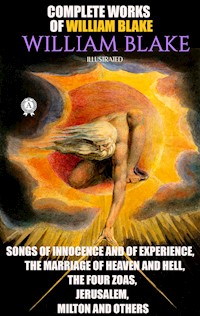

For the Sexes: The Gates of Paradise
Table of Contents
Introduction
Between desire and duty, body and spirit, man and woman, William Blake places a set of visionary gates, and invites us to pass through their thresholds with eyes remade by imagination, courage, and compassionate understanding.
For the Sexes: The Gates of Paradise stands as one of Blake’s most concentrated achievements, a compact illuminated book in which poetry and image collaborate to model a way of seeing. Blake, poet, engraver, and prophet of London’s turbulent late eighteenth and early nineteenth centuries, forged an art that refuses to separate mind from hand or symbol from sensation. Here he distills large philosophical concerns into emblematic scenes whose precision belies their brevity. The result is a classic: a work that renews itself with every reading because it asks not for passive consumption but for active, ethical attention.
The work has a layered history that underscores its richness. Blake first issued a sequence of emblematic plates as For Children: The Gates of Paradise in 1793, produced in London using his distinctive relief-etching method. Late in his career, he revisited and revised the plates, recontextualizing the sequence as For the Sexes: The Gates of Paradise, a retitling that signals a broader human address. The later state carries Blake’s mature voice, and shows how he returned to earlier inventions to refine their scope. This history is part of what makes the book inexhaustible: it is simultaneously early experiment and measured summation.
At its core the book presents a procession of images and short texts that trace the human journey from first awareness through trial, error, yearning, and instruction. Rather than a linear narrative, Blake offers a series of emblematic stations, each one a threshold where perception may change. The “gates” are not merely architectural tokens; they are metaphors for states of mind and moral choice. In retitling the work For the Sexes, Blake signals his concern with shared, mutual experience—what is common and what is differentiated in human life—without reducing that complexity to formula.
Blake’s medium is integral to his meaning. Illuminated printing allowed him to draw and write directly on the copper as a single act, uniting line, letter, and figure in a living field. Impressions could then be hand-colored, often with the assistance of Catherine Blake, so that each copy bears the aura of a studio performance. The revised inscriptions in the later state intensify the tension between aphorism and image, guiding but never closing interpretation. These small pages, intimate in scale, open onto vast questions, treating the margins as places where text and picture whisper across each other.
Within Blake’s larger oeuvre, this book converses with the paired Songs of Innocence and of Experience and the later prophetic books. The Songs stage the drama of contraries as complementary energies; the prophecies expand that drama into a myth of national and cosmic renewal. For the Sexes occupies a crucial middle ground: it is neither lyric collection nor sprawling epic but a distilled map of the soul’s trials. Readers who know Blake’s Albion, his spectres and emanations, will sense echoes here; newcomers will find an accessible gateway into his visionary philosophy.
The themes that animate these plates are enduring because they are existential: how perception shapes reality; how the imagination liberates or binds; how social institutions can either nourish growth or harden into prisons; how fear, jealousy, and pride deform love; and how self-knowledge opens the possibility of mercy. Blake’s moral vision is never merely punitive or consolatory. He insists that contraries generate life, and that progress consists not in denial but in continual regeneration of sight. The book’s economy intensifies its claims, asking readers to supply the breath that completes the circuit between seeing and understanding.
Blake’s method also renews the older European tradition of emblem books, in which motto, picture, and epigram triangulate meaning. He transforms that tradition by infusing it with a radical psychology and a craftsman’s intimacy. In his hands, the emblem is not a didactic diagram but a living paradox, inviting re-reading and re-seeing. The script itself—curving, compressed, occasionally erupting—becomes part of the expressive field, as do the margins and the coloration that can shift emphasis from copy to copy. This fusion of disciplined technique and imaginative risk is a signature of Blake’s classic authority.
The literary and artistic impact of work like this is far-reaching. Nineteenth-century admirers such as Algernon Charles Swinburne and members of the Pre-Raphaelite circle helped to recover Blake for modern readers; W. B. Yeats would later champion his visionary integrity. Twentieth-century critics, notably Northrop Frye, drew on Blake to rethink myth, symbol, and the structure of poetic imagination. Poets and countercultural voices, including Allen Ginsberg, found in Blake a model of prophetic candor and formal daring. The compact radiance of For the Sexes joins that legacy, offering a portable laboratory for imagination.
Its influence extends beyond poetry into the visual and book arts. Blake’s integration of text, image, and hand production anticipates the modern artist’s book, informs typographic experimentation, and provides a deep precedent for contemporary sequential art. The very premise that a page can be a total environment—where letterforms, figures, and blank space operate as co-equal elements—has shaped designers and illustrators who see reading as an embodied experience. Editions that reproduce Blake’s original plates restore this ecology of attention, reminding us that meaning arises from both what is said and how it is made visible.
Reading this edition, with Blake’s original illustrations restored to their dialogue with the words, is to experience a choreography of approach and withdrawal. The images invite immediate recognition; the inscriptions complicate that instant with irony, sympathy, or counsel. A slow, attentive pace rewards the reader: notice recurring motifs of boundaries and passages; trace the way gestures, tools, and landscapes echo one another. Without revealing outcomes, it suffices to say that each plate positions the viewer at a moment of choice, a poised instant where interpretation and action become indistinguishable.
For contemporary readers, the book’s concerns remain urgent. Its reflection on gender, mutual responsibility, and the formation of desire speaks to debates that continue to shape public and private life. Its insistence on imaginative freedom as a condition of justice challenges conformity in any era. And its craft—collaborative, handmade, materially precise—offers a counterweight to distracted consumption. For the Sexes: The Gates of Paradise endures because it marries a fearless moral intelligence to formal invention, welcoming us through its gates into a space where attention itself becomes a transformative act.
Synopsis
William Blake’s For the Sexes: The Gates of Paradise is an illuminated sequence that unites engraved images with brief textual cues to examine human life from a visionary angle. A late reworking of his earlier emblem book, it reframes the material for adults, addressing men and women alike. The work does not present a conventional plot but a procession of emblematic scenes that suggest a psychological and spiritual journey. Through the interplay of image and motto, Blake explores how perception, desire, restraint, and imagination shape experience. The manuscript’s design encourages readers to decode layered meanings, making interpretation an active part of the encounter.
The title signals thresholds: gates separating states of being, knowledge, and vision. Blake structures the sequence as a passage through these portals, inviting the reader-viewer to move from outer appearances toward inner discernment. The visual program proposes that every stage of life is a liminal site, where choices orient the soul toward confinement or expansion. While the work is compact, its argument unfolds cumulatively: each emblem recasts earlier images and questions, advancing a rhythm of approach, recoil, and renewed striving. The framing suggests that entry to wisdom is possible, yet contingent on how one reads, remembers, and sees.
Early images dwell on birth and first awareness. Figures appear close to the elements—earth, water, and sky—intimating that the senses begin by touching what is nearest and most tangible. Youthful bodies reach, crawl, and lift themselves into posture, modeling the emergence of selfhood. Textual tags sharpen the emblems’ paradoxes, hinting that innocence is already entwined with limitation. The sexes, named in the title, are not treated as opposing camps but as complementary bearings on beginnings: attraction, dependence, and differentiation are present from the start. Blake positions these opening plates as foundations, where the reader learns to distinguish appearance from significance without abandoning wonder.
The middle sequence turns to desire and curiosity, picturing upward glances, outward journeys, and gestures that strain against boundaries. Celestial lights, distant horizons, and vertical movements suggest the pull of aspiration. With aspiration comes risk: pursuit can either illuminate the way or intensify frustration. Emblems balance longing with caution, emphasizing that imagination requires direction rather than denial. The short inscriptions neither endorse reckless escape nor timid compliance. Instead, they pose questions about what the seeker truly wants and how the sought object reshapes the seeker. In this phase, the sexes imply different inflections of desire while sharing the same fundamental hunger for enlargement.
As the journey matures, Blake introduces social ties, duty, and the pressure of custom. Figures confront structures that curb movement—boundaries, enclosures, or burdens—signaling how collective norms refine and constrict. The engravings counterpose poised figures with strained bodies to dramatize the friction between prudence and creative energy. Desire meets the claims of responsibility; imagination argues with literalism. The textual cues offer compact judgments that refuse easy moral formulas, urging a discrimination that is both ethical and perceptual. The theme of the sexes reappears as negotiation rather than rivalry, asking how companionship, labor, and law can be aligned with vision without extinguishing it.
Blake then stages error, pain, and self-division. Emblems of darkness, entanglement, and isolation figure moments when perception narrows and vitality wanes. Yet the sequence avoids finality: natural cycles—germination, decay, and renewal—mirror the psyche’s capacity to change form. Motifs of metamorphosis suggest that constraint can be a chrysalis for transformation, provided it is read rightly. The inscriptions, brief but pointed, challenge readers to recognize how fear, envy, or pride misread the world. In this light, the sexes express misalignment when each tries to master or mirror the other, and promise adjustment when each acknowledges limits and gifts.
Approaching old age, the plates show figures that weigh memory, fatigue, and mortality. Gates and thresholds recur, now bearing the gravity of judgment and the tenderness of release. The images do not collapse into despair; they let time’s diminishment coexist with sharpened attention. The reader is prompted to view aging as a stricter pedagogy in seeing, where superficial desires fade and essential ones clarify. Companionship, whether granted or withheld, becomes a measure of perception: to see another truly is itself a crossing. The sequence implies that the sexes at their best participate in mutual recognition that steadies the final approach.
Near the end, Blake provides a compact apparatus that offers interpretive hints for the emblems. Rather than closing meaning, these keys open multiple pathways, aligning each image with a psychological or spiritual posture. Their aphoristic mode matches the book’s economy, sustaining tension between directive and enigma. The apparatus also reasserts the double address to both men and women, suggesting that each emblem bears more than one valence depending on who reads and how. By yoking image and motto, Blake cultivates an education of attention: understanding must be earned by revisiting, comparing, and letting contraries complicate each other.
Taken together, For the Sexes: The Gates of Paradise is a concentrated meditation on how human beings pass through life’s stages and interpret them. Its enduring force lies in the fusion of emblem, minimal text, and philosophical ambition. Without prescribing doctrine, it insists that vision matters: the way one looks at desire, obligation, suffering, and aging determines whether the world is a prison or a threshold. The book’s broader message remains spoiler-safe because it is not a single revelation, but an invitation to ongoing discernment. Blake leaves readers with the sense that perception, imagination, and mutual understanding can remake experience.
Historical Context
William Blake’s For the Sexes: The Gates of Paradise took shape in London during the last decade of the eighteenth century and the opening decades of the nineteenth, under the reign of George III and the early Regency. The city was Britain’s commercial and administrative center, governed by a constitutional monarchy and Parliament, with the Church of England dominant in religious life. Artistic institutions were led by the Royal Academy, and print culture flourished through booksellers, engravers, and radical pamphleteers. This was also an age of censorship by prosecution rather than licensing. Against this backdrop, Blake fashioned a visionary, artisanal alternative to mainstream literary and pictorial production.
Blake, born in 1757 to a working-class family in Soho, trained rigorously as an engraver under James Basire from the early 1770s and briefly studied at the Royal Academy Schools. His professional identity as an artisan-artist shaped his independence from academy taste and commercial publishers. Around the late 1780s he developed relief etching—his “illuminated printing”—which allowed text and image to be etched on the same copperplate, printed at home, and then hand-colored. Working closely with his wife, Catherine, he turned their lodgings into a workshop. This technology enabled him to publish small, idiosyncratic books that fused poetry, emblematic imagery, and prophetic critique.
The Gates of Paradise first appeared in 1793 as For Children: The Gates of Paradise, a suite of emblem-like images accompanied by brief captions. Emblem books had long offered moral lessons through pictures and mottos, a tradition stemming from early modern Europe. Blake’s version transformed the form, compressing philosophical and spiritual reflections on birth, growth, desire, and mortality into compact visual-poetic units. Produced during intense experimentation in his Lambeth years, the work speaks to the period’s appetite for didactic juvenile literature while quietly unsettling it, using symbolic figures and dreamlike settings to probe the boundary between innocence, instruction, and the pressures of a transforming society.
Blake returned to the project years later, issuing versions now known as For the Sexes: The Gates of Paradise, usually dated to around 1818–1820. Some later copies include added inscriptions and a short poem often called “The Keys of the Gates,” extending the emblem series into a sharper meditation on adulthood, gendered experience, and conscience. As with many of Blake’s books, copies vary: plates were re-inked, text altered, and coloring palettes changed across printings. This iterative practice reflects both his limited means and his evolving thought, and it shows how illuminated printing enabled a living book that could answer new cultural pressures across decades.
The French Revolution of 1789 and its British reverberations formed the political weather of Blake’s early illuminated productions. Britain witnessed public debates on liberty, rights, and authority, followed by treason trials in 1794 and the “Gagging Acts” of 1795 that restricted assembly and expanded definitions of sedition. Blake gravitated to radical debates hosted by dissenting publishers, and he illustrated for progressive writers. The Gates series, with its recurrent imagery of bonds, thresholds, and awakening, registers the era’s contest between repression and emancipation. While not a manifesto, its concentrated symbols invite readers to reflect on the moral and political meanings of constraint, obedience, and human possibility.
From 1793 Britain entered prolonged war with revolutionary and Napoleonic France, intensifying taxation, surveillance, and patriotic rhetoric. Londoners faced shortages and high prices, and artisans like Blake felt economic strain. In 1803, during his residence in Felpham under the patronage of William Hayley, Blake quarreled with a soldier and was later tried in 1804 for allegedly seditious words; he was acquitted. The episode points to a climate of suspicion in which outspoken criticism could invite peril. Such conditions help explain the oblique and emblematic mode of For the Sexes, whose private circulation and symbolic language allowed dissenting reflection without direct political pamphleteering.
Religion was a charged field in these decades. Evangelical revival reshaped the Church of England, Dissenting congregations grew, and the writings of Emanuel Swedenborg stimulated visionary Christian discussion in London circles. Blake engaged these currents while rejecting what he called priestly domination and merely moralistic religion. His illuminated books repeatedly oppose a punitive “moral law” to a creative, prophetic Christianity centered on imagination. In For the Sexes, motifs of infancy, schooling, temptation, and judgment echo scriptural narratives while questioning ecclesiastical authority. The work’s emblematic stages of life interrogate how institutional religion molds conscience—whether it opens inner vision or closes it with fear and accusation.
Debates about women’s education and rights also surged. Mary Wollstonecraft’s A Vindication of the Rights of Woman (1792) challenged entrenched customs, and conduct literature multiplied to defend or reform the domestic ideal. English common law’s doctrine of coverture subordinated wives’ legal identities to husbands, and philanthropic institutions policed sexual norms. Blake’s household, in which Catherine learned to print and hand-color, embodied a collaborative artisanal model. The shift from For Children to For the Sexes signals an expanded address that acknowledges differentiated male and female social experiences. Without prescribing programs, the book’s images and aphoristic texts probe how gendered expectations shape desire, shame, and spiritual growth.
Industrial and urban transformations recast everyday life. Enclosure and rural displacement pushed migrants into London and regional factory towns, and child labor became a stark feature of the new economy. Charitable and reformist writing increasingly targeted children as subjects of moral instruction, discipline, and rescue. Blake had long explored childhood as a site of both vulnerability and visionary possibility, famously in Songs of Innocence and of Experience. The Gates sequence stages a life-course from birth toward death, reframing improvement literature through symbolic scenes that emphasize imaginative awakening instead of mere social conformity, and hint at the costs industrial modernity exacted on bodies and minds.
The material form of Blake’s books mattered. Relief-etched copperplates integrated script and figure, printed in small formats suitable for private reading. He sometimes used colored inks and hand-applied watercolor, producing copies that vary in hue and emphasis. This hybridity—half print, half painting—encouraged slow, meditative viewing of each emblem. The small runs protected him from the mass market while also limiting revenue. In an era of mechanizing presses and expanding distribution, Blake’s method stood apart: artisanal, intimate, and resistant to the division of labor that assigned design, text, and engraving to separate hands.
Censorship after 1795 operated mainly through prosecution for seditious libel, blasphemy, or obscene publication, along with informers and police spies during the war years. Radical booksellers faced raids, and printers shouldered legal risk. Blake, who often printed and sold his own work, navigated these hazards through limited circulation and coded, visionary language. He also relied on patrons—including civil servant Thomas Butts—who purchased illuminated books and drawings. In this environment, For the Sexes could challenge prevailing moralism and politics while largely avoiding the courtroom, functioning as a form of private prophecy rather than a public campaign tract.
Blake’s relations with London’s artistic institutions were ambivalent. He studied at the Royal Academy but opposed President Joshua Reynolds’s aesthetics, favoring linear precision and imaginative vision over generalized effects. Friendships with artists like Henry Fuseli provided support, while rivalries—most famously with Thomas Stothard—exposed his marginal position. His self-organized exhibition in 1809 met little success, underscoring his outsider status. The emblematic mode of The Gates suited this marginality: it created a portable gallery of moral-political images independent of academy patronage, aligning Blake with older print traditions while advancing a fiercely personal visual language.
Britain’s imperial system and the transatlantic slave trade were central moral questions in Blake’s lifetime. Abolitionist organizing accelerated from the late 1780s, leading to Britain’s 1807 ban on the slave trade. Blake engraved powerful images for J. G. Stedman’s Narrative (1796), depicting brutalities in Suriname, and his Visions of the Daughters of Albion (1793) criticized sexual and colonial exploitation. Although The Gates is not an abolitionist treatise, its recurrent imagery of confinement and liberation belongs to a moral universe newly sensitized to domination’s bodily and spiritual costs, and its sympathy for the oppressed resonates with abolitionist and humanitarian sentiment of the period.
Scientific and philosophical currents also shaped the era. Enlightenment empiricism and Newtonian physics were celebrated in official culture, while physiognomy and new anatomical studies probed the body as a key to character. Blake read and annotated works by figures like Johann Caspar Lavater, yet he resisted reductionist materialism. His famous image of “Newton” (c. mid-1790s) exemplifies that critique. In The Gates, the human figure operates as emblem and mystery rather than measurable specimen. The sequence suggests that true knowledge is visionary and moral, not solely empirical—a stance contested in a London that prized experiment, classification, and utilitarian social schemes.
Postwar Britain after 1815 suffered economic depression, the imposition of the Corn Laws, and a sharpened reform agitation that culminated in the Peterloo Massacre of 1819. The public crisis surrounding Queen Caroline in 1820 exposed tensions between monarchy and popular opinion. For the Sexes emerged around these disturbances. Its enlarged address and added inscriptions emphasize conscience, temptation, and accusation, themes that resonated with a society torn between calls for reform and official repression. Without naming events, the work’s images of thresholds and ordeals reflect a nation negotiating whether power closes or opens the gates to justice and human flourishing.
The book trade’s structure framed Blake’s options. Despite the end of pre-publication licensing in 1695, London’s publishers balanced market tastes, prosecution risks, and patronage opportunities. Blake operated on the margins: he produced commercial engravings for income while using his own press for visionary works. Subscriptions and dedicated patrons allowed him to persist with small editions. Consequently, The Gates circulated among connoisseurs, friends, and a handful of sympathetic readers, building a subterranean legacy. Its intimate scale encouraged close reading and conversation, formative for later artists who encountered the work in albums and cabinets rather than in shop windows.
Contemporary reception was limited, but the long nineteenth century gradually rediscovered Blake. Biographical work in the 1860s, collecting by admirers, and the enthusiasm of later artists and critics brought renewed attention to the illuminated books. That later fame, however, should not obscure the historical profile of For the Sexes as a handmade artifact of the 1790s–1820s: a small, portable sequence in which a London engraver addressed his city’s greatest questions—authority, conscience, gender, education, and mortality—through a deliberately archaic yet innovative form. Its marginal production was part of its meaning, an ethical stance as much as an aesthetic choice. Ultimately, For the Sexes: The Gates of Paradise mirrors and critiques its era by enlisting a traditional emblem vocabulary for revolutionary pressures. It stages childhood and adulthood, masculine and feminine experience, faith and skepticism, as passages through gates policed by church, state, custom, and economy. By binding word and image in a handmade book, Blake challenged industrial production, academic taste, and moral pedagogy. The result is not a program but a diagnostic: a portable judgment on institutions that promised improvement yet often enforced submission, and an appeal to imaginative vision as the path through—and beyond—the gates of his age.
Author Biography
William Blake (1757–1827) was an English poet, printmaker, and painter whose work bridged the late Enlightenment and the rise of Romanticism. Living mostly in London, he forged a singular art that fused verse, image, and design, issuing hand-printed books now known as illuminated works. During his lifetime he was often regarded as eccentric and remained on the cultural margins, yet he sustained a rigorous, visionary practice that challenged prevailing taste. Today he is recognized as a key figure in British art and literature, admired for the imaginative scope of his poetry, his technical innovation in printmaking, and his prophetic critique of social and religious orthodoxies.
Blake’s formal training began with an apprenticeship to the engraver James Basire in the 1770s, a period that grounded him in line engraving and exposed him to medieval and Gothic monuments he studied and drew. He later attended the Royal Academy Schools, where he practiced life drawing and studied classical models while resisting fashionable neoclassical theories. His intellectual and artistic influences were broad and public: the Bible, Shakespeare, Milton, Dante, and the art of Michelangelo and Raphael. From the outset he worked for the print and book trades, producing engravings after other artists while steadily developing his own poetic and pictorial language.
In the mid-1780s Blake briefly ran a print shop and soon after devised a relief-etching process—his “illuminated printing”—that allowed text and image to be etched on the same copper plate, then printed and hand-colored. This method enabled intimate, artist-controlled books, including There Is No Natural Religion and All Religions Are One (late 1780s), Songs of Innocence (1789), and The Book of Thel (1789). The Marriage of Heaven and Hell (circa 1790–1793) pressed satire and aphorism into daring graphic forms, engaging, and ultimately critiquing, the ideas of Emanuel Swedenborg. His studio practice combined poetry, engraving, watercolor, and later tempera, in a tightly integrated craft.
The 1790s brought an outpouring of illuminated “prophetic books” shaped by the upheavals of the American and French Revolutions. He issued America a Prophecy (1793), Visions of the Daughters of Albion (1793), Europe a Prophecy (1794), and The First Book of Urizen (1794), elaborating a symbolic myth of figures such as Urizen and Los to dramatize repression, imagination, and liberty. In 1794 he paired Songs of Innocence with Songs of Experience, producing poems like The Tyger and The Chimney Sweeper in contrasting states. Alongside his own books, he created ambitious designs for Edward Young’s Night Thoughts in the later 1790s, expanding his range as an illustrator.
Around 1800 Blake worked for a time in Sussex under the patronage of William Hayley, producing literary illustrations and designs before returning to London in the early 1800s. An altercation with a soldier led to a widely noted trial on charges of sedition in 1803; he was acquitted the following year. He mounted a one-man exhibition in 1809 that attracted little public notice, and he continued to face mixed reception from critics. Yet he maintained steady support from patrons such as Thomas Butts, who commissioned biblical subjects, and he contributed illustrations to Robert Blair’s The Grave (published 1808), amid disputes about credit and production.
Blake’s great later projects deepened his visionary epic. Milton: A Poem (circa 1804–1810) included the lyric beginning “And did those feet in ancient time,” later set to music as the hymn known as “Jerusalem.” Jerusalem The Emanation of the Giant Albion (circa 1804–1820) was his most expansive illuminated book, uniting complex myth with engraved and hand-colored plates. With the support of the painter John Linnell, he produced the engraved Illustrations of the Book of Job (published 1826), widely admired for their formal power, and began a sequence of watercolors for Dante’s Divine Comedy (1824–1827), left unfinished. Younger artists, later called “the Ancients,” gathered around him and championed his independence.
Blake died in 1827 and was buried at Bunhill Fields in London. His reputation grew substantially in the later nineteenth century, aided by Alexander Gilchrist’s biography (1863) and the enthusiasm of artists and poets who found in him a model of imaginative integrity. The Pre-Raphaelites, Symbolists, and modernist writers drew on his example, while his fusion of word and image influenced the history of artists’ books and illustrated poetry. “Jerusalem” entered public life as a popular hymn, and poems such as The Tyger remain staples of education. Exhibitions and scholarship continue to reassess his technical innovations and far-reaching cultural impact.
For the Sexes: the Gates of Paradise (Illuminated Manuscript with the Original Illustrations of William Blake)
Plates
Text
What is Man[1q]!
The Suns Light when he unfolds it[2q]
Depends on the Organ that beholds it[3q]
Mutual Forgiveness of each Vice[4q]
Such are the Gates of Paradise[5q]
Against the Accusers chief desire[6q]
Who walkd among the Stones of Fire[7q]
Jehovahs Finger Wrote the Law[8q]
Then Wept! then rose in Zeal & Awe[9q]
And the Dead Corpse from Sinais heat[10q]
Buried beneath his Mercy Seat[11q]
O Christians Christians! tell me Why[12q]
You rear it on your Altars high[13q]
1I found him beneath a Tree[14q]
2Water:Thou Waterest him with Tears[15q]
3Earth:He struggles into Life[16q]
4Air:On Cloudy Doubts & Reasoning Cares[17q]
5Fire:That end in endless Strife[18q]
6At length for hatching ripe he breaks the shell[19q]
7What are these? Alas! the Female Martyr Is She also the Divine Image[20q]
8My Son! my Son!
9I want! I want!
10Help! Help!
11Aged Ignorance:Perceptive Organs closed their Objects close
12Does thy God O Priest take such vengeance as this?
13Fear & Hope are—Vision
14The Traveller hasteth in the Evening
15Death’s Door
16I have said to the Worm: Thou art my mother & my sister
THE KEYS
The Catterpiller on the Leaf
Reminds thee of thy Mothers Grief
of the GATES
1 My Eternal Man set in Repose
The Female from his darkness rose
And She found me beneath a Tree
A Mandrake & in her Veil hid me
Serpent Reasonings us entice
Of Good & Evil: Virtue & Vice
2 Doubt Self Jealous Watry folly
3 Struggling thro Earths Melancholy
4 Naked in Air in Shame & Fear
5 Blind in Fire with shield & spear
Two Hornd Reasoning Cloven Fiction
In Doubt which is Self contradiction
A dark Hermaphrodite We stood
Rational Truth Root of Evil & Good
Round me flew the Flaming Sword
Round her snowy Whirlwinds roard
Freezing her Veil the Mundane Shell
6 I rent the Veil where the Dead dwell
When weary Man enters his Cave
He meets his Saviour in the Grave
Some find a Female Garment there
And some a Male, woven with care
Lest the Sexual Garments sweet
Should grow a devouring Winding sheet
7 One Dies! Alas! the Living & Dead
One is slain & One is fled
8 In Vain-glory hatcht & nurst
By double Spectres Self Accurst
My Son! my Son! thou treatest me
But as I have instructed thee
9 On the shadows of the Moon
Climbing thro Nights highest noon
10 In Times Ocean falling drownd
In Aged Ignorance profound
11 Holy & cold I clipd the Wings
Of all Sublunary Things
12 And in depths of my Dungeons
Closed the Father & the Sons
13 But when once I did descry
The Immortal Man that cannot Die
14 Thro evening shades I haste away
To close the Labours of my Day
15 The Door of Death I open found
And the Worm Weaving in the Ground
16 Thou’rt my Mother from the Womb
Wife, Sister, Daughter to the Tomb
Weaving to Dreams the Sexual strife
And weeping over the Web of Life
To The Accuser Who is
The God of This World
Truly My Satan thou art but a Dunce
And dost not know the Garment from the Man
Every Harlot was a Virgin once
Nor canst thou ever change Kate into Nan




