


Erhalten Sie Zugang zu diesem und mehr als 300000 Büchern ab EUR 5,99 monatlich.
- Herausgeber: Origin
- Kategorie: Sachliteratur, Reportagen, Biografien
- Sprache: Englisch
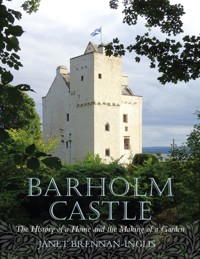
In 1999, Barholm Castle in Galloway had lain ruinous and derelict for over two hundred years when Janet Brennan-Inglis and her husband John bought it as a restoration project. Together with a team of architects, surveyors and builders, overseen by Historic Scotland, they turned this sixteenth-century tower house into a domestic residence once again – this time with central heating, bathrooms and a twenty-first-century kitchen. Since the restoration, they have researched the history of Barholm Castle and the McCulloch family who owned it; the stories they uncovered and the account of the painstaking restoration of Barholm Castle are told in this book. Having restored the tower, Janet and John turned their attention to the ground around it and set about developing a very special garden landscape. The third part of the book describes the process of transforming the wild area surrounding the castle into a series of mature gardens, providing a colourful and dramatic setting for the castle.
Sie lesen das E-Book in den Legimi-Apps auf:
Seitenzahl: 271
Veröffentlichungsjahr: 2025
Das E-Book (TTS) können Sie hören im Abo „Legimi Premium” in Legimi-Apps auf:
Ähnliche


















BARHOLMCASTLE
First published in Great Britain in 2025 by
Origin, an imprint of Birlinn Ltd
West Newington House
10 Newington Road
Edinburgh
EH9 1QS
www.birlinn.co.uk
ISBN: 978 1 78885 848 9
Copyright © Janet Brennan-Inglis 2025
The right of Janet Brennan-Inglis to be identified as the author of this work has been asserted by her in accordance with the Copyright, Designs and Patents Act, 1988
All rights reserved. No part of this publication may be reproduced, stored, or transmitted in any form, or by any means, electronic, mechanical or photocopying, recording or otherwise, without the express written permission of the publisher.
British Library Cataloguing-in-Publication Data A catalogue record for this book is available on request from the British Library
Designed and typeset by Mark Blackadder
Printed and bound in Britain by
Bell & Bain Ltd, Glasgow
Contents
Preface
Acknowledgements
Picture Credits
Abbreviations
Introduction
Life in Rural Scotland in the Sixteenth Century
Life within the Castle
The Galloway Castles
Life in Galloway
PART 1 The History of Barholm Castle
The Building
The McCullochs of Barholm
McCulloch and Barholm Characters
Barholm Castle in the Nineteenth and Twentieth Centuries
PART 2 The Restoration of Barholm Castle
The First Four Years: Before the Work Could Start
The Costs and the Building Process
The Interior
The Exterior
A New Life for Barholm Castle
PART 3 The Development of Barholm Castle Garden
Introduction
Designing and Creating the Garden
The Areas of the Garden
Managing the Garden
Garden Structure and Features
Reflections on Gardening
The Seasons in the Garden
Changing Times in the Garden
Glossary
References
Further Reading
Index
Preface
Ever since we moved to Barholm Castle in 2011, I have intended to write a full account of the history of the building and its owners. Thanks to previous researchers, various visitors from the USA and Canada and the former owner, whose papers included his very helpful historical research, I have been able to put together a history of Barholm Castle and the McCulloch family who built it that I believe is as exhaustive as it currently can be. It has been fun, fascinating and at times frustrating, trying to make sense of the sometimes contradictory and often mysterious pieces of evidence.
The book is in three main parts. In the Introduction I have set the scene in terms of what life was like in sixteenth-century Galloway and, more specifically, within the walls of a tower house. I have also looked at the context of the forty-two other tower houses and castles dotted across Galloway, mostly built at around the same time as Barholm Castle.
Part 1 tells the history of the building of Barholm Castle and of the McCullochs who built it and occupied it for a few hundred years. Their story continues once they left Barholm Castle in the eighteenth century, precipitating its slide into ruination; they built themselves a fine Adam mansion in nearby Creetown. Other McCullochs left the south-west of Scotland to make their fortunes in England and overseas. A few of their stories are told here.
In Part 2, I tell the story of the restoration of Barholm Castle, from the ruin that we first saw in 1997 to the completion of the building works in 2005 and beyond, through the years when it was let out to holidaymakers who wanted to ‘live like a laird’ in a Scottish tower house, to our finally taking up residence in 2011. The before and after photographs show the transformation that took place over the years.
Part 3 tells the story of the development of the garden we have made. I have always loved reading the stories of garden-making told by heroes such as Christopher Lloyd, Roy Strong, Beth Chatto and Tim Smit. Our garden at Barholm is not a great garden in the mould of Great Dixter, The Laskett or Heligan, but it is much loved by visitors. The 3 acres have developed and changed out of all recognition since we started the garden in 2005. The photographs tell the story pictorially, and I have added a narrative that charts the changes and includes some reflections on various gardening-related topics.
Acknowledgements
Grateful thanks are due to the following people for their help and encouragement:
Dr John Brennan; Dr Rose Brennan; Richard Agnew; Steve and Judy Robinson, executors of former Barholm owner Patrick Whitford; Dr David Hannay of Kirkdale; Dr A. Henry Spong, direct descendant of the McCullochs of Barholm; Adam McCulloch; Mary Winston Nicklin; Everett Post; Peter Drummond, architect; Patrick Lorimer, architect; Michael MacLeod, author and historian; James Shirreff, descendant of Bonnie Bess; Ian Robertson; Doug McCullough, author of A History of Clan McCulloch (2025).
Picture Credits
The author and publisher are very grateful to the following individuals and organisations for their kind permission to reproduce the images listed below.
Air Images: aerial photograph of Barholm Castle, 1999, p. 74; aerial photograph of Barholm Castle, 2006, p. 80
Angus Blackburn: the great hall, p. 92; the master bedroom, p. 94; the guest room, p. 96
Andrew Briggs: sketch of Barholm Castle as a ruin, p. 103
Andrew Crawley: the spiral staircase, p. 87; the Brennans at Barholm, p. 108
Heather Davies: watercolour of Barholm Castle, p. 107
Peter Drummond: aerial view of Barholm Castle and garden, p. 34
Clare Hewitt: map of the garden at Barholm Castle, p. 105
Historic Environment Scotland: plans and section of Barholm Castle, p. 33; plan of Barholm House, p. 49; Ian Lindsay plan of Barholm Castle, p. 77
Andy McKean: watercolour of Barholm Castle, p. 106
Michael MacLeod: Miss Jane McCulloch Grant, p. 64; Frederick Wickham Weekes, p. 65; Frederick Wickham Weekes, p. 66; Freddie and Agnes in a motor car, p. 67; intrepid climbers atop Barholm Castle, p. 68; Barholm Castle in the 1930s, p. 69
National Library of Scotland: Timothy Pont’s map of Galloway, p. 25; map of Creetown, p. 48; Ainslie map, p. 67
Dr A. Henry Spong: interior of Barholm House, p. 50; Bonnie Bess, p. 56;portraits of Captain Grant and Isabella McCulloch, p. 62
Abbreviations
HES
Historic Environment Scotland, an executive non-departmental public body responsible for investigating, caring for and promoting Scotland’s historic environment. HES was formed in 2015 from the merger of government agency Historic Scotland with the Royal Commission on the Ancient and Historical Monuments of Scotland.
HS
Historic Scotland, the predecessor (along with RCAHMS) of HES.
RCAHMS
The Royal Commission on the Ancient and Historic Monuments of Scotland; it was merged with HS in 2015.
RHS
Royal Horticultural Society.
TDGNHAS
The Transactions of the Dumfries and Galloway Natural History and Antiquarian Society. These are available online. The first volume was published in 1862.
Our very first view of Barholm Castle in 1997.
Introduction
When we first saw the ruin of Barholm Castle for sale in 1997 we instantly fell in love with it. We rather naively thought that it would be a fun project to bring it back into use as a domestic residence. After all, it was very cheap at only £65,000. Had we known that it would take two years to buy, four years to get all of the necessary permissions and the design and building teams in place, almost three years to do all the work of restoration, and that we would have to rent it out to holidaymakers for a further five years while we lived overseas, earning enough money to pay for it – the costs trebled from the original prediction, of course – we might have hesitated more. But fools rush in where angels fear to tread. To cut a very long story very short, we bought the place in 1999, and in 2005 the rebuilding of Barholm Castle was finally finished. Only the gardens remained to be developed, which has been our ongoing task for more than twenty years since then – never finished, of course. A garden is a dynamic performance which changes constantly and never, ever reaches a conclusion.
Barholm Castle is most likely a sixteenth-century building. I often think of the inhabitants of five hundred years ago as I move from room to room, up and down the steep spiral staircase, and I wonder about the lives that they led in the tower. The choir that I sing in has a repertoire of sixteenth-century madrigals, which might seem appropriate for the owner of a late mediaeval castle. However, it seems unlikely that the McCullochs of Barholm were sitting around singing madrigals in the tower. They were more likely to have been earnestly discussing their Covenanting beliefs, living an accordingly puritan lifestyle, and perhaps plotting revenge on the neighbours who had murdered members of their family on account of religious differences.
Life in Rural Scotland in the Sixteenth Century
For the majority of inhabitants of sixteenth-century rural Scotland, life was tough. Nearly everyone was involved in agriculture or food production and most people spent their daily existence tending livestock and crops and producing food and drink. They were dependent on the weather, the harvest and the fairness or generosity of the laird whose land they farmed. There was a famine in Scotland in the 1590s, and almost half of the years in the second half of the sixteenth century saw local or national scarcity. Difficulties were exacerbated by outbreaks of plague, with major epidemics in the periods 1584–8, 1595 and 1597–1609.
Malcolm McLachlan Harper, in his 1876 book Rambles in Galloway, described rural life in the seventeenth century:
The greater part of the fertile districts of lower Galloway was apportioned to small squatters or crofters, who had neither the means, the inclination, nor the skill to improve the land. They held a right of pasturage in common, on the whole property of the landlord, and the small crofts around their wretched dwellings being the perpetual scene of their agricultural labours, how to improve their material or social condition was never dreamt of by them. From time immemorial this had been the usage, but shortly after the beginning of the last century [i.e. the eighteenth century] various agricultural improvements were commenced.
(Harper 1876, p. 2)
An excellent representation of sixteenth-century farming life was shown in Tudor Monastery Farm, a BBC television series broadcast in 2013, where a historian and two archaeologists lived immersively on a late mediaeval style farm for several months. There had been a previous series where the same team had lived on a Victorian farm for a full year; I was struck by the differences between the two periods in history. The Victorian farm seemed comfortingly familiar – many of the farm tools, household implements and working practices have still been in use within living memory – and life there had a jolly Dickensian quality, despite the lack of modern conveniences. The Tudor farm, on the other hand, was unrelenting hard work with little by way of comfort for the inhabitants; the industrial manufacture of goods had not yet begun, meaning that almost everything had to be hand made from locally sourced materials. Both the agricultural and industrial revolutions of the eighteenth century brought enormous changes and many benefits (as well as misery and disruption) to the people of Scotland, but neither had started when Barholm Castle was built.
Most sixteenth-century dwellings were small and rudimentary, damp and deeply uncomfortable. The tower house, on the other hand, was – literally – the height of relative luxury, although according to Margaret Sanderson,
The contrast in the standard of the domestic circumstances of landlord and tenant was probably less marked than it was later to become; a tower house might be bigger and safer than the farmer’s steading, but it afforded little more private accommodation for the householder and his family, in proportion to the number of people living in it. The paternalist feeling, which might extend to physical protection of the tenants by the landlord, was still strong, even in the Lowlands. A laird’s children might be fostered in a cottar house, and as the sixteenth century progressed the sons of lairds, tenants and craftsmen would learn side by side in the parish school. (Sanderson 1982, p. 170)
Even so, the lifestyles and possessions of the inhabitants of towers and castles would be much more luxurious than those of the tenants.
In Galloway, the focus of outward communication was towards the Solway estuary. A Land Apart is the apt subtitle of Andrew McCulloch’s book on the region: ‘Even by the seventeenth century the province was relatively isolated from the rest of the country, still an area of warring clans, religious strife, gipsies, smugglers and coastal raiders’ (A. McCulloch 2000, p. 12). Roads were generally poor, and the landscape was isolated from the rest of Scotland, penetrable only by high valley passes to the north and east. The sea, however, gave access to Ireland, the Isle of Man, Cumbria and the coast of Ayrshire, as well as providing a means of travelling between towns and villages in Galloway. Just along the coast from Barholm Castle was the Ferry Toun of Cree, officially renamed Creetown in 1792, when John McCulloch V of Barholm had it constituted as a Burgh of Barony. The Ferry Toun was where one could depart – by ferry, of course – for Wigtown, or for the sacred shrine of St Ninian at Whithorn.
In 1525, in an attempt to control the disputes in the lands around the border with England, James V laid down a new Act of Parliament. It required that every landed man in the region ‘shall build a sufficient barmkin upon his heritage and lands in the most suitable place, of stone and lime, containing three score foot of the square, one ell thick and six ells high, for the protection and defence of him, his tenants and their goods in troublesome times’. This translates to barmkin walls that were just under 1 metre thick, 5 metres high and enclosing a courtyard of at least 18 square metres. The area would, of course, depend on status of the family constructing the building and the depth of their pockets. Some of Barholm Castle’s enclosure walls are almost 1 metre thick at the base, but nowhere near 5 metres high. The one surviving barmkin in Galloway is at Hills Tower near Dumfries, where the walls are about 2.5 metres high; this is about the standard height for the few remaining barmkins in Scotland, such as those at Smailholm and Craigievar castles. There is clear evidence at Lennox Plunton Tower near Gatehouse of Fleet that its barmkin was 2.74 metres high. Only military buildings tend to have walls higher than 5 metres.
Larger establishments than Barholm would have had extensive outbuildings housing stables, an alehouse, a dairy and a bakehouse, but as a small laird’s tower, Barholm would have needed only a few agricultural outbuildings, including a small dairy and bakehouse. The inhabitants of the castle would have been supported by a range of rural craftsmen, including a blacksmith, wheelwright, cooper, weaver, shoemaker, miller, baker and tailor. To sustain themselves in such a rural area, these men would have divided their time between farming and the practice of their craft. They were in thrall to the rhythm of the seasons and the weather, working from sunrise to sunset. In the depths of winter, the sun rises after 8 a.m. and sets before 4 p.m., so the days would be short. But in the west of Scotland, summer days are long and the climate is temperate, giving an opportunity to make up the time lost in the dark winter months. Ploughing with cows or oxen was a task that the majority of men had to engage in. It was very hard physical work and required a degree of skill to complement brute strength.
The relationship between laird and tenant farmers is explored by Margaret Sanderson:
The contact between tenants and landlords, most of whom, after all, were lairds, bonnet lairds and feuars, was probably closer in the sixteenth century than it was ever to be again, if for no other reason than that landlord and tenant still spoke the same language, vernacular Scots. Absenteeism, at least among the smaller lairds and feuars, was probably the exception, at any rate for long periods.
(Sanderson 1982, pp. 170–1)
‘Man works from sun to sun, but a woman’s work is never done’
Women had many tasks to complete beyond childcare. They had to milk the cows and goats, make the cheese, daily bread and ale, look after the poultry and pigs, clean the house, wash the linen, cook the meals, tend the herb and vegetable garden and generally make sure that the household ran smoothly. Most of these tasks could not be alleviated by any kind of laboursaving device, because very few had yet been invented, but general help would have been given by the older children of the household. One of the most common causes of death for women – apart, of course, from childbirth – was their heavy linen skirts catching fire as they stood cooking over an open fire.
The food
The sixteenth-century diet was dictated by the seasons and by the religious calendar of feasting and fasting. During Lent, in February or March, when no meat, eggs or dairy produce were to be consumed, dried peas and beans were made into savoury puddings, supplemented with the staples of bread and ale. Even for those who did not care to follow the Church’s injunctions, after a long winter the hens and geese were often not laying, the cows not producing milk and the beasts scraggy, so there was little to offer by way of animal protein. There might be some pickled herring or salted fish from last year, but fresh fish was unlikely as fishing tended to be a seasonal activity. By Easter, the most important feast of the Christian year, the grass would be growing again, the poultry laying and cows and sheep producing milk. Milk was also used to produce cheese, and in order to start that process, a young calf would need to be slaughtered to provide rennet. The meat from the calf would provide an Easter meal, the first meat of the year for most. In April, stillborn lambs provided bursts of meat-eating, which could be flavoured with fresh herbs. By summer, after the sheep were shorn, mutton would be available, and eggs, butter, milk and cream would continue to supplement the diet, along with fresh strawberries and some green leafy vegetables and fresh peas and beans. In the autumn, the grain harvest meant that pies, pastries and cakes would be plentiful; beef would also be at its best. November was the traditional time for slaughtering pigs, so sausages, hams and bacon would be produced, with some stored for the winter. Herring and cod would be pickled, also to store for the winter, and hard cheeses made which kept for weeks or months. At the beginning of December came Advent and four weeks of abstinence from meat, although fish was allowed. Turnips, parsnips and carrots provided bulk to the pottage made throughout the month. The feast of Christmas might be celebrated with a pickled pig’s head and mince pies made with meat, suet and dried fruits. In January the stored cheeses, pickled fish and cured meats, as well as some sprouting scraps of winter kale and dried peas and beans – and, of course, the year-round staples of bread and ale – would provide a reasonably healthy diet until Lent began the cycle again.
Life within the Castle
Like most late mediaeval buildings, Barholm Castle is a kind of Tardis in reverse. It looks imposingly grand, and people assume that it must have commodious accommodation. But the walls are so thick that there is less living space inside than you might imagine. It is the very opposite of the estate agent’s description ‘deceptively spacious’: the footprint of the ground floor is two thirds wall and only one third room. The vaulted cellar, which has become our kitchen, and which constitutes the ground floor of most tower houses, would have been a storehouse and not in general use by the family.
Interiors of sixteenth-century tower houses had little natural light, because of their small windows, but they were usually brightly decorated. Walls were either panelled, often with paintings on the panelling, or hung with tapestries, which also added a layer of insulation. Ceilings were often brightly painted. Textiles such as rugs and runners were richly patterned, and ornamental ceramics would add to the impression of colour and pattern. The great hall was where family activity was centred. With its huge fireplace and window seats, there was plenty of space for dining and family activities. There may have been a screen at one end to give the laird and his family some privacy; this was often the layout in great halls. Rushes would have been laid on the floor, to absorb food spillages and mud from animal paws and human feet.
The great hall was also the focus of hospitality, where the laird’s family and their guests and servants dined. Michael Pearce has made extensive studies of sixteenth-century Scottish inventories, which shed light on the furnishings and possessions of the lairdly class.
The sixteenth-century hall was equipped for a ritual of hospitality which was instantly recognisable and socially cohesive. Its hierarchic arrangement was intended to emphasise inequality of wealth and power. Followers were intended to be reassured by the display that their masters would fulfil social obligations towards them. Six characteristic groups of furnishings are regularly seen in sixteenth-century inventories:
Cutaway section of Urquhart Castle: this shows a typical layout for a Scottish mediaeval tower house, and the thickness of the walls.
• the high table, the principal seat and its decoration;
• the ‘side tables’, seating for everyone else;
• the cupboard and silver plate;
• the hanging chandelier, often described as a ‘hart horn’;
• displayed weapon(s) – often a single halberd as a symbol of seigniorial power;
• the cloths and napery used during dining. (Pearce 2015, p. 80)
The lairdly inhabitants of the sixteenth-century tower house often had plenty of personal belongings. The thorough inventory of clothing and household articles from Elshieshields Tower near Dumfries (which is a similar size to Barholm), ‘left at the decease of Lady Elshieshields 7th December 1670’, shows that the possessions of a local lady in the seventeenth century were extensive. Among her ‘clotheses’ were twelve pairs of shoes, two pairs of boots and a pair of galoshes. She left nine headdresses, fifteen shirts, seven pairs of stockings, a chapeau and a hankie. Among her household articles were forty-two pewter plates, twenty-nine small linen sheets, thirty-two napkins and twelve new blankets. The range of goods in a sixteenth-century tower house would have been similar, although Lady Elshieshields does sound rather extravagant.
Sleeping arrangements were probably crowded. If there were many family members and servants to accommodate, some people would sleep in the great hall. On the second floor of Barholm Castle were two bedchambers, each with its own door accessed by a little corridor built into the thickness of the wall. Each chamber had a fireplace and two windows. Both of the fireplaces were modified at some point to make them smaller, with stones inserted at the sides and a new, lower lintel, presumably to save on fuel. If the laird and his wife had a bed with curtains, that would have afforded them some additional privacy and protection from drafts.
One of the chambers on the main bedroom floor (now used as a bathroom) has a garderobe toilet with a ‘moss box’ cut into the wall for the mediaeval equivalent of toilet paper. There is even a little window in the garderobe chamber. At the east end of the exterior south wall, the exit of the garderobe chute can clearly be seen at ground level, with a large flat stone set in at an angle of 45°, no doubt to aid the efficient egress of effluent. Those who had the unpleasant task of collecting human excrement from garderobes were called ‘gong farmers’, and large castles would regularly employ such workers to manage and empty these cesspits. Barholm was probably too small an establishment to need such services and has no cesspits; a general low-ranking servant would have attended to matters when necessary. The other bedchamber also has a similar tiny apartment, or intra-mural recess with a window and door, which, mysteriously, contains no garderobe. It may have been a ‘dry stool’, ‘close stool’ or ‘stool of ease’ chamber, which contained a chamber pot inside a cabinet or inside a stool. But why one room should have a garderobe and the other not is a mystery. The empty intra-mural chamber may instead have been a muniments room, used to store title deeds and other important documents, perhaps with an iron door to protect the contents from the danger of fire. A second garderobe chute can be seen outside the castle at the south-west corner, but this does not line up with the intra-mural chamber; evidence shows that this originated from the wall walk (a passageway behind the castle wall) outside the long gallery on the floor above.
The third floor, as was common in such towers, was one long gallery, or garret (see page 6), with a fireplace and small window at one end. There is also evidence that there was a garderobe near the window, perhaps on the wall walk, with a step to the outside. This would be where servants slept, with the highest-ranking nearest the fireplace and window. There may have been dormer windows bringing in more light, but there is no evidence one way or another as the roof disappeared more than two hundred years ago.
Living in the castle for several years has given us insight into the likely lifestyles of the former inhabitants. When we had a lengthy power outage one winter, we discovered that without the underfloor heating the great hall becomes cold very quickly once the fire has died down. With the full width of the great hall fireplace reaching 9 feet, the amount of wood needed to keep a fire going would have been staggering. We know that the woods around the castle were mainly of oak and ash, which both burn well and would doubtless have been used in the castle for heating and cooking. We occasionally light a fire at Christmas or when we have guests; a large basket of logs does not last a full evening, and that is in the relatively small grate which we have inserted in the fireplace. Even with the small grate the fire gives out a good heat – as long as you keep close to it.
Tower houses generally had small windows with unglazed wooden shutters. Often these were expanded in later years once glass-making technology had evolved to make larger panes cheaper and more readily available. This did not happen at Barholm, however: instead of being modernised, it was abandoned in the eighteenth century. We had windows with unglazed shutters installed in the great hall at Barholm as there was evidence that this type of window was there originally. The upper part would have been glass or, if that was not available, oiled linen or translucent animal hide. The interior of the great hall would have been gloomy, even on sunny days. Window seats made the most of natural light, and I imagine the women who were involved in sewing would have used them. After dark, oil lamps or tallow (rendered animal fat) candles would be used to light the castle.
The garderobe on the second floor, with its moss box cut into the wall.
A mediaeval garderobe in action, with the ‘gong farmer’ shovelling out the fallen excrement.
The historian Alastair Maxwell-Irving (2014) notes that there would have been a yett at the door, as there is a bolthole for a drawbar. I keep a selection of secateurs and string in the bolthole, handily placed for snatching up as I go out to the garden.
Wooden shuttered window in the great hall, showing the unglazed bottom part and small leaded panes above. These may have been animal hide or waxed linen originally, rather than glass.
The Galloway Castles
All over Scotland, from the middle to the end of the sixteenth century, numerous tower houses were being built, including many of the forty-two in Galloway that are still standing and recorded here. What Stewart Cruden (1981, p. 144) calls the ‘long pause’ – when few tower houses were built – occurred from about 1480 until the Scottish Reformation in 1560. After the Reformation there was a frenzy of building, leading to an estimated total of 6,000 castles and tower houses across Scotland in the sixteenth century. Castle historians MacGibbon and Ross point out that tower houses were ‘remarkably uniform’ throughout Scotland: ‘in few instances is there any indication of marked originality or individual effort. In other words, there is rarely any appearance of the architectural or designing mind; the work is rather that of the builder acting on traditional lines’ (MacGibbon and Ross 1887–92, vol. 5, p. 545). The builder would probably be a master mason, with a group of masons working under him. Indeed, the builder who carried out our restoration work was firmly of the opinion that an architect was still unnecessary in the twenty-first century. However, although there may be little evidence of the ‘designing mind’, the Galloway tower houses that are more or less contemporaneous with Barholm Castle do display a large range of sizes, settings and levels of verticality, finish and comfort, despite all being recognisably of the same form.
Two local towers were also owned by McCullochs, i.e. Myrton and Cardoness, both now ruinous, and there would have been communion among them. Others, such as Carsluith and Hills, were owned by Catholic families, the Browns and the Maxwells respectively, and they were McCulloch adversaries. Most Galloway towers are ruinous, or at least unoccupied, some depressingly so (e.g. Cally Castle and Castle Clanyard). Only eleven are inhabited (Abbot’s, Auchness, Barholm, Barscobe, Rusco, Buittle, Craigcaffie, Hills, Kirkconnell, Lochnaw and Isle of Whithorn) and three (Castle of Park, Machermore and Old Place of Monreith) are let out for holiday accommodation. Many would have been built on the sites of earlier buildings where defensive features were present and there was access to the sea and clean water.
The architectural historian Charles McKean was puzzled by
those who decided to enhance the verticality of their house in the teeth of domestic logic. Why erect a tall house – sometimes an unconscionably tall house – when height was not required for defence? Probably because the owners considered height as a way of signalling status and lineage in a society preoccupied with history, genealogy and precedence. Perhaps, too, they were determined that their seat should be visible above the tops of the increasingly protected trees; or even that this was the form of house required by their status or their pocket. (McKean 2001, p. 143)
Certainly, almost all of the Galloway tower houses are uncompromisingly vertical; they make a statement in the landscape and would have been even more prominent five hundred years ago, when they were harled and painted. What has become clear, as I have looked for a common set of dates for the castles of Galloway, is just how little we know of the precise dates of building and the details of ownership and occupancy for many of the individual tower houses. ‘Probably’ is the most common and useful adverb I can use in their descriptions.
It is clear from the number of towers and castles in Galloway – over forty of which are still in existence – that Barholm Castle was part of a network of grand buildings across the region, ranging from small laird’s houses to the fortified magnificence of Threave. The area of Galloway is 1,418 square miles; given that most castles tended to be clustered along the coast or by rivers or lochs, near villages and towns, the buildings must have been very evident. Most would have been harled and limewashed, like Barholm, and thus would have stood out in the countryside, signalling the status of their lairdly owners. The majority were built, or at least expanded, in the fifty years between 1560 and 1610, making it likely that many of them shared builders and masons. Carsluith Castle is near Barholm and very similar in size and design, and Buittle Castle and Sorbie Tower share characteristics, for example. When Barholm was being restored, our builders were also employed by the owners of Lochnaw Castle near Stranraer, who were restoring their building at the same time.
Galloway castles west of Barholm
Barholm Castle lies almost in the middle of Galloway. Heading westwards from Barholm, just a couple of miles along the coast is the ruin of Carsluith Castle




