


13,99 €
Mehr erfahren.
- Herausgeber: The History Press
- Kategorie: Sachliteratur, Reportagen, Biografien
- Sprache: Englisch
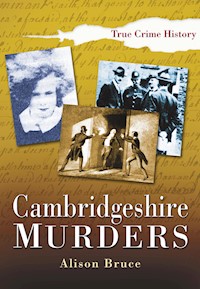
The cases covered here record the county's most fascinating but least-known crimes, as well as famous murders that gripped not just Cambridgeshire but the whole nation. From the mysterious barn fire at Burwell that killed seventy-six people to the unsolved murder of Cambridge shopkeeper Alice Lawton, and from poisoning in St Neots to the murder of a fifteen-year-old drummer boy whose ghost haunted the killer and drove him to confess, this is a collection of the county's most dramatic and interesting criminal cases. Alison Bruce has gone back to original records and documents to uncover the truth about these extraordinary crimes. Using contemporary illustrations and tracing the stories through the words of those who were actually there, she re-creates the drama of case and courtroom. Cambridgeshire Murders is a unique re-examination of the darker side of the county's past.
Das E-Book können Sie in Legimi-Apps oder einer beliebigen App lesen, die das folgende Format unterstützen:
Veröffentlichungsjahr: 2012
Ähnliche


















Cambridgeshire
MURDERS
Alison Bruce
For Jacen
Thank you for encouraging me to write and for introducing me to such a diverse and fascinating part of England
First published in 2005 by Sutton Publishing
The History Press
The Mill, Brimscombe Port
Stroud, Gloucestershire, GL5 2QG
www.thehistorypress.co.uk
This ebook edition first published in 2012
All rights reserved
© Alison Bruce, 2010, 2012
The right of Alison Bruce, to be identified as the Author of this work has been asserted in accordance with the Copyrights, Designs and Patents Act 1988.
This ebook is copyright material and must not be copied, reproduced, transferred, distributed, leased, licensed or publicly performed or used in any way except as specifically permitted in writing by the publishers, as allowed under the terms and conditions under which it was purchased or as strictly permitted by applicable copyright law. Any unauthorised distribution or use of this text may be a direct infringement of the author’s and publisher’s rights, and those responsible may be liable in law accordingly.
EPUB ISBN 978 0 7524 8413 6
MOBI ISBN 978 0 7524 8412 9
Original typesetting by The History Press
CONTENTS
Introduction
1 The Flaming Heart
2 Arsenic and Old Laws
3 Prime Minister’s Elimination Time
4 The Early Bird Catches the Killer
5 From Waterhouse to Slaughterhouse
6 A Fatal Attraction
7 The One Shilling Killing
8 ’Tis Quite Harmless
9 An Ironic Twist of the Knife
10 A Good Night Out and a Bad Night Inn
11 Eat, Drink and be Murdered
12 The Little Shop of Secrets
13 A Different Sort of First for Cambridge
14 The Dog was the First to Die
15 To Love, Honour but Mostly Obey
16 Other Notable Cambridgeshire Crimes
Select Bibliography
Acknowledgements
INTRODUCTION
Cambridgeshire, which now incorporates its old neighbour Huntingdonshire, is largely rural and therefore not densely populated. Without any major cities, it is understandable that the crime rate for the county is lower than that of many other shires; but this does not mean that the murders that do occur there are in any sense mundane; in fact, many achieved such notoriety that they became cases of national interest.
When I first began to research this book I knew I would come across old and interesting murder cases that had not been fully documented. Those selected here cover three centuries of Cambridgeshire history, highlighting changes in society as well as trends in methods of committing murder. Although most cases were solved, in some the accuracy of the verdict and the fairness of the trial often served as good examples of why the laws allowing the admission of hearsay and circumstantial evidence needed to be changed; ‘Arsenic and Old Laws’ is a particularly good example.
Much of the research has involved going back to original assize and other period documents. Unfortunately, Cambridgeshire’s inquest records relating to the period between the late 1800s and the late 1930s were destroyed by flooding – having been stored in a basement. Conversely, some of the best surviving documents are the oldest – the Ely Diocese Records include many sheets of beautiful handwritten statements, often signed by witnesses with a shaky ‘X’.
While many of the county’s murder cases are covered by the Newgate Calendar, I have not used this source verbatim: if you come across a copy you may notice differences between the details reported there and the information used in this book. This is because when cross-checking sources, I often found inaccuracies in the calendar – which of course does not mean that this is not an interesting source from which to initiate an investigation.
One reported murder that I chose not investigate further was the killing of a young lad named George Burnham. Although the case appears to be interesting, contemporary documentation was too limited to shed much more light on the case. The following is from the Newgate Calendar and demonstrates the sensationalist and ‘fire and brimstone’ nature of the publication:
RICHARD FAULKNER A Boy, executed at Wisbech, in 1810, for the Murder of another Lad of Twelve Years of Age
RICHARD FAULKNER was, at the Summer Assizes for Norfolk, 1810, capitally convicted of the wilful murder of George Burnham, a lad about twelve years of age, at Whittlesea, on the 15th of February, by cruelly beating him to death, for no other cause than for revenge on Burnham’s mother, who had thrown some dirty water upon him.
The prisoner was not sixteen, but so shockingly depraved and hardened that after condemnation he repeatedly clenched his fist and threatened to murder the clergyman who attended the jail, or anyone who dared to approach him. Indeed he was so ferocious that the jailer found it necessary to chain his hands and feet to his dungeon, where he uttered the most horrid oaths and imprecations on all who came near him; and from the Friday to Saturday night refused to listen to any religious advice or admonition.
At length, to prevent the termination of his existence in this depraved state, the expedient was devised of procuring a child about the size of the one murdered, and similar in feature and dress, whom two clergymen unexpectedly led between them, by the hands, into the cell, where he lay sulkily chained to the ground; but on their approach he started, and seemed so completely terrified that he trembled in every limb; cold drops of sweat profusely fell from him, and he was almost continuously in such a dreadful state of agitation that he entreated the clergymen to continue with him, and from that instant became as contrite a penitent as he had before been callous and insensible.
In this happy transition he remained till his execution on Monday morning, having fully confessed his crime, and implored, by fervent prayer, the forgiveness of his sins from a merciful God!
Writing and researching this book has been a hugely enjoyable experience, especially when I have had the opportunity to see artefacts or visit places connected with the cases described. Walking along the narrow street outside Miss Lawn’s old shop, seeing the hangman’s noose that hanged one of these murderers or standing in a rainy Burwell churchyard next to the Flaming Heart were moments that made me feel as if I were touching Cambridgeshire’s past. I hope that the cases included and the illustrations chosen will make some of the darkest stories from our county’s history come alive for you too.
1
THE FLAMING HEART
One of England’s earliest fairs was held at Stourbridge, Cambridge, and was granted a charter in 1211. Many authors wrote about the fair and in 1724 Daniel Defoe gave a detailed account: ‘ . . . it cannot be very unpleasant, especially to the trading part of the world, to say something of this fair, which is not only the greatest in the whole nation, but in the world . . .’.
The fair originally lasted for two days but by the middle of the sixteenth century it ran from 24 August to 29 September each year. A vast array of products was on sale until the last day, which was reserved as a horse-fair. Defoe’s description notes:
Towards the latter end of the fair, and when the great hurry of wholesale business begins to be over, the gentry come in from all parts of the county round; and though they come for their diversion, yet it is not a little money they lay out, which generally falls to the share of the retailers, such as toy-shops, goldsmiths, braziers, ironmongers, turners, milliners, mercers, etc., and some loose coins they reserve for the puppet shows, drolls, rope-dancers, and such like, of which there is no want, though not consider-able like the rest.
One of the puppet shows mentioned by Defoe belonged to Robert Shepheard, who was travelling towards Cambridge in the early part of September 1727 with his wife Martha, his daughter, also called Martha, and a couple of servants. Running low on funds, as they were passing through the village of Burwell they decided to raise some money by putting on a puppet show. On 8 September 1727 they hired a barn from a Mr Wosson. It was a clunch1 barn with a thatched roof, and situated near Cuckolds Row.
The interior of the barn was approximately 17ft 6in high, 45ft long and 16ft 9in wide. The straw bales inside were stacked up to about 9ft, leaving about a third of the area available for the puppet show. Adjoining the building, and separated by just a lathe and plaster wall, was stabling. This partition was the same height as the stone walls of the barn, about 9ft, and the stable and its hayloft shared the same thatched roof as the barn.
The arrival of the puppet show caused much excitement in the village and there was a rush to gain admission at the price of 1d per person. With far more people wishing to see the show than the barn could hold, it was decided to lock the doors from the inside – many reports describe them as being ‘nailed shut’.
The audience numbered in excess of a hundred with over half being made up of local children and families from nearby villages, including Reach, 2 Swaffham-Prior and Upware. Among them were villagers from all walks of life, including John and Ann Palmer, children of Henry and Sarah, who belonged to a prominent Burwell family, and Thomas Howe, his brother and sister Sarah.
At about nine in the evening a young ostler named Richard Whitaker was attending to Robert Shepheard’s two horses in the adjacent stable. He was carrying a candle and a lantern. Wanting to see the puppet show but not wishing to pay the entrance fee, he climbed up into the hayloft where he was able to look down into the crowded barn. While there he threw hay down to the stable below; inevitably, some hay caught alight on the naked candle flame and Whitaker rushed from the building to raise the alarm.
In An Account of a Most Terrible Fire by Thomas Gibbons (see pages 3–4), young Thomas Howe described watching the show while sitting on a beam inside the barn. He was one of the first to spot the flames, which were ‘so small that he thinks he could have enclosed it in his hands’. This small fire began high up in the building very close to the thatched roof, which was unusually dry due to a recent drought. As well as the straw and hay, the inside of the barn was draped in old cobwebs and the fire quickly took hold, rushing along the length of the thatch – according to the parish register, ‘like lightning flew round the barn in an instant’.
The audience rushed to the door, which was not only sealed but also blocked by an oval table that the puppet master had used earlier in his show. In their desperation to escape they crowded the door and many ended up falling into a great heap behind it.
Outside the barn, the first to give assistance was a Wicken man, Thomas Dobedee, who happened to be in Burwell. Described as ‘a very stout man, in the prime of life’, he managed to force the door and began pulling survivors from the blaze.
Thomas Howe saw the doors open and leapt down from his beam on to the pile of bodies below, which he described as being three or four feet deep with not one person left standing. The parish register explains ‘that most of those that did escape were forced to crawl over the heads and bodies of those that lay in a heap at the door’. Thomas Howe’s brother clambered over the bodies accompanied by two smaller boys who refused to let go of him; all three of them managed to reach safety. Two men who had escaped helped Dobedee to rescue others. Dobedee stayed so long that his hair was singed, having put his own life at tremendous risk.
The wind, however, remained strong, fanning the flames and sending burning stalks of straw into the air. Five other houses in the neighbourhood were razed to the ground, one of which was home to bed-ridden Mary Woodbridge, who perished.
After about half an hour the thatched roof collapsed and the last hope of rescuing anyone else vanished. Although Thomas Howe and his brother had survived, their sister had died, as had John and Ann Palmer. In total there were about eighty deaths, the bodies transported by cart and buried in two large pits in the graveyard. A gravestone known as ‘The Flaming Heart’ was erected in Burwell cemetery commemorating seventy-eight deaths, although a 1769 account lists seventy-nine with a possibility of two more unnamed victims. The bodies of John and Ann Palmer were buried separately since the Palmer family had its own dedicated area in the churchyard. A number of the casualties were children who had climbed from their bedroom windows to see the show. Also among the dead were the puppeteer and his family.
The sermon later preached by Alexander Edmondson, vicar of the parish, came from Lamentations 4: 8: ‘Their visage is blacker than coal; they are not known in the streets; their skin cleaveth to their bones: it is withered, it is become like a stick.’
Richard Whitaker was arrested and charged with arson. He was about 25 years old and came from Hadstock in Essex. Some reports suggest that he was tried at the Essex Assizes, others that he was tried at the Cambridge Assizes. The original assize records for these hearings no longer exist but it seems most likely that he was tried in March 1728 in Cambridge.
Whitaker was found to have been the cause of the fire, but only through negligence, and so he was acquitted of the charge of arson. Parish records say ‘that the fire was occasioned by the negligence of a servant who set a candle and lantern near the heap of straw which was in or near the barn’.
Apart from references to the fire in parish records the only other account of the day was a half-sheet produced by a Northampton printer very shortly afterwards. It contained several major inaccuracies including the date being wrong by a day and the listing of an incorrect number of casualties. However, it is still an interesting, if graphic, account:
September 9th, 1727. At Burwell in Cambridgeshire a Puppet Show was exhibited in a barn, ye doors were locked, and there was a stable adjoining to it where a boy was got with design to see it, for which purpose he climbed up upon some beams and took his candle with him, while he was viewing ye show fell down among a heap of straw and find it alight which ye boy perceiving he sprung out and narrowly escaped. The fire burning very fierce had catcht ye roof of this barn before ye people perceived it, ye doors were lockt to keep people out, and with some difficulty ye doors were broke and some escaped – but the rest pushing to get out wedged one another in yet none could stir till the roof fell in and 105 persons perished in ye flames. Some few were escapd into an adjoining yard which was built round with thatcht houses and on fire, but were forced to lie down and perish in it. An excise man and his child perished there and his wife is since quite distracted. After the fire was abated they found here an arm and there a leg, here a head there a body, some burnt with their bowels hanging out, most deplorable sight. There were abundance of people from the adjacent towns in ye number all most young persons.
The Revd Thomas Gibbons wrote An Account of a Most Terrible Fire, a more comprehensive account of the incident, published by J. Buckland in London in 1769. Gibbons had spent some of his childhood in Reach and in 1728 attended a school in Little Swaffham, just outside Burwell. He saw the site of the fire and many years later revisited Burwell and drew his account from village records and the memories of survivors, primarily Thomas Howe, who were keen to have the fire recorded more accurately than the account produced at the time.
The fire had a huge impact on the small rural village of Burwell and its surrounding hamlets. Of Burwell’s 800 inhabitants at the time, it is said that barely a family escaped without loss.
The barn was located in Cuckolds Row, near the footpath which now runs between the pharmacy and the bank. Since the fire some villagers have claimed to have heard the ghostly clanking of water pails.
In February 1774 the following report appeared in the Cambridge Chronicle:
A report prevails that an old man died a few days ago at a village near Newmarket (Fordham), who just before his death seemed very unhappy; said he had a Burthen on his Mind, which he must disclose. He then confessed that he set Fire to the Barn at Burwell on ye 8th. of September 1727, when no less than 80 persons unhappily lost their lives; that he was an Ostler at that Time, at or near Cambridge, and having an Antipathy to the Puppet Show Man was the cause of his committing that diabolical Action, which was attended with such dreadful consequences.
Frustratingly, the man is not named, therefore making it impossible to check the likelihood of this claim, but according to parish records the old man in question was not Richard Whitaker.
Notes
1 Clunch is a traditional building material, usually a soft limestone, often used in the east of England, where more durable stone is uncommon. It can be rich in iron-bearing clays or be very fine and white – in effect just chalk. As it is not a long-lasting material, it is now used mostly for boundary walls, and occasionally for traditional agricultural buildings. Clunch was quarried in Burwell.
2 Reach (sometimes spelt Reche) is the location of the Reach Fair, whose charter dates from 1201. The fair is still held in May each year, making it England’s longest surviving fair.
2
ARSENIC AND OLD LAWS
Amy Conquest1 was born to Thomas and Mary Conquest in Whittlesey and baptised on 19 October 1729. The family were not well off but nevertheless Amy’s parents ensured that she received an education until she reached the age of 12. By the age of 16 she had grown into a tall, fine girl and began to receive attention from Thomas Reed2 of Whittlesey.3 Her father did not approve of the liaison and wanted his daughter to stop seeing the young man, but the two had fallen in love and soon consummated their relationship, which, according to a later description in the Newgate Calendar, ‘continued till it became criminal’ .
Amy fully expected that she would marry and so was shocked when, in the summer of 1748, Thomas told her that he was planning to travel to London and did not know when he would come back to Whittlesey. Despite assuring her that they would marry upon his return, Amy still felt betrayed and began to spend time with another local man, John Hutchinson, who had also been a suitor but one she had not encouraged. Despite the fact that Amy had never particularly liked John, her family, and her father in particular, felt that he was a better choice than Thomas Reed. Consequently, when John formally asked for Amy’s hand in marriage on 24 August 1748, her father was quick to consent. As the wedding was arranged for the very next day, Amy’s father may have thought that a quick wedding would avoid any possibility of the union being spoilt by Thomas Reed’s return.
However, Thomas got word that Amy and John Hutchinson were about to marry and rushed back to Whittlesey only to see the two leaving the church as man and wife. Amy was distraught when she saw him and instantly realised what a terrible mistake she had made by marrying a man she did not love.
Within days Thomas and Amy were seeing one another again but were not as discreet as they should have been. Very soon neighbours were gossiping and John Hutchinson became jealous. Amy’s arguments with her husband culminated with him beating her with a belt or stick on several occasions, but also with a realisation that his wife would not change her ways. He began to drink heavily and to stay away from home.
At about 5 a.m. on 14 October, just seven weeks and one day after their wedding, John Hutchinson became ill, complaining of the ‘ague’. Amy brewed him some warm ale but on seeing no improvement she sent for Mary Watson. Mary stated that she found John very ill and that the boiled beer given to him by Amy had made him feel worse. According to some accounts John was still alive at 9 a.m., but died soon afterwards. Mary Watson claimed that:
Ann Conquest, the sister of the said Amey [sister-in-law] went for this deponent in the afternoon following to desire after to come and see the said John and upon going he apprehended to this deponent to be dying and dyed within about three-quarters of an hour after. That he did not complain that any means had been used to shorted his life. That this deponent was at the laying out of the said John after death and that nothing appeared to her this deponent but that he dyed of his natural death.
Initially John’s death was not considered suspicious, and the burial took place in Whittlesey on 16 October 1748. However, when Amy’s lover moved in only a few days later in what seemed to be a blatant act of disrespect, the people of Whittlesey grew uneasy. On 19 October John’s body was exhumed and three surgeons, John Clarke, William Benning and John Stona, carried out an autopsy. In the mid-eighteenth century methods of detecting and identifying poisons were primitive, so their account of their findings is both graphic and fascinating:
We whose names are here unto subscribed being called upon the day and date above to open the body of John Hutchinson deceased found his stomach had been much inflamed and in it a bloody liquor with a mucus matter of the same colour which we imagine to be caused by some corrosive medicine taken inwardly.
The said liquor and mucus we immediately gave to a dog kept him confined and he expired about seven hours after.
The next day upon opening the dog found his stomach much in the same manner as the deceased John Hutchinson’s and caused as we believe by the liquor out of his stomach.
The ensuing inquest heard statements from a variety of Whittlesey residents. One of the statements, which was to lead to Amy’s arrest, came from shopkeeper William Hawkins, who testified that he had sold Amy Hutchinson an ounce of white arsenick4 (sic) on Thursday 13 October. He said that she had wanted it to poison rats but could not say what use she had actually put it to.
By Tuesday 18 October Amy was under arrest and being held at the house of John Stona. A villager named Mary Addison, who asked her whether she had any poison in her house, visited her. Amy told her about the rat poison, saying that she had mixed it up with oatmeal and placed it under the floorboards. Mary went to the Hutchinson house the following morning where she found a broken pot containing the mixture Amy had described. Unfortunately for Amy, instead of retrieving it so that an attempt could be made to gauge the amount of arsenic it contained, Mary covered it with hay and left it there.
Most of the witness statements did not help Amy’s situation. Even though Mary Watson said that John Hutchinson did not think he had been poisoned, telling the jury it was the beer that had made him worse would have weighed heav-ily against Amy. Even when John Hutchinson was portrayed at the inquest as a brutal man, the evidence did not lean in Amy’s favour.
An example of John Hutchinson’s violence was relayed to the inquest jury by Prudence Watson of Whittlesey, who testified on 20 October. About three weeks earlier she had been at John and Amy’s house. She and Amy had been drinking tea and decided to try reading their tea leaves when John returned home. After an angry exchange with his wife, John turned on Prudence and kicked her down the stairs. Prudence explained to the inquest that soon after this assault she had received a visit from Amy, who suggested that, as she was pregnant, she should press charges. Amy also stated that she feared that her husband ‘would knock her on the head’. However, instead of winning any sympathy for Amy, Prudence’s disclosure was seen as a sign of Amy’s faithlessness and willingness to betray her husband.
Prudence Watson’s statement
Many of the statements were little more than hearsay and gossip, including accounts of tea-leaf reading from Alice Hardley (the mother of Amy’s sister-in-law Ann) who said that Amy had seen a man’s coffin and a child’s coffin in her cup. There was a questionable statement from Alice Oldfield, who claimed that Prudence Watson had talked about an unnamed man who had died and whose wife was under suspicion; Alice suspected this to be Amy.
Statements such as this offered little in the way of evidence but they do show the weight given to rumour. It is possible that many of the friends, neighbours and even relatives who gave evidence against Amy at the inquest and the trial did not distinguish between scandal-mongering among themselves and testifying under oath. Unfortunately for Amy, when the inquest jury returned its verdict on Monday 7 November, the opening words demonstrated the damage that had been done: the said John Hutchinson was wilfully and maliciously murdered by poison of which the said John on Fryday the fourteenth day of October last languished and dyed that it does not appear to them who were the person or persons that committed the said murder but that they have just reason to suspect that the same was committed and done by Amey the wife of the said John.
On 12 November summons were issued for witnesses to appear at the next Ely Assize or General Gaol Delivery. Records exist showing that among those to receive a summons were John Hammant, John Clark, John Stona, William Benning, William Hawk, Thomas Boon, Ann Baggerley and Alice Setchells, and that failure to appear in court ‘and there give such evidence as one knoweth against Amey Hutchinson’ would result in a £20 fine being issued upon the individual and their heirs. Of course £20 would have been a vast sum of money and these witnesses would have taken their duty very seriously.
Prudence Watson elaborated on her previous statement and claimed that Amy did not care about her husband, would like to ‘get shot of him’ and ‘that she didst not go to bed without taking a knife along with her’. Prudence also named Thomas Reed, butcher, as a regular visitor to Amy’s house, although she only said that he had attempted to get in and made no mention of reports that he had moved in after John Hutchinson’s death. Strangely, Thomas Reed was not called to give evidence.
Nor do there appear to be any surviving copies of Amy’s own statements or the numerous appeals that were said to have taken place.
Amy was arrested and charged with petit (petty) treason, which was essentially the same as murder, but was considered to be more serious because the murderer was in a position of trust in relation to the victim. Petit treason applied to the murder by a woman of her husband or a servant of his master or a clergyman of his superior: in all these cases the victims were considered to be the killer’s superiors in law. In the 1750s William Blackstone wrote the following in his Commentaries on the Laws of England: ‘The punishment of petit treason in a man was to be drawn and hanged, and in a woman to be drawn and burnt’ and later in the same publication that this ‘was the usual punishment for all sorts of treasons committed by those of the female sex’.
Burning at the stake was abolished in 1790. From 1700 until this date women who were sentenced to be burned were strangled with a rope first. However, in several instances this was attempted only as the fire was kindling, the result being that the fire often started burning the unfortunate condemned before the executioner could strangle her. The last time a woman had been burnt at the stake in Ely was when Mary Bird had been executed for petit treason on 1 July 1737.
The final surviving document on the Amy Hutchinson case from the Ely Diocese Records is dated 10 October 1749, almost a year later than the other statements; it is the verdict from a trial said to have lasted for four hours at which Amy always protested her innocence. It concludes:
The said John Hutchinson not in the least suspecting any poison to have been mixed or compounded with the said potion but believing the said potion to be wholesome . . . by which taking and swallowing the said potion so as aforesaid compounded mixed vitiated and infected with the said poison called Arsenick the said John Hutchinson then and there became sick and greatly distempered in his body of which sickness and distemper the said John Hutchinson from the aforesaid fourteenth day of October in the year aforesaid until the fifteenth day of the same month of October did languish and languishing did live on which said fifteenth day of October died.
And so the jurors upon their oaths do say that the said Amey Hutchinson the said John Hutchinson her late husband in manner and form aforesaid feloniously, traitorously, wilfully and of her malice aforethought did poison kill and murder against the law of our said Lord the King his Crown and Dignity.
Ely Assizes were held only once each year, and while awaiting trial Amy was held in the Ely Gaol (now Ely Museum). The assizes were regarded as a great social event and attracted large crowds. Many assize towns in the shire counties had designated ‘hanging days’, often market days to ensure the biggest crowd: the spectacle of the execution was intended to deter as many as possible from committing crimes.
The 1749 Assizes were a particular attraction because two people, Amy Hutchinson and John Vicars, were being tried for murder, and, as leniency in murder cases was rare, spectators had a good chance of seeing an execution. Curiously, both John Vicars and Amy Hutchinson were from Whittlesey and were on trial for the murder of their spouses. Amy had been married for just seven weeks and Vicars for about ten. But there the similarities ended, as after weeks of bad relations with his new wife, John Vicars had openly gone to the shop where she worked and cut her throat, then ran into the street and shouted for someone to arrest him. It was said that he admitted that ‘he dearly loved his wife, but her provocation was so great, and she was such a damned whore that he could not let her live, nor live without her’. The verdict at his trial declared that he:
Feloniously wilfully and of his malice aforethought did make an assault and that he the said John Juckers, otherwise Vicars, with a certain knife of the value of four pound which he the said John Juckers, otherwise Vicars, then and there had and hold the said Mary Juckers, otherwise Vicars, in and upon the left side of the neck or throat ... one mortal wound of the breadth of three inches and of the depth of four inches of which said mortal wound the said Mary Juckers, otherwise Vicars, from the said twenty-fifth day of April in the year aforesaid until the twenty-seventh day of the same month of April ... of the said mortal wound died.
Vicars readily admitted his guilt at the assizes, his only request being that he wished to see Amy Hutchinson dispatched first. This was an unusual request in that it was common for the burning of women to occur after the other condemned prisoners had been hanged; but the wish was granted. Both were executed on 7 November 1749. A sledge drew Amy Hutchinson to the execution site and ‘her face and hands being smeared with tar, and having a garment dawb’d with pitch, after a short prayer, the executioner strangled her, and 20 minutes after, the fire was kindled, and burnt half an hour’. Despite the spectacle of the execution, there was some disquiet in the crowd, since there had been no solid evidence against Amy and she had never admitted her guilt.
One week after Amy’s death at least two publications carried her ‘confessions’: the Norwich Mercury of 9 November 1749 contained a full account, purportedly in Amy’s own words. Then the November 1749 edition of the Gentleman’s Magazine repeated most of the account in the form of a letter from an unnamed third person who had recounted the story ‘chiefly’ from Amy’s own words.
The origin of both is a document witnessed by the gaoler Mr Alday. Amy only ‘signed’ with a cross, and yet she had received schooling until the age of 12 so should have been able to write her name. By contrast, the words of the statement appear to have been written by someone who had received a better education than Amy.




