


13,99 €
Mehr erfahren.
- Herausgeber: The History Press
- Kategorie: Sachliteratur, Reportagen, Biografien
- Sprache: Englisch
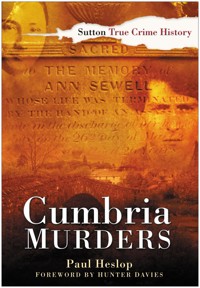
Cumbria Murders brings together numerous murderous tales that shocked not only the county but also made headlines throughout the country. They include the cases of Wai Sheung Siu Miao, strangled while on honeymoon in 1928; William Armstrong, shot by the Revd Joseph Smith in 1851; Ann Sewell, stabbed to death by farmhand George Cass in 1860; and the murder of Jack West at his home near Workington in 1964, whose killers were the last two men to be lawfully hanged in England. Paul Heslop was a policeman for over thirty years, mostly as a detective. His experience and understanding of the criminal justice system give authority to his unbiased assessment and analysis of the cases in this book. His carefully researched, well-illustrated and enthralling text will appeal to anyone interested in the shady side of Cumbria's history, and should give much food for thought.
Das E-Book können Sie in Legimi-Apps oder einer beliebigen App lesen, die das folgende Format unterstützen:
Veröffentlichungsjahr: 2012
Ähnliche

















Cumbria
MURDERS
Paul Heslop
This book is dedicated to former policeman, international athlete, writer and colleague, Arthur McKenzie, and also to writer and writing course tutor, Nick Cook; both of whom have been my inspiration.
First published in 2007 by Sutton Publishing
The History Press
The Mill, Brimscombe Port
Stroud, Gloucestershire, GL5 2QG
www.thehistorypress.co.uk
This ebook edition first published in 2012
All rights reserved
© Paul Heslop, 2007, 2012
The right of Paul Heslop, to be identified as the Author of this work has been asserted in accordance with the Copyrights, Designs and Patents Act 1988.
This ebook is copyright material and must not be copied, reproduced, transferred, distributed, leased, licensed or publicly performed or used in any way except as specifically permitted in writing by the publishers, as allowed under the terms and conditions under which it was purchased or as strictly permitted by applicable copyright law. Any unauthorised distribution or use of this text may be a direct infringement of the author’s and publisher’s rights, and those responsible may be liable in law accordingly.
EPUB ISBN 978 0 7524 8417 4
MOBI ISBN 978 0 7524 8416 7
Original typesetting by The History Press
CONTENTS
An Impression of John Hatfield
Foreword by Hunter Davies
Acknowledgements
About the Author
A Double Execution
1. A Heart Regardless of Mercy
Lanercost, 1834
2. ‘That Bad Woman’
Carlisle, 1847
3. An Englishman’s Home
Walton, 1851
4. Nothing but Doubt and Difficulty
Kirkland, 1854
5. A Barbarous Murder
Embleton, 1860
6. The Killing of Old Jane
Carlisle, 1861
7. Suffer the Little Children
Penrith, 1877
8. A Campaign of Crime
Carlisle, Plumpton, Tebay, 1885
9. A Defect of Reason
Haverigg, 1892
10. A Walk of Fatality
Walney Island, 1901
11. A Honeymoon Tragedy
Borrowdale, 1928
12. Shot in Cold Blood
Newby, 1933
13. A Frenzied Attack
St Bees, 1950
14. The Last to Hang
Workington, 1964
15. A Capacity for Murder
Newton Arlosh, 1977–8
Bibliography
AN IMPRESSION OF JOHN HATFIELD
I wish you to be seriously impressed with the awfulness of your situation. Reflect with anxious care and deep concern on your approaching end. Employ properly the short space of time you have to live in preparing for eternity. Hear now the sentence of the law, that you be carried from hence to the place from whence you came, and from thence to the place of execution, there to be hanged by the neck till you are dead. And may the Lord have mercy upon your soul.
These were the words of the trial judge, directed at John Hatfield who was convicted in August 1803 at the Cumberland Assizes, Carlisle, for forgery and avoiding payment of postage charges while falsely purporting to be a Member of Parliament.
On 3 September 1803, Hatfield was ‘indulged with a chaise’ and, accompanied by a gaoler and his executioner, taken to the place of execution, a small island on Carlisle Sands on the River Eden. A large crowd watched as a small dung cart was placed under the gibbet, and Hatfield climbed the ladder to it. Asked if he wished for any support, he replied, ‘No, though my body may appear weak, my mind is perfectly firm.’ After thanking his gaoler for his ‘indulgence and humanity’ during his confinement, he was ‘launched into eternity’, the first person to be executed in Cumberland in the nineteenth century.
Hatfield’s execution had not been favoured by the jury, which declared an unwillingness to let him hang for forgery. They were reconciled, however, because of his heartless conduct towards Mary Robinson, the so-called Beauty of Buttermere, whom he had married while falsely claiming to be the Hon. Colonel Hope, brother of the Earl of Hopetoun, Scotland. Hatfield’s remains were interred in a criminal’s grave in St Mary’s churchyard, outside the city walls.
John Hatfield.
FOREWORD BY HUNTER DAVIES
Who better than a modern-day copper to investigate what coppers in the past were trying to solve?
Paul Heslop has carried out painstaking research, revisited scenes and examined, as far as possible, all the available evidence before writing about selected crimes committed in what is now the county of Cumbria*. He includes, in detail, the executions of those convicted, and at the end of each chapter offers his verdict, taking into account the testimony of witnesses, the evidence gleaned and, finally, whether justice was done – or otherwise.
Paul Heslop is a retired policeman, with over thirty years’ experience, most of them as a detective. Beginning his career on the streets of Newcastle, Paul went on to serve in CID and Regional Crime Squads in two police forces. The ‘investigative’ experience gleaned over this period has enabled him to reinvestigate and analyse the crimes featured in this book. The result is an interesting and entertaining narrative, inviting the reader to draw his or her own conclusions, just as Paul has done.
Hunter Davies, journalist and author, is a regular contributor to a number of national publications, including the Sunday Times and New Statesman. He has written over 40 books, including biographies on Beatrix Potter, William Wordsworth and Alfred Wainwright, as well as the authorised biography of The Beatles. His many books include A Walk Along the Wall, The Good Guide to the Lakes, The Beatles and Football and Me among others.
* The county of Cumbria was formed in 1974, being an amalgamation of the former administrative counties of Cumberland, Westmorland, the Furness district of Lancashire and a small part of the West Riding of Yorkshire. The crimes featured in this book were committed within this area, the presentday Cumbria. Where appropriate, the former county names are used in this book.
ACKNOWLEDGEMENTS
The author wishes to thank staff at Cumbria Record Offices at Carlisle, Whitehaven, Kendal and Barrow, who assisted with the research required to produce this book, in particular Mr Stephen White at Carlisle Library with regard to the archive images reproduced herein; and editorial staff at Cumbrian Newspapers Ltd, the Westmorland Gazette and the Evening News, Edinburgh, regarding reproduction of images from past publications.
Thanks also to: Mr Brian Parnaby for kindly providing material concerning the murder of his great uncle, PC Joseph Byrnes; Mr Jim McMonies and staff of Cumbria Constabulary regarding information and images relating to Chapter 14; Mr Stewart Lister of Cummertrees; Mr Hunter Davies who kindly wrote the foreword; and, not least, my partner Kate for her support.
Please note that in exceptional circumstances some images have been reproduced without sanction of the original publisher, but only after I have exhausted all means of tracing and identifying them.
ABOUT THE AUTHOR
Paul Heslop joined Newcastle upon Tyne City Police in 1965 (later amalgamated into Northumbria Police). He learned his trade on the beat, supervised by patrol sergeants and shift inspectors, when on-the-street contact with the general public was seen as an essential ingredient in policing. Thereafter, he spent most of his career in CID and regional Crime Squads as a senior detective with Northumbria and Hertfordshire Constabularies, which included investigating serious crime in London and the Home Counties. He retired from the force in 1995 and is now an established writer. He lives in Cumbria.
By the Author:
The Job (Froswick Press, 2000)
The Walking Detective: An account of a walk from Cornwall to Caithness (Froswick Press, 2001)
Old Murders and Crimes of Northumberland and Tyne & Wear (The People’s History, 2002)
Bedfordshire Casebook: A Reinvestigation into Crimes and Murders (The Book Castle, 2004)
Hertfordshire Casebook: A Reinvestigation into Crimes and Murders (The Book Castle, 2006)
A DOUBLE EXECUTION
Robert Fox and Philip Tinnaney had little in common, save their lowly position in life. But on a wet and blustery March day in 1827, they would share the moment of death, watched by an expectant crowd of ‘several thousand’, there to witness the administration of justice in the Border City.
The scaffold was arranged on the roof of the prison wall, facing English Street. At noon the prison bell tolled the ‘knell of departure’ and they were brought up, two murderers about to pay the penalty for their wicked deeds: Fox, the farm worker from Bankhouse, near Gosforth, who slipped arsenic into his wife’s coffee and food, so that she died three days later – following the birth of their child, stillborn, also effectively murdered by poisoning; and Tinnaney, the Irishman who enticed his lover, Mary Brown, into a Carlisle field where he remorselessly beat her to death with a hammer. Now it was their turn to die in the cause of justice. ‘I hope the pain won’t be protracted,’ said Fox. ‘Never mind the pain,’ replied Tinnaney, pragmatically, ‘think of something beyond that.’
The two men appeared, their eyes raised to see the ‘engine of death’. Fox, in a state of collapse, cried out to his saviour for pardon. Tinnaney, a Roman Catholic, opted to conclude his devotions on the platform. He knelt in prayer with the priest for nearly ten minutes, as the wretched Fox waited, trembling, forced to listen to the protracted religious mutterings. He was heard to say ‘God bless you all’ as the executioner stepped forward, tying the legs of the prisoners and pulling the handle that would release the bolt.
The platform did not give way readily, but creaked and sunk a little as the two men, bracing themselves for death, were forced to await their fate. Then it fell, and so did they, together, on that wet and windy afternoon. It was reported that they died instantly, and that afterwards the rain stopped and the sun appeared.
Judgement, without mercy, I own is my due,
I murdered the woman, my confession is true.
With me you may do as you please,
In your great hands you own the keys
Of life or death.
‘Tis one request of you I crave,
Leave not this corruption in a grave,
It would be too great honour on it conferred,
Where Christian bodies are interred.
But hang it up on a gibbet high,
Erect between the Earth and Sky.
And let the gibbet rest upon
The ground where the wrong was done;
And in that pasture let it stay
Till it’s glutted on by birds of prey,
To be a warning to further ages
In hope to stop such base outrages,
That all who pass that way may see
What human passion brought on me,
That they may tell it with surprise
‘Tis life for life did sacrifice.
(Presented to the judge at Assizes by Philip Tinnaney at his murder trial.)
1
A HEART REGARDLESS OF MERCY
Lanercost, 1834
Wilful murder is taking away the life of a fellow creature by malice aforethought. You have to consider whether the violence used rose from an unfeeling disposition and a heart regardless of mercy …
These words, spoken by Judge Baron Parke at the Cumberland Spring Assizes of 1835, could have been drafted with John Pearson in mind. Forty-seven-year-old Pearson was charged with murdering his wife, Jane, in the most brutal circumstances. This was a wicked crime, perpetrated on an innocent woman whose prolonged and agonising death was sufficient to melt the hardest of hearts.
Pearson was born near Haltwhistle, and had been a serial poacher with ‘dog and gun’ for thirty years, during which he had suffered imprisonment and fines. He admitted that at the age of 18 he had fallen into the ‘evil habit of drinking, the mother of many evils’. He had been a gamekeeper, but through drinking and womanising was dismissed. He had married, then joined the army but sought discharge, which was granted after three years. His wife died, leaving five children, four of whom were ‘doing for themselves’, the other living with a friend. He ended up living and working as a mole catcher at Denton, near Brampton, and married Jane, aged 42. Two months later he murdered her.
The Pearsons lived at Randylands, an isolated house situated alongside the line of Hadrian’s Wall, a mile north of Abbey Bridge, near Lanercost Priory. They had lived there for only eleven days when they went for a drink on the evening of Tuesday 14 October 1834, at the Abbey Bridge Inn. Dinah Hodgson, the licensee, recalled their visit. They arrived at about 6 p.m. and left around 8 p.m. John wore a hat, while Jane carried a reticule basket; a small bag made of net with a drawstring. Pearson would later say that he gave Jane his hat to carry also. He drank spirits; she drank no alcohol at all. He was tipsy when they left to walk home; he carrying some coals upon his shoulder, she a bottle loaned to her by Mrs Hodgson containing rum so that John could continue drinking at home. Taking the rum home was Jane’s idea. It was an unwise decision.
Lanercost Bridge over the River Irthing. John and Jane Pearson crossed this eighteenth-century bridge on their way home to Randylands. (Paul Heslop)
Randylands had another tenant, a woman named Rachael Whitehead. She was married, but her husband was away. There were no ceilings in the building, just internal walls, which meant that conversations in adjoining rooms could easily be overheard. When the Pearsons arrived home from the inn that evening, Mrs Whitehead heard their voices before they even reached the house. They were quarrelling. ‘He was abusing her very sore and for many things, including of being a whore’. She heard them enter the building and go to their room, where the quarrelling continued.
Then the beating started. As Mrs Whitehead lay in her bed, she could not help but overhear John ‘striking and licking’ his wife. She told the jury: ‘They were very heavy strokes. I heard them more than once, but I cannot say how many times. I was not keeping count. It went on till between 11 and 12. I was awake all the night. I did not take my clothes off. It wasn’t very likely I could strip when there was such work carrying on in the other room. Jane called out “murder”. That was all I heard her say during the night.’
The next morning Pearson returned to the inn, where he asked Dinah Hodgson for a pint of ale, producing the now empty bottle that had contained the rum. Mrs Hodgson obliged, unaware that Pearson’s wife had by then sustained such terrible injuries that she was dying. While Pearson was out, Mrs Whitehead heard Jane call out for a cup of tea. She duly took a cup to her and Jane drank it. She then asked for water, which was also delivered. Mrs Whitehead noted that Jane was lying in bed, naked, and that there was a ‘vast deal’ of blood about the bed and on her person, including her face. It was the last time she saw Jane alive.
Just after 9 a.m., when Pearson returned home, he showed Mrs Whitehead his wife’s gown, telling her she had been in ‘idle company’ and that she had behaved very badly to him the night before. Later she heard him say to Jane, ‘As soon as I have finished then I will finish her,’ meaning Mrs Whitehead, who stated that from the time he returned from the inn until 11 a.m. ‘he was going on as the night before – striking her.’ She told the jury that he had asked Jane ‘if she knew the man she was with,’ but she made no answer. He said it was ‘some person who had followed her out, saw her tipsy and had used her ill.’
Mrs Whitehead left the house around 11 a.m. and chanced upon a neighbour, Sarah Thirlwell, just ten yards from her door. On hearing Mrs Whitehead’s account, Thirlwell went up the path to Randylands and looked through the kitchen window in the part of the building occupied by the Pearsons. Inside, she saw a man standing by a bed with a long stick in his hand. His arm was stretched ‘full length’. She could not see if anyone was on the bed, nor did she see the man’s face. She watched him for three minutes and described him as ‘middle sized’, wearing a black hat and light jacket. Thirlwell did not know Pearson, but at the subsequent coroner’s inquest she saw that Pearson had the ‘same appearance’ as the man she had seen.
Around the same time, a pedlar named James Barrett happened along. He was walking to Hayton Gate, just east of Randylands. At 100 yards away, he saw a man ‘step away’ and walk from the house. He identified him as John Pearson, whom he did not know but recognised later at the inquest. As he passed Randylands, Barrett saw ‘a person lying before the door’. She was ‘quite in a naked state, without clothing at all’, he said. He knew her to be Jane Pearson. As he watched, she got up and went inside the house.
Ann Thompson lived at Hayton Gate. After meeting Barrett, she went to Randylands where she found Jane Pearson dead on the bed at about 1 p.m. Pearson said his wife was done, and went outside. Thompson said nothing to him but awaited the arrival of neighbours. When Pearson returned, she asked him ‘what had put all the blood on his hands?’. ‘It made no matter about that,’ was his reply. There was a long stick, like a rake shank, lying in the kitchen. ‘It was all blood and hair and sand,’ Mrs Thompson told the jury. She also noticed blood in the passage, and ‘a great quantity of blood sprinkled on the wall at the bed head where the body was’. She also noticed ‘chairs and other things standing disorderly’, and that Pearson was ‘a little intoxicated’ and ‘drank from a little bottle’.
Joseph Holmes, a farmer, went to Randylands between about 2 p.m. and 3 p.m. that day. He saw the deceased woman through the window, lying on the bed. He went inside and searched for Pearson but was unable to find him. He then saw Pearson walking along the opposite side of the hedge, whistling and singing, and drinking from a bottle. Meanwhile, those present agreed to lay the body out. Holmes examined the deceased’s arms, and different parts of her body. He told the jury, ‘I can’t describe so horrid it was. I mean by that the body was very much injured. I was shown a large wound on the back of the ahouse was bloody all over. There was hair and blood lying outside the door.’
John Pearson led Holmes to ‘a piece of ground’ where he said a man had ill-used his wife. It was in the field where the house stood. He said Hugh Hewer knew the man, and that Rachel Whitehead ‘knew all about it’. Holmes went to Brampton and brought Constable Robert Sloan to the scene. Pearson was arrested and his clothes and other articles seized. The judge asked Holmes about the place indicated by Pearson, where he said his wife had been ill-used. ‘There was an impression on the grass as if some person had been lying there,’ said Holmes.
George Gill, a surgeon, carried out the post-mortem examination on Jane Pearson. He found the body ‘almost literally covered with contusions and scratches’. There was a wound to the forehead and a contused wound on the back of the head, with a separation of the scalp on each side. This was the cause of death. A stick, like the one produced – about 5ft long and 1½in thick – would have caused it. By the appearance of scratches from hip to head, he considered that Jane Pearson had been dragged along the floor. She could have got up and walked after receiving the fatal blow. Her clothes, the pillow and other articles were produced. There was ‘a general expression of horror in the court at the sight of the shocking evidences of the horrid deed’.
Hugh Hewer testified at the behest of Pearson, who had called on him to support his defence. He agreed he had seen Pearson in a field south of Randylands at about 9 p.m. on the evening of 14 October. Hewer, accompanied by his son, had been walking from Garthside to Banks, taking them in a west to east direction. Opposite Randylands he discovered Jane’s basket and a man’s hat, about seventy yards from the house. Hewer called out, ‘Has anybody lost anything?’ to which Pearson replied, ‘Yes, but stop till I come to you.’ Pearson rushed through the hedge and fell over. ‘He was very drunk,’ claimed Hewer. Pearson then asked ‘Where are they?’ meaning the basket and hat. Hewer said he would fetch them, and did so. Pearson put the hat on and Hewer handed him the basket. Pearson said the next time he met Hewer in a public house he would ‘treat him with a glass’ for his kindness.




