


13,99 €
Mehr erfahren.
- Herausgeber: The History Press
- Kategorie: Sachliteratur, Reportagen, Biografien
- Sprache: Englisch
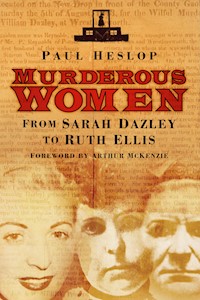
Serial poisoners, crimes of passion, brutal slayings and infanticide; this new book examines the stories and subsequent trials behind the most infamous cases of British female killers between the early part of the nineteenth century and the 1950s. Among the cases featured here is that of Sarah Dazley, hanged in 1843 for poisoning her second husband; Mary Ann Cotton, who murdered up to twenty-one people, including many members of her own family; Amelia Dyer, the 'baby farmer' who murdered countless numbers of children; Susan Newell, who murdered her newspaper boy; the execution, in 1923 of Edith Thompson for the murder of her husband, a crime she swore she knew nothing about; and, Ruth Ellis, who gunned down her boyfriend outside the Magdala Tavern in 1955, the last woman to lawfully hang in Britain. Retired police detective Paul Heslop has carefully and objectively analysed each of these prominent British cases. His narrative includes post-trial material as well as the executions of the offenders. Finally, he offers his 'verdict', taking into account all the circumstances so that there are times when justice itself is put on trial.
Das E-Book können Sie in Legimi-Apps oder einer beliebigen App lesen, die das folgende Format unterstützen:
Veröffentlichungsjahr: 2011
Ähnliche

















PAUL HESLOP
FROM SARAH DAZLEYTO RUTH ELLIS
‘Truth will come to light; murder cannot be hid long.’
William Shakespeare, The Merchant of Venice
First published 2009
The History Press
The Mill, Brimscombe Port
Stroud, Gloucestershire, GL5 2QG
www.thehistorypress.co.uk
This ebook edition first published in 2011
All rights reserved
© Paul Heslop, 2009, 2011
The right of Paul Heslop, to be identified as the Author of this work has been asserted in accordance with the Copyrights, Designs and Patents Act 1988.
This ebook is copyright material and must not be copied, reproduced, transferred, distributed, leased, licensed or publicly performed or used in any way except as specifically permitted in writing by the publishers, as allowed under the terms and conditions under which it was purchased or as strictly permitted by applicable copyright law. Any unauthorised distribution or use of this text may be a direct infringement of the author’s and publisher’s rights, and those responsible may be liable in law accordingly.
EPUB ISBN 978 0 7524 7430 4
MOBI ISBN 978 0 7524 7429 8
Original typesetting by The History Press
Contents
Foreword by Arthur McKenzie
Acknowledgements
About the Author
A Public Execution in Kent, 1867
1. A Denial of Guilt
Sarah Dazley, Bedfordshire, 1843
2. Premeditated Murder
Maria Manning, Bermondsey, London, 1849
3. A Temporary Frenzy
Mary Ann Brough, Surrey, 1854
4. Murder in the Glenkens
Mary Timney, Kirkudbrightshire, 1862
5. A Murderous Liaison
Priscilla Biggadike, Lincolnshire, 1868
6. ‘A Sort of Inhumanity’
Mary Ann Cotton, County Durham, 1872
7. ‘The Barnes Mystery’
Katherine Webster, Surrey, 1879
8. ‘A Bad End’
Catherine Churchill, Somerset, 1879
9. A Murderous Solution
Florence Elizabeth Maybrick, Lancashire, 1889
10. Loss of Rational Control
Mary Eleanor Wheeler, Kentish Town, London, 1890
11. A Depth of Wickedness
Amelia Dyer, Bristol, Oxfordshire, Berkshire, Willesden (London), 1896
12. ‘A Motive So Utterly Inadequate’
Mary Ann Ansell, Hertfordshire, 1899
13. The Worst of Human Passions
Emily Swann, West Riding, Yorkshire, 1903
14. A Passage Full of Crime
Edith Jessie Thompson, Essex, 1922
15. A Deflection of Blame
Susan Newell, Lanarkshire, 1923
16. An Eternal Triangle
Charlotte Bryant, Dorset, 1935
17. Driven by Suffering
Ruth Ellis, Hampstead, London, 1955
Bibliography
Foreword
As a former colleague and personal friend of Paul Heslop for forty years, there is no one better qualified to focus on the subject of murderous women.
A few years ago I accompanied Paul to the former home of multiple killer Mary Anne Cotton in West Auckland, when he was researching the case for a television documentary. He identified the house from old photographs, and knocked at the door. The current occupant had scant knowledge of the house’s history (maybe just as well). However, immediately on entry Paul began to immerse himself into the atmosphere of this simple, small terraced dwelling, wondering what thoughts would have flickered through Mary Anne Cotton’s mind when she looked out of the front window as she viewed the tranquillity of village life beyond the nightmares within.
In an age where ‘cold case’ examination of old crimes has become the genre of modern times, with forensic advances accelerating, we still need the questioning minds of ‘detectives’ such as Paul to disentangle the tight knots of justice.
His ability to professionally and thoroughly evaluate events through critical research unravels both the history and mystery of each case, which are presented in an absorbing way. His verdicts at the termination of each chapter are, on occasions, controversial, but they spring from a wealth of investigative experience and common sense.
The evidence is presented to the reader in Paul’s unique style, which captures some of the essence I felt in the house where Mary Anne Cotton murdered her stepson. Murderous Women is an illuminating read, and, given that the original verdicts are recorded as fact, can we really be certain that justice has been served in every case ‘without a scintilla of doubt’?
Arthur McKenzie, 2009
Arthur McKenzie was a career detective with Northumbria Police, whose service included investigating corruption in Hong Kong. Over the past thirty years he has become an established author, playwright, television scriptwriter, radio pundit and journalist. His stage plays include The Boilerhunters, which also featured on BBC Radio Four’s Saturday Night Theatre, Man in a Bottle, My Son’s on the Force, Pickets and Pigs and Cuddy’s Miles. His television credits include The Bill, Harry, Casualty, Spender and Wycliffe, as well as many documentaries.
Acknowledgements
The author wishes to thank staff at the County Archives and Record Offices at: Bedford, Dumfries, Lincoln, Durham, Taunton, Reading, Hertford, Barnsley, and Airdrie; the Mitchell Library, Glasgow; the Central Resources Library, Hatfield; the British Newspaper Library, Colindale. Also Ken Wells, curator at Thames Valley Police Museum, for permission to use the images in the Amelia Dyer case.
Please note that in exceptional circumstances some images may have been reproduced without sanction of the original publisher, but only after exhausting all means of identifying them.
Finally, please note that the names of counties appear as they were known before the Local Government reforms in 1974 and 1975.
About the Author
Paul Heslop is a retired police officer with over thirty years’ service with Northumbria Police and Hertfordshire Constabulary. He learned basic policing skills on the streets of Newcastle upon Tyne, when contact with the public was vital, and street supervision by sergeants and inspectors was the rule. He became a ‘career detective’, serving in CID and Regional Crime Squads in both forces, the latter including the investigation into serious crime in London and the Home Counties. He retired in 1995. Since then his writing career includes features for regional newspapers and magazines on subjects including, health and safety, country walking, local history and true crime. His published works also include Cumbria Murders (Sutton Publishing, 2007). He lives in Cumbria with his wife, Kate.
A Public Excution in Kent, 1867
She had told her sister the day before the crime that she would do it. ‘The child shall not go back to her father’s house. I will take her out into the fields and put her into a ditch and drown her.’ The child was her stepdaughter, 11-year-old Louise, her husband’s ‘bastard’, as she described her. On Saturday 25 August 1867, when visiting her parents at New Romney, she had taken Louise for a walk on the Kent marshes, a place of ‘shallow and stagnant ditches, varying in depth and sometimes furnished with sluices’. It was getting dark when they left, and at ten o’clock she returned without the child.
‘Where is Louise?’ her mother asked.
‘Oh, mother,’ she replied, ‘two horses frightened us into a ditch. I went in after her and tried to get her out.’ Her husband saw her skirts were wet. Neither he nor her mother was satisfied with her story, and the police were called.
She told Constable Aspinall, ‘You will find the child just above Cobb’s Bridge.’
The policeman searched and found Louise. She was lying in a ditch, in fourteen inches of water. A child of four or five could have scrambled out, yet death was due to drowning. At the Spring Assizes at Maidstone the following March, the jury took just twelve minutes to return a guilty verdict. Justice Byles told her, ‘You have been convicted of the murder of this poor child. The sentence is that you be taken to the place from whence you came, and from thence to a place of execution, and there hanged by the neck until you are dead. And may the Lord have mercy on your soul.’
In the condemned cell in Maidstone Gaol, Frances Kidder confessed to the crime, but denied it was premeditated. On the day of reckoning, 2 April 1868, she walked with a firm step to the scaffold. Steady hands helped her to the drop, where she was supported by two warders, the proceedings watched by a crowd of 2,000 or so. The scaffold was draped with a black cloth, so that when she fell nothing would be seen of her except her head. Before the cap was put over her face she smiled and said, ‘Lord Jesus, forgive me.’ When Calcraft pulled the bolt, she struggled before life ceased.
The Maidstone and Kentish Journal reported that the crowd was ‘particularly orderly’, with little of the ‘coarseness and brutal joking’ that too often prevailed at executions. Frances Kidder, aged 25, was the last woman to be publicly hanged in Britain.
1
A Denial of Guilt
Sarah Dazley, Bedfordshire, 1843
‘In consequence of various rumours being spread that the deceased had come to an unfair death, the coroner for Bedfordshire, Ezra Eagles Esq., has ordered the body to be disinterred.’ So reported the Bedford Mercury and Huntingdon Express concerning the death of William Dazley. ‘The most conclusive evidence has been obtained,’ reported the newspaper, ‘about which we are requested not to give any clue until the inquest has found a verdict, as justice might be perverted by premature publicity and the supposed guilty party having absconded.’
It was almost five months, since 3 November 1842 to be precise, that William Dazley was buried in the churchyard at Wrestlingworth. And now they were digging him up. But the residents of Wrestlingworth were far from mystified as to the ‘conclusive evidence’, and they knew perfectly well who the ‘supposed guilty party’ was: the deceased’s flirtatious wife, Sarah.
On 27 March 1843, William Dazley’s exhumed remains were placed in the aisle of Wrestlingworth Parish Church, the coffin lid was removed and the body, ‘in a fair state of preservation’, was formally identified. Two surgeons, Isaac Hurst and George Dixon Hedley, then commenced a port-mortem examination. They removed the whole of the alimentary canal – both the throat and the intestines – which they placed into a stone jar and sent to Bedford Infirmary for analysis. The inquest, held at the Chequers Inn, was then adjourned pending the result.
But what had alerted the authorities to possible foul play? Rumours that Dazley’s wife, Sarah, had poisoned him, had reached the ears of the local policeman, PC Forester. PC Forester had told the chairman of the Quarter Sessions, Francis Pym, who in turn had instructed the coroner to hold the inquest. Rumours also reached the ears of Sarah herself, who fled, taking the road to London with a man called Samuel Stebbing.
The fleeing Sarah went to the house of one of her brothers, Edward Reynolds. He wrote to another brother, John, at Potton near Wrestlingworth, saying, ‘Sarah has arrived safe and well’. John Reynolds must have been an upstanding citizen, for he told the police. Superintendent Blunden of Biggleswade was dispatched to London, and detained Sarah at her brother’s house.
‘I know they said I murdered my husband,’ said Sarah, ‘but they can’t prove I bought the poison, or gave him anything but what I bought of the doctor. They say the last thing I gave him was out of a teacup, but that is not true, for I gave him some pills. If you had not come for me I should have given myself up, for I am sorry I done it.’ Those last six words seem damning, but it would be a surprise if Sarah ever admitted she uttered them.
In the meantime, the coroner was told that analysis of William Dazley’s alimentary canal had revealed white arsenic ‘in considerable quantity’.
Sarah Dazley had to be taken back to Wrestlingworth, but first she had to appear before the Lord Mayor of London, suspected by now of having murdered two husbands and her own child. Sarah, speaking with assuredness, readily admitted her identity, saying the moment she had heard there were suspicions she had resolved to return to Bedfordshire to clear her character.
‘How long were you married to your first husband?’ the Lord Mayor asked.
‘Six years.’
‘Your second husband?’
‘Two years and nineteen days.’
‘How old was your child when it died?’
‘Ten months.’
‘Why did you run away when the inquest was summoned?’
‘I did not run away. I came to London to look for a situation, because the parish refused to do anything for me.’
His lordship informed Sarah he had been told she was to be married again, that banns had been read, but cancelled. ‘No, no such thing,’ she lied (they had been read by the Revd Twiss on 5 February).
Inspector Woodroffe, presenting the case, declared his lordship’s information was correct, saying that, as Mrs Dazley and the person she was going to marry were going to church, a man who was acquainted with the husband-to-be had said, ‘You are not going to marry that she-devil who has already murdered two husbands and her child.’
The husband-to-be, George Waldock, promptly withdrew the banns. There can be little wonder that the Lord Mayor believed Dazley had a case to answer, and she was given over to the custody of Superintendent Blunden. En route to Wrestlingworth they stayed overnight at the Spread Eagle Inn, Biggleswade. Two women residents at the Spread Eagle, Mary Ann Knibbs and Fanny Simmons, were instructed by Blunden to sleep with her that night. Their testimonies, concerning what she allegedly told them, would weigh heavily against her at her trial.
The following day the inquest into the death of William Dazley was resumed. Sarah Dazley was present and ‘much affected’, her assuredness having deserted her. Elizabeth Dazley, William Dazley’s mother, told the court that her son had taken ill one Sunday the previous October and had died the following Sunday.
Ann Mead, a 14-year-old orphan, had lived in Wrestlingworth with the Dazleys until she became ill on the Wednesday before William Dazley died. Ann said she had seen Sarah making three pills on the Tuesday. She made them in a blue saucer and wrapped them in a piece of newspaper. Sarah asked William to take the pills, but he would not. After Sarah had gone out, Ann tied to persuade him, believing they would make him better. She swallowed one herself, saying, ‘See me take one.’ William Dazley, presumably reassured, then swallowed one of the pills. After about quarter of an hour Ann became ill. She was sick, suffering from aching in her chest and throat and was ill for the next three days until she left the house, never to return. Dazley became more ill than he had been before.
Mary Carver, a local woman, had gone with Sarah to the house of Mr Sandel, the local doctor, that Wednesday morning. Sarah asked Sandel to give her a few pills, as her husband would not take his medicine. Sandel said he would send him three resting pills, which he put into a box. On the way home Mrs Carver saw Sarah throw the pills into a ditch, and take three others from her pocket and put them into the box, saying they would do her husband ‘more good’. Mary Carver witnessed the painful wretchings of both Ann Mead and William Dazley. Ann Mead was fortunate to survive.
On 23 October, Sandel was called by a tearful Sarah to the Dazley household. He found William to be ‘under severe sickness’, complaining of irritation to stomach and bowels. He prescribed a saline medicine to allay irritation. The following Tuesday he called again and prescribed further treatment, after which he seemed to get better. Then, suddenly, he learned that Dazley was dead. Sandel was so surprised he asked Sarah for permission to carry out a post-mortem examination on her late husband, but both she and William’s mother refused. When asked by a member of the inquest jury about prescribing pills for William Dazley, Sandel said he did not recall prescribing pills (except the resting pills, made of opium), but he had prescribed powder, and he explained precisely what it was. He was adamant the powder was not white in colour.
One wonders about Sarah Dazley’s feelings when, at the inquest, she heard the gruesome details of the post-mortem examination on her late husband, given by the surgeon, George Dixon Hedley.
From the stomach, 2½ ounces of ‘dirty brown fluid’ was poured into a glass and a white powder subsided at the bottom. More white powder was found in the gullet and intestines. In the lower part of the small intestine the surgeon found roundworms, ‘fresh and un-decomposed’. He boiled some of the particles of white powder in distilled water. One portion of the resulting liquid was ‘introduced’ into a glass vessel called a Marsh’s Apparatus, with distilled water, sulphuric acid and a piece of zinc, and the gas formed by this was set on fire. A piece of plate glass was held over the flame, upon which a ring of metallic arsenic was deposited. More experiments followed, all tests combining to prove the white powder to be arsenic.
‘Are you of opinion enough to cause death?’ the coroner asked.
‘Certainly,’ Hedley replied. ‘I have no doubt the deceased died from the effect of arsenic. I also believe the extraordinary preservation of the internal parts of the body has resulted from arsenic.’ He might have added, ‘sufficiently enough for worms to thrive five months after the body was buried.’ The inquest jury decided that ‘William Dazley died from the effects of arsenic administered to him with a guilty knowledge by Sarah Dazley’. That amounted to wilful murder, said the coroner. Sarah was taken to Bedford Gaol to await trial. It was a place she was familiar with, having visited her father there when she was a little girl.
Sarah Dazley was born Sarah Reynolds at Potton, Bedfordshire, about 1815. Her father, Philip, was the village barber and rat catcher. He worked hard for a living, but nonetheless fell into debt, even squandering the small fortune left to him by his father. He ended up in Bedford Gaol where he contracted consumption. He died in 1824.
In 1835, Sarah, aged 19, married Simeon Mead of nearby Tadlow, Cambridgeshire. The couple went to live in Wrestlingworth. They had a son, Jonas. The marriage lasted only five years, for Simeon died on 10 June 1840, aged only 24. That October, Sarah married William Dazley. The following month, her son, little Jonas Mead, was dead; he was just nine months old. Father and son had died barely six months apart.
In July 1842, when Sarah was married to William Dazley, she had visited the house of George Waldock, a ‘rustic labourer’.
‘How do you like married life?’ Waldock asked her.
‘Very well,’ replied Sarah, adding that she had a good husband, but thought he would soon be in the churchyard.
‘Why so?’ asked Waldock.
‘I can’t help thinking so,’ she replied.
In February 1843, four months after William Dazley’s death, Elizabeth Dazley, his mother, visited Simeon Mead’s mother, and they spoke of the loss of their sons. Mrs Dazley said she had ‘no doubt’ that both had been poisoned by her daughter-in-law. Mrs Mead was aghast.
‘Poisoned?’ she exclaimed, ‘do you think so?’
‘Yes,’ replied Mrs Dazley, ‘I know Sarah gave your son some quicksilver (mercury) among some sliced onion.’ Mrs Mead knew her son was partial to sliced onion, so this unexpected revelation would have struck a cord. She might have wondered why Mrs Dazley had not said so before.
With William Dazley’s untimely death attributed to poisoning by arsenic, it was hardly surprising that the coroner ordered the exhumation of the bodies of Simeon and Jonas Mead. On 20 April 1843, there was an inquest into their deaths.
Keziah Mead, Simeon’s mother, spoke of her son complaining about being ill. He was unwell for two weeks, then became worse on the Sunday before he died, when he complained about his throat. Betsy Mead, his sister, said her brother had complained about his chest, and said that there was white froth running from his mouth. Betsy had frequently heard Sarah say that she wished he were dead. They quarrelled frequently, and she had heard Sarah say, ‘Damn you, I wish you had never come near me.’ Hannah Darts said she had been with Simeon the night before he died, when he complained about his throat and mouth and was in great pain; Elizabeth Dazley (William’s mother) said that Simeon had complained of pains in his throat and mouth. She said she had seen Simeon and Sarah quarrelling over a shilling; he had wanted it and had knocked her down and taken it. She had later heard Sarah declare, ‘Damn him, I’ll poison him but what I’ll get rid of him.’
Noah Darts, a carpenter, had made the coffins for both father and son. He said they had been buried in the same churchyard at Tadlow, in separate graves. He was able to identify Simeon Mead’s coffin, upon which he had affixed a plate bearing the inscription ‘S.M. aged 24’. No one could identify Simeon Mead’s body, of which only the skeleton remained. It was not possible to establish whether or not he had been poisoned.
The inquest was then opened into the death of 9 month old Jonas. Betsy Mead, the child’s aunt, said Jonas was not a sickly child. She had heard his mother, Sarah, say to him, ‘I wish you were dead,’ several times, but had thought nothing of it. Keziah, Jonas’s grandmother, saw nothing amiss with him save for a bad cough. Elizabeth Dazley said Sarah was ‘a brute of a mother who never washed the child or kept it clean’.
Sarah Morley saw Jonas just before he died. Sarah had brought him to her cottage, saying he was ‘very ill’, and she was off to Potton to see if she could get anything for him from the doctor. Leaving the little boy with Mrs Morley, Sarah returned two hours later with three powders, saying she had to give one to Jonas when she got home. The child was ‘wonderfully ill’, said Mrs Morley. Sarah took the child home, and returned one and a half hours later when she said Jonas was ‘dead and laid out’. If the testimony of witnesses was not damning enough, the result of the post-mortem examination most certainly was, as George Hedley explained.
Jonas’s body, though decomposed, was nevertheless in a ‘state of preservation suitable for examination’. Hedley found metallic arsenic in the belly, enough to kill. Having heard the evidence on father and son, Simeon and Jonas Mead, the jury’s verdict on the former was that he died on 10 June 1840, after ‘an illness’, and that Jonas had ‘died from arsenic administered to him with guilty knowledge by his mother, Sarah Dazley’. Hearing the verdict on the death of Jonas, the crowd outside was reportedly showing ‘strong feelings’ against Mrs Dazley. It was hardly surprising.
Sarah Dazley stood trial at Bedford Assizes that July. Judge Baron Alderson presided. The courtroom was packed to ‘an almost suffocating degree’. Dazley was indicted with murdering both her husbands and Jonas Mead, her son, but the charge of murdering Simeon Mead was ‘ignored’, and that of Jonas set aside. She was tried for the murder of William Dazley only, which she denied. The prosecution would have little difficulty in proving William Dazley was murdered; it would be another matter to prove that the person responsible was his wife.
Mr Prendergast, prosecuting counsel, said Dazley’s wife attended William during his illness. No medicine was given to him but by her, he said, and she was in possession of arsenic when his illness commenced, on Sunday 23 October 1842. Elizabeth Dazley gave a full account of her visits to the Dazley household during her son’s week-long illness. She had visited him every day. On the Sunday she heard him complain of a pain in the stomach. On Monday morning he was vomiting, and he was sick again on Tuesday. Wednesday morning he appeared a little better, but was vomiting again later that same day, when he appeared worse. He complained of pain in the bowels and she laid a bran poultice on his stomach. He complained of heat in the throat and she put three leeches on it. ‘They drew, and he bled profusely.’ She remained with her son all night Wednesday. William vomited into a pot, which she emptied into some straw in the front yard. The consequences of this were as damning as the testimony of any witness. Ebenezer Gurry, a neighbour, kept a pig in the yard. It was a healthy pig, about ten weeks old. On the morning after Mrs Dazley emptied the pot in the yard, he found the pig dead, ‘swelled like a bladder’.
On Thursday morning William Dazley was more cheerful, although still vomiting; on Friday morning he was the same. On Saturday, about two o’clock, he got out of bed for an hour and by six o’clock he was talking quite cheerfully. But at one o’clock on the Sunday morning, when his mother visited, she found him in severe pain. He died at half past six. This was the harrowing account of a mother who attended her dying son for a whole week as his intestines succumbed to the effects of arsenic. There was no hospital, no close treatment by doctors, only the scant attention by the local surgeon who had no hope of saving his patient.
Mary Carver, who saw Sarah Dazley take three of Sandel’s pills from their box and throw them into a ditch, told the court that she saw Dazley replace them with three pills of her own, which she took from a piece of newspaper she carried in her pocket, saying they would ‘do him the most good’.
William Sandel, the surgeon, said he found Dazley complaining of pain in the stomach, sickness and retching. He thought it was a common irritation of the stomach and that he should have saline composed of carbonate of soda and tartaric acid for effervescing. He later sent an aperient (laxative) powder, and found Dazley better by the Wednesday, but the following Monday he heard he was dead. Sandel did not keep arsenic, and he never prescribed any white powder. He never suspected William Dazley had been poisoned.
William Dazley’s two brothers were with him throughout his last night and when he died. John Dazley sat up with him, and saw Sarah put some white powder into a cup, along with some water, which she stirred with a spoon. ‘She took it from a paper at the bedside,’ he said, telling her husband to drink it, and that he would soon be ‘better or worse’. William drank it down, then vomited and complained of pain. Mr O’Malley, defending, asked him about the light. ‘It was candle-light,’ said John Dazley, ‘and the candle was half burnt out.’ It stood on the table where the white powder was, about 2ft from the bed. The light was on the same side she stood at, so he could see the cup.
Gilbert Dazley, the other brother, saw Sarah with white powder, which ‘she took from her bosom’. The powder was wrapped in paper. She told her husband if it ‘operated right’ he would soon be better, if it ‘operated wrong’ he would soon be dead. Mr Sandel had said so. She put the powder into a teacup and poured water from a teapot into it. Her husband was unwilling to drink it at first, but eventually did so. He began retching and went to his room about 4 a.m. and stayed there until he died.
Mr J. Burnham, a chemist, knew Sarah Dazley as someone who ‘had been in the habit’ of coming back and forward as a customer. He recalled selling her one pennyworth of arsenic ‘in the fall of last year’. She told him she had wanted to poison some rats and mice.
The testimonies of the two women who slept with Sarah at the Spread Eagle Inn, Biggleswade, were now given. Mary Ann Knibbs and Fanny Simmons confirmed they were asked to sleep with Sarah ‘by the constable’ (Superintendent Blunden). Their testimonies were conveniently identical. ‘Get into bed and I’ll tell you all about it,’ Sarah was alleged to have told them. They said Sarah told them that her husband had taken ill and that, at the request of his mother, she had gone to the doctor’s. She hadn’t thrown any pills away, as Mary Carver had said.
Simmons told Sarah it was reported that she had said that she would have ‘seven husbands in seven years’. Sarah had replied, ‘I did not say so. I said I would have seven husbands in ten years’. According to the women, she added, ‘No one knows where I bought the poison. No one saw me give it to him.’ Damning indeed – if she said so.
George Dixon Hedley reiterated the findings of his post-mortem examination, giving specifics: ‘We found at least a drachm of arsenic in the body.’ This was more than enough to kill. ‘Arsenic is not readily thrown out when vomiting,’ he explained, which accounts for it remaining in William Dazley’s insides, even when he was being sick. He would not have expected Dazley to live two or three days ‘after the contents of the bowels had escaped into the cavity’.
Sarah Dazley had no right to testify in her own defence. The law then presumed that anyone charged with a crime would say anything to secure acquittal and could not therefore be relied upon to tell the truth. No witness was called on her behalf. Instead, Mr O’Malley, her counsel, rose and told the jury that the case against Dazley was one built of prejudice. There had been rumours, he said, that had circulated ‘far and wide’. Stories had been told about the crime, presuming she was guilty. Justice could only be done by juries acting contrary to prejudices.
‘Expressions Mrs Dazley had used had been raked together, considerably coloured and presented to the jury as material evidence to prove her guilt,’ he said. Her conduct was of the highest character, and there was no circumstance of her married life showing any malice or evil disposition towards her husband. It might be assumed they were a loving couple. Referring to their quarrelling, he asked, ‘Where are the wives who would not sometimes in the lightness of their hearts indulge in frivolities?’ He meant, of course, that all married couples quarrelled, and sometimes said ‘I wish you were dead’, without meaning it.
Could the jury believe the prisoner guilty? O’Malley asked. William Dazley is taken ill one Sunday. He dies the next. Does the prisoner seek opportunity to poison him? She sends for his relations and friends. For what? To witness her guilt? She sends for the doctor, who would have been most capable of discovering poison. She sends for him twice again, and goes once herself. Would a guilty person have done so? Crime seeks seclusion, but she sought to make it public. He drew attention to the administration of powder and pills, pointing out that others were always present.
William Dazley died by taking arsenic. But did his wife have arsenic in her possession? Mr Burnham, the chemist, said he sold her arsenic. Yet there was no entry of the sale. As to the two brothers who sat by candlelight, could they really have seen the colour of the powder they saw Sarah administer? There was a discrepancy: one swore the powder was lying at the bedside, the other that she took it from her bosom. And suppose arsenic was in the house. It was not improbable that in the hurry and confusion of the moment, she might have picked it up by mistake, and poisoned her husband by accident. What motive was there? It had not been shown that there was an attachment to any other man. As to her refusal to allow Mr Sandel to examine her husband’s body, it was natural for any wife to refuse consent. Dazley’s mother had refused too.
The judge told the jury, ‘The questions to consider were: Did William Dazley die from the effects of poison administered to him by someone? And was the poison wilfully administered?’ Mr Sandel had no arsenic in his shop, so he could not have made the mistake of giving it to Mrs Dazley. As to there being no record of the purchase of arsenic, would every ‘one pennyworth’ sold be recorded? Several people said powder had been given by Mrs Dazley to her husband, even if there were discrepancies in their evidence. He added, ‘You must look for the truth, dreading not the consequences.’ In other words, the jury must not take into account the fate of Mrs Dazley if they should find her guilty; their verdict was all that mattered. After only half an hour they returned a guilty verdict.
An ‘awful silence’ prevailed as the judge fixed his eyes on the woman in the dock. The silence continued for some time, so that the clerk thought the judge must somehow have missed the verdict. Finally, his lordship spoke. ‘Sarah Dazley, you have been tried and found guilty of a most atrocious crime, the murder of your husband. I regret …’ Then he was overcome, and remained silent awhile with his face in his hands before continuing, ‘I regret that the murder of your husband is not the only murder you have been guilty of. I allude to this to soften your hard and impenitent heart …’ Sarah Dazley now broke down and wept. ‘To murder the man you love and cherish is a crime truly appalling,’ said his lordship, ‘but to lay your murderous hand on your own helpless babe, to take away the life of your only child is a crime we have no language to express. Though your guilt is great and your time is short, there is everything to encourage you to fall at the footstool of your offended Maker and plead for pardon. It now only remains for me to pass the awful sentence of the law upon you, Sarah Dazley, that you be taken from this place to the gaol whence you came, and that you be hanged by the neck until you be dead, and that your body be buried within the precincts of the gaol. And may God have mercy upon your soul.’
Sarah Dazley, overcome as she was, exclaimed simply, ‘I am not guilty!’
Post-Trial
It was common for convicted persons who had been sentenced to death, who had earlier denied their crime, to confess before execution. Sarah Dazley was convicted of murdering her second husband, suspected but not tried of murdering her first as well as their baby, and accused by the judge of murdering the latter. But she never confessed to anything. Instead, she hoped for a reprieve, based on her apparent belief that ‘hanging was not so frequent as formerly’. She cited a case where, she said, a woman called Johnson, convicted of murdering her children some years before at Cambridge, was pardoned even as she ascended the gallows. If she thought she might yet escape the noose, based on these grounds, it was little wonder she never confessed.
Far from showing repentance, Dazley made a statement in which she accused her husband, William, of murdering her child, Jonas, and that he took the arsenic himself through remorse, or maybe to cause her suffering by being falsely charged with his murder and hanged. If she really believed that, why didn’t she urge her defence to say so at her trial?
The executioner arrived from London, ‘a person dressed in a suit of black, recognised as the fearful extinguisher of criminal life’. One newspaper reported:
We never saw Bedford in such a state of excitement. On no occasion have so many women been visible in the streets. Carriages of all descriptions, from a gentleman’s to a chimney sweep’s cart, are arriving, pouring in new population, amongst whom is an immense proportion of the abandoned of both sexes on the lookout for a subject to victimise.
Public hangings were about more than witnessing the dispensation of justice. They were also an excuse for a shindig, a get-together of the masses, a reason to drink and sing and pick pockets. They were, in truth, a shameful episode in history. People invented ballads about the condemned, and the crowds sang along, fuelled by alcohol as the day wore on and long after the accused had hanged. Of Dazley’s execution, the Northamptonshire Mercury reported that ‘Vagabonds of both sexes were bawling out the last dying speech and confession of the woman of three murders, when in truth she did not acknowledge one.’
There were conflicting accounts of the execution of Sarah Dazley. In one:
The procession appeared on the top of the gaol porch at twelve o’clock. The chaplain read prayers, in which the prisoner fervently joined. At the conclusion she was asked if she had anything to confess. ‘No,’ she replied, ‘if I confess to the crime I shall die with a lie in my mouth.’ She ascended the ladder to the drop, where the executioner placed a man’s nightcap over her head and face, then the rope about her neck, which he fastened to the beam above. Then the bolts were drawn. A shriek from the crowd burst forth as the culprit fell, her arms pinioned and her hands clasped. She heaved her bosom heavily several times, her body quivered and she again heaved her bosom, more feebly than before and hung dead till one o’clock when her body was taken down and carried into the gaol …
In another account, Dazley, when asked if she had anything to confess, replied, simply, ‘I have nothing to say.’ After the service was read she shook hands with the minister and gaoler and said, ‘God bless you,’ before ascending to the platform, saying, ‘Lord have mercy on my soul,’ which she continued to repeat during preparations by the executioner and until the bolts were drawn and she was ‘launched into eternity’.
Whichever account is correct, there would be no doubt that many would be shocked at the hanging of someone who had not confessed. A confession justified an execution; no confession left that ray of doubt. Twelve thousand people watched Sarah Dazley hang. After the deed they drank their fill, and sang verses allegedly written by Dazley herself, in reality penned by a local printer. A public hanging was a day of profit for many, but surely a day of loss for decency and justice itself.
Author’s Verdict
There can be no doubt that William Dazley and little Jonas Mead were murdered by means of arsenic poisoning. But was the culprit Sarah Dazley? There was no evidence that it was she who poisoned Jonas; no person saw her administer anything to him. Nor was there any proof that she administered poison to her first husband, Simeon Mead, nor indeed that he was poisoned at all. But she poisoned William, at least her relatives and neighbours would have said so, for the evidence of ‘rumour’ had her convicted before she was even arrested, let alone tried.
There is much cause to believe that a jury sitting somewhere other than in Bedfordshire should have heard this case; twelve men good and true who had never heard of Sarah Dazley and the gossip that abounded in the village community of Wrestlingworth and nearby. Then she might have had a more impartial hearing by people who could have drawn their own conclusions, taken from the evidence rather than what they heard on the grapevine.
That said, there was much to condemn her. Throwing away pills and substituting them with her own; administering white powder, even in front of witnesses; her readiness to marry before her late husbands were scarcely cold in their graves; fleeing to London when she heard of the impending disinterment and forthcoming inquest into the death of her second husband. Buying arsenic was commonplace then, so its purchase at the chemist’s was not that significant, except that it proved she had it.
Her counsel said, ‘It had not been shown that there was an attachment to any other man.’ Any other man? There was always another man. If she killed Simeon Mead, was it because he knocked her down, or because she was fed up with one husband and wanted another? If she killed Jonas, was it because he was in the way so soon after she acquired another husband? Did she kill William Dazley because she was fed up with him, and killing had become easy? George Waldock may count himself to be a lucky fellow indeed, for he would surely have been next.
2
Premeditated Murder
Maria Manning, Bermondsey, London, 1849
Patrick O’Connor, an Irishman, was a customs officer. He lived at Greenwood Street, Mile End, and his life was routinely spent between his lodgings, his place of work at London Docks and visiting the house of Frederick and Maria Manning at 3 Miniver Place, Bermondsey. He was a popular chap, and when he apparently disappeared, not having been seen since Thursday 9 August, some of his workmates made it their business to enquire about his welfare. There was one obvious place to start their enquiries, and on Sunday 12 August, William Keating and David Graham came knocking on the Mannings’ door.
Keating and Graham knew O’Connor had planned to visit the Mannings on the Thursday, as at about 4.45 p.m. that day, they had chanced upon him at the end of London Bridge and he had showed them an invitation from Mrs Manning to dine with them that very evening. O’Connor had walked off in the direction of Miniver Place and had not been seen or heard of since.
When Mrs Manning opened the door, Keating asked her if O’Connor had dined with her that Thursday evening. He had not, she replied. He asked her if she had been to his lodgings since then. She had called at his lodgings that evening, she said, to enquire after his health, as he had been at her house on the Wednesday evening when he had not been well. That was strange, remarked Keating, as he had seen Mr O’Connor at the end of London Bridge on the Thursday, going towards her house. Could they speak to Mr Manning, they asked? Alas, no, she said, as her husband was out, possibly ‘gone to church’.
The next day, William Flynn, another customs officer, called at 3 Miniver Place, in company with a plain clothes policeman, PC James Burton. He asked if she or her husband had heard anything of Mr O’Connor?
‘No,’ replied Mrs Manning, adding that Mr Keating and another man had seen him on London Bridge on the 9th. She described Mr O’Connor as ‘fickleminded’, saying he often called at her home for a minute or two and suddenly ‘jumped up’ and went away. ‘Poor Mr O’Connor,’ she added, ‘he was the best friend I had in London.’ At this point Flynn fancied Mrs Manning’s ‘countenance changed’, and that she turned pale. Later, Flynn went to O’Connor’s lodgings where he knew O’Connor kept money in a cashbox in his bedroom. He forced the cashbox open, finding a few memorandums, but no money.




