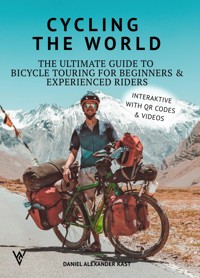
Daniel Alexander Kast
Cycling the World
The Ultimate Bicycle Touring Guide
The Book
Around the world in 1,751 days — in this practical guide, Melanie Nadja and Daniel Alexander Kast share their extraordinary experience of what makes a cycling journey truly successful. From choosing the right touring bike and calculating travel costs to route planning and equipment, as well as accommodation options, water supply, roadside repairs, and safety, they cover every essential aspect of bike travel.
This book is not a dry theoretical manual, but a hands-on companion for anyone who wants to explore the world — or their own country — by bicycle.
With easy-to-understand explanations, personal anecdotes, helpful packing lists, and interactive QR codes linking to additional information, downloads, videos, and articles, this guide offers both inspiration and practical support. It is the ideal companion for anyone planning their own cycling trip — whether it’s a weekend getaway, a summer adventure, or a journey around the world.
The Author
Daniel Alexander Kast is a passionate adventurer and engineer. Together with his wife, Melanie Nadja Kast (née Steinigen), he traveled through 27 countries by bicycle, covering more than 55,000 kilometers. Their remarkable journey took them from a spontaneous wedding in Morocco through the 50°C heat of the Iranian desert, all the way to the highest drivable border crossing between China and Pakistan at 4,700 meters. They cycled across the legendary Thorong La Pass in Nepal at 5,416 meters, contracted dengue fever while traveling in India, were escorted by armed police, and experienced devastating floods in Pakistan. Despite all the challenges, they collected unforgettable moments that profoundly shaped their outlook on life.
Their first book, “GONE, CHASED, MARRIED: An Adventurous Bicycle Journey Across Morocco” was published in December 2022 in its original German version.
More about their travels: https://www.vaegabond.com and @vaegabondsworld on social media.
Daniel Alexander Kast
Cycling the World
The Ultimate Guide to Bicycle Touring for Beginners and Experienced Riders
From First Plan to Final Mile:
The Complete Guide to Bicycle Travel
From Weekend Escapes to Global Expeditions
Based on experience in over
27 countries
55,000 km
up to 5,416 meters above sea level
from -20°C to +50°C
© 2026 Daniel Alexander Kast B. Eng.First edition, 2026Editing: Melanie N. Kast (Steinigen) B. Sc., Klaus C. Landgraf M.A.Cover design, illustrations, photographs: Daniel Kast ©vaegabond.com
Self-publishing imprintMelanie & Daniel Kast GbRGreiffenbergstr. 4996052
[email protected]/vaegabondsworldwww.facebook.com/vaegabondsworld
Originally published in German under the title „Die Welt im Sattel“Translation © 2026 by Melanie N. Kast & Daniel Alexander Kast
Copyright © 2026This work is protected by copyright.
All rights are reserved, including the rights of translation, audio adaptation, reprinting, and reproduction of this work or any part thereof. No part of this publication may be reproduced, processed, duplicated, or distributed in any form or by any means (including photocopying, microfilm, or other methods), including for educational purposes, without the prior written permission of the author, nor may it be stored or processed using electronic systems.
Table of Contents
Preface
Chapter 1: Introduction
1.1 Why Bicycle Touring?
1.2 No Experience? No Problem!
1.3 Typical Types of Bicycle Touring
1.4 Financing a Cycling Trip
Chapter 2: Choosing the Right Bicycle
2.1 Types of Bicycles
2.2 Bicycle Manufacturers
2.3 Bicycle Frames
2.4 Components
2.5 Component Manufacturers
2.6 Ergonomics
2.7 Which Bike Should You Choose?
Chapter 3: Luggage Systems
3.1 Panniers
3.2 Backpacks
3.3 Bike Trailers
3.4 Choosing the Right Luggage Solution
3.5 Packing Your Gear Properly
3.6 Luggage System Manufacturers
Chapter 4: Common Setups & Weight Distribution
4.1 The Importance of Setup
4.2 Weight Distribution
4.3 Setups for Different Types of Cycling Trips
Chapter 5: Packing List & Power Supply on a Bike Tour
5.1 General Equipment
5.2 Camping Equipment
5.3 Hygiene & Personal Care
5.4 Travel First-Aid Kit
5.5 Clothing & Accessories
5.6 Tools & Repair Gear
5.7 Food & Drink
5.8 Electronics
5.9 Other Things
5.10 Packing List Tips
5.11 Power on a Bike Tour
Chapter 6: Repair & Maintenance
6.1 Maintenance Before Your Trip
6.2 Basic Maintenance While Traveling
6.3 Emergency Repairs
6.4 Professional Help & Spare Parts
Chapter 7: Route Planning & Visa
7.1 Planning Your Route
7.2 Tools for Route Planning & Navigation
7.3 Receiving Packages While Traveling
7.4 Organizing a Visa
Chapter 8: Accommodation & Locals
8.1 Why Sleep Outdoors?
8.2 Choosing the Right Sleeping Bag
8.3 Choosing the Right Tent
8.4 Tips for Wild Camping
8.5 Alternatives to Sleeping in a Tent
8.6 Special Accommodation Options
Chapter 9: Drinking Water & Hygiene
9.1 Possible Water Sources on the Road
9.2 Transport & Treatment of Drinking Water
9.3 Hygiene on the Road
Chapter 10: Your Questions, Our Answers
Chapter 11: Helpful Resources
11.1 Downloadable checklists
11.2 Useful information & tips
11.3 Our films
Acknowledgements
Afterword
Preface
Welcome to our guide to short cycling trips, bikepacking, and long-distance bicycle travel. We are Melanie and Daniel Kast, two passionate cycle travelers. From 2019 to the end of 2024, we covered more than 55,000 kilometers in the saddle during our journey around the world, crossing 27 countries with our own muscle power.
This guide brings together valuable tips, honest insights, and practical tricks we gathered along the way. We share things that few people talk about and show you how to prepare for a wide range of challenges — from setting up your bike correctly and choosing the right equipment to thoughtful route planning. You’ll learn how to find the perfect place to camp and what to keep in mind when wild camping. The guide also covers everything you need to know about maintaining your bike.
Every cycling trip is as individual as you are. Your needs, health, and sense of comfort determine what your ideal setup looks like and which route is right for you. That’s why we strongly recommend consulting a professional or a local bike shop when choosing your bicycle, components, and ergonomic setup.
What we describe in this guide is based on our own experience — yours may be completely different. That’s one of the beauties of cycle touring: there is no right or wrong, only your own personal path. What matters most is setting off with common sense, openness, and curiosity — if you do, you’ll be rewarded with meaningful experiences and unforgettable moments.
This guide is meant to help you plan your very own journey, set off with confidence, and enjoy every moment on the road. Let’s head out together — toward new routes, new encounters, and new adventures!
High mountain range in Pakistan - 4,114 m MSL on August 27, 2022
And here’s a little bonus: we’re often asked fascinating — and frequently similar — questions about our cycling journey. In Chapter 10, we’ve gathered our honest answers so you can benefit from our experience without having to figure everything out on your own.
Scan the QR codes to learn more
Throughout the book, you’ll find QR codes that you can easily scan with your smartphone or click on in the e-book. For best results, scan the codes while the page lies flat and is not curved. They’ll take you to additional information, videos, and articles, making this guide even more interactive and engaging.
This guide reflects our own opinion, and all content is genuine and free of product placement. Thank you for your support (see Acknowledgements)!
Chapter 1: Introduction
Cycling trips offer a unique way to experience the world in a deeper and more authentic way than is otherwise possible. In this chapter, you’ll discover why cycling is such a rewarding way to travel and what possibilities it opens up for you. Whether you’re an experienced cyclist or a complete beginner, bicycle travel is for everyone. You don’t need to be a pro to enjoy the freedom and adventure that traveling by bike brings. We also introduce different forms of cycling travel and the equipment that suits them — from short weekend tours to journeys lasting several months, from wild camping to other unique overnight options.
1.1 Why Bicycle Touring?
Cycling allows you to experience a foreign country — or your own home region — in one of the most intense and authentic ways possible. On a bike, you feel closely connected to nature and to yourself. You can stop whenever you like, discover new places spontaneously, and travel independently of schedules and public transportation. You move at your own pace: slow enough to notice the details, fast enough to keep moving forward.
You experience more — and in different ways: On a bike, you’re more approachable. People often strike up conversations, offer help, or simply share a smile. Whether it’s at a market in Southeast Asia, a gas station in the Balkans, or a dirt road in Germany, it’s easier to connect and experience genuine, unfiltered encounters. Culture, everyday life, and humanity become tangible in ways other forms of travel often can’t offer.
Healthy and restorative: Cycling trips keep you physically fit. Regular cycling strengthens your heart and circulatory system, boosts your immune system, and helps reduce stress. Being active outdoors can lift your mood, combat fatigue, and provide you with vitamin D. Body and mind find balance — without the need for a gym.
Good for you — and for the environment: Bicycle travel is nearly emission-free. You don’t need fuel, plane tickets, or air conditioning. You significantly reduce your ecological footprint and, aside from the production of your bike, travel in an environmentally friendly, sustainable, and resource-efficient way.
Travel doesn’t have to be expensive: Cycling trips are comparatively affordable. You save on costly transportation, can camp along the way or stay in simple accommodations, and cook your own meals. This keeps your budget small — while the experience remains rich.
We’re convinced that anyone who enjoys traveling, staying active, and seeking adventure should try cycle travel at least once. It has the power to fundamentally change how you think about mobility, nature, and your own limits.
More and more people are discovering the bicycle as the ideal means of travel. Whether it’s short weekend trips, multi-week tours, or journeys around the world that last for years — cycle travel is booming. There are even fully organized tours with fixed routes and pre-booked accommodations. Those who prefer to stay flexible can opt for an independent journey: no set route, no fixed daily distances. You alone decide where the road takes you.
Of course, this also means organizing things yourself along the way. Navigation, accommodation, and food are all your responsibility. But that’s exactly where the appeal lies. You face new challenges, learn how to plan a tour, solve problems, build confidence, and grow beyond your limits.
Cycling trips are not just a way to explore the world — they are a journey to yourself. An adventure that stays with you.
A Typical Camping Scene — Doğubeyazıt, Turkey – 1,500 m MSL on June 12, 2021
1.2 No Experience? No Problem!
What do you do if you get a flat tire in the middle of the desert? How long will the cassette last? And what kind of maintenance does a bicycle actually need on a round-the-world trip?
So many questions — and no answers? No need to panic. Don’t let that hold you back. From our own experience, we can tell you this: it’s perfectly okay not to know everything. We started our cycling world journey from absolute scratch, too. Before that, the bike was simply a practical way for us to get around — to work, to the lake, or to visit friends. Multi-day tours? Not a thing. Melanie had never even changed a tire. There were no training rides with luggage, no full rehearsal, and only one test packing session… and yet we loaded up our touring bikes with around 70 kilograms including gear and simply set off from our adopted home of Bamberg — straight into a five-year journey around the world.
After about 30 kilometers on the very first day, we were completely exhausted. Doubts crept in: was this crazy idea of a cycling world tour really such a good one? Slightly paranoid, we searched for a wild camping spot — as secluded as possible, so no one would notice us. In the end, we stood somewhere in a harvested field, far from the bike path, unsure whether an angry farmer might show up at any moment.
Today, we laugh about that first day. Back then, though, it felt truly adventurous — and at times overwhelming. Were we in peak physical shape? Not at all. Did we have experience with bicycle travel? We didn’t. And yet, somehow, it worked.
Why are we telling you this? Because we want you to know that you can do it too. You don’t have to be a pro, a bike nerd, or an outdoor expert. You don’t need to chase personal records or prove anything to anyone. All you need is the courage to take the first step. The rest comes with time. You learn along the way, grow into it — and you’ll be amazed at what you’re capable of.
This guide offers valuable support for your own cycling journey. In Chapter 6, for example, you’ll find practical tips for dealing with breakdowns and maintaining your bike yourself. Back then, we would have loved a compact, honest, and practical source of information — just like this book. A guide that doesn’t lecture, but supports you.
From choosing the right bike and gear to repairs and route planning, you’ll find everything we’ve learned over many years on the road. After countless kilometers, breakdowns, encounters, detours, and challenges, we’ve gained a wealth of experience — and now we want to share it with you.
Because what matters most isn’t that everything goes perfectly.
What matters most is that you set off.
When the Route Becomes the Destination - Iran – 2,077 m MSL on April 28, 2022
1.3 Typical Types of Bicycle Touring
We’ll take an in-depth look at everything you need to know to plan and carry out short cycling trips, bikepacking tours, and long-term bicycle journeys. Before diving into the details, however, it’s important to clarify what these terms actually mean — because not all cycling trips are the same.
1.3.1 Short Cycling Trips
"Cycling trips” are an umbrella term for all forms of travel in which you ride a bicycle while carrying your own luggage:
a relaxed weekend ride on designated cycle paths
a multi-day tour with overnight stays
a journey lasting several months across countries or even continents
You may ride on paved roads, gravel tracks, or unpaved trails.
Typical bike for a short cycling trip
Luggage: 2 panniers| Bike weight: 15–19 kg| Payload: 7–15 kg
1.3.2 Bikepacking
Bikepacking is a particularly minimalist form of cycle travel. It relies on lightweight, compact equipment attached directly to the bike’s frame, handlebars and seatpost. This keeps the bike agile, light, and easy to handle — even on rough terrain.
Adventure off the beaten track: Bikepacking often means traveling far from developed roads and asphalt. It’s not about comfort or speed, but about freedom and the spirit of exploration.
Lightweight gear: You travel with minimal equipment, usually using frame bags and an ultralight tent. Everything is small, light, and efficiently packed, as space and weight are limited.
Independent and flexible: Bikepacking requires a certain level of planning and mental flexibility, as you’ll often need to improvise — for example, when it comes to water supply or finding a suitable place to sleep. The lightweight setup also allows you to carry your bike over large rocks, through streams, or up steep sections.
Limited self-sufficiency: Due to the reduced amount of gear, you’re more dependent on supermarkets or accommodations. Staying out for long periods and remaining fully self-sufficient is more challenging with a bikepacking setup.
Typical Bikepacking Bike
Luggage: 3–7 bags| Bike weight: 12–17 kg| Payload: 5–13 kg
1.3.3 Long-Distance Cycling & World Travel
A long-distance cycling journey around the world is arguably the most intense form of cycle travel — a demanding adventure on two wheels. You’re not out for just a few days or weeks, but often for many months or even years. The goal isn’t to get from point A to point B as quickly as possible, but to consciously experience new cultures, breathtaking landscapes, spontaneous encounters — and yourself. Travel becomes everyday life, leading to an entirely different way of perceiving the world. The feeling of being on vacation fades. You change, often unconsciously adapting to the countries and regions you pass through.
Immersion instead of passing through: On a journey like this, you create a new daily routine and immerse yourself in a slower, more mindful way of traveling. You don’t just get to know countries — you experience them with all their quirks, smells, sounds, and flavors. Over time, your perception shifts. You experience every climb, every headwind, but also every special moment in a way you never have before. Being in foreign countries gradually becomes normal, something you think about less and less as time goes on.
Thorough planning and reliable equipment: A long-term cycling journey requires careful preparation — choosing the right bike, suitable gear, the right mindset, tools and spare parts, clothing for different climate zones, a good tent, cooking equipment, and possibly technology for documenting your trip or working on the road. Long-term travelers usually carry significantly more luggage in order to remain self-sufficient, even in remote regions.
Physically demanding, mentally empowering: This type of travel requires not only physical endurance, but emotional resilience as well. Along the way, you’ll encounter not just breathtaking moments, dreamlike beaches, and majestic landscapes and mountain ranges, but also challenges, pain, illness, doubt, and loneliness. And that is exactly what makes a long-distance cycling journey so special: you grow beyond yourself, learn to let go, and gain an entirely new perspective on the world — and on yourself.
Typical Bike for Long-Distance Cycling Travel
Luggage: 6–9 bags| Bike weight: 19–25 kg| Payload: 35–45 kg
1.4 Financing a Cycling Trip
The cost of a cycling trip is difficult to pin down, as it depends on individual factors such as your travel style, activities, and accommodation choices. However, we’ve put together resources to help you calculate your own expenses. Simply scan the QR codes to access them.
For the first 2.5 years of our cycling world journey, we spent a total of €12,615.83 per person (an average of €15.36 per person per day), including initial equipment purchases. This amount also includes ongoing expenses of €7,412.59 per person (€9.03 per person per day). You’ll find a detailed breakdown of all costs and helpful calculation tools here:
Cost breakdown
Financial planner
Savings planner
15 money-saving tips
When estimating your own budget, keep in mind that your expenses will be higher if you prefer staying in accommodations or eating out regularly — something that isn’t fully reflected in our average figures. The amount of time you have available also plays a major role. If you work while traveling, you’ll often need additional equipment and funds for a mobile workspace. And if you’re under time pressure due to visa limitations or a pre-booked return flight, you may rely more on public transportation to cover long distances. On top of that, travel costs can vary significantly from country to country. For example, a kebab costs around €6 in Germany, but only about €1 in Turkey.
1.4.1 Saving Tips Before You Go
A long cycling journey costs money — but often less than many people expect. With some planning and a clear overview of your finances, you can save a great deal without giving up on adventure. We’ve created a savings planner that makes it easy to see how much you need to save for your next trip and how long it will take. Simply scan the QR code at the top of the page.
Here’s an overview of our best money-saving tips before your journey:
Get a clear picture of your real costs: Before you set off, take an honest look at your financial situation and travel budget. Ask yourself: How long do I want to be on the road? What do I want to spend my money on (e.g., equipment, accommodation, emergencies)? Which fixed monthly expenses can I reduce or eliminate before leaving? Creating a simple mind map on paper can help you clearly organize goals, ideas, and budgets.
Review your spending habits: Keep a household budget for at least one to two months — digitally or on paper. Simply becoming aware of where your money goes can make a huge difference and help you cut expenses deliberately. You may be surprised at how much you spend on small, everyday items.
Our Financial Planner: We developed it for both everyday life and travel, and we’ve been using it ourselves for over ten years. It’s continuously improved, simple, intuitive, and can be used without any Excel knowledge. The template automatically tracks your income and expenses, generates analysis, highlights savings potential, and compares your monthly spending.
Review insurance policies & subscriptions: Many ongoing contracts continue to cost you money while you’re traveling — often without providing any real benefit. Check your health insurance (e.g., public insurance or international coverage), gym memberships, streaming services, mobile phone plans, electricity, internet, or club memberships. Compare providers, cancel what you don’t need, and you can easily save hundreds of euros per year.
Question your habits: Even small everyday habits add up. How often do you eat outside? Do you regularly order food or buy new clothes online? Do you buy things impulsively instead of planning ahead? Becoming more mindful in these areas can quickly free up a significant amount of money for your travel budget.
Sell belongings & manage savings: Sell what you no longer need. Before our departure, we sold clothes, furniture, and electronics and generated several hundred euros in extra starting capital. Also consider keeping your savings in a separate account with interest and flexible access, so you can maintain a clear overview while traveling.
Discounts and second-hand gear: Many high-quality pieces of equipment are much cheaper outside the main season. Especially in autumn or winter, retailers often offer strong discounts on outdoor gear, tents, or cycling accessories. Used equipment is often just as reliable. Well-made panniers, tents, or stoves can last for years — saving both money and resources. Better yet, use what you already have.
1.4.2 Financial Tips While Traveling
For us, saving money doesn’t necessarily mean going without — it means traveling more consciously. If you keep your finances under control, you can stay on the road longer, remain flexible, and focus on what really matters: freedom on two wheels. Here are some tips for saving money while you’re traveling:
Minimize accommodation costs: Camping saves money and gives you freedom. If you need a bed, look for affordable hostels, guesthouses, or youth hostels and compare prices. Travel networks can also offer free places to stay and meaningful encounters (see Chapter 8.6).
Reduce transportation costs: The more you ride, the cheaper your journey becomes. If you do need other means of transport, compare flights and trains early, use local buses, or — depending on the country — consider hitchhiking. We, and many other cycle travelers, have had positive experiences with it.
Eat like the locals: Eat where locals eat and shop — at markets, small restaurants, or street food stalls. It’s usually cheaper, more authentic, and often tastes better. In some countries, you can also rescue surplus food.
Communication and internet: Use free Wi-Fi and local SIM cards instead of roaming. Messaging and calling apps vary by country — pay attention to what’s commonly used, such as Signal, Line, Viber, Zalo, or WhatsApp. They’re useful for calls and messages.
Earn money on the road: If you’re traveling long-term, you can generate income along the way — for example through online work (writing, design), language teaching or tutoring, affiliate projects, or blogging. Be sure to research legal requirements early on.
Know the prices: Take note of average prices and ask for the same products in different places (basic food items, water, cooking fuel) — for example at local markets or supermarkets away from tourist areas. This helps you develop a realistic sense of price levels and gives you a solid basis for negotiating.
Negotiate: In many countries, bargaining is part of everyday life. Ask politely but confidently for a better price, and always remain respectful. Keeping an eye on current exchange rates also helps you choose favorable times to withdraw cash. Our tip: suggest a price yourself based on your research — it shows you’re informed and reduces the chance of being overcharged.
In the end, everyone has their own travel style, needs, and personal idea of comfort. What remains priceless, however, are the experiences along the way. Every moment on a journey like this is unique — and that’s something no one can ever take away from you.
Chapter 2: Choosing the Right Bicycle
Choosing your destination and route is a crucial step when planning a cycling trip. But just as important — if not more so — is selecting the right bicycle. It not only affects your comfort on the road, but also your safety and your ability to reach your destination reliably.
In this chapter, we’ll show you what to look for when choosing a bike and which factors really matter. Before we dive into the details, let’s make one thing clear: there is no single perfect bicycle for every type of cycling trip. The bike that’s best for you depends entirely on your planned journey — the terrain, the weight of your luggage, your body size, and, last but not least, your personal preferences.
That said, there are a few key points that can help guide your decision. In the next section, we’ll introduce these factors so you can choose a bicycle that truly fits your needs. Take your time with this step. A well-chosen bike makes all the difference. It can make your journey far more enjoyable and help you tackle challenging stages with confidence and without technical issues.
2.1 Types of Bicycles
In this section, we’ll give you an overview of different types of bicycles and how suitable they are for various kinds of cycling trips.
2.1.1 City Bikes
City bikes are well suited for short rides or everyday use around town. They offer a comfortable, upright riding position and are easy to handle, making them ideal for relaxed rides. On longer journeys, however, the seating position can become uncomfortable over time.
Light suspension, limited versatility: City bikes are only partially suitable for long tours or riding on rough surfaces.
Less robust, more prone to breakdowns: They’re generally not built for heavy use and often come with thinner tires, making them more susceptible to flats on gravel, forest paths, or other unpaved roads.
Limited luggage capacity: A bike basket may work for city errands, but it’s not enough for multi-day trips. City bikes often offer only limited options for securely attaching panniers.
Simple gearing, limited range: The gearing is usually basic. That may be fine on flat terrain, but it quickly reaches its limits in hilly areas.
Conclusion: For a short cycling trip — for example along a flat cycle path — a city bike can be a good and affordable way to try out cycle travel without a big investment. For more ambitious or longer journeys, however, it’s better to opt for a more robust model.
Example: City Bike
2.1.2 Road Bikes
Road bikes are known for their light weight, speed, and agility. With their narrow tires and sporty geometry, they’re designed for higher speeds on paved roads. For classic cycling trips, however, they are less suitable.
Sensitive on uneven surfaces: The narrow tires of road bikes are made for smooth asphalt. On rough pavement, gravel, or forest paths, the risk of punctures increases significantly.
Very limited luggage capacity: Road bikes aren’t built to carry luggage. They often lack mounting points for panniers or racks, and the frame geometry isn’t designed to handle additional weight in a stable way.
Uncomfortable riding position over long distances: