


1,99 €
Mehr erfahren.
- Herausgeber: Publisher s13381
- Kategorie: Geisteswissenschaft
- Sprache: Englisch
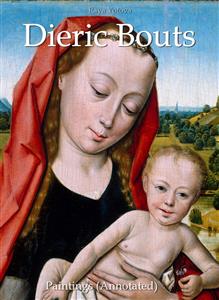
Dieric Bouts (1415 –1475) was to a great extent guided by Rogier van der Weyden, under whom he may have learned and by Jan van Eyck. Bouts is first time recorded in Leuven and painted in this town until his death. He was one of the first northern artists to display of a solitary disappearance spot. Doric’s Bouts method has a definite archaic rigidity of depiction, and his human bodies are often strangely long and sharp, but his paintings are extremely expressive, strongly planed and wealthy in colors, with in particular high-quality landscapes in backgrounds.
Das E-Book können Sie in Legimi-Apps oder einer beliebigen App lesen, die das folgende Format unterstützen:
Veröffentlichungsjahr: 2018
Ähnliche
Dieric Bouts
Paintings (Annotated)
Annotated by Raya Yotova
––––––––
First Edition
*****
Copyright © 2018 Annotated by Raya Yotova
Table of Contents
Title Page
Copyright Page
Foreword
Paintings
Foreword
Dieric Bouts (1415 –1475) was to a great extent guided by Rogier van der Weyden, under whom he may have learned and by Jan van Eyck. Bouts is first time recorded in Leuven and painted in this town until his death. He was one of the first northern artists to display of a solitary disappearance spot. Doric’s Bouts method has a definite archaic rigidity of depiction, and his human bodies are often strangely long and sharp, but his paintings are extremely expressive, strongly planed and wealthy in colors, with in particular high-quality landscapes in backgrounds.
His first artwork was the Triptych of the Virgin's Life, painted about 1445. The Last Supper is the second of his paintings to show an accepting of Italian style of linear perspective. Art historians too have noted that his work Last Supper was the earliest Flemish painting on wood panel to represent thematically the Last Supper. In this wood painting, the artist did not centered on the biblical history itself but as an alternative showed Jesus Christ in the character of a chief priest executing the blessing of the Eucharistic crowd from the Catholic Mass. This distinguishes powerfully with other Last Supper images, which frequently centered on Judas's perfidy or on Jesus’ comforting of St John. The painter as well inserted to the complication of this depiction by with 4 servants all of them clothed in Flemish garments. Even though one time recognized as the Dieric Bouts himself and his two sons, these four figures are almost certainly images of the confraternity's associates accountable for commissioning the altarpiece. This masterpiece was the middle element of the altarpiece in the St. Peter's Church in Leuven.
Following he gaining the position of town artist of Leuven, Dieric Bouts accepted a order to create 2 additional paintings for the City Hall. After finished this commissions, the painter start working to the superior order for the Justice Panels, which engaged Bouts until his end of life. Many of his genuine paintings are small-size devotional wood panels, as a rule of the Madonna and Child.
In the field of portrait painting, he reached upon the practice instituted by Jan van Eyck, Robert Campin, Petrus Christus and Rogier van der Weyden. Dieric Bouts’ Portrait of a Man is the foremost example of a model exposed in 3/4 vision ahead of a distinct environment with a indication of the landscape out the window.
Paintings
Triptych of the Virgin's Life, 1445, Oil on canvas, 80 x 217 cm
Detail




