


Erhalten Sie Zugang zu diesem und mehr als 300000 Büchern ab EUR 5,99 monatlich.
- Herausgeber: The History Press
- Kategorie: Sachliteratur, Reportagen, Biografien
- Sprache: Englisch
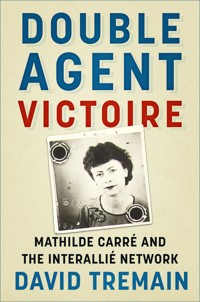
Mathilde Carré, notoriously known as La Chatte, was remarkable for all the wrong reasons. Like most spies she was temperamental, scheming and manipulative – but she was also treacherous. A dangerous mix, especially when combined with her infamous history of love affairs – on both sides. Her acts of treachery were almost unprecedented in the history of intelligence, yet her involvement in the 'Interallié affair' has only warranted a brief mention in the accounts of special operations in France during the Second World War. But what motivated her to betray more than 100 members of the Interallié network, the largest spy network in France? Was she the only guilty party, or were others equally as culpable? Drawing on material from MI5 files, Double Agent Victoire explores the events that led to her betrayal, who may have 'cast the first stone', and their motivations, as well as how the lives and careers of those involved were affected. It reveals a story full of intrigue, sex, betrayal and double-dealing, involving a rich cast including members of the French Resistance, German Abwehr and British Intelligence.
Sie lesen das E-Book in den Legimi-Apps auf:
Seitenzahl: 875
Veröffentlichungsjahr: 2018
Das E-Book (TTS) können Sie hören im Abo „Legimi Premium” in Legimi-Apps auf:
Ähnliche


















Dedicated to my mother,Barbara, 1934–2023
First published 2018
This paperback edition first published 2025
The History Press
97 St George’s Place, Cheltenham,
Gloucestershire, GL50 3QB
www.thehistorypress.co.uk
© David Tremain, 2018, 2025
The right of David Tremain to be identified as the Author of this work has been asserted in accordance with the Copyright, Designs and Patents Act 1988.
All rights reserved. No part of this book may be reprinted or reproduced or utilised in any form or by any electronic, mechanical or other means, now known or hereafter invented, including photocopying and recording, or in any information storage or retrieval system, without the permission in writing from the Publishers.
British Library Cataloguing in Publication Data.
A catalogue record for this book is available from the British Library.
ISBN 978 0 75098 870 4
Typesetting and origination by The History Press
Printed and bound in Great Britain by TJ Books, Padstow, Cornwall
eBook converted by Geethik Technologies
The History Press proudly supports
www.treesforlife.org.uk
EU Authorised Representative: Easy Access System Europe
Mustamäe tee 50, 10621 Tallinn, Estonia
Contents
Abbreviations
Author’s Note
Acknowledgements
Dramatis Personae
Introduction
1 ‘An Exceedingly Dangerous Woman’
2 ‘A Man of Great Daring and Initiative’
3Interallié is born
4 ‘A Squalid Tale’
5 An American in France
6 ‘The Kraus Affair’
7 The Interallié Network
8 Betrayal
9 MAURICE’s Escape
10 Colonel Henri’s Story
11 Turning the Tables
12 Penetration of the LUCAS Network
13 Gloria in Excelsis
14 LUCAS’s Story
15 BENOIT’s Story
16 ‘An Important Affair’
17 ‘A Nasty Taste in One’s Mouth’
18 WALENTY and the ‘Great Game’
19 Pointing Fingers
20 Winding Up a Troublesome Affair
21 Accounts Payable: The Cost of Doing Business
22 What Are we Going to Do about Mathilde?
23 Disposing of the Body
24 Strong Evidence from Many Sources
25 The Final Reckoning
Epilogue
Appendix 1 Members and Contact of the WALENTY Organisation Carded in VICTOIRE
Appendix 2 Particulars of Members and Associates of the WALENTY Organisation
Appendix 3 Chronology of the Betrayal and Arrests of Interallié
Appendix 4 The Case Against VICTOIRE: The Allegations of her Betrayals
Appendix 5 Members of the Interallié Organisation who Escaped to England
Appendix 6 Regulations for Special Internees at Aylesbury
Appendix 7 Major Ische’s Personnel in
Appendix 8 Proposed Messages Relating to the Return of LUCAS and VICTOIRE to France
Notes
Select Bibliography
Abbreviations
27 Land
SIS term for France
48 Land
SIS term for USA
A4
Country section dealing with Free French and Polish government-in-exile (MI6/SIS)
A5
Overseas Services, Organization and Administration; later (1943) Special Services (MI5)
ACSS
Assistant Chief, Secret Intelligence Service (MI6/SIS)
ADB1
Assistant Director, B Branch (MI5)
ADC
Aide de Camp
ADE
Assistant Director, E Branch (MI5)
AFS
Auxiliary Fire Service
ARC
Aliens Registration Card
ARO
Aliens Registration Office
ARP
Air Raid Precaution
B1a
Espionage, Special Agents (MI5)
B1b
Espionage, Special Sources section (MI5)
B1d
Special Examiners (MI5)
B2
Counter-espionage (MI5)
B3a
Censorship (MI5)
B3d
Communications: liaison with censorship (MI5)
B4a
Counter subversion section involved with suspected cases of espionage by individuals living in the UK (MI5)
B4b
Enemy espionage, industry and commerce (MI5)
B5b
Counter subversion (MI5)
B5d
Political subversion section (MI5)
B6
Watchers (MI5)
BAOR
British Army of the Rhine (post-war)
BEF
British Expeditionary Force
BLA
British Liberation Army
BRCS
British Red Cross Society
BSS
Bayswater Special Security Section (SOE)
CCU
Canadian Concentration Unit
CIA
Central Intelligence Agency (US)
CIC
Counter-intelligence Corps (US Army)
CID
Criminal Investigation Department
C-in-C
Commander-in-Chief
COBRA
Cabinet Office Briefing Room A
CSDIC(WEA)
Combined Services Detailed Interrogation Centre (Western European Area), also known as the ‘London Cage’ (q.v.MI19)
CX
Reports prepared by MI6 (SIS)
D4b
Port intelligence (MI5)
DC & D
War Office – unknown
DDMI O&S
Deputy Director Military Intelligence, Operations & Security
DFC
Distinguished Flying Cross
DMI
Director (or Directorate) of Military Intelligence
DSO
Defence Security Officer (MI5); also Distinguished Service Order
DZ
Drop zone
F Section
Section of SOE dealing with France
F2c
Russian intelligence (MI5)
F3C2
Nazi sympathisers and fifth columnists (MI5)
FANY
First Aid Nursing Yeomanry
FIC
Fellow of the Royal Institute of Chemistry (now Royal Society of Chemistry)
FSP
Field Security Police
FSS
Field Security Section, Intelligence Corps
G2
Home Office (N.B. It can also mean the Security and Intelligence Branch of the British or US Army)
G3
Responsible for operations, staff duties, exercise planning, training, operational requirements, combat development and tactical doctrine (British Army)
GPO
General Post Office
GSI
General Staff Intelligence
HO
Home Office
HOW
Home Office Warrant
IB
Intelligence Branch
IOM
Isle of Man
IP2 (a)
Ministry of Information (MOI) and Propaganda; liaison between War Office, Ministry of Information (MOI), the Press and BBC
IRA
Irish Republican Army
IRB
Inter-Services Research Bureau; cover name for SOE
IRC
International Red Cross
ISOS
Intelligence Service Oliver Strachey/Illicit Services Oliver Strachey
JIC
Joint Intelligence Committee
KOSB
King’s Own Scottish Borderers
LCI
Landing Craft Infantry
LCS
London Controlling Section
LNU
Last name unknown
LRC
London Reception Centre (q.v.RVPS)
LRCP
Licentiate Member of the Royal College of Practitioners
LZ
Landing zone
MA
Military Attaché
MAP
Ministry of Aircraft Production
MC5
Ministry of Information branch
MEW
Ministry of Economic Warfare
MGB
Motor gun boat
MI1a
Part of the Directorate of Military Intelligence in WW1 responsible for distribution of reports and intelligence records; remobilised in 1939 to interrogate enemy prisoners
MI5
British Security Service
MI6
British Secret Intelligence Service (q.v.SIS)
MI9
Escape and Evasion organisation of British Intelligence
MI14
A branch of Military Intelligence specialising in intelligence about Germany
MI19
Directorate of Military Intelligence (War Office): branch responsible for obtaining information from prisoners of war (q.v.CSDIC)
MM
Military Medal
MOI
Ministry of Information
MPD
Metropolitan Police District
MRCS
Member of the Royal College of Surgeons
NASA
National Aeronautics and Space Administration
NCO
Non-commissioned officer
NID
Naval Intelligence Division (Royal Navy)
NKVD
Narodni Kommissariat Vnutrennikh del – People’s Commissariat for Internal Affairs (Soviet Union, 1934–46)
NLT
No living trace
OBE
Officer of the Order of the British Empire
OC
Officer commanding
OSA
Official Secrets Act
OSS
Office of Strategic Services (wartime US equivalent of SOE)
OTU
Operational Training Unit (RAF)
PAIR
OSS code name for deciphered German intelligence messages (q.v.ISOS)
P&PO
Pass & Permit Office
POW or PW
Prisoner of war
POWN
Polska Organizacja Walki o Niepodległoścsi – Polish resistance movement based in Lyons
PRU
Photographic Reconnaissance Unit (RAF)
PUSD
Permanent Under-Secretary’s Department (Foreign Office)
PW1
War Office directorate of Prisoners of War dealing with enemy prisoners
RAF
Royal Air Force
RAFVR
Royal Air Force Volunteer Reserve
RAMC
Royal Army Medical Corps
RANR
Royal Australian Naval Reserve
RASC
Royal Army Service Corps
RLL
Refused leave to land (Immigration)
RN
Royal Navy
RNAS
Royal Naval Air Service
RNVR
Royal Navy Volunteer Reserve
RPS
Royal Patriotic School (q.v.LRC, RVPS)
RSLO
Regional Security Liaison Officer (MI5)
RVPS
Royal Victoria Patriotic School (q.v.LRC and RPS)
SAAF
South African Air Force
SAS
Special Air Service
SCI
Special Counter-Intelligence (OSS) (104 SCI was a British unit)
SCO
Security Control Officer (MI5)
Section V
SIS counter-espionage section
SHAEF
Supreme Headquarters Allied Expeditionary Force
SIME
Security Intelligence Middle East
SIS
British Secret Intelligence Service (q.v.MI6)
SLA1
MI5 legal section
SLB
MI5 legal section
SLD
Services Liaison Department
SOE
Special Operations Executive
UNRRA
United Nations Relief and Rehabilitation Administration
VB3
Counter-espionage sub-section which dealt with France, Corsica, Andorra and the Benelux countries (Belgium, the Netherlands, Luxembourg) (MI6)
VB5
Counter-espionage sub-section (MI6)
VBZ
Counter-espionage sub-section (MI6)
VCIGS
Vice Chief of Imperial General Staff
WO
War Office
WR-A
War Room Registry A (MI5) – supplies and internal information
WRAF
Women’s Royal Air Force
WRC1
War Room Registry (MI5). WRC was the Assessments Section; WRC1 dealt with officers and agents of the old Abwehr I and III
WSWoj
Wyźsza Szkola Wojenna or Higher War College, Warsaw (Poland)
W/T
Wireless telegraphy
X-2
Counter-espionage branch of OSS
XX
Double-Cross Committee
ZB
SIS symbol for MI5
French Organisations
BCRA
Bureau Central de Renseignements et d’Action (French WW2 forerunner of SDECE and DGSE)
BCRAL
Bureau Central de Renseignements et d’Action Londres (London branch of BCRA)
BMA
Bureau des Menées Anti-Nationales (organisation created by Vichy government to counter anti-nationalism)
CCI
Centre de Coordination Interarmées
CST
Contrôle de la Surveillance du Territoire (predecessor to the DST (France))
DCRI
Direction Centrale du Renseignement Intérieur (French security service, 2008–12, superseded DST)
DGSE
Direction Générale de la Sécurité Extérieure (French overseas intelligence service, superseded SDECE, 1982)
DGSI
Direction Générale de la Sécurité Intérieure (French security service, 2012 to present, superseded DST)
DIA
Division d’Infanterie Algérienne
DSDOC
Direction des Services de Documentation (or DSDoc)
DST
Direction de la Surveillance du Territoire (French security service, 1944–2008)
FFI
Forces Françaises de l’Intérieur (Gaullist Resistance fighters)
FTPF
Francs-Tireurs et Partisans Français
LN
Libération-Nord (left-leaning Resistance organisation)
PSF
Parti Social Française
PTT
Postes, Télégraphes et Téléphones (French Post Office)
SDECE
Service de Documentation Extérieur et de Contre-Espionnage (French intelligence service, 1947–82)
SFIO
Section Française de l’Internationale Ouvrière (French section of the Communist Internationale)
SMH
French Resistance network
SNCF
Société National des Chemins de Fer (French national railway system)
SNM
Service National Maquis
SR Guerre
Services des Renseignements Guerre
SSM
Service de la Sécurité Militaire (France)
German Organisations
Amt IV
Gestapo (part of RSHA)
Amt IVE
Gestapo Counter-intelligence (part of RSHA)
FAK 313
Frontaufklärungskommando (front reconnaissance [spy] command 313)
FAT 350
Frontaufklärungstrupp (front reconnaissance [spy] troop 350)
GAF
German Air Force (Luftwaffe)
GFP (Luft)
Geheim Feldpolizei (German field security police) Luftwaffe
GIS
German Intelligence Service
MBF
Militärbefelshaber Frankreich (military commander in France)
MK
Meldekopf (advanced message centre)
NSDAP
Nationalsozialistische Deutsche Arbeiterpartie (National Socialist German Workers’ Party – Nazi Party)
OKH
Oberkommando des Heeres (Supreme Command of the Army, Germany)
OKW
Oberkommando der Wehrmacht (Supreme Command of the Armed Forces, Germany)
RSHA
Reich Main Security Office
SD
Sicherheitsdienst (SS intelligence service)
Sipo
Sicherheitspolitzei (department which controlled the Gestapo and the Kripo (Kriminalpolizei)
SS
Schutzstaffel (security service of the Nazi Party); also German Secret Service
V-Mann
Vertrauensmänn or confidential person
WAKO
Waffenstillstandkommission (German Armistice Commission)
Abwehr Abbreviations
Abt.
Abteilung (Abwehr branch)
Branch I
Espionage
H
Heer (Army)
L
Luft (Air)
M
Marine (Navy)
Wi
Wirtschaft (Economics)
I
Communications
G
False documents, secret inks
Branch II
Sabotage
Branch III
Counter-espionage
Abt. IIIF
(Feind) Abteilung III F (penetration of enemy intelligence services; the largest and most important section)
Alst
Abwehrleitstelle (head Abwehr station)
AO
Auslandorganization; also Abwehrofficizier (Abwehr)
Ast.
Abwehrstelle (Abwehr station)
Ic
Third general staff officer (Abwehr) c.f. AO
KO
Kriegsorganization (War Organisation), Abwehr in Allied and neutral countries
1T/LW
Technik/Luftwaffe
Author’s Note
Unless otherwise specified in the Notes, all quotes and extracts have been taken from files in the National Archives at Kew (TNA). When quoting from these files some minor formatting changes have occasionally been made to ensure the text flows better, and accents added to French and German words where they were missed out in the original text because the typewriters of the time lacked those keys; otherwise, no changes have been made to the original punctuation or spelling. In these files many MI5 documents use the term ‘German S.S.’; in this context it is generally meant as a generic name for the German Secret Service rather than Schutzstaffel, the Nazi Party’s intelligence service. Likewise, the terms ‘MI6’ and ‘SIS’ are used interchangeably to mean the overseas branch of the British Intelligence Service.
The accounts of the Interallié and LUCAS networks are peppered with numerous code names or aliases indicated in official documents by the symbol @ meaning alias, with some people having more than two, their code names sometimes being used interchangeably, depending on which document is being cited, causing some confusion. Therefore, those code names have been compiled into Appendix 1. Where possible, only one code name will be used in the text unless another appears in a quote, in which case the alternate code name(s) will also be given in parentheses. The identities of some individuals still remain vague or unknown, but where possible, attempts have been made to identify them.
Acknowledgements
All files in the National Archives are © Crown Copyright and are reproduced with permission under the terms of the Open Government Licence.
Quotes from Hansard contain parliamentary information licensed under the Open Parliament Licence v3.0.
Every attempt has been made to seek and obtain permission for copyright material used in this book. In certain cases this has not been possible. However, if we have inadvertently used copyright material without permission/acknowledgements we apologise and we will make the necessary correction at the first opportunity.
The author and publisher would like to thank the following for permission to use copyright material in this book:
Amberley Publishing (The Women Who Spied for Britain)
Bloomsbury Publishing (Agent Zigzag; John le Carré: The Biography)
Crécy Publishing (We Landed by Moonlight)
Gerry Czerniawski (The Big Network)
Frontline/Pen & Sword (No Cloak, No Dagger)
Lauran Paine Jr (Mathilde Carré: Double Agent)
Nigel West (The Secret War)
Every effort has been made to verify the information in this book. Any mistakes are of my own doing and will be rectified in any subsequent editions that are produced.
I would like to thank my editor, Mark Beynon, and all those involved at The History Press, as well as Monica Aguiar; Cécile Carret, Secrétariat de la Société Chimique de France; Gerry Czerniawski, son of Roman Garby-Czerniawski; Katherine Doyle, Centre for Buckinghamshire Studies; Laura Sapwell, Governor of HM Prison, Aylesbury; Evelyn Tremain, and Nigel West.
Dramatis Personae
Maj. Hugh Waldorf Astor (1920–99): MI5 officer, B1a
Roger Bardet (ROGER): Member of Interallié network
S/Ldr Terence Elliot Beddard: MI5 officer
Hugo Bleicher (1899–1982): Abwehr Feldwebel, III F, Ast Paris
Renée Borni (VIOLETTE): Member of Interallié network; mistress of WALENTY
Michel Brault (MIKLOS) (b.1895–?): Paris lawyer
Princess Jacqueline de Broglie (1912–60 or 1918–65): Wife of Alfred Kraus
Col Maurice Buckmaster (1902–92): Head of F Section, SOE
Mathilde Carré (VICTOIRE) (1908–70): Member of Interallié network
Lieutenant Michel Coulomb (EVE): SOE agent.
Maj. Benjamin Cowburn (BENOIT) (1909–94): SOE agent
Comtesse Colette Dampierre (1911–69): Alleged Abwehr spy
Monique Deschamps (MONO): Member of Interallié network; first wife of Garby-Czerniawski
Cmdr Wilfred ‘Biffy’ Dunderdale (1899–1990): SIS officer, Section V; pre-war SIS Head of Station, Paris
Det. Sgt Louis V. Gale: Scotland Yard Special Branch; minder of Mathilde Carré
Roman Garby-Czerniawski (ARMAND; WALENTY; BRUTUS) (1910–75): Founder of Interallié network
Robert Goubeau (BOB): Member of Interallié network
Maj. Tom Greene: SIS Section V
Maj. Christopher Harmer (1910–96): MI5 officer, B1a; case officer of Mathilde Carré
Herbert Lionel Adolphus Hart (1907–92): MI5 officer, B1b
Col William Edward Hinchley-Cooke (1894–1955): MI5 interrogator and legal advisor, SLA1
Claude Jouffret (MICHEL): Member of Interallié network
Robert/Jean Lucien Kieffer (KIKI): Member of Interallié network
Maj. Maxwell Knight (1900–68): MI5 officer, B5b
Alfred Ignatz Maria Kraus (b.1908–?): Abwehr agent; husband of Jacqueline de Broglie
Suzanne Laurent (b.1914–?): Bleicher’s girlfriend
Capt. Guy Maynard Liddell (1892–1958): Director, MI5 B Branch; later Deputy Director General, 1945–53
Richard Dafydd Vivian Llewellyn Lloyd (1906–83): Welsh Guards officer; lover of Mathilde Carré; author
William ‘Billy’ Luke: MI5 officer, B1a
William Mackenzie: Friend of Mathilde Carré
John Marriott: MI5 officer, secretary of Double-Cross Committee
Maj. John Cecil Masterman (1891–1977): MI5 officer; chairman of Double-Cross Committee
Helenus Padraic Seosamh ‘Buster’ Milmo (1908–88): Assistant Director, B1 (ADB1)
Lt Roger Mitchell (ADAM): SOE agent
Lt Col Thomas Argyll ‘Tar’ Robertson (1909–94): MI5 officer, B1a; in charge of double agents
F/Lt Alfred Philip Frank Schneidau (1903–84): Also known as S/Ldr Philipson (FELIX); RAF liaison with SIS
Cmdr John Senter (1905–66): SOE Director of Security, 1942
Lt Col Robin William George ‘Tin Eye’ Stephens (1900–?): Commandant, Camp 020
Jona ‘Klop’ Ustinov (1892–1962): Part-time agent for MI5, SIS
Pierre de Vomécourt (LUCAS) (1906–86): SOE agent
Dick Goldsmith White (1906–93): Head of MI5’s B1b and assistant to Guy Liddell
Introduction
A cat is mercurial: she plays to her own rules, no one else’s. She is independent and does what she pleases, when she wants to, not when others think she should. She owes her loyalty to no one but herself. Then, when the fancy takes her, she is off, returning at her convenience. Female cats also like to be the boss; put two of them together and they will fight for dominance. The spy known as ‘La Chatte’ (the female cat) was much the same. In her lifetime she served three masters, but ultimately was serving herself. A report (undated) written by Patricia McCallum of MI5’s Registry about the woman later known as VICTOIRE begins:
On 28.2.42 there arrived in the U.K. a remarkable woman agent: Mathilde Lucie (or Lily) CARRÉ … Her case was later to receive the maximum publicity, although her arrival is not mentioned in the Curry History1 or in the record of Camp 020.2 Nor is there a reference to her in the Masterman Report3 though for several months she worked as a B1A double agent. Yet Mathilde CARRÉ (referred to hereinafter as VICTOIRE) was a highly successful agent, firstly on behalf of the Allies, secondly on behalf of the Germans, and thirdly – apparently – once more on the British side. The reason for the official silence about her arrival is that she came to England, not by parachute or as a refugee like other spies, but was brought over by the Royal Navy in company with one of SOE’s most important Resistance organisers: Pierre de VOMÉCORE @ LUCAS [sic]. Moreover their escape from occupied France was aided and facilitated in every way by Abt. III/F of the Abwehr.4
Remarkable she may have been, but for all the wrong reasons. Like most spies she was temperamental, untrustworthy, scheming, manipulative, jealous, and above all, treacherous.
Given that several MI5 officers were directly involved in her case, in particular Christopher Harmer, it is strange that John Curry’s official history of MI5 does not mention her, even in passing, particularly as Guy Liddell’s war diaries do from time to time, as do agents involved in other spy cases. She was never interned in Camp 020, which is why Robin Stephens never mentioned her in his account, even though he and his staff were occasionally involved in the case.
The Masterman Report, which only came to light in 1972 amidst controversy when the British government tried to suppress its publication, was a secret report by Oxford don Sir John Masterman, chairman of the Twenty Committee, about the Double-Cross System employed by MI5 to use spies who had been captured and then deemed suitable to be ‘turned’ against their original employer (mostly the German Abwehr) to work as double agents. Even though Masterman was to some extent involved in MI5’s dealings with ‘La Chatte’ by attending meetings where she was discussed, she was only ‘turned’ in the sense that once in England she continued to transmit to the Germans under the control of British Intelligence, which is perhaps why he does not mention her in his report as a bona fide double agent. Indeed, he states that ‘this was never my case beyond serving this woman with a Detention Order’.
The silence on behalf of the British Intelligence community may also have been because she had become an embarrassment to them, and once the war was over they were happy to be rid of her when they handed her back to the French to face trial.
VICTOIRE, the woman who would become notorious as ‘La Chatte’, was employed by the Interallié network, an organisation working on behalf of the Polish Secret Service in Occupied France. On 18 November 1941, she was arrested by the Abwehr, along with some of the more important members of the organisation. Shortly thereafter, she became one of their most trusted agents and worked for them as a double agent while still operating the Interallié network’s radio. Allegedly, she briefly became the mistress of Feldwebel (Sergeant) Hugo Bleicher, the senior Abwehr NCO who worked against the French Resistance in breaking up Interallié and other networks. While working for the Germans, Mathilde Carré provided them with the names and locations of organisation members still at large, as well as acting as a decoy or as an agente provocatrice, so they could be arrested by the Gestapo. Her motivations for betraying them are complex and will be examined during the course of this book and summed up in the final chapter.
VICTOIRE’s story, and those of the other two main protagonists – Roman Garby-Czerniawski @ ARMAND @ WALENTY (later also known as BRUTUS), and Hugo Bleicher of the German Abwehr – are inextricably linked. In the 1950s and ’60s they all wrote accounts of their involvement in the Interallié affair, but at that time did not have the benefit of access to official MI5, Special Operations Executive (SOE) or other files, some of which are now publicly available from the National Archives at Kew. Therefore, their versions of events have become blurred, glossed over, even romanticised; facts have been omitted, or simply merged together. As Garby-Czerniawski wrote in The Big Network:
Still, after publication of as many as four books in English which deal directly or indirectly with the story of the Interallié Network, I felt I could not, and should not, remain silent any more; not only from my own personal point of view but also in fairness to everyone engaged in the work of this Big Network.
I could no longer bear the inadequate or wrong pictures of the organization and the many people in it, nor the very inaccurate remarks about myself.5
Apart from their books mentioned in the Bibliography, the fourth was The Cat. A True Story of Espionage, written in 1957 by wartime Abwehr officer Michael Alexander Graf (Count) Soltikow. Soltikow was born Walter Richard Max Bennecke in Potsdam on 17 November 1902 but was adopted by Leo Graf von Soltikow and Alexandra Tzvatkoff in 1926. During the war he served with the Oberkommando der Wehrmacht (OKW) and claimed to have worked for Admiral Canaris and Hans Oster. He died in 1984. Both Garby-Czerniawski and Benjamin Cowburn (BENOIT) would later claim over £12,000 damages against Soltikow and Nannen Publishing Company, the publisher of the German edition of Bleicher’s book, alleging that their characters had been damaged by revelations in the book.
Until recently, the many authors who have subsequently written accounts of SOE – the Special Operations Executive established by Winston Churchill ‘to set Europe ablaze’ – in most cases also did not have complete access to the official files. Indeed, as one of Mathilde Carré’s biographers, Gordon Young, acknowledged in 1957, ‘the Home Office politely but firmly refused me any information on this subject’. Even after the release of those MI5 and SOE files to the National Archives, the many recent accounts of SOE and its agents have barely scratched the surface, only mentioning VICTOIRE and Interallié in passing, which seems strange, given the importance of what was then the largest network operating in France. Instead, they have tended to focus on the men and women agents who have now become household names, without necessarily adding anything new to their stories.
The story has also been portrayed in other media: On Tuesday 2 January 1962 The Big Network, based on Garby-Czerniawski’s book, was aired on the radio on the BBC Home Service, with James McKechnie as Garby-Czerniawski and Mary Wimbush as Mathilde Carré. A German TV film directed by Wolfgang Glück was made in 1972, entitled Doppelspiel in Paris, starring Luitgard Im as Mathilde Carré, Hartmut Reck as Roman Garby-Czerniawski, Barbara Lass as Renée Borni, and Ferdy Mayne as Maître Brault.6 Given the current interest in wartime exploits, perhaps the time is now right for a full-length feature film to be made on the subject.
Roman Garby-Czerniawski (as BRUTUS), together with Juan Pujol García (GARBO), would later go on to play an integral part in the D-Day deception plan, Operation Fortitude. However, this part of Garby-Czerniawski’s career is outside the scope of this book and will not be dealt with here; nor will the many other operations in which Bleicher was later involved. The sole purpose of this book is to examine the ‘Interallié affair’ and how it came to be broken up, as well as Mathilde Carré’s subsequent involvement in the LUCAS network.
How the betrayals came about, who may have ‘cast the first stone’ of betrayal, and the motivations behind them will be explored in detail in these chapters, as well as how this affected the lives and careers of those involved and, to some extent, other networks with which they came into contact – the main ones being the LUCAS and SMH/GLORIA networks. Initially, Roman Garby-Czerniawski and Pierre de Vomécourt (LUCAS) were considered in part to blame and came under suspicion from British Intelligence and the Polish government-in-exile, but they were later exonerated. Those accusations will also be examined. Interallié was not alone; other networks were also betrayed from time to time, perhaps the most controversial being the Prosper network, which has already been the subject of a number of books and studies, but never fully resolved to some historians’ satisfaction.
During the four-year occupation of France by Germany from May 1940 to August 1944, many disparate groups emerged, with different political affiliations, some Communist, some Gaullist (centre right), all seeking to disrupt their occupiers’ operations, if not to rid them altogether of this ‘plague’, as Camus called it. But in reality, as has been revealed in recent years, the number of French men and women claiming to have been members of the Resistance is greater than the actual size of the networks. Many citizens preferred to sit out the war quietly, while a comparatively small percentage actively collaborated with the enemy, in some way or the other. That these French networks could be betrayed was largely the result of a climate of evolving mistrust of their fellow countrymen, and not necessarily the result of the competence of the German intelligence services, which was often questionable.
The overall picture that emerges from the ‘Interallié affair’ reveals a tragic set of circumstances caused by a morass of lies, scheming and treachery. This was symptomatic of the many factions struggling to assert themselves against the Nazi occupation of war-torn France, as well as, to some extent, the response by the various British Intelligence agencies and their refusal, in some cases, to acknowledge that a problem existed. This account is my attempt to set the record straight.
David TremainOttawa, 2025
CHAPTER 1
‘An Exceedingly Dangerous Woman’
The woman known as ‘La Chatte’ was born Mathilde-Lucie Belard at 13, rue de la Barre in Le Creusot, Saône-et-Loire on 30 June 1908. Some of the correspondence about her refers to her as Ly Carré-Belard, Ly Carré de Roche, or Lily. In the summary of her case in one of her MI5 files she was also known by a variety of other names – Maintena Barrel, Micheline Donnadieu, Madame Berger and Marguerite de Roche – as well as by her code names LA CHATTE, BAGHERRA and VICTOIRE.1 Her father, Arsène Narcisse Joseph Belard, a draughtsman, and her mother, Jeanne (née Gros), both born in 1886, had little time for her as a child. Her parents had a very active social life, so she was forced to live a sheltered life under the care of her maternal grandfather and two 35-year-old maiden aunts, known to her as Aunty ‘Tine’, later known as Isoline, and Lucie, or Aunty ‘Cie’, whom she called ‘the Sad One’ because she ‘never laughed …only preached morality, modesty, virtue, duty, devotion and self-sacrifice’,2 all traits that Mathilde would later eschew. Her maternal grandfather was ‘very tall and very old. He had to be treated with great respect. He spoke very little and frightened me, yet he was tender and indulgent to his little granddaughter.’3 She described her father as ‘small, thin and looked mild and good’, her mother as ‘a large lady who always looked to me on the point of flying into a passion or getting angry’. During the war her father, who had served as an engineer at Verdun in the First World War, was taken prisoner, but was released because of his age and honoured with the Légion d’Honneur and the Croix de Guerre.
At the age of 12 she went to the Lycée Jeanne d’Arc, a private school at 2, rue Dupanloup, Orléans, where she discovered boys for the first time. This served as a distraction from her schoolwork, which she regarded as intruding on this new-found interest. Her MI5 file gives her age as 14, depending on which account is read, but her autobiography says that in 1920 she was in her first of four years as a boarder, which would indeed make her aged 12. When she was 16 she transferred to the Lycée Victor Hugo in Paris at 27, rue de Sévigné in the 3rd arrondissement. This was, according to her, on 1 October 1924. One particular date – 30 June 1924 – she speaks about as being one she would never forget. A guest at dinner that evening, whom she described as ‘gentle and loving’ was a 19-year-old boy, the son of an old friend of her aunts, who they hoped would one day make her an excellent husband. His name, and what became of this encounter are not recorded, except to add that on that night, her sixteenth birthday, she ‘shed my tainted innocence’, which could be taken to mean that she lost her virginity, although this appears to be contradicted later on when she got married.
In her autobiography she speaks of other men who drifted in and out of her life: a tall, attractive man whom she had met in the church of Saint-Julien-le-Pauvre on the Left Bank, whom she refers to as ‘Philippe’, who brought her books – Les Nourritures terrestres (Fruits of the Earth) by André Gide, and À la recherche du temps perdu by Marcel Proust – but who went out of her life just as quickly as he had come into it. There was also ‘Robert’ whom she had met at the Sorbonne when they were both studying philosophy. He gave her flowers, talked of love and death, took her to the Louvre and drove her on outings to the Bois de Boulogne and the forest of Fontainebleau – ‘the epitome of youth, dreams and love’. She had wanted to follow him to study medicine, but her mother declared that it was an unseemly profession for a girl, so she entered the Faculty of Law instead.
Then there were ‘Adolphe’ and ‘Louis’ (not their real names), thirty years older than her, who competed for her affections and ‘wooed this girl who was irresistibly drawn towards evil’. While Adolphe’s attraction to her was purely physical, Louis was mainly attracted to her intelligence and culture. Adolphe tried to get her to read Flaubert instead of Gide and Proust, while Louis wanted her to read about Saint Teresa of Avila. A clue to how she came to be attracted to evil may be explained in her autobiography when she spoke of her classmates at the school in Orléans who taught her the facts of life, something her aunts had failed to do. Exactly what she interpreted as this ‘evil’ is inferred to be carnal relations as a means of manipulating men by using her body to obtain what she wanted.
As well as literature, she showed an interest in music, listening to Johann Sebastian Bach and plainchant. She also took singing lessons, liking French composers Henri Duparc, Maurice Ravel, Ernest Chausson and Gabriel Fauré. After struggling to play Edvard Grieg, she gave up the piano, claiming to be a mediocre pianist. She once told a close friend named Marc, whom she had met in the Faculty of Law at the Sorbonne, that she wanted Mozart’s Requiem played at her funeral – a comment that would later come back to haunt her – but she also told herself that she wanted Pavane pour une infante defunte by Fauré.
According to some sources, she never graduated, although she claimed to have passed two baccalaureates. Yet in spite of a not-so-stellar performance at school, she still managed in the 1930s to enrol in the Faculty of Law at the Sorbonne in Paris. As Gordon Young writes, she obtained her diploma and became a schoolteacher.4 The account in her MI5 file states that she ‘took degrees in science, mathematics, philosophy and law’.5
While at the Sorbonne, working as what would now be referred to as a ‘supply teacher’ at a small school in Montmartre in May 1932, she met a handsome, well-dressed man of about 30, a schoolteacher named Maurice Henri-Claude Carré. His mother was Corsican, and he had a brother, Roger, who would later be killed in an air crash in March 1939. The problem was that Maurice had no money and came from a lower class than her, but he wanted to marry her anyway, declaring:
‘Nothing more, Lily, a man does not marry his mistress. You must respect the woman you have chosen to be your wife.’
I was completely unmoved. I had never envisaged marriage and particularly marriage in these conditions. A teacher for a husband!6
However, her choice of partner did not meet with her parents’ approval, who thought that being a school teacher was beneath her and wished she would find someone better suited to their class. In contrast, another biographer, Lauran Paine, claims that Mathilde’s parents did not openly oppose the marriage to Maurice, even though it was really Marc she yearned for. He was someone who was ‘intelligent, cultured and delicate and had exquisite manners. We appealed very much to each other,’ she wrote.7
When Marc returned from his military service in North Africa they continued to see each other but his attitude towards her was very possessive. He declared that he still loved her and wanted to take her back to North Africa with him. She was concerned that, while she wanted to marry him, he would not be able to provide for her in the way that she had become accustomed as a member of the middle class; nor did she want to become a pauper. On top of all that, her parents would not provide her with a dowry. She had to make a choice: who would it be? Sitting on the steps of the grand staircase to the Palais de Justice (Law Courts) she flipped a coin: heads Marc, tails Maurice; it came up tails, so sadly Marc left Paris without her. Part One of a summary of her life and career compiled for her MI5 file comments on the story of how she came to choose her husband, saying that it was by ‘cutting cards’ and not the flip of a coin:
This story is probably told in order to enable her to emphasise how many different people wished to marry her, but it does demonstrate at the outset the irrational way in which she conducted her life and the absence of any deep-rooted loyalty.8
Mathilde and Maurice were married on 18 May 1933 and honeymooned in Italy.9 Their marriage, however, was not a particularly satisfactory or happy one and she took no pleasure in being Maurice’s wife. She recalled that on their wedding night Maurice, obviously aware of her previous boyfriends, had remarked:
With your free and easy life as a student I should never have believed that you were a virgin … I did not reply. I merely closed my eyes to keep back the tears that welled up in them. The whole affair seemed to be false, comic and a complete illusion.10
They would live apart – he with his mother, and she with her parents – until they moved to North Africa.
Maurice had hoped to get a posting to the military zone south of Oran, Algeria. Instead, he obtained a teaching post as director of European and Arab Schools in Ain Sefra, Southern Algeria, where Mathilde would work as his assistant. By 18 September 1939 they were in Oran, ‘the noisiest of the North African ports’. Being the restless soul she was, it is not surprising that she became disillusioned with Maurice, yet as Patricia McCallum reported, ‘VICTOIRE maintains that she was faithful to her husband in spite of the very many defects in his character, the worst of which appears to have been that he did not pay her sufficient attention.’11 Her claim of fidelity was not strictly true as she did have many affairs, one in Ain Sefra with a Muslim friend of Maurice, possibly Mustapha Ben Aliona to whom she later wrote on 12 March 1944 while she was in Holloway and he was living in Oran.12 (The typed envelope says Aliona, which, judging from her handwriting on the original envelope, is correct. In her autobiography she refers to him as ‘Mus’.) In that letter, apart from general news about her situation, she told ‘Mus’, ‘I very much regret not to have followed your advice and those of Khellardy in 1939 and stayed in Africa!’13 MI5 regarded her conduct towards Maurice as an example of ‘all the same defects of character that appeared later on when she became involved in Intelligence matters’.
Maurice became tired of teaching and reverted to his old military career, going to an École de Guerre (Reserve). When war broke out he had had the opportunity to go to the Western Front or to Syria. Not wanting to actively participate in the war, much to Mathilde’s annoyance, he chose Syria, later becoming a Staff officer in Beirut. The revelation by her mother-in-law that a bout of childhood mumps had left Maurice impotent (her autobiography says it was peritonitis and a mastoid), and the fact that his father had died in a lunatic asylum, not during the First World War as he had originally told her, gave Mathilde the excuse she needed to leave him. On 18 September 1939, her marriage had come to an end as far as she was concerned, and Maurice was to all intents and purposes dead. Now ‘full of fire and want[ing] to get at the enemy’,14 she decided to become a nurse. As a result of these mitigating factors the couple would divorce in 1940, and her Paris lawyer, as we shall discover, ‘later became of considerable importance’ and would feature prominently in her Resistance activities.
A recent short biography of Mathilde in a chapter of The Women who Spied for Britain describes her as ‘not a pretty girl but she possessed a certain physical attractiveness that made her appealing to both boys and men. She had numerous admirers and had an active dating life while attending the Sorbonne.’15 Yet, in spite of having an active libido, she claimed that she had remained a virgin until she was 23. (She was 25 when she married Maurice, which tends to contradict his claim that she was a virgin on their wedding night.) A photograph of her taken in 1933 from a Le Creusot website shows a not unattractive young woman with a haircut similar to a young Mireille Mathieu, the French singer popular in the mid-1960s.16
Her MI5 file describes her as being 5ft 4in with dark brown hair, an oval face and slightly turned-up nose, as well as being extremely shortsighted, ‘but never wears glasses, except for reading, when she puts the paper practically up to her eyes’.17 (A prescription for glasses in one of her files indicates that it was -15 diopters, or high myopia.) Elsewhere she is variously described as:
A small, chic figure, with abundant dark hair, strikingly intelligent green eyes, a lively sense of fun, and even at that age, a certain taste in dress. To all outward appearances she was the ideal type of the French jeune fille bien elevée [young, well brought-up girl].18
She is also described as having a wide and sensuous mouth and a voluptuous body that ‘attracted men young and old’.19 Her biographer Gordon Young described her at 23 as:
A woman if not of beauty at least of a striking appearance which people noticed. Her figure was the characteristically stocky one of many French women of her class. Her nose was a little too large and prominent, her jaw a shade too square and determined, her wide, sensuous mouth would part sometimes to reveal teeth which were widely-spaced and somewhat fang-like. Yet there was always a provocative look of intelligence in her staring green eyes – she suffered from shortsightedness all her life.20
Less charitably, she was later described as a ‘whore, traitor, a liar, a killer and, most of all, an ingenious spy’.21 At her trial she was even called a ‘dangerous nymphomaniac’ by an unnamed witness. By her own admission she was ‘deceitful, untruthful and vicious’.22 Lauran Paine, on the dust jacket of his biography, notes, ‘She was not vicious nor spiteful, but she was a woman possessed of a tremendous sexual motivation, and from this … came her unreasoning periods of violent jealousy.’ He also refers to her as a ‘green-eyed nymphomaniac’ in his book on the Abwehr.23 The MI5 report on her also says:
She is undoubtedly intelligent and certainly selfish and self-centred. With no extraordinary powers of attraction, she has managed throughout her life to attract a great deal of attention and limelight by a combination of vanity, cunning, ruthlessness and complete absence of deep-rooted loyalty and emotions. One searches for signs of genuine feeling and the only stable thing in her life appears to be her love for her mother … The outstanding point about her is her complete lack of ordinary human understanding and sympathy, and her inability to judge any person or problem except in relation to herself … She is fundamentally vicious, spiteful and amoral. Her redeeming features are her intelligence, her culture (she has a very wide range of knowledge), her industry (if, and only if, it serves her immediate ends) and her charm and conversational abilities, best expressed by the French word ‘spirituelle’ [lively, witty, humorous].24
Another report in one of Mathilde’s MI5 files, dated 4 May 1942, to John Marriott of the Double-Cross Committee from Mrs S. (Susan) Barton of MI5, refers to her as having:
A very thin veneer of charm, kindness … consideration; utterly egotistical … who cares for nothing and nobody but herself and her own well [being?] and pleasures … very lazy and will only do what amuses her. When happy she can be very amusi[ng] and although she goes in a lot for dirty stories her sense of hum[our] at times is almost infantile.
She is clever but not as clever as she thinks she is, and has an enormous vanity and with flattery it is possible to guide her to a certain extent and for a limited period. On the other hand, she has an enormous arrogance, completely unfounded and a sense of her own infallibility which results in the most offensive remarks and behaviour, particularly against unfortunate Free French officers whom she may come across in restaurants and whom she has a habit of lecturing by simply butting into their conversation.
As long as she gets what she wants she is perfectly charming and merely asks for more, but at the slightest sign of opposition she will either burst into fury, ending up in a pathetic scene or, if that is not successful, act the injured party and become difficult and obstinate and refuse to eat … as she is very vindictive, she would quietly try to get her own back on the person or persons opposing her, and if she did not get what she wanted for herself she would try and find somebody else who would give it to her. In fact, given a chance she would sell any information she has to the other side …
Added to all this there is, of course, her interest in men. She feels she is irresistible to men anyhow and to sleep with a man seems a necessity to her. But once she gets hold of a man it is up to her to drop him or be unfaithful to him, and God help the man or for that matter the Service he is in, if he dares to drop her. From all her talk and the hints she has given me there does not seem to be a [limi]t to her vindictiveness.
Summing up, I think she is an exceedingly dangerous woman when [cross]ed.25
With such damning character assassinations it is easy to understand how later events came to unfold.
Susan Barton was the cover name for Austrian-born Gisela Ashley, who worked in B1a as the case officer for Double-Cross agents GELATINE (Friedl Gartner) and TREASURE (Nathalie ‘Lily’ Serguiew) and had initially served as Thomas Argyll Robertson’s secretary. Robertson, better known as ‘Tar’ from his initials, was in charge of running double agents for MI5’s B1a. According to Christopher Andrew’s magisterial official history of MI5, Barton had worked as a ‘casual agent’ for MI5 before the war, ‘providing information on the German colony in Britain before moving to the Netherlands in 1939’. There she had also worked with Jona ‘Klop’ Ustinov.26 In The Hague she had renewed contact with Serguiew, almost penetrated the German legation, and was offered a job by Kapitän Kurt Besthorn, the German naval attaché.27 After the ‘Venlo Incident’ on 9 November 1939, when the German Sicherheitsdienst (SD), the intelligence arm of the Schutzstaffel (SS), set a trap for Captain Sigismund Payne Best of the British Secret Intelligence Service (SIS) and Major Richard Stevens working for SIS under cover as a passport control officer, and the two were arrested, she was pulled out. Ben Macintyre describes Barton as ‘vivacious’ and the only woman in B1a, who was:
… a most formidable intelligence operative … and vigorously anti-Nazi, Gisela had left Germany [sic] in the 1920s appalled by the rise of German fascism. She married a British man and then divorced him when he turned out to be homosexual, retained her British citizenship, joined MI5, and established a lifelong partnership with another intelligence officer, Major Gilbert Lennox.28
When war was declared in September 1939, Mathilde left Oran and took a boat to Marseilles. From there she headed to Paris, where she joined ‘L’Union des Femmes de France’, one of three companies that formed the French Red Cross before 1940, and volunteered with them as a nurse, training at a surgical hospital outside of Paris. In her autobiography she mentions her studies began on 1 November 1939 and finished on 1 May 1940. Her MI5 file incorrectly notes that when she studied nursing in Paris at the age of 20 (which would have made the year 1928) she took a particular interest in psychological cases and psychiatry.
In April 1940 she was posted to a hospital near the Maginot Line where she proved to be a capable and conscientious nurse. As the German Army advanced into Belgium and France the field hospitals were evacuated, with Mathilde as one of only eighty of the original nursing candidates ending up at a hospital in Beauvais on 10 May. There she made friends with Dr Raymond Legros, who had lived in Scotland for two years before the war, Dr Pierre Vernette, a surgeon living at 45, rue St Honoré, Paris and a ‘woman of doubtful morals called Jane Smiro’. Jane later joined her at a first aid post in Beauvais where Mathilde was matron. Mathilde described how the dying men were brought to her in wheelbarrows or whatever was available to transport them. They worked round the clock, fortified with sandwiches from the village and whisky provided by a kindly major, which helped to raise their spirits. Completely unfazed by the attacks by the Luftwaffe, she remarked to Dr Guy, a doctor attached to the hospital, ‘There’s almost a sensual pleasure in real danger, don’t you think? Your whole body seems suddenly to come alive.’29 This vicarious thrill of living dangerously, knowing that at any moment she could be killed, was to become a recurring theme throughout Mathilde’s life.
In June 1940, when the Germans had captured Paris and France had capitulated, she met a young lieutenant named Jean, referred to in her autobiography as ‘Jean M’. This was probably Jean Mercieaux, a lieutenant in the 1st Regiment of Engineers who is referred to in the MI5 report; however, Mathilde says he had been in the Foreign Legion and the Tank Corps.30 According to her, it soon became common knowledge that the other soldiers in his unit regarded them as a married couple. At a seminary outside Cazère-sur-Garonne they slept in a bed in the bishop’s cell above which was a large crucifix, made love under the watchful eye of the Virgin Mary, and ultimately she became pregnant.31 But Fate would take its hand; early in the pregnancy in September 1940 she suffered a miscarriage. Mathilde was heartbroken, and their relationship fell apart because she somehow blamed Jean for her loss.
Mathilde, it seems, was always prone to melodrama and at first contemplated suicide by flinging herself into the Garonne, but instead decided to put her heart and soul into the war to ‘commit a useful suicide’. This was not the first time she had shown suicidal tendencies, nor attempted to draw attention to herself. She described in her autobiography how, while she was at school in Orléans, she had drunk a bottle of blue Waterman ink, largely it seems, because she did not feel at home there.
She met another engineer, named Camille Riy, and a couple of old friends who would go on to work for the WALENTY organisation. One was René Aubertin (RENÉ), a French officer who at one time was Mathilde’s lover,32 the other ONCLE MARCO @ MARCHAL or Kawovic, a distinguished French scientist of Russian extraction and president of the Association of French Chemists, who became head of the sabotage section. (Unfortunately, the Société Chimique de France has no record of any such person holding this office.) At some point during this time, probably after 12 June 1940 when the 51st Highland Division had surrendered at Saint Valéry-en-Caux, Normandy, according to ‘Michael’ (Stella Lonsdale), Mathilde had a ‘mild flirtation’ for a day in Rouen with a certain ‘Dr Garrow’. This was Lieutenant Ian Grant Garrow of the 9th Battalion, Highland Light Infantry, who by that time was on the run from the Germans and would later join up with Nancy Wake and Albert Guérisse (‘Pat O’ Leary’) to help British and Allied internees escape using the ‘Pat’ Line.
On 22 June 1940 the Armistice was declared in France and signed in the same railway carriage near Compiègne where the Germans had surrendered in 1918. On 17 September 1940 Mathilde found herself in Toulouse, having unsuccessfully tried to reach Bordeaux. This date and place are significant since it was there that she met a young fighter pilot on the General Staff of the Polish Air Force named Captain Garby-Czerniawski who was sitting next to her at dinner at La Frégate restaurant on the corner of the rue d’Austerlitz and the Place Wilson.33 How the two of them actually met depends on who is telling the story.
On 21 October 1942, Garby-Czerniawski (who would become code-named WALENTY, but known to her as ARMAND) described in a report given to MI5 in the presence of Major Witołd Langenfeld of Polish Intelligence, his version of how he had met Mathilde.34 At La Frégate he had been unable to find a table so the head waiter had sat him at one where two women, one of whom was Mathilde, were seated. Neither objected to this interloper joining them. He described her as:
… small, and in her thirties. Her pale thin face, with thin lips, was animated by very vivid eyes. She wore a black, tailored costume of good cut and elegant taste. With my lowered eyes I could see her lovely hands with slim, long fingers carefully kept. I could hear her voice as she talked to her companion, a slightly older, plumper woman.35
Mathilde’s own account quite naturally suggests it was she who invited him to sit with her, which may well have been the case, given her flirtatious nature. The draft manuscript of her autobiography in her MI5 file states that because the restaurant was always full she and her friend Mimi Muet (mentioned in her autobiography simply as ‘Mimi M’) were forced to share a table with two men – ‘un capitaine sans gloire certainement et un juif sans guerre’ (literally, ‘certainly an undistinguished captain and a Jew without war’ – but perhaps this is a metaphor for something else). However, she changed this in her published autobiography to, ‘A man was sitting near us alone at a small table and he had smiled at me from time to time.’ She described how Mimi, a beautiful 35-year-old woman, hair wonderfully coiffed, well-dressed in a much-sought-after black ensemble and the latest style of hat – ‘a charming, gay creature but quite feather-brained’ – and she, her hair dishevelled and dressed as she usually was in a classic ‘tailleur’ (coat and skirt), sat opposite him. She remarked that it was one of those evenings she hated, as it made no sense and she wondered what she was doing there. It was only after dinner, when the two women had stopped at Fregaton for a drink, that Mimi had said, ‘Don’t look to your right, but he’s there again.’ The officer, who, she observed, was a fighter pilot, had followed them.36
Christopher Harmer’s MI5 report on Mathilde (hereinafter referred to as ‘the Harmer report’, unless other reports are specifically quoted from) states that ‘WALENTY and VICTOIRE made eyes at one another and he followed her out into the street and spoke to her.’ According to her account in the draft manuscript, this was after she and Mimi had gone their separate ways. During the course of their conversation he asked her if she could give him some lessons so that he could brush up on his French. He also asked if he could see her home. Reportedly, Mathilde taunted him by asking:
‘Why do you come to me when there are plenty of other girls around here who are prettier?’
And in broken French, with a serious look in his dark eyes, the Major replied ‘Because you look so intelligent and gay. You know what I shall call you? My little Spitfire.’37
Translated from the French in Mathilde’s autobiography, it actually reads, ‘You’re like a Spitfire.’ When they met at the Café Tortoni (now a McDonald’s) in the Place du Capitole at eleven o’clock the next morning they both discovered that they were restless and fed up with nothing to do. Clearly she was intrigued by his appearance:
As soon as he saw me coming he rushed up, kissed my hand and thanked me for coming. He was a man of about the same height and age as myself, thin, muscular, with a long narrow face, rather large nose and green eyes which must have originally been clear and attractive but were now flecked with contusions as the result of a flying accident. All his teeth were false or crowned. With his dark, sleek hair he could have been mistaken for a tough, excitable Corsican. He was not handsome but he radiated a kind of confidence and the enthusiasm of youth, an intelligence and a will-power which would alternately give place to a typical Slav nonchalance, or the airs of a spoilt, affectionate child.38
As Garby-Czerniawski later told MI5:
From that time onwards I met her more and more frequently. Apart from the lessons I entered in no closer relations with her. She told me her real name and many details of her life. After about a fortnight, during our long conversations, she told me of her outlook. At the same time I hinted that I was working in some organisation. ‘La Chatte’ grew very interested and she, in turn, hinted that she would like to work in this organisation. As I was not yet certain of her, I explained that to her that I was engaged in helping Poles to get from France to England.39
According to Part Two of Mathilde’s memoirs covering the period 17 September 1940 to 18 November 1941, written when she was in prison in England, after their meeting they continued to see a lot of one another, purportedly so that Garby-Czerniawski could receive French lessons. He told MI5 that because he needed a cover to be in Occupied France, he had been looking for someone of French origin to take care of matters concerning finding a flat and facilitating his registration card with the French authorities, but he thought his Polish accent would attract too much attention. ‘They found they had much in common and their friendship became intimate.’40 This is contrary to the Harmer report, where Mathilde (VICTOIRE) claimed that they became lovers ‘but that there was no serious affair between them’, which MI5 doubted.
CHAPTER 2
‘A Man of Great Daring and Initiative’
Roman Garby-Czerniawski was born on 6 February 1910 to Stefan, a financier who died in 1941, and Zusanna, or Susanna (née Dziunikowska), in the village of Tłuste in the county of Skałeckiego, later Ternopil (now part of the Ukraine). His brother, Stefan, was an artillery lieutenant who later became a prisoner of war in Germany. The young Roman was educated at the Lycée in Pomerania before joining the Aviation Cadet School in Deblin, from which he graduated on 15 August 1931. Upon graduation he was assigned to 11 Squadron, No. 1 Aviation Regiment. There he received high marks as a pilot and was transferred to 11 Fighter Squadron with the rank of lieutenant. From 1936 to 1938 he spent two years of advanced training at the Wyźsza Szkola Wojenna (WSWoj) or Higher War College, in Warsaw. In 1938 he was promoted to captain and organised the Aviation Command of the Polish Air Force HQ in Warsaw.




