


Erhalten Sie Zugang zu diesem und mehr als 300000 Büchern ab EUR 5,99 monatlich.
- Herausgeber: The History Press
- Kategorie: Sachliteratur, Reportagen, Biografien
- Sprache: Englisch
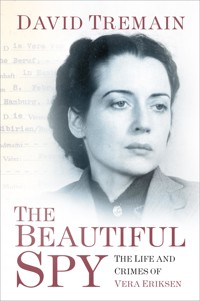
In September 1940 a beautiful young woman arrived by seaplane and rubber dinghy on the shores of Scotland accompanied by two men – one of Germany's many attempt to penetrate British defences and infiltrate spies into the UK. This seems to be one of the few established facts in the otherwise mysterious tale of Vera Eriksen. Even the origins of the woman described as 'the most beautiful spy' remain hazy, as does her ultimate fate. David Tremain delves into the archives, and in doing so begins to reveal glimpses of her fascinating life story: her career as a dancer in Paris; a tumultuous and violent dalliance with a White Russian officer of uncertain identity; her time in England with the Duchesse de Château-Thierry, an Abwehr agent; the suspicious and untimely death of her husband, and a rumoured pregnancy. The Beautiful Spy also grapples with perhaps the biggest mystery of all: what happened to Vera after she was released by the British?
Sie lesen das E-Book in den Legimi-Apps auf:
Seitenzahl: 689
Veröffentlichungsjahr: 2019
Das E-Book (TTS) können Sie hören im Abo „Legimi Premium” in Legimi-Apps auf:
Ähnliche
















To my wife, Evelyn
First published 2019
The History Press
The Mill, Brimscombe Port
Stroud, Gloucestershire, GL5 2QG
www.thehistorypress.co.uk
© David Tremain, 2019
The right of David Tremain to be identified as the Author of this work has been asserted in accordance with the Copyright, Designs and Patents Act 1988.
All rights reserved. No part of this book may be reprinted or reproduced or utilised in any form or by any electronic, mechanical or other means, now known or hereafter invented, including photocopying and recording, or in any information storage or retrieval system, without the permission in writing from the Publishers.
British Library Cataloguing in Publication Data.
A catalogue record for this book is available from the British Library.
ISBN 978 0 7509 9107 0
Typesetting and origination by The History Press
Printed and bound in Great Britain by TJ International Ltd
eBook converted by Geethik Technologies
CONTENTS
Acknowledgements
Author’s note
Abbreviations and Terminology
Introduction
1 A Mystery Unfolds
2 The Red Menace
3 The Importance of Being Ernst
4 Recruitment
5 Vera and the Duchesse
6 A Taste of Freedom?
7 A Stranger Calls
8 The Duchesse’s Circle
9 What Her Daughter Knew
10 ‘The Aliventi Group’
11 Dr Rantzau, I Presume
12 The Mission. ‘A Sullen Dispirited Group’
13 ‘A Boyish Interest in Detectives’
14 ‘Something Particularly Odd’
15 At His Majesty’s Pleasure
16 The Doctor’s Report
17 Walti’s Role
18 The Trial
19 A Breath of Fresh Air
20 The Missing Spy
Appendices
Notes
Bibliography
ACKNOWLEDGEMENTS
All files in the National Archives are © Crown Copyright and are reproduced with permission under the terms of the Open Government Licence. Quotes from Hansard contain Parliamentary information licensed under the Open Parliament Licence v3.0.
Every attempt has been made to seek and obtain permission for copyright material used in this book. In certain cases this has not been possible. However, if we have inadvertently used copyright material without permission/acknowledgements we apologise and we will make the necessary correction at the first opportunity.
The author and publisher would like to thank the following for permission to use copyright material in this book:
Arcade Publishing: Reprinted from Zigzag: The Incredible Wartime Exploits of Double Agent Eddie Chapman by Nicholas Booth, by permission of Arcade Publishing, an imprint of Skyhorse Publishing, Inc.; © Ben Macintyre, 2007, Agent Zigzag, Bloomsbury Publishing Plc; Century, for extracts from Deadly Illusions by John Costello & Oleg Tsarev; Dover Publications for extracts from The Dictionary of Espionage. Spyspeak into English by Joseph Goulden; Henry Hemming for permission to quote emails between him and the author; The History Press, for an extract from The Spy Beside the Sea by Adrian Searle; Giles Milton, for an extract from Russian Roulette; Taylor & Francis, for permission to quote from KGB Lexicon by Vasiliy Mitrokhin; Nigel West, for extracts from Mortal Crimes (Enigma Books), The Crown Jewels (Harper Collins), and Spycraft Secrets: An Espionage A-Z (The History Press), as well as emails between him and the author; Wiley-Blackwell, for permission to quote from Anthony Masters’ The Man Who Was M © Anthony Masters, 1984: All rights reserved. Except for the quotation of short passages for the purposes of criticism and review, no part of this publication may be reproduced, stored in a retrieval system, or transmitted, in any form or by any means, electronic, mechanical, photocopying, recording or otherwise, without the prior permission of the publisher. In addition, to Giselle Jakobs, for information on Vera Eriksen, Peter Miebies for his Dutch translation and Katherine Ritter Wallace for the illustrations of Nikolaus Ritter.
AUTHOR’S NOTE
Unless otherwise specified in the Notes, all quotes and extracts have been taken from files in the National Archives at Kew (TNA). When quoting from these files some minor formatting changes have occasionally been made to ensure the text flows better, and accents added to French and German words where they were missed out in the original text because the typewriters of the time lacked those keys; otherwise, no changes have been made to the original punctuation or spelling. In these files many MI5 documents use the term ‘German S.S’. In this context it is generally meant as a generic name for the German Secret Service rather than Schutzstaffel, the Nazi Party’s intelligence service. Likewise, the terms ‘MI6’ and ‘SIS’ are used interchangeably to mean the overseas branch of the British Intelligence Service. The symbol @ is used throughout to indicate the word alias, as in Theodor MALY @ Paul HARDT.
ABBREVIATIONS AND TERMINOLOGY
Abbreviations
ADDB
Assistant Deputy Director B Branch (MI5)
ADNI
Assistant Director Naval Intelligence
AFS
Auxiliary Fire Service
ARO
Aliens Registration Office
ARP
Air Raid Precaution
B1b
Espionage, Special Sources section (MI5)
B2
Counter-espionage (MI5)
B4a
Section involved with suspected cases of espionage by individuals living in the UK (MI5)
B4b
Espionage, Country Section (MI5)
B5b
Counter subversion (MI5)
BAOR
British Army of the Rhine (post-war)
BdS
Befeldshaber der Sicherungsstreitkräfte der Nord See (BdS.d.N) or der Ostee (BdS.d.O.) – Commander of the security forces of the North Sea (BdS.d.N) or Baltic Sea (BdS.d.O.) (Germany)
BUF
British Union of Fascists
CAC
Canadian Armoured Corps
CAN
Controller, Northern Area (SIS), post-war
CASC
Combined Arms Staff Course
CCG (BE)
Control Commission Germany (British Element)
Cheka
Vecheka (All-Russian Extraordinary Committee to Combat Counter-Revolution and Sabotage), December 1917–February 1922
CID
Criminal Investigation Department
CSDIC (WEA)
Combined Services Detailed Interrogation Centre (Western European Area) (also known as the ‘London Cage’ q.v. MI19)
CSWBL
Central Security War Black List
CX
Reports prepared by MI6 (SIS)
D4b
Port intelligence (MI5)
DPP
Director of Public Prosecutions
DSVP
Director Small Vessels Pool (Royal Navy)
F2c
Responsible for Russian intelligence (MI5)
FAK
Frontaufklärungskommando (Front reconnaissance [spy] command)
FAT
Frontaufklärungstrupp (Front reconnaissance [spy] troop)
FIC
Fellow of the Royal Institute of Chemistry (now Royal Society of Chemistry)
FSB
Federal’naya Sluzhba Bezopasnosti (Federal Security Service) (Russia), 1995 to present
FSP
Field Security Police
FSS
Field Security Section, Intelligence Corps
GAF
German Air Force (Luftwaffe)
GFP
German Feldpolizei
GIS
German Intelligence Service
GPO
General Post Office
GPU
State Political Directorate (USSR), February 1922–July 1923
GSI
General Staff Intelligence
HO
Home Office
HOSI
Home Office Suspect Index
HOW
Home Office Warrant
IB
Intelligence Branch
Inter-ServicesResearch Bureau
Cover name for Special Operations Executive (SOE)
IOM
Isle of Man
IRB
Cover name for Special Operations Executive (SOE)
ISK
Intelligence Service Knox/Intelligence SectionKnox/Illicit Services Knox
ISOS
Intelligence Service Oliver Strachey/Illicit Services Oliver Strachey
KGB
Komitet Gosudarstvennoi Bezopasnosti (Committee for State Security) (USSR), 1954-1991
LMS
London, Midland & Scottish Railway
LRCP
Licentiate Member of the Royal College of Practitioners
MI5
British Security Service
MI6
British Secret Intelligence Service q.v. SIS
MI1a
Part of the Directorate of Military Intelligence in the First World War responsible for distribution of reports and intelligence records; remobilised in 1939 to interrogate enemy prisoners
MI14
A branch of Military Intelligence specialising in intelligence about Germany
MI19
Directorate of Military Intelligence (War Office): branch responsible for obtaining information from prisoners of war (q.v. Combined Services Detailed Interrogation Centre (CSDIC))
MK
Meldekopf (Advanced message centre)
MPD
Metropolitan Police District
MRCS
Member of the Royal College of Surgeons
NASA
National Aeronautics & Space Administration
NCO
Non-Commissioned Officer
NID
Naval Intelligence Division (Royal Navy)
NKVD
Narodnyy Kommissariat Vnutrennikh del (National Commissariat for Internal Affairs), (Soviet Union) July 1934–April 1943
NSDAP
Nationalsozialistische Deutsche Arbeiterpartie (National Socialist German Workers’ Party – Nazi Party)
OC
Officer Commanding
OGPU
Joint State Political Directorate (USSR) July 1923–July 1934
Okhrana
Tsarist secret police
OKW
Oberkommando der Wehrmacht - Supreme Command of the Armed Forces (Germany)
OSA
Official Secrets Act
OSS
Office of Strategic Services (wartime US equivalent of SOE)
OTU
Operational Training Unit (RAF)
P&PO
Permit & Passport Office
PAIR
OSS code name for deciphered German intelligence messages q.v. ISOS
POW or PW
Prisoner of war
PRU
Photographic Reconnaissance Unit
RAF
Royal Air Force
RAFVR
Royal Air Force Volunteer Reserve
RCMP
Royal Canadian Mounted Police
RFC
Royal Flying Corps
RN
Royal Navy
RNAS
Royal Naval Air Service
RNVR
Royal Navy Volunteer Reserve
ROF
Royal Ordnance Factory
RSLO
Regional Security Liaison Officer (MI5)
SCO
Security Control Officer (MI5)
SD
Sicherheitsdienst (SS intelligence service)
SIME
Security Intelligence Middle East
SIS
British Secret Intelligence Service q.v. MI6
SO (I)
Staff Officer Intelligence (RN)
SOE
Special Operations Executive
SOS
School of Oriental Studies; now SOAS (School of Oriental & African Studies, University of London
SS
Schutzstaffel (Security Service of the Nazi Party); also German Secret Service
SVR
Sluzhba Vneshney Razvedki (Foreign Intelligence Service) (Russia), December 1991 to present
VB3
MI6 counter-espionage section that dealt with France, Corsica, Andorra and the Benelux countries (Belgium, the Netherlands, Luxembourg)
W/T
Wireless Telegraphy
WIR
Worker’s International Relief (Comintern organisation)
WRC-1
War Room Registry (MI5). WRC was the Assessments Section; WRC1 dealt with officers and agents of the old Abwehr I and III
WRNS
Women’s Royal Naval Service
X-2
Counter-espionage branch of OSS
Abwehr Abbreviations
Abt
Abteilung (Abwehr branch)
AO
Auslandorganisation; also Abwehrofficizier (Abwehr)
Ast
Abwehrstelle (Abwehr station)
Branch I
Espionage
G False documents, secret inks
H Heer (Army)
I Communications
L Luft (Air)
M Marine (Navy)
Wi Wirtschaft (Economics)
Branch II
Sabotage
Branch III
Counter-espionage
Ic
Third general staff officer (Abwehr) c.f. AO
KO
Kriegsorganisation (War Organisation), Abwehr in allied and neutral countries
Terminology
Accommodation address ‘A location where an agent can receive mail, even though he does not reside there or have any visible connection with anyone who does.’*
Cut-out 1. ‘The go-between, or link, between separate components of an intelligence organization – for instance, the person who maintains contact with a clandestine agent on behalf of the handler controlling him.’* 2. ‘An intermediary designed to eliminate the risk of direct contact between two members of an espionage ring is known as a cut-out.’‡
Double agent 1. ‘A person who goes to work for one secret service and then changes his allegiance to a rival.’* 2. ‘When a spy consciously betrays his (or her) controller and collaborates with an adversary to deceive the original employer, that person has become a double agent.’‡
Establishing bona fides ‘The use of recognition signals that enables agents unknown to one another to meet and establish contact.’*
Illegal 1. ‘An intelligence agent who operates in a target country without the benefit of official status.’* 2. ‘Agents operating outside the protection of diplomatic immunity are generally known as illegals, although the term is usually employed in connection with Directorate S of the KGB’s First Chief Directorate.’‡
Kriegsorganization (KO) War Organisation; Abwehr in allied and neutral countries e.g. Switzerland, Spain, Portugal.
Nansen passport Named after Fridtjof Nansen the Norwegian explorer, a Nansen passport was an internationally recognised travel document first issued by the League of Nations in 1922. It was issued to 800,000 Russians who had become stateless after their citizenship had been revoked by Lenin.
Rezident 1. ‘An intelligence officer who is appointed to head a residency by decree of the central apparatus.’(Soviet Union/Russia)†; 2. ‘The senior intelligence officer in a Soviet or Russian rezidentura is known as the resident, and is the equivalent of a chief of a CIA station, or a British SIS station commander…’‡
Sleeper agent ‘An agent put into a circumstance or situation where his sole job is to wait until it becomes possible to actively gather intelligence, regardless of the length of time required.’*
Talent-spotter 1. ‘A deep-cover agent responsible for spotting persons who are suitable recruits for intelligence work.’* 2. ‘An agent who identifies and recommends a potential candidate for recruitment is known as a talent spotter.’‡
Triple agent 1. ‘A triple agent pretends to be a double agent for one side, while he or she is truly a double agent for the other side.’ 2. ‘A double agent is said to have become a triple agent in two circumstances: either an agent is despatched originally with the purpose of becoming a double agent for an adversary, yet retaining the original loyalty; or a double agent finds a means of alerting their original employer to the fact that they are now operating under the enemy’s control.’‡
Walk-in 1. ‘A person who volunteers their services to an espionage agency’ [usually off the street], or, ‘an agent who works for three intelligence services but is usually truly loyal to only one of them.’ 2. ‘An intelligence source who makes direct contact with a diplomatic mission to deliver a pitch is known as a walk-in.’‡
Sources
* Goulden, Joseph, The Dictionary of Espionage: Spyspeak into English (Mineola, NY: Dover Publications, 2012). Reproduced with permission of the publisher.
† Mitrokhin, Vasiliy (ed), KGB Lexicon: The Soviet Intelligence Officer’s Handbook (London; Portland: Frank Cass, 2002), p.120. Reproduced with permission of the publisher.
‡ West, Nigel, Spycraft Secrets: An Espionage A-Z (Stroud: History Press, 2016). Reproduced with permission of the publisher.
INTRODUCTION
Who is Silvia? what is she,1
Often described as ‘The most beautiful spy’, Vera Eriksen could almost rival First World War spy Mata Hari and the various ‘Bond girls’ who followed her. Indeed, she is perhaps the archetypal ‘femme fatale’ of the Second World War spy, but her story is perhaps less well-known than perhaps it should be. Like most spies, nothing about her background is clear-cut, or straightforward. Many of the facts surrounding her life are contradictory; some are speculation, or simply fantasy; the rest have been expunged from her official MI5 files; and few can be verified absolutely, making it difficult to discern which are true and which are not, and who is telling the truth. Indeed MI5 often referred to her as ‘a confirmed liar’. To paraphrase Shakespeare in Two Gentlemen of Verona), ‘Who is Vera, what is she?’ Or more correctly, ‘Who was she?’ She is perhaps best summed up by Winston Churchill’s oft-quoted remark about Russia, ‘… a riddle, wrapped in a mystery, inside an enigma.’
In many ways, in spite of her involvement in espionage she also comes across as a somewhat tragic figure who was yearning for a lost love. When she set out on her spying mission in September 1940 her husband had just been killed, albeit accidentally by one of her fellow conspirators. Yet was he the love of her life or someone else? Her story is one shrouded in mystery and intrigue, and clouded by the mists of time. Even her fate at the hands of British Intelligence is contentious. Had they employed her against the Russians after the war? If so, for how long, and under what name? This seems implausible since, as we shall see later on, in captivity she became disillusioned and vowed to ‘get out of the racket’. Another theory is that after the war she disappeared to the Isle of Wight, remarried, and became a grandmother. All of this is conjecture, with no hard evidence to prove it. Yet another theory states that she died in Lancashire in 1978 having worked for MI6 after the war.
The young, attractive, Garbo-esque woman shown in photographs taken for her MI5 file the day after she was captured conjure up a number of adjectives to describe her: hauteur; aloof; nonchalant; ennui; wistful. One author goes so far as to say, ‘she oozes the sexuality that seems to have been a notable feature of her life up to the 1940s and transcends the tiredness and anxiety all too obvious in those images.’2 Nikolaus Ritter, the Abwehr officer, also known as ‘Dr Rantzau’, who was to play an important part in her career as a spy, summed up her attractiveness to men in his memoirs Deckname Dr. Rantzau written in 1972, saying that she was ‘one of our most remarkable and beautiful female agents. There was hardly a man who was not entranced by her.’3 Part of that entrancement was undoubtedly due to the aura of mystique that surrounded her. She was Slavic, had good looks, and was mysterious; in its day that was enough to get men’s pulses racing. However, Ritter’s affection for Vera was not reciprocated; she disliked him, for reasons we shall discover later. Remarkable, she may have been, but how successful was she as a spy?
A German film made about her in 2013, starring German actress Valerie Niehaus, had Vera portrayed as a prostitute blackmailed into spying for the Germans. While Vera was undoubtedly blackmailed, there is no evidence available to suggest that, unlike Mata Hari, she was promiscuous or ever indulged in the world’s oldest profession. If anything, she was exploited by the various men with whom she came into contact. And the circumstances surrounding her recruitment into the world’s second oldest profession are much more fascinating. Had the film been made during the first half of the twentieth century, Ingrid Bergman would have been the obvious choice for the lead role, or perhaps even Garbo herself.
Trying to make sense of Vera’s story sometimes became a challenge, but hopefully, as we wend our way through it, all will start to become somewhat clearer. It is by no means a fait accompli, but is it ever possible to know the whole truth in a spy case? Hopefully, as time goes on more information will be released that will settle once and for all what the truth is. In the meantime, this is my account of her story as far as it is known.
David Tremain
Ottawa, 2019
1
A MYSTERY UNFOLDS
Our main protagonist Vera Eriksen (sometimes spelled Erikson or Erichsen) should not be confused with My Erichsson (real name Josephine Fillipine Emilie Erichsson), whose case will be examined later, and who also plays an integral part in Vera’s story. Three people who are inextricably linked to Vera’s life are Hilmar Dierks and Nikolaus Ritter, both operating under a variety of aliases for the Abwehr, and who also appear in accounts of other spies employed by them during the Second World War; the third is the Duchesse de Château-Thierry, a faded member of the European aristocracy.
Vera was born Vera Schalburg (sometimes spelled Shalburg, Schalbourg or von Schalburg), in Barnaul, Altai, Siberia, near the Chinese border on 23 November 1912, although another source claims it to be 10 December.1 The discrepancy in the date might be explained by the use of either the Gregorian or Julian calendar, except this being the case, the date should have been 6 December, there being thirteen days difference between the two of them. During an interview with MI5 on 1 October 1945 Hilmar Dierks’ brother Gerhard, who had been Leiter in Meldekopf Leer (Grenzgangerorganization) of the Abwehr,2 claimed that she had been born in Kieff (Kiev) on 10 December 1912 and was the adopted daughter of August Schalburg and his wife née Staritzky (to be correct it should be Staritzkaya), but there is no indication of who her natural parents might have been, or even if she was illegitimate, as has been suggested. In a document in her MI5 file entitled ‘Summary of Information Obtained from Vera Eriksen’ (no date),3 Vera also claimed this to be the case. The report states that:
Her origin is something of a mystery, and her parentage doubtful. It is evident that she is partly non-Aryan. She claims that her parents’ name was STARITZKY, and that she was adopted in Russia by Russians of German origin called Von Schalbourg, who left that country at the time of the Revolution in 1918 and settled in Denmark where they assumed Danish nationality.4
An article written by Günther Stiller that appeared in Hamburger Abendblatt on 11 August 2011 claimed that Vera was born in Riga to a Tsarist admiral.5 This myth appears to have been first perpetrated by Ladislas Farago (Faragó Ládislás), the Hungarian military historian, who claimed her real name was Vera or Viola de Witte, ‘the daughter of a Baltic aristocrat and Tsarist naval officer’.6 The claim was perpetuated by former OSS agent Tom Moon, who described her as a ‘beautiful Nordic blonde … daughter of a Russian naval officer who died fighting the Bolsheviks’.7 The idea that Vera was a ‘beautiful Nordic blonde’ was continued by renowned author and expert on cryptography David Kahn in his monumental book on German military intelligence, Hitler’s Spies. He refers to her as ‘the classic woman spy … whose name was given as Vera de Schallberg’.8 Vera was not blonde, and, as we shall see, Farago made other dubious claims about her that were also ill-informed.
An MI5 report dated 24 February 1942 by Agent U.35 (of whom more later) shows that Vera had initially refused to tell them where she was born, but when Agent U.35 pointed out to her that her Russian accent suggested that it originated between Warsaw and Kieff, she said it was Kieff (Kiev). The report adds that her reticence in revealing her birthplace may have been due to the fact that she was ‘not pure Russian, but partly “non-Arian”’ [sic]’, implying that she was actually part-Jewish. It concluded that this may have been a cause for the German Intelligence Service to blackmail her, and also for the attitude of her second husband, von Wedel (Dierks) towards her. However, nothing so far has been uncovered to confirm that she may have had Jewish heritage. Other facts gleaned from the report were her extensive knowledge of music; that she was well-versed in history and literature; her knowledge of Latin; her ability to speak, read and write five languages (Russian – her mother tongue, German, French, Danish and English); and the impression that she was ‘an intelligent Russian girl of an upper middle class fami[ly] with a sound and thorough education’.9
Vera’s father, August Theodor Schalburg, born on 6 July 1879, and who died 25 October 1964 in Gentofte, Copenhagen, was a half-Russian, half-Danish export merchant. One source claims he was a dairy farmer, another that he was the manager of Sibirisk Kompagni, a Danish company involved with agriculture and forestry in Russia and Siberia. Her mother, Elena Vasiljevna Staritzkaya Siemianowskaya, born 11 July 1882 in Poltava, Ukraine, and died 25 June 1962 in Gentofte, Copenhagen, was half-Russian (Ukrainian), half-Polish, from the ‘Army officer class’.
Even the information about Vera’s immediate family is contradictory. She had two brothers, Christian Frederik (her MI5 file suggests his name was actually Constantine), born in 1906, and the youngest, August, born in 1909. However, a Registry document in the Copenhagen State Archives dated 1920 gives her father August’s birthplace as Nyborg; her mother’s date of birth as 24 July 1882 (listed as Helene, the anglicised version of Elena); her brother Christian’s as 13 April 1906; her brother August’s on 13 August 1909 (yet another document gives the date as 15 August); and Vera’s as 23 November 1907.10
When the Russian Revolution broke out in October 1917 Vera’s family fled St Petersburg for Copenhagen, having lost everything. Her uncle, Ernst (or Ernest) Schalburg,11 told John Day of MI5’s B1b that this was between 1917 and 1918, but Vera contradicts this by saying that they left in 1919. Given their bourgeois background it seems more likely that Ernst’s information is correct, and not Vera’s. What is known is that, as of 1 November 1921, Vera, her father, and her brother Christian were living in Vibevej, Copenhagen, and at Borups Allé 4, Copenhagen, as of 1 May 1923, which concurs with the Copenhagen State Archives’ document.12 Strangely, the document on the Danish website does not mention her mother or her younger brother August, and neither does the Geni website.
Other information about Vera’s background came from Major Geoffrey Wethered of B1b on 30 September 1943 when he commented to Edward Blanchard Stamp, also of B1b, that, ‘It looks to me that the S.O.E. report from Sweden is founded on some sort of misapprehension.’ Writing to Stamp again on 25 October 1943, Wethered referred to the SOE report of 21 September 1943 (listed as 143a):
The position seems to be that Mrs. Vera COLLIN, referred to in the report from Denmark at 143a is a family connection of Vera ERIKSEN. The relationship seems, from the information on the last page of this file, to be that Vera ERIKSEN’s uncle, Ernst SCHALBURG, had a sister, Ellen, who married William KNUDSEN. Ernst Sergei SCHALBURG-KNUDSEN is described as Mrs. COLLIN’s brother. It therefore seems probable that Ernst and Vera are children of the marriage between Ellen SCHALBURG and William KNUDSEN. As far as I can disentangle this it seems that as if Vera ERIKSEN and Vera COLLIN are first cousins by marriage.13
The report from Denmark (143a), addressed to Wethered from an unnamed source in SOE, refers to Richard Olsen of the ‘contre-espionage branch of the Danish Police now in Sweden’ who sent it to SOE:
Dr Osier of Copenhagen,14 who together with several others was arrested by the Germans, has stated in confidence that the information which was supplied to the Germans could have emanated from only one source, namely, Fru [Mrs] Vera Wedel, nee Schalburg who according to him, is now in England.
Within informed circles in Copenhagen, there has been talk of a leakage in England, perhaps this is the solution to the riddle:
Several months ago, there was in Copenhagen, a German by the name of Wedel, this man was described as a German master spy. Perhaps there is a certain connection between these two people … Please note that the woman mentioned in the report, Fru Vera Wedel, is stated to be born ‘Schalburg’. This woman may be Mrs. Vera Collin of ‘Heathcote’, East Grinstead, Sussex, who may be a German agent. Her name has been given as a reference by two recent arrivals in Denmark, namely:
a) Ernst Sergei Schalburg-Knudsen, a Kornet [Second Lieutenant] of the 3rd regiment’s (infantry) ‘Kanoncompagni’. This man admits to being related to the late Von Schalburg of Frikorps Danmark. [see below]
b) Vagn Holm, a Lieutenant of the Danish air force.15
However, the veracity of the SOE report must be questioned when it asserts that, ‘Several months ago [in 1943], there was in Copenhagen, a German by the name of Wedel, this man was described as a German master spy.’ It could not have been Hilmar Dierks, also known as von Wedel, because by that time he was dead and Vera was in custody in England.
Originally the two Veras (Eriksen and Collin) were thought to be identical but a letter to Wethered on 23 October 1943 from Major Grassby, the MI5 Regional Security Liaison Officer (RSLO) in Tunbridge Wells, referring to a report received from the Sussex Police, stated, ‘it appears that this woman is definitely not identical with Vera ERIKSEN’. The Sussex Police report forwarded by the Assistant Chief Constable, No.1 District, Lewes on 22 October, provides further background on Ellen Vera Collin (née Knudsen) and confirms that she had been born in Denmark on 13 November 1912 and was married to Dr John Olaf Collin sometime in early 1939. He died in 2000 and his wife Ellen in 2001. Their son is now a Harley Street ophthalmic surgeon.16
In Copenhagen Vera’s brother, August, joined his father’s business; little else has been recorded about his life. On the other hand, Christian Frederik joined the Danish Free Corps, and later in 1935 the Royal Danish Life Guards. There he was described as ‘unstable and for the army possibly a dangerous man’. Meanwhile, in the Russian Orthodox Alexander Nevsky church in Copenhagen on 18 October 1929 he married Baroness Helga ‘Helle’ Friderikke von Bülow, the daughter of Friederich August Heinrich Freiherr von Bülow and Frederikke Hedevig Christiane Damm. Helga was born on 2 February 1911 in Wilhelmshaven and died in 1995 in Hillerup, Denmark, although a website states that she died in Frederiksborg Amt, Norsjaelland.17 Her Wikipedia entry describes her as a Danish-German Nazi. A declassified CIA document suggests that, according to X-2, the counter-espionage branch of the OSS, forerunner of today’s CIA, a relative of Helga, Baroness Fritze von Bülow, worked as an agent for the SD (Sicherheitsdienst), the intelligence arm of the SS:
BULOW, Baroness Fritze von. Dane. Important Sicherheitsdienst agent, living in a well-furnished flat. Employs sub-agents and possesses a direct telephone line to Sicherheitsdienst H.Q. at ‘Dagmarhus’. Makes periodic journeys to Germany. Is thought to be relative of Schalburg’s wife whose maiden name was von Bulow. Born about 1900. Attractive. Address: Fridtjof Nansens Plads 8, 2nd floor, Copenhagen. Note: Two branches of von Bulow families, the Danish and German. Baroness is German. The Danish branch is patriotic.18
According to Vera, Helga von Bülow had lived in Denmark since she was 4 and was ‘really more Danish than German’. Helga and Christian’s son, Aleksander, was born on 22 November 1934 and died in 2006. His god parents were the Grand Duchess Olga Alexandrovna Romanova of Russia (1882–1960), sister of Tsar Nicholas II and youngest daughter of the late Tsar Alexander III, and her second husband, Nikolai Alexandrovich Kulikovsky (1881–1958). Kulikovsky’s name would come up later during various interrogations of Vera by MI5.
In September 1940 Christian joined the Waffen-SS and served in the 5th SS Panzer Division Wiking as an SS-Hauptsturmführer (captain). It has been suggested that Christian had joined the SS to avenge the gang rape of his sister Vera by the Bolsheviks when she was 6 years old, which he had been forced to watch whilst tied to a chair.19 Whether this was in fact the case cannot be verified and has not been referred to anywhere else, certainly not by Vera, but the obvious embarrassment and stigma of such an act inflicted on her may explain her reticence. Christian was killed by Russian shrapnel on 2 June 1942 during an attack on the Demyansk Pocket, near St Petersburg. That same day Himmler posthumously promoted him to Obersturmbannführer (lieutenant colonel). Afterwards, a medal, the Schalburgkreuz, worn by officers, NCOs and enlisted men, was struck to commemorate his death.20 At Himmler’s instigation the name of the Germanic-SS was changed to Schalburgkorps in his honour, something to which Helga initially agreed but later regretted.
In Vera’s own words, the family moved from Copenhagen to Paris in 1929, where she studied dance under the great Anna Pavlova in the Trefilova Company.21 Once again, Vera’s account conflicts with that of her uncle Ernst, as well as Gerhard Dierks, who both said that her family moved to Paris in 1924. Yet in the undated MI5 report referred to earlier (‘Summary of Information Obtained from Vera Eriksen’), she contradicted herself yet again by stating that she had moved to Paris in 1927. For seven years she ‘led a somewhat vivid life as a ballet dancer’, performing classical and acrobatic dancing at the Folies-Bergères and with the Russian Opera at the Théâtre des Champs-Elysées. Whether she actually met Serge Diaghilev as has been claimed largely depends on whether she had been in Paris from 1924 onwards as Diaghilev died in Venice in 1929.
One person with whom Vera was aquainted in Paris was the Abkhazian Prince, Aleksandr Konstantonovich Chachba-Shervaschidze (1867–1968) (written as Chervachidze in her file), who worked in Paris from 1920 to 1929 as a scene painter for Diaghilev’s Ballet Russes. A note in her file states that, ‘Vera danced with him. Probably the Montecarlo [sic] gigolo. Vera showed some interest in his and his wife’s whereabouts.’22
A letter dated 16 March 2001 from Vera’s 84-year-old sister-in-law Regna Schalburg – this must have been August’s wife, as Christian’s wife had died in 1995 – has appeared on a website created by Michael Dierks, the grandson of Hilmar Dierks, and purports to shed some light on Vera and her life as a dancer:
Dear [Redacted, but obviously Michael Dierks]
Thank you for your letter and for the articles which I found very interesting. But I still not understand why your great interest in the family Schalburg. Has it got to be a sport[?] for you?
I [don’t] have any photo of August or the rest of the family and I don’t know anyone who has.
Vera had a wishfull [sic] thinking of being a ballerina, and therefore got an agreement with Pavlova and another ballerina about teaching her, but the both died [sic].
Therefore she came to the balletmaster Diaghilev (how to spell it)? and that was the beginning of her remarkable destiny! Because he sold her to the Communists and under threats again her family and herself she was forced to work for them. She got small threating [sic] letters and once in the Metro[?] they stabed [sic] a knife in to the back for getting her to obey them. Every night after dancing her brother August escort her home after this treachery. Diaghilev’s little girl became lamb [lame?] in both her bones and yet Vera took care of her. She was a very good young girl! First she danced on ‘Folies Bergeres’, but Mistinguette was jealous and spite [?] her off, and so she went to ‘Moulin Rouge’.
As anyone could help her to get rid of the Communists her brother Christian managed to send her in Germany with an orderly, but there she fell in love with an submarine captain [sic] and got pregnant. However she sailed to Schotland [sic] and you know the rest. This history was what August told me and I hope you are satisfied! This is the first letter in English I have wrote since I was 21 years old so please forgive the … [letter ends]
Yours sincerely,
Regna Schalburg [sic]23
The information in this letter must be treated as somewhat unreliable, in part by Regna’s own admission that her English was not good, so some things may have been lost in translation, and also old age. Other inaccuracies are:
1. Regna implies that it was Diaghilev who ‘sold her to the Communists’, yet the new Bolshevik regime regarded him as an ‘insidious example of bourgeois decadence’,24 so she must be mistaking him for Ignatieff (see below).
2. Exactly when Vera first went to Germany is unknown. As we shall see in Chapter 3 the most likely contender for the identity of this submarine captain is Hans Meissner, who was a submarine commander during the First World War, known to have met Vera in Copenhagen in 1940, but had she known him before? According to a document produced by CSDIC in 1945, he had re-joined the Kriegsmarine in 1933 when he was recalled to active service. He was also later at Ast Angers in France. It is quite possible that Regna Schalburg’s memory is confused and she is actually referring to Vera’s meeting with him in 1940.
3. There is no reference in any of her files that Vera became pregnant by Meissner, although she was supposed to have been pregnant by von Wedel (Dierks).
4. Meissner’s file shows that in 1926 he married Anneliese Osterroth, who gave birth to a son on 30 August 1928.25 He was still married to her in May 1945 as they went on a trip to Lucerne on the 15th, where he was arrested by Swiss police. Obviously this does not preclude his having had a little dalliance with Vera, if indeed it was him.
Vera’s parents were still ‘hopelessly poor’ and most likely she was the main source of income. Her uncle Ernst managed to get his brother August a job in Brussels as a representative of Danish Agricultural Interests. But it seems that the concept of Vera being, if not a prostitute, a woman of loose morals, persisted when Farago wrote with far too much dramatic licence:
While she was still in finishing school she became infatuated with a much older Frenchman, and when her mother refused to permit her to marry him, they eloped … Abandoned by her French lover, she was left to the not inconsiderable resources of a beautiful and charming young woman with a seductive air. But somehow Vera felt more comfortable in the gutter than in the drawing rooms. She drifted from bed to bed, danced in shabby cabarets, and lived with a succession of squalid swains in the wretched poverty of the Montparnasse slums.26
Given that Vera’s parents were ‘hopelessly poor’, it is unlikely that she would have attended a finishing school, most of which tended to be (and still are) in Switzerland, and expensive. Exactly who this ‘much older Frenchman’ was whom she had supposedly met while still at finishing school Farago does not mention, nor is he identified in any of her MI5 files, so it is doubtful whether he existed. Neither is it clear when Farago mentioned ‘a beautiful and charming young woman with a seductive air’ whether he was actually referring to Vera herself or some other, possibly Mistinguette – Jeanne Florentine Bourgeois (1875–1956), a French actress and singer who appeared at the Casino de Paris, Folies-Bergères and Moulin Rouge – referred to in Regna’s letter. That Vera could be seductive is highly plausible, but at this point she probably did not have ‘inconsiderable resources’; nor is it likely that she slept around with ‘squalid swains’ in the beds of Montparnasse or any other part of Paris.
Farago claimed that one of these so-called ‘swains’ was making a living ‘as an Apache dancer in a basement café on rue de Champollion, but was in fact a political agent of the Soviet secret police, spying on White Russians in France’.27 This café must have been the Théâtre des Noctambules, established by Martial Boyer in 1894, at 7 rue Champollion in the 5th arrondissement (Latin Quarter). Farago then claims that Vera became a GPU agent under the tutelage of this ‘double-barrelled pimp’ who later tried to kill her in Brussels. To use the term ‘double-barrelled’ implies that he had a hyphenated surname, but no one recorded in Vera’s files meets this description. The only one having a double-barrelled name was Prince Aleksandr Konstantonovich Chachba-Shervaschidze. There is no evidence to suggest that it was he who tried to kill her.
In the rest of his account of Vera and the Duchesse de Château-Thierry, Farago manages to confuse Vera Erikson with My Eriksson, claiming that they were one and the same, as well as claiming that ‘Château-Thierry’ was a code name Ritter had assigned to the Duchess Montabelli di Condo. Brian Simpson, in a footnote in his book about detention in wartime, also repeats Farago’s allegation, but notes ‘there is no such Duke or Duchess’.28 It is unclear to which Duke and Duchess Simpson is referring, but it must be assumed to be that of Montabelli di Condo, as there is documentation in Château-Thierry’s MI5 file on her late husband’s title. I have been unable to find any such Duchess Montabelli di Condo. Simpson also ponders on the identity of My Eriksson, suggesting that she may have been the Countess Costenza (see Chapters 7 and 8), which, as we shall see, she was not.
What is known is that while Vera was in Paris she met a White Russian officer whom she knew as Ivan Ignatieff. He styled himself a count and was also referred to as ‘Petersen’. How she met him is not known. However, he does not appear to be the same person to whom Farago referred. In the indictment of Walti and Drueke (of which more later) it was stated that in 1930 Vera had married a certain Ivan Ignatieff, a Russian with a Nansen passport who was posing as a White Russian but who was in fact a ‘Red’ Russian. An anonymous, heavily redacted report in Vera’s file states that it was in 1930 that she:
became associated with and married one IGNATIEFF, an unscrupulous blackguard, who appears to have had a strange hold over her. This man was not only engaged in espionage on behalf of the Soviet [sic], but also in dope trafficking and was himself a drug addict. He appears to have introduced Vera to the drug habit, but she never became enslaved to it. He used her as a courier in connection with his espionage, and she used to travel round the capitals of Europe, carrying messages on his behalf. Although she only lived with him for one year, her association with him lasted for six, and terminated in 1936 in his stabbing her near the heart in a fit of jealousy. The sordid realities of this glamourous romance have not been fully explored and there is doubt as to whether IGNATIEFF may not still be alive.29
What this Svengali-like hold Ignatieff had over Vera was, and what provoked the jealous rage that caused him to stab her, will be examined shortly.
Farago makes reference to Vera’s stabbing when he refers to her bumping into Drueke ‘in a sleazy nightclub near Place Pigalle in time to rescue her from a dreadful liaison when her lover, a South American gigolo, stabbed her in the chest in true Apache fashion’,30 whatever that is supposed to mean. As we shall see later, there is no record of her meeting Drueke in Paris, nor any mention of a ‘South American gigolo’.
Ignatieff’s true identity has been cause for speculation and not entirely resolved, nor made easier by the name ‘Petersen’, which contributed to this confusion. In a note in Vera’s MI5 file dated 7 August 1941, R. Pilkington, the head of F2c, responsible for Russian intelligence and the Communist Party, concluded in discussion with Dick White, the Assistant Director of B Division, that it would be pointless interviewing her about Ignatieff, as she was:
a confirmed liar and there is not in any case any suggestion that she worked for the Russians against this country or has any knowledge of Soviet espionage activities here. It would seem that her work for the Russians in Paris ended at least seven years ago.31
Various people speculated on who Ignatieff might be. On 9 October 1940 Millicent Bagot of MI5’s B4b, which dealt with Soviet affairs – she is often said to be the model for John le Carré’s Connie Sachs – suggested four possible candidates for Ignatieff:
1. IGNATIEFF, Count Alexis, born Petrograd 18.2.77 formerly Military Attaché at the Russian Embassy in Paris under the Tsarist regime, subsequently in 1933 Soviet Military Attaché in Paris and in charge of Soviet espionage and Comintern work.
2. PETERSEN, Peter, aged 40 in November, 1938, Danish who was arrested at the end of 1938 in connection with the PFLUGK-HARTTUNG [sic] espionage case,32 and was connected with the German espionage system working against Britain, France and the U.S.S.R. in Denmark.
3. PETERSEN, Henry, German, reported in 1935 to be the courier in contact with Martha and Charlotte SCHOLZ of the Strasbourg Soviet Espionage Case.
4. PETERSEN (no initial) of Holsteinhasse 7, Copenhagen who was reported in February, 1940, to be connected with Soviet S.S.33
Gerhard Dierks claimed that Ignatieff was Sergei Ivanovitch Ignatieff, ‘an unscrupulous rogue engaged in drug traffic and espionage for the Soviet government’. A Count S. Ignatieff is listed as being a captain in the Imperial Russian Guards. Although no date is offered for this post, it must be pre-Revolution (i.e. before October 1917), so he is unlikely to be the same one as claimed by Gerhard Dierks.34 A report from B4b to Dick White, dated 17 October 1940, suggested that Ignatieff:
1. May be identical to Count Alexis IGNATIEFF who went over to the Soviets and worked for the G.P.U. in Paris 1937, or –
2. He may be Theodor MALY @ Paul HARDT @ PETERS @ PETERSON @ MANN.35
However, the suggestion that Ignatieff was Theodore Málly (1894–1938) @ PETER @ PETERSON @ Paul HARDT @ Fjodor @ Der Lange (‘the tall one’), just succeeds in muddying the waters even more. The claim is not supported by any other information in the literature or MI5 files currently available, nor do they make any connection between Vera and Málly. When Vera was shown a photograph of ‘Paul Hardt’ on 30 October 1940 she failed to identify him as the man she had known as Ivan Ignatieff, although the two men were about the same age (47/48). There are many reasons why Ignatieff could not have been Málly/Hardt, which will shortly become apparent.
2
THE RED MENACE
Theodore (Téodor) Stephanovich Mály (or Málly) was born in Timişoara, Hungary (now Romania) in 1894. He would later go on to control for a time the ‘Cambridge Five’ – Kim Philby, Guy Burgess, Donald Maclean, Anthony Blunt and John Cairncross – before being recalled to Moscow and murdered during one of Stalin’s purges. ‘Paul Hardt’, one of his adopted aliases, was apparently born in Odenburg, Austria, on 21 January 1894, according to his registration card for 5 April 1937 in his MI5 file. This file also gives his (Hardt’s) wife’s name as Lydia, née Koch, born in Sereth, Austria, on 18 December 1906, which is also borne out by the date on her registration card of 5 April 1937. Nigel West and Oleg Tsarev’s book The Crown Jewels says she was his second wife and gives her name as Lidya Grigorievna (Lifa Girshevna) Razba, born in Riga in 1906.1 Hede Massing described her as a Russian Jewess. Málly’s true nationality, Hungarian, was confirmed by Percy Glading,2 Walter Krivitsky, Hede Massing, Margarete Charlotte Moos @ Jacoby,3 and Elsa Bernaut, the widow of Ignace Reiss.4 In 1923 Málly’s wife gave birth to a son, Theodore Theodorevich. William Duff, Málly’s biographer, writes, ‘Nothing is known of his wife and very little of his son.’5 This concurs with West and Tsarev.
Margarete Charlotte Moos née Jacoby (or Jacobi), also referred to as Lotte, was a petite brunette (she was 5ft 2½in), born in Berlin on 9 December 1909, who became a naturalised British subject on 15 September 1947. On 14 October 1932 she married Siegfried Moos, 5ft 10in with brown hair, born in Munich on 19 September 1904, who became a naturalised British subject on 9 September 1947. The couple had fled Germany, first to Paris in July 1933, then to London in December 1933, as Jewish refugees from Germany after Hitler had come to power. A note on Siegfried in Margarete’s MI5 file states that he was wanted by the Gestapo.
In April 1937, Siegfried, described as a university lecturer and statistician, had hoped to undertake economic research in conjunction with the Department of Social Biology at the London School of Economics. He had previously been working on the staff of the London office of the New York Times in the News Photographic Continental Service. Later he worked at the Institute of Statistics at Oxford University under the British economist Sir William Beveridge, best known for the ‘Beveridge Report’ on the post-war Welfare State written in 1942.
Described as ‘a scholar of International Student Service’ and a poet and playwright, Margarete had been studying at University College, London, and at the Institute for Slavonic Studies. She also hoped to enroll on an interpreter course at the Regent Street Polytechnic. She had first come to MI5’s attention in February 1934 when she had stayed with Robert McKinnon Wood, a principal scientific officer then working at the Royal Aircraft Establishment at Farnborough who was described as an ‘ardent Communist’. During the First World War McKinnon Wood had been sent by the Royal Aircraft Establishment to Göttingen, Sweden, to Ludwig Prandtl’s laboratory to study his wind tunnel experiments on the aerodynamics of airframes. Margarete and Siegfried separated in 1935, although they got back together again later as their daughter, Merilyn Anne, was born on 28 June 1944. This separation, according to Siegfried, was:
entirely due to my attitude. I could not get accustomed to refugee life … I therefore separated from my wife, against her will. It was my neglect which drove her to loneliness and despair and made her thankful for the friendly attitude of Mr. Verschoyle who was a common friend of us and who I esteemed very much.6
At the time of their arrest and internment in 1940, ‘strongly suspected of espionage on behalf of a foreign power’, the Home Office Warrant gave their address as 159 Banbury Road, in the Summertown area of Oxford. Another resident of the house was Isabel Judith Masefield, the daughter of writer and Poet Laureate John Masefield and illustrator of his book The Box of Delights. Margarete was arrested on 11 April 1940 and sent to Holloway, then transferred to Rushen Camp on the Isle of Man on 7 June 1940; Siegfried was interned on 29 June 1940 but released on 23 August 1940 ‘as a useful alien’; he returned to 159 Banbury Road.
The reason for Margarete’s internment was that she had been suspected of being an OGPU agent. This was confirmed in a note in her MI5 file by Jane Archer: ‘KRIVITSKY has told us that he is convinced that Margaret MOOS is a member of the Ogpu [sic], and he considers that she is very important.’7 She was also a close friend of Brian Goold-Verschoyle (1912–42), code-named FRIEND, whom she had met at a German class in November 1934 and with whom she later began an affair. She admitted to MI5 that she had been co-habiting with him ‘at a time when we know him to have been acting as an Ogpu agent in this country … She admits visiting Russia with GOOLD-VERSCHOYLE and that she had in the past herself indulged in political activity.’8
Her MI5 file goes on to note, ‘We would have been prepared to permit this woman’s release on restrictions, but as Category B. are now all interned, we see no alternative but for her to remain in internment during the present crisis period.’9
Various appeals for her release had been launched, by McKinnon Wood, and one by the MP for Oxford Quintin Hogg, later Baron Hailsham of St Marylebone. Siegfried had applied to the Home Office for his wife to be released ‘on the ground that the Home Sec. had held out the prospect of interned wives being treated with special consideration where the husbands in Cat. C have been released’. On 17 September Kathleen (Jane) Archer of MI5, writing to the Home Office on behalf of MI5, expressed, ‘We have no objection to the release of Margarette Charlotte MOOS [sic].’ She was released on 8 October 1940 and went to live at 10 Wellington Street, Oxford, according to an entry on internees on the Isle of Man. A letter in her MI5 file to ‘Jasper’ Harker of MI5 from the Chief Constable of Oxford City Police, Charles R. Fox, refers to it as Wellington Square. Both street and square exist; exactly which is immaterial to this story of Vera, but for our purposes the police account is taken to be more accurate.
Goold-Verschoyle was a member of the Communist Party of Ireland (he was born in County Donegal), and while in London between 1935–36 was being used as an NKVD courier by Henri Piecke and Paul Hardt (Málly); he also served as a contact between Málly and Captain John Herbert King (see below). On 15 April 1939 Krivitsky (of more later) wrote an article about Goold-Verschoyle’s disappearance for the New York Saturday Evening Post. Goold-Verschoyle had been suspected of being a Trotskyite and was kidnapped in Barcelona while covering the Spanish Civil War. He was brought to Moscow by ship, where he was taken to the Lubyanka, before dying in Orenburg gulag in 1942 as part of Stalin’s ‘Great Purge’. Officially, he had died during a German air attack on Russia. A Foreign Office enquiry was launched into determining his alleged death in that air raid.10
From January to June 1939 Margarete was living at 26 North Dithridge Street, Pittsburgh, employed as a teacher at the Federated Labor School. She had contacted Krivitsky in New York after the Saturday Evening Post article’s publication. From August 1935 to March 1936 (one document says in early April 1936) she made a journey to Russia; her address in Moscow from April to October 1936 is given as Hotel Novaja Moskowskaja. A report by Special Branch on 31 March 1936 indicates that she left Folkestone on 17 March en route for Vienna. On 30 December 1938 she left Southampton for America, returning on 2 July 1939.
Prior to her affair with Goold-Verschoyle, between 1935 and 1936 Special Branch observed Margarete as being ‘in relations’ with Jack Rapoport, a member of an Austrian Communist group operating in London led by Engelbert Broda.11 Broda later worked at the Cavendish Laboratory and was thought to have recruited Alan Nunn May, his son-in-law, the spy later convicted of passing atomic research secrets to the NKVD.
Interestingly, Margarete’s address from August 1935 to March 1936 and again from October 1936 to January 1937 was two rooms at 9 Lawn Road, London NW3, shared with Goold-Verschoyle. David Burke’s book on Melita Norwood, The Spy Who Came in from the Co-op, states that Margarete and Goold-Verschoyle moved in there, a few doors down from Robert and Ruth Kuczynski at number 12.12 Indeed, the ‘Lawn Road Flats’ harboured a number of Communist and left-wing sympathisers, as well as writers such as Agatha Christie.
Robert Kuczynski, code-named ‘René’ and Ursula Kuczynski @ Ruth Werner @ Ursula Beurton @ Ursula Hamburger, code-named ‘Sonja’, were two Communist spies working for the NKVD. Special Branch observed that Margarete, often referred to by her second name, Charlotte or Lotte, was seen frequenting the address of Edith Tudor-Hart at 158a Haverstock Hill, NW3, where she had a photographic studio. She had been introduced to Tudor-Hart by Dr Edith Bone (1889–1975) née Edit Olga Hajós in Hungary, a casual acquaintance of Siegfried’s when he was in Berlin. She had hoped to find work in Tudor-Hart’s darkroom but without success: ‘However, there was hardly any work to be done … we went there mainly to take a bath … and I to wash and to iron my things, and to print photos, also sometimes to have a good meal, for Mrs. T.H. had a very good cook.’13
Also of note is that the work Siegfried intended to do at the Department of Social Biology at the London School of Economics was with Dr Kuczynski and Dr Glass. Margarete died on 3 January 2008.
When Vera was supposed to have met Ignatieff, Málly was in Moscow serving under the newly appointed Vlacheslav Rudolfovich Menzhinsky, head of the OGPU, following the death of Lenin in 1924. At that time, Vera may or may not have been in Paris, depending on which story is to be believed. According to William Duff, Málly was in Moscow in 1930 working on a file regarding a farmer sentenced to death, but was sent away on a two-week assignment. Exactly what this assignment was or where, Duff does not record. Part of a redacted document from B2 dated 22 October 1940 states that:
It was decided between Captain Cowgill and B.2. that the name of IGNATIEFF @ PETERSON (the Russian who directed Vera ERIKSON’s activities in Paris on behalf of Russia and whom she describes as her first husband) should be referred to various White Russian contacts of [Redacted] of S.I.S. who came to this country from Paris after the collapse of France.14
Captain, later Major, Felix Cowgill was head of SIS’s Section V, counter-intelligence. The SIS name redacted from the document was the colourful Commander Wilfred ‘Biffy’ Dunderdale, RNVR, who had been the MI6 Head of Station in Paris at that time, and long thought to be a possible model for Ian Fleming’s James Bond, although Fleming denied it.15
Hede Massing stated that Paul Hardt (Málly) whom she knew as ‘Der Lange’ (the tall one) and not as Málly, was in Paris in the summer of 1933 and again when she met him there in 1935–36. From June 1935 to June 1937 Málly was in Britain as the chief ‘illegal’ OGPU rezident. His presence in Britain during that time is confirmed by his banking records for that period as well as his Travel Index record of arrivals and departures through English ports. A memorandum in the MI5 file on Hardt written by Jane Archer (née Sissmore) and dated 23 October 1939, states that:
The man PIECK and the man referred to as PETERSON in KING’s statement are both well known to the Military Intellige[nce] Branch of the War Office as Soviet agents operating in the collection of political and military intelligence in this count[ry] from January 1935 to February 1936, and February 1936 to June 19[?] respectively. It is within my knowledge that both these men handled large sums of money for the payment of agents of the Sov[iet] Intelligence Organization in this country.16
Captain John Herbert King (MAG) was a Foreign Office cypher clerk convicted in October 1939 of passing Foreign Office communications to the Russians between 1935 and 1937.17 Henri Piecke (COOPER) (1895–1972) was a Dutch citizen working for the Russians to whom King passed his information.18 Archer adds:
this man’s correct name is Paul HARDT, an Austrian, who took over the Soviet Espionage Organization in this country from PIECK in February 1936. From that date onwards HARDT paid continual visits to this country … HARDT left this country in June 1937 for Paris, where he was concerned in the arrangements for the murder of the ex-Soviet agent, Ignace REISS. From there he went to Moscow, and has not since returned to this country.19
Hardt’s record of arrivals to and departures from England for 1935–37 are shown here in Figure 1.20
Figure 1
Arrived/Left
Date
Observations
Arrived
14.6.35
at Croydon from Paris (pleasure)
Left
24.6.35
Croydon for Paris
Arrived
11.9.35
at Newhaven (pleasure)
Left
14.9.35
Dover
Arrived
4.1.36
Dover (textiles)
Left
4.3.36
Dover
Arrived
16.3.36
at Croydon from Paris (textiles)
Left
25.3.36
Croydon for Paris
Arrived
15.4.36
Croydon from Paris
Left
9.5.36
Croydon for Paris
Arrived
21.5.36
Croydon from Amsterdam
Left
6.6.36
Croydon for Paris
Arrived
7.7.36
Croydon from Paris (Described as representative of Gada textiles of Amsterdam, going to Austin and Son, Atlas Wharf, Hackney Wick)
Left
24.8.36
Dover
Arrived
6.1.37
at Croydon from Paris (textiles)
Left
20.2.37
at Croydon for Paris
Arrived
27.2.37
at Folkestone (Described Textiles proceeding to Dandridge and Co., Atlas Wharf, Hackney Wick)
Left
24.6.37
Dover
Flights to Croydon Airport would most likely have been with Imperial Airways’ Silver Wings lunchtime service from Le Bourget, Paris.
***
Ignace Reiss (1899–1937) was an ex-OGPU agent who had been their rezident in England from 1931 to 1934 and was murdered in Lausanne, Switzerland, on 4 September 1937. Swiss police suspected that Reiss’s assassin was a man named Josef Leppin, who had worked for Hardt in London. Christopher Andrew, MI5’s official historian, states that Reiss, also known as Poretsky, was killed by a French ‘illegal’ in the ‘Serebryansky Service’21 known as Roland Jacques Claude Lyudvigovich Abbiate @ François Rossi and code-named LETCHIK (‘Pilot’).22
Abbiate’s real name was Vladimir Sergeevich Pravdin (1915–70), code-named SERGEJ, born in Leningrad on 15 August 1915. He was an NKVD assassin who later operated as head of the TASS news agency in the USA (1944–45)23 and described by Nigel West as ‘an impressive, sophisticated operator’.24 His wife, Olga Borisovna Pravdina, also referred to as ‘Margaret’ and ‘Lucy’, was born in Tomsk on 10 May 1915. For a short while she was employed by Amtorg in New York – the Amtorg Trading Corporation, the first Soviet trading organisation in the USA.25




