


Erhalten Sie Zugang zu diesem und mehr als 300000 Büchern ab EUR 5,99 monatlich.
- Herausgeber: THP Ireland
- Kategorie: Sachliteratur, Reportagen, Biografien
- Sprache: Englisch
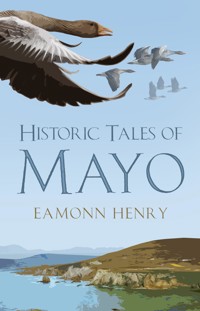
These true stories drawn from historical sources and local reminiscences, have been brought together and retold by Eamonn Henry. This collection is a heady mix of tragic, funny, passionate and moving stories. Included here are tales of well-known events such as the Night of the Big Wind and the Flight of the Wild Geese as well as less well-known occurrences such as the Doolough Tragedy and the Lough Mask Murders and recalls local characters such as confidence trickster Old Neddy and the universally reviled Shaun na Soggarth.
Sie lesen das E-Book in den Legimi-Apps auf:
Seitenzahl: 283
Veröffentlichungsjahr: 2018
Das E-Book (TTS) können Sie hören im Abo „Legimi Premium” in Legimi-Apps auf:
Ähnliche


















I ndíl-chuimhne m’athair ’gus mo mháthair; ar dheis Dé go raibh a n-anam.
In loving memory of my parents; may they rest in peace.
First published 2018
The History Press Ireland
50 City Quay
Dublin 2
Ireland
www.thehistorypress.ie
© Eamonn Henry, 2018
The right of Eamonn Henry to be identified as the Author of this work has been asserted in accordance with the Copyright, Designs and Patents Act 1988.
All rights reserved. No part of this book may be reprinted or reproduced or utilised in any form or by any electronic, mechanical or other means, now known or hereafter invented, including photocopying and recording, or in any information storage or retrieval system, without the permission in writing from the Publishers.
British Library Cataloguing in Publication Data.
A catalogue record for this book is available from the British Library.
ISBN 978 0 7509 8746 2
Typesetting and origination by The History Press
Printed in Great Britain
eBook converted by Geethik Technologies
CONTENTS
Foreword
Preface
1 The Year of the French
2 The Aftermath
3 Great-Grandmother’s Tales
4 Old Animal Charms and Cures
5 Scrawing and Burning
6 The Bellmen
7 Achill Breezes
8 Window on the Past
9 The Night of the Big Wind
10 Amusements at Wakes
11 Before the Famine
12 Mountain Dew
13 In Feudal Days
14 Ultachs
15 Old Charms and Customs
16 A Tale of Barnalyra Wood
17 The Lad from Inishkea
18 From Matriarchs to Piteógs
19 Fishy Stories
20 Migrants and Emigrants
21 Tales of a Spailpín
22Alt a’ Chléibh
23Droichead na dTuile
24 ‘Fighting Fitz’
25 Seeing Ghosts?
26 Kilconduff in Local Tradition
27 Killasser Mysteries
28 Fun of the Fair
29 The Ribbonmen
30 When Red Hugh Came to Tawin Island
31 The Souper’s Little Cow
32Shaun na Soggarth
33 The Welshmen of Tirawley
34 Leg Warmers and Treheens
35 When the Motor Car Came West
36 In the Year of the Hot Summer
37 Before School Buses
38 Brick Making
39 In Captain Houston’s Country
40 Brian Rua and the Achill Railway
41 The Doolough Tragedy
42 Charles Boycott
43 The Lough Mask Murders
44 George McNamara
About the Author
FOREWORD
This is a family affair! I ask you, dear reader, to hold that sentiment close as you go through the following pages of this anthology. Many of the events and customs of these tales will seem almost alien to many of the modern Irish. Famine ships, rebellions fought with pikes and cross-country cart rides seem like features of a modern fantasy series. But then mass evictions, emigration and Machiavellian landlords strike an immediate and familiar chord. These circumstances were the hard reality for the subjects of these Historic Tales of Mayo.
In 1979, my brother Eamonn compiled numerous stories, yarns and anecdotes that our late father, John Edward, had assembled. The initial publication was Tales from the West of Ireland – an immense moment for Eamonn and our father. For my father, it represented the culmination of a lifetime spent assimilating spoken tales and being an acclaimed storyteller himself (note there is a stark difference between a storyteller and someone who just talks!). In spite of his travels and the places he worked, he maintained a solid and unbreakable connection with his homelands: its people, its history, its identity.
For Eamonn, our siblings and I, growing up, the forthcoming passages were an everyday part of our lives. They were not merely folklore or ‘dad’s yarns’ – they were accounts of people and places we knew and appreciated. Relatives, neighbours and town locals featured prominently. This proximity to the source material instilled a pride in us and aroused a curiosity that has lasted throughout the decades since we left Ballydrum. Few more than Eamonn can exemplify that connection (himself an already published author on the subject of Maigh Éo, the Land of the Shamrock and Heather).
And so when he asked me to scribe the Foreword for this book, I was both humbled and very proud. Sons and brothers continuing their father’s passion. My own children, in whom we have nurtured a respect for ‘the West’, assisted me with this piece and supported Eamonn through the greater work where possible. So as we started so shall we finish – always remember that this is a family affair!
Michael Henry, 2018
PREFACE
The tales in this book are mainly based on the collection of folktales written by my late father, John Edward Henry, with some additions made by me. My father was a tireless collector of the lore and legends of former generations. The last six tales were written by me but they are based on conversations I had with my dad and also on his notes, which were passed on to me.
My father was born in Ballydrum, a village near Swinford, East Mayo, in 1904. His father, Patrick Martin, ran a busy brick-making operation, a business he had inherited from his own father before him. Many private houses and public buildings throughout East Mayo were part-built with bricks from Ballydrum and the house was a hive of activity during John Edward’s early years. He developed a love of storytelling and, perhaps more importantly, of listening to the stories and tales of the older people who regularly stopped by.
In 1928, he emigrated to the US in 1926, where he spent a number of years working in Chicago before returning to take over the running of the family farm and to marry his childhood sweetheart, Margaret Salmon, from Curneen, Claremorris.
He spent a number of years working as a charge hand or ‘ganger’ for Mayo County Council, carrying out road maintenance, bridge-building and pier-maintenance projects. From conversations with local people, especially those of older generations, he gathered much of the material that would later form the basis of his collection.
He took a supply of pencils and wire-bound notebooks with him whenever his work took him away from home and he would pass long winter evenings making notes and annotations as he listened to the accounts of those with whom he chatted about former times. When he returned home at weekends, he used those notes to write up more complete accounts in longhand.
He was a prolific writer and his work appeared in many local magazines and community publications. A collection of his stories, Tales from the West of Ireland, was published by the Mercier Press in 1979 and was re-issued in 2000. He was also a regular contributor to an American travel company’s newsletter, writing commentaries on Irish current affairs.
Some of the stories to be found in this book have appeared before in book form or in magazines and periodicals, but the majority have not been published before.
Before his death in 1986, my father passed his folklore collection of stories, songs, myths and legends on to me and expressed the hope that I would make them available for future generations. The tales in this book form part of his legacy.
Note: The reader should keep in mind that most of the tales in this book were composed in the period between 1976 and 1980; therefore, references to current events have to be qualified.
Eamonn Henry, 2018
1
THE YEAR OF THE FRENCH
When the little French expeditionary force under General Humbert landed at Kilcummin, near Killala, North Mayo, on 22 August 1798, they were received with open arms by the local people, who looked on their coming as a wholehearted attempt by Napoleon to free Ireland from English domination. They would not have dreamed of regarding it as an operation to divert a sizeable amount of England’s land and sea forces from theatres of war on the Continent.
The ensuing campaign, which resulted in the capture of Ballina and then Castlebar and the clearing of County Mayo of all enemy forces by the Franco-Irish force, was a brilliant opening to the short-lived insurrection in the west. The fatal delay of almost two weeks in Castlebar unfortunately gave the enemy time to regroup and plan counter-attacks and encircling movements unhindered.
During the French stay in the town, they were wined and dined in the most lavish way by the people of the town and the surrounding countryside. The victory of the Franco-Irish forces at Castlebar and the proclamation of the Republic of Connacht under President John Moore infused the people of Castlebar and the rest of the country with renewed spirit.
Those who did join for active service came loaded with gifts of meat, butter, poultry, eggs, fish, etc., for the troops. One party came with a steer that had been cooked in a quarry near the town on heated slabs of limestone, a custom dating back to Hannibal’s time. Gifts of clothing and footwear donated by merchants from Castlebar and the nearby towns also arrived. Drilling the raw recruits and getting them accustomed to the French muskets, swords and small arms took up valuable time. Despite all this, it has been stated that the Irish recruits who stuck to or reverted to their traditional weapon, the pike, gave a better account of themselves and inspired more fear among the Redcoats at Carricknagat and Ballinamuck, as well as in the capture of Castlebar.
A large contingent came from the Newport–Ballycroy area. A company from Ballycroy and Erris had previously marched to Ballina to join. A body of insurgents from Westport and Louisburgh included two Augustinian friars, Fr Myles Prendergast and Fr Michael Gannon. This force was led by Johnny Gibbons, locally nicknamed Johnny the Outlaw. From the Knock–Aughamore district came two strong companies under Captain Seamas O’Malley and Richard Jordan. A company of recruits came from Killedan and Bohola parishes under Henry Valentine Jordan of Rosslevin.
A large company from the glens around Nephin Mountain, who joined on the route from Ballina to Castlebar, was led by Captain Peadar Jordan of Coolnabinna. Jordan escaped to Achill Island after the collapse of the rising and died suddenly while on the run there. He composed the poem ‘Cúl na Binn’, one of the finest poems of the ’98 period.
It is worth mentioning that one of the martyred priests of the Penal Days in East Mayo was Fr Fulgentius Jordan, so the Jordans should hold an honoured place in the turbulent history of Mayo.
Another local leader who joined the Franco-Irish force just before the fight for Castlebar with a strong body of pikemen was Captain Willie Mangan of Sion Hill.
According to local tradition, the first rout of any of the Redcoat regiments guarding the approaches to the town took place at Sion Hill. This, coupled with a flanking attack from the west side of the town by around 300 pikemen, is believed to be the main factor in the complete rout of England’s regular soldiers and the hated Irish militia. This event has gone down in Mayo’s history as ‘The Races of Castlebar’.
Four years previously, the people of Castlebar and the neighbourhood had flocked onto Main Street to watch two wine-soaked rack-renting landlords fight, or attempt to fight, a sword duel. Caesar French of Oughterard and the local bully boy, George Robert (or, as he was nicknamed, ‘Fighting’) Fitzgerald of Turlough House, were the contestants.
During the scuffle, Fitzgerald’s spurs got entangled in his greatcoat and he fell to the ground. Immediately, French placed his foot on Fitzgerald’s chest and pointed his sword at his throat, with the familiar duellist’s demand that he surrender or die. Just then, the crowd surged forward to save their local oppressor, with the result that French was forced to flee for his life. He wisely had his attendant waiting with two saddled horses at the top of the town and lost no time in fleeing for his life towards Oughterard.
One of the few landlords who led a company of United recruits to Castlebar was John Moore of Ballintaffy (midway between Claremorris and Kiltimagh). Four years previously, John Moore, with his landlord neighbours, John Joyce of Oxford House and Thomas Ormsby of Ballinamore, sat on the jury that found ‘Fighting’ Fitzgerald guilty of the murder of another landlord, Randal McDonnell of Windsor House, Castlebar.
The High Sheriff of Mayo, Denis Browne, saw in Fitzgerald (an influential landlord and nephew of Thomas Hervey, the Earl of Bristol and bishop of Derry) an enemy to be eliminated at all costs and he did not hide his happiness when Fitzgerald was executed. Browne was to become one of the most execrated individuals in Irish history because of the ruthless way in which he put down all attempts at rebellion in the wake of the defeat at Ballinamuck. He was known far and wide as Donncha an Rópa (Denis of the Rope).
Seeing one of his hand-picked jurors side with the rebels led him to have a secret tunnel constructed between his house (now the Convent of Mercy in Claremorris) and a grove of trees some distance away as an escape route in case of a rebel victory.
During their march from Castlebar to Ballinamuck, the French and Irish force marched through Bohola direct to Swinford. The Castlebar–Swinford main road at that time joined the Swinford–Kiltimagh main road at Carrabawn, a mile from Swinford, and it was on this road that General Humbert entered Swinford.
When a historian, Dr Hayes, travelled to Castlebar and Swinford, and retraced Humbert’s march to Longford nearly fifty years ago, he was wrongly informed regarding the route taken. He was told in Swinford that Humbert marched to Foxford and then to Swinford. Such a route would involve a detour of 15 or 16 miles, two unnecessary crossings of the River Moy and a march through mountain foothills, which would be ideal ambush terrain for enemy units. This, to seasoned campaigners like Humbert or Blake, the Irish commander, would have been unthinkable. General Humbert and his aides, Sarrazin and Charcot, dined in Anthony Corley’s Hotel, now O’Hare’s, on the square in Swinford.
The French leader first called a halt and, after sentries were posted and scouting parties sent out, ordered the troops into a large field, part of which is now the grounds of the vocational school. Two steers donated by Brabazon (the local landlord) and two more donated by or taken from the Bohola landlord McManus were hastily prepared and roasted. Four large iron gates belonging to Brabazon were used as roasting grids over large turf fires. Having eaten, the troops marched on to Bellaghy, where they spent the night. There, one of their flanking parties, sent out the day before leaving Castlebar, rode up with the news that large enemy forces lay directly between them and the River Shannon.
This prompted Humbert to change course in the hope of outflanking his enemies and getting into the central plain and, hopefully, on to Dublin via the upper reaches of the Shannon. He marched his men northwards, hoping to find a crossing on the Shannon that was unguarded. Meanwhile, an English army was advancing from Sligo to confront him under the command of Colonel Vereker, an ancestor of Lord Mountbatten.
Unfortunately for Humbert, there was an orchard in the vicinity of the site where the army rested for the night. The apples were unripe, but the French soldiers were ravenous by this time and ate all that they could find. The consequences were predictable. The next morning the vast majority were in no condition to confront Vereker as they were suffering from what could politely be called Montezuma’s revenge.
In the ensuing engagement, Humbert’s men were suffering heavy casualties as the English held an advantageous position and they had a field piece that was causing havoc in the French lines. Then, in a feat of outstanding courage, Bartholomew Teeling, an Irishman and a captain in Humbert’s army, rode forth, zigzagging to dodge the bullets, and managed to get close enough to the gunner to shoot him dead.
At that, Vereker fell back and retreated as far as Ballyshannon in Donegal. It is unclear why Vereker faltered in his resolve when the gunner was shot or why he retreated as far north as Ballyshannon. Humbert found an unguarded crossing at Ballintra Bridge, south of Lough Allen, and the Franco-Irish force swung south, heading for Granard.
Teeling was captured when Humbert lay down his sword at Ballinamuck and unconditionally surrendered. He tried to have Teeling treated as a French officer and given prisoner-of-war status, but his pleas were in vain and Teeling was hanged as a traitor to the Crown. A street in nearby Tubbercurry bears his name. There is also an adjoining street named after General Humbert.
Meanwhile, the United Irishmen of Longford and Westmeath had assembled. They captured Wilson’s Hospital near Mullingar, but failed to take the town of Granard. Humbert, on hearing of the midlands, rising decided to link up with the insurgents there and headed straight for Granard. He abandoned some of the heavier guns so as to travel at greater speed. So far he had eluded the cordon closing in around him. With some luck, he hoped to slip past the net, reach Granard and then strike for Dublin, which was virtually unprotected as most of the garrison has been moved to Connacht. Humbert was in a perilous position as General Cornwallis, with an immensely superior army, was straight in front of him, blocking his attempt to link up with the United Irishmen who had rebelled, while General Lake was closing in from the rear. The Franco-Irish force was like meat in a proverbial sandwich.
They had got as far as Cloone in South Leitrim, where scouts brought the news to Humbert that Cornwallis was 5 miles away at Mohill, blocking his way to Granard, and Lake, with an army of equal size, was closing in from the rear.
Humbert realised that he was surrounded and outnumbered, but decided to push on, even though the best he could do then was to offer token resistance before surrender. The skirmish took place at Ballinamuck in County Longford. The French surrendered after half an hour of desultory skirmishing and then, with their honour satisfied, Humbert ordered his men to lay down their arms. The French were treated as prisoners of war but the Irish were shown no mercy.
Left to fight on their own, their stubborn resistance earned tributes from some of their enemies. The French force at Ballinamuck has been estimated at about 900 men. There are no definite figures of the Irish casualties in this battle, although it is believed that 300 died, 400 were taken as prisoners and another 400 escaped. However, with martial law and unauthorised killings by the victors being a regular pattern of life in Ireland for three years or more after the rising, it is, of course, impossible to accurately estimate the number of casualties connected with that Continental invasion of Ireland.
It must also be remembered that records were scant and unreliable, especially in relation to Tone’s ‘men of no property’, who were not fully regarded as human beings by the victorious, occupying army.
2
THE AFTERMATH
Writers have often commented on the difficulty of obtaining reliable information on events connected with the ’98 Rising in the west of Ireland in comparison to County Wexford and other Leinster counties. Unfortunately, the reason for this is the famine. In Mayo and in the west in general, whole villages, with all their history, folklore and customs, were wiped out. The famine did not make such an impact on more prosperous, thinly populated counties like Wexford, Wicklow, Carlow and Kildare. Many farms in those counties remain in the possession of direct descendants of people who took part in or witnessed events connected with the 1798 Rising.
Many of the Mayo men who escaped from the massacre of Ballinamuck were Gaelic speakers and were between 150 and 200 miles from their native heath. To add to their woes, the River Shannon lay between them and home, and it was well watched and guarded to prevent their return. Ill-clad and ill-shod, with winter around the corner, their lot was not a happy one. There is a tale of a Shannon boatman who rowed two loads of Mayo men across the river one night shortly after the fight of Ballinamuck.
Only on his deathbed a few years later, could he dare to mention the matter as blood money and spies were plentiful for years after ’98. There was another story of a Roscommon woman living near the Shannon in 1798, who, on a few occasions, found her cows milked dry when she collected them for the morning milking. She was afraid to mention the matter to anyone, as she guessed that it meant that some Mayo rebels had passed during the night or early morning.
In 1798, the summer and autumn were finer than average and all the hay and grain crops were collected early. However, the potato stalks remained green until mid-October; this was the favourite hiding ground for the hunted rebels during the day and they travelled all night.
To make matters worse, most of them had to discard their pikes as they were too noticeable and unwieldy. It is no wonder that a high proportion of the Mayo insurgents are listed as ‘never returned’. A few of the insurgents were men who deserted from the Redcoats or militia regiments and when caught, whether armed or not, their fate was sealed. Leaders like General Blake of Garracloon, Colonel O’Dowd of Bonniconlon and Colonel Bellew of Killala, all trained veteran soldiers, were executed without any semblance of a trial.
Colonel McDonnell of Carracon, who was wounded at the capture of Castlebar, escaped to France, was refused promotion by Napoleon and so went to America, where he died. One of the Murrisk Abbey friars who joined the United men (insurgents), Fr Michael Gannon, escaped to France in a French officer’s uniform and rose to a high rank in the French army. The other friar, Myles Prendergast, escaped to Connemara along with Johnny Gibbons and a few more United Irishmen.
Johnny Gibbons was captured by the Redcoats with the aid of a spy who had damped the powder in Johnny’s pistols to ensure his downfall. When Johnny saw that his pistols were useless and that the house was encircled by his enemies, he exclaimed: ‘Tá Johnny i nead lachain ’gus a mhéar i bpoll tráthair!’ (Johnny is in a duck’s nest and his finger in an auger-hole!)
This saying survived and was used to describe anybody in a tight corner. Packing victims’ fingers into grooved auger-holes was a form of punishment in those days and ducks’ nests were so constructed that the ducks could not leave until released (duck eggs were too valuable as a food in those days of continuous privation to allow the ducks to lay out in ponds or rivers).
When Johnny Gibbons was executed in Castlebar, his godfather Denis Browne (Donncha an Rópa), took pleasure in being present, as he had when his sworn enemy, Fighting Fitzgerald, had been executed some years earlier.
Captain Mangan of Sion Hill was killed a few years after the rising, just as a free pardon was being prepared for a number of insurgents. Local tradition says that his fate was sealed by a spy who felled him with a stone after he had got through a ring of soldiers at Letter, near Nephin.
Among those listed as ‘never returned’ are John Moore of Ballintaffy, Henry Jordan of Rosslevin and Seamas Dubh Horkan of Rathscanlon, Swinford. (Henry Jordan is believed to have died in Connemara.)
Among those who went from Swinford with Seamas Dubh Horkan to join up in Castlebar were Paddy Brennan, a blacksmith who forged the pikes for the local United Irishmen, and Seamas ‘Taillúir’ (Tailor) Durkin. Durkin had his workshop in what is now the local garda station. His grandfather was a landlord, locally known as Muiris na Muaidh (Maurice of the Moy). Muiris lived a half mile south of Cloonacanana ford on the River Moy. The walls of his dwelling still stand close to the main Swinford–Aclare road.
Muiris na Muaidh was the landlord of the nine townlands nearest to Cloonacanana ford. He fought as a young officer in the Jacobite army at Aughrim, one of the bloodiest battles in Irish history. After Aughrim, he lost most of his lands in the Williamite confiscations. Admittedly he was not fighting for Ireland’s freedom. He was fighting, like his commander, Patrick Sarsfield, Earl of Lucan, for the right of the poltroon English King James II to rule Ireland instead of William of Orange. Incidentally, he was, of course, fighting for his landed estates. Ironically, the Vatican supported William of Orange.
Seamas Durkin escaped from the massacre of Ballinamuck and found refuge in a disused sandpit in a large field, from which he saw the Redcoats searching along the hedgerows around the field. After nightfall, he headed in an easterly direction, luckily for himself, as all roads to the west were well watched. After some days, he found shelter and employment with a farmer in a quiet spot 30 miles from Ballinamuck. Some time afterwards, he went back to his old trade and worked as a journeyman tailor as he moved from place to place.
It was almost three years after ’98 before he returned home. He re-opened his tailor’s shop at first, but friends advised him to close it down and leave the town, as spies were still on the lookout for easy money and the townspeople of Swinford were loyal to the Crown. He heeded their advice and built a small house in the townland of Cloonacanana, beside the old fort of Lisconnell.
He married a few years later and I can remember his two daughters, Nellie and Winnie. Winnie married a local man, Tom Salmon, and Nellie married Martin Henry of Ballydrum, my paternal grandfather. Grandmother Nellie never fully mastered the English language, but for a torrent of invectives in Gaelic she was hard to beat. When she died in 1912, she was nearly 100 years old.
Two Mayo priests were executed for complicity, or aiding and abetting the insurgents. Father Manus Sweeney of Achill was executed on the market crane in Newport and Fr Conroy of Addergoole in Castlebar. Another priest, Fr Owen Cowley, died from ill health and hardship while on the run. The tree in the Mall on which Fr Conroy was executed was blown down by a storm in 1918. At a huge county anti-conscription meeting in the Mall a few days later, De Valera referred to the tree and its history, having been briefed on the matter by local republicans.
The priests who sided with the rebels in 1798 were excommunicated. To this day it is believed the fiat or excommunication edict has not been revoked.
3
GREAT-GRANDMOTHER’S TALES
My maternal great-grandmother, who died in 1911 and to the best of her reckoning was 102 years old, was a mine of information regarding events connected with the famine. Unfortunately, nobody thought of recording her tales of her early days.
Her husband Thomas McDonnell of Ballintaffy, Claremorris, died a young man in 1847, leaving her with a very young family. In keeping with local custom, the Widow McDonnell was known all her life by her maiden name, Mary McHugh. Her holding of land, being a middleman’s holding, was larger than the average and this she regarded as being more of a liability than an asset as the annual rent to her landlord, Ormsby of Ballinamore, was correspondingly high.
At the time of her husband’s death, she had four cottiers as small sub-letters on her holding. Each cottier rented one field with his cottage and tilled it to the utmost. The size of the field varied from 1 to 2 acres. Milk was usually supplied by the landowner who let the cottage and field, in return for seasonal assistance with spring and harvesting work.
Her landlord allowed her to increase the number of sub-letters to eight. This, she maintained, was the difference between security and eviction for her. Their small rents, plus the assistance they gave her on the farm as required, almost paid her rent to the landlord.
She told a rather interesting tale involving her husband.
Sometime after their marriage, he went to Dublin to lodge some money in a bank, there being no provincial barks at the time. One of his horses was lame and the other one, a mare, was rearing a foal, so he set off walking at daybreak on a fine summer morning. Sometime on the second day, having crossed the Shannon, he got a lift from two men on a horse-drawn miller’s dray or low-slung cart. He found that his companions could not speak Irish. Luckily for himself, he could understand English much better than he could speak it. Between their hints and whispers, he picked up enough of their conversation to realise that they meant to rob and kill him, if necessary, when they came to the wood beyond the next little town. He had donned a new suit and shoes leaving home and this led his companions to believe that he was worth robbing.
He planned to jump off the dray when they reached the town. Hearing an unusual animal-like roar, he looked ahead and saw a drover and a bunch of donkeys approaching along the road. On spotting the horse, one donkey ran forward, braying loudly.
The horse wheeled around on the road and bolted in the opposite direction at top speed. My great-grandfather leaped off the dray and over the fence into a nearby field. He had never seen a donkey before, and judging by their blood-curdling braying, he felt it would be better to get out of their reach as fast as possible. The drover, however, hailed him and assured him that his animals were harmless. Seeing a donkey was an experience for him as donkeys were almost unknown in Mayo at the time.
The Napoleonic wars left Ireland almost denuded of horses, which were snapped up for the imperial cavalry regiments, so English and Scottish donkey dealers saw a ready market in Ireland. They shipped the donkeys in their thousands over the short Larne–Stranraer route in flat-bottom boats.
My great-grandfather called to a farmhouse shortly afterwards and stayed there overnight. He continued his journey at daybreak the next morning and took care not to fall in with his carter companions again.
The McDonnells kept a bull. In Irish farming circles, a bull rated nearly as high as a hunter or a racehorse as a status symbol. One of the most sustaining foods in those famine days, a mixture of oatmeal and blood known as preasán fola, was expected to sustain a hard-working man for a full day. (A mixture of oatmeal and milk was known as preasán and a mixture of oatmeal and butter, which could be moulded into cakes or rolls, was known as bustán. It was said that this was the staple diet of Humbert’s army.)
In the McDonnell household, the bull bore the brunt of the bleeding rituals. For some reason, the bleeding operation was always carried out on Sunday afternoons. The widow said that her bull became so accustomed or resigned to the ritual that he uttered the most mournful bellows when he saw his tormentors approaching.
Bleeding was effected by puncturing a vein in the animal’s left shoulder. On the final occasion (for the bull), the operation was carried out by a son of the regular vet, who was ill. Through some miscalculation, the bleeding could not be stopped and in the excitement the bull broke loose and quickly bled to death from over-exertion.
The widow decided to make the best of a bad job. She sent to Claremorris for a regular butcher and got the bull prepared and salted.
She found that she had to send a man on horseback to Kisallagh, Westport, for a bag of salt as she could only get pinches of it locally. The man who sold the salt was known as a panner. He got it from trapped seawater using what was known as the shallow-pan method. Having salted most of the animal, she found she had enough left to make a feast for her cottiers, relatives and neighbours. That feast, and what they took home, got them through the hungriest spring she ever remembered – 1848.
Watercress was a highly prized piece of food in the famine years. A broad, sluggish drain where watercress abounded, midway along the Claremorris–Kiltimagh road, was mentioned by the Widow McDonnell as being black with people eating this plant in the famine years. The edible root of a herb known as the blioscán was dug up and eaten raw, as was another herb root known as the cútharlán, which had a marble-sized bulb on the root.
My great-grandmother had vivid memories of turbulent elections and bye-elections around the famine years and later. The candidates, all landlords, were adept at rousing the starving peasantry. In the words of James Connolly, ‘They engendered as much heat as was possible into the part of the body politic furthest removed from the idea of social justice.’
In one election, Lord Oranmore and Browne, the Tory candidate, was opposed by Kirwan, a Catholic landlord with repeal sympathies. After 1848, the year of revolutions around the world and the first incipient attempts at democratic upsurge, the English government passed a law that made a defeated election candidate accountable for the victorious candidate’s election expenses.
This in itself was a blow against democracy, as it ensured that only men of substance could seek election. When Lord Oranmore opened his election campaign in Claremorris, he had a kinsman, a son of Donncha an Rópa, on his platform. A local clergyman, Fr Gibbons, led a group who broke up the meeting, shouting ‘soap the rope’ at young Browne. This was one of his father’s nicknames.




