


1,99 €
Mehr erfahren.
- Herausgeber: Publisher s13381
- Kategorie: Geisteswissenschaft
- Sprache: Englisch
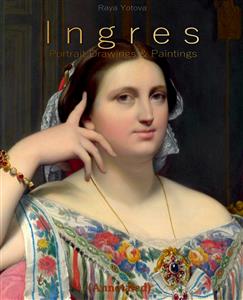
Jean-Auguste-Dominique Ingres was a French Neoclassical painter. Even though Jean-Auguste-Dominique Ingres regarded himself to be an artist of the past in the tradition of Jacques-Louis David and Poussin, it is his portrait painted and drawn works, that are distinguished as Ingres valued heritage. At all, Jean-Auguste-Dominique Ingres is referred as neoclassical painter. He was deeply engaged by ancient imaginative background, and desired to become the protector of academic accepted belief in opposition to the rising Romantic Movement, expressed by painters like Delacroix. The significant twists of structure and perspective made Delacroix an important forerunner of Modernism, but not influencing Ingres.
Das E-Book können Sie in Legimi-Apps oder einer beliebigen App lesen, die das folgende Format unterstützen:
Veröffentlichungsjahr: 2018
Ähnliche







Ingres:
Portrait Drawings & Paintings (Annotated)
Annotated by Raya Yotova
––––––––
First Edition
*****
Copyright © 2018 Annotations by Raya Yotova
Table of Contents
Title Page
Copyright Page
Foreword
Paintings & Drawings
Foreword
Jean-Auguste-Dominique Ingres was a French Neoclassical painter. Even though Jean-Auguste-Dominique Ingres regarded himself to be an artist of the past in the tradition of Jacques-Louis David and Poussin, it is his portrait painted and drawn works, that are distinguished as Ingres valued heritage. At all, Jean-Auguste-Dominique Ingres is referred as neoclassical painter.
He was deeply engaged by ancient imaginative background, and desired to become the protector of academic accepted belief in opposition to the rising Romantic Movement, expressed by painters like Delacroix. The significant twists of structure and perspective made Delacroix an important forerunner of Modernism, but not influencing Ingres.
Born into a not rich family unit in Montauban, Ingres moved to capital Paris to learn in the school of famous painter David. After he made his first exhibition in Salon about 1806, and gain the Prix de Rome for his work “The Ambassadors of Agamemnon in the tent of Achilles”, his painting method—revealing Ingres close learning of Flemish and Italian Renaissance artists—was completely established, would transform slight for the rest of his lifetime.
Jean-Auguste-Dominique Ingres resided in capital Rome and Florence to 1824 and approximately 20 years he on a regular basis sent his artworks to the Salon in Paris, where they were criticized by juries who named Ingres method “strange” and “old fashioned”. Ingres gained a small number of commissions orders for the duration of this time for the history paintings he wishes to work, but was capable to sustain his family as a portraitist.
Ingres was at last distinguished at the Paris Salon in 1824, when his painting in “La Raphaelesque” style named “Vow of Louis XIII” was acclaimed vocally for grand success, and he was recognized as the head of the French Neoclassical style.
Even though the profits from orders for paintings with history themes permitted Ingres to create smaller number of portrait paintings, his picture of Louis-Francois Bertin spotted his subsequently public triumph in 1833.
The next year, Ingres's resentment at the cruel disapproval of his ambitious large canvas “The Martyrdom of Saint Symphorian” caused him to go back to Italy. He returned once more to Paris lastingly in 1841.
In the later years of his life Ingres created new variants of many of his earlier works, sequences of designs for stained glass windows, some significant portraiture paintings of women, and his masterpiece “The Turkish Bath”, which is the final of his numerous Orientalist works of the female nudes.
Paintings & Drawings
Self-portrait at Twenty-four, 1804, Oil on canvas, 770 x 610 mm *
––––––––
Madame Riviere, 1805, Oil on canvas, 116.5 × 81.7 cm *




