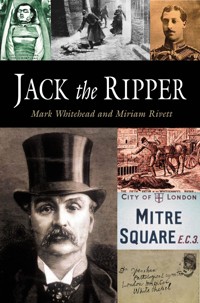
So who was Jack the Ripper?
No-one in the annals of crime is capable of arousing such passionate debate as the perpetrator of the Whitechapel Murders in 1888. Was he a demented Royal, a Masonic assassin, a sexually-frustrated artist, a member of the Czarist secret police, a crazed reformist or even an escaped gorilla?
More than a century has passed since this unknown killer murdered East End prostitutes under the very noses of the police and yet we seem no closer to uncovering the Ripper's identity. Countless volumes have been written by warring researchers, seemingly unable to agree even on the number of his victims. Is it possible that we will ever know the truth or is the Ripper destined to remain an enigma, his place in history secured as both an English-heritage crime icon and a universal bogeyman?
This revised and updated edition contains a summary of Jack's crimes, victims and the ill-fated police investigation. It considers many of the Ripper's proposed identities, bringing you up to date with the latest suspects and includes a guide to the Ripper's many fictional outings, from The Lodger to From Hell.
If nothing else, this makes great background reading for the new Ripper movie, From Hell, which is released in the spring. - Guardian Online
Mark Whitehead is the co-author (with Miriam Rivett) of the Pocket Essential Jack the Ripper and author of Pocket Essentials on Slasher Movies, Roger Corman and Animation.
Jack the Ripper
MIRIAM RIVETT & MARK WHITEHEAD
POCKET ESSENTIALS
For Ian and Joel, who put up with endless Ripper discussions, and for Meryl, who knew it all already.
Acknowledgements
Our thanks to Paul, Ion and David, for patience, encouragement and books (you all know which).We would also like to extend our thanks to Philip Sugden, Paul Begg, Martin Fido, Keith Skinner, Stewart P Evans, Donald Rumbelow and Ross Strachan, whose research and diligence aided our own work invaluably.
Contents
Acknowledgements
Contents
Introduction - The Trouble with Jack
In Hindsight
‘Watchman, Old Man, I Believe Somebody Is Murdered Down the Street'
‘Cool Impudence and Reckless Daring’
Interlude
Double Event
A Study in Terror
Jack’s Back
The Suspects Assemble
Ripping Yarns
Ripper Haunts
Copyright
Introduction
The Trouble with Jack
'I was killing when killing wasn't cool'
Al Columbia
'In this business no one knows anything'
William Goldman
You might not have heard of Amelia Dyer. In the late 1880s this ex-Salvation Army 'soldier' fostered orphaned infants. While she collected their
boarding fees, she swiftly disposed of her charges by strangling and dumping them in the Thames. She was known as 'The Reading Baby Farmer'.
Nor may you have heard of Herman Webster Mudgett (aka HH Holmes). Mudgett ran a hotel in Chicago which benefited in more ways than one from
the 1893 World's Fair. A gothic eyesore, the place was a massive killing jar, full of secret entrances, trapdoors and hidden rooms. By the time the police
twigged, Holmes had fled. Estimates of the dead found range from twenty-seven to over two hundred.
Or Rhynwick Williams. In 1790, he was arrested and tried as the 'London Monster'.With over fifty victims to his name, the Monster had been
the terror of London women from 1788. He approached them with lascivious talk then slashed their buttocks with a knife.
Other names do stick in the mind. Brady and Hindley, Peter Sutcliffe, Fred and Rose West. They remain in our collective consciousness,
their memory sustained by tabloid hysteria and broadsheet pontificating. Their victims' lives have been chronicled exhaustively through oral tradition, the
media and by noted authors. The murderers' lives continue to be scrutinised, each new event a source of outrage and discussion. All of it feeds our
curiosity about Those Who Did What We Would Never Do. When Fred West committed suicide, it was a cause for populist, pun-filled celebration ('Happy Noose
Year!' – The Sun, the day after West hanged himself in jail).
And that's the real reason that they remain ever present. It's not outrage or grieving over the victims that really shift units or fill
column inches. No matter how liberal we try to be, one word remains (and it's not 'monster').The word is: Why?
There is a desire to understand what motivates such crimes. There has to be a reason, there just has to be. The detective approaches the
subject by deductive reasoning, by using the grey cells – whodunnits tell us this is so. They must know the motive to know the killer. The killer gets an
opportunity to tie up any loose ends before they are led away. The motives are always there in a nebulous form: power, sex, boredom, money. These are
universal things that tie us to Them. But it's never the Reason. That's personal, the collision of countless moments in time, emotions, desires, beliefs
and the indefinable. Something We could never understand.
And still we search.
There's another name that might just ring a bell. He remains in our collective consciousness, subject to occasional tabloid outbursts.
His victims' lives have been chronicled exhaustively over the past hundred-odd years. The murderer's many, many possible lives continue to be scrutinised .
Each new discovery about him is greeted with heated discussion. All of it feeds our curiosity about The One That Never Got Caught. Jack the Ripper. It is the
perfect name for a villain. It is probably too perfect. The letters that gave him his name are most likely hoaxes perpetrated by a journalist wanting to
boost sales, but the name remains. We know the name before we ever know anything about the case. It's as if we've been born with that name in our heads, part
of our common mythology. It's all part of the trouble with Jack.
Jack, familiar name for John, a name of fairy tales and legends – Jack the Giant Killer, Jack and Jill, Jack-Be-Nimble... Jolly Jack Tar
(well, the Ripper was often described as wearing a sailor's hat). London, no stranger to crimes or legends, had already been visited by one malevolent Jack
in the 1800s. Spring-Heeled Jack, a fire-breathing, metal-taloned monster capable of prodigious leaps, who attacked bewildered London suburb dwellers. His
reign of terror from 1838 to around 1904 saw him enshrined in nursery folklore as a bogeyman and as a popular figure for the penny dreadfuls. Curiously,
just as the new Jack moved into London, the old one was spotted in Liverpool.
The Ripper? Well, he certainly ripped up his victims, and several suspects were claimed to have threatened to rip up people. Late
19th-century slang already used the word to mean both 'a first-rate man' and 'a person who behaves badly.' So was the name meant as a clue? Or was it used
because it sounded cool or frightening? That's the trouble with Jack. Everything has been analysed to the nth degree, everyone knows too much and yet no one
knows anything.
Each new theory pores over the same details, the same cold entrails, searching for meaning, for an identity to leap out. Princes are named,
doctors, writers, sailors. A game of cherry stones would be an equally useful divining tool. The trouble with Jack is that we can only build up his
appearance through other people's perceptions and experiences. What he did to his victims and the mixed descriptions of the sightings of men with the
victims are continually cited. Everything is coloured by press reports, the public's reactions , the police's inability to find so much as a trace of him and
the memoirs and theories that paint many different pictures. Even by Hollywood. A man of medium build with a curled-up moustache and a sailor's hat. A
top-hatted, caped toff with a little black bag sweeping through a pea-souper. The devil himself. Jack shifts and morphs in our imagination the more that we
read. And that's without his supposed diary.
The lies that surround him are enough to send anyone mad: He removed Kelly's foetus (she wasn't pregnant), he fed his victims poisoned
grapes (greengrocer Matthew Packer, the only witness to this fact, changed his story every day), he left ritualistic patterns of the victims' belongings near
the corpses (nope), and so on and on. Stephen Knight quotes The Protocols of the Elders of Zion (an early 20th-century anti-Semitic hoax) as being
Masonic oaths. Donald McCormick dramatises scenes, complete with Cockney sing-songs, but insists that the dialogue is authentic. Jonathan Goodman named
'Peter J Harpick' as a suspect, complete with background and history in his book Who He? (1984). Although this was clearly an anagram, requests for
further information about 'Harpick' over the years left Goodman with a low opinion of Ripper enthusiasts. AP Wolf starts by claiming Ripperologists'
infighting has obscured all truth behind the Ripper case and then savages Colin Wilson. Paul Feldman as good as invites anyone who doubts the veracity of
Maybrick's diary outside for a fight. The myth sucks you in. Each step you take pulls you harder, deeper. You fight your corner by whatever means necessary,
because you, and you alone, have The Truth.
The truth? The incredible police investigation into the crimes derived not from sympathy for the victims but from politics. In 1876,
corruption on a massive scale had been uncovered in the higher echelons of the CID. The Metropolitan Police, under Sir Charles Warren, were regarded as
an increasingly militaristic force. The press, previously in favour of the forces of law and order cracking down on the unruly poor, suddenly began to
support those they had vilified. The police in all areas had to be seen to prove themselves.
Jack was born just as the popular press was finding its feet and they helped each other immeasurably. He gave them murders to boost their
circulation and they, in turn, made him into a legend. No detail was too titillating or unpleasant to be left unreported or undistorted. Researchers hoping
to provide a correct history of the murders are left with the daunting task of sorting the lies from the truth through acres of print, reports,
statements...The coroner,Wynne Baxter, held lengthy inquests into many of the victims. These sup plied the press with every possible detail of the victims'
backgrounds, their murders, their mutilations. Gaudy posters advertising the latest reports from the press were pasted up around Whitechapel,
saturating the people of the area in the deeds of the monster. Peter Turnbull in The Killer Who Never Was (1996) suggests that the Ripper was a
product of such heightened awareness. The hysteria that greeted each crime, fuelled by so much information, created copycat killers, each of whom murdered
another prostitute and further fanned the flames. One theory amongst hundreds. But it happens. The 'Halifax Slasher' of 1938 was the product of such
increasing hysteria. Women were found to have slashed themselves and blamed a mystery assailant. It is entirely likely that the reign of The London Monster
contains similar elements. But these were phantom crimes. The trouble with Jack is that there really were murders. Someone did it. Whether a legion of
copycats or a single-minded individual, someone did it. We have the bodies, and the same constantly reproduced photographs to prove it. Tabram, Nichols,
Chapman and Stride, just sleeping. Eddowes naked, bloody, propped up and sewn up, empty. Kelly at rest, Manet's Olympia adapted by the Chapman
Brothers.
So who was Jack? We have no more idea than you do. Pick a suspect. MJ Trow showed how easy it is to make anyone fit the Ripper's clothes in
his essay The Way to Hell (1999). Pick a name and then find the isolated incidents in his (or even her) life that you can bend to your theory. We have
no new theories to propose and no new names to put forward. What you find here are the speculations of other, more qualified people, members of that driven
breed, the Ripper researchers. We tip our hats to them. The facts contained in this book are, hopefully, the essentials – compared and distilled from their
work to bring you an overview of the Ripper's reign of terror and of the women that he murdered.
They did not die in vain. Jack is accredited with instigating social reform where others had failed. The highest in the land were regularly
informed of the state of the poor. Even Queen Victoria sent letters to the police, offering suggestions as to how the killer might be traced. Whitechapel,
the labyrinthine immigrant quarter so close to the City, home to 80,000 forgotten people, became front-page news. The reports drew attention to the
neglected, the poor and, at the bottom of the social ladder, the extreme poor, forced to sleep in doorways, to beg or sell themselves for fourpence for their
doss in one of the 233 overcrowded common lodging houses. Between them these houses accommodated around 8,500 people. Despite the frequent cries of
'Murder!' which most witnesses remarked on and ignored, and despite the brutality and violence which thrived in the area, not one of the 80 murders committed
in London the previous year had occurred in Whitechapel. Jack's victims, drawn from 'the unfortunates' (the polite euphemism for prostitutes), raised the
profile of the area as no reformer had done before. George Bernard Shaw went so far as to acknowledge the Ripper as achieving what he and fellow socialists
had failed to do. This said, Jack London's The People of the Abyss (1902), relating his time spent living amongst the extreme poor of the East
End, revealed that little had been done to alleviate the suffering in the area fifteen years after the Whitechapel Murders.
Sexual maniac, proto-serial killer, social reformer, black humorist, man of a thousand faces... The trouble with Jack, ultimately, is that
the more you read about him, the more his stature as a legendary figure grows. At some point the masks have to be removed. Not to reveal his identity. That
bearpit remains. Stripped of his iconic veneer, Jack is just a murderer. Someone who found women who had no other option but to sell their bodies then
strangled and mutilated them. Not a devil. Not a ghost. Not a black magician endowed with supernatural powers. An ordinary person, one of the crowd,
like you or I. Someone who could pass without let or hindrance through the East End streets with no one noticing his presence as being out of the ordinary.
The trouble with Jack is getting people to realise that.
In Hindsight
'Vice can afford to pay more than honesty, but its profits at last go to landlords.'
Reverend Samuel Barnett, letter to The Times, 19 September 1888.
Emma Smith
Sometime between 4 and 5am on 3 April 1888, Emma Smith returned to lodgings at 18, George Street, Spitalfields. She told the house's deputy keeper, Mary Russell, that she had been assaulted and robbed in Osborn Street (about 300 yards away). Smith, a 45-year-old prostitute , had lived at George Street for 18 months and was known for returning at all hours, usually drunk. That night, she had been returning from a night's soliciting at 1.30am when three men had attacked her outside Taylor Bros Cocoa factory near Brick Lane.
Russell and Annie Lee, a lodger, escorted her to London Hospital where she was attended by house surgeon Dr George Haslip. As well as bruising to her face and a torn right ear, Smith's vagina had been penetrated by a blunt object so forcefully that it had ruptured her peritoneum. Peritonitis resulted. After slipping into a coma, she died at 9am on 4 April.
Despite probably passing several policemen during her journeys to and from George Street, Smith had not reported the incident, or asked for assistance. Officers on patrol that evening said that they hadn't seen or heard anything unusual. The police were not alerted to the attack on Smith until they were informed that a coroner's inquest was to be held on 7 April.
Wynne Baxter presided over the inquest at the London Hospital. Baxter would conduct inquests into six other Whitechapel murders associated with the Ripper. Known for his flashy dress and, later, his friction with the Metropolitan Police, Baxter had become coroner for East London and Tower of London in 1887 after a bitter election contest. At the inquest an anonymous witness testified to having seen Smith at around a quarter past midnight near Burdett Road (about two miles from where she was attacked), talking to 'a man dressed in dark clothes with a white neckerchief'. The witness had been hurrying away from the area since she had been assaulted by two men a few minutes before she saw Smith. One man had asked her the time and the other had struck her in the mouth before both ran away. The witness didn't think that the man talking to Smith had been one of these.
Also present at the inquest was Chief Inspector John West of H Division. West would become acting Superintendent during the murder investigations of Mary Ann Nichols and Annie Chapman, and be responsible for combining the enquiries into the Whitechapel murders under Inspector Abberline. At this point,West had no official information on the assault.
The jury's verdict was 'Wilful murder by some person or persons unknown'. Unofficially, it was believed that Smith had been killed by members of a band of street thugs from The Nichol, a slum area near Old Nichol Street at the top of Brick Lane. The gang's preferred livelihood consisted of extracting protection money from East End prostitutes and it was possible that they'd brutalised Smith as a warning to other women to pay up or suffer similar treatment.
Martha Tabram
Martha Tabram (aka Martha Turner, Emma Turner) was the ex-wife of Henry Samuel Tabram, foreman packer at a furniture warehouse. They'd had two sons but separated in 1875 because of Martha's excessive drinking. By 1879 she was living with Henry Turner, a street hawker. He too found Martha's drinking difficult to cope with. As a result they often spent periods apart and finally separated in July 1888. Martha supported herself through prostitution and selling trinkets on the streets. During this time, she took lodgings at 19, George Street, Spitalfields, living there under the name Emma Turner. On Saturday 4 August 1888, Martha met Turner in Leadenhall Street where he gave her money to buy some more trinkets to sell. It was the last time that he saw her.
The following Monday, Martha went out for the evening with Mary Ann Connolly (also known as 'Pearly Poll'). According to Connolly they met two guardsmen, a corporal and a private, in The Two Brewers pub, most likely situated in Brick Lane. They drank with their new-found acquaintances in various other pubs, including the White Swan in Whitechapel High Street until about 11.45pm when they paired off to have sex. Connolly and the corporal went to Angel Alley (situated next to Osborn Street), while Martha and the private went into George Yard (now Gunthorpe Street). The buildings there were relatively new (constructed in 1875) but cheap, single-room dwellings, occupied by the poorest in the area.
At around 2.00am, PC Thomas Barrett was patrolling the area. He encountered a soldier he later described as being a Grenadier Guardsman. The soldier was in his early-to-late twenties, 5 feet 9 inches tall, with a fair complexion, dark hair and a small brown moustache turned up at the ends. The man was loitering in Wentworth Street. He claimed he was 'waiting for a chum who had gone with a girl'. Barrett later stated he would recognise the soldier, a private, if he saw him again. This he was later asked to do.
Arriving home at 3.30am, a cab driver, Albert Crow, came across a body on the first-floor landing of George Yard buildings. He thought it was a tramp sleeping rough, a regular occurrence in the area. At 4.45am in the same block, John Reeves, a waterside labourer, left his home to seek work. He also saw the body on the landing but was more observant than Crow. He saw that it was a woman lying on her back in a pool of blood. He immediately sought a police officer and found PC Barrett, who sent for a doctor. Barrett noted that the woman's clothes were 'turned up as far as the centre of the body' leaving the lower half exposed as if 'recent intimacy had taken place'. At the coroner's inquest, Reeves testified that he hadn't seen any footprints or blood leading to the body, or any sign of a weapon.
The doctor called to the scene, Dr Timothy Killeen, arrived around 5.30am, and estimated that the woman had been dead for three hours. She had been stabbed 39 times. As there was no public mortuary in Whitechapel the police took the body to the workhouse infirmary in Old Montague Street. Killeen conducted the post-mortem, finding wounds to both lungs, the heart, liver, spleen and stomach as well as the breasts and genital area. He concluded that most of the wounds had been inflicted by a right-handed assailant and that all the wounds bar one could have been inflicted by an ordinary penknife. However, one wound penetrated the sternum , and Killeen thought that this must have been inflicted by a dagger or possibly a bayonet. Whether this wound had been caused by another assailant, Killeen did not speculate, but he contended that it was possibly made by a left-handed person unlike the others. It has been pointed out that he may have been unaware that the standard-issue triangular bayonet had been withdrawn from issue the previous year and that the blade replacing it could well have made all of the wounds.
At the coroner's inquest on 9 August, the deputy coroner for south-east Middlesex, George Collier (Wynne Baxter was on holiday) remained hopeful that the body would be identified. Three women had come forward but identified the dead woman under three different names. The inquest was adjourned for a fortnight. On 14 August, Henry Tabram, Martha's ex-husband, positively identified her. He'd only learned of her death when he noticed the name Tabram mentioned in one of the newspaper reports of the murder.
Meanwhile, Mary Ann Connolly had come forward to give details of Martha's last night. On 9 August, she told the police at Commercial Street station that she could identify both soldiers if she saw them again. An identity parade of corporals and privates in the Grenadier Guards who had been on leave that evening was assembled at the Tower of London the following day. Connolly failed to show. Later traced by the police to her cousin's house in Drury Lane, Connolly was taken to a second identity parade at the Tower on 13 August, but failed to identify the men. She now said that they'd had white bands around their caps, which suggested they were Coldstream Guards. A similar parade was assembled at Wellington Barracks, Birdcage Walk on 15 August. Here Connolly picked out Guardsmen George and Skipper, both of whom had strong alibis. Let down once more by 'Pearly Poll,' the police did not seek her question able assistance any further.
PC Barrett also attended identity parades at the Tower. On 8 August he picked out two men. Later, Barrett admitted his first choice was wrong (this private wore medals whereas the man Barrett encountered on the 7th wore none).The second, Private John Leary, had been drinking with Private Law in Brixton until closing time. Losing Law, Leary had returned via Battersea and Chelsea, meeting up with Law once more in the Strand at about 4.30am. They had reached barracks around 6.00am. Law corroborated Leary's statement.
Inspector Edmund Reid of H Division CID organised the identity parades and questioned those guards picked out by Connolly and Barrett. In his report dated 24 September 1888 he concludes:'Having both picked out the wrong men they could not be trusted again as their evidence would be worthless.'