


1,99 €
Mehr erfahren.
- Herausgeber: Publisher s13381
- Kategorie: Geisteswissenschaft
- Sprache: Englisch
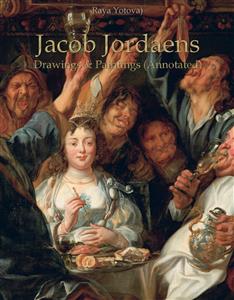
Jacob Jordaens is a completely distinct Flemish artist who, unlike most of his compatriot artists from his era, has never taken trips to Europe, and especially to Italy, to study the experience of foreign artists. He was born and spent his entire life in Antwerp, where he created his glory as an unsurpassed master of painting. Today, along with Peter Paul Rubens and Anthony van Dyck, he is considered one of the three greatest representatives of Flemish Baroque art. Jordaens came from a middle-class family. His father was a wealthy merchant, and this allowed young Jacob to get the best of his age education. He knew perfect French and Latin, which is evident from his paintings and letters, as well as well-known ancient history and mythology. He began his career as a student of the great Flemish artist Adam van Noort, who also trained Peter Paul Rubens. He spent eight years as a student, before applying for membership in the Antwerp Art Guild "St. Luka", where he was admitted as a tapestry master. His narrowest specialty was watercolor sketches-tapestry projects, and he had worked on such projects throughout his career. It seems that his relationship with his teacher, Adam van Noort, has not exhausted with the relationship between a master and a student, because he later married one of van Noort's daughters, and the houses of the two men were in close proximity to each other. Although he has never traveled to Italy, Jacob Jordan’s' paintings have an immediate impact from the Northern Italian painting school, particularly Caravaggio, Titian, but also Veronese, and Bassano.
Das E-Book können Sie in Legimi-Apps oder einer beliebigen App lesen, die das folgende Format unterstützen:
Veröffentlichungsjahr: 2018
Ähnliche
Jacob Jordaens
Drawings & Paintings (Annotated)
Annotated by Raya Yotova
––––––––
First Edition
*****
Copyright © 2018 Annotated by Raya Yotova
Table of Contents
Title Page
Copyright Page
Foreword
Paintings and Drawings
Foreword
Jacob Jordaens is a completely distinct Flemish artist who, unlike most of his compatriot artists from his era, has never taken trips to Europe, and especially to Italy, to study the experience of foreign artists.
He was born and spent his entire life in Antwerp, where he created his glory as an unsurpassed master of painting. Today, along with Peter Paul Rubens and Anthony van Dyck, he is considered one of the three greatest representatives of Flemish Baroque art.
Jordaens came from a middle-class family. His father was a wealthy merchant, and this allowed young Jacob to get the best of his age education. He knew perfect French and Latin, which is evident from his paintings and letters, as well as well-known ancient history and mythology.
He began his career as a student of the great Flemish artist Adam van Noort, who also trained Peter Paul Rubens. He spent eight years as a student, before applying for membership in the Antwerp Art Guild "St. Luka", where he was admitted as a tapestry master. His narrowest specialty was watercolor sketches-tapestry projects, and he had worked on such projects throughout his career.
It seems that his relationship with his teacher, Adam van Noort, has not exhausted with the relationship between a master and a student, because he later married one of van Noort's daughters, and the houses of the two men were in close proximity to each other.
Although he has never traveled to Italy, Jacob Jordan’s' paintings have an immediate impact from the Northern Italian painting school, particularly Caravaggio, Titian, but also Veronese, and Bassano.
The artist has received many orders for portraits of rich fellow citizens and crowned persons, as well as orders for church decoration, but is known primarily for his chamber festivals and carnival scenes from the Flemish lifestyle.
It can be said that, unlike most of his famous colleagues, he never showed interest in the life of the aristocracy and court orders. However, after Rubens' death, his name was the greatest of the living Flemish painters, and the commission's orders he had painted for were highly valued.
In his paintings, he can find a tremendous interest in the Bible and the stories associated with it, but also the influence of Protestants in the interpretation of these plots. He was a fully freed spiritual creator, far from the narrow-mindedness of most artists who painted paid church decoration orders in his day.
Jordaens has been extremely valuable in his native Antwerp, which is also evident from a large number of students in his studio; the official recorded was over 20. Like other artists at that time, he used his students for the finishing works of his conceptual projects.
For most of his mythological paintings, Rubens has a very strong influence over Jordaens, but in those with home and carnival themes, some of which reach grotesque style, the artist was absolutely original.
As a portraitist, his paintings could not be compared technically and in details with those from Rubens and Van Dyke, but Jordaens has demonstrated a rare sense of improvisation and was able to capture the momentary state of his sitters.
Paintings and Drawings
Female Nude, Seen from the back, 1611, Black Chalk, and white Chalk on paper, 25.7 x 20.3 cm




