


Erhalten Sie Zugang zu diesem und mehr als 300000 Büchern ab EUR 5,99 monatlich.
- Herausgeber: The History Press
- Kategorie: Sachliteratur, Reportagen, Biografien
- Sprache: Englisch
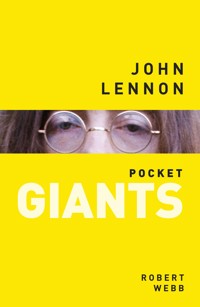
John Lennon is a giant of popular music and culture. As one-quarter of the Beatles, he was in the vanguard of music, art, fashion and popular culture during the sixties. His music, humour and outspoken calls for peace inspired a generation. He stands as an iconic figure for those who lived through the sixties and seventies, as well as for those who grew up long after his untimely death in 1980. Above all, Lennon was one of the twentieth century's greatest and most important songwriters. Songs he wrote with Paul McCartney, such as 'She Loves You' and 'A Day in the Life', define an era. Others he wrote alone, such as 'God', 'Help!' and 'Revolution', betray an often complex, contradictory and troubled character. Lennon was never one to hide his love away, nor his anger, nor his convictions. In 2000 his anthem 'Imagine' was voted the song of the millennium.
Sie lesen das E-Book in den Legimi-Apps auf:
Seitenzahl: 118
Veröffentlichungsjahr: 2016
Das E-Book (TTS) können Sie hören im Abo „Legimi Premium” in Legimi-Apps auf:
Ähnliche


















For Kathy, Barney and Arthur – all you need is love
Cover image © Getty Images
First published in 2016
The History Press
The Mill, Brimscombe Port
Stroud, Gloucestershire, GL5 2QG
www.thehistorypress.co.uk
This ebook edition first published in 2016
All rights reserved
© Robert Webb, 2016
The right of Robert Webb to be identified as the Author of this work has been asserted in accordance with the Copyright, Designs and Patents Act 1988.
This ebook is copyright material and must not be copied, reproduced, transferred, distributed, leased, licensed or publicly performed or used in any way except as specifically permitted in writing by the publishers, as allowed under the terms and conditions under which it was purchased or as strictly permitted by applicable copyright law. Any unauthorised distribution or use of this text may be a direct infringement of the author’s and publisher’s rights, and those responsible may be liable in law accordingly.
Ebook ISBN 978 0 7509 6911 6
Original typesetting by The History Press
eBook converted by Geethik Technologies
Contents
Introduction – A Giant of Popular Music
1 ‘Who am I Supposed to Be?’ – Childhood
2 ‘When You’re Crippled Inside’ – Quarryman
3 ‘Oh Yeah, I’ll Tell You Something’ – From the Cavern to the World
4 ‘Above Us Only Sky’ – Beatle
5 ‘Christ, You Know it Ain’t Easy’ – Acid, Apple and Yoko
6 ‘Now I’m John’ – Plastic Ono Band
7 ‘Whatever Gets You Thru the Night’ – Lost Weekends
8 ‘Strange Days Indeed’ – House Husband
9 ‘Through a Glass Onion’ – Legacy
Notes
Timeline
Web Links
Further Reading and Viewing
Introduction – A Giant of Popular Music
Life is what happens to you, while you’re busy making other plans.
John Lennon
(‘Beautiful Boy [Darling Boy]’)
I first became aware of John Lennon when my father brought home a plastic toy guitar. On it were etched the faces and signatures of the four Beatles. They grinned out from behind the multi-coloured nylon strings that soon snapped, rendering it useless as a musical instrument. The cadence of ‘John, Paul, George and Ringo’ was soon a familiar one to me. It was always ‘John’ first: he must have been the leader. I was now able to put faces to the records I had heard on the radio, songs that by 1964 were unavoidable to anyone with ears. I’d like to say that a John Lennon song was my favourite back then, but actually it was ‘All My Loving’, a brisk, walking blues by his bandmate Paul McCartney; the co-written ‘I Want to Hold Your Hand’ was a close second though.
By the seventies I was old enough to buy my own records and, although to begin with I knew McCartney’s output better, thanks to my cousin who bought everything and played it whenever we met, I was increasingly drawn to Lennon as the more controversial, and thus interesting, of the two ex-Beatles. The first of his solo albums I heard was Mind Games, the 1973 release which appeared to promote a ‘conceptual country’ Lennon called Nutopia. One track was the ‘Nutopian International Anthem’: three seconds of silence. That the dead space between tracks could also have titles was at least original. Elsewhere Mind Games was a fine little album, I thought – ‘rock at different speeds’, as Lennon put it.1
The more I listened to Lennon, the more intrigued I was. His music wasn’t always great and it varied enormously, from surreal pop, banner-waving anthems and gut-wrenching diatribes, to saccharine love songs and avant-garde. As the seventies unfolded into progressive rock, new wave and electronica, Lennon withdrew into fifties rock ’n’ roll.
Still, you knew that whatever form the music came in, Lennon meant it from the heart. So when I awoke on the morning of 9 December 1980 and heard back-to-back John Lennon songs on the radio, one after the other, punctuated by breaking news that he had been murdered in New York by a crazed fan, I was genuinely grief-stricken. Somehow, Lennon’s assassination meant more than just the passing of a musician, however famous he was. I kept thinking of the W.H. Auden line, written for W.B. Yeats, ‘What instruments we have agree/The day of his death was a dark cold day’.
As I discovered more about his backstage life – his early days, his time with the Beatles, his later years with (and without) Yoko Ono – he became a harder man to like as a person. Behind the scenes Lennon could be a monstrous egoist, cruel and selfish; but he knew this and worked out why, and addressed it as best a man of his generation and upbringing could. And sometimes he got it wrong. Over the years, this process of self-analysis was all too visible and audible. He made sure we were within earshot when he told Yoko, cloyingly so at times, how much he loved her. When he sat in bed with his new wife, naked and angry and in love, demanding that peace be given a chance, he did so with the world watching.
Lennon was one of the giants of the twentieth century. He dazzled us in the sixties and early seventies with brilliant, era-defining songs that will endure long after we are forgotten. He could have left it at that; but he also chose to speak out for what he believed in. He was an idealist and a dreamer who stood by his conviction that the world could – and should – be a better place. We forget that we only use the phrases ‘all you need is love’ and ‘give peace a chance’ because Lennon did.
1
‘Who am I Supposed to Be?’ – Childhood
I was hip in kindergarten. I was different from others. I was different all my life.
John Lennon
(in Sheff, All We Are Saying, p.156)
John Lennon will forever be associated with the city of Liverpool. It was where he lived for more than half of his relatively short life, where he drew his first breath, took his first steps and where he met his first loves. And the city, in turn, loved him back. In the 1960s, Lennon and the Beatles transformed the bustling, workaday Lancashire port into one of the most famous cities on the planet.
Between the wars Liverpool was thriving. It boasted over 7 miles of docks and a prosperous middle class, comfortable on the profits of maritime trade. The Stanley family lived in one the smartest residential areas, under the shadow of the city’s imposing Anglican cathedral.
George Stanley was a sailor turned respectable insurance investigator; his five daughters were anything but conventional. The Stanley sisters grew into a domineering, headstrong quintet. Mary, known to the family as Mimi, was the eldest. Then there was Julia, occasionally known as Judy. She was, according to her daughter Julia Baird, the most unusual and unpredictable of them all, often cast in later histories – somewhat inaccurately, as Baird has shown in her own book – as a frivolous, flirtatious woman.
It was the musically intrepid Julia who would in later years show her young son his first chords on the guitar. But before that, in 1938, she married a roving seaman, Alfred Lennon, the son of an Irish clerk and one-time music-hall entertainer. ‘That Alf Lennon’2 was immediately unpopular with the Stanley family and none of Julia’s sisters attended their register office wedding. Alf later claimed they married just for a laugh and that he took his bride to the cinema for their honeymoon. He was a mercurial character, establishing the pattern for the marriage by sailing for the West Indies within a week of the wedding, as a ship’s steward on board one of the luxury liners that plied the Atlantic.
Julia stayed at home, receiving visits from her husband whenever he was in the country. He was on shore leave at Christmas 1939, when Julia fell pregnant. The couple’s son was born at around 6.30 p.m. the following 9 October at Oxford Street Maternity Hospital. He was named John after his paternal grandfather. Liverpool, an obvious target for German bombers, had borne the brunt of aerial attacks that week. As a patriotic gesture Julia added a middle name borrowed from Britain’s redoubtable new prime minister.
John Winston Lennon spent his early years at the Stanley family home in Newcastle Road, at No. 9 (a digit that would recur throughout Lennon’s life, from the date of his birth to the day he died). The house was not far from the orphanage where Alf himself had grown up. John’s errant father was proving to be as unreliable as the other Stanley sisters feared he would, his frequent maritime jaunts putting further strain on his and Julia’s stuttering marriage.
When Julia met another man, John ‘Bobby’ Dykins, her sister Mimi – now, with the death of their mother, the matriarch of the family – was aghast. Julia was still married to Alf and her new home with Dykins – a small flat in the Gateacre district – was, in Mimi’s emphatic opinion, an unsuitable place to raise the toddler. Mimi demanded that John be handed over to her as Julia was no longer a fit mother. When Liverpool Social Services discovered that the 5-year-old didn’t even have his own bed, let alone a bedroom, they ruled in favour of the eldest sister and John was moved across town to Mimi’s semi-detached house, ‘Mendips’, at No. 251 Menlove Avenue. Mimi and her husband George Smith, childless themselves, welcomed John into their home and for the first time the youngster began to enjoy something of a settled childhood in the quiet suburb of Woolton.
When word reached Alf Lennon – always one to turn up like a bad penny, as the Stanleys would put it – the generally absent father invited John to spend some time with him at the seaside. Julia tracked the pair down to a boarding house in Blackpool. ‘She’d now got a nice little home and decided she wanted him,’3 Alf later recalled. Alf planned to take John with him to New Zealand and, he claimed, asked Julia to accompany them. She refused. They turned to John and asked him to choose. The boy was faced with a grave choice, the outcome of which would inevitably alter the course of his life: New Zealand with his father, or back to Liverpool with Julia. Initially, it looked as if Alf’s gamble had paid off. Without a moment’s hesitation, according to Alf, John turned to his father. Julia asked him once more and again he replied, ‘Daddy’. However when Julia rose to leave, dabbing her eyes, John ran to her. Easily resigned to the situation, Alf Lennon wouldn’t see his son again until the whole world knew his name.
John returned to Mendips and life with Aunt Mimi, now more determined than ever to ensure her young nephew was raised in a secure environment. He was encouraged by Mimi to read classics such as Just William, Alice’s Adventures in Wonderland and The Wind in the Willows. They sparked his imagination and John soon began scribbling verse and stories in his own notebooks, as well as compiling scrapbooks of cartoons and cuttings from magazines.
From 1951, increasingly he would spend time at the house his mother now shared with Bobby Dykins, a couple of miles across town. Julia loved spurring on her son’s artistic endeavours and introduced him to a world of music unheard in Mimi’s strait-laced household. They would jive around the lounge to Elvis Presley hits and it was Julia who later purchased John’s first Teddy Boy clothes: a coloured shirt, drainpipe jeans and coat. These were carefree days for Lennon, punctuated only by the unexpected death of Mimi’s husband George in 1955. John was devastated at the loss of his father figure.
At Quarry Bank High School, Lennon’s approach to learning was characterised by a rebellious spirit. His 1956 school report was littered with ‘could do better’ and ‘lacks effort’. ‘He has many of the wrong ambitions and his energy is too often misplaced’,4 concluded his head teacher. Chief amongst his distractions was the latest youth craze to sweep the country: skiffle, which involved strumming acoustic guitars and plucking tea-chest basses to the percussive rhythm of scraped washboards. It was Britain’s first do-it-yourself music; the only real instrument you needed was a guitar. Lennon ordered an acoustic model by mail order and Julia allowed it to be delivered to her address, rather than to his disapproving Aunt Mimi.
Ownership of a guitar was something of a coup for the ambitiously hip Lennon and in the late summer of 1956, he formed his own skiffle band, the Quarrymen, the name derived from a line in the Quarry Bank School song. The group’s repertoire comprised versions of songs made famous by Lonnie Donegan, Lead Belly, Hank Williams and other musical heroes. They landed their first gig in autumn 1956 at the local church hall, and more soon followed.
By the end of his last year at high school John had converted the Quarrymen from an accomplished but run-of-the-mill skiffle outfit into a would-be rock ’n’ roll band. This was inspired in part by a trip to the cinema. The Girl Can’t Help It was the influential movie of the day, starring Jayne Mansfield and showcasing the ‘teen’ sound of Little Richard, Gene Vincent, Eddie Cochran and others. Its screening at the city’s Scala Cinema in the summer of 1957 marked a pivotal moment in the development of Liverpool’s musical youth. Lennon had heard the future.
Another cinema-goer who loved rock ’n’ roll, and had even learned to play some of the songs by listening to Radio Luxembourg’s evening broadcasts and patiently working out the chords, was a lad from neighbouring Allerton: Paul McCartney.
2
‘When You’re Crippled Inside’ – Quarryman
That’s the music that brought me from the provinces of England to the world … I don’t know where we’d have been without rock ’n’ roll and I really love it.
John Lennon
(Beatles Anthology, p.11)




