


Erhalten Sie Zugang zu diesem und mehr als 300000 Büchern ab EUR 5,99 monatlich.
- Herausgeber: The History Press
- Kategorie: Sachliteratur, Reportagen, Biografien
- Sprache: Englisch
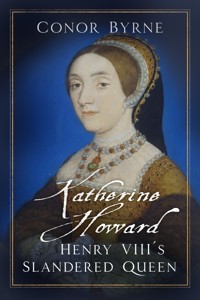
Over the years Katherine Howard, Henry VIII's fifth wife, has been slandered as a 'juvenile delinquent', 'empty-headed wanton' and 'natural born tart', who engaged in promiscuous liaisons prior to her marriage and committed adultery after. Though she was bright, charming and beautiful, her actions in a climate of distrust and fear of female sexuality led to her ruin in 1542 after less than two years as queen. In this in-depth biography, Conor Byrne uses the results of six years of research to challenge these assumptions, arguing that Katherine's notorious reputation is unfounded and redeeming her as Henry VIII's most defamed queen. He offers new insights into her activities and behaviour as consort, as well as the nature of her relationships with Manox, Dereham and Culpeper, looking at her representations in media and how they have skewed popular opinion. Who was the real Katherine Howard and has society been wrong to judge her so harshly for the past 500 years?
Sie lesen das E-Book in den Legimi-Apps auf:
Seitenzahl: 460
Veröffentlichungsjahr: 2019
Das E-Book (TTS) können Sie hören im Abo „Legimi Premium” in Legimi-Apps auf:
Ähnliche


















Front Cover: Portrait of a Lady, perhaps Katherine Howard (1520–42),Royal Collection Trust / © Her Majesty Queen Elizabeth II, 2018
First published 2019
The History PressThe Mill, Brimscombe PortStroud, Gloucestershire, GL5 2QGwww.thehistorypress.co.uk
© Conor Byrne, 2019
The right of Conor Byrne to be identified as the Author of this work has been asserted in accordance with the Copyright, Designs and Patents Act 1988.
All rights reserved. No part of this book may be reprinted or reproduced or utilised in any form or by any electronic, mechanical or other means, now known or hereafter invented, including photocopying and recording, or in any information storage or retrieval system, without the permission in writing from the Publishers.
British Library Cataloguing in Publication Data.
A catalogue record for this book is available from the British Library.
ISBN 978 0 7509 9158 2
Typesetting and origination by The History Press
Printed and bound in Great Britain by TJ International Ltd
eBook converted by Geethik Technologies
CONTENTS
Acknowledgements
Introduction: The Historiography of Queen Katherine Howard
1 Henry VIII’s Accession and the Howards
2 A Howard Queen
3 ‘His Vicious Purpose’: Manox and Dereham, 1536–39
4 ‘Strange, Restless … Years’: The Howards at Court, 1537–40
5 The Fourth Queen
6 Queen Katherine
7 Queenship, 1540–41
8 The Culpeper Affair
9 Disgrace and Death
Appendix I: Katherine Howard in Film and Television
Appendix II: Katherine Howard’s Age
Notes
Bibliography
ACKNOWLEDGEMENTS
THIS BOOK IS THE culmination of over five years of research into the life of one of England’s most defamed queens consort. When I began researching Katherine Howard’s brief life in 2012–13, very little had been written about her. Popular evaluations of her usually repeated sordid rumours of her sexual misdemeanours and the scandalous reasons for her execution after less than two years of marriage to Henry VIII. Katherine Howard: A New History (2014) aimed to redress these shortcomings in the extant writing about her; since then, two further biographies of Katherine have been published. Some of the theories I put forward in the 2014 biography have subsequently been adopted by other historians, including my agreement with Susan James that the portrait dated c. 1540–45 housed at the Metropolitan Museum of Art (reproduced in the images section of this book) may well be a likeness of Katherine painted during her brief period as queen.
This biography provides further insights into Katherine’s life and queenship, while responding to the latest scholarship concerning her. It stresses my initial conclusions that Katherine was neither adulterous nor a ‘juvenile delinquent’ who was solely responsible for, or deserved, her execution in 1542. My interpretation draws on and is informed by early modern perceptions of sexuality, fertility and gender, while providing additional evidence for her date of birth and portraiture. The present volume also offers a discussion of how Katherine has been represented in the medium of film and television. Essentially, republishing this biography has offered me a welcome opportunity of revisiting my earlier conclusions about Katherine’s brief life in the context of early modern gender relations. As this book indicates, I have long been fascinated by how Katherine has been represented, both during her lifetime and posthumously, by her contemporaries and by those living in the twentieth and twenty-first centuries. This book is as much a study of Katherine’s historiography and how she has been represented as it is a narrative and analysis of her life.
There are a number of libraries and archives that I wish to thank: in particular the University of Exeter Library, the National Archives at Kew, the Surrey History Centre, Cheshire Record Archive and Fleet Library. I want to thank the team at The History Press, especially Mark Beynon, for agreeing to take on my project and for providing invaluable support during the research and writing of this book. A number of individuals have encouraged my research and writing over the years: in particular my sixth-form teachers, Diana Laffin and Jo Chambers, who subsequently invited me to return to speak to A-level students about my experiences. I am immensely grateful for the opportunities that they have afforded me.
I must thank the lecturers, professors and teachers at the universities I attended who inspired me with their passion and knowledge of the past, especially those who specialised in early modern history and fuelled my fascination with the period. My research into Katherine Howard’s tragic life began in 2012, and I am very grateful to St Hugh’s College, Oxford, for responding so warmly to my initial research for their essay competition. I wish also to thank those who have encouraged me to write for their websites and publications over the years, including Natalie Grueninger (On The Tudor Trail), Susan Bordo (The Creation of Anne Boleyn), Olga Hughes (Nerdalicious), Moniek (History of Royal Women), Janet Wertman (Jane the Quene) and Debra Bayani (Jasper Tudor).
I would also like to thank my colleagues at the Universities of Exeter and St Andrews for publishing my research in their undergraduate academic journals and for working with me on the respective committees, whether as a writer or co-editor. I must also pay tribute to the many historians who corresponded with me over the years, with whom I discussed theories and whose work I continue to respect and enjoy, including among others Retha Warnicke, Alison Weir, Gareth Russell and Suzannah Lipscomb. Retha Warnicke, in particular, was very helpful in sharing her thoughts and research with me about Katherine.
And finally, thanks to those historians and researchers who have provided friendship and support in varying circumstances, including Melanie V. Taylor for providing both advice and editorial assistance, but also to my close friends and family outside of history who have been there for me when I have needed it.
INTRODUCTION
THE HISTORIOGRAPHY OF QUEEN KATHERINE HOWARD
In histories that treat men as three-dimensional and complex personalities, the women shine forth in universal stereotypes: the shrew, the whore, the shy virgin, or the blessed mother.
Retha M. Warnicke, The Rise and Fall of Anne Boleyn: Family Politics at the Court of Henry VIII (Cambridge, 1989).
It is not yet said who will be Queen; but the common voice is that this King will not be long without a wife, for the great desire he has to have further issue.
French ambassador Marillac writing to François I of France on 13 February 1542, the day of Katherine Howard’s execution.
FOLLOWING HER EXECUTION ON charges of high treason in February 1542, as the second of Henry VIII’s queens to be beheaded in less than six years, Katherine Howard was consigned to history as a flirtatious and irresponsible teenager who courted disaster through her reckless behaviour and adulterous liaisons with a succession of lovers under her ageing husband’s nose. Unlike Anne Boleyn or Katherine of Aragon, she has not proved to be a particularly popular subject among historians, almost certainly due to the briefness of her reign and the scarcity of wide-ranging source material. Despite this relative lack of interest, the historiography relating to Katherine is significant in offering insights into how the specific political and social context has informed interpretations of the career of Henry’s fifth queen. Exploring the historiography of Henry’s fifth queen is relevant, from the perspective of this biography, in indicating how problems of evidence and a lack of cultural awareness have often obscured understandings of Katherine’s story. To many, she remains the vain and unintelligent ‘bad girl’ who deceived her doting husband firstly by concealing her pre-marital past and secondly by actually cuckolding him after their marriage. It is worth emphasising, as Holly Kizewski noted, that ‘both detractors and defenders usually reduce Katherine to her sexuality’.1
The first contemporary writer to explore Katherine’s career in detail was the unknown author of The Chronicle of Henry VIII of England, more usually known as the Spanish Chronicle, which was probably composed ten years or more after the events it describes, by an unknown Spaniard living in London.2 Characterising Katherine as ‘more graceful and beautiful than any lady in the Court’ when she first met the king aged around 15, the chronicler created a sympathetic tale of true love, passion and premature death.3 This writer emphasised the queen’s youth, explaining that it created difficulties in her relationship with her elder stepdaughter Mary Tudor, before recounting how her ‘giddy’ nature guided her infatuation with Thomas Culpeper, who had been in love with Katherine before her marriage to the king.4 Downcast with his poor fortune, Culpeper supposedly wrote a letter to the queen which he passed to her while dancing with her, leading the queen to reply in encouragement. Revealing her secret love for Culpeper to a lady-in-waiting named Jane (perhaps inspired by Lady Jane Rochford), the queen was eventually arrested and charged with treason when that lady informed Edward Seymour about the relationship.5 Later, both the queen and Culpeper were beheaded, professing their love for one another on the scaffold.6 In this chronicle, no mention was made of Francis Dereham, Henry Manox or Jane Rochford, all of whom were implicated in the queen’s downfall and, with the exception of Manox, were executed alongside Katherine and Culpeper.
Other contemporary sources found Katherine a less interesting subject. Lord Herbert, writer of The Life and Raigne of King Henry the Eighth,7 spent at most four pages (in a work comprising over 600) on the brief queenship of Katherine, which was overwhelmingly focused on her downfall in 1541. Herbert concluded his brief account with the detail of Katherine’s execution alongside Lady Rochford.8 Nicholas Harpsfield, an English historian and Catholic apologist and priest writing during the reign of Katherine’s stepdaughter Mary I, scarcely mentioned Henry VIII’s fifth queen but recounted her ‘pain and shame’ at being found ‘an harlot before he [Henry] married her, and an adulteress after he married her’.9 Perhaps Harpsfield was aware of Katherine’s alleged conflict with her stepdaughter, whom Harpsfield surely admired as the restorer of what he perceived as true religion. George Cavendish, writing during the 1550s, similarly emphasised, as had the writer of The Chronicle of Henry VIII, Katherine’s ‘floryshyng … youthe with beawtie freshe and pure’. Cavendish made mention of Katherine’s youth several times in his narrative, while indicating that the queen’s ‘blazing beautie’ brought her ‘myschefe’. Believing, like the Spanish chronicler, that Katherine and Culpeper had indulged in a romantic or adulterous liaison, Cavendish wrote: ‘Culpeper yong, and I, God wott, but fraylle, we bothe to feeble our lusts for to resist.’ Culpeper allegedly ‘folowed [his] pleasure’ through his ‘pride and viciousnes’ in choosing to seduce Queen Katherine, which eventually resulted in his disgrace and execution.10 Nicholas Sander, who wrote a treatise attacking Henry VIII and the annulment of his marriage to Katherine of Aragon, ignored Katherine Howard entirely but for his dismissive comment that ‘but as the king was faithful neither to God nor to his first wife, so also his wives were not faithful to him’, explaining that Katherine had sexually sinned with both Francis Dereham and Culpeper.11 For Sander, Katherine’s betrayal of Henry constituted a form of poetic justice.
The first modern historian to discuss Katherine’s career in detail was Agnes Strickland, whose Lives of the Queens of England was published in twelve volumes between 1840 and 1848; her Memoirs of the Queens of Henry VIII followed in the 1850s. Undoubtedly influenced by pervading Victorian values, Strickland characterised Katherine’s life as ‘a grand moral lesson’, in which she condemned ‘the vanity of female ambition’ and Katherine’s personal ‘guilt’.12 Despite this judgemental analysis, Strickland seemed to view Katherine sympathetically, for she blamed the ‘polluting influence’ of individuals within the household of the dowager Duchess of Norfolk, who took ‘a fiendish delight in perverting the principles and debasing the mind of the nobly born damsel [Katherine]’.13 Strickland doubted that Katherine committed adultery with Culpeper, believing that the testimony of Katherine’s ladies was ‘unfavourable’ to their mistress and prompted by the ‘deadly malice’ of the enemies of the Howards.14 Strickland also remarked bitterly that ‘Katharine Howard was led like a sheep to the slaughter, without being permitted to unclose her lips in her own defence’.15
Henry Herbert’s short book on the queens of Henry VIII, published in 1860, similarly viewed Henry’s fifth queen with sympathy, believing that ‘history … has no sadder tale than this of the young, beautiful, unhappy Howard’, and remarking that ‘from the stones of the Tower yard, [her] blood still cries for vengeance’.16 Martin Hume, who edited The Chronicle of Henry VIII in which, as has already been noted, Katherine was presented as a youthful beauty who was forced to marry an ageing monarch despite her affections for his courtier Thomas Culpeper, suggested in his biography of Henry’s queens, published in 1905, that when she became queen Katherine was ‘a very beautiful girl of about eighteen’, who had participated in ‘immoral liberties’ with the musician Henry Manox ‘while she was yet a child, certainly not more than thirteen’, before she fell ‘deeply in love’ with Dereham. Hume concluded that Katherine ‘had erred much for love … but taking a human view of the whole circumstances of her life, and of the personality of the man she married, she is surely more worthy of pity than condemnation’.17
Lacey Baldwin Smith’s biography of Katherine in 1961, however, marked a watershed in the historiography of Henry VIII’s fifth queen, for it was the first full-length study of her and the circumstances of her brief tenure as queen. Like Strickland, Baldwin Smith was undoubtedly influenced by the social and cultural values present in his own day, while adhering to traditional gender stereotypes in his characterisation of Katherine. Believing that Katherine was guilty of adultery with Culpeper and thus deserving of her eventual fate, Baldwin Smith concluded that her life was ‘little more than a series of petty trivialities and wanton acts punctuated by sordid politics’.18 As with Strickland in the Victorian age, Baldwin Smith believed that Katherine’s life could be interpreted as ‘a lesson in Tudor morality’.19
In suggesting that Katherine was a tool of her ambitious family, Baldwin Smith indicated that she was orthodox in her religion and ‘naïvely credulous’.20 He argued that Katherine willingly and knowingly engaged in sexual relations with both Henry Manox and Francis Dereham, accepting the details of the indictments in which Katherine was presented as the instigator in both relationships – ‘That Catherine knew exactly what she was doing is undeniable’.21 Baldwin Smith stated that, during her teenage years, Katherine ‘was a bundle of contradictory passions and desires’ who was attractive, passionate, mercurial and giddy, who sought to advance her family’s fortunes at court.22 Believing that Katherine rashly committed adultery with Culpeper with the aid of Lady Rochford, Baldwin Smith concluded his study of the queen’s life with his pessimistic opinion of her:
The end would have been the same, history would have been unchanged, had she never lived or died … the Queen never brought happiness or love, security or respect into the world in which she lived. She enacted a light-hearted dream in which juvenile delinquency, wanton selfishness and ephemeral hedonism were the abiding themes.23
Baldwin Smith’s characterisation of the queen marked the beginning of a trend in which she was interpreted as a selfish hedonist who cared for nothing but her own pleasure.
Other modern historians have been similarly critical of Katherine’s behaviour. Because he accepted that Katherine was involved in a love affair with Culpeper, Eric Ives unfairly and incorrectly concluded that she had no respect for royal protocol.24 Alison Plowden, in her book Tudor Women: Queens and Commoners, published in 2003, believed that Katherine ‘possessed all the instincts of a natural tart who knew exactly what she was doing … having discovered the delights of sex, [she] saw no reason to settle for the first man who’d bedded her’.25 In 2010, Tracy Borman likewise argued that the ‘empty-headed’ Katherine ‘was far from the corrupted innocent she is often portrayed as. The evidence suggests that she was as much a sexual predator as Dereham and knew exactly what she was doing.’26 Alison Weir, in her 1991 biography of the six queens of Henry VIII, agreed with this interpretation of Katherine’s life, believing that Katherine was ‘certainly promiscuous’ before her marriage while, during her adulterous affair with Culpeper, she ‘had not only been playing with fire, but she had also been indiscreet about it, and incredibly stupid’.27 Similarly, in her biography of Henry’s wives, Antonia Fraser voiced some sympathy for Henry VIII’s fifth wife in suggesting that ‘a less moralistic age will feel more sympathy for girl whom the freak wave of the King’s desire threw up so cruelly ill-prepared on the exposed shore of history’, but nonetheless concluded that, in relation to Katherine’s involvement with Culpeper, ‘the repeated confessions and reports of clandestine meetings between a man notorious for his gallantry and a woman who was already sexually awakened really do not admit of any other explanation than adultery’.28 So apparently widespread has acceptance of Katherine’s love affair with Culpeper become that in his book The Queen and the Heretic, Derek Wilson indicated that Dereham and Culpeper were Katherine’s ‘bedfellows’ and ‘lovers’.29
These modern interpretations of her brief life and reign have been filtered through the prism of sexuality, leading to mostly negative conclusions about her character and actions. In his 2012 biography, David Loades proclaimed that ‘a biography is inevitably largely a study of her sexuality and its consequences’.30 Undoubtedly Loades had indicated that Katherine’s sexuality shaped his views on her in earlier books; in 2009, he thundered that Katherine ‘certainly behaved like a whore both before and after her marriage’.31 Believing that Henry VIII’s fifth consort ‘was a stupid and oversexed adolescent’,32 Loades concluded that her sexuality ‘was devious and manipulative’ and ‘fraudulent’.33 Unlike her predecessors, Katherine ‘had almost no redeeming feature’.34 It is interesting that Loades contrasted Katherine negatively with her four predecessors, especially Jane Seymour, without once considering that Katherine was significantly younger and less experienced in court protocol than Henry’s four previous queens were. Jane, for example, was at least 25 and possibly closer to 28 when she married the king in 1536. She and Anne Boleyn had resided at court for lengthy periods of time, while it hardly needs emphasising that Katherine of Aragon and Anne of Cleves were foreign princesses and were educated as such. Few historians have contextualised Katherine’s actions at court with regard to her age, education and duration of service to Anne of Cleves prior to marrying the king. One exception was Anne Crawford, who noted that ‘Katherine was not really in the same position as either her cousin Anne [Boleyn] or Jane Seymour … Katherine … was much younger, without experience, and with nobody to keep an eye on her’.35 Unfortunately, despite showing this awareness of the queen’s youth and inexperience in her analysis, Crawford concluded that Katherine was ‘a spoilt child’ and her downfall in 1541 ‘contained none of the tragedy or dignity of the end of Anne Boleyn’.36 As might perhaps be expected from his excessively harsh judgements, Loades failed to interpret her career in the context of sixteenth-century gender relations and sexual mores, while omitting to consider the contemporary evidence for her age, especially with regard to how old she might have been when her relations with Manox and Dereham took place during the mid to late 1530s. Concluding that she ‘may well have had others [lovers]’,37 for which there is no evidence whatsoever, Loades appears to have transferred the joint guilt of Katherine and her male admirers to her shoulders alone, without appreciating that she was 13 years old in 1536 and 15 in 1538, whereas Dereham was at least fourteen years her senior, as will become apparent. Her relations with Manox and Dereham took place in a social and cultural context that stressed female inferiority. Such misguided and one-sided perspectives on Henry’s fifth queen, which mostly seem to be informed by the author’s own attitudes to sexuality and gender, are thankfully no longer as prevalent in modern historiography.
Other historians have, for a variety of reasons and from a range of differing perspectives, interpreted Katherine’s life more sympathetically. Joanna Denny, in her 2005 biography, characterised Katherine as a ‘vulnerable and abused child of 11 or 12’ during her affair with Manox and agreed with Strickland that Katherine was strongly influenced by the examples of her childhood companions within the household of the dowager duchess, since she was ‘eager to be part of their inner circle and to be included in their romantic adventures’.38 Later, as ‘a precocious and knowing girl with an attractive figure’, Katherine indulged in a sexual relationship with Dereham, in what could be termed ‘persistent child abuse’.39 At court, the Duke of Norfolk manipulated his niece Katherine ‘to further his own political agenda’, for she was ‘the victim of a conspiracy between … Thomas Howard, Duke of Norfolk, and Stephen Gardiner, Bishop of Winchester’.40 As queen, Katherine engaged in an adulterous affair with Culpeper as a means of conceiving a child to pass off as the impotent king’s: ‘Katherine was urged to become pregnant as soon as possible, regardless of the paternity. Culpeper’s bastard could be passed off as the King’s legitimate son.’41 One would assume that the subtitle of Denny’s biography, A Tudor Conspiracy, alluded to this deceitful plan allegedly concocted by Katherine and Culpeper. Interestingly, Denny is the only biographer to actually suggest that Katherine attempted to cuckold the king by giving birth to another man’s son, for which there is no contemporary evidence whatsoever.
David Starkey, in his 2004 study of the six queens of Henry VIII, disagreed with the prevailing view that Katherine committed adultery with Culpeper in the physical sense. Agreeing with other writers that ‘she knew how to attract men with a skill beyond her teenage years’, Starkey believed that Katherine did not allow Manox to have sexual intercourse with her, ‘not out of virtue, but rather a fierce sense of Howard pride’.42 He was appreciative of her personal qualities, believing that, during her childhood, ‘she … displayed leadership, resourcefulness and independence’ as ‘a rebel without a cause’.43 Characterising the queen as a ‘love-sick Juliet’ during her relationship with Culpeper, Starkey interpreted their affair as ‘like a piece of romantic fiction’.44 Concluding that, while Katherine and Culpeper were strongly attracted to one another, they never engaged in sexual intercourse, Starkey perceived Katherine to be ‘a sympathetic figure’.45
Karen Lindsey’s feminist reinterpretation of the careers of Henry’s queens saw her agree with Starkey that a virtue can be discerned in ‘promiscuity’. Viewing the events of Katherine Howard’s life through a twentieth-century mindset of sexuality and femininity, Lindsey believed that ‘a lot of pity has been wasted on Henry VIII over Kathryn’s infidelity’, arguing that Katherine was ‘a woman who enjoyed both sex itself and the admiration she got from the men with whom she had her few sexual adventures’. Katherine ‘was a woman who listened to her body’s yearnings, and in spite of all she had been taught, understood that she had a right to answer those longings. She was willing to risk whatever it took to be true to herself.’46 By contrast, Retha Warnicke characterised Katherine as ‘a victim of sexual predators’ from the age of 13, believing that ‘in her short life, she had faced great adversity because of cultural attitudes toward human sexuality. Her male abusers seemed to assume that her reluctance to have sexual relations masked “interior consent”.’47 In 2016, Josephine Wilkinson similarly affirmed that Katherine was victimised by the ‘many persuasions’ of both Manox and Dereham, who took advantage of ‘her relatively lowly position’ in the household of the dowager Duchess of Norfolk. Both men ‘pestered’ Katherine ‘relentlessly’ and Dereham ‘forced himself upon Katherine’.48 Unlike Warnicke, who believed that Culpeper coerced the young queen, Wilkinson suggested that Katherine’s relationship with Culpeper was that of friendship, in which she relied on him to ‘provide … information about her husband’s health and his ever fluctuating moods’.49 By contrast, Gareth Russell’s 2017 biography, which disagreed with the arguments presented by Warnicke and later Wilkinson, offered a portrayal of Katherine’s character and motives that was closer to that presented in Baldwin Smith’s 1961 version of her life. While acknowledging that Katherine’s queenship has been interpreted as ‘shallow yet profane’, Russell concluded that she ‘probably did not commit physical adultery with Thomas Culpeper … but … adultery would have taken place had their liaison not been discovered in November 1541’.50 Russell’s conclusion is especially interesting in light of the extant evidence for Katherine’s relationship with Culpeper and her recorded remarks about their interactions, especially her insistence that Lady Rochford chaperone the handful of meetings that took place between queen and courtier. It is recorded that Katherine herself explicitly instructed Lady Rochford ‘bid him [Culpeper] desire no more to trouble me or send to me’, and dismissed him as a ‘little sweet fool’.
The extant historiography reveals, firstly, the emphasis that both contemporary authors and modern historians placed on Katherine’s sexuality. This is unsurprising in the sense that she was convicted and executed for intending to commit adultery with Culpeper – the act itself was suspected, never proven – but it limits the insights that can be achieved with regard to her brief tenure as queen. Moreover, it has fuelled the popular and salacious perception of her as a ‘bad girl’ (as Starkey characterised her in his 2004 biography). In almost every account of Katherine’s life, the author’s interpretation of her pre-marital liaisons and her subsequent association with Culpeper was informed by their own sexual attitudes. Yet ‘upon closer examination of the primary sources, Katherine appears to have been, at least outwardly, an almost “ideal” sixteenth-century Englishwoman, and the perfect queen to the aging king’.51 The dominant perception of her as a ‘bad girl’ who recklessly committed adultery, or intended to, and thus in a sense ‘deserved’ her beheading in 1542 ignores two critical realities: firstly, the exact nature of her relations with Culpeper remains uncertain and it will be argued in this biography that adultery was not committed and was probably not intended or welcomed by Katherine, even if Culpeper pressured her for it. Secondly, Katherine’s personal and political difficulties arose essentially because she failed to provide her husband with a male heir with which to secure the continuation of the Tudor dynasty. The unsavoury gossip that circulated about Katherine from early on in her marriage placed her in a difficult situation, especially when individuals from her youth, such as Dereham, arrived at court and openly boasted of their – often dubious – acquaintances with her. But this unfavourable political context could have proven negligible had Katherine delivered the much longed-for second son. These two essential circumstances have usually been marginalised, if not ignored, in accounts of Katherine’s brief life, in preference to representing her as a sexually immoral adulteress. Moreover, the extant historiography demonstrates that, while several historians have noted Katherine’s youth, they have not always factored this awareness into their analyses of either her pre-marital liaisons or her actions as queen. As an illustration of how significant Katherine’s youth is – or should be – in modern analyses of her life and queenship, she was the youngest woman to become Queen of England in almost 100 years.
Only in recent years have historians recognised the importance of analysing Katherine’s life from the perspective of gender, which pays attention to how both her biological sex and sixteenth-century conceptions of womanhood influenced the nature of her career and her ultimate downfall. This study will interpret her life in the context of sixteenth-century social customs and cultural values, focusing on Katherine’s experiences from a gendered perspective, which focuses on attitudes to sexual relations, fertility customs and early modern gender mores. It will probe the mostly fragmentary surviving evidence for insights relating to fundamental questions which should be considered: why was it, for instance, that highborn women within the Henrician court were readily expected to play critical roles in raising their family’s fortunes and prestige, yet were vulnerable to accusations of heinous crimes such as witchcraft or adultery by male contemporaries in unfavourable political and religious climates who may have feared these women’s alleged power? Why were sexual relations often attributed to the licentiousness and moral failings of women rather than men? What led to women being frequently blamed and condemned for failures in pregnancy and childbirth, resulting in accusations of sorcery or witchcraft? And why have documents, including both letters and interrogations produced by the Crown, often been read transparently and uncritically, rather than situating them in the context of early modern legal, religious and social mores?
In asking such questions through analysis of contemporary evidence, this biography seeks to address lingering misconceptions and myths concerning Henry VIII’s fifth queen, who was executed in 1542 for sexual crimes perceived to be treasonous to her husband and, by extension, to the state. Interpreting such sources from a gendered viewpoint illuminates the extent to which early modern men feared and mistrusted their female contemporaries, whom they associated with unrestrained, even deviant, sexuality and the ability to bewitch or inflict ill upon men. As a result, this study will conclude that not only Katherine but her four predecessors were at least partly victims of what will here be termed fertility politics: their ability, or in four cases inability, to provide a male heir to solve the paranoid if understandable issues surrounding the Tudor succession. From the moment that she married Henry VIII in July 1540 to her shocking downfall in November 1541, court rumours and gossip circulated about Katherine’s alleged pregnancies, which indicates how her childbearing role as Henry’s consort was perceived to be central to her queenship. It underpinned whether she was perceived to be a successful consort; ultimately her childlessness – the reasons for which are still not clear – placed her in a vulnerable position. The belief that she committed adultery with Culpeper in 1541 may have encouraged some court observers to conclude that she was attempting to pass off Culpeper’s bastard as the king’s legitimate child. Some historians, including Joanna Denny, have argued that this attempt to produce a child – irrespective of who the father was – accounts for Katherine’s secret meetings with Culpeper.
With this political and cultural context in mind, it will be argued that the prevailing modern notion of Katherine Howard as an immoral young woman who recklessly took several lovers under her ageing husband’s nose is unconvincing. While it is unlikely that her reputation will ever be fully restored, it is important to challenge the prevalent and ultimately sexualised interpretation of her as a ‘juvenile delinquent’ or ‘empty-headed wanton’. These condemnatory opinions of Katherine mean that it is possible to regard her as Henry VIII’s slandered queen, a woman whom Lacey Baldwin Smith argued lacked supporters ‘because she was shallow and brittle, arrogant in success and servile in distress’.52
It is worth emphasising, however, that this biography does not pretend to offer a definitive account of Katherine Howard, mainly because the evidence is fragmentary and much of it is no longer extant. She remains one of the more shadowy of Henry VIII’s queens, understandably so in view of the brevity of her tenure as consort and because of how young she was when she died in 1542. From their recorded actions, letters, personal possessions and patronage, we can know a great deal about Katherine of Aragon, Anne Boleyn and, to a certain extent, Katherine Parr. This is much less true in the case of Katherine Howard. The reader is warned, therefore, that much of Katherine’s life and character remain unknown and may never be recovered from the lost fragments of history. This study is as much an examination of her historiography, that is, the ways in which she has been represented in modern analysis, as it is a straightforward biography of her life. The biography also makes no apologies for examining the tenures of Anne Boleyn, Jane Seymour and Anne of Cleves in the period 1533–40, for they have direct bearing on Katherine’s experiences as queen and the context in which she married the king, while also shedding light on the political fortunes of the Howard family in the years prior to her marriage. It is impossible to fully understand her life without this political and religious context.
Ultimately, Katherine only became Queen of England because of her husband’s failed marriage to Anne of Cleves, and one could argue that the rejection of Katherine of Aragon, the downfall of Anne Boleyn and the unexpected death of Jane Seymour also, in the long term, paved the way for Katherine Howard to become the king’s wife in 1540. Irrespective of the incomplete historical record, she remains one of England’s most slandered queens, and this biography attempts to offer a fairer and more sympathetic version of her brief life.
1
HENRY VIII’S ACCESSION AND THE HOWARDS
THE ACCESSION OF HENRY VIII to the throne of England in 1509 was viewed positively by his expectant subjects, ushering in hopes of dynastic stability following the devastation caused by the Wars of the Roses in the previous century. Henry’s accession was the first time in some eighty years that the crown had passed directly from king to son without the challenge presented by a pretender, and, in an attempt to enhance his lineage and improve his international standing, he decided to marry the Spanish princess Katherine of Aragon, the widow of his elder brother Arthur. Indeed, ‘great provision was made for the … costly devices of the other [Henry VIII] with that virtuous Queen Katherine, then the king’s wife, newly married’.1
Those present at court in the early years of Henry VIII’s reign were unanimous in their praise of him. The Venetian ambassador Sebastian Guistinian opined that ‘nature could not have done more for him … He is much handsomer than any sovereign in Christendom; a great deal handsomer than the King of France, very fair and his whole frame admirably proportioned’.2 That same ambassador went on to record in 1514:
His Majesty is the handsomest potentate I ever set eyes upon: above the usual height, with an extremely fine calf to his leg, his complexion very fair and bright, with auburn hair combed straight and short in the French fashion, and a round face so very beautiful that it would become a pretty woman, his throat being rather long and thick.3
Such statements offer revealing insights into sixteenth-century perceptions of masculinity and kingship, for they indicate that the ideal of early modern kingship extolled virtuous masculinity, demonstrated through a rigorous physicality combined with an almost godly beauty, which Henry personified to foreign observers visiting court. The apparently unanimous praise of England’s new king was at least partly influenced by the ambivalence, if not dislike, with which the English had viewed Henry’s father, Henry VII, the first Tudor king. Although he has perhaps unfairly been represented as a miser, there is no doubt that Henry VII lacked the charisma and personal charm that endeared his son to his subjects.
Katherine of Aragon, Henry’s queen, would have been well aware of her marital duties, for the expectation at the sixteenth-century English court was, as it would have been elsewhere in the courts of Europe, that she would present her husband with several sons in order to ensure the continuation of the ruling dynasty and prevent the dynastic bloodshed and civil war that would be caused by her failure to bear a son. Indeed, Katherine had no better example than her own family; her only brother, Juan, had died as a teenager, plunging the Spanish succession into turmoil. The repercussions of that in the long term were to prove problematic, with conflict occurring between Katherine’s father, Ferdinand of Aragon, and her brother-in-law Philip, husband to her sister Juana, as to who had the stronger claim to the throne of Castile.4 It was imperative that Queen Katherine present the new king with male heirs in order to preserve the stability of the Tudor lineage in England. Indeed, having been married to Henry VII’s ill-fated heir Arthur for a period of five months in 1501–02, Katherine would have appreciated the concerns and fears of Henry VIII. Both of them were aware that a ‘spare’ male heir was always necessary in case the firstborn died, as had proved to be the case in 1502.
At the time of Henry VIII’s succession, several English noble families could claim royal blood through their descent from Edward I. The most prominent was the Howard family, whom one author lyrically wrote of thus:
What family pervades our national annals with achievements of such intense and brilliant interest as the Howards? As heroes, poets, politicians, courtiers, patrons of literature, state victims to tyranny and revenge, they have been constantly before us for four centuries … No story of romance or tragedy can exhibit more incidents to enchain attention or move the heart, than might be found in the records of this great historical family.5
At least to begin with, the Howard family were viewed with suspicion if not hostility by Henry VII and later his son, for the 1st Duke of Norfolk, father of the present Thomas Howard, Earl of Surrey, had died fighting for Richard III, the last Yorkist king, at Bosworth in 1485. Surrey, however, successfully placated the hostility of the Tudors directed towards the Howard dynasty by publicly demonstrating his loyalty and support of the ruling royal family. As a consequence, by 1501 – the date of Katherine of Aragon’s first marriage to Arthur, Prince of Wales – Surrey’s lands in East Anglia could be valued at £600 a year and he had risen to Lord Treasurer of England. Surrey conclusively proved his loyalty to the Tudors through his victory against the Scots at Flodden in 1513 at the age of 70.6 Indeed, ‘long before the Howards won back their ancient titles, the family had been systematically fortifying its political and social position through marital alliances with the most vigorous and distinguished families of the century’.7 This was amply demonstrated in Surrey’s achievement of a marriage alliance in 1495 between his heir and Anne of York, sister of Queen Elizabeth. As a demonstration of his intimacy with, and value to, the Tudor dynasty, Surrey was also closely involved in the marriage negotiations of Henry VIII’s younger sister Mary Tudor to Charles of Castille in 1508 when that princess was aged 12.8
Surrey was to act as effective head and representative of the Howard family until his death in 1524, leading to the succession of his eldest son Thomas, Lord Treasurer since 1522, to the dukedom of Norfolk and estates worth over £4,000 per annum.9 Thomas was one of three sons and two daughters born to Surrey and his second wife Elizabeth Tilney who lived to adulthood. Thomas Howard became Earl of Surrey in February 1514, with an annuity of £20 per annum, receiving two castles and eighteen manors in Lincolnshire in ‘consideration of the timely assistance he rendered his father … at the Battle of Branxton, 9 Sept. last. This creation is made on surrender by the said Duke [of Norfolk] … of the title of Earl of Surrey.’10 In 1513 Surrey’s influence increased further through his marriage alliance with the 15-year-old Elizabeth Stafford, daughter of Edward, 3rd Duke of Buckingham, thus further glorifying the prestige of the Howard lineage through its alliance with this noble English family. The Howard–Stafford alliance proved short lived, however, for the 3rd duke was to be executed for treason against the king in 1521, with his own father-in-law, the Duke of Norfolk, presiding as Lord High Steward of England at his trial.11
Thomas Howard, Earl of Surrey and later 3rd Duke of Norfolk, remains a controversial figure, with one author emphatically describing him as a ‘monster … ruthless in his cold-blooded use of those around him, including the members of his own family [who were] just pawns for his ambition’.12 This is, however, to view the events in the mid Tudor period with hindsight and a lack of awareness of political and social norms among the English nobility in the sixteenth century. Indeed, one Venetian ambassador lauded Thomas’s ‘liberal, affable and astute’ personality and his desire to associate with anyone regardless of social origins.13 He was experienced and shrewd, as well as pragmatic in setting aside his Roman Catholic faith in order to achieve the will of the king through his ‘versatile and inconstant humour’, according to the Spanish ambassador.14
Thomas’s younger brother Edmund, born around 1478, was comparatively less successful in his ability to equal, or surpass, his elder brother’s achievements at court and his closeness to the king, on which much depended in the way of attaining political and financial prestige and preferment. Edmund had still managed to demonstrate his loyalty and usefulness to the English crown through commanding some 1,500 men from Cheshire, Yorkshire and Lancashire at Flodden in 1513, where he was knighted by his father as a reward for his courage.15 One popular verse thereafter ran thus: ‘And Edmund Howard’s lion bright / Shall bear them bravely in the fight.’16 Despite this martial achievement, Edmund never managed to gain the trust and support of Henry VIII that was readily, if intermittently, granted to his elder brother. He was, however, granted a pension of 3s 4d daily, terminated three years later.17 Edmund had also fought in the jousts in 1511, held to celebrate the birth of Henry VIII’s son by Katherine of Aragon. Starkey’s dismissive view of Edmund as ‘a man of no importance’ is somewhat misguided, for it may not have been so much his personal characteristics as his relative state of economic poverty following the death of his father Norfolk in 1524 that limited Edmund’s ability to live and perform as a successful nobleman at the Henrician court.18
However, Edmund’s situation was somewhat improved by his appointment to the lucrative position of Comptroller of Calais in 1531, perhaps as a result of the intercession of his niece and Henry’s wife-to-be Anne Boleyn, which he held until his death in 1539. Notwithstanding this, the king’s disfavour for Edmund was demonstrated when he was elected mayor by the assembly of Calais in August 1537, when the Lord Privy Seal Thomas Cromwell quashed the election, since ‘the King will in no wise that my lord Howard be admitted to the mayorality’.19 According to John Hussey, the agent of Lord Lisle at Calais, ‘my Lord Comptroller [Edmund] is not contented because he was not admitted Mayor, your lordship shall right well abide his malice’.20
By 1515 Edmund had married Joyce Culpeper, born in 1480 to Sir Richard Culpeper of Oxenhoath, Kent. Married at the age of 12 to Ralph Legh, Joyce brought considerable assets to her marriage with Edmund for both the Legh and Culpeper families held substantial lands in Kent, Surrey and Sussex.21 Notwithstanding this, the Legh family were well aware of Edmund Howard’s financial difficulties and understandably viewed with concern his ability to successfully keep a wife in a lifestyle sufficient to her status and lineage. Unsurprisingly, in his will dated 16 June 1523, John Legh, stepfather of Joyce, wrote that ‘if the Howards trouble the Executors they are to have nothing. If any others make trouble the difficulty to be expounded and ordered by Sir Richard Broke Knight of Kings Bench John Rooper the Kings attorney John Spylman Serjeant at law and Roger Legh.’22 The birth date of the eldest son, Henry, probably named for the king, is unknown but seems to have been relatively early in the marriage, perhaps in 1515 or the year after, with two additional sons, Charles and George, following at some point before 1527.23 These sons may have spent their childhoods residing in the households of their Howard relatives in East Anglia and perhaps within the household of their step-grandmother, Agnes Howard, the dowager Duchess of Norfolk.24 The eldest daughter, Margaret, was born to Edmund and Joyce by 1518, probably earlier, for she is known to have married Sir Thomas Arundell of Wardour Castle in November 1530.25 Legally, girls could marry at 12 years of age in sixteenth-century England, but it was unusual for them to do so. In view of this, one would expect Margaret to have been aged at least in her mid teens when she wed Arundell in 1530.
Thereafter, two younger daughters were born to Edmund and Joyce: Katherine and Mary, probably born in about 1523 and 1525 respectively, although without conclusive evidence it is impossible to be certain. The birth date of 1520–21 for Katherine was favoured by early historians, but this is almost certainly incorrect for it relies on the French ambassador Charles de Marillac’s apparent suggestion that the queen was aged around 18 in 1539. However, since that same ambassador was certainly incorrect about the respective ages of both Anne of Cleves (believing her to be 30 when she was in fact 24) and Margaret Pole, countess of Salisbury (stating that she was 80 when she was only 67), his remarks on women’s ages must be viewed with caution, if not scepticism, and cannot be uncritically relied on when considering Katherine’s exact age when she attracted the attention of Henry VIII.26 For an extended discussion of Katherine’s date of birth, which draws on several years of research and includes a reinterpretation of the French ambassador’s comments on Katherine’s age, see Appendix II. The exact birth order of the six children born to Edmund and his wife is unknown, but since Katherine was appointed a maiden of honour to Queen Anne of Cleves in 1539, rather than her sister Mary, it would seem likely that she was the second of the three daughters. Where the children were born is a matter of mystery, though some sources indicate Lambeth in London, the seat of the Howard family.27
At an unknown date, Edmund’s wife Joyce died, likely in her late forties, although she appears to have still been alive in 1527.28 It has been surmised that she may have died in childbirth, especially since it is apparent that women living in the mid sixteenth century were able to bear children into their early fifties according to the Spanish ambassador Eustace Chapuys, although it cannot be known for certain whether this actually was the context in which Joyce died.29 In 1527, Edmund’s financial problems, compounded by the birth of six children by his wife, led him to complain to Cardinal Thomas Wolsey and assert that, were it not for his noble status, he would gladly ‘dig and delve’ in order to remedy his poverty.30 By her first marriage Joyce had borne five children, which worsened Edmund’s economic difficulties since he was expected to provide for them as well as for his own. By 1528 Edmund had married Dorothy, widow to Sir William Uvedale of Wickham, who was a landholder of some substance in Hampshire; this marriage may have perhaps led to Edmund’s appointment to the commission of peace for that county in 1531.31 It is possible, therefore, to interpret Edmund’s regional influence as transferring from Kent, where his first wife’s lands and wealth had been based, to Hampshire by virtue of his second marriage. Following Dorothy’s death, Edmund married Margaret Jennings, daughter of Markeaton Hall in Derbyshire, by whom he had no further issue.
Before she was sent to the household of her step-grandmother, the dowager Duchess of Norfolk, it is reasonable to suppose without any other surviving evidence that Katherine was brought up in the household of her stepmother while her father performed his duties in Calais. According to Gerald Brenan and Edward Statham, following the death of her mother, Katherine lived with her maternal aunts: in Oxenhoath with Margaret or in Teston with Elizabeth Barham.32 It is more likely, however, that Katherine grew up with her stepmothers Dorothy and Margaret respectively, for surely Edmund would have intended these women to act as mothers to his infant daughters. Following the death of a parent in the early modern period, and the subsequent remarriage of the surviving parent, children were accustomed to referring to their new step-parent as ‘father’ or ‘mother’ irrespective of their personal feelings on the matter. Henry VIII’s daughter Elizabeth, for instance, addressed Katherine Parr in a 1545 letter as ‘your hithnis humble doughter’. Katherine’s own personal relations with her parents are impossible to ascertain, although whether or not they were similar to those recorded by a fifteenth-century Venetian in London as follows is possible, if ultimately unknown:
The want of affection in the English is strongly manifested towards their children, for having kept them at home until they arrive at the age of seven or nine years at the utmost, they put them out, both males and females, to hard service in the houses of other people, binding them generally for another seven or nine years.33
An immediate difficulty apparent with analysing Katherine’s childhood is the fact that, as has been stated, ‘much of the evidence about them [women] … was compiled or invented by men and rests on male assumptions’.34 It is essential to appreciate how Katherine, as a young aristocratic girl in early Tudor England, was harnessed to meet the ambitions and hopes of the Howard family at a young age. By 1531 it is likely that Katherine had been ‘put out’ by her father into the household of her step-grandmother Agnes, dowager Duchess of Norfolk, at Chesworth in Horsham, aged 7 or 8; as the Venetian visitor commented, young children – both male and female – were usually placed outside the home by this age.35 In 1531, as noted, Edmund Howard was granted the controllership of Calais, which may have led to the dispersing of his household in England in order to reduce expenses. At the same time, a vacancy in the dowager duchess’s household arose when her ward, Katherine Broughton, married the dowager duchess’s son Lord William Howard.36 Edmund undoubtedly would have viewed his daughter’s entry into the dowager duchess’s household as an honour. At an early age, aristocratic girls were instructed in the necessary skills of household management and in feminine pursuits, such as singing, dancing and learning musical instruments, which enhanced their attractiveness to potential suitors.37 Usually, the girl’s mother was deemed responsible for providing her daughter with this ‘informal’ education, although attendants and mistresses of the household also played a part.38 As has been suggested, ‘elite parents regularly placed their children in the homes of wealthier or better-connected friends and relatives to complete their educations and extend their personal contacts’, with Agnes, dowager Duchess of Norfolk specifically performing this function for Katherine and three other grandchildren.39 Because no mention in the interrogations during Katherine’s downfall was made of a nurse or supervisor at Horsham, except for Katherine’s step-grandmother, it is therefore possible that she was in her pre- or early teens, around 12 or 13, when she began receiving music lessons from Henry Manox in 1536, since she seemed to lack a governess.40
According to contemporary customs in the mid Tudor period and the expectations of her Howard relatives, which undoubtedly interacted closely with one another in a symbiotic relationship, it was reasonable, even ideal, for Katherine to live in her step-grandmother’s household and obtain an education of sorts which focused on the aforementioned ‘feminine’ skills. The date of 1523 is thus more convincing as Katherine’s birth date since, had she been aged 13 or older in the mid 1530s, it is likely that her uncle, the Duke of Norfolk, and perhaps her father would have sought an appointment at court for Katherine as a maiden in the household of her cousin, Queen Anne, who married Henry VIII in early 1533.41 Proponents of a 1520–21 birthdate cannot explain why Katherine’s ambitious relatives apparently failed to seek an appointment for her in the household of Anne Boleyn or Jane Seymour between 1533 and 1537 when, according to their theory, she would have been aged between 13 and 17. The most reasonable solution to that conundrum would be that she was not born as early as 1520–21. Dwelling in an environment with other young relatives who performed tasks for the dowager Duchess of Norfolk in return for lodging and sustenance, Katherine must have been aware of the importance of maintaining her family’s honour through virtuous maidenly behaviour. The values which Katherine could expect to learn and emulate, intended specifically for young females, were as set out in How the Good Wife Taught Her Daughter: ‘Reverence thy father and mother as Nature requires … Wipe thy mouth when thou shalt drink ale or wine on thy napkin only … Blow not your nose in the napkin where ye wipe your hand.’42 In view of this context, alongside the fact that Katherine’s father was constantly occupied in Calais, the suggestion that ‘it was an evil hour for the little Katharine, when she left the paternal roof and the society of the innocent companions of her infant joys and cares, to become a neglected dependant in the splendid mansion of a proud and heartless relative’ is demonstrably incorrect.43 Her appointment to the household of the dowager Duchess of Norfolk was entirely conventional in the context of sixteenth-century aristocratic society, and it presented a range of opportunities to her that she would have been expected to understand and appreciate.
It is apparent that women within the Howard family were able to play important and sophisticated political roles as a means of consolidating and enhancing their family’s prestige and furthering its influence both at court and outside of it, which is relevant in understanding Katherine’s subsequent career both before and after she married Henry VIII in 1540. Perhaps the most obvious and inspiring example to Katherine would have been Anne of York, younger sister of Queen Elizabeth (wife to Henry VII) and wife of Thomas Howard, 3rd Duke of Norfolk, who as sister-in-law to Henry VII not only ‘represented an important step’ in the rehabilitation of the Howard family but brought this noble family closer to the Tudors, something which was to provoke the hostility and suspicion of the royal family who remained insecure about their dynastic future.44 This couple’s closeness to the Tudors was further enhanced in July 1510, when Henry VIII granted his aunt and Thomas Howard land in several counties as compensation for the land claimed in right of Anne’s great-grandmother Anne Mortimer, wife of Richard, earl of Cambridge.45 The fact that Anne was in constant attendance on her sister the queen also helped to ensure that Thomas’s influence was represented in court affairs, his wife actively symbolising the Howard family’s political and financial interests within the queen’s privy chamber and strengthening the opportunity for the Howards to attain favour from the Tudors through their connection with the ruling family.




