


Erhalten Sie Zugang zu diesem und mehr als 300000 Büchern ab EUR 5,99 monatlich.
- Herausgeber: The History Press
- Kategorie: Sachliteratur, Reportagen, Biografien
- Sprache: Englisch
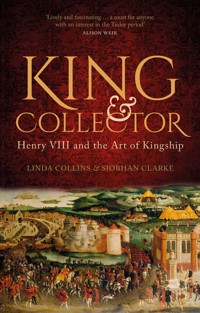
'Packed with absorbing detail and brilliant insights ... I was gripped from the first paragraph.' - Alison Weir No English king is as well-known to us as Henry VIII – famous for his six marriages, for dissolving the monasteries and for the ruthless destruction of his foes. But Henry was also an ardent patron of the arts, whose magnificent tapestries and paintings adorned his lavish court and began the Royal Collection. In contrast to later royal collectors, Henry was more interested in storytelling than art for its own sake, and all his commissions relate to one central tale: the glorification of the king and his realm. Henry's life can be seen through his collection and the works reveal much about both his kingship and his insecurities. King and Collector tells this unique story of art and power, peeling back the layers of propaganda to show the true face of the Tudor monarch.
Sie lesen das E-Book in den Legimi-Apps auf:
Seitenzahl: 235
Veröffentlichungsjahr: 2021
Das E-Book (TTS) können Sie hören im Abo „Legimi Premium” in Legimi-Apps auf:
Ähnliche


















Linda Collins: With thanks to my husband John for his invaluable support and endless cups of tea.
Siobhan Clarke: To my darling, Roger Pheby, for your encouragement and endurance of all things Henry.
First published 2021
The History Press
97 St George’s Place, Cheltenham,
Gloucestershire, GL50 3QB
www.thehistorypress.co.uk
© Linda Collins & Siobhan Clarke 2021
The right of Linda Collins & Siobhan Clarke to be identified as the Authors of this work has been asserted in accordance with the Copyright, Designs and Patents Act 1988.
All rights reserved. No part of this book may be reprinted or reproduced or utilised in any form or by any electronic, mechanical or other means, now known or hereafter invented, including photocopying and recording, or in any information storage or retrieval system, without the permission in writing from the Publishers.
British Library Cataloguing in Publication Data.
A catalogue record for this book is available from the British Library.
ISBN 978 0 7509 9624 2
Typesetting and origination by The History Press
Printed in Turkey by Imak
eBook converted by Geethik Technologies
CONTENTS
Foreword by Florian Schweizer
Foreword by Brett Dolman
List of Illustrations
Introduction: Pictures and Patterns of a Merciless Prince
1 Father and Son: Henry VII and Henry VIII
2 From War to Diplomacy: The Early Years
3 Painted Jewels: Miniatures and Stained Glass
4 The Break from Rome: Stoning the Pope
5 The King’s Painter: Hans Holbein at Home and Abroad
6 Images of Heroes: The Whitehall Mural
7 Magnificence and Propaganda: The Abraham Tapestries
8 Painting a Dynasty: The Family of Henry VIII
9 Death and Memorial: The Body of Henry VIII
10 The Royal Collection: Henry VIII and Afterwards
Appendix: List of Art Works and Treasures
Bibliography
LIST OF ILLUSTRATIONS
p. 23The Family of Henry VII with St George and the Dragon, Flemish school, c. 1503–09, oil on panel. Hampton Court Palace, London. Royal Collection Trust/© Her Majesty Queen Elizabeth II 2020
p. 27 Portrait of Henry VII by an unknown Netherlandish artist, 1505, oil on panel. National Portrait Gallery, London. © Photosublime/Alamy
p. 31 Henry VIII when a young boy (?) by Guido Mazzoni, c. 1498, painted and gilded terracotta. Royal Collection Trust/© Her Majesty Queen Elizabeth II 2020
p. 37Tomb of Henry VII and Elizabeth of York by Pietro Torrigiano, 1509, black marble and gilt bronze. Westminster Abbey, London. © Angelo Hornak/Alamy
p. 43The Battle of the Spurs, Flemish school, c. 1513, oil on canvas. Hampton Court Palace, London. Royal Collection Trust/© Her Majesty Queen Elizabeth II 2020
p. 47The Battle of the Spurs (detail), Flemish school, c. 1513, oil on canvas. Royal Collection, Hampton Court Palace, London. © Peter Barritt/Alamy
p. 53The Field of the Cloth of Gold, English/Flemish school, c. 1545, oil on canvas. Royal Collection, Hampton Court Palace, London. © GL Archive/Alamy
p. 63 Portrait of Henry VIII by Lucas Horenbout, 1525, body colour on vellum on card. Fitzwilliam Museum, Cambridge. © Bridgeman Images
p. 72 Stained-glass window of King Henry VIII by an unknown Flemish craftsman, 1526. St Margaret’s Church, Westminster. © Holmes Garden Photos/Alamy
p. 73 Stained-glass window of Katherine of Aragon by an unknown Flemish craftsman, 1526. St Margaret’s Church, Westminster. © Holmes Garden Photos/Alamy
p. 79 Portrait of Cardinal Wolsey by Sampson Strong, 1610–11, oil on panel. Magdalen College, Oxford. © Bridgeman Images
p. 85A Protestant Allegory by Girolamo da Treviso, 1538–44, oil on panel. Hampton Court Palace, London. Royal Collection Trust/© Her Majesty Queen Elizabeth II 2020
p. 93 Self-portrait by Hans Holbein the Younger, 1542–43, coloured chalks and pen on paper. Uffizi Gallery, Florence. © FineArt/Alamy
p. 103 Portrait of the Merchant George Gisze by Hans Holbein the Younger, 1532, oil on oak panel. Gemaldegalerie, Berlin. © Granger Historical Picture Archive/Alamy
p. 107 Portrait of Anne of Cleves by Hans Holbein the Younger, 1539, oil and tempera on parchment mounted on canvas. Musée du Louvre, Paris. © GL Archive/Alamy Stock Photo
p. 113 Copy of The Whitehall Mural by Remigius van Leemput, c. 1667, oil on canvas. Royal Collection, Hampton Court Palace, London. © The Picture Art Collection/Alamy
p. 119 Cartoon for The Whitehall Mural by Hans Holbein the Younger, 1536–37, ink and watercolour drawing. National Portrait Gallery, London. © Granger Historical Picture Archive/Alamy
p. 129The Sacrifice of Isaac from The Story of Abraham series, attributed to Pieter Coecke van Aelst, 1540–43, wool and silk. Hampton Court Palace, London. Royal Collection Trust/© Her Majesty Queen Elizabeth II 2020
p. 143The Family of Henry VIII, English/Flemish school, c. 1545, oil on canvas. Royal Collection, Hampton Court Palace, London. © Art Collection/Alamy
p. 151 Engraving of William Somers by Francis Delaram published in 1789. Private Collection. © Bridgeman Images
p. 165 Henry VIII in old age by Cornelis Metsys, c. 1548, line engraving. National Portrait Gallery, London. © Classic Image/Alamy
p. 173Sketch of Henry VIII’s Vault in St George’s Chapel by Alfred Young Nutt, 1888, watercolour on paper. St George’s Chapel, Windsor. © Windsor Chapel Archives
p. 195 Portrait of Her Majesty Queen Elizabeth II by an unknown artist, c. 1953, coloured photograph. Private Collection. © Heritage Image Partnership Ltd/Alamy
FOREWORD
BY FLORIAN SCHWEIZER
Learning about the arts should always be an enriching and satisfying experience. Crucial to that experience are inspiring narrators who can breathe life into the stories of the past that are captured in art and material culture. It is a real joy to be in the presence of experts who not only understand their subject matter but also the audience they are sharing their knowledge with. Patricia Fay, the founder of The Arts Society, always insisted that learning should be enjoyable. This is still an ideal we aspire to in all we do at The Arts Society today, and in this book we find much that readers will enjoy.
Linda Collins and Siobhan Clarke bring a magnificent and dreadful king to life through the visual medium of his paintings, and in doing so create an impression of knowing the man more intimately. Henry VIII left a collection of not just valuable gold and jewels, but smaller and more personal items such as toothpicks and bandages for his legs.
Holbein’s drawings of Henry’s court create the cast of a Tudor play in which the twists and turns of the plot were often deadly. We can look into the faces of men and women whose last memory before facing the scaffold may well have been the cold and frigid eyes of King Henry himself.
To read this book is to become more personally acquainted with this tyrannical Tudor king through images of him painted by the people who knew him.
‘The Art of Kingship’ is indeed an apt subtitle for this little book that offers us an enormous visual slice of Henry’s life. It is presented in a human context of which Patricia Fay would almost certainly have approved.
Florian Schweizer CEO, The Arts Society
FOREWORD
BY BRETT DOLMAN
Back in 1537, when Hans Holbein the Younger put down his brushes and paints and stood back to admire his latest creation, he would not have known that his portrait of Henry VIII, full-size and confrontational, staring down from the wall of the Whitehall Palace Privy Chamber, would become the most iconic royal portrait in English history.
Holbein’s Henry VIII is immediately recognisable to us as a statement of the unforgiving, brutish power of the Tudor dynasty. We can look through and beyond the portrait (with the benefit of hindsight and from the distant safety of the twenty-first century) to uncover the terror and magnificence of the Tudor age. We can glimpse the luxurious hubris, the paranoid authority and the unforgiving justice of Henry VIII’s reign. Art reveals the past.
And Tudor art is more than just Holbein’s portrait. The first half of the sixteenth century was a rich and revolutionary period when England attempted to embrace the Renaissance, enticing continental artists across the Channel to add cultural lustre and modernism to Henry’s court. At the same time, teams of artists and craftsmen were employed on a startling range of artistic endeavours, from heraldic decoration to mural cycles celebrating the achievements of the Tudor monarchy.
This is a book about Tudor art, but also the stories within and around each artwork, from the history paintings that eulogised Henry VIII’s early military campaigns in France through to the Abraham tapestries, commissioned towards the end of his reign, that were as much a vindication of the King’s political and religious choices that shaped early modern England as they are stunning Renaissance artworks, still jewels in the Royal Collection and on display at Hampton Court Palace today.
In their account, the authors have succeeded where many others have failed. Art has not been reduced to mere illustration; it becomes an immersive gateway into an exploration of Tudor culture, political symbolism and spirituality. We also have a well-matched account of Henry himself – the nature of his kingship, his ambitions, achievements, failures, frustrations and insecurities – and we follow his path from ebullient masquer and triumphant jouster to the crippled, irascible tyrant. For Henry VIII, art was both an integral part of what has been called ‘the swaggering theatre of court life’ and a personal statement about his magnificence, sophistication and dynastic power. He commissioned, collected and consumed art.
From the audacious scale and ambition of the ephemeral architecture on display at the Field of Cloth of Gold to the exquisite quality and detail of English miniature portraiture, this book traces the dazzling range of artistic achievements of Henry VIII’s reign, along with contextual and technical insights to help the reader navigate this very different visual world. Through the text and the artworks, we can glimpse a lost world of bejewelled courtiers and palaces drenched in the colour and symbolism of sixteenth-century art and craftsmanship, as well as understand what it meant to Henry VIII and the Tudor art of kingship.
Brett Dolman Curator (Collections), Historic Royal Palaces
INTRODUCTION
PICTURES AND PATTERNS OF A MERCILESS PRINCE
IF ALL THE PICTURES AND PATTERNS OF A MERCILESS PRINCE WERE LOST IN THE WORLD, THEY MIGHT ALL AGAIN BE PAINTED TO THE LIFE OUT OF THE STORY OF THIS KING
SIR WALTER RALEIGH
WHITEHALL PALACE, SPRING 1537. The assistants have stretched the drawing over the wall of the great privy chamber and pounced charcoal dust into holes they have pricked around the outline. Pigments and varnishes, purchased from London apothecaries, stand ready alongside an array of brushes, made from the hair of hogs and squirrels’ tails.
A 40-year-old foreigner crosses the chamber casually; he is accustomed to the magnificence of gilded panelling, costly tapestries, shining tiled floors and brilliant moulded ceilings. He is extremely well dressed for an artist, but this is no ordinary craftsman. There is a hush as he removes his fur-collared gown, changes into a paint-stained doublet and starts to roll up his linen shirtsleeves. Everyone stands back when the drawing is removed from the wall and the dots of charcoal left behind show the outline of a man, massive and menacing. Another hush. Hans Holbein is about to paint Henry VIII into history.
No English king is as well known to us as Henry VIII. He is famous for six marriages, for breaking with the Pope, dissolving the monasteries and creating the Church of England, and for his ruthless elimination of those who stood in his way. Between 1509 and 1547, more English notables were executed than under any other monarch before or since. But he was also an enthusiastic patron of the arts who established the most magnificent court ever seen in England.
No English monarch ever owned as many houses or spent so lavishly. His palaces, tapestries and paintings enriched the Tudor court and began the Royal Collection, but in contrast to later royal collectors, Henry was not interested in works of art or artists for their own sake. He was interested in storytelling through art, displaying his wealth, and promoting his own agenda.
‘Art’ is not a term that would have been recognised in early sixteenth-century England. An artist was simply a craftsman who shared the same status as a carpenter or a saddler and with an earning potential well below that of a goldsmith or silversmith. The whole concept of ‘painting a painting’ was alien in England. There was no ‘art for art’s sake’ and the Italian idea of an artist being a ‘genius’ was almost unknown.
Most painters in this early Tudor age were employed in producing decorative work that would not have been intended to endure – signwriting, inn signs, banners, coats of arms and painted cloths. Artists employed at the royal court were required to produce stage scenery for court masques and heraldic emblems within the palaces. Even decorating the royal barge would have been included in their job specification. Due to its ephemeral nature, only a small amount of this kind of production is left to us.
Later in the Tudor period, art began to appear in public spaces, in town halls and livery companies, and in domestic homes; to own a portrait of the monarch was to show allegiance to the Crown. In a century rife with theological dispute, pictures of people tended to survive where overtly religious works did not, but even a conservative estimate assumes that 40 per cent of the portraits produced in the reign of Henry VIII are lost. We should therefore be aware that we are judging the genre on what we have left, rather than on what was produced within its time.
Before 1540 the majority of portraits commissioned were of royalty or the aristocracy, but from then onwards the merchant classes began to contract with artists to produce painted images. This has something to do with affluence, but it was also a leap in self-confidence. In only one generation, families advanced to the point where they wanted and were able to imitate the fashions of the royal court.
In his pursuit of glory and magnificence, Henry VIII has left us with a collection that has continued to grow. Until the Civil War and the execution of Charles I – during which many works were put up for sale – the Royal Collection that Henry founded was the equal of any great collection in Europe. Today, it comprises over 1 million objects including more than 7,000 paintings and over 2,000 tapestries, plates, engravings, books, clocks and furniture.
Those objects acquired by Henry VIII tell the story of his life and reign. It is the story of a boy who was not expected to become king and who grew into a man yearning to show off his prowess in warfare. In The Battle of the Spurs we see a young king, in his early 20s, impatient to fight. Seven years later in the large picture The Field of the Cloth of Gold Henry is learning the art of diplomacy. A Protestant Allegory presents Henry’s version of the break from Rome, and the Whitehall Mural shows us an intimidating king at the height of his power who has defied the Pope. The art of miniature painting became popular in Henry’s reign and, with the arrival of Hans Holbein the Younger, the fashion for portraiture began. In his search for a fourth queen, Henry chose Anne of Cleves on the strength of a portrait by Holbein, although he later regretted his decision. These images still have the power to bewitch centuries later, though for different reasons. There is a fascination with portraiture in general that may stem from the ability to look at the face of a person who was alive in the past. We can know the excitement of looking at someone who looked into the eyes of Henry VIII. The glorious Abraham tapestries embody the splendour and propaganda of the Tudor dynasty and The Family of Henry VIII, set in a sumptuous Whitehall Palace, portrays an older Henry, presiding over his dynasty and its secure continuation. Finally, an engraving of the king in old age, by Cornelis Metsys, shows us a man in decline, but a man who to the end employed magnificence as a symbol of his authority.
The life of Henry VIII – his passion and power – can be seen through his art collection. The paintings he commissioned tell us much about his kingship and (unintentionally) his insecurities. Ultimately, each of the works told some aspect of one central story: the glorification of Henry and his England.
1
FATHER AND SON: HENRY VII AND HENRY VIII
THE GREAT DEBATE, COMPETITION AND GREAT QUESTION IS WHETHER FATHER OR SON IS THE VICTOR.
FOR BOTH, INDEED, WERE SUPREME
WHITEHALL MURAL
HENRY VIII WAS BORN at Greenwich on 28 June 1491, the second son of Henry VII and Elizabeth of York. He passed his early years happily at Eltham Palace, playing in the royal nursery with his sisters and learning his letters from his mother. The young prince would grow up tutored in both the rationalism of the new humanist learning and the romance of medieval chivalry. He read Jean Froissart’s Chronicles and Sir Thomas Malory’s Le Morte Darthur with his first tutor, the poet John Skelton; stories which glorified personal combat and the pure code of honour for all true knights. This code would be crucial to Henry’s sense of self for the rest of his life. Unsurprisingly, his favourite personal hero was Henry V, the English king who vanquished the French at Agincourt in 1415.
Henry saw little of his brother, Arthur, who was five years his senior. Upon Arthur’s sudden death in 1502, Henry became heir to the throne and went to live at court with his father. According to chroniclers, the king underwent a change of character in his later years: he became more secretive and avaricious, extracting money from his subjects through bonds and fines. His behaviour became erratic, with long bouts of illness and sudden rages, and his relationship with young Henry was distant.
English history is full of conflicts between the monarch and the heir to the throne. The prince who took Arthur’s place was a boisterous youth, highly educated and athletic, who looked like his Yorkist ancestors. We are given an insight into the outgoing temperament of Henry VIII as a child by Desiderius Erasmus, who met him at Eltham Palace in the company of fellow humanist writer Sir Thomas More:
In the midst stood prince Henry, then nine years old, and having already something of royalty in his demeanour, in which there was a certain dignity combined with singular courtesy. More … presented [Henry] with some writing. For my part, not having expected anything of the sort, I had nothing to offer, but promised that on another occasion I would in some way declare my duty towards him. Meanwhile I was angry with More for not having warned me, especially as the boy sent me a little note, while we were at dinner, to challenge something from my pen.
However, in the company of Henry VII, the boy seems to have been more subdued. It may have come as a shock to find that life at his father’s court was very restrictive. He was closely monitored and protected by bodyguards, his movements limited even within the palaces. The Spanish Ambassador described him as ‘so subjected that he does not speak a word except in response to what the king asks him’. Henry VII may have feared that discontented elements might make his son a figurehead for rebellion; or perhaps he was simply being overprotective of his only surviving male heir. Over thirty years later, Henry VIII would make clear the relationship between father and son in the Whitehall Mural, with a statement in the Latin inscription: ‘The great debate, competition and great question is whether father or son is the victor. For both, indeed, were supreme.’
Henry VII had used painters, stonemasons, illuminators, poets and historians to project himself as the legitimate King of England through regal image-making. His claim to royal blood was tenuous, derived from his mother Margaret Beaufort, who was descended from Edward III. Henry Tudor had taken the crown by force in 1485, after defeating Richard III at Bosworth Field. His subsequent marriage to King Richard’s niece Elizabeth of York had done much to heal his war-torn kingdom, but there were still discontented elements and rivals to his throne. The new Tudor king needed propaganda to bolster his position. He understood that the illusion of power and wealth was as important as the real thing and was prepared to spend lavish amounts on royal palaces and tapestries. Portraits were mainly commissioned for display at court or for diplomatic purposes. Henry VII’s use of them differed little from that of his immediate predecessors, the Plantagenet Houses of York and Lancaster, who produced portraits to send to foreign courts or to advertise themselves in the marriage market. Images of the king might also be placed within a religious setting, to emphasise how his position was legitimised by his relationship with God and the Church; for example, in The Family of Henry VII with St George and the Dragon.
THE FAMILY OF HENRY VII WITH ST GEORGE AND THE DRAGON
Flemish school, c. 1503–09, oil on panel, Royal Collection Trust
The story of St George varies, but the most popular version is told in Jacobus de Voragine’s Golden Legend, written in 1292. Voragine was a Dominican chronicler who became Archbishop of Genoa. The scene takes place in a small settlement in Libya, represented in the painting by the exotic towers in the background. A fearful dragon occupied a lake in Silene and threatened to enter and destroy the town, looking for food. To prevent this, every day the dragon was provided with a sheep. When all the sheep in the area had been consumed it was decreed the creature should be fed a child. Lots were drawn to select the unlucky victim.
One day, the short straw was chosen by the king, who was expected to give up his daughter, the beautiful Princess Cleodoline. He offered all his gold in her place, but the townspeople refused so the maiden was clothed in regal finery and led towards her death. The lamb with her, in the painting, represents the sacrificial lamb, suggestive of martyrdom. Just as she was about to be fed to the dragon, St George witnessed her plight and pierced the monster’s neck with his lance – but he stopped short of killing it and tied it to a tree instead. Turning to the people of the town, George told them that if they converted to Christianity then he would save them from further bloodshed. When the whole town pledged to convert, St George slayed the dragon.
The Family of Henry VII with St George and the Dragon. Probably an altarpiece, possibly for Richmond Palace.
In most paintings of St George and the dragon, the creature is pictured on the ground with St George towering above him. However, in this version, the two adversaries are facing each other. They are eye-to-eye and – unusually – the dragon is slightly higher than St George. A broken lance lies discarded on the ground; clearly, the battle is not yet won.
St George was patron saint of England and one of the three saints of the Order of the Garter, a group of honourable knights. Tudor roses abound in this composition, and the resemblance between St George, protector of England, and King Henry VII, defender of his land and people, would not have been missed by the contemporary viewer.
In the lower half of the painting two campaign tents are held aloft by tiny angels. Tudor roses again decorate the tents, along with the portcullis, the symbol of Henry’s mother, Margaret Beaufort. Within the tents are the family of Henry VII, the males on one side and the females on the other. A larger angel grasps the flaps of the tents in each of his hands, visually uniting the family.
The scene is a reminder of the fragility of life. Henry VII died soon after the painting was completed, and of the princes kneeling behind him only Prince Henry was still living. His older brother, Arthur, had been dead for seven years and his youngest brother, Edmund, had passed away at only a year old. On the female side, Henry’s queen, Elizabeth of York, died following the birth of their daughter Catherine in 1503. Two of the princesses were still living, but two of them, Elizabeth and Catherine, had died as babies.
The children who died in infancy have been painted into the picture as if they had lived. The Tudor dynasty was in its early days and the need for a fruitful marriage with a large family and a string of healthy male heirs and beautiful princess brides was required to reinforce a message of strength and continuity. The painting may have been intended as an altarpiece for Richmond Palace, but there are no signs that it had adjoining wings, which would make it an extremely early example in England of a single panel altarpiece. More likely, it would have been placed on a wall behind the altar.
EARLY PORTRAITS
The Tudors were possibly the first English rulers whose faces were familiar to their subjects, and Henry VIII’s desire to be regarded as a European monarch led to his image being disseminated far more widely than that of his predecessors.
The term ‘portrait’ was unknown and painted images were referred to as a ‘counterfeit’ or a ‘duplication’ because they copied the image of a person who was absent. Every portrait in early Tudor England was painted for a specific occasion – to display wealth, power and status or to mark an important event in the life of the sitter. There was no concept in England that art could be purchased purely as decoration for the home. Portraits of men dominated the genre; there were fewer pictures of women and fewer still of children.
HENRY VII
Unknown Netherlandish artist, 1505, oil on panel, National Portrait Gallery
Portraits of Henry VII, Elizabeth of York and their daughter Margaret Tudor were sent to James IV in 1502, during negotiations for Margaret’s marriage with the Scottish king. Three years later, an unknown Flemish artist completed an impressive and lifelike portrait of Henry VII, now a widower. The inscription confirms that the portrait was painted on 29 October 1505 on the order of Herman Rinck, an agent of the Holy Roman Emperor, Maximilian. It was part of Henry’s attempt to marry Maximilian’s daughter, Margaret of Savoy, as his second wife.
Margaret of Savoy’s life had been turbulent. Her mother died when she was just 2 years old and, having made an alliance with Louis XI, her father sent her to live at the French court, to be raised as a future Queen of France. However, she was returned to Burgundy aged 13 and, four years later, she married Prince Juan of Spain. It was a union marred by tragedy. Margaret appears to have loved her husband, but he died after just six months and their first child was stillborn. She married again, aged 21, to Philibert, Duke of Savoy, but within three years, he too died, leaving her childless. Not surprisingly, she vowed never to marry again. Her court in Mechelen, a city between Brussels and Antwerp, gained a reputation for education and elegance. Anne Boleyn, Henry VIII’s second wife, would later spend time there before moving to the French court. It is against this background that the 25-year-old Margaret of Savoy was asked to consider Henry VII as a potential husband.
King Henry, now 48, had lost his eldest son three years before and his wife had died following childbirth. We are looking at a man in mourning, but also at a king searching for a political alliance to strengthen his rule and his country.
This portrait of Henry VII by a Netherlandish artist dates from 1505 and is the earliest painting in the National Portrait Gallery’s collection.




