


11,99 €
Mehr erfahren.
- Herausgeber: Luath Press
- Kategorie: Sachliteratur, Reportagen, Biografien
- Sprache: Englisch
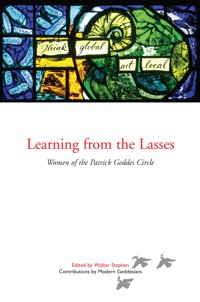
In his time his revolutionary ideas appealed to women and he was surrounded by more than a generation of clever and forceful women. One who could say that 'life is not really a gladiators' show; it is rather a vast mothers' meeting!' could not fail to attract followers. WALTER STEPHEN Patrick Geddes - Sociologist, Town Planner, Biologist, Peace Warrior. It is well known that this extraordinary Scot shaped the cityscape of Edinburgh, but for the first time Walter Stephen turns the lens onto the strong, wilful women who influenced the revolutionary man - and who were in turn influenced by him. From his wife and mother in Scotland, to a nun in India and a Marchioness in Ireland, this insightful volume shows the wide range of women across the globe whose lives intertwined with Geddes's, whether professionally or personally. Delving deeper into Geddes's personal life than ever before, Walter Stephen and his fellow Modern Geddesians go beyond the surface of the Scotsman's acclaimed works to reveal the female characters that shaped him throughout his life. Contributors include: Veronica Burbridge, Sian Reynolds, Anne-Michelle Slater, Kenny Munro, Swami Narasimhananda, Sofia Leonard, Kenneth MacLean, Robert Morris and Kate Henderson. A well-researched and thoughtfully written book. SCOTTISH REVIEW OF BOOKS on The Evolution of Evolution [The book] makes the reader realise in what esteem Geddes should be held, not just in Scotland, but across the globe. LALLANS MAGAZINE on A Vigorous Institution
Das E-Book können Sie in Legimi-Apps oder einer beliebigen App lesen, die das folgende Format unterstützen:
Seitenzahl: 423
Veröffentlichungsjahr: 2014
Ähnliche

















WALTER STEPHENcould not proceed beyond GeologyIat Edinburgh University due to colour blindness – the analysis of crystals and subtle maps were hidden worlds for him. Degrees in Geography, Economic History and Education qualified him as an academic jack-of-all-trades with a lifelong devotion to environmental awareness and understanding. One of his achievements was the establishment and operation for 20 years of Castlehill Urban Studies Centre, the first successful Urban Studies Centre in Britain.
Latterly he has taken up Interesting Victorians. A former Chairman of the Sir Patrick Geddes Memorial Trust, he has been responsible forThink Global, Act LocalandA Vigorous Institution, collected essays on Patrick Geddes. In his introduction to the new edition ofA Herd of Red Deerhe brought out the importance of Frank Fraser Darling as the founder of ecology and forerunner of David Attenborough. InThe Evolution of EvolutionWalter Stephen sets Darwin at the centre of a circle of Interesting Victorians. All four books, plus his biography ofWillie Park Junior: The Man who took Golf to the WorldandWalter’s Wiggleswere published by Luath Press.
Learning from the Lasses
Women of the Patrick Geddes Circle
Edited by WALTER STEPHEN
LuathPress Limited
EDINBURGH
www.luath.co.uk
First published 2014
eBook 2014
ISBN: 978-1-910021-06-4
ISBN (eBook): 978-1-909912-92-2
The publishers acknowledge the support of Creative Scotland towards the publication of this volume.
The author’s right to be identified as author of this work under the Copyright, Designs and Patents Act 1988 has been asserted.
© the contributors 2014
Contents
Acknowledgements
Modern Geddesians
Preface
Introduction
CHAPTER ONE The Mother
Janet Stivenson(Geddes) (1816–98)
WALTER STEPHEN
CHAPTER TWO The Big Sister
Jessie Geddes(1841–88)
WALTER STEPHEN
CHAPTER THREE ‘Three little girls with a school are we…’
The Geddes Sisters, Jane, Margaret and Charlotte
WALTER STEPHEN
CHAPTER FOUR PG’s First Garden
Mrs Helen Nutt
WALTER STEPHEN
CHAPTER FIVE Wife and Pillar of Strength
Anna Morton(Geddes) (1857–1917)
WALTER STEPHEN
CHAPTER SIX Sympathy, Synthesis and Synergy
Patrick Geddes and the Edinburgh Social Union
VERONICA BURBRIDGE
CHAPTER SEVEN Women of the Watergate
PROFESSOR ROBERT MORRIS
CHAPTER EIGHT Failure in Dundee?
Mary Lily Walker, Patrick Geddes and the Dundee
Social Union
VERONICA BURBRIDGE
CHAPTER NINE A Dreamer’s Daughter
Norah Geddes(Mears) (1887–1967)
WALTER STEPHEN
CHAPTER TEN ‘A troublesome assistant who will not be dismissed’
Mabel M Barker(1885–1961)
KENNETH MACLEAN
CHAPTER ELEVEN Marie Bonnet and Jeanne Weill (aka Dick May)
Two women from the Geddes French Circle before 1914
SIÂN REYNOLDS
CHAPTER TWELVE The Noble Patroness Lady Aberdeen
(1857–1939)
ANNE-MICHELLE SLATER
CHAPTER THIRTEEN A suffragette and her passage to India
Annie Besant, Theosophist(1847–1933)
KENNY MUNRO
CHAPTER FOURTEEN Sister Nivedita, The Dedicated
The Ardent Student
SWAMI NARASIMHANANDA
CHAPTER FIFTEEN Professor Mary Jacqueline Tyrwhitt: 1905–1983
SOFIA LEONARD
CHAPTER SIXTEEN The Patrick Geddes Memorial Panel
KATE HENDERSON
Picture Plate Section
Geddes Chronology
Select Bibliography
Patrick Geddes: Extract fromWho’s Who, 1930
Think Global, Act Global
Acknowledgements
As Editor my first pleasure is to recognise the authority and professionalism of the team of Modern Geddesians who have contributed toLearning from the Lasses.Handling such a mettlesome team might have been a stressful experience. In the event, each contributor produced a readable and authoritative chapter in good time. The individual contributors have thanked those with whom they worked.
I now wish to acknowledge the support received in respect of the book as a whole.Learning from the Lasseshas been accepted by the City of Edinburgh Council as part of its contribution to International Womens Year 2014 and the Lord Provost, The Rt Hon Donald Wilson, has contributed a Preface.
We are fortunate in being surrounded by great institutions, whose staff are not only efficient but sympathetic.
The following illustrations are reproduced by kind permission: Fig 2 (Aberdeen University Library), Fig 8 (City of Edinburgh Libraries), Fig 11 (Dundee City Archives), Fig 9 (Edinburgh City Archives), Fig 6 (National Library of Scotland), Fig 13 (Perth Museum), Fig 12 (University of Edinburgh), Fig 1 (University of Strathclyde). Figs 17–21 are reproduced by kind permission of Ernest Press and Williamina C Barker. Plate 4Ais reproduced by kind permission of Artwork Brett Housego, Dundee.
The Appendix fromWho’s Who 1930is reproduced by kind permission of A&C Black Publishers Ltd.
The image of the Patrick Geddes Memorial Panel on the cover is reproduced by kind permission of Kate Henderson.
Walter Stephen
Modern Geddesians
VERONICA BURBRIDGE
Veronica Burbridge continues to do research in retirement. As Director of the Royal Town Planning Institute in Scotland she was responsible for organising the annual Sir Patrick Geddes Commemorative Lecture. She has recently been involved in helping to restore the Maclagan family graveyard, Laggan Wood, Comrie.
KATE HENDERSON
Kate Henderson is an artist based in East Lothian who specialises in stained glass and painting. She was invited to submit a proposal and then commissioned to create the Patrick Geddes stained glass panel in 2005. The panel is situated in the new headquarters of Edinburgh City Council on Market Street.
She greatly admires Geddes’s forward thinking and his approach to the importance of art in society. She finds his Reference to ‘Place, Work and Folk’ an exciting format which has inspired her to create a new series of glass work.
SOFIA LEONARD
Sofia Leonard is a Fellow of the Sir Patrick Geddes Memorial Trust and former Director of the Patrick Geddes Centre for Planning Studies, University of Edinburgh.
As a student of the International Planning Institute of Lima, she worked in multidisciplinary teams on planning projects at a regional scale using Patrick Geddes’s Valley Section as the main tool. Required reading includedCities in Evolutionby PG in its translated version into Spanish.
She worked at the National Planning Office of Peru on the design, planning and implementation on the First New Town for 40,000 people in Peru. In Edinburgh she worked for three years for Percy Johnson Marshall & Associates in the Plan for the Porto Regional Plan, Portugal, based on the principles of Patrick Geddes. The Plan was approved and implemented by the Portuguese government. Until retirement she worked for 14 years with the unsorted papers of Sir Patrick Geddes from the Outlook Tower, to protect them for posterity.
KENNETH MACLEAN
Kenneth Maclean was formerly Principal Teacher of Geography at Perth Academy. Now retired, he still maintains an interest in the history of geographical education, a subject replete with references to the role and significance of Geddes and his ‘disciples’. In common with other geography teachers, perhaps the main impact of Geddes upon his teaching was to encourage as much fieldwork as time, staffing, finance and resources permitted.
ROBERT MORRIS
R J Morris is Emeritus Professor in Economic and Social History, Edinburgh University. He was president of the European Urban History Association in 2000–2002 and is President of the Economic and Social History Society of Scotland and editor elect of theBook of the Old Edinburgh Club. He has written extensively on the British middle classes, on urban history in industrial England, in Scotland and in Ireland. Geddes is always a contributor to any urban history. Current research into the rebuilding in the Old Town of Edinburgh finds an active place for Geddes.
KENNY MUNRO
After graduating in Sculpture from Edinburgh College of Art and The Royal College of Art, London he attended the Oslo Summer School in 1976, established by Philip Boardman, a student of Patrick Geddes in France.
A former Chairman of Edinburgh Sculpture Workshop. Promoting his ‘field-work’, educational exchange arts projects and films he has followed theGeddes Trailto the Scots College, Montpellier, France and significantly three expeditions to India have helped raise awareness of historic Indo– Scottish connections and current work with The Green Wave Art Centre in Kolkata. He is a director of thePGMT.
SWAMI NARASIMHANANDA
Swami Narasimhananda is a monk of the worldwide twin-organisation Ramakrishna Math and Ramakrishna Mission started by Swami Vivekananda. He is the city editor ofPrabuddha Bharata, an English journal founded by Swami Vivekananda in 1896. He writes regularly on philosophy, social sciences, religion, Indology, and Ramakrishna-Vivekananda, and Vedanta. He edits books in English, Hindi, and Sanskrit published from Advaita Ashrama, Kolkata, India, a publication house of the Ramakrishna Math. He has edited a compilation of Swami Vivekananda’s teachings –Vivekananda Reader.He also translates old Sanskrit texts hitherto unpublished in English.
While doing research on Sister Nivedita and unearthing more unpublished letters written by her, Swami Narasimhananda came upon many letters written to Sir Patrick Geddes and Anna Geddes showing the extent of influence of Geddes’s thought on Nivedita. Since Vivekananda had also met Geddes, it became an interesting subject of study.
Swami Narasimhananda is actively involved in formulating an Indian perspective on various disciplines of humanities and social sciences, especially Philosophy, Religious Studies, Comparative Religions, and Sociology of Religion. He interacts with academia and others to create an academic framework from the Indian standpoint away from a mere transplantation of external thought. In this he brings into play, various methodologies of Geddes as understood and further developed by Nivedita. This is an ongoing effort and much work is to be done.
SIÂN REYNOLDS
Siân Reynolds is Emerita Professor of French at the University of Stirling. She has explored Patrick Geddes’s networks and enterprises in France, in several articles and in her bookParis-Edinburgh: Cultural connections in the Belle Epoque(2007). She also helped organise the exhibition ‘Patrick Geddes: the French Connection’ at the Scottish National Portrait Gallery in 2004.
ANNE-MICHELLE SLATER
Anne-Michelle Slater is currently the Head of the Law School at the University of Aberdeen. She is a planning law specialist with a particular interest in the development of marine spatial planning. Patrick Geddes and his ideas about town planning were first introduced to her by a visit to the Outlook Tower in Edinburgh, when she was in her late teens, and since then his ideas and activities have been a constant thread. Anne-Michelle believes in students learning by doing and in particular getting out of the classroom and looking at what is around them.
WALTER STEPHEN
Walter Stephen can be described as an independent scholar and is Publications Convener and a former Chairman of the Sir Patrick Geddes Memorial Trust. Arthur Geddes, Patrick Geddes’s younger son, supervised his Geography dissertation. Influenced by Patrick Geddes, he set up and ran for 20 years Castlehill Urban Studies Centre, the first successful Urban Studies Centre in Britain, in Cannonball House, the apex of a triangle whose other corners are the Outlook Tower and Ramsay Garden.
Preface
SIR PATRICK GEDDEShas many associations with the City of Edinburgh. He set up the Outlook Tower on Castlehill in 1892, was involved in the rehabilitation of older buildings as student accommodation, and was instrumental in completing the striking redevelopment of Ramsay Garden, where he himself lived for a spell. The summer schools he started at Granton in 1885 proved highly successful.
Geddes’s life, ideas and accomplishments have inspired a large body of work. The present volume adds to this, but Walter Stephen, a long time admirer, has gathered together a series of essays that explore an unusual element of Geddes’s life.
Many of those who fell under Geddes’s spell were women. Many of those women were Edinburgh based: his wife Anna; his daughter Norah; students from the summer schools; volunteers in the Edinburgh Social Union. They took inspiration from Geddes, but gave him much in return. This volume delves into that relationship, and is a tribute to those women.
It is fitting that the City of Edinburgh Council should promote this book, which adds to our knowledge of Geddes, Edinburgh, and the role women have had in the development of modern society. Moreover, it is entirely appropriate that its publication by Luath Press should form part of the city’s contribution to International Women’s Day 2014.
The Rt Hon Donald Wilson,
Lord Provost of the City of Edinburgh,
City Chambers, High Street,
EdinburghEH1 1YJ
Introduction
While Europe’s eye is fixed on mighty things,
The fate of Empires and the fall of Kings:
While quacks of State must each produce his plan
And even children lisp the Rights of Man,
Amid the mighty fuss just let me mention,
THE RIGHTS OF WOMANmerit some attention.1
FOR THOSE WHOthink that Robert Burns was a whisky-swilling fornicating lout who wrote incomprehensible doggerel it may come as a surprise to learn that in 1792 there was in Dumfries, a modest Scottish county town, a Theatre Royal where, on her Benefit Night (26 November), the exotic Miss Fontenelle delivered Burns’sThe Rights of Women, an Occasional Address,of which the six lines above form the introduction. When we realise that Tom Paine’sThe Rights of Manwas published in 1792 and Mary Wollstonecraft’sThe Rights of Womenin 1793 we should be amazed at how fast good news can travel.
Unfortunately, the 32 lines that follow are fairly anodyne.
Patrick Geddes was influenced by Burns. On the end of Ramsay Garden – his splendid magnet luring the middle class back to the Old Town of Edinburgh – is a handsome sundial with two quotations. One is from Aeschylus and the other from Burns – ‘It’s comin’ yet for a’ that’. Which, as every schoolboy knows, precedes the revolutionary aspiration:
That Man to Man the warld o’er Shall brithers be for a’ that.
In Edinburgh the infant Environment Society changed its name to the Edinburgh Social Union, which figures strongly later. InTo A Mouse: On Turning Up Her Nest With the Plough, November 1785Burns expresses a tolerance for his fellow-creatures:
I doubt na whiles but thou may thieve; What then? Poor beastie thou maun live. A daimen icker in a thrave (one ear of corn in 24 sheaves) ’S a sma’ request.
And tries to apologise on behalf of the human race:
I’m truly sorry Man’s dominion Has broken Nature’s social union.
FIG.1 Ramsay Garden, Summer School, 1898. University of Strathclyde
From August 1887 Patrick Geddes organised (with Anna Morton) and led Summer Schools or Meetings based on his Outlook Tower on Castlehill in Edinburgh. In true Geddes style, it was not enough just to run a Summer School; success had to be celebrated and recorded. So we have a series of ‘team photos’, one of which can be seen above.
In the place of honour in the middle is Patrick Geddes, lecturer and charismatic leader of field excursions. On his right is Anna Morton, a little stiff, organiser of the event and the social activities in Ramsay Garden. In the bottom right are the guest lecturers, one with distinctly foreign headgear. Artistically arranged as in a theatre set are the students, mature men and women, well-dressed with an interesting range of hats.
Looking at Fig 1, it is tempting to see this as a Patrick Geddes Circle, with the great man at the centre and his followers neatly arranged around him. This is too simplistic, there was never anything so neat as a circle, rather there were a multitude of circles which overlapped on occasion, touched on occasion, or did not connect in any way. Another analogy would be the kind of liquid sculpture once to be found in dentists’ surgeries where, in a column of coloured liquid, bubbles rise up, break up or coalesce, or just hang around quietly. Nevertheless, the Patrick Geddes Circle is a convenient collective noun which saves lengthy explanation and qualification, and will be used as such.
What proportion of the clientele of the Summer Meetings were women? Whatever Professor Geddes was offering must have appealed to women. To what extent was the curriculum slanted towards women? What alternatives were available to these women?
To understand Geddes, the women in Ramsay Garden and their lives it is necessary to understand the society they grew up in. The late 19th century could be said to be The Age of the Double Standard, neatly summed up by the following statistics relating to the Metropolitan Museum of Modern Art in New York:
3 per cent of the artists whose works are on display are women,
83 per cent of the nudes on display are female.
On the perceived importance of women in society, it is worth quoting from Roy Soweto’sThe New Dawnat some length.
When Jacob Bronowski, in the early 1970s, presented his celebrated and seminal television programme on the rise of mankind from primitive origins to its contemporary elevated status, he called itThe Ascent of Man, although The Ascent of Men would have been a more appropriate title. Seven women were given a mention in the series and in the resulting book: Queen Anne because she knighted Newton; Queen Isabella I, because she, with her husband Ferdinand, backed Columbus; Marie Antoinette, because she was, well, Marie Antoinette; Queen Victoria, because in her time she ruled the world’s greatest power, and Madame Curie for obvious reasons.
One of the other two women who got a mention, Ellen Sharpless, was included for the not so obvious reason that she made a pastel portrait of Joseph Priestley (an inclusion made even less worthy since Priestley discovered oxygen two years after the Swedish apothecary, Carl Wilhelm Scheele). One woman did get in on merit (apart from Madame Curie). Dame Kathleen Kenyon was from 1961 to 1966 director of the School of Archaeology in Jerusalem and was responsible for the excavation of Jericho to its Stone Age beginnings and for revealing it to be the oldest known site that has seen continuous occupation.
Bronowski could include such a mixed bag of token women in his account because it was so blindingly obvious to him that mankind had ascended almost entirely due to the efforts of men. If this was true of the 20th century, how much worse could it have been in the 19th, before women were allowed to vote, or have their own property?
What was it about Patrick Geddes and his ideas that made women relate to him? Let us look briefly at two of his more famous pronouncements.
Those American superiorities which surprise and disconcert old Europe very largely turn, indirectly and directly, upon the superior culture and status of women.
Geddes – despite the Metropolitan Museum of Modern Art in New York – is setting out a direct cause and effect relationship. He is saying that American women are superior in culture and status – to European women? Or to American men? – and as a result American society is better than that of tired old Europe where, for example, the women of France did not get the vote till 1944.
What was decided among the prehistoric Protozoa cannot be annulled by Act of Parliament
has raised quite a few hackles from those who see this as an expression of sexism. For myself, I cannot see this. It seems to me that Equal Opportunities are just that; that the opportunities must be open to all, but we must not be surprised if individuals respond to the opportunities in different ways.
Veronica Burbridge suggests that Geddes and Thomson (his running mate and co-author) emphasised the different contributions to be made by men and women. They expected that increased participation by women in social and political life would result in a redirection of social change toward a cooperative society, provided that it preserved separate sex roles appropriate to male and female temperaments. Many of the powerful women who feature inLearning from the Lasseswould have been content with such a role, preferring to get things done by networking than by militant action.
In the 1880s Geddes, in entries for theEncyclopaedia BritannicaandChambers’ Encyclopaedia,wrote onDarwin, Darwinian TheoryandEvolution.InThe Evolution of Sexhe took issue with TH Huxley and his well-known assertion that:
From the point of view of the naturalist the world is on about the same level as a gladiator’s show.
Geddes suggested that, as well as struggle, cruelty and selfishness in evolution, there is also cooperation; and: ‘that “creation’s final law” is not struggle but love.’
The ideal of Evolution is thus an Eden; and, although competition can never be wholly eliminated… it is much for our pure natural history to see no longer struggle, but love, as creation’s final law.
On the death of Geddes in 1932, SA Robertson, a former student at Geddes’sCollège des Écossais,paidA Scottish Tribute:
Even a noble soul like Huxley could see in life essentially a ‘gladiator’s show’. Geddes… challenged the verdict in his books, in his lectures, in the flood of vivacious speech which leaped from him like a fountain. I recall the thrill which went through an audience as he traced the basal feature of all life to be the sacrifice of the mother for her offspring and closed by saying … ‘So life is not really a gladiator’s show; it is rather – a vast mothers’ meeting!’
Geddes’s journey through life began with objective study through the microscope but, partly as a result of his illness in Mexico, his interests broadened until the objective biologist was subordinated to the subjective sociologist, the town planner, the peace-warrior. Detachment became involvement – and that appealed to many of the women of his time.
For some considerable time I have felt that an examination of the women who influenced Geddes and were, in turn, influenced by him would be a worthwhile enterprise. Unfortunately, I was unable to convince any of the busy people I approached to take on this task. Eventually I decided I could wait no longer, so I drew up a list of all the women I could trace as having been in some way connected with Geddes.
This I circulated to a number of people with some expertise in the field, with an invitation to write a chapter on one or more women on the list – or on some other appropriate women of whom I was ignorant. The response was gratifying, in that we now have coverage relating to all stages of PG’s career, to all his major interests and in several countries.
There was one problem, however. Geddes had a mother, an older sister, a wife (in fact, he had two) and a daughter. Clearly there were actions and reactions with these – but nobody wished to tackle them. So these ladies became the editor’s responsibility.
Which brings up the question of organisation. How should the 16 chapters be arranged? Thematically? But Geddes was too much of an intellectual will o’ the wisp to be strictly subdivided. Chronologically? Which would mean the book must start with my tedious family histories. In the event I settled for a consecutive approach based on the time when Geddes and the subject of the chapter swam into each other’s ken. This had the fortunate result that some chapters did group themselves thematically.
The other organisational problem related to the sheer volume and complexity of the subjects’ activities. One could get lost in a forest of foot-notes, end-notes and repetitions, making a clean narrative impossible. What I have done is to provide, after the main text, an extract from theWho’s Whoof 1932 and a Geddes Chronology. These provide a framework for all the contributions. There is also a Select Bibliography, the ‘basic kit’ of Geddes-related references, which it can be assumed all the contributors have used.
To supplement this general information some contributors have added a bibliography and chronology pertaining to their own chapter.
What kinds of women do we Modern Geddesians consider? In the planning stages we tended to divide them into three categories – women who played an important role in PG’s life, important women with a minor role in PG’s life, and minor players. We have examples of each, giving a rich kaleidoscope illustrative of society roughly a century ago.
Janet Stivensoncould be seen as almost the stereotype of the Scots countrywoman of the 19th century. The old Scots proverb, ‘the ganging fit is aye getting’,2fitted her perfectly. Her determination to do well for her husband and children, allied to her intense piety, made her a formidable role model – and also, perhaps, someone against whose extremes there might be reaction. Yet she had her gentler side. In the garden at Mount Tabor it was she who tended and loved the flowers while Patrick and his father measured out the plots and planted the potatoes. She had a care also for lame dogs, looking after her disgraceful father who returned from the United States to die.
WithJessie(the fifth successive Janet in her family) we have another Victorian stereotype. Working in the mill or in service was quite out of the question for a girl from her modestly prosperous background. Becoming a schoolmistress or a governess does not seem to have been considered, while in the Perth of that time there could be no professional opportunities for such as she. So Jessie stayed at home, helped her mother (although they always had a live-in servant) and lived a quiet social life. She did not marry, but found a kind of fulfilment as young Patrick – 13 years her junior – was growing up and she could help him along. But he soon left her behind and her support then came in the form of reassuring him that he was ready for advancement, or grumbling that he had, once again, been passed over.
Jessie did, however, have her moments. She railed occasionally at the excessive religiosity of her friends. She would walk over the hills to stay with her uncle’s family at Braemar and cause great pain at home because she was missing the ‘awakening’ of religious life back in Perth.
In her later years, when Patrick and Anna Morton had married, and especially after Norah was born, Jessie softened a great deal and a warm relationship developed until Jessie’s death at 47.
I think of the chapter I have called ‘Three Little Girls with a School are we…’ as something like a piece of tapestry or a wall hanging, which is colourful and interesting but plays little part in the action in the room. The tapestry is in three colours and the weaving together of three narrative strands gives a good representation of the kind of society in which Anna Morton and Patrick Geddes were to flourish.
ThreeGeddes Sisters, Jane, Margaret and Charlotte, from the same airt as Geddes’s father, but unrelated, ran a very successful finishing school in Dresden.
Agnes Tillie was the daughter of William Tillie of Tillie and Henderson, the largest shirt factory in the world (admired by Karl Marx), in Londonderry. She wrote to her cousin describing in some detail her experiences at the Geddes’s school, emerging from the page as a thoroughly nice girl.
Anna Morton’s father was an Ulster Scot engaged in the linen trade in Liverpool. Anna spent a year (1875) in Dresden, equipping herself for a career teaching music. She must have known of the Geddes sisters’ establishment. Her life in Dresden was probably similar to Agnes Tillie’s and Anna certainly shared with her a full share of moral earnestness.
At the very least, when Anna Morton was first introduced to Patrick Geddes, the ‘Geddes connection’ must have ensured that they got off to a good start.
Mrs Helen Nuttwas the Principal of Grange House Boarding School on the south side of Edinburgh. In 1883 PG developed what he called an Order Garden for the school and read a paper onA Type Botanic Gardento the Royal Botanical Society of Edinburgh. The garden was a miracle of organisation in that it contrived, in a small space, to show the plant kingdom arranged systematically. More importantly, his paper was his first articulation in public of the importance of the garden as a learning tool, as a locus for practical study, as a non-controversial instrument for change – initially within the educational system, and then across the whole of society.
Anna Mortonwas ‘the calm grey-haired lady who could bring order out of chaos.’ Both she and her husband were well endowed with social responsibility, but while Patrick’s enthusiasm could be electric, Anna was the one who organised, negotiated and tempered his wilder notions with good sense. Patrick taught and wrote about education, but it was Anna who managed the sometimes complex business of Home Education and somehow kept the family going while all around was falling apart.
Mention has already been made of theEdinburgh Social Union, often quoted as one of Patrick Geddes’s most successful legacies. It aimed to raise the standard of comfort and beauty in everyday life whilst improving the general well-being of the poor. It is often seen as the key example of Geddes’s contributions to the Arts and Crafts movement, urban conservation and renewal, and social reform. Its work is seen as embracing and implementing Geddes’s triad of ‘Sympathy, Synthesis and Synergy’.
Burbridge takes a considered look at theESUand assesses the differing contributions of Geddes, the innovator, and a powerful group of organising ladies who ensured that the good work of theESUcontinued until 1956.
The Watergate was essentially a 17th century building in the Canongate in Edinburgh. In 1896 Patrick Geddes became interested in ‘a plan of restoration and conservative reconstruction comparable to that of Castlehill.’ InWomen of the WatergateProfessor Morris offers a masterly micro-study of this development, which survived until replaced by modern social housing in 1970. He provides a wealth of detail on the contrast between the women who lived in the Watergate and those who financed and supervised the development. House plans, ‘pipes and balconies’, take the description of the changes made beyond the stage of broad generalisation into the realm of fascinating practical information.
Veronica Burbridge reappears withFailure in Dundee?– a third chapter examining the relationships between Patrick Geddes and the Social Unions. In Dundee Mary Lily Walker started as a ‘lady rent collector’ with the struggling Dundee Social Union, re-energised its flagging programme and introduced new branches of philanthropy. Patrick Geddes was ‘baffled’ by Dundee, but it is satisfying to note that, in 2013, Lily Walker’s double anniversary was cheerfully celebrated and the Grey Lodge Settlement centre she founded continued to serve her community.
Patrick Geddes was a force in the movement towards university reform. He condemned the ‘cram-exam’ system and wrote persuasively on home education.Norah Geddesloved and admired her father but in herMemoircould be quite bitter about their relationship. In A Dreamer’s DaughterI try to establish whether this was merely a matter of normal teenage angst, or whether there was a more fundamental resentment at work.
There is not much evidence of keenness on sport and organised games in Patrick Geddes’s circle. An exception was Mabel Barker – ‘a fearless and supremely talented climber’ – who displayed much of the tenacity, endurance and – it must be said – total concentration merging into blinkered vision associated with top-class climbers.
Mabel Barker was Geddes’s goddaughter, a responsibility he took seriously. She trained as a teacher of Geography and became particularly committed to Geddes’s ideas on Regional Survey and on Local Study – first-hand experience in the environment. (Local Study is, of course, the Sympathy of Geddes’s planning model – Sympathy, Synthesis, Synergy). As a networker she was vigorous in spreading the Geddes message. As a teacher and trainer of teachers her professional life was a continual search for a place where Regional Survey and fieldwork were an integral part of the curriculum and not just a bolt-on diversion for the few. As a follower of Geddes the Peace Warrior she served in camps in the Netherlands for Belgian refugees (the Netherlands were neutral in World WarI).
PG’s lifelong love affair with France and the French began with his work on the distribution of chlorophyll in animals at Roscoff in Brittany in 1878, where the sandy beaches famously turn bright green at low tide as myriads of flatworms –Convoluta roscoffensis– whose skin is packed with green algae living within, rise to the surface to allow these single-celled plants to photosynthesise. The love affair only ended with his death at Montpellier in 1932.
Professor Siân Reynolds (author ofParis-Edinburgh: Cultural Connections in the Belle Epoque) focuses on two very different Frenchwomen of the early 20th century.Marie Bonnet (1874–1960)andJeanne Weill (1859– 1925)although chalk and cheese in many ways, were part of a cohort of women in France around the turn of the century, who were reacting against restrictive French society, and chose to pursue their own projects despite legal and French bourgeois opinion.
Marie’s family were close to the Geddeses. Marie was quiet and self-effacing but developed a truly Geddesian networking talent, always among women, and largely among Protestants, building a career as warden of lodgings for young women, and later still as administrator of women’s organisations.
Jeanne Weill (‘Dick May’) was undoubtedly not a woman to be trammelled by the conventions of the day. A woman of formidable presence, she cultivated a rather bohemian appearance. The more strait-laced Marie Bonnet was unfailingly censorious of her.
Starting with journalism she became involved with theCollège libre des sciences sociales.This was a state-subsidised, though not state-directed ‘free college’, offering courses onle social,i.e. sociology, without being tied to any particular current of thought. Dick May described it as a ‘living library’. In the aftermath of the Dreyfus affair she also launched yet another school, theÉcole du journalisme– having grasped during the Dreyfus affair the power of the press. This had varying fortunes in the period up to 1914, being relatively unstructured, but offered much-valued open lectures and practical advice, both to would-be journalists and students looking for general studies.
For both women, the outbreak of war came as a bitter blow to their idealistic schemes for regenerating the youth of France through education. During the war, Weill worked on various humanitarian, war-related projects, but after the armistice she seems to have faded from the scene. Dick May died in the Alps in 1925, in what the papers described as a mountaineering accident, although some references appear to hint at suicide.
Born Ishbel Maria Marjoribanks,Lady Aberdeen, later 1st Marchioness of Aberdeen and Temairwas the kind of woman one either loves or dislikes. She and her husband resolved to devote their lives to solid useful work, which should do something of good in the world, but her aptitude for getting things just a little wrong upset some. In an extraordinary and influential life she drove many good causes.
During two spells as Vicereine in Ireland she tackled the problems of poverty, seeing town planning as one way out of the morass. She and Geddes had a remarkable rapport and he was brought in to prepare plans and mount two major exhibitions. Unfortunately, along came World WarIand the Easter Rising – and that was the end of planning!
Many years before he first set foot in India Geddes was heavily involved with Indians, in Europe, America and through correspondence.
Annie Besantis well known as a pioneering social and educational reformer in England, fighting the cause of equal rights for women in general. Yet in the prime of her life and vigour, disillusioned by the hypocrisies that she had exposed in the ‘Christian values’ of Britain, she went off into the mystic groves of Hindu philosophy and religion, to become a persistent fighter for Indian independence and President of the Indian National Congress. In each phase of Besant’s life, her path and Geddes’s crossed – to their mutual benefit.
Kenny Munro, himself a creative artist with a wealth of experience in the Indian sub-continent, moves from the straightforward consideration of a life and its achievements to a meditation on the Religion of the River, the renewal of the spirit and irrigation of the soul – a recurring theme in the poetry of Rabindranath Tagore (1861–1941), another of the Patrick Geddes circle.
We were extremely fortunate when Swami Narasimhananda agreed to contribute a chapter onMargaret Noble (‘Sister Nivedita’). The Swami is a monk in the Advaita Ashrama, Kolkata, a branch of the Ramakrishna Math and Mission, which funded the establishment of the Sister Nivedita Girls’ School in 1898.
Margaret Noble (‘Sister Nivedita’)was born in Dungannon, Co Tyrone. She opened a school on Froebel/Pestalozzi lines in Wimbledon and made a career in journalism. At 28, in a drawing room in London, she met Swami Vivekananda and was swept off her feet. In 1898 she followed the Swami in order to rebuild India – which she proceeded to do for the remaining 13 years of her life. She was a revolutionary, freedom-fighter, educator, social reformer, spiritual leader, supporter of arts, womens’ rights activist and so on. She became aware of Geddes and became his secretary for the Congress of the History of Religions in Paris in 1900 – with very mixed results.
Swami Vivekananda brings toLearning from the Lassesa very welcome Indian perspective. He is shamelessly enthusiastic about his subject and is not afraid to mention emotion – he probably uses the word ‘love’ more often than all the other contributors together.
‘Jacky’ (Mary Jane) Tyrwhittwas the link between Sir Patrick Geddes, and the Architectural and Planning professions. Geddes was an important formative influence on her career and she was instrumental in bringing his town planning theories to a wider audience after his death in 1932. She is remembered for her ‘courage, determination, unquestioned integrity, efficiency and infinite capacity for hard work’.
Alternatively, Tyrwhitt is sometimes said to have been one of the last ‘Moderns’ who worked willingly as ‘the woman behind the man’.
In the entrance hall of Waverley Court, the headquarters of the City of Edinburgh Council, is the attractive backlit Patrick Geddes Memorial Panel.Kate Henderson, its creator, is an East Lothian artist who specialises in stained glass and painting, and who created the panel in 2005. She describes how the project was realised and analyses the components and symbolism of the design plus the complexities of the actual making of the panel.
What an impressive variety of impressive women – a veritable kaleidoscope of talent!
So what of these women who influenced Patrick Geddes? What did he learn from the lasses? The kaleidoscope has many pieces, rich in colour and glittering. Clearly there was a great diversity among the women. Is there any commonality among the group, or is each woman one of a kind?
Geddes loved triads – like Work, Place, Folk, or the three doves of Sympathy, Synthesis and Synergy. Industry, Integrity and Internationalism could well be a Geddes triad and could equally well describe the subjects of this book.
Geddes’s work rate was, of course, phenomenal, as teacher, planner and networker. The Index alone to the Papers of Sir Patrick Geddes in Strathclyde University Archives amounts to six volumes, totalling 1,617 pages! And this is only one of several testaments to his industry.
His disciples could not possibly keep up – some tried to live normal lives. But almost without exception, the women featured inLearning from the Lassesshowed great commitment to their causes.
Integrity was a common characteristic. Much is made by most writers of the evangelical branch of the Free Church of Scotland which drew attention to the moral duty of the individual in society. Geddes’s father joined the Free Church at the Disruption in 1843, was made an elder in 1857 and was influential in the move to the new Free Middle Church in Perth in 1887. Patrick’s parents would walk down to the morning service, picnic on the North Inch, and return to the kirk for the afternoon service. In the family it is generally supposed that John McKail Geddes, Patrick’s senior by 13 years, fled to New Zealand to avoid being pushed into the ministry. In the 1890s, according to Norah Geddes:
Family prayers were said night and morning with readings from the scriptures. The maid was duly called in and when praying we knelt over the seat of our horsehair chairs.
Although Geddes was to leave behind his membership of the Free Church, Murdo Macdonald, inThink Global, Act Local,says that:
Geddes’s stance has rightly been described as first and foremost ‘a moralist, deeply concerned with bettering man and his lot’ and Geddes’s Free Church background is a crucial factor in this… Geddes also makes clear his own commitment to the Free Church, asserting that it is the organisation of which he is ‘proudest of all to belong to’.
But the Free Church did not have a monopoly in social responsibility and some of Patrick Geddes’s followers were from the other Presbyterian churches or the Episcopal Church. Some were agnostic or atheist or turned to the East for a way of life, but all demonstrated a high moral purpose and a belief in the betterment of society which transcended points of doctrine and observance.
The Arts and Crafts movement, in which honest endeavour, fair dealing and good craftsmanship were raised to an almost spiritual plane, was another force for integrity.
Geddes was the supreme Internationalist. In a world where it took at least a week to cross the Atlantic he roamed around three continents, surveying, planning, lecturing and inspiring.
In 1917 the notepaper of Geddes and Colleagues had the following addresses:
Outlook Tower, Edinburgh More’s Garden, Chelsea, S.W. Town Planning Office, Lucknow.
In the 1920s, his notepaper still had three addresses – the Outlook Tower in Edinburgh, the Chelsea address and the Collège des Écossais in Montpellier. His Outlook Tower provided a refuge for intellectuals unwelcome in their homelands. His exhibitions toured the world – the Cities Exhibition ending up in the depths of the Indian Ocean. Where did he get his itchy feet from?
PG’s mother spent 11 years and 65 days in Corfu, Malta and Bermuda, not only supporting her husband and bringing up her family but teaching in the regimental school and accumulating enough in her own right to buy two decent properties in Ballater in 1852, jointly with her husband. Her oldest son, Robert, went to Mexico, where he became successful enough as a banker to retire at the age of 40. For John McKail Geddes New Zealand gave the opportunity to make a fortune in coffee and spice, to the extent that his widow was able to make a career out of spending and philanthropy, taking her five children on two trips to Europe, buying a grand new Daimler and staying at places like the Ritz.
Anna Morton from Liverpool spent a year in Dresden, qualifying herself to teach music and acquiring the social skills which enabled her to support and restrain her husband in so many situations at home and abroad. Mabel Barker was so committed to Geddes’s ideas on Regional Survey that she moved from one post to another as each failed to come up to her high standards – and she had a spell working in the camps for Belgian refugees in the neutral Netherlands during World WarI. Jacky Tyrwhitt, born in South Africa, educated in London, was another who racketed around the world as she grew in authority. After planning in England and during World WarIIshe spent long spells in Canada, the United States and India. Involved in the Athens Centre of Ekistics, she settled permanently in Greece. Margaret Noble and Annie Besant were very different women but were similar in that each became so immersed in Indian culture and beliefs that they only returned to Europe for the next round of fund-raising.
‘Industry, Integrity and Internationalism’ – not a bad banner to lead a cause!
Walter Stephen
Notes
1 Robert Burns, fromThe Rights of Women an Occasional Address.Spoken by Miss Fontenelle on her Benefit Night, 26 November 1792, in The Theatre Royal, Dumfries.
2 Probably best thought of as the opposite of ‘the rolling stone gathers no moss’.
CHAPTER ONE
The Mother
Janet Stivenson(Geddes)(1816–98)
THE GEDDES FAMILYcorrespondence is valuable in that it records the experiences of an early immigrant to New Zealand (John McKail Geddes) and the internal workings of a Victorian family unusual only in having one very bright family member who went on to earn world renown. According to John McKail Geddes’s daughter ‘emigration was her father’s preferred method of escape to avoid becoming the minister of the family’. Further:
It is apparent from the letters that the boys were raised in a heavily religious environment, enough to drive Jack as far away as he could possibly go.
Unfortunately, there was pressure on John McKail (as his New Zealand family call him) not only to write regularly, but to write to each member of the family at home – not the best recipe for a rich historical source, as each piece of information is trotted out several times in a mechanical fashion. Incredibly, given the state of communications at the time, John wrote home saying that he had missed two letters from Bob in Mexico and asking that the Perth copies be sent on to him, which he would return in due course! Bob’s view of the correspondence became obvious when he burnt the letters with the words ‘Nobody will ever want to read these’.
Within a family there are many references and allusions which are impossible for us to work out now. Wouldn’t it be interesting to know what was behind John’s writing to his sister:
… hope that the Don Juan’s cookery shines of the Sunday Schoolteachers flirtation with the Right Revd Sambo have made you all right?
and signing it ‘Yours affectionately, A tea Pot’?
There is a deal of preaching, especially in the earlier letters, and John at first conceals the fact that he has gone to the gold diggings, and then feels the need to confess and apologise to his father. But there is also some humour, often expressed as rather ponderous semi-military banter. Patrick gave his sister the nickname ‘Mousie’ – which must be significant – and closed one letter ‘I remain Yours, Jeremiah Diddler to Madam Snopplechops’. Patrick Geddes was baptised ‘Peter’ and through the correspondence we can trace his evolution from Peter to Patrick, taking in, on the way, ‘Pat’, ‘My dear Pat’, ‘Dear Wee Pat’, and ‘Patie’.
In the early 19th century Ayrshire, Lanarkshire and Fife were centres of tambouring, highly skilled fine embroidery using a tambour or embroidery frame, done by women in their own homes and organised on the ‘putting out’ system. An advertisement inThe Edinburgh Evening Courantof 2 November 1835:
To the Ladies Repository for Ayrshire and Moravian Needlework, and Child-Bed Warehouse
in Edinburgh’s George Street, demonstrates the country-wide complexity of the system.
The work was notoriously hard on the eyes and the embroiderers traditionally bathed their eyes with whisky as a remedy. Janet Stivenson’s mother did not live long enough to go blind but her grandmother and her mother were both supposed to have gone blind. Janet also lost her sight. We do not know why, but given her life of industry and canny self-improvement it would not be surprising if those had been built on the ceaseless drag of precision work in an insalubrious setting.
The first letters centre around a tragic event which must have done something to confirm Janet’s innate seriousness. John Stevenson was a baker in Airdrie. (Baillieston also recurs, it is five miles west of Airdrie).
Stevenson (who later changed his name to Stivenson) had a connection with Beith in Ayrshire and Janet, aged 17, was sent there for a fortnight with her brother John, aged 15. On Saturday 31 January 1829, during a cold spell, Kilbirnie Loch was frozen. Young John, like many others, played on the ice. He disappeared and after several days was found trapped in eight feet of water under the ice.
Janet Stivenson may have felt partially responsible for her brother’s death. She was ‘a favourite of the Author’s’ and the recipient of a sentimental poem of 12 four-line stanzasOn the death of John Stevenson.
After the death of his son, John Stivenson deserted his wife and went off to America – from where he was to emerge much later. His wife, also Janet Stivenson, was left with three daughters and coped by making a living by baking until she died of cholera between 1830 and 1835.
One would like to think that the effect of these three hammer blows on young Janet was mitigated to an extent by her marriage in 1832.
Alexander Geddes was born in Grantown-on-Spey on 20 November 1810, the son of a general merchant (shopkeeper). His parents died young and he moved to the Glasgow area. On 23 December 1826, in Paisley, he enlisted, aged 15 (according to the Attestation for Regiments), in the 42nd Foot, the Royal Highlanders, also known as the Black Watch. His occupation was given as Labourer and his first three years were spent as an underage Drummer, non-pensionable. In 1829 he began pensionable service as a Drummer, being promoted to Private in 1833, to Corporal in 1834 and to Serjeant in 1836. As Acting Serjeant Major he was discharged on 25 November 1851 ‘having been found unfit for further service’.
The Medical Report said that:
The Nature of the man’s Disability is General Debility & Emaciation the result of long military service and climate and has neither been reduced or increased by intemperance or other vice. In a word, he is worn out and recommended for Discharge.
With regard to his Character and Conduct:
… his general character has been very good, having been a non-commissioned officer for upwards of 17 years – seven years of which he was Srjt Major.
Nevertheless, in 1831 he had been tried for absenting himself without leave and found Guilty, for which he was imprisoned for ten days without pay. The Army may forgive, but it never forgets! Why did Alexander go ‘on the trot’?




