


11,99 €
Mehr erfahren.
- Herausgeber: Luath Press
- Kategorie: Sachliteratur, Reportagen, Biografien
- Sprache: Englisch
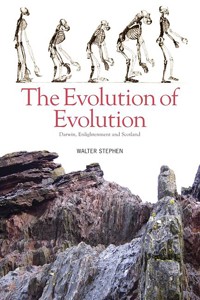
The Evolution of Evolution takes a multi-layered approach to history, moving from discussing an important predecessor to Darwin's Origin of Species, The Vestiges of Creation by the Scot Robert Chambers, to analysing episodes from Darwin's life and questioning his motives. Stephen also discusses the contribution other people made to Darwin's theories, both in person and through their own works, finishing by discussing interpretations and developments of Darwin's ideas after his death. By discussing social factors as well as academic or scientific influences, Stephen combines biography with scientific development and shows that understanding the man and the culture in which he lived is vitally important to understanding Darwin's theory. Stephen also highlights the many Scottish scientists and their ideas which have been overlooked by previous commentators, but who were an essential influence on Darwin.
Das E-Book können Sie in Legimi-Apps oder einer beliebigen App lesen, die das folgende Format unterstützen:
Seitenzahl: 252
Veröffentlichungsjahr: 2020
Ähnliche
















First published 2009
eISBN: 978-1-912387-88-5
The paper used in this book is acid-free, recyclable and biodegradable. It is made from low-chlorine pulps produced in a low-energy, lowemission manner from renewable forests.
Printed and bound by
Typeset in 11 point Sabon by
3btype.com
The author’s right to be identified as author of this book under the Copyright, Designs and Patents Act 1988 has been asserted.
© Walter Stephen 2009
Contents
Illustrations – Figures
Acknowledgements
Frontispiece
CHAPTER ONE Darwin and his Mentors
CHAPTER TWO Darwin and the Vestiges of Creation
CHAPTER THREE Three Men in a Boat
CHAPTER FOUR Silent, upon a peak in Darien
CHAPTER FIVE Charles Lyell – the Long Way Round
CHAPTER SIX The Riddle of Glen Roy
CHAPTER SEVEN The Anatomist and the Alienist
CHAPTER EIGHT Charles Darwin and Patrick Geddes
CHAPTER NINE Patrick Geddes and Charles Darwin
Conclusion
End Notes
An Evolution Chronology
Appendix – Extract from Who’s Who – 1930
Further Reading
Illustrations – Figures
Frontispiece Title pages of Vestiges of Creation and Origin of Species
FIG 1 No 1 Doune Terrace, Edinburgh
FIG 2 Three Men in a Boat
FIG 3 Siccar Point, Phase 1
FIG 4 Siccar Point, Phase 2
FIG 5 Siccar Point, Phase 3
FIG 6 Siccar Point, Phase 4
FIG 7 An Urban Unconformity
FIG 8 Hutton Plaque, Hutton Memorial Garden
FIG 9 La Campana National Forest, Palm Forest
FIG 10 Chilean Sugar Palm (Jubaea chilensis)
FIG 11 ‘Dr James Manby Gully practised the Malvern Water Cure here 1842-1872’
FIG 12 The Parallel Roads in 1898 (Ordnance Survey Six-Inch map)
FIG 13 Upper Glen Roy, the two higher Parallel Roads
FIG 14 Ice-dammed lakes at time of maximal ice extent
FIG 15 Glen Roy in the time of Chambers (Ancient Sea Margins)
FIG 16 Terror (from a photograph by Dr Duchenne) (The Expression of the Emotions)
FIG 17 Plan of St Louis’ Church, La Salpetrière,
FIG 18 Quadro-portrait of Patrick Geddes (A Most Unsettling Person: An Introduction to the Ideas and Life of Patrick Geddes)
Acknowledgements
THE AUTHOR IS INDEBTED to Professor Aubrey Manning, Emeritus Professor of Natural History, University of Edinburgh for suggesting him for a project which made for an enjoyable winter, and to Professor Susan Manning of the Institute for Advanced Studies in the Humanities, University of Edinburgh for encouragement to proceed. So much is known and so much has been written about Darwin – for example, Marc Giraud’s bibliography cites over a hundred books in French – that one has to poke around in obscure corners to come up with anything new that is worth sharing.
Staff in the great national institutions have been supportive beyond the call of duty. Rhoda Fothergill, doyenne of the Perthshire Society for Natural Science, has helped to illuminate a Darwin core-periphery relationship. Bob Mitchell, leader of botanical explorations, opened my eyes in Chile. Philip Stone, of the Edinburgh Geological Society, ironed out a few prejudices, while Mrs Lloyd helped to locate Darwin’s much-decayed Malvern bolt-hole. Anne-Michelle Slater, of the University of Aberdeen, created opportunities for sharpening up inchoate thoughts.
The cover of A Most Unsettling Person: An Introduction to the Ideas and Life of Patrick Geddes, by Paddy Kitchen, is reproduced as Fig 18 by kind permission of the publisher, Victor Gollancz, an imprint of the Orion Publishing Group. The map extract of part of Glen Roy (Fig 12) and the sketch of Glen Roy from Chambers Ancient Sea Margins (Fig 15) are reproduced by kind permission of the National Library of Scotland. The Frontispiece reproduces the title pages of Vestiges of Creation and Origin of Species, again by kind permission of the National Library of Scotland. ‘Terror’ (Fig 16) is reproduced by kind permission of The Folio Society. The Appendix from Who’s Who 1930 is reproduced by kind permissin of A&C Black Publishers Ltd.
The clear diagrams and map (Figs 3–6 and Fig 14) are by Olrig Stephen.
Frontispiece
As the younger Old Red Sandstone lies on top of the older Silurian roks at Siccar Point, so does the title page of Origin of Species (1st edition, 1859) overly the title page of Vestiges of Creation (1st edition, 1844)
Contrast the light and sparse nature of Vertiges – with no indication of authorship – with the weighty and tendentiou title of Origin and the establishment of its author’s authority.
CHAPTER ONE
Darwin and his Mentors
THE CELEBRATION OF anniversaries has become big business and, at its mid-point, 2009 promises to be another good year for the anniversary business. It is a special anniversary year for many interesting and important people, such as Burns, Haydn and Mendelssohn. Burns wrote of his own birthday (25 January 1759) when the gable end of his parents’ house collapsed in a gale:
Our monarch’s hinmost year but ane
Was five-and-twenty days begun,
‘Twas then a blast o’ Janwar’ Win’
Blew hansel in on Robin.
In November 1785, on turning up a mouse’s nest with the plough, he opened up the whole question of Man’s relationship with his fellow-creatures:
I’m truly sorry Man’s dominion
Has broken Nature’s social union.
In his sentimental poet’s way he might even seem to be apologising for the Book of Genesis in which Man was created separately from and superior to the remainder of Creation.
Haydn’s death in 1809 brought to an end a great stream of tuneful and apparently straightforward music. Modern programme-makers love him because he wrote 104 symphonies and there are 52 weeks in the year.
One of Haydn’s sidelines was to write arrangements of Scots songs for George Thomson, an Edinburgh publisher, among them some of the songs we now think of as by Burns. These are by no means Haydn’s best work and must be thought of as potboilers. But The Creation is a great work of faith and optimism. According to The Oxford Companion to Music: ‘It is naïve but charming, and admirably reflects the simple devotion of its author’ who said he: ‘knelt down daily and prayed God to strengthen me for it.’ Haydn’s Creation is straight out of Genesis but much of it sounds like a musical foretaste of the much-quoted passage from Darwin’s Envoy:
There is a grandeur in this view of life, with its several powers, having been originally breathed by the Creator into a few forms, or into one; and that… from so simple a beginning endless forms most beautiful and most wonderful have been, and are being, evolved.
Mendelssohn was a 20-year-old celebrity when he visited Scotland in 1829. Fingal’s Cave or the Hebrides Overture is much more than a simple souvenir of a happy holiday; more, even, than a simple sound picture of the waves rolling up the beach. Mendelssohn was probably the first to convey effectively through music the grandeur of natural forces and the puniness of Man when set beside them. Again, we can see in some of his work the kind of emotion experienced by Darwin in La Campana, Chile.
In the middle of the year and turning to Charles Darwin, 2009 has a double significance. It is the 200th anniversary of his birth, on 12 February 1809 and on 24 November 1859 was published one of the most influential and disturbing books of all time. The title page called it: On the Origin of Species by Means of Natural Selection, or the Preservation of Favoured Races in the Struggle for Life. The first five words are bland enough, but the next phrase is controversial and the latter half of the title is downright provocative. It could be that more people have learnt about their selves and their relationship with the natural world through The Origin of Species than via the combined efforts of the other great men we celebrate in 2009.
One recalls 1970, the year in which the Council of Europe decided that the 200th anniversary of the birth of Beethoven be celebrated throughout Western Europe. At the time I thought this quite unnecessary, after all, Beethoven’s music was everywhere and did not need any artificial attention. But I was wrong, the celebration meant that, not only did we hear a lot of Beethoven, but all kinds of new relationships and forgotten works were brought into the open, for our greater enjoyment and understanding.
Do the Darwin anniversaries matter? Especially in this year? Steve Jones, Professor of Genetics, University College, London would say ‘No!’ His hope for Darwin Year was that:
…by its end, its subject’s beard, his gastric troubles and even his voyage on HMSBeagle will have faded from public consciousness. I would be even happier if the squabbles about the social, moral, legal, political, historical, ethical and theological implications of his work were to find, at last, their long-delayed demise. In 2009 we should celebrate the science rather than the man – the fact rather than the anecdote.
One sees his point – Archimedes is more than a man running down the street crying: ‘Eureka!’ and Newton did more than doze under a tree in an orchard – but there is surely a middle position.
Despite Steve Jones, there is a case for celebrating the man as well as the science, so long as celebrating the man contributes to our understanding of how he learned and thought, of the evolution of evolution and does not descend to antiquarianism and pawky anecdote. The big beard features in the work that follows, but only as an element in a scene explaining Darwin and his charisma. Gastric troubles do not rate a mention, but again and again we come up against the ambiguities and uncertainties of Darwin’s relationships and can work out for ourselves what the consequences were likely to be. The Beagle voyage is here, but not as a travelogue. Instead, it was the setting for a basic change in attitude which was eventually to answer our biggest questions: Where do we come from? And where are we going?
An event of this kind deserves great celebration and 2009 is being marked by special programmes on the media and a rush of new books. In every university and natural history society there are lectures, seminars and audio-visual presentations. Perhaps inevitably, this coverage tends to be metropolitan and looks at Darwin at Cambridge, or in relation to the London-based scientific societies and the great London museums. Much of his working life was spent at his one-man laboratory, database and research centre 13 miles from Marble Arch at (as it says on his notepaper): ‘Down1, Beckenham, Kent. Railway Station, Orpington, South Eastern Railway.’ As Desmond and Moore, Darwin’s meticulous biographers, have said:
There was no place for natural history like London, even if there was no nature in the ‘odious dirty smoky’ capital. London was the imperium of science.
This statement bears closer examination. Clearly we know what the authors mean. London – ‘the Great Wen’ – is and was the magnet for everything worthwhile and everything undesirable in the country. Until London acquired its university in 1836, there were two universities in England, both of them easily accessible from the city and each more accessible from London than from the other.
But there are at least two tendentious phrases in this rather facile quotation. As I sit, I look across at a bookshelf on which stands London’s Natural History, by R. S. R. Fitter, 282 pages, 40 colour plates, 32 plates in black and white and 11 diagrams and maps, published in 1945. The message is clear. Nature is everywhere, from the deepest oceans almost to the tops of the highest mountains. When it is destroyed by volcanic eruption or human chemical intervention it immediately begins to recolonise the lost ground. Nowhere on Earth has ‘no nature’ for very long.
Later we shall see how three men made a boat journey to a lonely shore in Berwickshire in order to revolutionise how we think about the Earth and its age. That experience could be replicated in thousands of locations all over the world – given that the viewers are able to see and think clearly. London is, and was, the meeting place of scientists, where their work is published, and is the home of great research institutions – but a great deal of science is still done in the field or in certain favoured locations. In Darwin’s time, if London was the imperium of science, there was at least a principality four hundred miles to the north, where Edinburgh was one of the four (five until Marischal College and King’s College amalgamated in 1860) Scottish universities.
The young Darwin did not burst, perfectly formed, from the brow of some Greek goddess. His Autobiography tells us that he spent two unsatisfactory years at Edinburgh University and left without graduating,
At Cambridge he followed a gentleman’s course which would have led to a place in the Church of England. The connections he made there led him to the voyage on the Beagle, the outcome of which was a career as a naturalist – a choice greatly eased with his inheritance on the death of his father. Along the way he met a series of mentors and it is with these and their relationship to Darwin that this book is concerned.
Some threads run right through the book. Today we would equate Natural History with Biology – Botany and Zoology. In Darwin’s time Geology was also a part of Natural History, often the most important part. Darwin considered himself a geologist first for quite some time after the Beagle cruise. Science was still in the discovery phase during Darwin’s lifetime – new species of plants and animals seemed to be being found every day. These had to be identified, named and their relationships with others established. Fossils might provide evidence of change (or not). The rocks in which fossils were found had to be ordered and dated.
The turning point of the Beagle voyage is generally considered to be the Galapagos Islands, where Darwin observed the differences between the fauna from the different islands, to deduce that these differing populations had evolved from a common ancestor over time. Yet recording and explaining were quite separate processes, it was only after several years in England that Darwin made the necessary deductions.
Earlier, in the Chilean Andes, Darwin had stood, observed, measured and realised that the making of the mountains had taken an extremely long time. This meant that, when he came to consider the evolution of the Galapagos finches, he was able to see that process as being a long series of minute changes from generation to generation – but that there was ample time for these changes to take place. ‘Deep time’ was the engine for evolutionary change.
‘Deep time’ could get people into trouble with the authorities. The ancient universities were theocracies (London – ‘The Godless Institution of Gower Street’ – was not), staffed by clergy of the Church of England and open only to students subscribing to the Church of England. The Earth had been created in six days, then God rested. Man was a special creation, in that he was created in the image of God, and was made master of the rest of creation. Noah’s Ark was a problem. Its dimensions were known and its capacity calculated. All other species had been eliminated in the Great Flood (these were the fossils – ‘vestiges of creation’) yet new species were being discovered all the time which could not possibly have been accommodated in the Ark.
To enter the church, Darwin would have had formally and publicly to subscribe to these beliefs. At Cambridge and subsequently, his mentors were the Cambridge divines, Buckland, Sedgwick and Henslow. All were senior in the Church and in the University; all were ‘men of science’ of some distinction and influential in the scientific community. Darwin could not afford to estrange men with such power. What was he to do?
James Joyce defined the situation of the creative artist in Ireland in the early 20th century as: ‘silence, cunning or exile.’ Joyce chose cunning and exile. Under similar repressive pressures, Darwin chose – consciously or unconsciously – silence and a degree of cunning. Darwin was an avid networker. He wrote thousands of letters and a shelf full of solid, informative books, but he was very circumspect about his views, to the point of being secretive or deceptive. Like one of today’s blogging travellers, he kept in touch with Henslow from South America, carefully easing out gradually his ‘conversion’ to deep time in the knowledge that Henslow would read out his letters in public and publish them.
Darwin kept journals and notes all his life: surely they must provide unambiguous evidence of his thoughts at critical points? Perhaps, but most of what appeared in the public domain was much less spontaneous than it seems. For example, Darwin kept a detailed diary during the Beagle voyage but it was seven months after his return to England before it was published. Voyage of the Beagle appeared in 1839, three years after her return. There was clearly ample opportunity for massaging the text to fit the conclusions.
Darwin did not wish to antagonise, nor did he wish to offend. His wife, Emma, was comfortably domestic and of simple faith We are told that Darwin would do nothing that would distress her. Secrecy and ambiguity became a way of life and must, I believe, have been responsible for his ill-health, the cause of which is still an unresolved issue among the medical profession.
In episodes from the life of Darwin, I am now about to describe and analyse the contribution made to Darwin’s development by a series of mentors, starting with the rigorous basic training which qualified him for independent research work and provided the building blocks for his work on evolution and natural selection. Light is also thrown on some vexing questions. Why did Darwin denigrate his Edinburgh experiences? Why did he seem to be unaware of the concept of ‘deep time’? Why did he seem to undervalue mentors who did so much for him?
For evolution to work and for natural selection to operate an enormously long time-scale was necessary – a recent broadcast I half overheard suggested that a mere 100,000 generations would have been enough for the simplest fossil eye to move its position and to evolve into something like our own fairly sophisticated eye! To a historian 100,000 generations seems an inordinately long time but 100,000 human generations is only two million years. The Old Red Sandstone at Siccar Point was laid down about 400 million years ago, allowing abundant opportunity for what was called in Darwin’s day ‘transmutation.’
In 1788 Dr James Hutton of Edinburgh, at Siccar Point, gave a field demonstration of the immensity of time. He said: ‘We find no vestige of a beginning, no prospect of an end.’ Yet Stephen Baxter, in Revolutions in the Earth (2003), can say:
In the 19th century even Charles Darwin would graduate from Cambridge University believing that the world was six thousand years old, give or take.
Matthew Bramble, in Smollett’s Humphry Clinker of 1771 described the Edinburgh of his time as ‘a hotbed of genius’. How did Darwin, in two years in an Edinburgh still shaped by the Enlightenment, manage to avoid the concept of ‘deep time’ and its consequences? And why, when the concept was eventually absorbed by him, had it come the long way round?
Charles Lyell (1797–1875), in 1824 was a keen young geologist, and was taken to Hutton’s Unconformity at Siccar Point by Sir James Hall. It was the first volume of Lyell’s Principles of Geology (1830) which the young Darwin took with him on the Beagle and which he said opened his eyes to geology, repeatedly referring to it and the two later volumes, which were sent out to him. In his account of the Beagle voyage we can empathise with Darwin’s struggle to accept the evidence of his eyes, which told him of the great age of the Andes. On his return to England he and Lyell became professional and personal friends until the latter’s death.
The Parallel Roads of Glen Roy are a striking feature of the Lochaber landscape. In Darwin’s early days explanations ran from the legendary to the scientific. Fresh from the Beagle in 1838 he had ‘eight good days in Glen Roy,’ trying to solve the riddle of the Parallel Roads and coming up with an answer (which was, sadly, wrong) based on his South American experience. However, in his defence, it was only in 1840 that Louis Agassiz recognised that these were the shorelines of vanished ice-dammed lakes, while a full explanation only came with Jamieson in 1863. And there are still unresolved puzzling features about the area.
Vestiges of Creation created a sensation when it was published in 1844, partly because of its anonymous authorship. Who was the author? Why did he (or she) want to remain anonymous? Could it really be Prince Albert, according to the report of a joke made at a Liverpool party?
The unknown author put forward a theory of evolution and challenged fundamental Victorian beliefs. The Unknown’s anonymity gave him a kind of protection in that the establishment were slow to respond until they could be sure of their target. Then churchmen and scientists were as one in rejecting its message. The Unknown seemed to be questioning the Biblical account of creation and the special status of Man among the animals. The scientists were unhappy that The Unknown did not appear to be of their number and did not seem to have spent many hours grinding away at minutiae and writing papers crowded with detail. Later editions were aimed at, and popular with, the lower and middle classes – which was perceived as a dangerous fault.
Vestiges of the Natural History of Creation is often seen as a kind of curtain-raiser for Darwin’s Origin of Species. This is too simple, Vestiges was an important book in its own right. When it came out, Darwin had written 200 pages on evolution. This had to be abandoned and it was 15 years before Origin of Species further progressed thinking on evolution. Darwin in public was as vigorous as any in condemning The Unknown, although in private he expressed some sympathy for his situation. In his study he studied Vestiges closely in order to learn how to avoid controversy and still tell the truth simply. Darwin considered the publication of Vestiges to have smoothed the way for his Origin of Species – its reception certainly made him more cautious when his own time came.
Yet, even after Origin of Species entered the field, Vestiges continued to maintain its popularity; it was only about 1900 that Darwin’s great work finally overtook Vestiges in the race for sales. Victorian society in the second half of the 19th century was very fortunate in having available parallel justifications for evolution, the classic scientific text of the heroic Darwin, and the readable Vestiges by ‘a provincial popular author’.
Robert Chambers, who was officially named as the author after his death, was a grandchild of the Scottish Enlightenment and I will examine his influence, negative as well as positive, on Darwin, at a turning point in his career.
The Plinian Society of Edinburgh University operated from 1823 to 1841. In 1826 the Secretary was Dr Robert Grant (1793–1874), later first Professor of Zoology in University College, London. All commentators agree with Darwin on the importance of Grant and the Society for his development. A controversial paper was read to the society on 21 November 1826 by William Browne. As was his wont, for many years Darwin brooded on the subject, engaging in correspondence and collecting material. He thought of giving it a chapter in The Descent of Man (1871), only to find that his mass of information and speculation demanded a book of its own.
The Expression of the Emotions in Man and Animals was published in 1872 and is a very odd book indeed, quite unlike anything else Darwin wrote. He claimed that booksellers had subscribed to 5267 copies on the day of publication, making it his first-day best-seller.
Patrick Geddes (1854–1932) was an Eminent Victorian in his own right, rating an entry of 358 words in the Who’s Who of 1930. Twice nominated for a knighthood, he received the accolade a mere 52 days before his death. Born in fairly modest circumstances he made an unconventional way to eminence as: ‘Biologist, Town Planner, Re-educator, Peace-warrior.’ Taking Geddes as a sample, the question is asked: ‘How did a young man from a very modest background in a small provincial city, with the sketchiest of qualifications, break into the upper echelons of the scientific society of his time?’ Darwin influenced him in three ways and this makes an interesting case study of the effect of ‘old Father Darwin’ on the next generation.
Geddes was a compulsive educator and a prolific writer, although by no means an easy read. Geddes repaid his debt to Darwin by disseminating and interpreting for the next generation the contributions to knowledge and understanding of: ‘the greatest Naturalist of the age.’ The Geddes approach is one of critical awareness rather than blind hero-worship and in it can be traced the evolution of ideas on evolution after Darwin.
Hutton’s: ‘We find no vestige of a beginning, no prospect of an end.’ – was an uncomfortable thought which many, in his time and later, have chosen to misunderstand and which some have still not had the courage to accept. That natural selection is the main driver of evolution is the conclusion of observation and reason, but it is a chilling and uncomfortable message for many and it is understandable that they seek comfort in alternative explanations.
For me, it is extremely worrying to hear that, in the United States, the world’s richest nation, stuffed full with clever and innovative people, over half the population say that they believe absolutely in the Biblical account of creation, that the Earth and everything in it was created in six days, that that was the end of it, except for the creation of Man, who was created specially in God’s image. Other clever and innovative people have brought forward the theory of ‘Intelligent Design’, that there is a ‘higher power’ for the complexities of life.
The Biblical account of creation, and of the subsequent Flood, are beautiful and logical narratives. There is another little Biblical narrative worthy of some attention. A rich young man asked Jesus: ‘What shall I do to inherit eternal life?’ After some discussion he received the answer: ‘Sell all that thou hast, and distribute unto the poor, and thou shalt have treasure in heaven.’ And when the young man: ‘heard this he was very sorrowful, for he was very rich.’
When we see scores of Fundamentalists carrying out the actions demanded by Scripture we may begin to give some serious attention to their words anent Creation.
Fortunately, the churches – who gave Chambers and Darwin such a hard time in the 19th century – have used the Darwin bicentenary to redefine their relationship with evolutionary thought. In September 2008 the Church of England conceded that it had been ‘over-defensive and over-emotional’ in dismissing Darwin’s ideas. In a statement the Church said: ‘Charles Darwin: 200 years from your birth, the Church of England owes you an apology for misunderstanding you’, comparing the situation to the mistakes made in the 17th century in doubting Galileo’s astronomy.
The headline in The Times of 11 February 2009 read: ‘Vatican buries the hatchet with Charles Darwin.’ Archbishop Gianfranco Ravasi declared that Darwin’s theory of evolution was compatible with Christian faith and could even be traced to St Augustine and St Thomas Aquinas: ‘In fact, what we mean by evolution is the world as created by God.’ At a papal-backed Darwin conference in March it had been intended to ban Intelligent Design. Instead, it was given a marginal slot as a ‘cultural phenomenon’ rather than a scientific or theological issue.
Much is usually made of the influence on Darwin of ‘the Cambridge set’, and some of this will emerge as we proceed further. Darwin was not surrounded by Scots, but some of the most significant influences came from his Edinburgh days and from the wandering Scots he came across at crucial points in his career, several of whom had made the transition to the national scientific community centred on London.
When we aggregate the experiences and influences of these Scots, most of them children or grandchildren of the Enlightenment, on Darwin, we are struck by the range and diversity of their thinking, but we are also struck by the range and diversity of his achievement.
For whatever reason, Darwin undervalued the time spent in Edinburgh as a student, yet he owed much to Hutton, Chambers and others of similar background.
As already suggested, Darwin did not burst, perfectly formed, from the brow of some goddess. The high level of Scottish scientific thought in Darwin’s time had its influence on the great man.
He made mistakes and false starts, but he had something to teach us – not only about science – but in how to cope with frustration and adversity.
CHAPTER TWO
Darwin and the Vestiges of Creation
ONE OF MY favourite images is conjured up by a piece of music by Erik Satie (1866–1925), one of the avant-garde of the 1920s, known as Les Six. His Gymnopédie No 2 became very popular among the young in the 1960s when its long, gentle, flowing phrases seemed to sum up the dreamier side of that cultural revolution. On paper it looks very easy, even dull, but on my instrument, the clarinet, its long, long phrases twisting and turning gently for many, many bars must be taken without a breath, which is, of course, impossible.
Gymnopédie is meant to represent the statue of a beautiful young man on a plinth which rotates very slowly, while a powerful light throws up subtleties of light and shade, which alter as he slowly turns.
For Darwin and the




