


Erhalten Sie Zugang zu diesem und mehr als 300000 Büchern ab EUR 5,99 monatlich.
- Herausgeber: epubli
- Kategorie: Sachliteratur, Reportagen, Biografien
- Sprache: Englisch
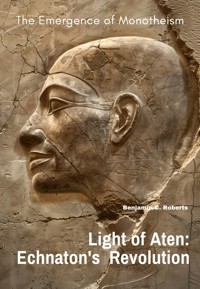
In "Light of Aten: Echnaton's Revolution - The Emergence of Monotheism" by Benjamin C. Roberts, readers are invited on a compelling journey back to the heart of ancient Egypt, to the reign of one of history's most revolutionary figures, Pharaoh Echnaton. Defying centuries of traditional Egyptian polytheism, Echnaton embarked on an audacious quest to redefine the spiritual landscape of his time, establishing the worship of a single deity, the Aten. Roberts meticulously unravels the story of Echnaton's radical reforms, exploring how this enigmatic leader attempted to concentrate divine, political, and artistic expression around the worship of the sun disk. Through a blend of historical facts, archaeological evidence, and engaging narrative, this book paints a vivid picture of a tumultuous period marked by intrigue, power struggles, and a profound ideological shift that would echo through the ages. From the construction of the new capital, Akhetaten, to the suppression of the traditional pantheon, "Light of Aten" delves into the motivations behind Echnaton's bold moves, the societal upheavals they caused, and the legacy of his religious revolution. Roberts critically examines how Echnaton's monotheism influenced future generations and the development of monotheistic religions, making this book essential reading for anyone fascinated by the origins of monotheism, ancient Egyptian history, and the enduring power of faith to transform societies.
Sie lesen das E-Book in den Legimi-Apps auf:
Seitenzahl: 72
Veröffentlichungsjahr: 2024
Das E-Book (TTS) können Sie hören im Abo „Legimi Premium” in Legimi-Apps auf:
Ähnliche



















Light of Aten: Echnaton's Revolution
The Emergence of Monotheism
Benjamin C. Roberts
Impressum
© 2024, Benjamin C. Roberts
Druck und Verlag: epubli GmbH, Berlin, www.epubli.de
Printed in Germany
Bibliografische Information der Deutschen NationalbibliothekDie Deutsche Nationalbibliothek verzeichnet diese Publikation in der Deutschen Nationalbibliografie; detaillierte bibliografische Daten sind im Internet über http://dnb.d-nb.de abrufbar.
I. Introduction to Akhenaten and the Aten Cult
Akhenaten: The Pharaoh Who Challenged Tradition
Step into the intriguing world of ancient Egypt, where the lines between politics and religion blur and the fate of a civilization hangs in the delicate balance of one man’s convictions. Explore the birth and family lineage of the enigmatic figure known as Akhenaten, and delve into the religious environment that shaped his upbringing. Witness the events that led to his ascension to the throne, and uncover the early showings of Aten worship that would define his reign. Join us as we uncover the fascinating journey of Akhenaten, from his decision to establish monotheism to the effects of his religious reforms on Egyptian society. Discover the political motivations behind these radical changes and the aftermath of Akhenaten’s religiosity as we unravel the intricacies of his reign.
Early life and ascension to the throne
Akhenaten, born into Egyptian royalty as the son of Pharaoh Amenhotep III and Queen Tiye, traced his lineage back to powerful and influential lineage. His mother, Queen Tiye, was known for her unparalleled influence in the royal court, and her beliefs likely had a significant impact on Akhenaten’s upbringing.
Growing up in a religiously diverse society, Akhenaten was immersed in the traditional polytheistic beliefs of ancient Egypt, with reverence for gods such as Amun-Ra. Despite this environment, Akhenaten’s education and teachings may have included exposure to alternative religious philosophies and ideas.
Akhenaten’s path to the throne was unexpected, following the premature death of his older brother, Thutmose. This turn of events positioned him as the next in line for the throne, paving the way for a transformative reign.
Before his formal coronation, indications of a departure from traditional beliefs began to emerge in Akhenaten’s thinking. Influenced by his mother’s non-traditional beliefs and possibly other advisors, he started to show a fascination with the worship of the solar deity Aten. This early preference for Aten worship foreshadowed the groundbreaking religious reforms that would define his reign, setting the stage for the Atenist revolution and the establishment of the revolutionary Aten cult.
Religious reforms and rejection of polytheism
Aten’s emergence as the supreme deity marked a significant departure from traditional Egyptian religious practices. Akhenaten’s decision to establish monotheism was not just a religious one but also deeply intertwined with political motivations. By elevating Aten above all other gods, Akhenaten sought to centralize religious authority and consolidate power under the Aten cult, diminishing the influence of the priesthood associated with traditional polytheistic beliefs.
The effects of this monotheistic shift were far-reaching. Egyptian society underwent a transformation as rituals, temples, and societal structures were reorganized to accommodate the worship of a single deity. The exclusive devotion to Aten challenged the long-established polytheistic norms, creating a schism within Egyptian religious and social fabric.
Following Akhenaten’s reign, the aftermath of his religiosity was characterized by resistance and backlash. The abrupt shift to monotheism faced opposition, leading to the eventual restoration of traditional polytheistic practices by his successors. The Aten cult’s decline highlighted the complexities of enforcing religious reforms and the enduring influence of deeply entrenched belief systems in society.
Despite its eventual decline, Akhenaten’s monotheistic experiment left a lasting legacy. It stimulated theological discourse, influenced later monotheistic faiths, and underscored the enduring tensions between religious innovation and societal adherence to established traditions. The echo of Akhenaten’s religious reforms reverberated through the annals of history, shaping the trajectory of Egyptian religion and serving as a crucial chapter in the evolution of monotheistic beliefs worldwide.
Construction of Akhetaten, the capital of the Aten cult
Akhenaten’s choice of Akhetaten for his capital was a deliberate and significant decision shaped by various factors. Situated between the traditional capitals of Thebes and Memphis, Akhetaten’s location allowed the pharaoh to establish a new center of power, away from the influence of the priesthood and administration of the old religious centers. The site itself, nestled in a valley bordered by cliffs, provided natural protection and privacy for the royal family.
The planning and architectural design of Akhetaten reflected Akhenaten’s revolutionary religious beliefs. The city was meticulously laid out in a grid pattern, with wide, straight streets and grand avenues leading to the Great Temple of the Aten at the city’s center. Important structures like the King’s House, the Northern Palace, and various administrative buildings dotted the cityscape, emphasizing the pharaoh’s central role in religious and political life.
The populace of Akhetaten adapted to the new city with a mix of curiosity and acceptance. The innovative layout and emphasis on the Aten’s worship prompted a shift in daily life and communal activities. The open design of the city encouraged a sense of unity and connectivity, fostering a community bonded by shared religious beliefs.
The city’s layout held profound religious significance, mirroring Akhenaten’s monotheistic vision. The east-west orientation of the city aligned with the path of the sun, symbolizing the Aten’s daily journey across the sky. The Great Temple of the Aten, with its open courtyard and altars, served as the focal point for worship, emphasizing the deity’s presence in all aspects of life. The architectural elements and urban planning of Akhetaten were intended to physically manifest Akhenaten’s religious ideals and assert the supremacy of the Aten amidst the urban landscape.
Family life and relationships
Akhenaten’s family life provided an intriguing glimpse into the dynamics of ancient Egyptian royalty. His marital relationship with Nefertiti was central to his reign. In art, they are frequently depicted together, showcasing a closeness and mutual respect that was uncommon in Egyptian royal portraiture. This portrayal emphasized not just their bond but also their shared devotion to the Aten cult.
Their daughters, particularly Meritaten and Ankhesenamun, were essential figures within the royal family. They were depicted participating in religious ceremonies, highlighting their roles in promoting the worship of Aten. The family unit, therefore, became a symbol of unity and piety under Akhenaten’s rule.
As the family at the center of the Aten cult, their influence was pivotal in spreading the monotheistic beliefs throughout Egypt. Their portrayal in art and inscriptions not only underscored their devotion but also served as a form of propaganda, solidifying the cult’s place in society.
The changing royal family dynamics under Akhenaten’s reign reflected a shift towards a more centralized and monotheistic form of worship focused on the pharaoh and Aten. As his rule progressed, the family’s prominence in religious and political spheres grew more pronounced.
Following Akhenaten’s death, the family’s role in maintaining the Aten cult was challenged. Succession was uncertain, with Tutankhaten eventually taking the throne and reverting to traditional polytheistic practices, marking a significant shift away from the Aten cult. The family’s fate and the legacy of their religious reforms were intricately linked, showcasing the interconnectedness of family, religion, and power in ancient Egypt.
Historical Context of Ancient Egypt
As we delve into the complex tapestry of ancient Egyptian religious beliefs, we are transported to a time when the land of the Nile was rich with a pantheon of gods and goddesses, each with their own attributes and significance in the lives of the people. This intricate web of polytheistic beliefs not only shaped the worldview of the ancient Egyptians but also had a profound impact on the society at large. Within this context, we will explore the dominant gods and their roles in daily life, as well as the religious responsibilities of the Pharaoh as a spiritual leader. Furthermore, we will examine the fascinating views of the afterlife held by the ancient Egyptians, shedding light on their beliefs surrounding death and the journey beyond. As we navigate through this section, we will also witness the remarkable ascension of Akhenaten to the throne, a pivotal moment that marks the transition from polytheism to monotheism in Egypt. This monumental shift not only had profound implications on the political structure of the time but also set the stage for a series of diplomatic exchanges with foreign powers. Join us on this captivating journey as we unravel the intercultural influences that shaped the religious landscape of ancient Egypt.
Overview of Egyptian religious beliefs before Akhenaten
In ancient Egypt, before the reign of Akhenaten, the religious landscape was dominated by polytheistic beliefs. The Egyptians worshipped a vast pantheon of gods and goddesses, with each deity embodying specific characteristics and having distinct roles in the cosmic order. Among the most revered gods were Ra, the sun god and creator deity; Osiris, the god of the afterlife and resurrection; Isis, the goddess of magic, fertility, and motherhood; and Horus, the falcon-headed god associated with kingship and the sky.
These gods played essential roles in daily life, with rituals and offerings dedicated to them for various purposes such as ensuring agricultural prosperity, protection in battle, or success in endeavors. The Pharaoh, as the earthly ruler of Egypt, held unparalleled religious significance. He was believed to be the link between the gods and the people, often depicted partaking in religious ceremonies and rituals to maintain cosmic balance and harmony.




