


Erhalten Sie Zugang zu diesem und mehr als 300000 Büchern ab EUR 5,99 monatlich.
- Herausgeber: The History Press
- Kategorie: Sachliteratur, Reportagen, Biografien
- Sprache: Englisch
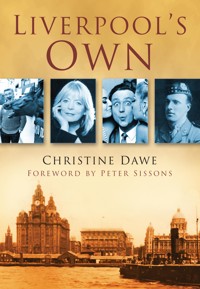
Liverpool has been the birthplace or home to literally hundreds of extraordinary men and women. In this book Christine Dawe features a great many of them - from all eras and walks of life. Locally noteworthy figures, such as Kitty Wilkinson, who started the first public wash-houses in the city, Father Nugent, who rescued hundreds of starving orphans after the Irish Potato Famine, and Teddy Dance, who played a grand piano outside Marks & Spencers for many years and raised over £16,356,000 for Cancer Research, appear alongside some of the more famous faces from the past, including Rex Harrison and Bessie Braddock, as well as more contemporary figures, such as Ken Dodd, Cilla Black, Carla Lane, Ricky Tomlinson and Sir Simon Rattle. This book contains more than a hundred mini-biographies of Liverpool's famous sons and daughters - all of whom are illustrated. A perfect souvenir for visitors to the city, this is also essential reading for Liverpudlians everywhere, and is sure to appeal to those wanting to know more about these people's contributions to the great city we know today.
Sie lesen das E-Book in den Legimi-Apps auf:
Seitenzahl: 329
Veröffentlichungsjahr: 2008
Das E-Book (TTS) können Sie hören im Abo „Legimi Premium” in Legimi-Apps auf:
Ähnliche

















LIVERPOOL’S
OWN
LIVERPOOL’S
OWN
CHRISTINE DAWE
First published 2008
Reprinted 2009, 2010
The History Press
The Mill, Brimscombe Port
Stroud, Gloucestershire, GL5 2QG
www.thehistorypress.co.uk
This ebook edition first published in 2013
All rights reserved
© Christine Dawe, 2008, 2013
The right of Christine Dawe to be identified as the Author of this work has been asserted in accordance with the Copyright, Designs and Patents Act 1988.
This ebook is copyright material and must not be copied, reproduced, transferred, distributed, leased, licensed or publicly performed or used in any way except as specifically permitted in writing by the publishers, as allowed under the terms and conditions under which it was purchased or as strictly permitted by applicable copyright law. Any unauthorised distribution or use of this text may be a direct infringement of the author’s and publisher’s rights, and those responsible may be liable in law accordingly.
EPUB ISBN 978 0 7509 5344 3
Original typesetting by The History Press
This book is dedicated to the two most wonderful men in my life
Picture Credits
The author is indebted to the following people and organisations for permission to use photographs in this book.
Alan Bleasdale
Jean Boht
Tony Booth
Liverpool Central Library
Liverpool Football Club
Carl Davis
Liverpool Daily Post & Echo
Mersey Television
Cain’s Brewery
Joan Finn
City magazine
Anthony George
Mersey Kidney Research
Geoffrey Hughes
Carla Lane
Angus Tilston
Sharon Maughan
Peter Ware
Nugent Care Society
Trevor Owens
Derek Holden
Anne Robinson
Walker Art Gallery
Alison Steadman
Clive Swift
David Swift
Liverpool Medical Institution
Ronald McDonald House
Sophie Baker
Contents
Foreword by Peter Sissons
Introduction
About the Author
Cilla Black
Alan Bleasdale
Jean Boht
Tony Booth
Bessie Braddock
Jamie Carragher
The Chavasse Family
Teddy Dance
Carl Davis
William Ralph Dean
Ken Dodd
Ray Dunbobbin
Dr William Duncan
Ronnie Finn
Anthony & Eric George & Primrose Agbamu
Steven Gerrard
William Gladstone
John Goldsmith
Reginald Carey Harrison
Frank Hornby
Jeremiah Horrocks
Geoffrey Hughes
Glenda Jackson
Sir Robert Jones
Margaret Kelly
Bill Kenwright
Carla Lane
Canon Thomas Major Lester
William Hesketh Lever
Gerry Marsden
Sharon Maughan
Sir Paul McCartney
Jimmy McGovern
George Melly
John Middleton
Mother Noblett & Old Ma Bushell
Monsignor James Nugent
Yoko Ono
Sir Simon Rattle
Red Rum
Anne Robinson
William Roscoe
Bill Shankly
Alison Steadman
George Stubbs
Clive Swift
David Swift
Hugh Owen Thomas
Ricky Tomlinson
Cathy Tyson
Kitty Wilkinson
Joseph Williamson
Harold Wilson
Stephen Yip
Acknowledgements
Foreword
by Peter Sissons
Every address in Liverpool and Merseyside should have a copy of Liverpool’s Own. Whether, like me, you were born here, or have simply adopted this great city as your home, it is a compelling read. Of course, no one ever adopted Liverpool – the city does the adopting.
Within the pages of Liverpool’s Own is a reminder of the city’s uncanny ability not just to produce so much talent, but to turn so many extraordinary people into honorary Liverpudlians, inspiring them with a lifelong loyalty and affection for this special place, and drawing out of them some of their finest work. Wherever you come from, be it high or low, if you have something to give to Liverpool, then Liverpool will never forget you.
All Liverpudlians know that their city and its surroundings are special. They feel it in their bones. To outsiders, some can seem aggressive and arrogant about it. Others manifest their pride with a hurt defensiveness that unkind and ignorant outsiders characterise as mawkishness. To them it seems that the metropolitan media miss no chance to get on their backs. The critics forget that this was once one of the greatest port cities in the world – and that there was more than a geographical reason for it.
Now Liverpool again is resurgent, reminding the world of its cultural and sporting wealth, and its artistic, scientific, philanthropic and charitable heritage. So what better time to celebrate the great roll-call of those who made the city what it is?
But hold on! Although we know Liverpool is a special place, how many of us can name the people who made it special – and who gave the city, and in many cases the world, so much? We’ll be able to name some, but within these pages is a glorious list of Liverpool and Merseyside’s sons and daughters second to none. Their collective impact on the city, the nation, and in many cases the world is inestimable. Famous names like Gladstone, Shankly, Dodd, Leverhulme, McCartney, Rattle and scores more besides. Scientists, doctors, artists, entertainers, the high-born and the humble. And running through it all a thread of philanthropy and concern for their fellow men and women which is woven deep into Liverpool’s heritage. These are people who not only cared about Liverpool, they cared about humanity.
To understand Liverpool, to understand its present and its future, and the hold that it has on those who count themselves fortunate to be part of it, just get to know Liverpool’s Own. And, if you seek a monument to these extraordinary people, go to Merseyside and just look around you.
Introduction
Hims (and Hers) Ancient & Modern
There are many worthy tomes concerning Liverpool, the growth of the city and its beautiful architecture. There are histories of Merseyside’s dark days in the nineteenth century and there are biographies galore of local politicians, sports stars, pop groups and famous show business figures.
This book is a pot-pourri of all these – a celebration and a commemoration of Merseyside’s most colourful, charismatic or eccentric personalities, both past and present. Their achievements are possibly already well known, but I have attempted to present ‘the stories behind the stories’, so that the reader may make a more personal acquaintance with those who might be household names but whose backgrounds may not be so familiar.
My research has brought to my attention the determination and dedication shown by so many Scousers in their journeys towards success. Some of the most honoured and celebrated people came from humble or tragic beginnings. Others, with the good fortune of parental support and encouragement, have used their abilities to enrich the lives of others, either by philanthropic generosity, by striving for better working conditions or by giving the gift of laughter or sporting pride.
I was surprised and delighted to learn of the great diversity of charitable endeavour on Merseyside. Many organisations are of national origin, while others have actually been founded by the initiative of Liverpool’s own, right here on our doorstep.
It has been a great pleasure to discover so much good news and to meet so many praiseworthy notables. I hope readers will enjoy being introduced to their Merseyside ancestors and to their present-day friends and neighbours as much as I have enjoyed the research.
Christine Dawe Liverpool, 2008
About the Author
Christine Dawe had her first short story published at the age of ten, on the children’s page of the Liverpool Daily Post and Echo. For this she received the princely fee of 10s. She was so delighted she immediately wrote another which was also accepted.
While in her teens, she continued to write features for arts and youth magazines, including one, illustrated by herself, concerning teenage fashions with some suggested improvements to school uniforms. Again, this was published by the Echo.
She also took the lead in many local drama productions. At fifteen she represented all Merseyside Youth Clubs by reading the Lesson at a ceremony in the Anglican Cathedral. She won several public speaking competitions and later became an adjudicator for the English Speaking Union public speaking contests. At Holly Lodge High School, West Derby, she won the Pilling Prize for Literature despite being the youngest entrant.
For eleven very happy years she taught A-Level English and Drama at a huge comprehensive school in Belle Vale, to adults and sixth-formers in the same class, plus English Comprehension to special needs groups. She then changed careers to take up acting and writing professionally. Recording the audio versions of full-length novels and biographies became her speciality, interspersed, for several years, with reading short stories on the BBC Radio Merseyside literary programme, Write Now. Her audio books include all of Helen Forrester’s autobiographical saga, starting with Tuppence to Cross the Mersey. Although Christine narrates commentaries for travel documentaries, she also loves the fun of character voices for cartoons and computer games. On television, her appearances have included Coronation Street, Brookside, Hollyoaks and several commercials.
The author, aged twelve, a Oberon in A Midsummer Night’s Dream.
Using her previous experience in education, Christine has written books used in both senior and primary schools, some especially for reluctant teenage readers and others for the new citizenship subject in primary schools known as PSHE (Personal, Social and Health Education).
In memory of close family members, Christine supports the charities for Cancer Research, Kidney Research and the British Heart Foundation.
Cilla Black
‘Hello Chuck, tell us yer name and where yer come from’
In 1960, when teenager Priscilla Maria Veronica White and her friends saved up enough money for a trip from Liverpool to North Wales, young Priscilla was delighted to see real cows and sheep at last. She had seen pictures of them before, but never the living animals. Quite a milestone in her life. But an even more important milestone was winning the talent competition at their destination, Butlins, Pwllheli, and being presented with the prize by a boy she had met several times before. His name was Richie Starkey, the drummer with Rory Storm and the Hurricanes. She always enjoyed his great sense of humour and in time they became good mates.
Ever since she was a toddler, Priscilla had loved music. Her mother had a beautiful soprano voice and could sing many operatic arias with ease. Her father was also musical. After work at the docks, he often played the harmonica during family sing-songs. He took great pride in his appearance and even more pride in his close-knit and loving family. When Priscilla was still a young child, she was encouraged to join in these informal gatherings. She soon realised that she loved being the centre of attention and developed an early ambition to become a professional singer. At this stage, she had no idea how to achieve this but she was determined to find a way.
Cilla Black with Phil Redmond and the cast of Brookside.
First, she had to earn some money. On leaving school, she worked in the offices of BICC (British Insulated Calendar Cables) in Stanley Street. This brought two important advantages. As well as a reasonable salary enabling her to buy trendy jeans, colour shampoos for her hair and the occasional pop record from Nems music store, she was also entitled to a full lunch break. Being in the city centre was significant, too. It meant that she and her pals could dash to the nearby Cavern where the Beatles were alternating with other groups to play lunchtime concerts. Determined to become part of the Mersey Beat scene, and with her name now shortened to Cilla, she used her initiative and persuaded the manager of the Cavern that he needed a proper cloakroom with a check-out girl, instead of expecting fans to keep their wet and crumpled coats with them while screaming and leaping around to the music for an hour or more.
So she now had two jobs. Soon she had three. In the evenings, she became a waitress at the Zodiac coffee club. This helped her to mix with more of the up-and-coming stars from the music scene. On any free evenings she would go to hear the groups at the Blue Angel Club, in Seel Street.
Two separate events which were to shape the rest of her life happened almost simultaneously. Having wangled her way into singing occasional numbers at the Cavern, Cilla had become friendly with the Beatles. John would announce her, always jokingly pretending he couldn’t pronounce her name properly. One night, he introduced her to the Beatles manager, Brian Epstein, saying, ‘Brian, this is Cyril. She’s the one to watch. You should sign her up.’
The second momentous encounter happened one evening at the Zodiac club. Cilla spotted an attractive new customer, blond, tanned and rather Scandinavian-looking. It wasn’t long before the two got talking and Cilla was impressed by his chat-up lines. She soon discovered that most of this was just ‘blarney’, but by then she was totally smitten and the two became utterly devoted to each other. They never had eyes for anyone else from that moment onward. Bobby Willis and Cilla eventually married and, over the years to come, they had three sons.
Cilla’s first audition for Brian Epstein was a disaster. The Beatles accompanied her rendition of ‘Summertime’, but they played it in their own key, not realising that Cilla needed a different pitch. Cilla then tensed up with nerves and Brian was unable to appreciate her talent. In 1963, when by chance he heard her again, he immediately realised her potential and drew up a contract for her – his only female client. After a misprint in a local music paper, Cilla found herself transformed into Cilla Black. As Cilla mentions in her autobiography, Cilla, although her father was disappointed at the change of surname, Epstein insisted on keeping it. Her friend Richie Starkey also changed his name. After joining the Beatles, he became known as Ringo Starr.
Hit singles, television appearances and offers of representing the United Kingdom in the Eurovision Song Contest quickly flooded in. Cilla’s version of ‘Anyone Who Had A Heart’ became an instant number one, the highest-selling single ever by a British female singer. Her records, nearly always about love, have stood the test of time and have been re-issued in album form several times. With her trim figure, fantastic legs and bubbly personality, Cilla was a natural for television stardom. Always fashion-conscious, she changed her image according to the trends. Musical crazes come and go, but Cilla adapted by turning herself into a chat show host and celebrity presenter. With Bobby’s steadfast help as her business manager, Cilla’s career soared to new heights. From 1984 to 2003, her programmes, including Surprise, Surprise and Blind Date drew enormous audiences and created many thousands of affectionate new fans. All over Britain, admirers became familiar with her Scouse phrases, such as ‘A lorra, lorra laughs’, and her warm-hearted introduction of any girl named Claire as ‘Ar Clurr’.
Cilla turned down the chance of singing in the Eurovision Song Contest and at a later date she declined an offer of an Honorary Degree from John Moores University, Liverpool. This was owing to adverse comments from full-time students who didn’t welcome the idea. But as the years went by, she was proud to receive the OBE as well as the award for best presenter from the Royal Television Society and the Lew Grade Award for the most popular programme on television. At last, in 2000, when invited to become a Fellow of John Moores University, Cilla was happy to accept and the ceremony took place at Liverpool’s Anglican Cathedral.
For most of their married life, Cilla, Bobby and family lived in the manor house once owned by Sir Malcolm Sargent, the erstwhile principal conductor of the Royal Liverpool Philharmonic Orchestra. They celebrated their Pearl Wedding in the early part of 1999.
Cilla’s song ‘You’re My World’ must surely have been dedicated to her beloved husband who was her tower of strength until his untimely death late in 1999. Although devastated, Cilla continued hosting Blind Date for a while. When she felt she could no longer carry on, she made her surprise farewell, live on air. With the help of family and her very special friends, she later recuperated and regained her positive and optimistic outlook on life, and was happy to support Liverpool in 2008 – its year as Capital of Culture by starring in a pantomime at the huge Empire Theatre.
Alan Bleasdale
Jack of all trades; masterly and influential stage, screen and radio writer
Many people ask, ‘How can I become a screenwriter, (author, poet, journalist?) What training do I need? What is the recipe for success?’ The ingredients are simple. A wide experience of life, as many different kinds of jobs as possible, some foreign experiences and, above all, a deep understanding of human nature. All of these, plus supreme natural talent. Method: leave to mature, blend together with determination and hard work. Perfect role model? Alan Bleasdale.
Alan Bleasdale’s CV reads like the Yellow Pages. In his time he has worked as a shop assistant, bin man, ‘can lad’ at a steelworks, labourer in a soap factory, postman, what he describes as an ‘insecurity guard’ at Liverpool Docks and, finally, combining English and PE as a schoolteacher. ‘Dickens and handstands make a fascinating mixture,’ he says.
Huyton and Widnes were Alan’s childhood haunts. His infant and junior school was St Aloysius, followed by Wade Deacon Grammar School, Widnes. His interest in sport provided a most enjoyable period during his session as team manager, with Eddie Kilshaw, at Huyton Boys football team, especially as the team won the English Schools Trophy in 1970/1. In fact, Alan regards it as one of his fondest memories.
‘Teamwork’, he says. ‘You just can’t beat it.’
This applies equally to his groundbreaking (in more ways than one) television series The Boys from the Black Stuff.
‘Everything and everybody fell into place,’ he continues. ‘Everything I’ve ever done that has been any good has always involved other people. Otherwise, you might as well go off and be a novelist. Or even a hermit.’
In confirmation of this, Alan is keen to stress the strengths he has derived from a loving and supportive family. ‘I wouldn’t have had any so-called success without the backing of my parents, my wife and my children.’
Other people’s children, particularly those suffering hardship, hold a special place in Alan’s heart. He supports Steven Yip’s charity KIND (Kids In Need and Distress) (see pp. 146–9) and he also takes a keen interest in Sahir House, a multicultural HIV support and information centre, linked with Liverpool’s Hope University.
Modestly, Alan prefers not to name the many awards he has won, saying he prefers to leave mention to such things to fellow Liverpudlians with higher profiles than himself! But everyone knows that his awards are numerous and highly prestigious. His writing is always powerful, innovative and hugely influential, not least because of his darkly humorous style and full-blooded characterisations. After Boys From The Black Stuff gripped the nation’s imagination, Yozzer’s plaintively menacing demand, ‘Gizza job. I can do that!’ leapt into the English language and has stayed there ever since. The whole series had such far-reaching effects, it was repeated sooner than was usual, and most viewers were glad to watch it on both outings!
Scully was Alan’s debut on television in 1975, having already been extremely well-received on radio. Black Stuff followed in 1982. Then, in 1986, came the dramatic Monocled Mutineer, starring Paul McGann, one of the four McGann brothers from the Liverpool television and theatrical dynasty. GBH again made a huge impact in 1991 and Jake’s Progress reached Alan’s devoted viewers in 1995. It was followed by Alan’s own interpretation of Charles Dickens’s Oliver Twist. In 2008, Alan’s hilarious yet nail-biting comedy, On the Ledge, filled the newly resurgent Royal Court Theatre to capacity.
When writing or talking about his home town, Alan pulls no punches. He is a loving son of the city, one whose humour always shows through but who is not blind to the shortcomings of his ‘ancestors’ and ‘siblings’. Let us allow him to sum up his philosophy in his own words, ‘I’ve always thought that one great advantage to have as a writer, is the good fortune to be born and brought up somewhere interesting. You will note, for example, that there have been no truly notable or even vibrant writers from either Bognor Regis or Spital. And as you’ve probably gathered by now, I’ve lived almost all of my life in and around Liverpool. You should know straight away that I have no romantic illusions about Liverpool – parts of the city are still broken-down and run-down – it has considerable political and social problems – there are as many prats and pillocks in this city as there are anywhere else. Furthermore, we are a notoriously “last minute” city. At the time of writing, just weeks before the start of the celebrations of the City of Culture, it seems that “last second” city might be more appropriate’.
‘However, Liverpool is also a fund of stories – a great gift to a writer. Sardonic humour and violence and genuine loud warmth all mixed together in a city that has been a league of nations for a very long time. It’s usually a privilege to live in Liverpool. And, above all, you can’t get too big-headed here – it’s simply not allowed. For example, when there was all the fuss about The Boys From The Black Stuff, a lot of journalists came up from London to interview me. One such journalist got a cab from Lime Street station, and on the way, not being soft, he pumped the taxi driver about me, and what my work might mean to the people of Liverpool. I was lucky, and the driver was a fan, and he waxed lyrical all the way – apparently. Alan Bleasdale this and Alan Bleasdale that – all promise and fine adjectives – until the journalist got out of the cab at our house and said, “By the way, I’m actually meeting Alan Bleasdale now – I’ll tell him what you were saying, if you want.” The driver looked him straight in the eye and said, “Yer kiddin’, aren’t yer? Tell him from me – he can’t f*****’ write to save his life!”’
Good on yer, Alan! ’Nuff said!
Jean Boht
Winner of the ‘Scousology Award’ and many others
‘The favourite period of my career? That’s easy,’ says Jean, ‘Any time I’m working. I’ve been stage-struck from a very early age.’ Jean was born in Bebington on the Wirral, close to Lord Leverhulme’s Port Sunlight. Her infant and junior school days were spent at St Andrew’s Primary, Bebington, followed by Wirral Grammar School For Girls.
‘Both were important’, says Jean. ‘They both encouraged my “performing”, from the age of five right through to sixteen. I showed off poems to the visiting vicar and wrote plays for myself. In my first year at grammar school, I played Elizabeth Bennett in Pride and Prejudice. This was wartime, remember, and frequently our lessons had to take place in bomb shelters. Fortunately, the staff were wonderful. I had a genius of a music teacher, Doris Parkinson. Every morning she would play a classical record in assembly. This was a treat, as in those days none of us had record players at home. “Parky” took us to concerts at the Philharmonic and opera at the Royal Court Theatre. The Art, English and History staff were excellent, too.’
Jean with her husband Carl Davis.
Jean also enrolled at the Bedford School of Dancing and the Hillary Stafford-Burrows Dance School. From the age of thirteen, Jean appeared with the Birkenhead Operatic Society. This company had a very high reputation on Merseyside for the quality and professionalism of its productions, playing to packed houses in the enormous Royal Court and Empire theatres in Liverpool.
‘I had a wonderful time,’ recalls Jean. ‘I ended up playing Nelly Forbush in South Pacific.’
‘In those days,’ she continues, ‘the once-lovely Royal Court was the premier theatre in Liverpool, hosting major productions including the National Theatre and the Royal Shakespeare Company, and not the woebegone dump it is now. How sad that in this Year of Culture, there is nowhere in Liverpool for any London touring plays to be seen.’ The Empire Theatre is ideal for spectacular shows, ballet and musicals but straight plays bypass Merseyside to find an audience at Theatr Clwyd, North Wales. ‘We should be providing suitable experiences to encourage youngsters to enjoy theatre and think of it as part of their lifestyle,’ insists Jean.
Jean’s first professional job was in rep at the Liverpool Playhouse, for the princely salary of £1 per week, rising between 1961 and 1964 to stage manager, at £5 a week, while appearing in most productions as well, ‘Usually playing old ladies. The “resident” old lady, Dulcie Bowman, had to leave suddenly to look after her sick husband so I took over all her parts.’ In 1964, Jean went to London for a production of St Joan of the Stockyards at the Queens Theatre in the West End. After a season at Bristol’s Old Vic, she returned to Liverpool for principal roles with John Hopkins, Lynda La Plante (Lynda Marchal in those days), Patrick Stewart and John Savident. ‘The only drama training I ever had, was from David Scase, a most inspired director, and Philip Hedley who introduced us to the Stanislavsky method.’ The year 1965 saw Jean at London’s Royal Court, as well as the National Theatre and Joan Littlewood’s Theatre Workshop.
‘Television work came as a boon when I had children – easier than touring.’
Sons and Lovers, Boys From The Black Stuff and Scully were followed by Some Mothers Do ’Ave ’Em and Last Of The Summer Wine. Robin Nash directed Jean in Carla Lane’s I Woke Up One Morning and Bread.
‘This was to change my life for ever,’ Jean recalls.
Ma Boswell, with her cordless phone tucked into her apron pocket, caught the nation’s imagination and endeared Jean to family audiences everywhere. Presiding over the domestic trials and tribulations of the funniest dysfunctional tribe ever seen, Jean imbued the character with scatty affection and matriarchal devotion. Her memorable personification of the archetypal Scouse Mam, led to many West End engagements, to Chichester and to touring in Alan Bennett’s Monologues. In 2006/7, Jean worked on six different films in Canada and New York, as well as appearing in Holby City and The Bill.
At one time, Jean was patron of twenty-seven charities.
At the moment her special interests are the British Homeopathic Association, Carla Lane’s Animaline and the Jelly Bean Appeal at Wirral University Teaching Hospital, which aims to provide a relaxing environment for child patients. ‘The A&E department is to be decorated as the interior of a yellow submarine,’ says Debbie Green, Fund Raising Co-ordinator. ‘Playstations and televisions are to be installed. We hope that residential areas can be provided for parents and siblings.’ Jean also tries to find homes for racing dogs which have to retire at only five years of age. ‘Such gentle creatures,’ says Jean. ‘They can make wonderful family pets.’
Jean was amazed and thrilled in 1989 when she was the subject of This Is Your Life. In the same year, another great joy was when Paul and Linda McCartney ‘attended’ Aveline’s wedding in an episode of Bread.
Since their wedding in 1971, Jean and her composer/conductor husband, Carl Davis, have celebrated many years of happy marriage. Jean is justly proud of all her family; two daughters, Hannah who makes movies with husband David Law, and Jessie, who was in television administration until she and her cameraman husband, Richard Stevenson, started a family.
Jean won the best comedy actress award, the Variety Club Award and the Scousology Award (for local talent in aid of the BBC Children In Need appeal) for her appearances in Bread. She was also awarded an Honorary Fellowship by John Moores University.
Jean’s mother, Teddy Dance, was also a remarkable lady in many ways; so much so that she warrants her own piece devoted especially to her (see p. 21).
Tony Booth
Proud to be a Scouse Git!
Tony Booth was born in Waterloo. He is a descendent of Algernon Booth whose nephew, John Wilkes Booth, shot President Abraham Lincoln. The Waterloo in question is situated on the outskirts of Liverpool, on the way to Southport.
Somewhere in this interesting lineage, a few fiery and unconventional genes have found their way into Anthony George Booth, the actor who became an overnight sensation along with Warren Mitchell in the BBC comedy series ’Til Death Us Do Part. In this hugely popular sitcom, Tony’s role was that of Mike Rawlins. But that is not the name by which Alf Garnett’s son-in-law was so readily identified. Tony was universally recognised as the ‘Scouse Git’, a compliment, of course, to his convincing portrayal of that character and the way ardent admirers related to him. But Tony recalls a couple of incidents when fans obviously couldn’t separate the actor from the character.
‘I was driving along the motorway one day,’ he says, ‘when another car appeared behind me from nowhere. It stayed in the slow lane, right behind me but not attempting to overtake. The driver was tooting the horn for no reason. I couldn’t make out what he wanted. There I was, in the slow lane, keeping to the speed limit. I wasn’t preventing him from overtaking. So I wound down the window and signalled that he could overtake if he liked. At last, he moved into the middle lane and drove along beside me. His windows were open and he shouted across the carriageway, “Hiya, you Scouse Git. You alright?”
‘Well, I though to myself, Johnny Speight, the writer and Denis Maine Wilson, the director, have made me so famous, people can even recognise the back of my head while driving at 65 miles an hour!’
‘Another time,’ he continues, ‘I was walking along Lime Street in the centre of Liverpool, when a young feller shouted to me, “Alright, yer Scouse Git?” So I shouted back, “Hiya, yer Scouse Git. You alright?” he shot across the pavement, grabbed me by the throat and shoved me against the wall. “Don’t you dare call me a Scouse Git,” he roared at me. “But you started it. You called me a Scouse Git.” “Yeah, but that’s because you ARE a Scouse Git!” he growled. I didn’t know whether to laugh or cry!’
Tony’s first forays into the entertainment field took place during his National Service and from there he went into repertory theatre. Before long, parts in films and television began to materialise. Between 1960 and 1970, the saucy young adventurer type of character became popular. Tony’s blond good looks made him an ideal candidate for the series of Confessions films, as the foil to Robin Askwith, the cheeky lad with the roving eye. Their spontaneous personalities and wicked charms brought assured success. For Tony, this was a mixed blessing. Plenty of enticing opportunities came his way and he was quick to take every advantage of short-lived dalliances. But long-term relationships and his first marriage suffered and slowly faded.
In ’Til Death Us Do Part, Tony’s continuous sparring with his screen father-in-law became the main feature of the series, despite the fact that Alf Garnett’s bigoted views were, much against the writer’s intentions, sometimes taken at face value and supported blindly by unthinking fans.
The strains of a long run can often be detrimental to an actor’s health. Tony’s contemporary, Richard Beckinsale, worked himself into an early grave. Many others fell by the wayside and had to give up the profession altogether. Tony found solace in alcohol, until the inevitable happened: drink turned from support to slave-driver and Tony could no longer function without it. Demanding schedules, an unstable family life and a stormy temper, coupled with the effects of the grape and the grain began to shape his lifestyle.
Then came the terrible disaster which could so easily have resulted in his death. It happened one night in 1979 when Tony invited a couple of SAS men back to his flat. ‘Because the door was locked, I decided to force an opening via the loft.’ To gain entry, he piled up three drums of paraffin. Once he was inside, he heard an explosive sound ‘like a whoooosh,’ he says. He suddenly realised that flames were licking up all around him. In a panic, he screamed a warning to his wife of that time, Susie, and their daughters. Then he tried to escape but the exploding drums caused massive burns to his body and hands. He was in hospital for six months and had a total of twenty-six skin grafts. In the initial days of intensive care, he was declared clinically dead on three occasions. The only small mercy was that his face was spared. He says that throughout the whole of the six months, his eldest daughter, Cherie Blair, came to visit him every week without fail, consistently supporting him and helping him to build up the positive attitude that life was still worth living.
When at last able to leave hospital, he returned to Liverpool where his mother nursed him through the early stages of convalescence. In 1980, during the slow and painful recovery, Tony met up again with his long-time friend, the actress, Pat Phoenix. There had always been a deep affinity between them, dating back to their early days in show business. In the meantime, Patricia had become hugely popular as the icon Elsie Tanner in Coronation Street. Now that she was in a stable financial position, she invited Tony to live with her in her Cheshire home. In dressing his injuries and caring for him in every way, she continued his mother’s good work and brought him back to a fitness he had never thought possible. After a blissful few years together, Pat’s own health began to deteriorate. She had lung cancer. In 1986, when it became clear that Pat could not survive, she and Tony sealed their love by marrying in a Manchester hospital. A few days later, when Pat’s death was announced, the whole nation was touched by the news of their tragic romance.
Tony has always had a flair for words and an engaging, if outrageous, charm. He has served as the president of the actors’ union, Equity, and at one time used to campaign to further his son-in-law’s political aspirations. Having canvassed on behalf of his daughter, Cherie, when she attempted to win a seat at Thanet, Booth then set about attending every possible by-election, telling voters that he had been specially sent by Tony Blair. These days, however, Booth questions the principles of Labour’s foreign policy.
His connections with the ex-Prime Minister have caused Booth some wry smiles. On one occasion, when Tony Booth and his fourth wife, Stephanie, were living in Ireland, Tony wanted to send Christmas presents to his grandchildren, including the ones living at 10 Downing Street. When the Irish officials saw the famous address on the parcels, they over-reacted and subjected Booth to an embarrassing strip search. But years ago, when Booth was questioned for allegedly driving under the influence, he gave his address as ‘The Palace of Westminster’! When asked to supply the name of his next of kin, he replied with all the dignity he could muster, ‘The Prime Minister’!
In the final decade of the twentieth century and the early years of the twenty-first, Booth has shown his talents as a serious actor in several films, including the controversial Priest, as well as in the television soap operas Eastenders and Emmerdale. Having in the past appeared in Coronation Street but missed out on the Liverpool-based Brookside, Booth only needs a role in Hollyoaks to complete a neat quartet.
Cherie Blair and her sister Lyndsey are Tony’s daughters from his first marriage to Gail. His other six daughters are from marriages and relationships with Julie, Susie and Stephanie.
In 1987, when Booth was travelling around Britain campaigning on behalf of the Labour Party, bedroom space at one location was in short supply. Tony had to share a bed with a colleague. Acutely aware of what the gossip columnists could make of such a situation, the two blokes lay in the darkness making a verbal list of all the women they could rely on as witnesses to their masculinity. Tony could have gone on until the early hours of the morning!
Bessie Braddock
Battling Bessie, the Poor Man’s Friend (1899–1970)
Mention Liverpool and a few outstanding personalities immediately spring to mind. Whatever the list, the name Bessie Braddock is never missing. Born just before the turn of the twentieth century, this bouncing baby girl would grow up to live through at least part of the reigns of five monarchs, that is to say, the last two years of Victoria, then Edward VII, George V, Edward VIII, George VI and Elizabeth II.
Bessie, however, had no time for the trappings of royalty. She was interested only in improving the quality of life for the lowest-earners of British society. From the very start of her life, Bessie was involved in politics. Her mother, Mary Bamber, had always had a strong and genuine commitment to social reform and to improving working conditions. Giving birth to Bessie certainly wasn’t going to keep her at home when there was important work to be done. Only three weeks after Bessie was born, her mother carried her to a union meeting. No doubt there was a moment when baby Bessie used her healthy lungs to make her presence known, especially if she needed feeding.
That healthy pair of lungs and strident voice were to be used in public time and time again as the years went by. An indication of Bessie’s natural flair for oratory showed itself when Bessie, aged nine, recited a long poem before a large audience at a Labour meeting in Sun Hall, Kensington. Her practical help for the poor also started at an early age. As a child, encouraged by her parents, Bessie often joined her mother outside the imposing St George’s Hall to help with the soup kitchen. Bessie would ladle broth into bowls for the lean, dispirited and poverty-stricken of the area. Although it was now the twentieth century, many homes still had no running water and the women market traders still wrapped themselves in black, hand-knitted shawls to keep out the cold. Mother and twelve-year-old daughter were both present, once again outside St George’s Hall, on ‘Bloody Sunday’ in 1911, when police charged at the hundreds of striking transport workers who had gathered peacefully to hear Tom Mann address them.
Bessie grew up with only one aim in mind, to raise the living conditions of her townsfolk. At first, she thought her route to achieving this ambition was via the Communist Party. It wasn’t long, however, before she became disillusioned. She lost patience when she realised that everything seemed to be dictated by faraway Russia, leaving no room for decisions by those who were closely involved in local situations. She was just as resentful of the hierarchy in Moscow as she was with those in London. She claimed, ‘The Communist Party hates social democracy even more than it hates the Tories.’




