


Erhalten Sie Zugang zu diesem und mehr als 300000 Büchern ab EUR 5,99 monatlich.
- Herausgeber: Parthian Books
- Kategorie: Sachliteratur, Reportagen, Biografien
- Sprache: Englisch
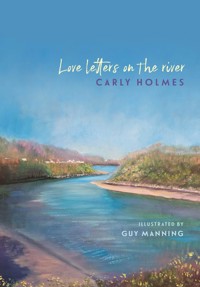
From a young age Carly Holmes has been in thrall to the creatures that live around us. Her childhood companion was a blind gander called Beep Beep who thought she was his wife. She nearly postponed her wedding when a pair of wrens nested in a hole by her back door and cut it very fine to fledge their chicks into an assorted audience of cats and magpies. This collection of essays, beautifully illustrated throughout, are each of them love letters to the Teifi valley and to the river that winds through Carly's days. The wild animals ‒ the badgers who visit nightly for peanuts; the juvenile osprey who learned to fish on the estuary across the lane; the young jackdaw she nurtured until it was healthy enough to ignore her whenever she went into the garden; the cuckoos she discovered in flagrante one afternoon on a lockdown walk ‒ are the very heart of it. Describing encounters and missed encounters with the wildlife that surrounds the Teifi, Love Letters on the River is a lyrical, honest and tender tribute to the many creatures ‒ both in the garden and beyond the garden wall ‒ that bring joy to Carly's life simply by existing. Includes a dozen black and white illustrations commissioned exclusively for this publication by acclaimed local artist Guy Manning.
Sie lesen das E-Book in den Legimi-Apps auf:
Seitenzahl: 176
Veröffentlichungsjahr: 2025
Das E-Book (TTS) können Sie hören im Abo „Legimi Premium” in Legimi-Apps auf:
Ähnliche

















1234
5For my husband, Si. With my love, always 6
Contents
Foreword
This book isn’t intended as an expert’s observations on the natural world, for I’m no expert when it comes to wildlife. Neither do I have a detached and scientific approach to nature. I unabashedly love the wild creatures I encounter and I gave up feeling embarrassed or ashamed for that love, that lack of detachment, a long time ago.
I try not to anthropomorphise animals except in a light-hearted, humorous way, one that doesn’t harm them or deny their essential wildness. But I also accept that I will slip at times, because I’m human and so my point of reference, the filters I apply to the world around me, are necessarily human, too. Besides, I don’t think anthropomorphising animals needs to be an inherently negative thing, for surely it’s through seeking connections and similarities that we form bonds of affection and a desire to cherish, and god knows the natural world needs to be cherished.
I read nature books to educate myself, and nature books that focus on animals I particularly love – Mark Cocker’s CrowCountry, for example – and I also read the newer breed of nature memoir, the kind of book that turns the natural world into a jumping-off point for humans to explore themselves: their musings on grief or divorce, becoming a parent or losing a parent. Nature as guide, as healer, as provider. A natural world that only seems to exist in relation to us, its value lying in the service it provides.
I don’t view nature as a frame for humans and their preoccupations. It isn’t there as a backdrop for the next Instagram post or the perfect saleable photograph. It’s not a theme park, 10to be sampled on a day out. I don’t chase rare birds around the county or country simply to tick them off a list – the pleasure seemingly lying in the achievement of the sighting and not the sighting itself – and I don’t have expensive equipment to record this or that creature’s existence before moving briskly on to the next thing. Seeing a bittern for the first time at my local wildlife reserve is of course going to be more of a thrill than seeing the long-tailed tits on the feeders in the garden for the twentieth time that day, but the pleasure I take from sitting quietly and watching those pretty little birds with their showgirl outfits and perfect pink eye shadow is just as profound.
It makes me happy to stand in the street outside my home and watch the house sparrows hanging rudely out of the entrance to the swift box I didn’t actually put up just for them. Lording it over their rivals, yelling to anyone who’ll listen that their spacious new pad – thank you very much, by the way – is so much better than some dank and cobwebby crevice tucked behind a drainpipe. They’ve raised three broods this year and fledged them all successfully. I’d love to know that box is being used to protect and shelter a new generation of swifts, but to see it protect and shelter any bird raising a family is a joy.
For me, the natural world exists alongside us, sometimes entwined with us, and often despite us. It fills me with a sense of wonder and awe to see such busyness and life all around me, all the time. The unruly patch of nettles at the end of the garden providing food for the caterpillars; the caterpillars providing an essential meal for the blackbirds; the sparrowhawk plunging out of the sun to take one of the blackbirds and then flying fast and low over the garden fences, trailing alarm calls and glossy jet feathers. I am nowhere in these scenes of survival and death. 11My existence, except as provider of sunflower hearts and peanuts, is without importance.
And yet by providing this food, and shelters for these creatures, I have inserted myself into the periphery of their lives in ways that are both positive and negative. If the thrushes hadn’t been enticed into my garden by the mealworms I put out, then the sparrowhawk wouldn’t have taken one of them. If I hadn’t put the mealworms out during the summer drought when the top layers of the earth hardened to rock and the worms sank to deeper, moister layers, then the thrush and its chicks may well have starved to death. I feel the push and pull of my meddling constantly, my impulse to care and keep them safe versus my equally keen impulse to leave them be as wild as possible. To love them as best I can, in ways that will only do good.
My grandfather on my father’s side was an enigma. Of Roma descent – the surname Holmes, according to family lore, he apparently adopted after seeing it on a gravestone – he was a farm labourer who worked and lived in the rural landscape around Canterbury. He was a formidable and scary figure when I was a small child, for he didn’t like children and was inclined to let that dislike show. Remembering him now, I wish I’d known him better or known him when I became an adult. I think we would have got along well, or as well as he was capable of getting along with his fellow humans.
He rose with the dawn and went for long walks with Jenny, the terrier he adored, checking on the birds’ nests along his meandering route through fields, orchards, and woodland. He 12knew where the wrens and the kestrels nested and where the weasels had their dens. Sometimes he stayed out for several hours, particularly when there were visitors to the house. He loved wild creatures and didn’t have much patience for humans. I wonder whether that sense of love and fascination we share was passed down to me via the essential, inescapable tangle of genes, or whether it was imprinted on my father as a way of life and then in turn onto me.
I was born on Jersey – the island my mother and the maternal line of the family are from – and spent the majority of my young childhood on a council estate near Southampton before my family moved to west Wales when I was eleven. My memories of those early formative years are fragmented: some things are still sharply in focus while others are wavering and indistinct. I remember, as the only two vegetarians at our school as well as being in receipt of free school meals, that my brother and I had to wait separately from the mainstream lunch queue. Every day we were fed last, cursorily handed a plate heaped high with grated cheddar and then dismissed. Waved away to add boiled vegetables from the parade of metal tureens, if we chose.
Grated cheese every day. I thought I’d gone to heaven.
The council estate was large, or certainly seemed so, and it was at times a frightening place for a shy and fearful child to live. But on the other hand, there was farmland and woodland accessible from the far end, and we would walk there with our dog Sophie, daily, often accompanied by an assortment of our cats. There was a particular meadow a barn owl quartered every evening and we’d go there in the school holidays to watch it. My brother found a monster one day on my mother’s fuchsia bush, which we then discovered was an elephant hawkmoth caterpillar. 13Every summer tiny frogs emerged from the pond in the back garden to make the journey into the overgrown lane behind the rows of houses, and I’d stay with them for hours, sprinkling them with water so that they didn’t scorch as they crossed the burning tarmac.
When we moved to Wales we had big skies, no near neighbours, and over an acre of land. My parents rescued battery-farm chickens, and added a waddle of ducks and a blind gosling who grew up to be a very stroppy gander who thought I was his wife. We’d been poor when we lived in England but we were even poorer now, deprived both materially and socially as my parents shared hours at their unit in Cardigan market and relied on benefits to make ends meet. Only my father could drive, while the nearest large village with a bus stop was several miles away.
My natural timidity and introversion rose to the surface to become the dominant traits of my personality, and as my teenage years unfolded, depression, arachnophobia and anorexia got mixed into the soup. I spent a lot of my adolescence in my bedroom with my cat Sootica, reading or listening to the gentle, constant scratch and squeak of the bats who roosted under the tin roof of our cottage, inches from my head. Sometimes I’d tap and scratch a response, chirrup to them, and there’d be a short silence before they started up again. The sound comforted me through grim and unhappy evenings, instilling a life-long love of the creatures.
When people think workingclassthey tend to think urban. They tend to think industrial. There’s little mention of the rural poor. With the move to Wales we were suddenly without community, isolated and without the means or money to forge links beyond our patch of land. Outsiders. So I relied on the animals – the cats 14and dogs, the ducks and geese, and also the wild creatures that visited the garden – for distraction and companionship.
The nature books I came across in those years and in my young adulthood were educational and informative, written to instruct the interested, mainly by men. People who’d had the privilege of a good education, for others with similar educational privileges who could understand the scientific or Latin terms used. They were written for people with the money to buy those glossy books brand-new in the first place – for they were rarely to be found second-hand, and public libraries in rural areas aren’t easy to access – and the money to visit the places mentioned. They were written for people with the money and means to buy the equipment needed to go out and study the natural world, and the spare time to indulge in it.
As a working-class writer and nature lover, one who was raised in rural settings with no access to money or to culture, I remember often feeling those books weren’t written for people like me. They were erudite and enlightening, yet somehow detached. None of them gave me permission to simply lovethe wild creatures around me, to watch them and enjoy them; feel some kind of kinship with them. The emphasis was on understanding these animals and their private lives rather than caring about them: observing rather than sharing space. I puzzled over the ones I came across, leafing through my brother’s LifeonEarthby David Attenborough without much real interest and abandoning TH White’s TheGoshawkbefore I’d got halfway through. I was too young to appreciate the anguished state of the man, and I was horrified by the tortures he put the bird through. I felt the same horror and distress when I read Helen Macdonald’s His forHawkdecades later. I sympathised with her grief over 15her father’s death but I couldn’t get past the awful image of poor captive Mabel living her life out in Helen’s living room. A beautiful, deadly bird of prey shackled and forced to live and fly by the whims and routines of her human owner.
Nature writing is still seen as a predominantly white, male, middle-class pursuit. Working-class naturalists are represented mainly in urban settings, finding jewels of life and wildness on their patch of housing estate or in the tight, green and brown spaces of a city. We are all encouraged these days to go out and hug a tree, bathe ourselves in the healing powers of the natural world. It’s all about us. What the natural world can do for us. But for me, as ignorant as I still am about a lot of the animals I am besotted with, it’s all about them. Meeting those wild lives on their terms. Not on mine. I don’t fool myself that the bond I feel for them is reciprocated, and that’s oddly liberating. I care so much, but for them I might as well not exist in any meaningful way. That frees me, maybe, from the ties that bind humans to one another, the sense of being beholden, of having to reciprocate. The love flows one way, without resentment or duty.
As I said, I’m not an expert. I simply love the natural world, the creatures who I happen across. I know that without them and the pure, deep joy that encountering them gives me, I would be deprived in ways more important than material ones; ways that are immeasurable and soul deep.
Mating Cuckoos by Foxhill Farm
We’d heard the cuckoo calling in a steady, patient tattoo of longing through the spring weeks before we saw it. He was somewhere on the outskirts of the village but not close enough to be able to pinpoint a location. After the initial excitement – in over a decade of living in St Dogmaels this was the first time that I’d heard a cuckoo – the sound soon became little more than a thread in the fabric of my days. I’d have noticed it, missed it, if the calling had stopped, but its very regularity relegated it quickly to the daily soundscape of my life.
We were deep into the first lockdown and both my partner Simon and I were working from home. Woven into the global anxiety of a lethal pandemic was the more immediate disquiet and difficulty of now having to share my every working day with someone who’d previously had an office to go to. And when the working day ended we had nothing else meaningful to do. Yes, we could (and did) drink more than was good for us and gorge on comfort foods whilst surfing the news channels – but we also walked. Thankfully the weather was kind and walking hadn’t yet been made illegal.
At 5pm every afternoon we’d leave our desks, lace up our trainers and stride through the village to its boundary. We’d pass the LLANDUDOCH / ST DOGMAELS sign and head onto Cwm Degwel lane. This winds through a valley whose sides are steeply banked with slate; icicles string its peaks and rivulets in the winter months, and the midsummer sun only sears a narrow path of gold along it. We’d walk the damp and slender gorge, slightly uphill 19the whole way, until we reached a junction a couple of miles on. A right turn, and then another right, and we were suddenly on a wider, higher lane where the sky was all around us and the view unspooled for miles. St Dogmaels spread below us in a spill of rooftops and the Teifi estuary gleamed every shade of sapphire.
We used to walk this four-mile loop infrequently in the years before the lockdown, but now we walked it every day. Sometimes grimly – sweating and struggling on that gentle hill which swiped less than gently at our calf muscles after a day of work and worry – and sometimes with a deep and profound sense of wonder and pleasure. The thick drifts of wild garlic, which were low and tender spikes one week, would be ripe and pungent and overspilling the bank, the next. A grey wagtail might flirt its tail and surprise us as it swooped over the stream that ran alongside the lane, joined the next day by another. We noted the differences in the hedgerows and marvelled at how many changes nature could effect in a mere twenty-four hours, if a person really paused to take notice.
A pregnant vixen, one late afternoon, was curled asleep in a soft pile of undergrowth just beyond the wire fence that separated the lane from a tangle of woodland. The next, she was crossing the lane in front of us, shoulder blades scissoring sharply under her thin fur, and swollen belly stretched taut. She paused to nose at something in the bank and then heaved herself slowly through the hedge and was gone.
Sometimes we stopped at a gateway to say hello to a field full of horses, and every day I’d remember that I’d once again forgotten to bring a carrot to give them. Sometimes we’d sit on the warm tarmac of the dusty lane and just listen to a world that had lost the background throb of cars and planes. The tiny shifting life all around us that we could only now really appreciate. 20Si, a committed carnivore, became fascinated by a herd of cows that gathered by the gate in one of the fields to watch us pass. He always stopped to stare at them, something like wonder on his face as they all gazed curiously at each other. He hasn’t eaten beef since.
The cuckoo’s call followed us around this meandering looped walk, and I felt for him as the weeks went by. His presence here was rare enough; to have the luck to attract a female seemed a wish too far. On my childhood council estate, several cuckoos would return to the area every spring and broadcast their availability to potential mates. It was the 1980s, and our estate rang with their call. I’d accepted the sound of the cuckoos with a child’s sure and casual belief that they were simply part of the advent of spring, that they would always be there. It hadn’t occurred to me to appreciate their presence as something that could ever be lost.
We were on the high, top lane when we saw the birds ahead of us, just outside the entrance to Foxhill Farm. It was another hot afternoon and we’d paused to capture that first glimpse of the hills and village tumbling down to the sea in the distance. At first I thought they’d been injured as they scuffled and rocked on the tarmac, wings colliding. And at first I thought they were a bird of prey that I’d never seen before. Some rare visitor blown in from the continent?
As we watched, they separated and one flew off over the fields. The other perched on the fence just ahead of us.
It hunched there, glaring at us from eyes the same fierce yellow as fire opals. We still didn’t know what it was, whispering 21suggestions to each other – ‘Surely it’s not a kestrel? Could it be a hobby?’ – whilst already knowing the guesses were wrong.
But then the cuckoo fanned his tail and leaned forward, and he began to call. Over and over, fixing us with his unblinking stare, he let us know exactly what he was. After a moment he flew into the hedge that divided two fields and continued his noisy staccato courtship of the female we’d scared off. Invisible now in the dense thicket of hawthorn and gorse, his voice followed us as we continued on our way.
When we got home I sat in the back garden and tuned in to the birdlife around me: the wren’s furious, jubilant trilling; the collared doves wooing softly from the rooftop; the blackbird taking his position at the very top of the alder in preparation for his headline act: just as soon as the sun dipped below the horizon.
And beyond all this, somewhere a mile or two away, the cuckoo called and called. I hoped we hadn’t scared his lady off for good or disturbed them before the deed was done. I hadn’t realised how much I’d missed that sound, in all these years of not hearing it.
I hoped he’d return next year, and that I’d get to hear that sound again.




