


1,99 €
Mehr erfahren.
- Herausgeber: Publisher s13381
- Kategorie: Geisteswissenschaft
- Sprache: Englisch
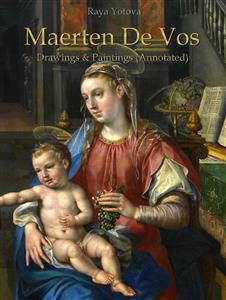
Maerten de Vos was mainly a painter of religious scenes. He was also a portrait painter. In the 1580s he produced many designs for prints and book illustrations. Beginning with style of Mannerism, his style evolved to become clear and descriptive, which fully corresponds to the ideas of Counter-Reformation. He is not an innovative artist, but rather an eclectic figure who has borrowed from the Italian masters. His work owes much differently to one or more Italian artists like Veronese, Tintoretto, and Michelangelo, as well as the Flemish's painters. His style is very recognizable, and his iconography and theme are in a clearly expressed Counter-reformation manner. Although in his style there was little evolution, his late altars recall the work of the earlier Flemish masters. In this later period, his palette became softer and more tonal. De Voss was very prolific, and his large production was popularized and widely circulated through engravings. He also designed for the publishers in Antwerp Plantin Press and made the illustrations for the Triumphus martyrum, a series of 13 wood-prints showing martyrs of the Old Testament as well as 78 drawings for the illustrated Biblical dictionary. The export of this illustrated Bible has contributed to the popularity of de Voss illustrations throughout Europe. His drawings are known for his lively and generally positive character.
Das E-Book können Sie in Legimi-Apps oder einer beliebigen App lesen, die das folgende Format unterstützen:
Veröffentlichungsjahr: 2019
Ähnliche

Maerten De Vos
Drawings & Paintings (Annotated)
Annotated by Raya Yotova
––––––––
First Edition
*****
Copyright © 2019 Annotated by Raya Yotova
Table of Contents
Title Page
Copyright Page
Foreword
Paintings and Drawings
Foreword
Maerten de Vos was born in Antwerp. His father was also an artist, and Maerten and his brother, Pieter, first trained with their father. Probably his next training was at Frans Floris, the leading 16th-century historical painter. Since the trip to Italy had become a ritual for the practice of Flemish artists in the 16th century, de Vos traveled to Italy, with at least part of his journey going south together with Brueghel the Elder. He lived in Rome, Florence, and Venice. His work shows a strong influence on the colors of the Venetian painters. He worked at the Tintoretto's studio in Venice, which would explain this influence.
Upon his return to Antwerp, he became a member of the Antwerp Guild of St. Luke. At that time, Frans Floris was a leading historian painter in Flanders and ruled a large workshop in Antwerp. This made it difficult for other artists to find commissions, but de Vos was lucky to have received orders from a wealthy merchant in Antwerp.
In the 1560s Flanders suffered from Beeldenstorm, the iconoclast rage that peaked in 1566. During the iconoclasm, Catholic art and many forms of church accessories and decorations were destroyed by the Protestant Reformation. Frans Floris, who at that time was a leading Flemish artist, never recovered from the shock that his works had been destroyed. As Floris stopped painting, the younger generation of artists took advantage of the opportunity to make his important position in historical painting. Among these painters, Maerten de Vos became the most famous.
His reputation grew, and he was appointed as dean of the Antwerp Guild. De Vos initially turned to the Lutheran faith, but once again returned to Catholicism after the defeat of the Protestant cause from the Habsburgs of the Netherlands. His career went up when he was given significant orders. He performed monumental altars at the Cathedral of Antwerp and other churches in Antwerp.
He became the head of the Antwerp Guild of St. Luke in 1573. In 1589, he and Ambrosius Franken were selected as chief designers of the decorations for the the newly appointed governor of the South of the Netherlands. Besides, Maerten de Vos is one of the founders of the Romanist Guild, founded in 1572 in the Cathedral of Antwerp of Our Lady. The variety of organizations in which he belonged offered the artist an excellent opportunity to contact potential patrons. To satisfy his strong demand for work, including for foreign clients, de Vos has developed a sophisticated practice for his studio. He had 11 students between 1564 and 1599. His two sons became artists, but their work is poorly known.
Maerten de Vos was mainly a painter of religious scenes. He was also a portrait painter. In the 1580s he produced many designs for prints and book illustrations. Beginning with style of Mannerism, his style evolved to become clear and descriptive, which fully corresponds to the ideas of Counter-Reformation. He is not an innovative artist, but rather an eclectic figure who has borrowed from the Italian masters. His work owes much differently to one or more Italian artists like Veronese, Tintoretto, and Michelangelo, as well as the Flemish's painters. His style is very recognizable, and his iconography and theme are in a clearly expressed Counter-reformation manner. Although in his style there was little evolution, his late altars recall the work of the earlier Flemish masters. In this later period, his palette became softer and more tonal.
De Voss was very prolific, and his large production was popularized and widely circulated through engravings. He also designed for the publishers in Antwerp Plantin Press and made the illustrations for the Triumphus martyrum, a series of 13 wood-prints showing martyrs of the Old Testament as well as 78 drawings for the illustrated Biblical dictionary. The export of this illustrated Bible has contributed to the popularity of de Voss illustrations throughout Europe. His drawings are known for his lively and generally positive character.




