


Erhalten Sie Zugang zu diesem und mehr als 300000 Büchern ab EUR 5,99 monatlich.
- Herausgeber: Edition Königstuhl
- Kategorie: Sachliteratur, Reportagen, Biografien
- Sprache: Englisch
Life stories, life experiences, tragedy, funny: What Dr. Colette C. Camenisch hears every day in her consultation hours as a plastic-aesthetic surgeon has made her the person she is today. Moving stories that have shaped her as a person and as a physician. She is grateful for that. In her book My Craft Plastic Surgery, Dr. Colette C. Camenisch, plastic-aesthetic surgeon and senior physician at the Clinic Beethovenstrasse in Zurich, writes about her work. But their patients also have their say. It is important to her to do away with the idea that aesthetic interventions are only a privilege of the upper class. She sees her task as fulfilled when patients can identify with their body and accept themselves again. An impressive text/picture book full of life stories and life experiences.
Sie lesen das E-Book in den Legimi-Apps auf:
Seitenzahl: 158
Veröffentlichungsjahr: 2025
Das E-Book (TTS) können Sie hören im Abo „Legimi Premium” in Legimi-Apps auf:
Ähnliche

















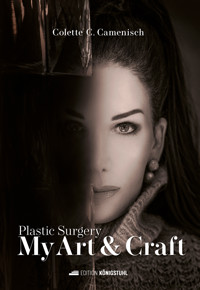
Plastic Surgery—My Art & Craft
Colette C. Camenisch
Edition Königstuhl
2025-06-10
Plastic Surgery—My Art & Craft
About this book
Instead of a Foreword: A Commitment
Part 1 – My Calling
A Surgeon in the Making—Anatomy of a Childhood Dream
Indian Lessons—A Formative Journey
Difficult Years in Emergency Medicine
Stockholm calling—Memories & Mentors
Independence in Practice
Colette C. Camenisch – Interview:
Behind the Scenes—My Clinic
Part 2 – My Patients
Christina, 28
– Tummy Tuck / Arm Lift:
“I have not truly settled into my new body yet”
Anna, 54
– Lipoedema:
“After the operation, I felt sexy”
Silvia, 60
– Breast Implant Exchange:
“Looking good makes you happy”
Mark, 67
– Eyelid Surgery:
“Eyes Wide Open”
Carmen, 45
– Tubular Breasts:
“Remaking the Mirror”
Mia, 23
– Labiaplasty:
No Sports for Four Weeks—A Small Price for Happiness
Andrea, 61
– Breast Reduction:
“Freedom at last”
Acknowledgements
Imprint
Title Page
Cover
Table of Contents
About this book
“Life stories, life experiences, tragedy, and humour: what I get to hear every day in my clinic moves me and has made who I am today.” So writes the plastic and aesthetic surgeon Colette C. Camenisch.
Plastic Surgery—My Art & Craft is not a medical guide. In deeply personal terms, the author describes her path to becoming a plastic surgeon. Above all, however, she writes about those who suffer in solitude and hide themselves away, but who ultimately overcome their shame and find the courage to enter her clinic. She writes about the legitimate longing for beauty that lies within every person.
Seven of her patients describe their journeys toward an aesthetic result that brought them happiness. These are moving narratives that reveal how plastic surgery plays an important role, not only on a physical level, but also on a profound psychological one.
Instead of a Foreword: A Commitment
Every day, my patients share their personal stories with me—life experiences filled with both tragedy and humour—narratives that profoundly move me, shaping who I am as a physician and as a person.
From a young age, I knew I wanted to become a doctor and, before long, I had set my sights on surgery. Ultimately, I pursued and completed two surgical specialisations, a decision I’m profoundly proud of today.
I’ve spent decades refining my craft, learning from leading surgeons. This book traces that journey. Hopefully, medical students and aspiring surgeons will be interested in my challenging yet rewarding path, and in the medical-aesthetic standards physicians uphold.
Above all, however, it is dedicated to my patients, who continuously inspire me to strive for excellence. Witnessing their joy over successful outcomes fills me with deep satisfaction. Hearing words like “Thank you, Doctor, you’ve helped me feel comfortable in my own body,” reaffirms the significance of my work.
I also share the struggles my patients endured before visiting me. Several courageously offer their perspectives, guiding readers through their personal journeys—from their initial decision, through surgery, to final results. They speak openly about their fears, anxieties, and struggles, revealing deeply moving stories. It takes bravery to go public about real or perceived physical imperfections, and I’m grateful they have chosen to share their experiences. The idea for this book has not been to produce a medical guide or a gallery of idealised before-and-after images. It has been to amplify the voices of all those who are unhappy with their bodies, those who hide, suffer, or remain in the shadows, in the hope that their stories will help us understand the universal longing for aesthetic harmony and comfort with one’s own body—a longing that is justified and human.
My responsibility as a physician and surgeon is to tailor the best surgical techniques to each patient’s unique challenge. I strive to understand patient expectations, gently adjust them if necessary, and aim to fulfil their desires. My goal is always to achieve the best possible outcome—ideally, exactly what my patients envisage.
I consider myself a companion to my patients on this journey, taking them by the hand and guiding them. Together we discuss options, celebrate good results, and, if need be, also experience the highs and lows of the post-operative phase after a major procedure. This is all done with one goal in mind: to create a new, positive body image!
And here I want to deal with the notion that plastic surgery is a privilege only available to high-earners. Or worse: that it is unnecessary. People of both sexes, all age groups, and all professions, come to me. Some have suffered in solitude for years before finding the courage to take that step. Which deeply, and frequently, troubles me. Why, I ask myself, should procedures such as breast reductions, eyelid lifts, or labiaplasty carry a social stigma? As if such operations were a pure luxury of an affluent society.
It would be wonderful if, in these pages, I could succeed in breaking down prejudices with insights into the lives of my patients and into that of a plastic-aesthetic surgeon. Plastic surgery is not a trivial lifestyle choice. It is capable of providing emotional and physical healing, and improving people’s quality of life.
Part 1 – My Calling
A Surgeon in the Making—Anatomy of a Childhood Dream
A young schoolgirl is sitting on a large stone overlooking a Maiensäss, or alpine pasture, high in Switzerland’s Bündner mountains. In front of her stands an older gentleman who looks down at her and asks, “Do you know yet what you want to do when you grow up?” She doesn’t have to think for long: “I want to be a doctor,” she replies.
“I see,” he says. “Then you must put your name down for the exam with the teacher at the high school.
That girl was me, and I followed the advice of the older gentleman, who was our family doctor, although anyone who decides at the age of eleven to become a doctor has an endlessly long road ahead of them. But it became my passion over the years that followed.
I was not a high-flyer at school. Whenever I looked up at the high school, situated on a hill in my home town of Chur in Switzerland, I was filled with awe. A thousand students were taught there. The entire Oberland region came to this school to get their high school diplomas. For me, it meant putting in a lot of effort from the very beginning. I initially struggled mightily with maths and physics and, in my second year, the teacher recommended I should be downgraded to a secondary school. That was absolutely out of the question for me. I had a goal, after all: to study medicine. That wouldn’t be possible without a Matura. So, with the support of my parents, I stayed at the high school, and knuckled down.
A prerequisite for medical school is Latin, which, other than biology, was the only subject I truly enjoyed. Time and again during my high school years, I would fantasise about my dream job. Then, at the age of 17, two years before my graduation, it became clear to me that I didn’t just want to be a doctor; I wanted to become a surgeon. Two years later still, at 19, I had my Matura in my pocket.
I could hardly wait for my first opportunity to enter the medical world. I wanted to breathe hospital air, observe physicians in action, and get a glimpse of the life I’d imagined since I was a child. In Chur, young people could take part in what was affectionately called a Häfeli-Praktikum—literally, a ‘bedpan internship’. Yes, really! Interns were tasked with emptying the patients’ bedpans—Hafen in Swiss German—a humble but practical initiation into medicine. I was assigned to a medical-surgical ward and, notwithstanding the less glamorous tasks, I loved every moment.
My enthusiasm was so strong that I insisted on attending every dressing change and eagerly seized any opportunity to venture into the operating theatre. Standing quietly in the background, I absorbed every detail. I adored the energy and precision in the OT; I felt fully alive. But, although I found procedures like brain surgery and total knee replacements fascinating, every observation ended the same way—with me fainting. Admittedly, the sight of a fibula separated from a leg takes some getting used to, but, I was completely euphoric about the experience. What had been planned as a one-month internship turned into an unforgettable six.
Afterwards, I left for Zurich to enrol in medical school. Looking back, I realise that aspiring physicians in the early 1990s had a significant advantage: there was no numerus clausus, the restrictive enrolment quota and entrance exam that later became standard. At that time, anyone with genuine passion and determination could pursue medical studies. Today’s selection process, unfortunately, focuses largely on grades and standardised tests—assessments that hardly measure qualities essential to becoming a compassionate doctor, such as empathy and genuine dedication. Consequently, the system often favours those adept at test-taking rather than those truly called to medicine.
Even today, we urgently need young, innovative physicians who not only have strong medical knowledge but also understand the local language and culture. We need individuals who are genuinely motivated, eager to learn, and willing to consistently go above and beyond.
In this respect, I fully support the Swiss Parliament’s 2024 decision to abolish the numerus clausus for medical studies. Empathy, passion, and social skills are at least as important—perhaps even more essential—to successfully practising medicine as numeric test scores.
When I tried to register at the University of Zurich, officials informed me that my home canton, Graubünden, did not contribute sufficient educational subsidies, meaning I would have to study medicine in Berne instead. Berne! I was dismayed. Zurich was my chosen home; my social life and friendships were all established there. For me, no alternative existed—only the University of Zurich would do. Once again, I prepared myself for a fight, this time for a place in Zurich’s medical school. And I succeeded! Ultimately, I secured my admission precisely where I had always wanted.
Then came the first lectures. Six hundred eighty-five students crammed into the vast auditorium at Zurich’s Irchel campus. I immediately felt provincial as I observed the tall, elegant, blonde Zurich women in the front rows, all sporting designer handbags and chic silk scarves from Fabric Frontline—the height of Zurich fashion at the time. We from rural Graubünden stood out markedly, something that initially unsettled me. My male classmate from Graubünden, typically unfazed by such anxieties, simply handed me a bag of M&M’s, remarking casually, “Let’s fix this with some sugar.” My insecurity soon faded, but left in its place a less-than-ideal dietary habit: I felt as if I survived the entire preclinical phase on a diet of M&M’s and iced tea—an eating regime I wouldn’t recommend to future medical students.
The professor at the podium turned out to be a didactic ’genius’. “Take a good look at your neighbour,” he said into the microphone, “because a year from now, they won’t be here.” “Very encouraging,” I thought, sarcastically. Medical school was clearly not for the faint-hearted. For example, the students had to share just one printer between them. This meant either waking at dawn to print materials or bribing a fellow student ahead of you in the queue. I did both, quickly learning how to use my elbows and assert myself.
If I’m completely honest, the first four semesters—the preclinical phase—were pure drudgery for me. This part of medical education involved endless theoretical study, with virtually no patient interaction to keep things interesting. Preclinical training meant wrestling with physics and chemistry and memorising mountains of anatomy, biology, histology, and embryology—subjects far removed from my personal interests. I often found myself wondering what these abstract scientific concepts had to do with treating actual patients. Despite my difficulties, I managed to complete the first two semesters successfully.
In the second preclinical year, it became abundantly clear that my talents did not lie in biochemistry. My lab experiments became notorious for occasional explosions, proving conclusively that I wouldn’t have made a good pharmacist. I barely scraped through chemistry. My biochemistry professor bluntly told me I was completely unsuited to chemistry—not exactly encouraging words. After four semesters, the challenging second preclinical exam awaited, which would determine whether I could advance to clinical training. I failed, primarily due to biochemistry. I realised I had taken the wrong course. At first, it felt like my world had collapsed, and my medical aspirations had been crushed because the regulations dictated a mandatory one-year break before I could retake the exam.
Surprisingly, this interruption became my lifeline, the enforced break unexpectedly proving beneficial. To clear my head, I took a job as a farrier’s assistant in Zurich. Having grown up around horses, I found this hands-on work therapeutic—it gave me the reset I desperately needed and I simultaneously adopted new study methods for my next attempt at the exam. And on my second try, I succeeded! The sense of relief and achievement was overwhelming—my joy was immense. Finally, I could begin my clinical training, treating real patients instead of wrestling with test tubes.
In the clinical phase, spanning eight semesters, students learn about various medical specialties, including general medicine, ophthalmology, gynaecology, psychiatry, radiology, pathology, and, thankfully, surgery. Through internships and specialised courses at various clinics throughout eastern Switzerland, students gain practical experience, finally interacting directly with patients and experiencing daily medical practice first-hand.
It was the beginning of the most exciting period of my student life—an unforgettable time. By day, we attended engrossing clinical lectures, and by night we explored Zurich’s vibrant nightlife, often gathering at the famous Kaufleuten club. Naturally, we never had enough money to spend, but we managed to sneak in because one of our classmates conveniently worked as a bouncer. Our homemade Campari-and-orange cocktails, discreetly bottled, hidden in our handbags. Whenever I reminisce about those nights, it brings a smile to my face. Despite the rigorous demands of medical school, my social life was remarkably active.
A significant aspect of medical training included practical courses at the university hospital, when students often encountered seriously ill patients for the first time. While taking my turn in the intensive care unit, I witnessed the first cases involving ecstasy overdoses, vividly demonstrating the devastating effects of drug abuse. The emergency room particularly fascinated me—I immediately loved its energy and eagerly absorbed every detail. These experiences further strengthened my ambition to become a surgeon.
Throughout my seven years at university, I constantly struggled financially. My circumstances improved a little after my grandfather passed away, leaving me a modest inheritance that supported five years of my studies. However, during my final two years, I had to take on additional work, frequently pushing myself to the limit. I secured night-shift employment at a care facility in Stallikon, a small village outside Zurich, looking after children with severe physical and developmental disorders. Some had Down syndrome or autism; others faced profound disabilities such as cerebral palsy. My duties involved feeding, bathing, and changing the children—tasks that were both physically and emotionally demanding.
Balancing medical studies and hospital rotations during day and night shifts was exhausting. Yet I persisted, firmly believing that perseverance during these formative years would eventually pay off. At that age, one has remarkable resilience. Furthermore, not only did the job give me the financial support I needed, but it also provided invaluable direct patient-care experience. After my initial patient interactions during my ‘bedpan internship’, caring for children in the residential facility significantly enhanced my interpersonal skills. Unlike many medical students, I gained extensive early experience managing complex social interactions with vulnerable patients.
To me, medicine is about understanding the full spectrum of human anatomy, histology, and psychology—but it also means creatively solving medical problems, building meaningful connections with patients, and ultimately helping people regain their health. I was fortunate to learn from exceptional professors and mentors—outstanding physicians who consistently challenged and supported me, profoundly shaping my professional identity.
During my second year at medical school, I encountered someone who was to profoundly influence my career—Professor Mirjana Manestar. A brilliant Hungarian anatomist, she had established herself as a leading expert in what was then predominantly a man’s world, commanding respect through her exceptional intelligence and expertise. It was she who found me huddled in distress, tears streaming down my face, outside the anatomy lab—a stark, white-tiled room lined with stainless steel tables, where medical students dissected human bodies donated to anatomy research.
Our dissection group, which included an unusually high number of students from my native canton of Graubünden, all gathered around Table 16. I was instructed to make the initial incision. But standing over the cadaver, my thoughts fixated on the man lying before me: who he had been, the life he had led. Overwhelmed by emotion, I fainted before I could make the cut.
I was to realise later that the very quality that would eventually become essential in my medical career was precisely what held me back at Table 16. The cadavers in our anatomy lab were preserved with formaldehyde, a chemical whose intense, acrid-sweet smell made dissection even more challenging. For all my powers of determination, my second attempt ended exactly like the first—I collapsed again. Sitting defeated outside afterward, I was convinced my dream of becoming a surgeon was slipping away, just as I finally got to hold a scalpel. If I couldn’t manage an incision on a cadaver, how could I ever treat living patients?
This was how Professor Manestar found me. “Why are you sitting here?” she asked, firmly but kindly. “I’ve fainted twice,” I sobbed. “Well, that’s understandable—perhaps surgery isn’t for you,” she replied gently. “But surgery is exactly what I want!” I insisted tearfully. Taking a deep breath, she looked directly into my eyes and stated plainly, “Then we have a problem.”
She proceeded to shift my perspective. She explained calmly that the man who lay before us had voluntarily donated his body to science; he had chosen to become an essential teacher for future physicians, a role he would have taken pride in—and of course, he could feel no pain. With a perfect balance of compassion and authority, she guided me back into the lab and stood beside me.
“Now, Doctor,” she said clearly—deliberately using the title I had yet to earn— “compose yourself and do what needs to be done. This moment marks the beginning of your surgical career.” Under her steady gaze, I successfully made the incision. When I finished, she placed a reassuring hand on my shoulder and proclaimed: “You are a born surgeon!” They were words I would never forget, touching me more deeply than she could ever have known.
Years later, at an education seminar, our paths crossed again. “I remember you,” she said warmly, with a knowing smile. “Table 16. You were quite tender-hearted.” I laughed—indeed, I had been, and in many ways, still was.
Another unforgettable figure in my medical education was Professor Erwin Koller, a charismatic authority in physiology—the field that explores how bodily systems, such as cardiac rhythms, function. His lectures were a brilliant combination of scientific rigour and emotional engagement; he had the unique ability to make complex concepts not just accessible, but genuinely enjoyable to learn. His teaching often included provocative humour. With absolute conviction, he once declared, “If men had to endure a woman’s hormonal cycle for just a month, they’d be committing suicide in droves.” Beyond such amusing remarks, he rigorously trained us in interpreting electrocardiograms (ECGs)—critical readings of the heart’s electrical activity.




