


Erhalten Sie Zugang zu diesem und mehr als 300000 Büchern ab EUR 5,99 monatlich.
- Herausgeber: The Lilliput Press
- Kategorie: Sachliteratur, Reportagen, Biografien
- Sprache: Englisch
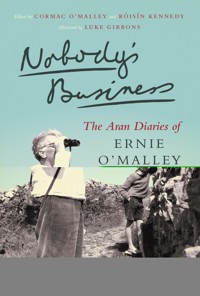
'Nobody's Business': The Aran Diaries of Ernie O'Malley presents new insights into the contradictions and complexities of the mind of Ernie O'Malley, one of mid-twentieth century Ireland's foremost cultural critics. In 1941, 1955 and 1956, the former revolutionary leader and author of the acclaimed memoir of the War of Independence, On Another Man's Wound, visited the Aran Islands. While on the islands, O'Malley kept diaries recounting his daily conversations and interactions with other visitors and islanders including Elizabeth Rivers, with whom he stayed on one occasion, Charles Lamb and Seán Keating. The diaries, devoid of sentiment and often highly critical, reveal his views on art, literature, history and contemporary Irish life and international affairs as well as his thoughts on the economic, religious and daily life of the Aran islanders. His unvarnished observations on the inconsistencies and hypocrisies of life in post-Independence Ireland make his diaries absorbing and provocative. Edited with introductory essays by Cormac O'Malley and Róisín Kennedy and an afterword by Luke Gibbons, 'Nobody's Business': The Aran Diaries of Ernie O'Malley offers fascinating insights into the mind and opinions of a key figure in Irish cultural nationalism.
Sie lesen das E-Book in den Legimi-Apps auf:
Seitenzahl: 420
Veröffentlichungsjahr: 2017
Das E-Book (TTS) können Sie hören im Abo „Legimi Premium” in Legimi-Apps auf:
Ähnliche
















The Aran Diaries ofERNIE O’MALLEY
Edited byCORMAC O’MALLEYandRÓISÍN KENNEDY
Afterword byLUKE GIBBONS
THE LILLIPUT PRESS
DUBLIN
Dedication
This volume is dedicated to Paddy Mullen of Inishmore (1948–2016) and to Dr Pádraig (Pat) O’Toole of Bung Gowla, Inishmore (1938–2015), who were so supportive of this endeavour.
Illustrations
Ernie and Cormac O’Malley on Inishmore, 1954. Photographer Jean McGrail. Courtesy of Cormac O’Malley. (Cover)
Ernie O’Malley on Inishmore,1954. Photographer Jean McGrail. Courtesy of Cormac O’Malley.
Elizabeth Rivers in doorway of Man of Aran Cottage, Inishmore, Aran,c. 1940. Photographer unknown. Courtesy of David Britton.
Pat Mullen. Photographer unknown. Courtesy of David Britton.
Sean Keating,Launching a Currach. Charcoal drawing. Private collection. Photograph courtesy of Adam’s Fine Art Auctioneers.© Seán Keating. All Rights ReservedIVARO,2017.
Irish Dancers in a cottage on Inishmore [Bridget Johnston, on right Sonny Hernon], March 1952. Photographer George Pickow. Ritchie-Pickow Collection – James Hardiman Library – National University of Ireland, Galway. © National University of Ireland, Galway.
Charles Lamb,A Quaint Couple, 1930.© Crawford Art Gallery, Corkand Laillí Lamb de Buitlear.
Elizabeth Rivers,Loading Cattle for Galway from the Aran Islands.Wood engraving. Courtesy of David Britton.
Annie Hernon knitting close to a cottage hearth, 1952. Photographer George Pickow.Ritchie-Pickow Collection – James Hardiman Library – National University of Ireland, Galway. © National University of Ireland, Galway.
Seán Keating,Two Girls waiting by harbour for hooker.Charcoal drawing. NationalMuseum of Ireland. Photograph courtesy of Adam’s Fine Art Auctioneers.© Seán Keating. All Rights ReservedIVARO,2017.
Maurice MacGonigal, Unloading Turf, Kilmurvey Pier, Inishmore, c.1954. Privatecollection. Photograph courtesy of Adam’s Fine Art Auctioneers.© Estate of Maurice MacGonigal, by permission of Ciaran MacGonigal.
Elizabeth Rivers,Seaweed Harvest, Aran Islands. Wood engraving. Courtesy of David Britton.
A young woman spinning, Aran Islands, c. 1952. Photographer George Pickow. Ritchie-Pickow Collection – James Hardiman Library – National University of Ireland, Galway. © National University of Ireland, Galway.
Seán Keating,Self-Portrait. Drawing. Private collection. Photograph courtesy of Whytes.com.© Seán Keating. All Rights ReservedIVARO,2017.
Preface: Aran on his Mind or‘Nobody’s Business’1
Cormac K.H. O’Malley
My father, Ernie O’Malley, had the Aran Islands on his mind on and off for almost forty years. The islands represented a special place for him, an intellectual getaway, a place where he could have ‘peace and freedom’. This relationship was not critical to his life or career, but his reflections on Aran in his diaries and in other writings tell us much about himself as a nationalist, a long-suffering patient, art critic, archaeology buff, folklorist, military organizer, parent, wanderer and writer.
In his youth my father summered around Clew Bay, Co. Mayo, and retained vivid memories of the local boats, islands, islanders, fishing, fishermen, stories and folktales, and he wrote of these nostalgically in the first chapter of his memoir,On Another Man’s Wound.2Thus when he first went to Inisheer, the smallest of the Aran Islands, in spring 1919, with Peadar O’Loughlin of Clare, to help start a company of Irish Volunteers there, he would have been familiar with some of the rural island traditions of storytelling and their way of life. Father was not an affable, easy-going young man who could sing a song or tell a ballad easily; in fact, he was a relatively shy introvert, who could never speak well in public. However, when required in the evening time sitting around a turf fire on Inisheer, he drew upon his resourceful memory to relate to the islanders some seafaring stories such as those of Till Eulenspiegel, Hakluyt’s sea tales, ‘Bricriú’s Feast’ and ‘The Story of Burnt Njal’. Since he could not speak Irish, no doubt, Peadar in translating his tales for the islanders must have added some engaging language, and they in turn apparently ‘rocked with delight’. Sadly for him from the perspective of his immediate mission, no Volunteer company was organized, and he comments on that in his later diaries, but at least his tales were remembered after he left. Folklore remained an interest throughout his life, and he wrote up tales and folk traditions when he travelled later in New Mexico and Mexico.
Ernie O’Malley on Inishmore, 1954.
Father took about ten years off after being released from his military internment camp just before the start of theTailteannGames in mid July 1924. He first went to Europe to recover from his ill health and wounds after his eight years of military activities. When he returned to Ireland in autumn 1926, he found he could not concentrate on his medical studies and by autumn 1928, he went off to the United States to raise funds for the founding of theIrish Press. When that campaign ended, he remained there and wandered around the United States and Mexico – writing his memoir, principally in New Mexico and New York. It was there he met my mother, Helen Hooker, an American sculptor, artist and photographer, and fell in love. When he returned to Ireland in 1935, one of the places he wanted to go to get away from his own family’s domestic life in Dublin was to the quietude of the West. Having lived in such relative isolation during his travels perhaps returning to the centre of his parents’ family home was too much, and soon after arriving home, he wanted some solitude. He would also have encountered many people who still wanted him to be as he had been in his activist nationalist days, whereas he had moved on and wished not to be thought of in that heroic light. As in his days on the run, he took off to wander around Ireland to see archaeological sites and monastic ruins. He went to Clare and Galway, and it is thought that he went on to Aran. By that September he had married Helen Hooker, settled down in Dublin where he returned to his medical studies, and started to prepare his memoir for publication in early 1936. Their first child was born in July 1936, and while Helen’s American family visited in Dublin, my father once again sought out peace and quiet and headed to the Aran Islands.
It must have been quite a surprise when my father landed in Kilronan on Inishmore and met Barbara MacDonagh, daughter of the 1916 executed leader, Thomas MacDonagh, who was there on her honeymoon with her husband, Liam Redmond, and had rented McDonagh’s hotel in Kilronan for a few weeks that August. There were plenty of unoccupied rooms there, and he was invited to stay. Despite his good intentions to be isolated, no doubt, he was interested in meeting up with young people who knew of nationalist politics, literature and theatre. Barbara was studying Arts while Liam was doing Medicine atUCD, and both were involved in the Dramatic Society, which father had helped found in 1926. There would have been great chats, and father would have met Dr John O’Brien who became a great source of friendship and information for years to come.
After his respitein Aran father returned to Dublin and continued his medical studies, but my parents spent more and more time on excursions around Ireland photographing archaeological and medieval Christian monastic sites. After father lost a libel suit on his memoir in 1937, my parents decided in 1938 to live in County Mayo where eventually they settled in an old O’Malley home at Burrishoole Lodge, near Newport.3There they started an almost self-sufficient farm during the Emergency years, but also spent time photographing rural Western Ireland. My mother took a special interest in fixing up the farm buildings and continuing her sculpting, while my father collected extensive folklore tales from around Clew Bay and started to research and write on local history.
In the autumn of 1941 when father wanted to avoid some unannounced guest at their home and to take a break from his farm responsibilities, he wandered off once again, this time towards Galway. When close to Galway he remembered Aran and went by the steamer,DunAonghus,out to Inishmore. He might have heard talk in Dublin from his friends in the art world that Elizabeth Rivers, an English artist, had moved to Inishmore in 1935 and was supporting herself by running a small boarding house for like-minded paying guests in Robert Flaherty’s former Man of Aran Cottage.4He arrived there in Kilmurvey unannounced, settled in for a few weeks and felt content to be able once again to write, talk and walk without domestic interference or responsibilities. The fruit of those writings is published here for the first time, though only three of his 1941 diary notebooks have been located.
After a few weeks, father returned to Burrishoole to continue supervising the farm during the day and to write and read in the evenings. Before the end of the Emergency, the family moved back from their relative isolation in Mayo to Dublin to place their children in schools there. They both became involved in various aspects of the arts: mother continued her sculpture and helped found the Players Theatre with Liam Redmond, who then lived next door in Clonskeagh; father became more involved in artistic and literary matters as the books editor ofTheBelland writer of art criticism. By mid-1948 their marriage had become dysfunctional and father took the three children, Cathal, Etain and myself, back to Burrishoole. All of us children had contracted some form of tuberculosis in Dublin thoughonly my brother and I were confined to bed. Father, in effect, homeschooled us for a period. In 1950 my mother returned to Ireland and without consulting my father took or ‘kidnapped’ my brother and sister from their Irish-speaking boarding school, Ring College in Dungarvan, thus contradicting father’s specific orders to the school. Father’s plan for our education was for us to become proficient in Irish and for the boys to have a Benedictine education in Ireland and then to go to Ampleforth College, a Benedictine boarding school in England. After spring 1950 father kept me on a tight leash during the summers when I stayed with his close friends; I was moved frequently from house to house and was placed in boarding school but under a veil of secrecy so no one knew where I was except one other person.
Almost thirteen years after father’s 1941 visit to Aran, he returned there,but much had changed in his life. His wife had left him. Two children had gone. He had suffered setbacks in his health with heart attacks in 1952 and 1953, had been told to stop living by himself in his beloved Mayo home and had had to move to a Dublin apartment where he would not have to climb stairs. He also had the dual challenge of making sure that I was not kidnapped by my mother and taken to America and of getting me to speak Irish before going to Ampleforth in 1956. His plan was for us to spend the month of August on the Aran Islands for at least three years. Accordingly, in the summer of 1954 we spent July in Burrishoole packing up his books, furniture and paintings and drinking off his wine cellar in preparation for our move to Dublin, and we passed August in Kilmurvey House in Kilmurvey, Inishmore.5After the month of work in Mayo my father was quite exhausted and by staying in an Aran guest house, we did not have to bother with shopping and cooking as three meals a day were provided. My recollection of Kilmurvey is that there were not many children in the vicinity with whom I could play and so my learning of Irish was quite minimal that summer. However, father and I explored the ruins of forts, castles, churches and houses as well clambering over stone walls and spent much time with colourful Dr John O’Brien.
For the summers of 1955 and 1956, my father decided that we should go to Inisheer, which was a smaller community; it had guest houses for outsiders and more children for me to play with and thereby learn Irish. Father always brought along books to read and notebooks to write in. Writing a diary was a mental exercise for him, a way to keep his writing in shape. He assiduously counted the number of words he wrote each day, and occasionally reread his diary and made minor corrections. Unfortunately, his 1954 diary has not been located though it may turn up yet. The short diary from 1955 and a longer diary from 1956 were found among his papers when he died, but had never been transcribed until the last few years after they had been donated to New York University Library.
These Aran diaries relate my father’s immediate reactions and reflections as to what he saw, felt and experienced; they were not studied, reviewed and restated. He titled his 1956 notebook ‘Nobody’s Business’. On a few occasions he contradicted an earlier comment and wrote his new insight on whatever page he was writing at the time, but did not bother to go back and change his original thought. When reading the diaries one feels that one is right there listening to the actual conversations or watching the windswept landscape. One senses the aches in his back as his rheumatism pained him and he searched for relief from the occasional sunshine. Father wrote these diaries in the same manner as his first published memoir with good, detailed descriptions of landscape and seascape including animals, birds, fish, fauna and local occupations. He included his characteristically brief but adroit character analysis and dramatic dialogue, which allows one to ‘hear’ better what is being said in a particular accent or dialogue. It is interesting to note that although he himself did not know much Irish, he insisted that his three children learn Irish fluently, and yet in his diaries he expresses some ambivalence towards time spent by islanders learning Irish in the Aran schools. He also picks up on the resistance by the islanders and others to the ‘official’ form of Irish, which was then being taught. His interest in folklore comes through as he relates the local lore and history. In short, he delivers a vivid slice of life in the world of the Aran Islands during those years – though, of course, his writings reflect only his own immediate perceptions and do not attempt to give an overview of life on Aran, and are also clearly once again, like many others, the observations of an outsider.
A quick note about editing my father’s extremely difficult handwriting. In some places ellipses have been used for limited deletions – where words were indecipherable, wording confusing or incomplete or for other reasons.
1The title ‘Nobody’s Business’ was written on two of the 1941 diary notebooks.
2Ernie O’Malley,On Another Man’s Wound(Cork 2013, originally 1936).
3This house had been owned by Owen O’Malley, whose two sons, Austin and Joseph (Jack) had joined the French forces after their landing at Killala in 1798. Thus this house, though not related to my father’s Malley family, at least had emotional ties to an earlier Irish revolutionary era.
4Robert Flaherty (1884–1951) was an American documentary and ethnographic film-maker, well known forNanook of the North(1922),Moana(1926) andMan of Aran(1934); the latter was the first ever talking documentary film. He moved to Ireland and lived on Inishmore with his wife and family to make his film during 1932–33. He built a small studio in Kilmurvey, which later became known as the Man of Aran Cottage. To finish the film he brought the cast over from Aran to London to record the dialogue. While they were there he made a second film, his first synch-sound production and the first Irish-language talkie,Oidche Sheanchais.
5Kilmurvey House was run by Mrs Bridget Johnston (néeCoyne of Galway), recent widow of James Johnston. Fellow guests that summer included the American Ambassador to Ireland William Howard TaftIV, William Boggs, Margaret D’Arcy (Russell) and others.
Introduction
Róisín Kennedy
Ernie O’Malley’s diaries were never intended for publication. As noted in the preface, two of the later diaries are labelled ‘Nobody’s Business’. They record observations and private conversations made on his visits to Inishmore and Inishmaan in 1941 and to Inisheer in 1955 and 1956. O’Malley’s constant curiosity and concern with art and material culture run throughout their pages. In 1941 he stayed in a cottage rented by the artist Elizabeth Rivers where he and the other guests shared an interest in theatre, books and painting. While in Inishmore, O’Malley also met the painter Charles Lamb who was based in Connemara and with whom he conversed about some of their mutual acquaintances in the Dublin art world.
The Emergency was an exciting time for art in Ireland, and O’Malley later recognized its significance.6While there was a lack of art materials and other restrictions, the war forced more adventurous artists, collectors and critics to return from abroad to live in the neutral Free State. The lack of international travel ironically assisted in the development of an already embryonic gallery system focused on modern Irish art. In 1943 Victor Waddington opened a new gallery in Dublin specializing in modern painting. In the same year the Irish Exhibition of Living Art was founded as an alternative annual exhibition forum to the Royal Hibernian Academy, rapidly outdoing its rival in popularity and quality. However, in 1941 when O’Malley was chatting with Rivers and Lamb about Irish art, he had yet to develop his later positive views on its progress in the Emergency period. The diary records several negative comments on the lack of quality in Irish art, the lack of commitment by artists and gallerists and above all the general lack of taste and awareness of artistic matters in Ireland.
O’Malley married and settled in Ireland in 1935 with his wife, the American sculptor Helen Hooker, after a seven-year period in the United States and Mexico. Partly through Helen’s involvement in the art world and partly through his own networks, he developed friendships and associations with many modernist artists in Dublin. He began to assemble an impressive collection of modern Irish art that came to include eight major paintings by Jack B. Yeats. He also collected work by Louis le Brocquy, Evie Hone, Mainie Jellett and Norah McGuinness among others. From the mid 1940s O’Malley, who had by then developed a positive attitude towards this cohort of Irish artists, was closely involved in promoting their work, which he believed could form the nucleus of an expansion of modernist Irish art internationally.7
When he returned to the Aran Islands in the mid 1950s, O’Malley’s material circumstances had altered dramatically. Helen had closed their home in Clonskeagh, Dublin, and returned to the United States in 1950 and divorced him. He had in effect abandoned his homein Burrishoole, near Newport, Co. Mayo and was living in Dublin. He was in poor health, having suffered a series of heart attacks. O’Malley and his son, the youngest of his three children and the only one not taken by Helen back to America, stayed in the guesthouse run by the Colman Conneely family in 1955 and at the guesthouse run by Marie Flaherty O’Donnell in 1956. On the more isolated island of Inisheer there was not the same mix of creative types that Rivers’ home had provided. But O’Malley sought and befriended a young Danish artist, Orla Knudsen. He also came into regular contact with another visitor to the island, Seán Keating, the leading academic painter in Ireland. A difficult character, he was often at loggerheads with the liberal art world with which O’Malley was aligned. Unsurprisingly the two men, despite their shared interest in art and nationalism, had a distinctly frosty relationship.
While the later diaries make reference to the ways in which the Aran Islands were being affected by emigration and changes in established farming practices, the art field continued to be of central concern to O’Malley. This was also changing. Despite the apparent advances of the foundation of the Cultural Relations Committee in 1949 and the Arts Council of Ireland in 1951, the wartime optimism associated with the art world was diminishing. There was a decline in one-person exhibitions and a slackening of art sales in Dublin in the post-war period. Victor Waddington moved his art gallery to London in 1957. He was undoubtedly helped in making this decision after the Irish government introduced a 60 per cent levy on artworks being imported into the country and a 40 per cent levy on art materials in 1956.8
O’Malley was a dispassionate observer of all things and people that came into his notice. As a consequence his account of the Aran Islands is remarkably unsentimental and devoid of the kind of rhetoric normally found in visitors’ memoirs. He does admit to having an affinity with the place in the 1941 diary: ‘A strange place, this Aran. I have settled down here as if I had lived here for a long time and as if I could stay a long time.’ Elsewhere it is evident that his feelings stem as much from the freedom from domesticity and the leisure to read and to write that his stays provided rather than from any attachment to Aran. While his earlier stay enabled him to discuss and consider the state of art and culture in Ireland generally, his later visits prompted him to look more closely at the islands as a microcosm of Irish culture, one that was being undermined and eroded by economic turmoil and official neglect but above all by what O’Malley considered to be the inherent suspicion of intellectualism amongst Irish men and women.
In his 1941 diary O’Malley laments the general lack of engagement with the arts and culture by the Irish. This he attributes to economic factors and by extension to the legacy of colonialism: ‘Art needs money necessarily for its development. It needs leisure, and we share neither so far, but might have both eventually … Leisure for sport most people seem to have in this country, but not leisure to read or to look at pictures.’ Introspection and a lack of knowledge or curiosity about the outside world have also had a negative impact on the Irish. The diaries consider the role of colonialism in this process: ‘At one time the Irish were open to every idea, and when their best work in manuscript and metal work was being done they were able to keep abreast of every foreign idiom in their work and to absorb or to change it. Conquest shut them off from the outside world. Then journeying was restricted and finally stopped altogether.’
‘“Things get so bad at times in the country,” I said, “that I feel like putting up a notice which would read as pure snobbery,people with creative tendencies welcomed,”’ O’Malley records in his diary. But even if the level of creativity was to increase, the Irish, unlike people of other countries, according to O’Malley, have no sense of how to appreciate art: ‘Abroad there are certain indefinable standards in creative work. Certain looks, a piece of sculpture, a picture, a concert have a quality which people understand. They are sound constructively and creatively. You haven’t to explain them every time you come across them, or to defend them against the resentment of people who cannot see the work.’
The low level of engagement in the arts in mid-twentieth century Ireland was exacerbated by the conservative education system that was run almost exclusively by the Catholic Church. The learning of Irish was the overriding priority of the Department of Education at the expense of other subjects, including the teaching of art and drawing.9The latter was dropped from the primary school curriculum in 1922. To add to this the introduction of censorship of film (1924) and of literature (1929) discouraged the development of an informed and engaged understanding of contemporary European cultural issues by large swathes of the population. Those in the know – through elite education, family connections or exceptional circumstances – were able to access forbidden literature and avant-garde art and cinema through travel, membership of private clubs and societies or through the British media. Most of these channels were not available to the less fortunate citizens of Ireland. As a result a two-tier system of engagement with arts and literature developed in the country that is evident in the diaries. For example, it is clear that interaction with modern literature, film and art did not pose any difficulties for O’Malley nor for the privileged guests with whom he mingled on Inishmore.
Aside from the world of high art and books, the diaries also refer to a much wider sense of culture; the buildings, monuments and objects of the past and present. The dramatic juxtaposition of the ancient past and the contemporary found in the Aran Islands offered O’Malley a unique context in which to observe the impact of the forces of historic and contemporary attitudes on the indigenous design and architecture of Ireland. The diaries note how on Aran the professional middle classes – the priests and teachers – differentiate themselves from the other islanders through the gentrification of their houses. These ‘show their authority’. The schoolteacher in Kilronan lived in what O’Malley describes as a ‘fine unisland house’. He admits that it is unrealistic to expect such people to live in a ‘cabin’ but he feels they should set an example through their choice of architecture. Instead they build ‘as a townsman would’. This is particularly lamentable as regards the priest because the Catholic Church, which wields such power amongst the islanders, allows convents, chapels and houses to be constructed without consideration of local traditions. He concludes by making the broader point that as most Irish people originate in the countryside they presume to understand country ways, without in fact having any appreciation of the uniqueness and the inherent symbolic value of vernacular design.
The Church comes in for other criticism, most notably in the high-handed attitude of the parish priest of Killeany towards the ancient monuments of Aran with which he does what he pleases. The local doctor, Dr O’Brien, shows O’Malley how at the remains of the monastic site of St Enda’s at Killeany on Inishmore three fragments of a high cross had been cemented together by the priest. O’Malley had previously advised the doctor to guard the pieces. He believes that the fragments came from different crosses and he criticizes their placement in the interior of a building, against a wall, which prevents the surfaces from being properly seen. To O’Malley’s amusement, the priest had also removed various stones from the Cromwellian fort of Arkin to make an altar at the site. This provides a perfect example of the circular nature of Irish history as played out in its monuments. Arkin was built in the seventeenth century from the ruins of a fifteenth-century Franciscan abbey and now it is being mined to recreate part of a church. But at another level the actions of the priest reinforce the misunderstanding of the significance of these fragments by the very people who should be educated and aware of their aesthetic and historical value.
Later in his stay on Inishmore, O’Malley comes across another priest, Fr Quinn, who has a much more serious interest in archaeology. He has marked the surfaces of a number of Early Christian crosses with chalk to bring out their forms in his photographs. The priest is researching the function and iconography of the crosses, but unlike O’Malley, he is not interested in their aesthetic content. He does not recognize them as pieces of sculpture, to O’Malley’s evident disappointment. For O’Malley the aesthetic and the functional aspects of the object are integral.
The diaries also consider the attitude of the Catholic Church towards modern art. O’Malley’s fellow guests admire the work of the modernist painter Jack Hanlon, a priest, but fail to understand his unswerving loyalty to the church. According to O’Malley the Irish Church considers that art ‘sidetracks you from their idea of how you should worship God, and it introduces ideas’. He did not believe that the church would ever take a lead in artistic matters in modern Ireland. His view is at odds with the Celtic Revival’s conviction that the decoration of new churches by Irish artists would provide vital patronage of Irish art and visually educate the Irish people.10The Revival was still continuing this project in the 1940s at Loughrea Cathedral in Co. Galway and arguably in the work of stained-glass artists like Evie Hone, whom O’Malley greatly admired. But unlike many influential contemporaries in the Irish art world, O’Malley saw a fundamental division between the aims of modern art and that of the Church.11
There was a good deal of debate about the Church’s role in visual art in the 1940s. While individual clerics were supportive of modern religious art, the vast majority were indifferent. This attitude stemmed, according to O’Malley, from the colonial suppression of the Catholic Church in Ireland: ‘You can’t expect to compel a people to do without churches and their decoration for over 200 years, do without rich vestments, ritual, choirs and sing the richness of ceremonial in their church and state, and expect people and clergy not to suffer for it. When their churches begin again there is no standard of taste.’ But since emancipation a lack of proper instruction of priests in the role of aesthetics and art had compounded the general ignorance of religious art. O’Malley suggests that ‘they begin a Chair of Ecclesiastical Art in Maynooth, which if they should, art may develop, but I see no hope for it, whatever’. The same suggestion was made by Dermod O’Brien, the President of theRHA, the following year.12No chair was inaugurated.
While the negative impact of the Catholic Church on architecture and design is foremost in O’Malley’s concerns, other conversations with O’Brien reveal more sinister interventions. The doctor speaks of collusion between the medical profession and the Church in the taking of the illegitimate babies of young Connemara women to the now notorious mother and baby home at Tuam. Both men appear sympathetic to the plight of these women but the real implications of this practice are not recognized.
Like many other visitors to Aran, O’Malley was drawn to the distinctive appearance and customs of its inhabitants in which issues of art and design became part of daily life. Such observations are reminiscent of those made in his journals of his time in New Mexico and Mexico in the early 1930s. Indeed, there are several points in the Aran diaries in which O’Malley is reminded of these earlier encounters with non-European ethnic groups. His conversation with Rivers about the behaviour of children leads to a comparison with Aran children and those of Native Americans. The low doorways of the houses on Inishmaan remind O’Malley of houses in New Mexico. The Aran diaries contain dispassionate, almost ethnographical accounts of the women in particular. O’Malley notes their beauty and attractiveness where relevant, but he is not in any way troubled by the limitations placed on their lives either by traditional island life or by the increasing interference of the new state. Their peculiar dress is of recurring interest and on his visit with Dr O’Brien round the houses of Inishmaan, he carefully notes their costumes: ‘The women wore black and white shawls, red petticoats, two, I could see and three, I suspect, as they belled out from the waist … Even the married women wore plaid, so it was hard to pick the unmarried from the married. All wore pampooties and all had red save a few in black.’
Later in the 1950s O’Malley notes the absence of women in public view on Inisheer: ‘Only occasionally does one see a red skirt, that of an elderly woman, when the steamer comes in on a Wednesday or Saturday. Occasionally a few girls of about 15 or 17 sit on the strand but only when the boat is due. A few young girls normally wander about the strand … and an odd woman may bring down an ass for turf to the pier, but the bulk of women are absent save at Mass on Sunday.’ This suggests that the earlier political drive as exemplified in Article 41 of the 1937 Constitution to keep women within the home was actually affecting their visibility in rural Ireland. Equally it reflects the demographics of the Irish population where young women were emigrating in large numbers to seek work abroad.13
O’Malley was equally interested in their homes. The diaries record the interiors of the cottages on Inishmaan: ‘All the dressers are nicely painted here and many of them are full of delph. In two houses were cradles of basket work with two pieces of board underneath which made them rock gently. The child lies on straw, clean and sweet with a blanket above that.’ O’Malley expresses a rare sense of humour when he sits with the doctor in the idiosyncratic home of the shrewd businesswoman Moya Flaherty who served them tea on Inishmaan: ‘The room was a repository for religious emblems. “I must count them,” I said. “I have never seen the like of this.”’ There were eleven large pictures, two small pictures, and two tiny pictures, five large statues, three small statues, five crucifixes and three medallions. That was indeed a record.’ The peculiar position of Mrs Flaherty, whom O’Malley considered to be enterprising and different from the other islanders, is expressed through the objects that she collects. Given to her by the parish priest, the plethora of religious kitsch ironically indicates her special standing, separate from her fellow islanders.
The Aran Islands had an exceptional place in Irish art, especially in the work of Jack B. Yeats and in the paintings of Maurice MacGonigal and Seán Keating. The uniqueness of its geography, archaeology, language, dress and customs provided artists with new and exciting material from which to create an alternative vision of modern Ireland. The islands were particularly popular with nationalist students in the Metropolitan School of Art in Dublin. In the 1910s and 1920s MacGonigal, Keating, Charles Lamb and Harry Clarke spent their summers sketching there, away from the monotony of the east coast.
But this cult of the West, typified in representations of the glorified male Aran islander, was breached during the Emergency when O’Malley’s diary recorded his visit to Inishmore. The subject matter of the West of Ireland peasant, treated in an academic realist style in mid-twentieth century Irish art, had by that time become stultifying. It appeared to be not only at odds with the realities of the lives of contemporary Irishmen and women, including the islanders themselves, but its domination of the exhibitions of the country’s major annual exhibition of art, theRHA, threatened the development of more modish types of subject matter. More tellingly the realist style associated with depictions of the West was seen to inhibit the progress of more innovative approaches.
While on Inishmore in 1941, O’Malley stayed with Elizabeth Rivers. She was a rare artist in that she made the Aran Islands her permanent home for a number of years rather than being a visitor for a few weeks in the summer. Having trained in printmaking in London and as a painter with André Lhote and at Gino Severini’sÉcole de Fresque in Paris from1931 to 1934, she visited the Aran Islands, returning and settling on Inishmore in 1935. (Rivers was to return to London in 1943 two years after O’Malley’s visit to work as a fire warden and play her role in defending her native city. But she came back to Ireland after the war.)
Aran was then internationally fashionable as an unusual destination for those seeking a primitive location. Robert Flaherty’s 1934 filmMan of Aranwas a major enticement to visitors looking for new horizons, as had been the 1931National Geographicarticle ‘The Timeless Arans’ that encouraged the director to make his epic in the first place. Upon Rivers’ arrival she rented the traditional Irish cottage that had been constructed especially for the shooting of the movie. She took in paying guests as a way of subsidizing her income. In 1942 these were to include Kenneth Hall and Basil Rákóczi, the two founding members of the White Stag group, who relocated from London to Ireland in 1939.14Other visitors to the cottage were the painters Hilda Roberts and Phyllis Hayward amongst many others. In addition to mainlanders, as S.B. Kennedy has written, Rivers ‘joined in the life of the islands, her cottage becoming a sort of open house for those who wished to call.’15O’Malley himself turned up without warning on her doorstep and was offered accommodation straight away. Rivers was, according to Rákóczi, a Bohemian at heart16and gained a lasting notoriety by being reprimanded by the parish priest on Inishmore for wearing trousers. The attitude of the priest towards Rivers was widely perceived by the islanders as a personal vendetta that extended beyond concerns over the wearing of trousers to the more subversive influence that a young single female artist with unconventional ideas might have on the locals.17The irony of this is that Rivers was in fact deeply religious, converting to Catholicism in later years.
Unlike the older generation of Irish artists who painted Aran subjects, Rivers came to the location without any particular interest or knowledge of the established identity of the islands in Irish nationalism. She was advised to go by an English friend who had honeymooned there and by the director of the Lefevre gallery in London, Alexander Reid, who suggested to the young artist, ‘go away and find yourself a definite locality for subject matter’. Rivers later admitted: ‘I knew nothing about Ireland I went straight to Aran.’18
Despite being based on Inishmore, Rivers succeeded in integrating into the growing Dublin art world. Her evident ability at networking would have appealed to O’Malley. An exhibition of her Aran scenes held in London in 1939 was opened by the Free State High Commissioner, John Dulanty. She played a role in the move of the White Stag group to Ireland in this period. She and Kenneth Hall along with the Irish artist Norah McGuinness were members of the art dealer Lucy Wertheim’s Twenties Group in London in the 1930s.19Rivers also knew O’Malley’s friend, the writer Frank O’Connor. He opened her second one-woman show at the Contemporary Picture Galleries in Dublin in 1942. O’Connor had come to know Rivers’ work through his job as an editor for the Cuala Press. The two collaborated onA Picture Book,a travel book with text by O’Connor and fifteen illustrations by Rivers, published in September 1943.20
Rivers’ exhibitions of her stylized paintings and woodcuts of the Aran Islands in London and Dublin received positive reviews. One critic commented that her paintings of the Aran Islands ‘gives us pictures which have strength, character and truth, rare in subject matter of this kind’.21In 1946 her refreshingly direct account of her experiences amongst the islanders in Inishmore,Stranger in Aran, was published. Rivers had probably completed the text of this book around the time that O’Malley stayed with her in 1941.22Illustrated with her sparse line drawings, one reviewer described it as ‘showing no trace of condescension or patronage’; being humorous, tender and dark it was ‘almost entirely objective’.23Ultimately inspired by J.M. Synge’s seminalAran Islands(1907), the book weaves stories of the islanders’ lives, with illustrations of the daily activities in a factual and sympathetic account.
Rivers took an active interest in the crafts of the islanders, which she saw as intimately linked to their resourcefulness and self-sufficiency.Stranger in Aranmakes reference to the constant creativity of her neighbours, recounting their cultivation of the land, gathering of kelp, spinning, knitting,crios(traditional woollen belt) making, basket-weaving and production of flannel. Rivers’ earliest exhibition after settling in Inishmore was a collaborative venture, shown in the Daniel Egan Gallery in Dublin in 1936. The exhibition consisted of a series of three-dimensional vignettes of island life, with sets made by Rivers and puppets by the Dublin artist Violet M. Powell. Dara Dirrane, Rivers’ neighbour in Kilmurvey, made the doll of Sebastine, a fairy protector.24Powell went on during the war to stage lectures and presentations of these vignettes in several cities in the United States. According to the diaries, O’Malley had bought one of her dolls. They also reveal that the dolls’ clothes were made by Naneen Mullen, who lived at Eoghanacht and was one of the island’s most celebrated knitters. But Rivers tells O’Malley that when Naneen came up to Dublin for the exhibition, the city ‘people all around talked as if she wasn’t there and said her costume was a fake and wasn’t worn at all … Naneen was very ashamed and wanted to come back home.’
Powell encouraged islanders like Naneen to consider selling their knitwear. This practical attitude towards the continuation of indigenous craft plus the desperate need for income amongst women living in rural Ireland was recognized by several enterprising women in Dublin in the 1930s and 1940s. Muriel Gahan’s Country Shop on St Stephen’s Green was the first commercial establishment to commission sweaters andcriosannafrom women in Inishmore. Gahan visited the island in 1931, immediately identifying the potential of its indigenous arts, which had, as she defined it, the three principles governing country crafts: necessity, economy and beauty: ‘The Aran Islands are a perfect illustration for our three principles, with their boat builders, their basketmakers, their weavers, their knitters, their blacksmiths, their carpenters – every kind of craft you can think of …’25She encouraged the knitters to make adult-sized versions of the white Holy Communion jumpers, which had previously only been made for children, thus instigating what would later be termed a design classic.26
Gahan wrote of her experiences of visiting craftsmen and women in Mayo, Connemara and the Aran Islands in the early 1930s. The ‘sad part was that nobody took the slightest interest in them, with the result that they took no interest in themselves. They didn’t realise that they were doing something very valuable. People looked down on people who worked with their hands. All that mattered was if you were a priest, or if you were a poet, or if you had a job in an office, but never, never if you were turning out the most beautiful crafts …’27Elements of this attitude are still evident in O’Malley’s diaries where despite his recognition of the ubiquity of design he nonetheless separates high art produced by professional writers and artists from the handiwork of ordinary men and women.
Being himself not well off for much of his career as a writer, O’Malley was sympathetic and aware of the financial difficulties for artists in contemporary Ireland.28But, perhaps realistically, he brings hard economics to bear on his appraisal of the Aran Islanders and the position of their goods on the open market. He discusses the high price of Aran sweaters with Rivers. It is noted that London shops pay25 shillings per sweater to Aran islanders as opposed to 8 to 10 shillings to Scottish Highlanders for a similar product. Elsewhere O’Malley calculates that an Aran girl making socks out of machine spun wool for the army ‘could make 30/- [£1.10.0] a week … working from 10 am til about 11 at night, with intervals I expect’. The high cost of the Aran sweaters reflects the fact that they were entirely home-produced but more significantly the unique quality of the product, not to mention the skill of the craftswomen who had made it. The travel writer Clara Rogers Vyvyan, who stayed with Rivers in the late 1930s, saw the artistic aspects of the Aran sweater in unequivocal terms:
They knit or weave and fashion their own woollen and homespun garments for themselves and their menfolk, but for all the simplicity of their needs and of their material, they execute their work with the devotion of an artist … There are circles and ellipses and zigzag lines and dots like a chain of pearls, and loops and lovers’ knots and lines like rippled water. These garments are like Gothic architecture that combines with simplicity of form a lavish richness of adornment on capital and column, on architrave and transom. Like those medieval craftsmen, those women put their own personal ideas in to their work, so that no two jerseys are alike.29
When O’Malley is charged 6 shillings for acriosin 1941 he refuses to pay, partly because it is made from shop wool. O’Malley also refers to what he considers to be the jealousy between the knitters, rather than recognizing it as the pride that they took in their own individual patterns and skill. When O’Malley returns to the Aran Islands in the mid 1950s, he pays more attention to the wearing of traditional dress by boys and men, noting that they have on new homespun sweaters at Mass and the fact that they are made of a finer material than that of his son’s. The diary notes elsewhere that the women on Inisheer are now making bright blue sweaters.
It is also revealing that in the mid 1950s thecrios, a piece of traditional costume, was being made by a Danish artist who had settled on Inisheer, and was now a fashionable item of contemporary craft. But while traditional crafts were succeeding on the level of trained middle-class designers and artists, they were being undermined by official government policy and by the mechanisms of a competitive market. Government initiatives in design in the post-war period focused on industry rather than handmade objects. In the 1950s the newly founded agency for development of the Gaeltacht regions,Gaeltarra Éireann, sought to use cheaper materials and to have the jumpers made for less money on the mainland. It set up knitting factories where machines were used to produce sweaters more quickly and homogenously. In 1956 in the face of such action, the Country Shop introduced the ‘Handmade in Aran’ labels as proof that their goods were not mass-produced. Only sweaters andcriosannamade on the islands were sold in the shop for all the years of its existence between 1931 and 1978.
Rivers was an important conduit between the Country Shop and the craftswomen of the Aran Islands as goods were packaged and posted from her home in Kilmurvey to Dublin. She knew the knitters andcrios-makers well, visiting them and recruiting new ones when needed. A set of her drawings of the craftspeople of the Aran Islands hung prominently in the Country Shop from 1943.30In 1951 Victor Waddington commissioned a set of wood engravings of the Aran Islanders from Rivers. Her work, more than that of any other modern artist, had an affinity with the islanders. These engravings and others of her woodcuts can be found in several homes on Inishmore, andshe was invited to design the covers for books written by islanders.31
Former neighbours on Inishmore continued to correspond with the artist years after she had left the island.32O’Malley notes in his diary that ‘Rivers has great feeling for the people and great sympathy with them.’ The diaries suggest that O’Malley, by contrast, was never completely at ease with the islanders. He chose as his principal companion and guide to the islands the educated professional Dr O’Brien, rather than a fisherman or driver. The visit to Inishmaan in the company of the doctor gave O’Malley the opportunity of observing the islanders without the need to engage with them directly. Another reason for his reliance on O’Brien, with whom he shared a medical background and a liking for travel and literature, was O’Malley’s deficiency in speaking Irish, which he found a handicap in his dealings with the locals. Other accounts of O’Malley’s personality suggest that he was more comfortable in the company of middle-class professionals and visitors. In his earlier dealings with fellow members of theIRAduring the Civil War it has been noted: ‘Even in prison he preferred the company of the cultured and landed gentry.’33However. in a letter written on his return from Aran in 1955, O’Malley tells his correspondent: ‘I had a wonderful holiday in Inisheer … the people themselves were an added attraction. They were simple and unspoilt.’34
While O’Malley obviously had high regard for Rivers, he is scathing in his accounts of other artists he encountered, or discussed in his diaries. His remarks, never intended to be publicly aired, highlight both his own prejudices and those of the wider artistic community in Ireland. Artists are condemned for their lack of commitment, their laziness or neglect of their talent, and their tendency to drink excessively.35The artist and writer Cecil Salkeld, whom Charles Lamb discusses with O’Malley, was later notorious in Dublin literary circles for failing to live up to his potential.36A child prodigy, he had studied at the Metropolitan School of Art before attending academies in Kassel and Düsseldorf in the early 1920s. His familiarity with German modernist art including the Neue Sachlichkeit movement was highly unusual amongst Irish artists (with the exception of Stella Steyn, who studied at the Bauhaus). Returning to live in Dublin in 1925 with his German wife, Salkeld wrote criticism and poetry as well as producing paintings and illustrations. In fact, Lamb’s suggestion that Salkeld was feckless seems at odds with all that he achieved in these years. In 1937 Salkeld set up the Gayfield Press. He participated in the Living Art exhibitions from 1943to 1949, was elected an Associate member of theRHAin 1946 and held one-man shows at Victor Waddington’s gallery in 1945 and 1946. His acclaimed playA Gay Goodnightwas performed in Dublin in 1943 and in 1942 his triptych of theTriumph of Bacchuswas completed in Davy Byrne’s pub, off Grafton Street.37Perhaps Lamb was referring to an underlying tendency of Salkeld’s that eventually surfaced in the late 1950s when he took to the bed.
O’Malley regarded Salkeld highly as a painter, including him in his 1945 shortlist of promising Irish artists whom he intended to promote.38Academic painters such as Lamb, Keating or MacGonigal did not feature on this. He later acquired two works by Salkeld,Late for Tea(1945) andMalin Town, Co. Donegal




