


Erhalten Sie Zugang zu diesem und mehr als 300000 Büchern ab EUR 5,99 monatlich.
- Herausgeber: Jonathan Ball
- Kategorie: Sachliteratur, Reportagen, Biografien
- Sprache: Englisch
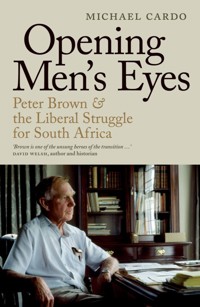
Peter Brown, leader of South Africa's Liberal Party until its demise in 1968, is one of the unsung heroes of South Africa's struggle against apartheid in pursuit of non-racial democracy. In Opening Men's Eyes, author Michael Cardo tells the story of how a privileged youngster growing up in the all-white world of racially conservative Natal settler society had the scales of racial prejudice removed from his eyes and how he set about opening the eyes of his compatriots. Cardo brings to life Brown's friendships across the colour bar with the likes of Archie Gumede, later one of the founders of the United Democratic Front, and his close relationship with the celebrated novelist Alan Paton, author of Cry, The Beloved Country. The book provides the first documented history of the Liberal Party, and shows how it was radicalised under Brown's leadership. Opening Men's Eyes offers a fascinating sidelight on South Africa's political and intellectual history.
Sie lesen das E-Book in den Legimi-Apps auf:
Seitenzahl: 615
Veröffentlichungsjahr: 2012
Das E-Book (TTS) können Sie hören im Abo „Legimi Premium” in Legimi-Apps auf:
Ähnliche















Description
Peter Brown, leader of South Africa’s Liberal Party until its demise in 1968, is one of the unsung heroes of South Africa’s struggle against apartheid in pursuit of non-racial democracy. In Opening Men’s Eyes, author Michael Cardo tells the story of how a privileged youngster growing up in the all-white world of racially conservative Natal settler society had the scales of racial prejudice removed from his eyes and how he set about opening the eyes of his compatriots. Cardo brings to life Brown’s friendships across the colour bar with the likes of Archie Gumede, later one of the founders of the United Democratic Front (UDF), and his close relationship with the celebrated novelist Alan Paton, author of Cry, The Beloved Country. The book provides the first documentary history of the Liberal Party, and shows how it was radicalised under Brown’s leadership. Opening Men’s Eyes offers a fascinating sidelight on South Africa’s political and intellectual history.
Title Page
Opening Men’s Eyes
Peter Brown and the Liberal Struggle for South Africa
Michael Cardo
JONATHAN BALL PUBLISHERS
JOHANNESBURG & CAPE TOWN
Dedication
To my parents, for everything, and to Francis, for being on the side of the angels
Acknowledgements
ACKNOWLEDGEMENTS
Not long after Peter Brown died in 2004, some of his friends and former colleagues from the Liberal Party suggested that a book be written examining the liberal tradition in South Africa and Brown’s place in it.
The idea gestated for a while, and in 2006, Francis Antonie, then Senior Economist at Standard Bank and currently Director of the Helen Suzman Foundation, put my name forward to write it.
It soon became clear that the nature of Brown’s contribution to the struggle against apartheid and for liberal democracy – assiduously documented at the Alan Paton Centre and Struggle Archive at the University of KwaZulu-Natal – warranted a full-scale political biography.
I am grateful to Francis Antonie for his wise advice and warm friendship during the course of my work, and for introducing me to Brown’s widow, Phoebe. Together with Colin Gardner, Randolph Vigne and David Welsh, they got the ball rolling on this project. All gave unstintingly of their time, interest and expertise. All read draft chapters and offered valuable criticism.
Phoebe Brown spent countless hours with me, patiently answering my (sometimes impertinent) questions with equanimity. She eased my path in innumerable ways, and I am deeply grateful to her for her kindness and generosity.
I owe Randolph Vigne a huge debt of gratitude. He read each chapter after it was finished, as well as the completed manuscript. He offered helpful editorial suggestions, pointed out errors of fact and was an indispensable resource in every way. He put me in touch with many of Brown’s friends and associates in South Africa and the United Kingdom, and was consistently solicitous and supportive.
This book was made possible through the material support of the Oppenheimer Memorial Trust and the Brown Family Trust. The Helen Suzman Foundation kindly awarded me a Visiting Research Fellowship while I researched and wrote about Brown’s life and work. I am particularly grateful to the Foundation’s former Director, Raenette Taljaard, and two of its Trustees, Doug Band and Richard Steyn, for this opportunity.
I find the detective aspect of archival work especially satisfying. My detections were undoubtedly made easier by Estelle Liebenberg-Barkhuizen and Jewel Koopman at the Alan Paton Centre. Ever friendly and ready to go the extra mile, they made researching at the Centre a real pleasure.
My thanks also go to the archivists and librarians at Michaelhouse; the Killie Campbell Africana Library in Durban; the Manuscripts and Archives Department at the University of Cape Town; the National Library of South Africa in Cape Town; the William Cullen Library’s Department of Historical Papers at the University of the Witwatersrand; the National Archives in Pretoria; the United Party Archives at the University of South Africa; the Borthwick Institute for Historical Research at the University of York; and Jesus College, Cambridge.
It is a measure of the esteem in which Peter Brown was held, and the fondness and devotion that he inspired in those who met him, that so many people were so ready to help me with this book. I would like to thank them all, especially the following people who gave me access to their private papers, letters and photo collections, and who shared their memories of Brown with me on more than one occasion: John Aitchison, Anton Brown, Christopher Brown, Vanessa Brown, Catherine Brubeck, Christianne Carlisle, Sam Chetty, Dot Cleminshaw, the late David Craighead, David Evans, Liz Franklin, Adelaine and Walter Hain, Eric Harber, Steve Hayes, the late Sir Raymond ‘Bill’ Hoffenberg, Douglas Irvine, Derick Marsh, Olga Meidner, Pat McKenzie, the late John Carlyle Mitchell, John Morrison, Neville Rubin, Simon and Joy Roberts, Peter Rutsch, Jack Spence, the late Helen Suzman, Beryl Unterhalter, Leslie and Pessa Weinberg, Jill Wentzel and Daphne Zackon.
In Pietermaritzburg, I was fortunate to share the reading room at the Alan Paton Centre with Norman Bromberger for several months. I owe much to him for the series of interviews he conducted with Peter Brown in the 1990s, the tapes and transcripts of which are lodged at the Alan Paton Centre. I spent many hours picking Norman’s brain about Peter Brown, the Liberal Party and the political and intellectual history of liberalism in South Africa. His probing intellect and good company spurred my labours.
In London, Wolf Hamm allowed me to make copies of over a hundred letters that Brown wrote to him over a forty-year period. He was also a gracious host and answered my numerous questions patiently and thoughtfully.
I would like to acknowledge Chizuko Sato, who sent me two chapters of her unpublished DPhil thesis, ‘Forced Removals, Land NGOs and Community Politics in KwaZulu-Natal, South Africa, 1953-2002’ (University of Oxford, 2006), which helped contextualise Brown’s land activism.
Thanks are due to the team at Jonathan Ball Publishers: Jonathan Ball, who took on the manuscript and galvanised me in his inimitable humorous and congenial way, and Jeremy Boraine and Francine Blum, who expertly saw the book through production. I am also grateful to Alfred LeMaitre for the scrupulous and professional manner in which he edited the manuscript and compiled the index; to Michiel Botha and Kevin Shenton for their design work on the cover and photo section respectively; Etienne van Duyker for the design, layout and typesetting of the book; and Valda Strauss for meticulously proofreading the book and patiently accommodating my changes.
Finally, I would like to thank my family – especially my parents for all their care and generosity on my research trips to KwaZulu-Natal – as well as my friends in Cape Town, who provided me with welcome distractions from writing. Without their support and encouragement this would have been a much harder book to write.
Cape Town
August 2010
Prologue
PROLOGUE
Three weeks after his release from jail in 1990, Nelson Mandela travelled to the strife-torn province of Natal, where members of the Inkatha movement and supporters of the United Democratic Front (UDF) were engaged in a bloody civil war.
Addressing a crowd of over 100 000 people, Mandela relayed his powerful message: ‘Take your guns, your knives, and your pangas, and throw them into the sea. Close down the death factories. End this war now!’
Throughout his speech, Mandela returned to the theme that was later to become the leitmotif of his presidency: unity in diversity.
Speaking in Zulu, he said that no one could boast more proudly of having ‘ploughed a significant field in the struggle against apartheid’ than the people of Natal. And that struggle had won the participation of ‘every language and colour, every stripe and hue’.
Along with Zulu elders who had provided leadership to the African National Congress (ANC), like John Langalibalele Dube, Pixley ka Isaka Seme and Albert Luthuli; together with members of the first black political organisation in Africa, the Natal Indian Congress (NIC); and with the workers from Durban who flexed their industrial muscle during the strikes of the 1970s, ‘Whites, too, [had] made a contribution to the struggle in Natal’:
It began with the lonely voices of Bishop Colenso and his daughters who denounced imperialist injustices against the Zulu people and who campaigned vigorously for the freedom of their leaders. The Natal Liberal Party waged steadfast campaigns against removals, and its work has been continued into the present by people like Peter Brown.1
Mandela saluted their ‘proud and courageous history’.
Four years later, as President, Mandela again paid tribute to Peter Brown when he invited him to attend a ‘luncheon in honour of the veterans of our struggle for freedom’ at the Union Buildings in Pretoria.2
Who was Peter Brown, to whose role Mandela made special reference in one of his first, and most important, speeches as a free man? And why, over the course of the following decade, until his death in 2004, was Brown’s contribution allowed to fade from the nation’s collective historical consciousness?
Reflecting on a visit to the Apartheid Museum in Johannesburg in 2003, the historian and journalist, RW Johnson, noted that there was ‘one old election poster of [Helen] Suzman’s about a foot from the floor but no pictures of Alan Paton, Peter Brown or any other white liberals who suffered and fought against apartheid’.3
The only white faces shown as part of the struggle, he observed, were communists. Was this a case of white liberals being deliberately airbrushed from the historical canvas?
To be sure, in death, Brown was paid handsome tribute by his friends and former colleagues in the Liberal Party (LP), which he helped to form in 1953 and which he led between 1958 and 1964. Memorial services were held in South Africa and England, and obituarists at home and abroad sketched his life and work. 4
In life, too, Brown did not go altogether unrecognised: in 1997, the University of Natal conferred on him an honorary doctorate, and in 2000, the Pietermaritzburg-Msunduzi local council awarded him a civic certificate of commendation for ‘his dedication to justice, the selfless work he [had] done over decades in a variety of different fields, and the quiet influence that he [had] exerted on a large number of people’.5
Yet there has been very little real understanding and appreciation, both in the past and the present, of the nature and importance of the part played by liberals like Brown in opposing apartheid and forging non-racial democracy. Winnie Mandela once recounted to Brown how, when she visited Robben Island in the 1980s and mentioned his name, she was ‘shocked to receive a whole lowdown on your quiet but most impressive political history’, adding that she ‘had no right not to know it’.6
The reasons for Brown’s relative obscurity are partly personal, partly ideological and partly political.
Brown was a modest man. Born into a Natal family of Scottish descent, country traders on his father’s side and farmers on his mother’s, he inherited two abiding characteristics.
The first was a heightened sense of community awareness, shaped by an appreciation for the rhythms of rural life and an allegiance to the soil. Land and community were Brown’s two great concerns. They are the golden threads that connect his liberal activism in the 1950s and 1960s, when he opposed the state’s programme of ‘black spot’ removals, through his chairmanship of the Association for Rural Advancement in the 1970s and 1980s, to his development work with African farmers in the 1990s.
The second was a natural Scots reserve, a diffidence that was occasionally pierced by his teasing, dry wit, which made Brown entirely indifferent to matters of reputation and veneration.
Even so, personal reticence alone does not explain why Brown’s contribution has gone largely unheeded. In post-apartheid South Africa, the ANC has inevitably sought to remember its own heroes. In the process, many others have been forgotten. This trend has been abetted by various currents in writing about South African history since the 1970s, beginning with the ideological dominance of the so-called ‘Marxist-revisionist’ school of that time.
The Marxists were hostile to liberal scholars, whose ‘conventional version’ of South African history they wished to overturn, since, in their view, it elevated race over class as an analytical tool and misunderstood the relationship between capitalism and apartheid. More than that, the revisionists viewed liberal history as an apology for British imperialism, whose material interests, they claimed, lay at the heart of racial discrimination. Such views served to marginalise liberal historians from the centre of public debate and to disparage the role of political thinkers and activists steeped in the liberal tradition.
Invigorated by the rising tide of social history in the 1980s, which overlapped with a move to write ‘history from below’, revisionists were further disinclined to engage with the history of (white) ‘high politics’ or to examine the life histories of individual politicians.
Liberalism itself – as a reformist, anti-apartheid political ideology and project – was deemed to be a subject unworthy of serious interrogation. Whatever their other achievements, the revisionists did South African history-writing a great disservice by vilifying liberalism as a mere adjunct of imperial conquest, racial segregation and capitalist exploitation.
Political factors, too, have played a part in pushing liberals to the periphery. Under apartheid, the word ‘liberal’ was a term of abuse, employed with equal venom by opponents on the left and the right. To the Nationalist government, the epithet signified sedition and, when prefaced with ‘white’, race treachery. To those in the ANC, which had its own liberal tradition, increasingly from the 1960s liberalism meant submission to white trusteeship and paternalism, and a commitment to gradualism that stunted the revolution.
In 1962, the ANC President, Chief Albert Luthuli, wrote in his autobiography that the Liberal Party had been able to speak with ‘a far greater moral authority than other parties with white members’ because of the quality of people at its head – people such as Alan Paton and Brown.7
Luthuli congratulated the LP for taking its stand on ‘principles and not on expediency’. He welcomed its policy of non-racial membership as ‘an act of courage’, and he expressed the hope that the Progressive Party would follow its example. His views typified those of an older generation of African leaders.
A younger generation, centred on the ANC Youth League and among whose notables were Nelson Mandela, Walter Sisulu and Oliver Tambo, were more dismissive. Their reservations were reinforced by a more explicitly leftist intellectual critique, often quite polemically powerful, that can be traced back to the Trotskyite Non-European Unity Movement in the 1930s and 1940s, and which fed into the thinking of the Congress of Democrats (COD) – the white, communist-leaning, section of the Congress Alliance. Prefigured by the Pan-Africanists who broke away from the ANC in 1959, Black Consciousness activists likewise denounced white liberals in the 1970s and 1980s. They insisted that the liberal identification of non-racialism with colour-blind integration served to keep the basis of the apartheid social order – white privilege – intact.
Ideological mistrust of liberalism has persisted in post-apartheid South Africa, fuelled by opposition to so-called ‘neo-liberal’ economic policies (which the ANC accuses the official opposition of advocating, and which, ironically, the ANC’s own alliance partners charge the government with pursuing). The new black political elite, girded by a resurgent Africanism, accuses ‘liberals’ – which it uses in a loose and imprecise way, much like the apartheid definition of ‘communists’ – of subverting its transformation agenda. The ANC believes it is faced with a major ideological offensive, ‘largely driven by the opposition and individuals in the mainstream media’, whose ‘key objective’ is ‘the promotion of market fundamentalism to retain the old apartheid economic and social relations’.8
Even a non-Africanist ANC leader like Kader Asmal (now since resigned from active politics) denigrates the history of white liberals by arguing that they waged a McCarthyite cold war against the ANC’s alliance partner, the South African Communist Party (SACP). Asmal believes that liberals were sanctimonious about the ANC’s recourse to violence. He claims they acquiesced in PW Botha’s murderous states of emergency and aggression against neighbouring African states in the 1980s.9
Peter Brown’s life and work present the clearest refutation of such claims. It is true that some Liberals, like Patrick Duncan, had a virulent dislike of communists, which on occasion bedevilled relations between the LP and the ANC and which prevented closer cooperation between the two organisations. Brown was wary of, but by no means antagonistic towards, communists. Distancing himself and his party from Duncan’s controversial ‘Open letter to Chief Luthuli’ in 1959, in which Duncan accused the ANC of being in thrall to communists (‘the worst oppressors of the modern age’), Brown wrote that ‘the communists among its [the ANC’s] members … have been in the forefront of those who have put up the most spirited defence there has been of fundamental democratic rights’.10
He pleaded for liberals and communists to sink ‘our ideological differences for the moment and get on with the job of disposing of the devil we know’.
In part, Brown’s pragmatic approach owed something to the fact that the COD (formed in 1953 as a front for the banned SACP) lacked the kind of presence in Natal that it had in the Cape and the Transvaal. However, it was also a measure of Brown’s common sense: dismissive of dogma, he sought to bring together different interests, traditions and organisations in the anti-apartheid cause. His liberalism was of the practical, not the purist, variety. Always focused on the promotion of social justice and non-racial equality, Brown’s liberalism was nurtured by close personal friendships and interactions that transcended racial and ideological divides.
Although Brown abhorred violence, he never judged those, both in his own party and in the ANC, who turned to arms. He believed that violence was ‘forced on reluctant people by the failures of the past’.11
In this way, he was quite unlike his friend and mentor, Alan Paton, whose exegeses on violence did indeed bear something of the self-righteousness of which Asmal complains.
The magazine Reality, which Brown edited after his ban was lifted in 1974, vigorously condemned the states of emergency imposed in the 1980s and the apartheid government’s contemporaneous incursions into neighbouring countries.
Brown’s life history, which spanned the rise and fall of apartheid, may offer the chance to re-evaluate some of the criticisms that have been directed at liberals. Brown’s biography is also a political history of the times: in particular, it encompasses the history of a remarkable party, which, despite a brief life, left an enduring legacy.
Forced to disband in 1968 by the state’s Prohibition of Political Interference Act, which forbade blacks and whites from belonging to the same political organisation, the LP worked to make the common society a reality. The ideas and values it promoted are today enshrined in the South African Constitution, having displaced both the Marxism-Leninism and exclusive Africanism with which liberalism vied for space in the marketplace of ideas.
Through his leadership of the Liberal Party, Brown played an early and crucial part in articulating an alternative vision to the racial exclusiveness of apartheid: this was at a time when other anti-apartheid organisations in South Africa, such as those that formed the Congress Alliance, were racially compartmentalised. In some ways, the Liberal Party marks a rupture in the history of South African liberalism. In style and substance, there are important discontinuities between the Liberal Party and the political tradition associated with nineteenth-century Cape liberals that preceded and nourished it. There are significant differences, too, between the activist extra-parliamentary liberalism of the LP and the parliamentary liberalism of the Progressive Party in the 1960s. The Liberals launched as a non-racial party, whereas the formation of the Progressives in 1959, Brown noted, ‘was an all-white launching and the policy decisions were all-white decisions’.12
The Progressive Party only reopened its membership to blacks, in defiance of the Prohibition of Political Interference Act, in 1984.13
While the Liberals advocated universal suffrage from 1960, the Progressives continued to support a qualified franchise until 1978. Where the Progressives rigidly adhered to ‘constitutional’ means of protest, the Liberals advocated boycotts and sit-ins. And, as the Progressives focused on civil rights, the Liberals campaigned for socio-economic rights, proposing various forms of regulation and redistribution to deracialise the economy.
By drawing attention to these distinctions, it is not my intention to praise one kind of liberalism at the expense of another: both hastened the end of apartheid, and both shaped the kind of society in which we now live. I do wish, however, to puncture some of the misconceptions that exist about the history of South African liberalism.
As chairman, Brown presided over and guided the radicalisation of liberalism in the Liberal Party. In his influential African Profiles, published a year before Brown’s ban in 1964, Ronald Segal called Brown ‘a figure of considerable political intelligence and realism’ who was ‘substantially responsible’ for attuning the Liberal Party to the ‘changing nature of political resistance to apartheid’.14
What follows is an attempt to understand how Brown applied this intelligence and realism to work for change, to show the significance of his contribution and to provide a documentary record of his life’s work, both during his years of involvement with the Liberal Party and after his return to public life in 1974.
1 Nelson Mandela, Address to rally in Durban, 25 February 1990. At www.anc.org.za/ancdocs/history/mandela/1990/sp900225-1.html. See also N Mandela, Long Walk to Freedom (Johannesburg: Macdonald Purnell, 1994), p 566 and A Sampson, Mandela: The Authorised Biography (London: HarperCollins, 2000), p 437.
2 The invitation to the event, on 23 July 1994, is in the University of KwaZulu-Natal, Alan Paton Centre and Struggle Archive (APC), Peter Brown Collection (PC16), PC16/5/4/7/6.
3 RW Johnson, ‘The Rainbow Nation paints out the whites’, Sunday Times, London, 27 July 2003.
4 See, for example, Chris Barron, ‘Peter Brown: Twice-banned Liberal Party stalwart’, Sunday Times, 4 July 2004; Howard Donaldson, ‘Death of a man of conscience’, Sunday Tribune, 4 July 2004; Michael Gardiner, ‘Adieu to “a particular kind of liberal”’, Mail & Guardian, 2-8 July 2004; Douglas Irvine, ‘Peter Brown: a pioneering democrat’, Sunday Independent, 4 July 2004; ‘A man of honour’, Natal Witness, 2 July 2004; Randolph Vigne, ‘Obituary: Peter Brown’, The Independent, 6 July 2004.
5 Peter McKenzie Brown: Matters relating to the award of a civic certificate of commendation, Pietermaritzburg-Msunduzi Transitional Local Council, 7 February 2000.
6 APC, PC16/5/3/3/92, Winnie Mandela to Brown, 15 January 1982.
7 A Luthuli, Let My People Go (Cape Town: Tafelberg/Mafube, 2006 [1962]), p 132.
8 Commission reports and draft resolutions, ANC national policy conference, 27-30 June 2007, Gallagher Estate. At www.anc.org.za/ancdocs/policy/ 2007/conference/commission.html.
9 K Asmal, L Asmal and RS Roberts, Reconciliation through Truth: A Reckoning of Apartheid’s Criminal Governance (Cape Town: David Philip, 1996). For a discussion of Asmal’s criticisms, see M Lipton, Liberals, Marxists, and Nationalists (London: Palgrave Macmillan, 2007), pp 138-144.
10 ‘Apartheid is the real enemy’, The Long View, Contact, 13 June 1959. Duncan’s open letter appeared in Contact, 2 May 1959.
11 ‘Why I support the boycott’, The Long View, Contact, 6 February 1960.
12 Cited in R Vigne, Liberals Against Apartheid: A History of the Liberal Party of South Africa, 1953-1968 (London: Macmillan, 1997), p 112.
13 C Eglin, Crossing the Borders of Power: The Memoirs of Colin Eglin (Cape Town: Jonathan Ball, 2007), p 200.
14 R Segal, African Profiles (Harmondsworth: Penguin, 1963), p 28.
Part One
PART
ONE
1. Origins and Childhood 1924-1938
1
ORIGINS AND CHILDHOOD
1924-1938
By the time Peter McKenzie Brown was born on 24 December 1924 at his parents’ Musgrave Road home, Monaltrie, high on the slopes of Durban’s tree-lined Berea, the Union of South Africa was a troublesome teen.
Fourteen and a half years earlier, on 31 May 1910, the Act of Union came into effect. It welded the two former British colonies, Natal and the Cape, and the two Boer Republics, Transvaal and the Orange Free State, into a single national polity. General Louis Botha, the man who fought heroically on the side of the Boers in the bitter South African War (1899-1902), was installed as Prime Minister with General Jan Smuts as his right-hand man.
Together, under the umbrella of the South African Party (SAP), they attempted to defuse old ethnic and linguistic rivalries by uniting Boer and Briton in a shared sense of nationhood. The fulcrum of their project was white supremacy: going into Union, all the provinces, with the exception of the Cape – where the nineteenth-century liberal tradition still prevailed – rejected black voting rights. With Botha and Smuts at the helm, a slew of segregationist legislation ensued. New laws imposed a job colour bar on the mines, restricted African land ownership to the ‘native reserves’ and controlled the influx of blacks to urban areas.
Botha and Smuts’s efforts to promote a shared national identity, based on Anglo-Afrikaner unity, were circumscribed by imperial notions of belonging. South Africa was still a British Dominion. The symbolic armour of Empire – ‘God Save the King’, the Union Jack and English itself – was brandished in public life in a way that rankled with those who had waged war against Britain. They had struggled for self-determination and resented this easy assumption of British superiority.
The adolescent nation was showing signs of fractiousness. Spurred on by their opposition to Union participation in the First World War, and galvanised by what they viewed as Botha’s heavy-handed subduing of the 1914 Boer Rebellion, those so aggrieved began to reassert themselves politically. Their message of cultural affirmation and national sovereignty was articulated not in the language of their forefathers, Dutch, but in the confident cadences of modern Afrikaans. They rejected British overlordship and wanted a more rigorous native policy to protect white interests.
In June 1924, the organisation that embodied their voice, the National Party, came to power by forming a coalition with the Labour Party. The Nationalist leader, General Barry Hertzog, was sworn in as Prime Minister. South Africa’s political trajectory was set to change decisively. Six months later, Peter Brown entered the world.
These, then, were the currents that were to determine the course of Brown’s public life and work: the fall of empire, the rise of Afrikaner nationalism, the legal codification of racial discrimination and their combined effect on black resistance to the Union’s racial politics.
* * *
59 Musgrave Road lies at the top of the Berea, the ridge which descends steeply into the Durban city centre below, and which, on a clear day, affords commanding views of Africa’s busiest port and out to the Indian Ocean beyond.
In the 1920s, as it is now, Musgrave Road was a prestigious address. Most of the gracious Victorian homes have given way to modern townhouse developments and apartment blocks, but the location still marks itself out as a place of privilege.
Framed by rows of palms and flamboyants, the Browns’ home, ‘Monaltrie’, was built in 1897 for the consul of Belgium and the Austro-Hungarian Empire, William Auerswald. Designed in the Queen Anne revivalist style, with red face-brick, white-painted balustrades, half-timbered gables, several verandas and an entrance portico, the two-storey villa was set on a large property that extended all the way up to Essenwood Road above. Today it is a national monument.
Brown’s father, Hugh, was a keen polo player, and he wanted space to stable his ponies. Many of Peter’s earliest memories were of time spent on the polo fields with his father and his two older siblings, Craig, born in 1917, and Elizabeth (known to the family as ‘Bet’), born in 1920.
Hugh Brown was born in 1886 to William George (‘WG’) Brown and his first wife, Dollie. WG Brown moved to South Africa from Scotland in the late 1870s and opened a trading store in a small settlement called Rietvlei, above the densely forested Karkloof Valley in the Natal Midlands. From there he settled in Pietermaritzburg, the capital of the Crown Colony of Natal, and became a minor importer and wholesaler. As his enterprise grew, he decided to relocate to the commercial hub of the colony, Durban, where he opened WG Brown & Co. The business supplied country stores with what was then called ‘Kaffir truck’ – goods such as blankets, copper wire, cheap cutlery and basic foodstuffs.
WG Brown was a tough Lowland Scot. (In later years, when Peter was asked whether he was conscious of his Scots descent, he replied: ‘Certainly, but more from my mother’s side than from his [WG Brown’s]. I think his was sort of Lowland, west coast of Scotland, whereas as they were true blue Highlanders.’).1
WG Brown was an astute businessman. His second wife, Elizabeth, a music teacher from Aberdeen whom he married in 1922, identified in him a ‘hard-headed Scottish capacity for driving good bargains’.2
He was as parsimonious as he was plucky, and he was unsentimental in his personal relationships – both with his son and his clients. But then relations between the traders of ‘Kaffir truck’ and their consumers were hardly based on charity and compassion.
For all that, Hugh, who took over the prospering family business and ran it until he died, became a businessman with a social conscience. Educated at Michaelhouse and Jesus College, Cambridge, he was a kind and temperate man who combined his business interests with active civic engagement and philanthropic pursuits. He was especially concerned with education and social welfare: he served on the Board of Governors of several Natal schools, and was a patron of St Martin’s Diocesan Home for Children in Durban.
Peter described his relationship with his father as ‘good’, and added, on reflection, that ‘it hadn’t reached the stage of any great intimacy’ by the time Hugh died on 21 August 1935.3
Hugh Brown died pursuing his passion: polo. He worked hard to establish polo as a sport in South Africa, as chairman of the South African Polo Association between 1930 and 1935. And he was a keen and able player (nicknamed ‘the Wizard’ for his control of the ball) and manager, having captained the South African team during a tour of Argentina in 1933.4
His death, in a semi-final at the South African Polo championships in Pietermaritzburg, was the result of an accident: he collided with two other players, was thrown off his pony and hit the back of his head on the ground. Hugh Brown was rushed unconscious to Grey’s Hospital, but it was too late to save him: his skull was badly fractured and he died of internal bleeding that night.
The Natal Witness ran a glowing tribute to Hugh Brown, noting that he had been the driving force behind polo in South Africa and ‘its most energetic proselytiser’.5
More than that, he was ‘one of those great and luminous souls … filled with a wide and abiding sympathy for the misfortunes of others’. His generosity was hidden behind a ‘modesty which was the outstanding trait of the man, a gentle unassuming manner which cloaked a character both rich and rare’. In his private life, he ‘was one to whom all in sorrow, need or happiness must gravitate, one who formed a centre wherever he was’. And, although he was a generous benefactor to good causes, the sum total of his benefactions would remain untold because ‘so many were unknown except to the recipient …’
Nearly seventy years later, when Peter Brown died, the Witness (as it had become) expressed similar sentiments about Brown junior. Peter inherited from his father a deep sense of civic duty. He also inherited a substantial amount of money. His father’s estate was valued at over £200 000, and part of it was used to set up a trust which, according to him, his mother ‘proceeded to administer very effectively’ with her brother-in-law, a Durban-based attorney named Jim Hathorn.6
Brown later reflected that he was financially independent, even during his mother’s lifetime, ‘as a result of that bequest’.
Brown’s mother, Helen Mary (affectionately known to family and friends alike as ‘Maisie’), also came from an affluent family. She was born in 1890 to a second-generation descendant of a Byrne settler,7 Archibald McKenzie, and his wife, Helen Jessie Weddel. Maisie was the fourth child in a family of ten daughters and one son (he was the first-born) – a rather expansive brood, which explained her father’s nickname of ‘ten-to-one McKenzie’. Maisie’s father was one of the first pupils at Hilton College, the elite private school in the Natal Midlands, which was founded in 1872, and where he excelled academically. He qualified as a medical doctor at the University of Edinburgh, to which he had been awarded a scholarship. On returning to South Africa, McKenzie set up a practice in Durban with a fellow Edinburgh alumnus, Sam Campbell, whose son Roy would go on to become a famous poet. Together they founded the Berea Nursing Home.8
Schooled in England, Maisie was a bright, lively and quietly forceful figure. Asked whether she read to him much, or steeped him in literary culture, Brown remembered his mother as a ‘detective novel reader’ rather than an ‘intellectual’: ‘she was much more a practical, down-to-earth person, I think.’9 He characterised their relationship as ‘close, but not demonstrative’.10
Peter never really got to know his brother well. Craig went up to Cambridge when Peter was still only ten years old, and then joined the navy when the Second World War broke out. His sister Bet was an eccentric girl, who battled with anorexia as a teenager, and although Peter had a soft spot for her, their relationship could at times be difficult. Bet died in 1977, in the psychiatric hospital at Town Hill.
Maisie did many good deeds for the community: she volunteered in old age homes and orphanages and she shared her husband’s concern for social welfare. But although her interests were wide-ranging, they were not, according to her son, ‘cross-colour line interests’. In fact, as far as the Union’s racial politics went, Brown’s parents assumed – in his view – that ‘the order of things was as it should be and that it would continue to be like that’. He explained: ‘[A]s far as everyday talk was concerned, I don’t think that black politics was a subject that came up at all. I think they were sort of benevolent, not quite despots, but benevolent masters, as it were.’11
In fact, neither Hugh Brown nor his wife was particularly political. On Maisie’s side, though, the family was not entirely unfamiliar with political controversy. ‘Ten-to-one’ McKenzie’s brother, Major (later Brigadier-General Sir) Duncan, was one of the main protagonists in the relief of Ladysmith during the South African War. Another brother, Peter, wrote several polemical socialist tracts, which was fairly unusual for the son of Nottingham Road farmers. Maisie’s sisters were politically divided when Smuts’s South African Party fused with Hertzog’s National Party to form the governing United Party (UP) in 1934, in the wake of the crisis triggered by the Great Depression. Some, like her sister Winifred, who married the bloedsap (as diehard SAP supporters were known) judge, Johannes Christiaan de Wet, stood by Smuts. Others, appalled by Smuts’s rapprochement with the Nationalists, supported the jingoist breakaway organisation, the Dominion Party.
Hugh and Maisie Brown were probably middle-of-the-road United Party supporters. Although they were public-spirited and took their civic responsibilities seriously, the world in which they operated was all white. If they were liberals, their liberalism wasn’t defined by their progressive attitude to the Union’s so-called ‘native problem’. Their attitude wasn’t progressive by the conservative standards of Natal’s Anglophone settler elite; it was entirely run-of-the-mill. Their younger son was to develop his particular brand of liberalism independently of them. And some of his earliest influences came from school.
1 APC, 96 APB3, Interview with Peter Brown by Norman Bromberger, 14 August 1995, p 3.
2 Elizabeth Brown, Personal memoirs, in possession of Phoebe Brown.
3 APC, 96 APB3, Interview with Peter Brown by Norman Bromberger, 14 August 1995.
4 Donald C McKenzie and John R McKenzie (eds), Polo in South Africa (Dargle, 1999), pp 28-29; pp 384-385.
5Natal Witness, 23 August 1935.
6 APC, 96 APB3, Interview with Peter Brown by Norman Bromberger, 14 August 1995, p 2.
7 The term ‘Byrne settlers’ refers to those emigrants brought to Natal by the company, JC Byrne & Co. They arrived between 1849 and 1851 and settled on allotments in the Byrne valley, near Richmond.
8 Interview with Pat McKenzie, Pietermaritzburg, 7 May 2007.
9 APC, 96 APB3, Interview with Peter Brown by Norman Bromberger, 14 August 1995.
10 APC, 96 APB3, Interview with Peter Brown by Norman Bromberger, 14 August 1995.
11 APC, 96 APB3, Interview with Peter Brown by Norman Bromberger, 14 August 1995.
2. Michaelhouse 1938-1942
2
MICHAELHOUSE
1938-1942
If Brown’s family life gave him little exposure to the everyday lived experiences of ordinary black South Africans, so too did his schooling. He attended private boarding schools in Natal – first Cordwalles Preparatory School for Boys and then Michaelhouse – where the pupils all came from similar privileged middle- and upper-class backgrounds. They were all white, all male and predominantly English-speaking. By and large, the teachers tended to support, rather than question, the racial status quo.
Modelled on the English public school system, these institutions were ‘liberal’ in the broad sense of the word: they sought to inculcate values like tolerance and compassion, and the education they provided was directed towards the cultivation of the mind for its own sake. As the founder of Michaelhouse, James Cameron Todd, noted in his Speech Day address in 1897, the year after the school was founded: ‘Our aim is to make, not accountants, not clerks, not clergymen, but men; men of understanding, thought and culture.’
Yet for all their emphasis on a liberal-humanist education, the ethos of these two schools was conservative – socially and racially. As outposts of ‘Little England on the Veld’,1 as Peter Randall describes private schools in South Africa, they schooled the scions of the white settler elite in the rituals of Anglicanism, masculinity and Englishness. The worldview they helped to fashion could easily accommodate – and sustain – the traditional racial order in South Africa: the belief that white was superior to black.
However, Brown did receive from Michaelhouse what he later identified as ‘a very strong liberal input’ which ‘had quite a substantial influence’ on him.2 This was the paternalistic liberalism of the 1930s – the idea that the role of the white man was to act as trustee for the ‘natives’ by providing them leadership with justice – which Brown would in due course reject. It was a long way from the non-racial liberalism, with its core belief in the common society, which Brown would embrace in the 1950s and 1960s.
The teachers at Michaelhouse made a far greater impression on Brown than those at Cordwalles. He felt that his schoolmasters at Cordwalles were ‘pretty remote’, although he did recall the headmaster – a ‘rather fearsome character called Jack Besant, of whom everyone was dead scared’.3 In the 1960s and 1970s, by which time he had retired, Besant used to visit Brown while he was under banning orders. Brown was touched by this expression of solidarity, for he had ‘never … dreamed that there was something like that in him from my experience of him at school’.
In 1938, the year before the Second World War broke out, Brown entered Michaelhouse. The official school history notes that: ‘By 1938, Michaelhouse evinced an unmistakable air of maturity.’ The grounds and buildings were a growing source of pride, sound standards of scholarship had been established, there was a committed core of staff, and pupils enjoyed a varied programme of extracurricular activities. ‘The standing of the school was … more secure than it had ever been and its reputation more widespread’ – thanks in part to the Illustrated London News, which had profiled Michaelhouse in a series of articles.
The following year marked the arrival of a new Rector, Frederick Rowlandson (‘FR’) Snell, whom Brown credited with bringing a liberal influence into the school. Snell had been schooled at Winchester and had read chemistry at Oriel College, Oxford. He had been a senior science master at Eastbourne College before he was appointed Rector of Michaelhouse. Snell was politically aware and civic-minded. In England, he had served as vice-chairman of the Eastbourne Unemployment Council and been a councillor for the Distressed Areas Association.
Snell’s major innovation during Brown’s time at Michaelhouse was to introduce an exchange programme with Adams College, the oldest school for black pupils in Natal, and the second oldest in South Africa after Lovedale in what is now the Eastern Cape. Situated south of Durban in Amanzimtoti, Adams was founded as a mission school in 1853 by Dr Newton Adams of the American Board of Missions. By the 1930s it comprised a teacher training college and an industrial school, as well as primary and secondary schools.
Adams College boasts several distinguished alumni and former staff members, many of whom went on to play prominent roles in public life. Many of them became active in the ANC. The three Natal ANC leaders whom Mandela identified in his famous speech in Durban in 1990 – John Dube, Pixley ka Seme and Albert Luthuli – were all at Adams. ZK Matthews – the anthropologist who went on to an illustrious academic career at the University of Fort Hare in the 1940s, served as provincial president of the ANC in the Cape in 1949 and was a key initiator of the Congress of the People at which the Freedom Charter was adopted in 1955 – was head of the high school between 1925 and 1932. In 1934, Edgar Brookes took over as the principal of Adams College.
By then in his late thirties, Brookes was already a pillar of the liberal establishment and a name to be conjured with in academic and political circles. He was to become one of the guiding lights in Brown’s life. He influenced the subject choices Brown made as a university student, helped Brown to find his first job and later formed an integral part of the Pietermaritzburg liberal network.
By the time he joined Adams, Brookes had undergone a Damascene conversion politically. Born in England in 1897, Brookes came to South Africa with his parents when he was four years old. Educated at Pietermaritzburg College, he was precociously bright, matriculating at the age of 14. His ambitions at that stage, as he wrote in his memoirs, ‘fluctuated … between becoming an Anglican priest and becoming prime minister of South Africa’.4 As it happened, unable to finance full-time university studies, Brookes took a job as a clerk in the Department of Customs and Excise in Durban – he was later transferred to Pretoria – and read for his Bachelor’s degree as an external student at the University of South Africa. In 1920, he entered the Transvaal University College (TUC) – the intellectual stronghold, along with the University of Stellenbosch, of Afrikaner nationalism – where, in his own words, he ‘fell in love with the Afrikaner legend’.5
While at TUC, Brookes, a historian with an interest in contemporary politics, wrote his Master’s thesis on the workings of the South African constitution during the first ten years of Union, and completed a book, The History of Native Policy in South Africa from 1830 to the Present Day, for which he was awarded a DLitt in 1924.
On the strength of his book, Brookes, the quintessential English gentleman who had grown up in that most English of provinces, Natal, was appointed to the chair of Public Administration and Political Science at TUC. The History of Native Policy defended racial segregation. It was subsequently used by the newly installed Prime Minister, Barry Hertzog, to give ideological legitimation both to the package of segregationist bills which his Pact government wanted to steer through Parliament and to the broad thrust of its ‘native policy’. For a time, Brookes became a darling of the Afrikaner Nationalist establishment. In September 1927, General Hertzog appointed him as a South African delegate to the Assembly of the League of Nations.
A research trip to the United States that same year made Brookes question his earlier support for segregation. His experiences there taught him ‘the salutary lesson that the black man was capable of considerable achievement in a milieu of white civilisation’.6 And so he began a ‘spiritual pilgrimage’ which took him from separate development to an inclusive liberalism. He soon recanted his views on segregation, and became active in liberal bodies like the Joint Council of Africans and Europeans and the South African Institute of Race Relations (SAIRR; formed in 1929), from where he championed the idea of incorporating an acculturated class of blacks into ‘white civilisation’ in the 1930s and 1940s.7
Anchored by his Christian faith, Brookes was warm, wise and gentle. Although he went on to enjoy an active career in liberal politics – first as a Senator representing Natalian Africans in Parliament between 1937 and 1952 and later as national chairman of the Liberal Party after Brown was banned in 1964 – Brookes was neither a political animal nor an instinctive liberal. He described himself as a ‘natural conservative’ who became ‘a liberal in South African circumstances almost in spite of myself’. His real gift was as an educator, and it was an inspired decision on his part, as principal of Adams College, to allow the exchange visits with Michaelhouse.
Looking back in 1979, Brown recalled the dramatic impact of his visit to Adams College:
I first knew him [Edgar Brookes] as a schoolboy. When he was principal of Adams College I went there with a party from my school on an exchange visit. Such visits, between a white school and a black school, were a revolutionary concept in the Natal of 40 years ago. And my visit had on me the effect they were no doubt intended to have. It shattered the accumulated stereotypes about black people with which I had grown up.8
Brown would recall that, at Michaelhouse, he ‘certainly had more of an interest in the race question than probably most of the others did’, and this was in part fuelled by his visit to Adams College.9 However, the radicalising effect of the Adams visits should not be overestimated. For some pupils, it reinforced the natural order of things. An entry entitled ‘Impressions of Adams’ by ‘NTA and HWM’ in the St Michael’s Chronicle for 1942 records the impressions of two boys who spent a week at Adams. Their conclusion is telling: ‘As a result of the unselfish work of both European and Bantu staffs, and the cooperation of all, Adams is proving a great success, and catering for two of South Africa’s most pressing needs – native teachers and cheaper skilled labour.’10
Michaelhouse offered ‘race relations’ as a subject in post-matric. The school also tried to stimulate among its pupils an interest in ‘native’ culture. For example, Hugh Tracey, then Durban branch manager of the South African Broadcasting Corporation and later one of the major figures of modern ethnomusicology, gave a lecture on ‘native music’ to the Music Society in Brown’s matric year (1941).11 The Debating Society, of which Brown was a member, also paid attention to ‘native affairs’. The Society met on 6 September 1941 to debate the motion that ‘The present difficulties between the two European races of South Africa will be submerged in the face of the growing Native Problem’. During the general discussion that followed, the House was addressed by Senator Brookes. The first vote was narrowly lost by 14 votes to 16, and the second, on opinion, was won by 19 votes to 17.12 The Debating Society did not always address such lofty concerns. In 1941, the motion, ‘In the opinion of this house pets lead to effeminacy’, was carried by 32 votes to 22.13
Michaelhouse got Brown thinking about race relations. As an alumnus, he would get very upset when he thought the school was lending support to the government’s racial policies. He would frequently fire off a letter of protest to the Rector and Board of Governors when Michaelhouse invited to address its Speech Day someone Brown found politically dubious. In 1963, it was CH Rautenbach, Rector of the University of Pretoria and Chairman of the state’s Education Advisory Council.14 In 1965, it was the Administrator of Natal, Theo Gerdener, who had formerly served as a Provincial Councillor for the Nationalists. ‘Who next?’, wrote Brown to Chairman of the Board, ‘Mr Vorster [the Minister of Justice], perhaps? Dr Verwoerd [the Prime Minister]?’ By the 1960s, he felt that ‘the school [had] become so closely tied to the established order in South Africa that it no longer produces, in any significant number, men who will see and fight the evils in that order’. ‘Does the school serve the purpose for which it was founded?’ he asked the Chairman of the Board of Governors.15 And the uneasiness persisted over time: for instance, he took issue with Hendrik Verwoerd’s obituary in the Michaelhouse Chronicle16, and he viewed with ‘the gravest misgivings’ the invitation to Rhodesian Prime Minister Ian Smith to address the boys.17
For the most part at school, Brown remembered going ‘along with the defined path of trying to pass matric, playing games, and so on’. Having been moved up a class at Cordwalles, he was in a higher age cohort at Michaelhouse. He recalled being ‘quite good at passing exams – not so good at remembering what I learnt a year later’. In his matric year, Brown was made a prefect in Pascoe house, along with his cousin Henry Barnby. Barnby, whose mother was Hugh Brown’s sister, was a good friend, as were Bud Chaplin, Duchesne Grice and Rex Pennington, alongside whom Brown later saw active service; and Simon Roberts, with whom Brown played first-team cricket.18 Both Roberts and Grice were to become lifelong friends. Pennington would go on to become Rector of Michaelhouse between 1969 and 1977.
In his post-matric year, 1942, Brown was made head boy. With characteristic self-deprecation, he would later ascribe this to having ‘been there longer than anybody else’.19 That year he was elected captain of the squash team and awarded colours.20 At Speech Day on 1 October 1942, Lord Harlech, the guest of honour and then British High Commissioner in South Africa, appealed to the boys to ‘make a sacrifice’ by eschewing a ‘security job’ in commerce and industry. Instead he urged them to go into the ‘nation-building professions’, such as the civil service, public administration and professional politics. He also predicted that the war would produce a swing to the left from which South Africa could not isolate itself. He urged the boys: ‘We have got to have far greater social unity; we have got to have better conditions for all races so that slums and the like are no longer tolerable, that bad public health is intolerable, while racial relations have got to be put on a better footing.’21
The official history of Michaelhouse claims that, for the boys, ‘the war was a swirling mist, sometimes clearing so that it was hardly noticeable, occasionally so enveloping as to halt them in their tracks, mostly evident as a bank ahead, beyond which lay university or careers and the questions of a new order and peace’.22 It is difficult to reconstruct Brown’s personal experience of the war, or to weigh the importance of Lord Harlech’s speech in his decision to join up. Certainly, by his post-matric year, a number of Brown’s older peers had enlisted. His brother Craig had joined the navy at the beginning of war and was stationed in the Far East for the duration. All of these factors must have influenced Brown’s decision to visit a recruiting office in Durban in October 1942, where he signed up and was assigned to the Tank Corps.
A few months short of his eighteenth birthday, Brown took the decision without hesitating. To him it was the ‘obvious thing to do’.23 Despite never having been drawn to the military life – his father was a conscientious objector and he had hated cadets at school – for Brown ‘there was no question that that was what one wanted to do as soon as one got out of school’.24
1 P Randall, Little England on the Veld: the English private school system in South Africa (Johannesburg: Ravan, 1982).
2 APC, 96 APB3, Interview with Peter Brown by Norman Bromberger, 14 August 1995, p 5.
3 APC, 96 APB3, Interview with Peter Brown by Norman Bromberger, 14 August 1995, p 5.
4 E Brookes, A South African Pilgrimage (Johannesburg: Ravan, 1977), p 6.
5 Brookes, A South African Pilgrimage, p 19.
6 Brookes, A South African Pilgrimage, p 35.
7 P Rich, White Power and the Liberal Conscience: Racial Segregation and South African Liberalism, 1921-1960 (Johannesburg: Ravan Press, 1984), pp 33-4. Curiously, there is still no full-length biography of Brookes, but see his autobiography, A South African Pilgrimage (Johannesburg: Ravan, 1977), and Chapter 3: ‘Edgar Brookes and the “Lie in the Soul” of Segregation’ in P Rich, Hope and Despair: English-Speaking Intellectuals and South African Politics, 1896-1976 (London: British Academic Press, 1993).
8 P Brown, ‘Some Thoughts About Edgar Brookes, South African Liberalism and the Future’, Delivered at the University of Natal, Pietermaritzburg, 16 August 1979, p 2.
9 APC, 96 APB3, Interview with Peter Brown by Norman Bromberger, 14 August 1995, p 6.
10St Michael’s Chronicle,Vol IX, No 4 (December 1942), p 22.
11St Michael’s Chronicle, Vol IX, No 1 (May 1941).
12StMichael’s Chronicle, Vol IX, No 2 (December 1941).
13St Michael’s Chronicle, Vol IX, No 1 (May 1941).
14 APC, PC2/9/11/1, Brown to the Governors, Rector and Staff of Michaelhouse, 6 August 1963.
15 APC, PC2/9/11/1, Brown to Rev Bishop Inman, Chairman of the Michaelhouse Board of Governors, 11 August 1965.
16 APC, PC2/9/11/1, Brown to Tommy Norwood, Rector of Michaelhouse, 15 November 1966.
17 APC, PC16/5/3/1/46, Brown to the Secretary of the Board of Governors of Michaelhouse, 4 July 1979.
18St Michael’s Chronicle, Vol IX, No 3 (September 1942).
19 APC, 96 APB3, Interview with Peter Brown by Norman Bromberger, 14 August 1995, p 8.
20St Michael’s Chronicle, Vol. IX, No. 3 (September 1942).
21St Michael’s Chronicle, Vol. IX, No. 4 (December 1942), p 11.
22 AM Barrett, Michaelhouse: 1896-1968 (Michaelhouse Old Boys Club, 1969), p 120.
23 APC, 96 APB3, Interview with Peter Brown by Norman Bromberger, 14 August 1995.
24 APC, 96 APB3, Interview with Peter Brown by Norman Bromberger, 14 August 1995, p 8.
3. War 1942-1945
3
WAR
1942-1945
The outbreak of the Second World War in September 1939 polarised South Africa. On 4 September, the Prime Minister and leader of the ruling United Party, General Hertzog, moved in Parliament that the House should adopt a position of neutrality. His deputy, General Smuts, moved an amendment to Hertzog’s motion, calling on the Union to declare war on Germany. Smuts’s amendment was carried by 80 votes to 67. The following day, Hertzog resigned his premiership and rejoined the National Party. On 6 September, the Governor General, Sir Patrick Duncan, asked Smuts to form a new government. And so South Africa went to war.
The war had some immediate political consequences domestically: it led to a reunification of Afrikaner nationalists in the Herenigde (Reunited) Nasionale Party and a hardening of attitudes – towards empire, towards English-speaking South Africans and towards blacks – among the Afrikaner nationalist right. The war also seemed, for a time, to tilt the United Party in a more liberal direction. The wartime imperative for increased production led to rapid industrialisation and increased African urbanisation, which in turn catapulted segregation into crisis. Economic integration was leading to social integration between the races, and in 1942 Smuts himself told the liberal South African Institute of Race Relations that segregation had ‘fallen on evil days’.1 That same year, the Smit Report on the social, health and economic conditions of urbanised blacks recommended the administrative recognition of African trade unions and the abolition of pass laws.2 The pro-democratic climate created by the fight against fascism, which led many liberals to engage more directly with notions of egalitarianism, universal franchise and the common society, also acted as a fillip to South African liberalism in the 1940s.3
These, then, were the prevailing political winds as Brown journeyed one Wednesday afternoon in October by train to Cullinan in the Transvaal, and from Cullinan to his new temporary home – a training camp at Kaffirskraal, near Klerksdorp.
Life at Kaffirskraal was monotonous. Describing his daily activities in a letter to his mother, to whom he wrote once a week with only irregular interruptions throughout the war, Brown noted:
We have breakfast at 6:30 and fall in for the day’s work at about a quarter to eight. We then have two periods [of squad drill] of about an hour and then break for tea at ten o’clock. We then have another three periods before lunch which is at about one. We get an hour off for lunch and then start again. There are only two periods in the afternoon and so we are finished by about 3:45 and then are free until the next morning unless you have extra drill, which is fairly easy to avoid.
Life at Kaffirskraal was made more bearable by the company of his cousin and friend, ‘Archie’ McKenzie, with whom he played tennis and drank beer in the canteen, Wednesday night ‘bioscopes’, grills at the YMCA recreation hall and occasional weekend visits to one of his mother’s sisters, Nancy Brayshaw, in Johannesburg.4 In Johannesburg, in the company of his cousins, Brown would meet civilian friends and go dancing in Orange Grove.
Late in 1942, Brown and a number of others who had joined the Tank Corps were reassigned to the Signal Corps. Theirs was the ‘rather unromantic’ job, Brown would later recall, ‘of stringing [the] infantry platoons together with telephone wire’.5 He told his mother that he ‘hadn’t the least desire to become a signaller, but the majority of the Rookie Depot were taken by force and dumped in it, so I suppose I will have to make the best of it’.6 At the end of January 1943, the signallers were sent to Piet Retief for further training. They stayed at a camp where the conditions seemed luxurious compared to Kaffirskraal: bungalows and beds made a decent change from gravel floors and leaky tents.
The transition was short-lived, however. In February, they were sent back to Kaffirskraal, and later to a camp called Balloon, where they waited with growing impatience to be incorporated into the 6th South African Armoured Division and sent ‘up north’, as military service in North Africa was known. By March, Brown had ‘had just about a stomachful of this signalling racket’ and the never-ending wait to join the ‘6th’.7
But in April, events began to gather momentum. From Balloon, Brown’s unit was taken to the Hay Paddock camp in Pietermaritzburg, from where, one night, they were taken by train to Durban, put on the troopship Ile de France and dispatched to Egypt, where Brown was ‘plonked right in the middle of the desert with just about nothing to be said in its favour’.8




