


Erhalten Sie Zugang zu diesem und mehr als 300000 Büchern ab EUR 5,99 monatlich.
- Herausgeber: The History Press
- Kategorie: Sachliteratur, Reportagen, Biografien
- Sprache: Englisch
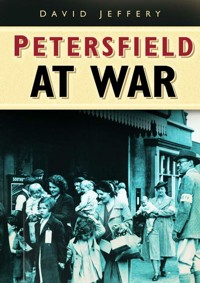
The small Hampshire town of Petersfield saw little direct conflict during the Second World War, yet its story reflects all the anxieties and concerns of Britain's inhabitants during that period: food shortages, evacuees, blackout restrictions, family losses - and the characteristically phlegmatic approach to these problems by all concerned. David Jeffery's research has uncovered some remarkable stories of individuals caught up in these world-changing events, and a series of interviews with over fifty long-time residents vividly brings back to life the everyday realities and intense atmosphere of these troubled times. This evocative record of the effect of the war will serve as a memorial to an exceptional period in Petersfield's history.
Sie lesen das E-Book in den Legimi-Apps auf:
Seitenzahl: 315
Veröffentlichungsjahr: 1980
Das E-Book (TTS) können Sie hören im Abo „Legimi Premium” in Legimi-Apps auf:
Ähnliche


















PETERSFIELD
AT WAR
DAVID JEFFERY
Title page picture: Royal Tank Corps on manoeuvres near Petersfield in 1938. (Imperial War Museum)
First published in 2004 by Sutton Publishing Limited
Reprinted in 2009 by
The History Press
The Mill, Brimscombe Port
Stroud, Gloucestershire, GL5 2QG
www.thehistorypress.co.uk
This ebook edition first published in 2013
All rights reserved
© David Jeffery, 2004, 2013
The right of David Jeffery to be identified as the Author of this work has been asserted in accordance with the Copyright, Designs and Patents Act 1988.
This ebook is copyright material and must not be copied, reproduced, transferred, distributed, leased, licensed or publicly performed or used in any way except as specifically permitted in writing by the publishers, as allowed under the terms and conditions under which it was purchased or as strictly permitted by applicable copyright law. Any unauthorised distribution or use of this text may be a direct infringement of the author’s and publisher’s rights, and those responsible may be liable in law accordingly.
EPUB ISBN 978 0 7509 5419 8
Original typesetting by The History Press
Contents
Foreword & Acknowledgements
Introduction: Petersfield in the 1930s
1. 1939 – The First Evacuees
2. 1940 – Petersfield Adjusts
3. 1941 – Daily Life
4. 1942 – Troops in Town
5. 1943 – Debating the Town’s Future
6. 1944 – The Beginning of the End
7. 1945 – Slow Recovery & Changing Times
Conclusion: Postwar Petersfield
Appendix I: Major Events of the Second World War
Appendix II:Biographies
Bibliography
Plan of Petersfield in the official town brochure of 1938. (Author’s Collection)
Foreword & Acknowledgements
At first glance, the title of this book appears to be a misnomer – Petersfield hardly experienced any enemy action and certainly none of the horrors which afflicted so many larger communities during the Second World War. But this is not intended as a history book, the military events having been amply documented in other works: it is rather a snapshot of a community living through six years of a war to all intents and purposes happening elsewhere; one which attempts to provide a social chronicle of Petersfield through the eyes of its contemporary residents whose lives were certainly coloured, and possibly impeded or enhanced, by the events of 1939–45. To this end, I have devoted a roughly equal amount of space to the recollections of the individuals who found themselves in the locality as to the purely factual account of events.
Oral history is a precious commodity. However, it does bring its own problems: it is like a flawed diamond whose individual facets only partly reflect reality yet contain sufficient truth and light to be accepted as a gem nevertheless. Carlyle called history ‘a distillation of rumour’, but I would hope that my account – or rather the accounts of my sympathetic and generous contributors – stood for more than that. As a Londoner born and bred, I trust that I have maintained a certain objectivity (despite, at the same time, being enamoured of the town); selection, after all, is inevitable, but I have preferred the anecdotal over the apocryphal, the complimentary over the conflictual.
Any process of selection is simultaneously one of rejection, so I apologise in advance for any inadvertent omissions, errors, or misjudgements which may offend those more familiar with the details than I am. In exploring and exploiting the Hants and Sussex News, I have eschewed private details occurring under the rubric ‘Petersfield Petty Sessions’, likewise personal tragedies reported under ‘News from our Men’, where it would have been quite invidious to find that I had omitted even one person among all those who fought – and died – so courageously during the war. For the purposes of the book, I spoke to around seventy people and received invaluable information from several others, but perhaps equally poignant were the personal mementoes, family albums, private photographs and other memorabilia which everyone has been gracious and generous enough to show me. For this, I thank my contributors most sincerely; my only hope is that this book does them and their memories justice. Their stories, after all, are our history.
In the process of writing the book, I became aware that I was describing not only the events of the war period, but also the changes which Petersfield itself and its inhabitants were living through, from the ‘old Petersfield’ of the 1930s to the newly emerging town of the 1950s. In fact, these three decades saw relatively small changes compared with the rapid, sometimes unforgivable, changes of the 1960s. From our new standpoint on the cusp of the twenty-first century, therefore, our three decades are most emphatically the ‘old’ Petersfield, and these insights seem tantalisingly close to the older generations.
I have deliberately left ladies’ names in their married form where appropriate, so that they may be more easily identified by the reader; their maiden names appear in the short biographical section at the back of the book.
As well as the individual thanks I owe to everyone I have interviewed, I would like to acknowledge especially the help I have received in compiling this volume from Doreen Binks and Mary Ray of the Petersfield Museum, Gillian and Vaughan Clarke of Sheet News, Tony Cross and the Hampshire County Council Museums Service for permission to reproduce prints by Flora Twort, Chris Lloyd for his collection of insignia and memorabilia, Simon Fletcher of Sutton Publishing, David Lee of Wessex Film and Sound Archive for the loan of recording equipment, John Sadden of Petersfield Library, and, for the bulk of the photographs which appear in these pages, Petersfield Museum archives.
Finally, I thank my daughter Anna-Louise for reading the manuscript and for making many helpful suggestions.
David Jeffery
Introduction: Petersfield in the 1930s
How to characterise a decade? Nonagenarian and octogenarian Petersfielders have amply provided a picture of the era: the predominantly agricultural community, the nascent social and cultural life of the town, the everyday atmosphere and the unusual happenings.
Joan Bullen and John Bridle both remember the 1920s and 1930s with equal lucidity, a time when they could claim to know everyone they saw in Petersfield. John and some friends would enjoy rambling over to Butser and then arrange a dance in Winton House in the evening; Joan and John both lived in Hylton Road and could look out of their bedroom windows across the fields where a herd of cows would be grazing and, beyond, towards the Weston hopfields and Butser; John and his wife-to-be enjoyed their favourite walk across Buckmore Farm’s wild-flower laden meadows; Joan also remembers hiking and country dancing and the Bedales’ Shakespeare plays which were put on every Christmas. It was a time when Petersfield had at least two dairies and two farriers; the ‘Electric’ cinema (with Mrs LeGoubin playing the piano at the front); electric lighting, which had only relatively recently been installed in the streets; and when the British Legion gave tea parties for children.
But this rural idyll did have another, more irksome and seemingly less prosperous, side: Amy Freeman talks of the impecunious existence of many hard-working people; of the total lack of holidays for the (often large) families; of the need for children to leave school at fourteen and start work to help increase family incomes; of the harsh regimes in schools for even the youngest children.
The churches played an important social, as well as religious, role in people’s lives. Families might go to church three times on a Sunday and Sunday school outings were a rare but welcome treat; besides St Peter’s and St Laurence’s, the so-called ‘free churches’ prospered: the Congregational (now United Reformed) church, the (Wesleyan) Methodist church in Station Road, and the ‘Primitive Methodists’ in Windsor Road, drew large congregations. In fact, it was in the 1930s that the two types of Methodism began preliminary discussions which eventually brought them together in March 1942. Mr Fuller, the Lavant Street grocer, was described as ‘a pillar of the Congregational chapel’. The first meetings of local Quakers took place at Bedales Lodge at Steep in 1934 and an Elim church was also started in the Corn Exchange building by Mr Victor Walker in the 1930s. There were also the Plymouth Brethren who met at 60 Station Road. Finally, the Salvation Army, active in Petersfield since the end of the nineteenth century, had its own hall in Swan Street and used to conduct open-air services in The Square and on the Heath; it also attended the Taro Fair and participated in marches through the town in the 1930s.
The corner of The Avenue and Dragon Street in the 1930s. (Petersfield Museum)
For boys, the Wolf Cubs and Boy Scouts groups, among the first in the country to be set up after the foundation of the Scouting Movement in 1908, provided activities, outings and excitement and there were dedicated leaders such as Charles Dickins, the High Street dentist, who spent many years organising displays, camps, and participation in Scout jamborees.
Petersfield Carnival Week took place annually in June at the Carnival Park, situated opposite the Jolly Sailor. It lasted for a week, starting with the crowning of a Carnival Queen, continuing with displays, dances and concerts, a huge fancy-dress procession, athletic events and a boxing tournament, and finishing with a lantern and torchlight parade to the grand evening concert in the Drill Hall. Proceeds went to Petersfield Hospital, a fund for a new Town Hall and to local organisations.
In many ways, the farming community dominated Petersfield in the 1930s. First, small farms proliferated in and around the town, most of which have now disappeared completely: Herne, Buckmore, Lord’s, Tilmore, Broadway, Penns, Weston, to name but those which were situated closest to the centre of the town. Some of the same names still exist, of course, but they are now associated with a housing estate and a school, an estate for park homes, or District Council offices! Secondly, the Wednesday cattle markets brought a whole population of farmers, drovers, buyers, stockmen and breeders to the very heart of Petersfield, where their presence was keenly felt (and appreciated) by the residents. It could easily be argued that they contributed in no small way to Petersfield’s sense of community. Thirdly, Petersfielders depended to a large extent on the products of farming: there was the abattoir next to the Grange and several minor slaughterhouses adjacent to the towns’ butchers, all of which provided specialised employment; meat, milk and poultry products were brought fresh into the town to their numerous retail outlets which everyone benefited from. In short, agricultural wealth generated general wealth. Fourthly, every ordinary citizen well understood and appreciated the contribution that farmers made to their existence, even if that merely meant the provision of a regular pint or two of milk from a churn at the local farm.
Fuller’s grocery shop, Lavant Street, in the 1930s. (Petersfield Museum)Fifthly, much of Petersfield’s historically indigenous professional expertise lay in the work of its agricultural workers who, together with the specialist carters, sheep-dippers and shearers, farriers, thatchers, pig rearers, charcoal-burners, hop-pickers and tellers, and horse workers, constituted a breadth of know-how probably unrivalled in the South Downs. Many schoolboys and girls assisted the regular farmworkers at certain times of the year, particularly at harvest-time, and so absorbed a considerable amount of knowledge about farming – and earned themselves a little pocket money in the process.
It was during the thirties, however, that farming methods and practices began to change radically. Most farmers used horse power until the beginning of the war, when the first (Fordson) tractors came in, some on lease-lend from America. In 1933, farmers became hostile towards the petty margins being earned from milk production locally and it was in that year that the Milk Marketing Board was formed. Peter Winscom’s cows were being hand-milked until 1937, and he would transport the filled churns by horse and cart to the South Eastern Farmers dairy by the station (now Dairy Crest), where the milk was processed.
Electricity, and therefore electric milking machines, came in during the war period. Water used to come from the farm well until a domestic supply was installed in the early war years. John Lovell helped with the threshing at Bolinge Hill Farm during the war and they used a wind engine to lift water – one of the few such engines in the area.
There was a great dichotomy between town and village life. As evacuees’ accounts attested later, there were some prosperous, middle-class families in Petersfield who could afford one or more servants, usually housemaids, although some even boasted cooks, parlour maids and butlers too. (This caused some surprise to one London evacuee who wrote to his parents that his host family had ‘men waitresses’!) Other families, especially those in the outlying villages, however, lived in what contemporary Londoners would have called primitive conditions.
Girls who found themselves in service may or may not have been treated well, but they were glad of a paid position in hard times. Gladys Turner made good friends among the staff where she worked at Island in Steep, but understandably rebelled against the injustice or ill-treatment she received at the hands of the butler. Hierarchies were important in those days.
The 1930s were a hard time for Gladys Betteridge too. She and her husband had moved to Queens Road in 1932 (she still lives there today), but money was very scarce with a son, the deposit on the house, and her husband (a baker) earning only 25s a week, a third of which went towards the mortgage. Enterprise sometimes paid off: both David Martin’s and Vic Walker’s parents had survived the 1930s by running itinerant businesses, Mr Martin senior delivering groceries and paraffin, Mr and Mrs Walker senior selling fruit and vegetables and making a success of it.
Buriton and Sheet are examples of villages where families existed without mains drainage until the mid-1930s. Clive Ellis remembers the weekly sewage collection in Sheet by the ‘ghost cart’ of George Money, when all wise people kept their windows tightly shut! It was not until 1936 that inside toilets were installed in Sheet houses. Village Street, then known as Sheet Street, was also known as ‘soapsud alley’ owing to the open drain which ran down the side of the street and took away the sink waste. On Mondays (washing day) it became white with foam.
Petersfield Square in the 1930s, with Norman Burton’s on the north side. (Petersfield Museum)
Petersfield Square, east side, in the 1930s. (Petersfield Museum)
The Town Hall on its completion in 1935. (Petersfield Museum)
For the parents of Don and Phil Eades in Buriton, it was ‘the old way of life’: their mother worked from morning till night cooking, washing and cleaning. Water was heated in a copper with a wood fire beneath it; the toilet was an earth-closet at the end of the garden and once a week there was a visit from the gentlemen with ‘the violet wagon’!
The 1930s saw the construction of a spate of both public and private buildings in Petersfield. In 1935 a new cinema, the Savoy, was built by Solly Filer to replace his old Electric cinema; the same year saw the completion of the new Town Hall, comprising a large and a small hall used for concerts, dances, plays and meetings of many kinds. Boots the Chemist came to the High Street in 1936; the Wesleyan church (now the Masonic Hall) followed in 1937, and over the course of that decade the Bell Hill estate, the Causeway and Woodbury Avenue were constructed. All these buildings, still in existence today, bear the distinctive architectural style of the period.
One building that disappeared during the course of the 1930s was the brewery in College Street, which had been in the Luker family since the early nineteenth-century. This family also owned or subsequently bought the Red Lion, the Dolphin Hotel, the Railway Hotel, the Market Inn, the Good Intent, the Harrow Inn in Steep and the Queen’s Head in Sheet. Shortly after the brewery was sold to Filer, the Portsmouth property developer and cinema owner, it was destroyed by fire in 1934, and the site, with the original tower demolished because the fire had rendered it unsafe, remained a demolition site until after the war. The neglected Antrobus Almshouses, dating from the seventeenth century and immediately adjacent to the brewery, also stood derelict in College Street during the war years.
Naturally, to different generations, the thirties represented different things. To schoolchildren, it evokes a time when discipline was strict, with severe punishments for misbehaviour: it was not at all uncommon for boys and girls to be caned for getting their sums wrong, for rulers to be smacked across children’s knuckles, or for two children’s heads to be banged together if they were caught talking in class. It has frequently been mooted that this severity towards schoolchildren was probably the result of schools being run as Dame schools by the ‘tribes of elderly spinsters’ (as David Scurfield has called them) who either had not been able to get married in the first place (as a result of the loss of men in the First World War), or had been widowed young, or had simply retired from teaching years before. They were still the Victorian generation operating Victorian values, educated but pedagogically démodé, available but unequal to the task of educating youngsters in the later 1930s.
To housewives, it was a time when they could order goods in a shop and have them delivered the same day; since shops in Petersfield were, by and large, family-run businesses, they showed courtesy, even deference, to their customers. Like many provincial towns, Petersfield was experiencing the golden age of the small shopkeeper. Victorian values of industriousness, self-help and individual enterprise were the foundations for the rise of those self-made men, the proud owners of small shops. Being a shopkeeper was very much a way of life and shop owners, together with their families who lived over the shops, were close-knit communities. A large percentage of these small shops passed down the family from generation to generation and many of the children of the different shopkeepers grew up together.
The new Savoy cinema, with Flora Twort’s shop (1 The Square) on the right. (Petersfield Museum)
Meanwhile, for the moneyed classes, there were servants, fine houses and leisure to enjoy; the Hambledon Foxhounds and their Master, the Petersfield Squire, Sam Hardy, met on the green in The Spain; and winter holidays abroad were not unknown.
The aspects of the town which cannot be recorded in print are the sounds and smells which must have characterised it three-quarters of a century ago: the cattle at the market, the smell of warm bread from the numerous bakeries in the town, the Salvation Army band playing in The Square, the clatter of the printing presses in Childs’ High Street offices, the lowing of the cattle in the meadows at the edge of town, the steam engines puffing across the viaduct at Ramshill, the aroma from the hopkilns at Weston, the horses at the Taro Fair each October, the swish of skaters on the Pond in the frozen winters, the clanking of the aerial wire systems for cash payments in certain shops, the wildlife – especially the birds – on the Heath. It is interesting to note that the official town guide for 1938 records 110 species of birds which had been sighted in the vicinity of Petersfield. Perhaps ‘progress’ has been at the expense of such delights and we are living in a more clinical, less sensory, age?
A theme which constantly recurs among the older residents of Petersfield when talking of the pre-war days is the sheer, unadulterated, safe, rural freedom enjoyed by contemporary children. They paddled in the Heath Pond (despite its muddy bottom), they skated (and cycled!) on its ice in winter, they played in the streams and meadows, walked for miles (often alone), created dens and caves in the sandy banks of Dark Hollow or Sheet Common ‘ravine’, or climbed and swung on trees out of view and earshot of their parents. In short, they invented their own entertainments outside the home without incurring the anxiety or wrath of the adult world.
The old Railway Hotel which was demolished in the early 1980s. It is now the site of Lavant Court. (Petersfield Museum)
Childs’ stationers, home of the Hants and Sussex News, the Squeaker. (Petersfield Museum)
Advert for E.J. Baker from the official town brochure of 1938.(Author’s Collection)
Adverts for businesses from the official town brochure for 1938. (Author’s Collection)
Much of this carefree idyll was brought to an abrupt halt, however, with the Munich Crisis of 1938. Hitler’s first attempt to unite Germany and Austria ended in the failed coup of 1934; four years later the new Austrian Chancellor, Artur von Seyss-Inquart, leader of the Austrian Nazi Party, invited Hitler to occupy his country and the Anschluss (Hitler’s annexation of Austria to Germany) became a reality in March 1938. In then demanding the return of the Sudetenland to Germany, which had been ceded to Czechoslovakia by the Treaty of Versailles in 1918, Hitler benefited from the great desire for peace among Germany’s erstwhile enemies and they acquiesced to his demand and signed the Munich Agreement in September 1938. The future began to look bleak as the appeasers’ optimism faded with the takeover of the whole of Czechoslovakia by Hitler the following March; protests from many quarters, however, did not lead to any action being taken, let alone any solution being found. Hitler’s next move, the invasion of Poland on 1 September 1939, sealed the fate of Europe for the next six years.
CHAPTER ONE
1939
The First Evacuees
NATIONAL SERVICE
In January 1939 His Majesty’s Stationery Office issued a booklet to every household outlining the types of voluntary work available for people to help answer the call to national service. The Prime Minister, Neville Chamberlain, wrote this foreword:
The desire of all of us is to live at peace with our neighbours. But to ensure peace we must be strong. The Country needs your services and you are anxious to play your part. This Guide will point the way. I ask you to read it carefully and to decide how you can best help.
National service could take many forms: people may have been choosing a career for the first time, or looking for a new career. The traditional form of active service in the Royal Navy, Army or Air Force or the alternatives, the regular Police Forces or Fire Brigades, were strongly promoted. For those already engaged in work vital to the country’s security, this could be considered national service in itself. There were also numerous possibilities for carrying out full- or part-time service in wartime which could serve as training for a peacetime job afterwards. The booklet explained the openings available in the auxiliary fighting services such as the Royal Naval Volunteer Reserve, the Territorial Army, the Royal Air Force Volunteer Reserve and the Auxiliary Air Force. These were mainly aimed at younger men, but older men could join the ARP (Air Raid Precautions) as wardens, ambulance drivers or communications experts, for example, or the Special Constabulary or the Observer Corps. For women, there were jobs similar to those for older men, with the alternative occupations in the Auxiliary Hospital Service or the Women’s Land Army, for example. Mavis Brett joined the AFS (Auxiliary Fire Service) and, like many women of her generation who took what had previously been thought of as ‘men’s jobs’, she found the skills she learnt invaluable in later life.
In fact, the ARP had already been mobilised during the Munich Crisis and some 38 million gasmasks had been delivered to households by September 1938. During the war, schoolchildren found having to carry the cardboard boxes containing their gas masks rather tedious; at school the boxes kept falling off chairs in classrooms or getting kicked around.
In February 1939 the government announced plans to distribute Anderson shelters. Made of steel and tunnel-shaped, these were to be erected in people’s gardens. By September that same year about 2 million had already been issued.
PREPARATIONS IN PETERSFIELD
By the middle of the hot summer of 1939 Petersfield appeared to be prepared for the war which now seemed imminent: civil defence exercises and air raid precautions were under way, and blackout practices were being held under the direction of the ARP organiser Mr R.H. Caplen. Consignments of tinned meat had already begun arriving at the railway station ready for the evacuees leaving London for Petersfield and who were to be supervised by the Rural District Council’s Chief Billeting Officer, Mr W.R. Gates. Meanwhile, some boys from Churcher’s College were taken by local builders’ lorries to the large sandpit in Borough Road, now the recreation ground, where they spent hours filling the sandbags which were used to protect public buildings in Petersfield such as the Town Hall, the post office, the police station, the churches and the banks. This work had previously started in the hot August of 1938, continuing through 1939, even before war had been declared. Mary Ray had already been attending first-aid lectures with her mother, who had joined the Civil Defence organisation as a first-aider.
A census of all babies and small children was in the process of being drawn up so that respirators (gas masks) and protective helmets could be issued with speed and efficiency. The Fire Brigades Committee reported that it currently had one 500 gallons-per-minute and two 120 gallons-per-minute pumps and recommended the purchase of a Dennis Light-Four fire engine to supplement the one it already possessed. This was agreed by the Petersfield Urban District Council.
Some identity badges of the voluntary services. (Chris Lloyd Collection)
Armbands for the voluntary services. (Chris Lloyd Collection)
In private households, people made their own preparations for war. Many families started by using their cupboards under the stairs to shelter in; the Burley family converted a downstairs toilet into a mini air-raid shelter and, after moving to a larger house in Bell Hill, they transformed the dining room into a purpose-built shelter for the whole family where they slept and ate throughout the war.
In May 1939 the government’s proposals for dispersing the population in the event of war were published. The scheme envisaged the division of the country into ‘danger’ areas (from which evacuation was recommended), ‘neutral’ areas (where no movement was permitted), and ‘safe’ or ‘reception’ areas (which included Petersfield). Each area contained roughly a third of the total population of the country. In the ‘safe’ areas, Billeting Officers were already drawing up lists of potential hosts for the expected arrivals.
THE OUTBREAK OF WAR
On 1 September 1939 Mary Ray remembers being with a friend in a house in the High Street when it was announced that Hitler had invaded Poland. This caused consternation among the adults present and made the young teenagers realise that something momentous was about to happen. Sunday 3 September 1939, the day war broke out, Shirley George was in Steep with her family, who were stunned into silence by the announcement. Ted Baigent was at Sunday school and came home to hear the Prime Minister, Neville Chamberlain’s announcement of Britain’s state of war with Germany. Jenny Dandridge started dancing round the garden because she and her friends thought that the war was going to be fun, while in Sheet, April Austin was performing handstands with her friend Barbara Todd in the garden of the Harlequin café, next to the Half Moon pub, where her mother worked. From the wireless at the open window of the café came Mr Chamberlain’s message, striking alarm into the listeners. At Sheet church that morning, some of the girls from Portsmouth High School evacuated at nearby Adhurst St Mary gasped when the vicar announced the news of war and they ran out of the church crying. Margaret Childs was standing in her parents’ bedroom in School Lane, Sheet, when she heard the neighbour telling her father that war had been declared: she looked out over the meadow and wondered if she might see Germans approaching at any moment. . . .
In a similar example of immediate panic, John Freeman remembers the feverish activity the day after war was declared, when Council workers began digging trenches on the Heath; however, these were never used or manned during the war. The eight-year-old John Lovell had been left for safety with a cousin and a maid in the family’s newly purchased, but incomplete, house in The Causeway, where building work was still under way. Unbeknown to his parents, the builders had left a gas pipe unplugged, and if it had not been for the windows being left open on that warm September night, John might not be alive today!
In St Peter’s church, where the vicar, the Revd E.C.A. Kent, was preaching, the congregation included a number of children and teachers from Emanuel School, Wandsworth Common, in London, who had already started arriving in the town. Among those who had first greeted the new arrivals was Revd Kent himself who, by a happy coincidence, was the former curate in their London parish.
Children’s gasmasks. (Chris Lloyd Collection)
A child’s protective suit for gas raids. (Chris Lloyd Collection)
Soon afterwards, gas masks were distributed to a frightened population. Children were issued with gas masks in cardboard boxes – the girls used to make smart little coloured cases to cover them – and gas mask drills started.
According to the Hants and Sussex News, affectionately known to all as the ‘Squeaker’, the great exodus from London – well over half a million people had already left the capital – was causing ‘a disturbing and lasting effect on the life of the community’. As in the rest of the country, the limitation on movement brought about by lighting and traffic restrictions and the large increase in the populations of rural districts, caused by the influx of thousands of children and their mothers from city areas, began to alter the face of Petersfield from the very beginning of the war. The four-day scramble to find homes for the first newcomers had been a testing time for the Chief Evacuation Officer, Colonel W.R. Beazley and his team, but, thanks to their efficiency, had produced satisfactory results. Assistance had been provided by the Women’s VAD (Voluntary Aid Detachment), the police and the Boy Scouts. While waiting to be taken to their billets, some children remained in St Peter’s church while others were taken to the Petersfield Senior Council School (the present Petersfield Junior School in St Peter’s Road). In a letter published by the Squeaker, the Second Master of Emanuel School, Mr W. Stafford Hipkins, expressed ‘the very real gratitude felt towards the inhabitants of Petersfield for their amazingly cordial welcome’.
The Squeaker of 20 September carried the already universally familiar message:
WALLS HAVE EARS!
There is too much talking! Information which might be of great value to the enemy is being passed on every day in hotels, public houses, and general meeting places.
Soldiers, sailors, and airmen are forbidden to talk shop – why should you?
It is every citizen’s duty to refrain from discussing with their friends such information as movements and numbers of troops and the names and nature of units and stations.
The enemy has a spy system. Chance remarks are often dangerous. Failure to comply with this request may result in severe penalties.
STOP TALKING!
FRANK CARPENTER & THESQUEAKER
Frank Carpenter was born in Petersfield in 1871. From the British School, next to the Congregational church in College Street (now the United Reformed church), he won a scholarship to Churcher’s College, where he stayed from 1883 to 1886. His first jobs were clerical; later, he began to report meetings and debates, and his career in journalism had begun.
When he started, everything was handwritten and then set in type by hand. The telephone was not available and a bicycle was his only means of transport other than foot. He became editor of the Hants and Sussex News at the age of twenty and remained with the paper for fifty-six years, retiring in 1947. His career as a journalist stretched from the days when it was customary to write column-length reports of every local meeting to the time when brevity and condensation, as well as accuracy, became the hallmark of journalism.
During the war the Squeaker (the Hants and Sussex News) was a four-page broadsheet, costing 1d (this rose to 11⁄2d by the end of the war). The front page was devoted to reports of meetings of the two Petersfield District Councils, of Petersfield Petty Sessions, and to major local (and sometimes national) events. It was not unusual to read in great detail the events surrounding a local wedding or a school Speech Day. The second page consisted almost entirely of small adverts or larger, boxed advertisements placed by local shopkeepers and notices of forthcoming events; pages three and four contained more in-depth news, articles, and, occasionally, letters from readers. There were no photographs and very few illustrated advertisements; nor was there any editorial comment. However, Frank Carpenter’s own elegant English and professionally accurate style were usually detectable in the articles.
Although his life’s work was spent in Petersfield, his was not a career without event. He saw the trend in election meetings change from the time when rotten tomatoes were hurled at candidates to the more sedate meetings of the 1945 general election. He sympathised with the Votes for Women movement and was a friend of Sylvia Pankhurst, the suffragette leader; he even had to confront a crowd of virulent anti-feminists outside St Peter’s vicarage when Mrs Pankhurst was present at a meeting with the vicar.
Frank Carpenter played a vigorous part in the life of Petersfield; in a unique way he became part of the local scene, being the one man everybody knew and who knew almost everybody. His knowledge of Petersfield personalities and local history was also unique; he was his own reporter, sub-editor, commentator and local historian, and editor. People used to say that there were two really permanent features of the town: the King William statue, and Frank Carpenter.
For nearly fifty years he was connected with the Petersfield Literary and Debating Society and was one of its vice-presidents; he was secretary of the Working Men’s Institute for more than twenty years; he was a self-taught musician, playing the organ and the piano with equal facility, as well as the violin and cello. He was also a keen sportsman and used to play both football and cricket for the town, being captain of the football club and its secretary for many years.
He died in 1960, in his ninetieth year, and over a hundred people crowded into St Peter’s church for his funeral service. In his address the vicar, Revd J.S. Long, called Frank Carpenter a man of integrity and uprightness with an innate kindness of heart, who had been content to spend the whole of a long working life serving the people of his native town which he loved so dearly.
Frank Carpenter. (Author’s Collection)
THE HOME GUARD
At the beginning of the war, there was a great burst of patriotism and enthusiasm among young people to perform some service within the community. The formation of the new LDV (Local Defence Volunteers) had begun in May 1940 in immediate response to a broadcast by the then Secretary of State for War, Anthony Eden. These units, which were later to become the Home Guard, were issued initially with a simple armband. Many of them had no weapons at all, but later they received obsolete rifles and a small amount of ammunition. Their role was to guard various strategic spots, prepare for a potential invasion and keep a general watch for paratroopers landing. In Petersfield, their duties amounted to guarding the Buriton and Privett railway tunnel entrances on the main line from London to Portsmouth; manning the concrete road blocks which had been set up by the Forebridge at the bottom of the Causeway, at the junction of Bell Hill and the Winchester road, and in Ramshill; keeping watch on key establishments in the area, and remaining in general readiness by attending drill sessions and military exercises several times a week. They were also taken to the Langrish range for rifle-shooting practice. The road blocks consisted partly of permanent concrete blocks, 5ft high and sunk into the ground with iron girders at the sides of the roadway, and partly of other blocks kept to one side to be lifted by crane into place across the road in the event of an invasion.
Vic Walker, in the Churcher’s OTC (Officer Training Corps) at this time, remembers his father, who had served in the Navy in the First World War, asking for instruction in army matters. Likewise, Margaret Childs’ father, who had learnt gunnery in the First World War, became an instructor for the Home Guard. Churcher’s College played an important role here: the senior NCOs in the school were employed at the Drill Hall in Dragon Street (subsequently demolished and the site now occupied by The Maltings) to train the Home Guard in drill, disciplinary matters and rough tactics on Field Days. This led to a few problems because the masters who had joined the Home Guard did not take kindly to being shouted at by their pupils! One such unfortunate master was told on parade one day that he looked like a ‘lopsided marrow’ at which he complained to the Headmaster about his treatment! In general, however, the Home Guard probably benefited from the semi-trained OTC.
The Commander of the Petersfield Home Guard was Captain, later Colonel, Charles, who had been gassed in the First World War and who, despite some deafness, was a French teacher at Churcher’s College.




