


5,49 €
Mehr erfahren.
- Herausgeber: The History Press
- Kategorie: Sachliteratur, Reportagen, Biografien
- Sprache: Englisch
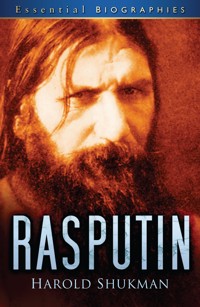
Gregory Rasputin features in Russian history as a malign and destructive force, a man with an unhealthy influence on the Empress Alexandra and undue power in Russian politics. Yet his purposes were ostensibly beneficent. An uneducated peasant, he left Siberia to become a wandering 'holy man' and soon acquired a reputation as a healer. The empress was desperate to find a cure for haemophilia from which her son Alexei suffered, and in 1905 Rasputin was presented at court. His positive effect on the heir's health made him indispensible. But his religious teachings were unorthodox, and his charismatic presence aroused in many ladies of the St Petersburg aristocracy an exalted response, which he exploited sexually. Shady financial dealings added to the atmosphere of debauchery and scandal, and he was also seen as a political threat. He was assassinated bin 1916.
Das E-Book können Sie in Legimi-Apps oder einer beliebigen App lesen, die das folgende Format unterstützen:
Veröffentlichungsjahr: 2011
Ähnliche

















RASPUTIN
For Barbara
RASPUTIN
HAROLD SHUKMAN
First published in 2009
The History Press
The Mill, Brimscombe Port
Stroud, Gloucestershire, GL5 2QG
www.thehistorypress.co.uk
This ebook edition first published in 2011
All rights reserved
©Harold Shukman, 1997, 2009, 2011
The right of Harold Shukman, to be identified as the Author of this work has been asserted in accordance with the Copyrights, Designs and Patents Act 1988.
This ebook is copyright material and must not be copied, reproduced, transferred, distributed, leased, licensed or publicly performed or used in any way except as specifically permitted in writing by the publishers, as allowed under the terms and conditions under which it was purchased or as strictly permitted by applicable copyright law. Any unauthorised distribution or use of this text may be a direct infringement of the author’s and publisher’s rights, and those responsible may be liable in law accordingly.
EPUB ISBN 978 0 7524 7073 3
MOBI ISBN 978 0 7524 7074 0
Original typesetting by The History Press
CONTENTS
Chronology
1 EARLY DAYS
2 RELIGION AND HIGH SOCIETY
3 GROWING FAME
4 TRIAL AND TRIBULATION
5 WAR AND SPY MANIA
6 FRIENDS AND ENEMIES
7 THE END
8 POSTSCRIPT
Notes
Bibliography
CHRONOLOGY
22 Jan. 1869
Birth of Gregory Yefimovich Rasputin in Pokrovskoe, Tobolsk Province, Siberia
1888 or 1889
Rasputin marries Praskovia Dubrovina
26 Nov. 1894
Nicholas marries Alix of Hesse
7 May 1896
Coronation of Nicholas II in Moscow
1901
Philippe Vachod, the French clairvoyant, introduced to empress
1903
Rasputin arrives in St Petersburg, returns to Siberia after five months
4 Feb. 1904
Outbreak of Russo-Japanese War
12 Aug. 1904
Birth of heir to the Russian throne, the Tsarevich Alexei
22 Jan. 1905
Bloody Sunday in St Petersburg
17 Feb. 1905
Grand Duke Sergei assassinated in Moscow
5 Sept. 1905
Russo-Japanese Peace Treaty of Portsmouth, New Hampshire
20 Oct. 1905
General strike
30 Oct. 1905
Nicholas II signs October Manifesto granting civil liberties
Autumn 1905
Anna Vyrubova introduced to Nicholas and Alexandra
14 Nov. 1905
Rasputin meets tsar and tsarina
10 May 1906
First State Duma opens
21 July 1906
Duma dissolved
Nov. 1906
Rasputin treats tsarevich for first time
3 Mar. 1907
Second Duma opens
15 June 1907
Second Duma dissolved, new electoral law announced
20 Nov. 1907
Third Duma opens
Summer 1909
Rasputin and Father Iliodor tour monasteries and visit Pokrovskoe; Rasputin meets Prince Felix Yusupov
1910
Complaints about Rasputin by grand duchesses’ governess
Mar. 1911
Prime Minister Stolypin sends Rasputin away from capital; Rasputin begins second pilgrimage to Jerusalem
14 Sept. 1911
Stolypin assassinated in Kiev
Dec. 1911
Church tribunal investigates charges against Rasputin
Jan. 1912
Prime Minister Kokovstev advises Rasputin to leave capital
28 Nov. 1912
Fourth, and last, Duma opens
1914
Rasputin meets Prince Andronnikov
Feb. 1914
Prince Felix Yusupov marries tsar’s niece, Princess Irina
Spring 1914
Rasputin meets Dmitri Rubinstein
June 1914
Attempt on Rasputin’s life by Chionya Guseva
1 Aug. 1914
Germany declares war on Russia
Sept. 1914
Rasputin returns to St Petersburg
Jan. 1915
War minister dismissed, spy mania spreads
Mar. 1915
Rasputin creates scandal at Yar Restaurant in Moscow, banished from capital; Princess Irina Yusupova gives birth to daughter
June 1915
Anti-German riots in Moscow; Yusupov’s father dismissed with ignominy as governor-general
July 1915
Empress calls Rasputin back from Siberia; Rasputin urges tsar to take over supreme command
Aug. 1915
Press campaign against Rasputin
5 Sept. 1915
Tsar takes over supreme command from Grand Duke Nikolai; Scandal over canonization of John of Tobolsk
16 Sept. 1915
Duma prorogued
Nov. 1915
Rasputin secures appointment of Pitirim as Metropolitan of Petrograd
Feb. 1916
Goremykin replaced by Stuermer as prime minister
Nov. 1916
Duma reconvenes, Milyukov makes his ‘treason or stupidity’ speech
30 Dec. 1916
Rasputin murdered
4 Jan. 1917
Rasputin buried at Tsarskoe Selo
Mar. 1917
Riots in Petrograd; Provisional government formed; Nicholas abdicates, royal family placed under arrest; Rasputin’s body exhumed and burnt
April 1917
Lenin arrives in Petrograd
July 1917
Kerensky becomes prime minister
Aug. 1917
Royal family removed to Tobolsk, Siberia
7 Nov. 1917
Bolsheviks seize power
1918
Volunteer Army formed by anti-Bolshevik generals
Mar. 1918
Soviet–German Peace Treaty of Brest Litovsk ratified
May 1918
Royal family moved to Ekaterinburg
July 1918
Tsar’s brother and other grand dukes murdered
29 July 1918
Royal family murdered by Bolsheviks
ONE
EARLY DAYS
The fall of an empire demands explanation in terms of historical forces that one expects to match the scale of the events themselves – major war, economic collapse, social revolution. But individuals also have their place. It is, for instance, impossible to think of the Russian revolution without mentioning Nicholas II, Kerensky, Lenin or Trotsky. Yet among these names we also invariably encounter that of Gregory Rasputin, usually described as a drunken, lecherous pseudo-holy man, a debauched peasant whose baneful influence over the Empress Alexandra was to prove fatal to the Romanov dynasty. A small private museum has been opened in his birthplace which aims to show that his reputation as an utterly amoral and mercenary reprobate is based mostly on myth. He has featured in novels and films – even in a pop song that opened with ‘Ra, Ra, Rasputin/Lover of the Russian queen/Russia’s greatest love machine’.
The purpose of this book is to identify the qualities that enabled Rasputin to enter Russian history, and that lent themselves to this sort of treatment, to ask what made the Romanov dynasty susceptible to his influence, and to explain why the relationship was ultimately disastrous.




