


Erhalten Sie Zugang zu diesem und mehr als 300000 Büchern ab EUR 5,99 monatlich.
- Herausgeber: The History Press
- Kategorie: Sachliteratur, Reportagen, Biografien
- Sprache: Englisch
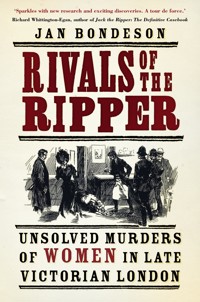
When discussing unsolved murders of women in late Victorian London, most people think of the depredations of Jack the Ripper, the Whitechapel Murderer. But he was just one of a string of phantom murderers whose unsolved slayings outraged late Victorian Britain. The mysterious Great Coram Street, Burton Crescent and Euston Square murders were talked about with bated breath, and the northern part of Bloomsbury got the unflattering nickname of the 'murder neighbourhood' thanks to its profusion of unsolved mysteries. Marvel at the convoluted Kingswood Mystery, littered with fake names and mistaken identities; be puzzled by the blackmail and secret marriage in the Cannon Street Murder; and shudder at the vicious yet silent killing in St Giles that took place in a crowded house in the dead of night. Rivals of the Ripper is the first to resurrect these unsolved Victorian murder mysteries, and to highlight the ghoulish handiwork of the Rivals of the Ripper: the spectral killers of gas-lit London.
Sie lesen das E-Book in den Legimi-Apps auf:
Seitenzahl: 623
Veröffentlichungsjahr: 2016
Das E-Book (TTS) können Sie hören im Abo „Legimi Premium” in Legimi-Apps auf:
Ähnliche


















CONTENTS
Title
Introduction
1 The Kingswood Rectory Murder, 1861
2 The St Giles’s Murder, 1863
3 The Dead Secret: The Cannon Street Murder, 1866
4 The Pook Puzzle, 1871
5 The Hoxton Horror, 1872
6 The Great Coram Street Murder, 1872
7 The Burton Crescent Murders, 1878 and 1884
8 The Euston Square Mystery, 1879
9 Murder and Mystery in the Year of the Ripper, 1887 and 1888
10 The Canonbury Murder, 1888
11 The Murder of Amelia Jeffs and the Disappearances in West Ham, 1890
12 The Murder of Elizabeth Camp, 1897
13 The Ripper and his Rivals
Bibliography
Copyright
INTRODUCTION
Dream on, dream on
Of bloody deeds and death.
Shakespeare, Richard III
When discussing unsolved murders in late Victorian London, most people think of the depredations of Jack the Ripper, the Whitechapel murderer, whose sanguineous exploits have spawned the creation of a small library of books: some of them thoughtful and scholarly works, others little better than publishing hoaxes. Even the most minute details of the Ripper’s career have been mulled and regurgitated by enthusiastic amateur researchers, helped by all the tools and resources of the Internet Age, and the suspects have ranged from tramps and Colney Hatch inmates to some of the highest in the land.
But in the 1890s, Jack the Ripper was just one of a string of phantom murderers whose unsolved slayings outraged late Victorian Britain. The mysterious Great Coram Street, Burton Crescent and Euston Square murders were talked about with bated breath, and the northern part of Bloomsbury got the unflattering nickname of the ‘murder neighbourhood’ for its profusion of unsolved mysteries. But whereas Jack the Ripper has strengthened his position in the history of crime, these other London mysteries, although famous in their day, are today largely forgotten.
The aim of this book is to resurrect these unsolved Victorian murder mysteries, and to highlight the handiwork of the Rivals of the Ripper: the spectral killers of gaslit London. The criteria for inclusion are that the victims must have been female, that the murders happened between 1861 and 1897, and that they happened in London. Of the fourteen murders included in this book, eleven happened in central London; there will be three suburban outings: to Kingswood, Eltham and West Ham.
As for cases missing out, I was sad to have to leave out the mysterious shop murder of the butcher’s wife Mrs Ann Reville in 1881, but this case happened in Slough and thus well outside London.1 Similarly, the so-called Thames Torso Murders had to be left out, since some of them are likely to have happened outside London.2 The mysterious murder of Mrs Arabella Tyler in Blackheath in 1897 came close to being included, as did the unsolved murder of Mary Kate Waknell in Brixton Water Lane in 1900, but both these cases were somewhat obscure and anticlimactic in their endings, and I have written about them elsewhere.3
Care has been taken to analyse the murder mysteries as far as possible, making use of the original police files if extant, of contemporary newspaper coverage of the crimes, and of various other primary and secondary sources. Online genealogical tools have sometimes proven crucial, as have certificates of death and marriage, and a variety of Internet sources. In spite of the obvious difficulties in analysing a century-old murder mystery, it has been possible to produce important clues in quite a number of cases, shedding new light on some fascinating mysteries, and perhaps even hunting down some of the elusive Rivals of the Ripper.
Notes
1. On the Reville case, see G.B.H. Logan, Guilty or Not Guilty? (London, 1929), 164–80, and J. Smith-Hughes, Nine Verdicts on Violence (London, 1956), 1–22.
2. R.M. Gordon, The Thames Torso Murders of Victorian London (Jefferson NC, 2002) and M.J. Trow, The Thames Torso Murders (Barnsley, 2011).
3. J. Bondeson, Murder Houses of South London (Leicester, 2015), 79–83 and 138–43.
1
THE KINGSWOODRECTORY MURDER, 1861
A ‘strange coincidence,’ to use the phrase,
By which such things are settled nowadays.
Byron, Don Juan
Today, Kingswood in Surrey is a large village, situated within the London commuter belt, meaning inflated property prices and trains full to bursting point during peak hours. Back in Georgian times, Kingswood was a sleepy village where little interesting ever happened, but this would change in the 1820s, when the wealthy politician and landowner, Thomas Alcock MP, took up residence in the stately castellated Kingswood Warren. He became Lord of the Manor of Kingswood in 1835 and took an active interest in the welfare of its residents. He made sure that a chapel was built, by subscription, and consecrated in 1836. Since it soon proved too small, the public-spirited Thomas Alcock undertook to have a church built, at his own expense; the church of St Andrew was modelled on a fourteenth-century church in Berkshire and completed in 1852 after four years of work. Importantly for this tale of mystery, Thomas Alcock also made sure that a rectory was constructed, just a quarter of a mile from his own mansion at Kingswood Warren. It was a large red-brick building of traditional design; next to it were the cottages for the village schoolmaster and for the parish clerk.
In 1861, the magnate Thomas Alcock was alive and well, and exercising a benign influence on the inhabitants of Kingswood. The Revd Samuel Barnard Taylor held the living of Kingswood and stayed at the rectory that had been built for him. In May 1861, this gentleman went for a prolonged stay with his father-in-law at Dorking, with his wife, children and servants. On 8 June, he returned to Kingswood, to discharge his clerical duties on the Sunday, but on Monday morning he returned to Dorking, leaving the 55-year-old Mrs Martha Halliday, the wife of the parish clerk, in sole charge of the rectory. She had no objection to sleeping alone on the premises, having done so more than once in the past when Mr Taylor was away with his family. On Monday evening at about 6 p.m., her husband left her to return to his own cottage in the churchyard, about 300yds away.
Kingswood church, from a postcard stamped and posted in 1904. The church still stands and looks much unchanged. (Author’s collection)
On the morning of Tuesday 11 June, Mr William Halliday went to see his wife at the rectory. Finding the door open, he went up to his wife’s room where he found her lying on the floor in her nightdress, with her hands and feet tied up, a sock crammed into her mouth as a gag and a handkerchief fastened tightly round her head and mouth. She was quite cold and had clearly been dead for several hours.1
As soon as the horrified Mr Halliday had made sure that life was extinct, he ran off to alert some neighbours, and soon a party of police was at the rectory. Martha Halliday’s dead body had no marks of external violence, so she had clearly choked to death on the gag. The burglars had broken out a pane of glass in a room at the front of the rectory and must have cut themselves in the process, since there were stains of blood on the woodwork. Since the shutters had been securely fastened, they had been unable to get in. They had then gone to the back of the house, only to find that the security-conscious parson had made sure that the ground-floor windows were protected by iron bars. But the burglars took the stump of an old tree, about 12ft long, and put it against a lean-to outhouse. They were able to climb up on to the roof and smash the window of an upstairs bedroom. This was the very room where Mrs Halliday was sleeping, and she must have made an alarm, only to be tied up and gagged by the intruders, with fatal results.2
The Kingswood Rectory burglars had searched Mrs Halliday’s bedroom, but there was nothing to suggest that they had entered the remainder of the rectory. When the Revd Taylor came home, he searched the house and could report that nothing had been stolen. It was presumed that the burglars had been unnerved by the resistance put up by Mrs Halliday, or perhaps frightened by the slamming of a schoolmaster’s gate when he returned home to his house nearby shortly before midnight. Interestingly, the burglars turned murderers had left behind a crude beechwood bludgeon, recently made from a large branch from a tree. There was also a bundle of papers tied together with a piece of string. When the latter were examined by the detectives, some very important matters came to light. The six documents were all written in German. First there was an Arbeitsbuch, or service-book, containing credentials for a German labouring man, issued to a certain Johann Carl Franz of Schandau in Upper Saxony. He had last been employed as raftsman by the timber merchant Wilhelm Gotthilf Biemer, but he had only lasted ten days in this job. Then there were the certificates of birth and baptism for Johann Carl Franz, saying that he had been born in 1835, as the illegitimate son of a soldier named Carl Gottlieb Franz, and spent his early years in Soldiers’ Boys’ Institute at Strupper. He had been discharged from the army-recruiting depot in 1855, as being unfit to become a soldier. The fourth document was a begging letter, sent by a German named Adolphe Krohn to the opera singer Therese Tietjens, asking for funds to be sent home to Germany, since he was starving and could not find work in London. The response from Mademoiselle Tietjens was apparent from the fifth document, which was a letter from the celebrated singer, giving instructions to Herr Kroll, proprietor of the Hamburg Hotel in America Square, to procure a passage to Hamburg for the carrier of the letter, on her expense. The reason this letter had not been made use of, the police surmised, was that the begging letter writer, Adolphe Krohn, had hoped for some ready cash rather than a return to Germany. The sixth document was a list of names of wealthy people, whom Adolphe Krohn presumably had planned to approach with his begging letters; one of them was Madame Goldsmith, the celebrated singer Jenny Lind.3
A fanciful illustration of the discovery of the murder of Mrs Halliday. (Cassell’s Family Magazine, 1896)
The police immediately suspected that the two Germans, Johann Carl Franz and Adolphe Krohn, had burgled Kingswood Rectory and murdered Martha Halliday. And indeed, the local labouring man, James Blunden, had spotted two foreign-looking men lurking in a thicket of beech trees called the Kingswood Roughit; when inspected, one of the trees had a large branch broken off, matching the crude bludgeon found at the murder scene. There was an appeal for information about mysterious foreigners, Germans in particular, prowling about in Kingswood and its surroundings. On 9 June, two foreigners, one short and dark, the other tall and fair, had entered Reigate from the direction of London and applied for lodgings at the Cricketers’ Inn, just opposite the police station. They had taken their meals in the taproom, and the pot-man, George Roseblade, had observed them several times when he served them their meals. They had spoken together in a foreign language that he did not understand, and they left the inn on the afternoon of 10 June. The wife of Thomas Pither, a Reigate brushmaker, had seen two foreign-looking men enter her shop, looking at various kinds of string, before purchasing a ball of ‘roublay cord’, a peculiar kind of string that was seldom manufactured. Since they had been jabbering together in a strange language, both Mrs Pither and her servant Mary Elsey had had a good look at them. The ‘roublay cord’ corresponded exactly with the string that had been used to tie up the murdered woman. At 2 a.m. on 11 June, Police Constable William Peck had stopped two men at Sutton; when he had asked where they were going, one had replied in broken English, ‘To Old Pye Street, Westminster.’ The police were encouraged to find that these observations of the Kingswood miscreants formed a definite pattern: they had tramped from London to Reigate, purchased string and manufactured a bludgeon for use in a burglary, chosen the rectory as their target, murdered Mrs Halliday and tramped back to London during night-time hours.
The two foreign villains are served a meal at the Cricketers. (Famous Crimes Past & Present)
The magnate Thomas Alcock took an immediate interest in the Kingswood Murder, which had been committed in the rectory he himself had ordered to be constructed, not far from his own residence. The dynamic businessman posted a £100 reward for the arrest of the murderers, which was soon matched by a government reward of the same sum. Mr Alcock urged Superintendent Charles Henry Coward, of the Surrey Constabulary, to make sure that a Scotland Yard detective was requested, and Detective Sergeant Robinson soon arrived to assist the local authorities. After a few days, the experienced Detective Inspector Jack Whicher was also called in. The previous year, Whicher had been involved in the investigation of the murder at Road Hill House: he had suspected the 16-year-old girl Constance Kent of murdering her 4-year-old half-brother, but the case against her was dropped due to lack of evidence. The national newspapers had been critical of Whicher, and he was seen as undermining the reputation of the Detective Branch, but in 1865 he would be vindicated after the sinister Constance Kent had confessed to a priest.4
Whicher found the witness reports of the two foreign vagabonds very encouraging. Since the taller man very much resembled the description of Johann Carl Franz in the service-book left at the murder scene, he strongly suspected that the two men seen in Reigate and Kingswood were Johann Carl Franz and Adolphe Krohn. He sent Robinson to interview Therese Tietjens at her house in St John’s Wood. She said that a German vagabond had turned up on her doorstep a week earlier, pleading poverty and asking her for help to return to his native Vaterland. Therese Tietjens, who had enjoyed much success since coming to London in 1858, and performed at Her Majesty’s Theatre and the Covent Garden Opera, was a wealthy woman, and a friend of distressed countrymen. She was no fool, however, and did not want to give the tramp any ready cash; thus she wrote the letter to the hotel manager promising him a free passage to Hamburg. Mademoiselle Tietjens believed she could identify the caller if she saw him again. He had been about 5ft 5in, with light brown hair and a fair complexion. He had worn a brown coat, speckled trousers, a striped shirt with a black necktie and a peaked cap.5 This was further good news for Whicher, who believed that the net was closing in around Franz and Krohn. There had clearly been some degree of planning preceding the botched burglary, as proven by the manufacture of the bludgeon and the purchase of the ball of string, which had been made into slipknots suitable for tying people up with. Either the burglars had had some degree of local knowledge, knowing that Mrs Halliday was alone in the unprotected rectory, or they had just chosen a house at random. One line of thought was that they had intended to burgle Mr Alcock’s house but chosen the rectory by mistake; this was adventurous speculation, since the Kingswood magnate was quite security conscious and employed a populous staff of servants.
The coroner’s inquest on Martha Halliday was opened on 15 June at the Red Lion public house in Kingswood, with Mr William Carter, the coroner for East Surrey, presiding. William Halliday was the first witness: he explained how his wife had come to spend the night alone in the rectory and how he had found her murdered in the morning. Police Constable Henry King described how he had been alerted and gone to Kingswood Rectory early on 11 June, where he had been met by the schoolmaster William Cretchley. He entered the rectory and saw Mrs Halliday lying dead on the floor in her nightdress. She was still wearing her nightcap, although it had almost been pulled off. A shirt belonging to the Revd Taylor was fastened around her neck, and a coloured silk handkerchief was tied around her face. The large bludgeon was in the room, but it was not marked with blood, and Mrs Halliday’s body had no bruises. A pane of glass was missing in the window opposite the bed, obviously from the forced entry of the villains. Superintendent Coward described how he had examined the crime scene. There were some marks of blood in the murder room, probably from the cut hand of the burglar who had broken the downstairs window. He believed that Mrs Halliday had been in bed when she had been alerted by a falling looking glass, but after she had got out of bed the two villains were already in the room; they had found it easy to overpower and subdue her, and she had died from suffocation and strangulation. There were footmarks in the garden from two different people, both wearing hobnailed boots.
The next witness was the Reigate surgeon Henry Harris, who had performed the post-mortem on Mrs Halliday. The sock had been thrust into her mouth with great force, so that the tongue was doubled and forced back, completely obstructing the respiratory passage. There were marks from fingernails on both sides of the mouth, and small bruises on one cheek and on the side. Her hands and feet had been tightly tied up before death. The schoolmaster William Cretchley testified that Kingswood Rectory was situated between his cottage and the church. On Tuesday morning, Mr Halliday had come to see him, saying, ‘Oh, God, my wife is murdered!’ The startled schoolmaster had replied, ‘No such thing; it can’t be!’ but his colleague had convinced him that there had really been a murder, and he had helped to call the police. He had been in Reigate the evening of the murder, returning at about 11.30 p.m.; there had been no light at the rectory, and no suspicious noise had been heard. He had slammed the garden gate, something that might have frightened the burglars off. The Revd Taylor described how he had left the murder house at 11.30 a.m., leaving a shirt and a pair of socks with Mrs Halliday to have them washed. It was with one of these socks that she had been suffocated to death. The murder room was normally a servant’s bedroom, and one of the female servants was missing a small brooch, which she had kept in a box in this room. Superintendent Coward recommended that a sharp lookout should be kept for this brooch, in pawnshops and elsewhere. The inquest was adjourned for a week.6
Whicher felt convinced that the solution to the Kingswood Murder lay in tracking down Johann Carl Franz and Adolphe Krohn. There were quite a few German immigrants in England at this time, many of them living in Whitechapel, where they were connected with the bakery trade. Since the sight of dirty, penniless German vagabonds tramping the streets was depressingly familiar at the time, finding the two Kingswood murderers would not be easy. Many German tramps were arrested, sometimes on the flimsiest of evidence, but Whicher ruled them out one by one.
On 18 June, the full details of the bundle of papers found in the murder room was published in TheTimes, to make the details of the presumed murderers known to the newspaper press, and the general public. The detailed description of the main suspect, Johann Carl Franz, narrowed down the search considerably, and there was immediate enthusiasm when, on 19 June, two German vagabonds were arrested near Chichester. They gave their names as Jacob Zimmerman and Henri Mynfors; the elder of the two described himself as a sugar baker and the younger, as a waiter. It attracted suspicion that one of them was without his passport, which he claimed had been stolen by another German tramp whom he had met at Winchester. The two Germans answered all questions with great readiness and did not seem at all alarmed by their predicament. The cutler and a female servant from the Cricketers in Reigate, and a person from the shop where the murderers had purchased the cord to tie up their victim, were sent for, but after they failed to identify the two Germans, the men were released in due course.7
The same day, 19 June 1861, the coroner’s inquest was reopened at the Red Lion. The Revd Samuel Barnard Taylor was recalled to testify that none of his property had been stolen from the murder house. King described finding the bundle of papers, and Coward read translations from the bundle of papers found in the murder room, thus making sure that the names Johann Carl Franz and Adolphe Krohn were published in the newspapers as those of the main murder suspects. From the service-book, the following description of the 24-year-old Johann Carl Franz was quoted: ‘Middle height, probably about 5 feet 6 inches; hair light brown; eyes brown; marks none.’ The superintendent declared himself convinced that after entering the murder room by the window, the murderers had accidentally left these papers behind. There was an air of general satisfaction that the suspects were foreign vagabonds, and the coroner commented, ‘No doubt these papers will quicken the public mind as to the fact that the murder was not done by any person in the neighbourhood.’ A juror then piped up: ‘Unless the papers were left there to mislead!’ ‘No,’ the coroner pontificated, ‘they were not at all hidden, and the supposition is that they fell from the pocket as the silk handkerchief was drawn out to fasten round the deceased’s neck.’ After a brief summing-up, the inquest returned a verdict of murder against some person or persons unknown.8
Whicher and Robinson were actively trying to track down Franz and Krohn. The inspector had an idea that the two suspects were hiding in the slums of Whitechapel, which were home to a large population of Germans, many of them penniless vagabonds. On Friday 21 June, a young German had been arrested at Union Court, City, under suspicion that he was there for an unlawful purpose. He gave the name of Auguste Salzmann but failed to give a good account of himself and was remanded for a week. Inspector Whicher thought the mysterious ‘Salzmann’ matched the description of Johann Carl Franz to perfection. He was able to find out that on the morning of Wednesday 12 June, Salzmann and another German had come to the Commercial Lodging house in Wentworth Street, requesting a bed for the night. When the manager, Mr Gilhooley, asked their names, Salzmann’s companion asked if they had to provide them, and when told that the lodging house always took the names of their residents, he rather cheekily gave his own name as McDonald, although it was obvious that he was a German. Salzmann, whose command of English was very poor, said that his name was ‘Franz’, but his companion pushed him aside and said, ‘He does not understand your language – his name is Franz Posser!’ The two Germans had remained at the lodging house until Saturday morning, when the younger man, who could speak English, went out to purchase some breakfast; he never returned.9
‘Salzmann’ did not look like a brutal murderer, but a weak, confused young man. A journalist described him as follows:
The prisoner is a short, slightly-made man, with fair complexion, and thin, fair, sleek hair. He is about 24 years of age, with a light-coloured, incipient beard. He is dressed in a brown frock coat, or jacket, dark trousers and waistcoat, and a reddish woollen checked shirt. He is a very docile-looking man. He was very much agitated when taken into custody for the affair in Old Broad-street, and has been occasionally so since.10
Whicher scented blood, however, since he strongly suspected that ‘Salzmann’ was none other than Johann Carl Franz, and that he knew better English than he pretended to do. He put pressure on ‘Salzmann’, asking him about his previous movements, with neither an interpreter nor legal counsel present. The German replied that he had only been in the country for a few weeks, tramping to London from the countryside. His command of geography was as defective as his broken English, and he could not tell where he had been travelling, except that the ship from Germany had arrived at Hull. When the inspector asked him what had happened to his companion, he said that he had been tramping together with a man who had called himself Samuel, although he had now left him. When asked if he knew Mademoiselle Tietjens, the German replied that he had not seen her, just gone with his companion, who showed him the letter she had given him. Hoping for a vital breakthrough, Whicher sent for the celebrated singer, but when she saw ‘Salzmann’ in Newgate, she confidently declared that he was not the man she had seen and given a free passage back to Germany. Nevertheless, there was quiet optimism among the detectives that the mysterious Kingswood Murder was to be solved. On 26 June, Captain Hastings, the Chief Constable of Surrey, and Mr Thomas Alcock MP, had an interview with Whicher and the authorities at Scotland Yard, expressing ‘their gratification that the perpetration of this barbarous murder was at length to be traced to its right source, and the guilty parties brought to justice’.11
On 27 June, the prisoner Salzmann was brought up before Mr Alderman Humphery, at the justice-room of the Mansion House. Jane Inall, housekeeper at No. 3 Union Court, Old Broad Street, testified that on Friday 21 June, her daughter had seen a mysterious tramp on the third floor, trying a door. She had called to her mother, who had caught the suspected burglar in a powerful bear hug as he tried to escape down the stairs. He had begun to cry and called out, in his broken English, ‘Oh, mistress, don’t hurt me!’ When arrested by Police Constable Charles Underwood of the City Police, he was found to be carrying a German prayer book, a razor wrapped in a black silk handkerchief and several begging letters. Underwood told the court that he was struck with the remarkable similarity between the prisoner and the description of the man Johann Carl Franz, about whom he had read in The Police Gazette. He had told his superiors in the City Police, and Detective Sergeant Spittle had questioned the prisoner. He found ‘Salzmann’ a short, slender man, very pale and poverty-stricken, with thin light hair. There were no marks of blood on his clothes. The prisoner now said that he had been eleven weeks in England, and that he had tramped to London from Hull. He had changed lodgings several times in London, but could not remember where he had stayed.12 Spittle had been liaising with Whicher and Superintendent Coward, and a number of Kingswood and Reigate witnesses had seen the prisoner. There was dismay from the enthusiastic inspector when the first three witnesses failed to recognise the prisoner: the Kingswood labourer James Blunden, who had seen two foreigners lurking among the trees, and the pot-man and servant girl from the Cricketers. Police Constable Peck, who had seen the two suspicious foreigners tramping through Sutton in the middle of the night, did not recognise Salzmann either. The suspicions of Mr Whicher remained, however, and he made sure that all the other Reigate witnesses were to be brought to London and confronted with the prisoner.13
On 28 June, the prisoner ‘Salzmann’ was again brought to the justice-room at the Mansion House; this time, the Lord Mayor presided in person. Mr Alcock was present, as were Captain Hastings the Chief Constable, Whicher and Robinson. A journalist wrote:
The demeanour of the prisoner during the proceedings of yesterday was marked by the same quiet self-possession as on the previous day. He is a timid-looking creature, destitute, to all appearance, of physical strength.
Other newspaper men also commented on the prisoner’s feeble physique and careworn manner: he certainly looked nothing like a brutal murderer. For the first time, a translator had been recruited, but when it was explained to ‘Salzmann’ that he was suspected of being one of the persons involved in a murder, he merely shrugged his shoulders. The first witness was the Reigate grocer James Bashford, who testified that on 10 June, he had spent an hour having luncheon at the Cricketers. He had seen two foreigners at the pub, and one of them was ‘Salzmann’, whom he had picked out among twelve other men at Newgate. The other foreigner had been very short, just 5ft in height, and also very youthful in appearance, with dark hair and a fresh complexion. The prisoner denied ever having been to any pub in Reigate. Mrs Mary Pither, the Reigate shopkeeper, testified that she had seen a man very much like the prisoner coming into her shop on 10 June and purchasing a ball of string. The other man, with dark curly hair, had spoken English, but the two men had spoken together in some foreign language that she did not understand. She said that the prisoner resembled the man in general appearance, but he was thinner and his face was different. Mrs Pither’s servant girl Mary Elsey testified that she believed she had seen the prisoner enter the shop on 10 June, together with another foreigner. When asked if he had any question for these witnesses, ‘Salzmann’ shook his head and said, ‘I have nothing else to say, but I am astonished that they should accuse me of murder.’ The Lord Mayor ordered that the prosecution for being found in a dwelling house with intent should be dropped, since that offence would have already been expiated by the time the prisoner had spent in custody. When Superintendent Coward took him out of the justice room, to be brought before the Reigate magistrates, ‘Salzmann’ wept bitterly and called God to witness that he was innocent of the murder.14
On 1 July, the prisoner ‘Salzmann’ was charged with being concerned in the murder of Martha Halliday, before the Reigate magistrates, at the old town hall. Whicher had prepared facsimile copies of the service book and other documents found in the bundle of papers in the murder room. He also had a novel discovery to tell the bench about: when the prisoner’s belongings had been searched at the lodging house, a checked shirt was found, which matched the garment worn by one of the foreigners seen at Reigate and Kingswood. Moreover, the bundle containing the shirt had been bound with a long piece of new cord, exactly similar to that sold to the two foreigners in Reigate and used to tie up Mrs Halliday! The begging letters found on the prisoner when he was arrested had been translated, and they were read aloud in court, with pathetic phrases like:
Sir, – Alone in the world and in a bad position, and for two days without a piece of bread, and nearly the whole of the week without a lodging – the blue heavens as a shelter, I find myself in a position which with words I cannot describe …
There was also a letter from the prisoner to his parents, in an incomplete state, and with no signature:
Dear Parents – For goodness sake what shall I do? You know with what resolution I went to work to get to America. I have already described my voyage to Hull. I will do it a second time. You will have thought me to be in America, but that is also not the case. I find myself in a most horrible position, but how I came into that position is very natural.
The pathetic ‘Salzmann’, who had again been provided with an interpreter, exclaimed, ‘I know that I am charged with murder, but I don’t know of whom?’ It was explained to him that he was concerned in the murder of Mrs Halliday, whose husband had just been the first witness examined. Through the interpreter, he declared that he was not the owner of the service book, and that he had never been to Reigate in his life. It was no surprise that he resembled the description of the man Franz since, in his opinion, one German looked very much like the next.15
When the examination was resumed on 8 July, the journalists once more marvelled at the mild and timid countenance of the prisoner: it looked like he would break down and cry any moment. Whicher explained that he was making inquiries with the police in Saxony, hoping to establish the identity of the prisoner once and for all. The witnesses James Bashford, Mary Pither and Mary Elsey then testified: the former was once more completely certain that ‘Salzmann’ was the man he had seen, whereas Mrs Pither was dubious and unwilling to swear. The girl Elsey’s memory had improved with time: after he donned a cap, she confidently pointed the prisoner out as the man she had seen in the shop. A twine manufacturer named Dinmore testified that the ‘roublay cord’ used to tie up Mrs Halliday was very uncommon. He had examined the specimens of string from the murder scene and compared them with the length of string used by ‘Salzmann’ to tie up his shirt; in his opinion, they came from the same ball of string. The prisoner objected to this, saying that he had picked up the string in the street. A man named David Levy, a Polish Jew who made a living as a steel pen dealer, testified that on 12 June he had met the prisoner and a companion in Wentworth Street. The companion had been quite young, perhaps just 18 or 19 years old, and also very short. Since Levy looked foreign, and spoke German, the two vagabonds approached him to ask for lodgings. He took them to the house at No. 48, where there were beds available for 6d. It had been the younger man, who introduced himself as Scheretzki and spoke good German, who did all the talking; the prisoner had looked very lachrymose and depressed. He said that he had deserted his wife and two children in Schandau, and that he wanted to travel to the United States, where his parents were, but lacked the money to do so. Once, when ‘Salzmann’ had sold a brush to another lodger for 3d, his companion, who had returned late at night in an intoxicated condition, gave him a knock on the head and called him a cursed fool, since the brush was supposed to be worth much more. Dominick Gilhooley, assistant manager of the lodging house at No. 48 Wentworth Street, also remembered the two foreigners, who had introduced themselves as ‘John McDonald’ and ‘Franz Fosser’. The prisoner had given him a blue woollen shirt tied up with string.
After Whicher had asked for a remand, stating that in a week he hoped to present conclusively that the book found in the murder room was the property of the prisoner, the wretched ‘Salzmann’ stood up. After being cautioned that what he said would be taken down and might be used against him, he confessed that he was Johann Carl Franz, from Schandau. On 16 or 17 June, he had been tramping round Whitechapel, chancing to meet two countrymen, to whom he explained his hungry and penniless state. One of them bought him 2d worth of peas in a cheap eating-house. When the other German read a newspaper and told him that two Germans named Johann Carl Franz and Adolphe Krohn were wanted for murder, Franz received a terrible shock to the senses: he grew pale and almost fainted. When he had tramped from Hull to London, he had accompanied two German sailors named Wilhelm Gerstenberg and Adolphe Krohn. These two villains were talking of robbing a wealthy Catholic priest, and the timid Franz did not like the company of such coarse ruffians. Gerstenberg had more than once coveted Franz’s identity documents, since the two were very much alike, but the prudent Franz had not given him them. One evening, the three tramps had gone to sleep near a haystack just south of Leeds. Franz had woken up at 6 a.m., finding that his two companions had stolen his travelling bag and gone off. The travelling bag had contained his service-book and other documents, his travel diary and a testimonial from a railway guard, and also his spare clothes: shirt, trousers, waistcoat and greatcoat. When he had heard the name Adolphe Krohn at the eating-house, he immediately realised that the sailors Gerstenberg and Krohn were the two murderers. Since Gerstenberg resembled Franz in build and colouring, and since he had been wearing the spare clothes he had stolen, there was no wonder that several witnesses had identified him as the murderer, when he had in fact never been anywhere near Reigate in his life.16
The startled Johann Carl Franz hears that he is the prime suspect for the Kingswood murder. (Famous Crimes Past & Present)
These revelations from Johann Carl Franz must have come as a bombshell to Whicher and his colleagues. It was good that Franz had finally admitted his identity, but what if his story of the two sailors and the stolen travelling bag was true? The inspector of course suspected that Franz was lying, but how would a man of mediocre intellect have been able to invent such a remarkable story and tell it with such impressive candour? Whicher decided that the best strategy to ‘crack’ the Kingswood Mystery was to apprehend the other man concerned in the murder, whether he was Adolphe Krohn or somebody else. There was a newspaper story that Krohn’s real name was Julius Ahlborn, the son of a Jewish schoolmaster at Breslau in Silesia and a proficient begging-letter writer. When a burglar was apprehended at Duffield in Yorkshire, there was speculation that he was identical to Krohn alias Ahlborn, but the witnesses Bashford and Gilhooley were sent to Duffield, where they confidently declared that he was not the man they had seen. Whicher himself suspected that a young Polish Jew named Marks Cohen was identical to the elusive Krohn, but here again he was mistaken. There was newspaper speculation that Krohn was still in England, hawking with a Jew named Graetz, or that he had travelled north to Scotland under an assumed name, to pester wealthy countrymen with his begging letters.17
When Johann Carl Franz was brought before the Reigate magistrates for the third and final time, on 16 July, all the major players in the case were present. The Reigate town hall was crowded to capacity, and many journalists were struck with the contrast between the thin, despondent-looking prisoner and the brutal Teutonic murderer they had expected to see. Whicher could announce that a communication had been received by the Foreign Office, that Johann Carl Franz had borne a very indifferent character in his native land, and that he had served two years and nine months in prison for a felony. He had a wife and two or three children in Schandau. He had worked at a railway in Königstein in April 1861 and then left there and worked his passage by water to Hamburg, as a raftsman. From Hamburg he had proceeded to Hull by steamer. The Kingswood labouring man James Blunden testified that he had seen two men in the Kingswood Roughit, about a mile and a quarter from the rectory. They had been speaking together in a foreign language. He thought one of them rather resembled the prisoner, although he could not be certain. Mademoiselle Therese Tietjens was next sworn. She testified that on 7 June a German had come to her house at No. 20 Grove End Road, St John’s Wood. He had been a boyish-looking person, perhaps 18 or 19 years of age, with light brown hair and neatly dressed in a brown coat and a blue and white shirt, with a black necktie. He had said that he was very poor, and that he had been sleeping rough for three nights. He wanted to return to Hamburg, where his former master Herr Kreisler would give him work. The beggar had come alone, and she could see no companion. The kind Mademoiselle Tietjens had given the lad something to eat and a letter to Herr Kroll, of the Hamburg Hotel, who knew all the captains of German vessels. Answering a question from the Bench, she confidently declared that the prisoner was not the person who had called at her house.
A postcard showing Reigate old town hall. (Author’s collection)
The next witness was George Roseblade, the pot-man at the Cricketers, who had twice failed to pick Franz out at police lineups. Now, his memory had improved markedly, and he declared that he could swear that the prisoner had been the taller of the two men at the Cricketers, the one who spoke no English. Mr John Faulkner Matthews, a Reigate architect and builder, next testified that between 3 and 5 p.m. on Monday 11 June, he had been walking from Kingswood to Reigate. He had met two men walking in the opposite direction and believed that the prisoner Franz had been one of them. He had a very indistinct recollection of the other person. Constable Peck could well remember that one of the two tired-looking foreigners he had stopped near the Cock Inn, Sutton, at 2.30 a.m. the morning after the murder had looked young, perhaps 19 years old, and had dark frizzly hair. He had spoken to his companion in a foreign language. The constable, whose memory had also improved with time, could not swear positively, but he believed the prisoner to be that man. After the Revd Taylor and the surgeon Henry Harris had given evidence, the prisoner was asked what he had to say in his defence. Poor Johann Carl Franz was quite overcome by the pressure of his situation, however: ‘He now burst into tears, and, although he evidently struggled hard to repress his emotion, he wept bitterly for some minutes and appeared completely unnerved.’ After recovering a little, he stated that he had nothing to say, and that he reserved his defence. He was next committed to take his trial at the Croydon Assizes on 6 August, on the charge of wilful murder.18
The Saxon Embassy paid for Franz’s defence, and hired the eloquent Hon. George Denman, an up-and-coming young barrister, with Mr W.M. Best as his assistant. Before the trial, some new information had come to light, to the benefit of the defence. Firstly, it turned out that although the ‘roublay cord’ was quite an uncommon kind of cord, the factory making it was actually based in Whitechapel, just two minutes’ walk from the tobacconist’s shop outside which Franz claimed to have found the piece of cord he had tied his shirt up with. When the attorney Mr Best went to see it, he found a ball of string of exactly the same manufacture in a printing-office next to the tobacconist’s. Even more remarkably, it turned out that on 9 July, some English tramps in a roadside lodging house 5 miles from Banbury had found Franz’s travel diary, and with it the railway guard’s testimonial, on a heap of straw. This was important and unexpected corroboration of Franz’s story that these documents had been stolen from him, together with the service-book. The trial began on Tuesday 6 August, before Mr Justice Blackburn. Mr Serjeant Ballantine and Mr Robinson were counsel for the prosecution. They presented their case very much like at the Reigate magistrates’ court. The grocer Bashford, Mrs Pither of the brush-maker’s shop and her servant Mary Elsey all gave evidence that Franz was the man they had seen in Reigate. The twine makers Robert Cramp and Joseph Dinmore faltered under cross-examination and were now unable to swear that the ‘roublay cord’ used to tie up Mrs Halliday and the specimen of string found with Franz’s shirt came from the same ball of string. Gustav Adolph Kyling, who gave his evidence through an interpreter, introduced himself as a police officer from Schandau, and identified the prisoner as Johann Carl Franz.
A postcard stamped and posted in 1901, showing the market place of Schandau in Saxony, the home town of Johann Carl Franz. (Author’s collection)
The following day, Mr Denman presented the case for the defence. One key aspect was the string evidence, which had been significantly weakened by the faltering of the two twine makers and the discovery that Franz could have come by the piece of string by perfectly natural means. Then there was the evidence of the travel diary and testimonial found by the tramps and handed over to Mr William Potts, a Banbury magistrate. The diary was clearly in Franz’s handwriting and proved that his story of having been robbed by the two tramps Gerstenberg and Krohn might well be true. The last entry in the diary was from ‘Leek’, whereas Franz had stated that he lost the diary near Leeds; could the monoglot foreigner not have mixed these two places up? Many people had been interested in the Kingswood Murder, Denman pontificated, and there had been a general feeling that a great crime should not go unpunished and that Reigate should not rival Road, of recent Constance Kent infamy. The prisoner Franz was an ordinary-looking young man, with no distinguishing features. Mrs Pither had been not been certain when she identified Franz and her customer, and she admitted that her shop had been rather dark. Her servant, who had spoken more positively when identifying the prisoner, was a young and inexperienced girl, and there was no doubt in his mind that she had been influenced by what she had read in the newspapers. Denman affirmed that the prisoner’s story was true from first to last: he had never been in Reigate or in Kingswood, and the reason he had taken a false name was that he had heard about a newspaper report that his name had been linked with a murder. The detectives involved in the case had spared no effort to secure a conviction against the poor, despondent prisoner, who had lacked legal counsel during most of his ordeal and who had only sometimes been provided with an interpreter. He called the jury’s attention to the destitute and helpless condition of the long-suffering Johann Carl Franz, who was not only steeped in poverty but entirely ignorant of the English language, and thus quite unable to manage his own defence; he praised the Saxon Embassy, but for whose humanity the prisoner would have been altogether without legal assistance to answer the dreadful charge that had been made against him. Justice Blackburn then proceeded to carefully sum up all the evidence, pointing out that it was a very material question whether the prisoner was one of the two men seen near the scene of the murder before it was committed. The jury retired for an hour, before finding the prisoner ‘not guilty’. There was applause in court when the verdict was pronounced. Johann Carl Franz had been saved by the exhortation of a first-rate barrister for the defence, and an honest and unbiased judge and jury.19
The Saxon Embassy made sure that Johann Carl Franz was ‘exported’ back to his native land as a matter of expedition. Before his departure, he wrote a heartfelt letter to his legal counsel, thanking him for his kindness. By a curious coincidence, Mademoiselle Tietjens was on the same ship; hopefully, Franz did not dare approach her with another of his pathetic begging letters.20 It is not known whether his narrow escape at the Croydon Assizes persuaded Franz to lead an honest and industrious life or whether he carried on his low life as a vagabond and small-time crook. Therese Tietjens made her home in London, although she sometimes toured abroad; she died in her London house in 1877. Inspector Whicher was never put in charge of another murder case after the Road and Kingswood debacles. He retired early, in 1864, and died in 1881. The Hon. George Denman, whose eloquent defence of Franz at the Croydon Assizes was much admired in the newspapers, became a High Court Judge and an MP, and he died in 1896. The Kingswood magnate Thomas Alcock lived on until 1866.
When a dead body turned up outside Liverpool in September 1861, there was newspaper speculation that this was the missing Adolphe Krohn, but without any evidence in favour of this being presented.21 The police file on the Kingswood Rectory Murder was closed after Franz had been acquitted, but in 1863, the Hull lodging house keeper Johann Pfeiffer accused a certain Edward Schmidt of having stolen Johann Carl Franz’s pocketbook and committed the Kingswood Murder. Schmidt had lodged with Pfeiffer in May 1861, but left without paying; when Pfeiffer saw him again in May 1863, he brought up the matter of Franz’s pocketbook, and Schmidt replied, ‘I am the man who committed the murder, but you cannot prove it!’ Pfeiffer caught hold of him and frog-marched him to the police station. Edward Schmidt denied having had anything to do with Franz’s pocketbook, or confessing to the murder. Nevertheless, the authorities took the matter very seriously, and Schmidt was transported to Reigate, where Superintendent Coward made sure that Mademoiselle Tietjens and two of the Reigate witnesses saw him; they failed to pick him out, and he was discharged. Since he was ‘a miserable-looking creature’, those present arranged a small subscription to enable him to go to London.22
As for Kingswood Rectory, it still stood in 1904, when featured in a crime magazine, but regrettably it has since been pulled down. The church of St Andrew still stands, and so does Thomas Alcock’s fine Kingswood Warren, which has recently been ‘developed’ into flats. The only trace of Kingswood Rectory is a small street close to the church called Vicarage Lane, containing nondescript modern housing.
* * *
So, who committed the Kingswood Murder? One school of thought is that Johann Carl Franz and his accomplice were guilty, that they had dropped the papers by accident and been seen by various witnesses, but that Franz had been able to lie his way out of trouble. The other is that Johann Carl Franz had been telling the truth all along: his papers had been stolen near Leeds (or Leek) by the two tramps who called themselves Gerstenberg and Krohn; these two had later committed the Kingswood burglary and murder, and had accidentally or deliberately planted Franz’s papers on the crime scene.
If we are to presume that Johann Carl Franz was the guilty man, we must accept that, driven desperate by hunger and poverty, he and an accomplice had tramped from London to Reigate looking for a house to burgle. Either they had received information, from some source or other, that the rectory was unprotected on the night of 11 June or they had chosen the house more or less at random, due to its secluded position. After botching the burglary and murdering Mrs Halliday, they returned to London, where they split up. Franz took the name Auguste Salzmann and begged money and food from kind-hearted countrymen, but not with much success. When skulking about in the City, looking for a house to burgle, he was ‘nabbed’ by the brawny housekeeper Jane Inall and taken into custody by the City Police. When first questioned by the police, without an interpreter, the muddled Franz made some damning admissions, in particular volunteering that he had stood outside when his companion went begging to Mademoiselle Tietjens. Three witnesses picked him out as the man they had seen in Reigate prior to the murder. Two of them had seen him purchase a ball of string, identical to the string used to tie up Mrs Halliday and also identical to the string used by Franz to wrap up his shirt. The evidence from Saxony clearly showed that the Johann Carl Franz prosecuted at the Croydon Assizes was the same man who had lived in Schandau, with his wife and children. He had a bad character and was a convicted felon, quite possibly for a burglary committed when he lived in Schandau. Whicher was convinced that Franz was guilty, and most journalists also took his guilt for granted, being dismayed when he was freed by the Croydon Assizes. A writer in the old crime periodical Famous Crimes Past & Present claimed to be a close friend of the son of the rector of Kingswood; they had many times discussed the murder in their Cambridge rooms. ‘The son, like the father, inclined to the belief that Johann Carl Franz was the real murderer, and that he only got off through clever juggling of the evidence by his able counsel.’23
Whicher was also convinced that the other man involved in the burglary and murder was Adolphe Krohn, but here he was treading some very slippery ground indeed. The only evidence that such a man as Krohn ever existed was the begging letter signed with his name, found in the murder room. The letter was not in Franz’s clumsy hand, and it was better written than his crude mendicantory epistles. It may well be that ‘Krohn’ was the name or alias of some other German begging-letter writer, who had given his letter and Mademoiselle Tietjens’ reply to Franz since, having hoped instead for ready cash, he did not need them. But if we presume that the man who visited Therese Tietjens was Adolphe Krohn, then he was completely unlike the very short man with dark hair who had accompanied the taller, fair-haired foreigner to Kingswood. Therese Tietjens described her visitor as having light brown hair and a fair complexion, but before the Reigate magistrates she confidently declared that he was not Johann Carl Franz. If we choose to believe Franz’s version of events, Adolphe Krohn was one of a pair of sailors who accompanied him on his tramp from Hull to Leeds (or Leek). He was a villain who planned to rob a priest, if he came across one. Then he and his colleague Gerstenberg stole Franz’s bundle of papers, which they left behind after burgling Kingswood Rectory and murdering Mrs Halliday. But if Adolphe Krohn had been one of the Kingswood murderers and left Franz’s papers behind to create confusion then why would he also leave a letter signed with his own name at the crime scene?
The witnesses involved in the case are also worthy of a short discourse. First we have three witnesses from the Cricketers, the pot-man George Roseblade, an unnamed servant girl and the pub visitor William Bashford. Of these three, Bashford picked out Johann Carl Franz and swore to his identity at the trial; Roseblade twice failed to pick him out but later changed his mind and swore to Franz’s identity before the Reigate magistrates, although he was not called upon to give evidence at the trial; the servant girl played no further part in the case after failing to pick Franz out in London. Then we have Mrs Pither and her servant girl Mary Elsey from the brush-maker’s shop. Mrs Pither identified Franz as the man she had seen, first tentatively but later with more confidence, and she swore to his identity at the trial; Mary Elsey picked Franz out and swore to his identity at the trial. The labourer James Blunden failed to pick Franz out; however, he later thought he resembled the man he had seen skulking among the trees. The architect John Faulkner Matthews saw the pair of foreigners leave Kingswood and thought Franz looked like one of them. The police constable, William Peck, failed to pick Franz out; although he later thought he looked like one of the men he had stopped in Sutton. Thus two of eight witnesses picked Franz out in police lineups; a third first vacillated but later swore to his identity; the other five were not called to testify at the trial.
It is clear from the technical evidence that two burglars entered Kingswood Rectory and murdered Mrs Halliday. Due to the evidence from the string and the bludgeon, and the matter of Franz’s and Krohn’s papers being left at the murder scene, there is strong reason to believe that they were identical to the two Germans seen by a number of witnesses in Reigate and Kingswood. There would be no reason whatsoever for Franz and Krohn themselves to leave these papers behind, but it would make good sense for another person, who had stolen the papers at some stage or other, to plant them at the scene to cause confusion in the minds of the police detectives. If we choose to believe Franz’s story, then one of the men who stole his papers, Wilhelm Gerstenberg, resembled him very much.24 Since Gerstenberg also had stolen his spare clothes, this would make them look even more alike and induce the abovementioned witnesses to make a false identification. Johann Carl Franz was not a strong, jackbooted brute of a German, but a miserable, half-starved wretch who looked very timid and wept profusely when frightened or unnerved. It is quite hard to believe that he would have had the strength to carry out a murder – the burglars would have been very likely to notice that their victim had ceased to breathe after they had gagged her – and then return to London, change his name and get on with his life just like before. The truth of the Kingswood Murder is lost in a ghostly Hinterland of German vagabonds infesting the London streets. These half-starved, monoglot wretches dreamed of a future in the faraway United States but lacked the money to afford a passage to the transatlantic paradise. What such desperate Untermenschen were capable of when tormented by hunger, frustration and the realisation of a wasted life was something that the blameless murder victim Martha Halliday would find out to her detriment.
Notes
1. The Kingswood Rectory Murder was described by Major Arthur Griffiths in his Mysteries of Police and Crime (London, 1898), 184–7, in Famous Crimes Past & Present 4(48) [1904], 211–14, in the Green Bag 11 [1898], 398–403, and in Otago Witness 7 September 1904. There is also an ill-researched account in Hargrave Adam’s Murder by Persons Unknown (London, 1931), 163–9. Adam was a careless writer, and his chapter contains many obvious errors. A brief modern account is in K. Summerscale, The Suspicions of Mr Whicher (London, 2008), 212–16. The police file on the case is NA MEPO 3/63.
2. Early newspaper reports of the Kingswood Murder are in The Times 12 June 1861 9e, The Morning Post 13 and 14 June 1861, The Daily News 14 June 1861 and The Morning Chronicle 14 June 1861.
3. These documents were described in The Times 18 June 1861 5f.
4. K. Summerscale, The Suspicions of Mr Whicher (London, 2008).
5. The Times 18 June 1861 5f and 19 June 1861 7f.
6. On the inquest, see The Standard 15 June 1861 and Lloyd’s Weekly London Newspaper 16 June 1861.
7. Morning Chronicle 20 June 1861, The Morning Post 20 and 21 June 1861.
8. On the conclusion of the inquest, see The Times 20 June 1861 12c, The Daily News 20 June 1861 and The Morning Post 20 June 1861.
9. On the arrest of ‘Salzmann’, see The Times 24 June 1861 11e and 27 June 1861 10f, and The Daily News 27 June 1861.
10. The Times 24 June 1861 11e.
11. TheDaily News 27 June 1861.
12. The Times 28 June 1861 10f.
13. NA MEPO 3/63.
14. The Times 29 June 1861 10f, The Daily News 29 June 1861.
15. The Times 2 July 1861 5f, The Morning Post 2 July 1861 and Reynolds’s Newspaper 7 July 1861.
16. The Times 9 July 1861 5d, The Morning Post 9 July 1861.
17. The Times 11 July 1861 12e, The Morning Chronicle 11 July 1861, NA MEPO 3/63.
18. The Times 16 July 1861 6a, The Morning Chronicle 16 July 1861 and The Standard 16 July 1861.
19. On the trial, see The Standard 8 August 1861 and Lloyd’s Weekly London Newspaper 11 August 1861.
20. The Cheshire Observer 17 August 1861.
21. The Daily News 7 September 1861.
22. Hull Packet 20 February 1863, The Standard 28 February 1863.
23. Famous Crimes Past & Present 4(48) (1904), 211–14.
24. Online genealogical tools have little success tracking down these German miscreants. Two Johann Carl Franzes are recorded to have died in Mecklenburg, and a Wilhelm Gerstenberg fought in the American Civil War and was made corporal in 1864; he survived the war and lived on until 1910.




