


Erhalten Sie Zugang zu diesem und mehr als 300000 Büchern ab EUR 5,99 monatlich.
- Herausgeber: Pushkin Press
- Kategorie: Gesellschafts- und Liebesromane
- Sprache: Englisch
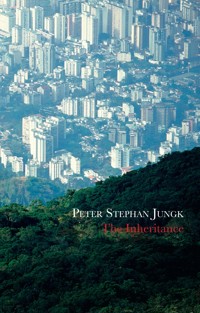
A harrowing chase from Venezuela to Miami, Peter Stephen Jungk's The Inheritance is a vivid, Kafkaesque novel set against the chaos of Hugo Chavez's doomed 1992 military coup. Daniel Loew, a poet based in London, has been told since childhood that one day he would become his wealthy uncle's only heir. When he learns of his uncle's death, in Caracas, a few weeks have since passed. A close friend of his uncle's tells Loew that he alone has been named executor of the will and blocks Loew from receiving his inheritance... Loew the poet must become Loew the man of action as he fights desperately to regain his inheritance. Peter Stephen Jungk's The Inheritance is translated from the German by Michael Hoffman in Pushkin Press. 'Yet another thrilling, vividly narrated novel from the pen of Peter Stephan Jungk - a plot worthy of film...'- Focus 'This eventful, thrilling novel proves to be the parable of a world whose heirs have all the rights, but cannot do anything with them...'- Die Zeit Peter Stephan Jungk (b. 1952) was born in Los Angeles and raised in several European cities. In 1974 he moved to Los Angeles and studied at UCLA and the American Film Institute, before releasing his first collection of short stories in 1978. Since then, he has written a further eight books, including The Snowflake Constant, Crossing the Hudson, and, most recently, The Inheritance. His fictional biography of Walt Disney's last months, The Perfect American, is being developed into an opera for performance in Madrid and London by Philip Glass.
Sie lesen das E-Book in den Legimi-Apps auf:
Seitenzahl: 334
Veröffentlichungsjahr: 2012
Das E-Book (TTS) können Sie hören im Abo „Legimi Premium” in Legimi-Apps auf:
Ähnliche















PETER STEPHAN JUNGK
THE INHERITANCE
Translated by Michael Hofmann
For Luc Bondy
We live in continual strife, but I love him extremely, almost more than myself. The same stubborn audacity, limitless emotional softness, and unpredictable lunacy—the principal difference between us being that Fate has made my uncle a millionaire, and myself the opposite, which is to say, a poet.
Heinrich Heine
Quitt charges head first into the block of granite. He gets up and charges into the rock again. Once more he gets up and charges into the rock.
The Unreasonable Are Dying Out Peter Handke
TABLE OF CONTENTS
Title Page
Dedication
Epigraph
Noise
Arrival
Esther Moreno
Albacea
Room 1813
Simone von Oelffen
First Aid
Red Meat
The Money-Belt
Meran
The Arbitrator
Afternoon Stroll
Daniel in the Lion’s Den
Before the Law
Pension Wagner
Forty Degrees in the Shade
Panama City
Eldorado
We Have Made History
The Hearing
Madurodam 191
Phylacteries
Miami
Samson’s Credit Card
The Wonder Rabbi
Also Available from Pushkin Press
About the Publisher
Copyright
THE INHERITANCE
1
NOISE
HELICOPTER DRONE SPINS HIM OUT OF DEEP DREAMS.
On the bedside table the red numbers of a digital alarm clock—it is 05:33.
He gets up, pushes the heavy nylon curtain aside. Looks down from the twelfth storey onto the city and the overcast, still dark November sky.
A squadron of jet fighters thunders above the hotel. The supersonic bang of the engines leaves the windows shaking. There is nothing extraordinary about air-force exercises in this country. He draws the curtains. Is careful not to leave a chink open, otherwise the light will come flooding in after sunrise. In the bathroom he takes out the box of Quies from his sponge bag, plucks a couple of wax balls out of the cotton wool they are embedded in, and shoves them deep into his ears.
He sleeps through until eight o’clock. Takes the pink wax balls out of his ears. Reaches for the remote control, for no particular reason, switches on the television. At the top of the hour, the speaker of a worldwide news station announces that a military coup had failed only hours before in Caracas, Venezuela. The government is once more in control of the situation.
He jumps out of bed, crosses the darkened room. Pulls back the curtain, looks down on the sun-drenched city beneath.
Three of the four domestic television stations are off air. The remaining programme screens a weather chart, with the predicted highs and lows for the day ahead.
The traveller struggles with the window lock, even though in the forty hours since his arrival here, he has been forced to realise several times already that the window cannot be opened.
He gets dressed. Yesterday, not far from the hotel, he found an espresso bar. In the company of a gang of earth-encrusted construction workers, who were digging the tunnel for a new subway line, he drank one of the best coffees in his life.
As he hands in the key, he remarks to the concierge: “Well, I guess it’s all over now?”
“No, señor, by no means …”
He thinks: the concierge is mistaken. And pushes through the revolving door on to the palm-lined street. Thick humidity settles on his body. He directs his steps to the workmen’s café. The steel shutters are down. The building site is quiet. Explosions can be heard, coming from not far away. The doors of a small car are wide open. A group of passers-by surround the parked car. From the car radio comes the sound of frantic voices.
In the bright neon of a restaurant, excitable men in short-sleeved shirts are hurling phrases back and forth. There’s a smell of fish and stale oil. The manager has a transistor pressed to his temple. The stranger, his shirt soaked with sweat, orders a pequeno. The manager doesn’t move the radio from his head.
After downing the last drop of the painfully bitter coffee, and choking down a piece of dry sponge cake, he heads out onto the street again.
He goes to the subway. The station on the Plaza Venezuela is barred with metal barriers. He asks a man who is carrying two suitcases where the nearest bus stop is; he must get to Avenida Urdaneta. Every ten steps or so, the muscular man has to stop and rest. “… Hoy?! No bus!”
In the middle of the Plaza the stranger waits—he doesn’t know what he is waiting for. A couple of helicopters circle overhead. A taxi stops, the cigarillo-smoking driver leans out of the window, asks him where he would like to go. He tells him, it’s five stops by subway. The driver names the price: “Hundredandtwentydollars.” He doesn’t see why he should pay more than ten for so short a distance, whatever the particular circumstances of the day.
The night before, he set up an appointment for this morning with the executor of the estate of his uncle, who had died at the age of ninety. He considers going on foot to the offices of the import-export company Kiba-Nova, where Julio Kirshman is waiting for him. More explosions fill the air. He decides first to call from his hotel room, and ask the executor to put off their meeting, scheduled for nine-thirty, to a later time when things might have settled down.
It had been imprudent of him to leave his Austrian passport in the safe of the Kiba-Nova company, but Kirshman, the junior manager and co-proprietor of the import-export business, had warned him that US and European passports were highly soughtafter items for the criminal class of the city, and his passport would be worth a fortune. The hotel safe offered absolutely no security for such a precious item. It was only in the company safe that he could leave it with an easy mind.
Back in his room again, the telephone rings. “Herr Loew? Dr Johannes here.” The lawyer recommended to him by the Austrian Consulate, to whom he had initially turned twenty-four hours before. “You must under no circumstances leave the hotel,” Friedrich Johannes warns him. “Did Kirshman not call you? A detachment of rebels is bombing the Presidential Palace as we speak. There are almost a hundred dead. I hope you’re carrying your passport with you at all times? Even in the hotel! I’ll call you later.”
A look out of the window. Everything seems quiet. It’s ten in the morning. He waits to see whether Kirshman will call. How will the executor, a close friend of his uncle’s, behave towards him?
Daniel Loew sits cross-legged on the soft wide bed, with his notebook open in front of him. He tries to find words to describe the atmosphere and the colours of this day, the situation on the street, the almost palpable sense of fear in the city. He manages nothing.
Kirshman doesn’t call.
Two hours later, Dr Johannes warns him again—not to leave the hotel. Daniel says he still hasn’t heard from the executor.
“That doesn’t surprise me. Remember what I told you last night?” replies the lawyer. “Have you thought some more about whether you’d like me to take on the case of Loew versus Kirshman?”
“I’d just like you to be … a little patient.”
At one o’clock, Loew calls the Kiba-Nova office. A recorded message with a woman’s voice gives the business hours of the company—Monday to Friday, eight-thirty to six-thirty pm, no break for lunch. He goes through his papers, looking for Kirshman’s home number. Julio picks up: “Well, so what do you say?! All this drama in our country, did you hear about it?”
“How could I not have heard?”
They speak German together—the mother tongue of Kirshman and Loew. Julio was born in 1948 in Caracas, Loew in 1954, in Vienna.
“You still there?” asks Kirshman.
Daniel doesn’t answer.
“Well, I guess the two of us will just have to sort it out tomorrow,” says Julio. “I expect the shooting will have stopped by then …”
2
ARRIVAL
ALEXANDER STECHER BRAVO’S SOLE RELATIVE, apart from Daniel’s father, Jacob Loew, had come to Caracas to resolve a few outstanding issues relating to the inheritance with Julio Kirshman. He had sent his flight number and expected arrival time from New York.
No one was there to meet him at Maiquetia Airport. In the arrival hall, he was mobbed by self-appointed helpers, tearing the suitcases from his grasp, offering him highly competitive exchange rates, promising cut-price deals for hotels, sightseeing visits, bordellos. He hardly succeeded in ridding himself of the helpers and supplicants, even chasing some of them away, finally subsiding in the back seat of a 1966 spaceship-sized Dodge Polara. The ride to the hotel took an hour. It went by jungle-covered hills, and through long unlit tunnels. He passed slum dwellings in all shapes and colours, assembled from corrugated iron and all kinds of other materials, gradually becoming denser as they approached the city centre. He was surprised by their seeming robustness, in view of their fragility. Petrol stations, autorepair workshops, bus depots, oil pumps all around the metropolis.
The clouds were like gleaming anthracite.
As soon as he had installed himself in room 1244, he called Kirshman at home. It was Sunday afternoon, four pm. An employee told him Señor Julio was in the office.
“Ah!” the executor sounded surprised, “you’re here already? Exhausted? Want to come by the office tomorrow?”
The flight from New York to Caracas hadn’t been particularly tiring. He didn’t see why he shouldn’t set off immediately.
“All right then—come on over. Take the subway, the B-line. Watch out for pickpockets, they’re on every corner!”
He found his way to Cuji a Romualda, not far from the Avenida Urdaneta subway stop, without any trouble; it was in the middle of a pedestrian zone full of textile shops, cheap dressmakers, carpet stores, all of them closed. High white metal gates separated the Kiba-Nova premises from the street. Loew watched three workers, their loud voices breaking the Sunday quiet, loading and unloading goods, calling out jokes and obscenities to one another.
And then he went inside.
Behind a massive table sat a short and heavy-set old man, hands buried in his trouser pockets, a cold half-cigar between his lips. He didn’t get up. He motioned him with his chin to sit down. They didn’t shake hands.
“So there you are!” Coughing, shortage of breath accompanied the words. He steered the cold cigar from one corner of his mouth to another. “Well, you’ve really dumped us in it, haven’t you!”
Daniel stood up: “That’s not going to get us very far.”
“Siddown, Professor, and calm down, it wasn’t meant like that!”
They were silent.
In his trouser pockets, Konrad Kirshman drove his long nails into the palms of his hands.
The stranger looked around. On shelves were stacks of halfopened boxes and dozens of ripped-open cartons, some full of goods from Asia, Europe, North and South America.
A door creaked behind him. A wiry individual, short military haircut, clean-shaven, mid-forties, walked into the room, as though stepping onto a variety stage to a little personal drum roll. He bounced up to the visitor, all jolly and cheerful: “At last! We meet!” They shook hands. “I’m Julio. I take it you’ve already met Papa?” Daniel had brought along his newest book of verse, and handed Julio the slim, black-bound volume. Julio cast his eye over it, and immediately stowed it away in the drawer of the enormous desk, locking it twice afterwards. In the instant that the deep drawer was open, Loew could see that it was brim-full of banknotes.
Julio turned to his father. “Dad? Will you leave us alone for a minute?”
“… You got secrets? Secrets from me, little fellow?”
“Will you leave us alone?”
The octogenarian slowly got to his feet, reeled towards the door with his hands in his pockets. As he left the room he barked instructions at the workers hanging around outside.
“Sorry about my father, I overheard what he said … I’m sure it wasn’t meant like that.”
Loew studied Julio Kirshman’s face. It looked relaxed to him, and mild, in contrast to the anger in the eyes of his father.
Julio looked at Daniel in turn. The tall visitor, with black shoulder-length hair and pale, delicate features didn’t look like the man he’d expected to meet. On his visits to Stecher, he would often ask to see pictures of the nephew. In the flesh, Loew looked more confident, more grown-up, and more serious, than in Kirshman’s impressions from photographs. The stranger’s manner had something oddly ceremonious about it, a kind of aura that didn’t permit one to play fast and loose with him, as he might have wanted to otherwise. He had used the intimate ‘Du’ form with Daniel, and was now wondering briefly whether it wouldn’t be more judicious to use the more respectful ‘Sie’ instead.
“Well, so how’s about taking a look over the warehouse?” asked the executor, having resolved to stay on ‘Du’ footing after all.
He led Loew from storey to storey, showing him vast expanses, the size of sports arenas, full of import-export goods. The first floor housed guitar strings and baseball bats from Taiwan, the second scissors, nail-files, and knives from Solingen, the third children’s violins, Hammond organs, and ping-pong balls from South Korea, the fourth table-tennis nets, dolls, fishhooks, and pocket-calculators from China, the fifth, sixth, and seventh more and more new and varied and colourful products from all five continents. On the eighth floor there was a very faint smell of cigar smoke. “Just you wait! If I catch the freak who dares to smoke up here!” swore Kirshman. “Among the fish and butterfly nets! I’ll string him up from the nearest lamppost!”
A slow goods elevator took them back down to the ground floor. “So, now that you’ve seen all that, do you still seriously think that we would want to take something away from you? We’ve got enough of our own here, we don’t need any of dear departed Alexander’s money.”
“Which is why I’m all the more surprised you’ve refused to give me what is mine,” the inheritor remarked, in the peaceable tones of someone praising a good cigar.
“Don’t worry! It’ll all be sorted out in no time. Down to the last cent. You know, you don’t have to stand on ceremony with us, just say ‘Du’, we’re practically family after all—Papa and your uncle, they were best friends for half-a-century! So now do you want to see the apartment?”
They drove in a black SUV to the Avenida Altamira, in the San Bernardino section of town, parked outside the apartment block that Stecher Bravo had moved to twenty years before. He had sold a large piece of land on the edge of the city, on which his pretty single-storey house had once stood in the middle of a mango orchard, to the municipality for a huge sum—and, for a fraction of the profit, acquired the modern apartment.
On the twelfth floor, they rang the bell next to the lift. They hadn’t called ahead, or announced they were coming. A high voice asked: “Quien es?” and Kirshman replied, “Sono yo, Julio!” But not until the executor had added that the nephew of Señor Stecher Bravo accompanied him was the door opened a crack. And then, still holding on to the doorframe, the old lady admitted the two men. Stecher had talked to her about him often, the stooped woman tried to explain to Daniel. His uncle in turn had told him not infrequently about Perpetua, his loyal housekeeper of the past thirty-five years, and described her to him regularly in his letters. He could only guess at the content of her verbal cascade.
Alexander’s black leather gloves were on a rickety wooden stool next to the fridge, along with a colour brochure on the South Tyrolean spa town of Meran.
Julio led the way into the drawing room. It was late afternoon. Kirshman hurried out onto the balcony, to check that his car was safe. Daniel followed him outside into the dusk. The air was fragrant with sweet tropical blossoms. Lights were coming on all round, in other blocks along the avenues and boulevards. A swarm of birds flew by, at a great height. Hundreds of pairs of wings were dancing synchronously.
“We can’t stay long,” said Kirshman, “otherwise I’ll be short one jeep.”
They went back into the drawing room. The furniture, among which Stecher had lived for more than five decades, ever since his emigration from Hamburg, without ever replacing any of it—skewed tables, peeling wallpaper, sun-bleached bookcases. The chaise longue, bought in summer 1940, with the last of his savings. A large, dark-brown radio from the nineteen-fifties, RCA, made in the USA. No TV. The sofas and armchairs, covered in coarse material, with patches of wear and tear. Perpetua pointed to the grey recliner, in which Alexander had spent every day in the years before his death. Even as a ninety-year-old, she said, he never stopped reading, with his legs on the red leather footstool. Loew sat down in the armchair, put his feet on the footstool. How extraordinary, he thought, to be sitting on my uncle’s chair, to be standing in the apartment that was home to him for decades. To be visiting these rooms for the first time, where for so long Alexander was hoping I would come, and I never went to visit him, all the many times he invited me. Perpetua brushed away a tear with the rough back of her thumb.
Julio sat down to the right of him. “This,” he said and cleared his throat, “is where I always used to sit, next to your dear uncle, when I visited him, I was the only one he wanted to see, the only one he allowed to come near him, those last years of his life—it was me he turned to for help, me he used to call in the middle of the night, over all sorts of nonsense, he wanted to see me, because he was frightened. Just me. He was stone deaf. Refused to put in his hearing aid. I used to have to yell to make myself understood. And where were you all that time? Did you ever come and see him? But the fact that you will inherit this apartment, that’s something you owe me, Daniel Loew, because let me tell you, he wanted to leave it to Perpetua, not to you, not at all!”
Kirshman ran on to the balcony, leaned far over the railing. Came back into the dark sitting room, head aggressively thrust forward, like a bull’s. Switched on a standard lamp. And picked up where he’d left off: “We’re left with the problem of Perpetua’s granddaughter, because our Sasha—I always used to call him Sasha, you know, Alexander—he was in love with her from when she was nine or ten years old, and now she turns round, the lying bitch, and says he promised the apartment to her, and right after his death she moved into the room behind the kitchen. Anyway, Manuela’s inherited your uncle’s little 1962 yellow Chevy, it’s in the will and all; anyway, she went around after his death, changing all the locks, and cutting the phone line, and performing voodoo ceremonies, right here in the apartment. The floors were all littered with cigar butts. Getting little Manuela out of the flat, ha!—that’s going to be your next challenge.”
Perpetua unlocked her nineteen-year-old granddaughter’s room. She had gone to the coast for a week, to Maracaibo, and wouldn’t be back. The room smelt strongly of incense. Pictures of Jesus, Mary and the angels decorated the dirty walls, the floor looked as though it had had soot on it, and blood. In a corner were a couple of battered saucepans with a few yellowish chicken bones in them.
“Didn’t I tell you? Voodoo!” Julio ran across the apartment, back out onto the balcony.
They said goodbye to Perpetua. The housekeeper gave Daniel both hands. He kissed her sunken cheeks. Her swollen palms felt like wood, a consequence of the care she had given Stecher. In the months before his death, he had developed fungal growths on his arms and legs. They had given Perpetua an eczema, which she couldn’t manage to shake off.
Julio dropped Daniel in front of the Hotel Presidente. He didn’t invite him back to his house. He didn’t introduce him to his wife or his three children. Didn’t advise him where to have dinner. By way of farewell, he said: “Bet you’re tired now!” Rolled down the window once Loew had got out. “Quite a nice place here, isn’t it? How’d you find it? I bet it costs a packet. I’ll see you in the office, tomorrow at eleven, and then we’ll get everything sorted out.”
3
ESTHER MORENO
NO-ONE IS ALLOWED TO LEAVE THE HOTEL. There is a long line of people in the lobby of the El Presidente, waiting to be admitted to the restaurant. Daniel joins the hapless ones, as they shuffle forwards. He listens to their conversations—the missed flights, the postponed trips, the delayed business meetings. A captain, whose cruise ship is at anchor in the port of La Guaira, is unable to join his crew. An eye specialist expected back at her clinic in Los Angeles tomorrow has had to cancel all operations for the next several days.
It feels unbearable to Daniel to stay in the queue of people, waiting like cattle to be fed. He goes back up to his room, and drapes himself in a couple of towels. Walks down a long passage in the basement, and finally reaches the swimming pool. The surface of the water is absolutely still. There is no one there. Deckchairs, parasols glimmer dully in the light. A smell of chlorine and heat.
He slips into the water. He has always felt in his element in a swimming pool. He swims on his front, mechanically repeating the simple, unchanging movements of arms and legs that he learnt at eight or nine under the turn-of-the-century cupola of the Diana Baths in Vienna, long since demolished. He swims with stamina from end to end, and back and forth. Overhead, twenty stories soar into the sky. The palms creak in the hotel gardens. Two parrots fly back and forth in a spacious cage, and shriek, as if their lives were in danger.
Daniel keeps seeing the picture of his uncle in front of him, smiling. Always smiling. Not just when he was being photographed did Alexander Stecher Bravo smile, he smiled in every conceivable situation. A slender man, always clean-shaven. Glasses, from early boyhood. Every day he wore a clean white shirt, and always a tie, even when it was very hot. His hair was white and kept short.
“Muy bien! Muy bien!” squawks one of the parrots.
He was just four; his uncle Alexander, fifty-two years older, was sitting at the foot of his bed, on the eighteenth floor of the New York hotel, the St Moritz, on Central Park South. His parents were going out that evening, to the world première of West Side Story on Broadway. They had left the relative whom Daniel had met for the first time a couple of hours before, never having seen him before, with the task of babysitting. For more than half-an-hour you were shaking your head, Stecher was still telling his nephew decades later, just incessantly. I thought you must be some kind of idiot. But then you suddenly stopped, and you blinked, and you saw that it was me who was sitting beside you, as always immersed in the stock market reports in the Wall Street Journal, the Washington Post, the New YorkTimes. You sat up, looked at me, and said: ‘Oh, you’re here, so there’s no point in my still shaking my head!’ And minutes later you were blissfully asleep.
Calm strokes, from end to end of the pool. The creaking of a rusty deckchair.
In a legal sense, Daniel Loew is not Alexander Stecher Bravo’s nephew, even though he has always felt and described himself as such. Daniel’s father, Jacob, had two cousins on his mother’s side, the sons of his mother’s only sister—Arnold and Alexander. Arnold, a high-school teacher, and a passionate ornithologist in his free time, died without having married or left any heirs. Alexander, another obdurate bachelor, had no children either. Stecher spoilt his second cousin from when he was born. Almost every year he travelled to Europe from Caracas, either flying or taking ship to Le Havre. For Jacob, his first cousin, Alexander had little interest. Whenever they would meet, both were lost for words.
His hair is still wet from the pool when he walks into the windowless dining room. There is barely anything left to eat on the long buffet table. Twenty neon lights give off a chill light. In the middle of the ceiling there’s a mirror ball. On gala evenings it’s set in motion, scatters lightings over the room.
From the almost empty platters he picks up a few withered lettuce leaves, an end of cheese, some greyish slices of sausage and dried-out pieces of white bread. A copper saucepan contains three bony pieces of oxtail in a black gravy. He sits all alone in the hangar-sized room. Gulps down what little is on his plate. Gets up to hunt for a piece of fruit.
A woman enters the room. Her eyes put him in mind of a deer’s caught in heavy nets. Her long white neck thrusts out in every direction. “I’m hungry!” she calls out. And once more: “I’m hungry!”
He gives her two oranges, the last there are.
“Let’s share,” she says.
He returns to his place, the round table is littered with leftover food, crumpled paper napkins, dirty cutlery, empty bottles and glasses. The unknown woman sits down at his table with him. Tears the peel off the oranges. Daniel becomes aware of a mild heat spilt by his solar plexus over his thighs and groin. A black Alice band holds the woman’s reddish, wiry curls back. She has beige fluff on her upper lip. Her suit, which is made of expensive material, is a little crooked on her, it’s too big for her, inherited, as it might be, from a heavier, broader relation. Her high heels are a little tight on her feet. He takes her to be roughly the same age as himself, late thirties. Her skin seems dry, her lips cracked, as though the climate were ice and snow. She has tiny, soft, blonde hairs on her cheeks and her prominent cheekbones. She gobbles up the orange he gives her.
Years ago she experienced a coup in Caracas, the woman says. “The rebels barricaded themselves into the fifth floor of the house I was living in at the time, and fired at the government troops until at the end of two days they were overpowered, and finished off there and then with shots to the head.” Stray bullets and pieces of shrapnel found their way into her apartment on the fourth floor, and damaged the Chagall painting she’d inherited from her grandparents called Leoncin in Winter, shattered her wardrobe, sideboard and a two hundred-year-old clock.
She picks the last few lettuce leaves off the metal dishes on the sideboard, and goes back to the table. She moved to Miami after the last government crisis, it was only a week ago that she returned to Caracas for the first time, to sell her apartment. “Ever since emigrating, I’ve kept trying to sell it, but my attempts have been unsuccessful,” not least because some distant relatives settled in it, and refused to be dislodged. Finally, she decided she had to take her family to court, and had already got in touch with a lawyer. But now the military coup would put an end to all such efforts for an unknown length of time. She stops to draw breath. “What about you? What are you doing here, who are you, what’s your name?” Her nasal voice has something whiny and plaintive about it, the torrent of her long sentences something oddly tired and bored.
The white plates reflect back the light of the neon tubes. There’s commotion in the background—a group of hotel guests are complaining because the telephone is down. They demand to be driven to the airport. The people on reception tell them the airport will be closed until further notice to all national and international flights. It was not possible to call a taxi, because naturally all taxi drivers were themselves subject to the citywide curfew.
“You don’t need to tell me if you don’t want,” says the woman. “I just thought, from the way you were sharing your oranges with me, that I must have known you before, even though I suppose we have never met before and might never see each other again. Time isn’t chronology, as people generally suppose. Time is the great everything-at-once, yesterday-today-tomorrow-always, if you know what I mean.”
In the lobby, the commotion is settling down. People are returning to their rooms.
“This is my first visit here … I arrived the day before yesterday.” He speaks very softly.
“On business?”
“My uncle lived here, for over fifty years …”
“I see! You’re visiting your uncle! …”
“He died a few months ago …”
“And before that … I mean, while he was alive … did you never visit him? Or did you have a quarrel?”
“He came to me. Almost every year.”
“I’m sorry, but … weren’t you at all curious about his life, his place?”
Daniel does not reply.
“And now? Why are you here now,” she continues, “now that he’s dead?”
He remains silent.
“I’ve got time, a lot of time, thanks to the circumstances of this peculiar day. What am I to do? Sit in my room and ponder? Think about my husband? He died of a heart attack when he was just forty-nine. We were happy together, very happy, if I may say so.”
She puts out a leg, her pointed knee touches his knee, as if by accident. Now she looks simultaneously pert, pretty and sad.
“Do I … remind you of anyone?”
He shakes his head.
“What’s your star sign?” she asks.
“Sagittarius.”
“Just like mine—December the eighth.”
“What a coincidence—mine’s the ninth.”
She smiles contentedly. “You said your uncle passed away five months ago?”
“He was over ninety …” Loew is gathering up the breadcrumbs on his plate into a little pile the size of a fingernail. “What do you do … in Miami?”
“When my husband died, he left me enough money that I can live in comfort till I’m a hundred and fifty.” Her half-embarrassed grin gives her a strangely sluttish air that Daniel hadn’t noticed before. Her uneven teeth show like a small animal’s, a marten’s, maybe. “And you? What do you do?”
“I’m a poet.”
“Can you live off that?”
“I live modestly,” he says. From time to time he garners literary awards, most recently one called the Hildesheim Rosenstock, a very long-established prize, which is awarded by German industry every ten years. “My works have appeared in several languages. Also I translate plays from English into German. Just lately I’ve started teaching seminars in creative writing at an American University in Bristol, which is work that, to me, pays remarkably well.”
“And where do you live?”
“In London.”
“… Alone?”
He gets up. “My wife is expecting our first child next year.”
She looks down at the ground. “Well, I won’t ask you any more questions.”
He grips the back of his chair with both hands.
“You haven’t told me your name—”
He tells it to her.
She nods appraisingly, as though the sound of his name separated him from other mortals. “And I’m …” she seems for a fraction of a second to falter, “I’m … Esther Moreno. Your uncle you were telling me about before …” She hesitates again: “Oh, never mind … It’s none of my business really.”
A waiter moving back and forth along the back wall of the dining room, like a wild cat in a cage, turns out the lights. He turns them on, then off again.
4
ALBACEA
ON HIS UNCLE’S NINETIETH BIRTHDAY, his nephew had decided to ignore Alexander’s wish not to have any more telephone conversations. The celebrant was not happy: “I’d rather you wrote me a letter. What? Can’t hear a word. I know it’s my birthday, thank you very much! I’m deaf! Who? Oh, it’s you! I’d much rather you wrote. Save yourself all that money you spend, finding out whether I’m still alive. Don’t worry, I’m tough. If she can’t feel my breath one morning, then Perpetua will see if my hands are still warm, because even in this monkey country they don’t put you in the ground if your hands are still warm. Anyway, if I do kick off, I’m sure you’ll be told soon enough …”
Since their last meeting, some years ago now, they had been corresponding once a month. Eight weeks after the ninetieth, the regular rhythm of letters stopped. Daniel waited another three weeks before deciding to ignore Stecher’s pleas once more. After many rings, the housekeeper picked up. “Muerte! Muerte!” she wailed, repeated “Kershenbohm! Kershenbohm!” several times, impatient that he didn’t know the name, and gave him a telephone number, where he would be told more.
“Hello?!” The voice of an old man.
“I’d like to speak to Mr Kershenbohm, please.”
“Kirshman. Konrad Kirshman.”
“Daniel Loew, I’m calling from Europe.”
“You’re the nephew of Alexander. We can speak German. I was his closest friend, for over fifty years. We cut a swathe through the whorehouses, your uncle and me, when he arrived in Caracas, back in December ’thirty-nine. That’s something you don’t forget! What can I do for you?”
“I wanted to know—”
“Whether you stand to inherit anything?!”
“No, when and how he died.”
“Stroke. A week ago. He came back from hospital, routine check-up. And then it happened. He didn’t suffer. My son Julio will tell you more. He’s not here at the moment. Your uncle nominated him as his albacea. You know what that is?”
Daniel said he didn’t.
“Executor. Call back next week, and then we’ll have more news for you. You’re the heir. But just before his death, Alexander changed his will. Now his housekeeper’s to get the apartment, did you know that?”
“I think that’s absolutely fine,” announced Loew. “He was forever going on to me about how wonderful she was, and how he worried she might leave him one day …”
“You must be out of your mind? Well then, whatever, nephew of the late lamented Alexander … call back next week.”
After the conversation was over, he was surprised never to have heard of Kirshman and son. His uncle had never mentioned the import-export business Kiba-Nova to him.
“In case anything happens to me, I’m going to leave you my current accounts plus securities held in the German Bank of Latin America in Hamburg, and in their branch in Panama City,” it said in one of his uncle’s letters two years before his death, a letter whose next sentence went on to rave about the intoxicating scent of a South American mountain grass that only flowered for four days of the year. “I’m going to leave you my current accounts plus securities held in the German Bank of Latin America in Hamburg, and in their branch in Panama City.” That was it. And the heir had been content to leave it at that. That was enough detail. He didn’t ask for any more information.
Eight days after the conversation with Konrad Kirshman, he called Caracas again.
“Ah, it’s nice to hear from you, Papa told me about your conversation … Your uncle changed his will shortly before his death—the apartment is to go to you, and not Perpetua!”
“That’s exactly the opposite of what your father told me a week ago.”
“He’s getting a bit old. The apartment is worth quite a bit. And in the late Alexander’s account here in Caracas, on the day of his death, there were four hundred thousand bolivares, which is roughly six thousand dollars. Which you’ll get as well. Any questions?” Julio’s voice echoed on the line.
There was of course every chance that his relative had used up all his savings, as a consequence of his extended travels, and the numerous visits to hospitals and doctors that had become necessary in order to cope with a recalcitrant bowel condition. “Of late, I’ve had to undergo four operations and six stays in hospital,” it said in one of Stecher Bravo’s last letters, “which is not exactly an inexpensive hobby in this country. I really couldn’t have anticipated this ridiculous inflation. Just imagine—my car insurance has gone up sevenfold from last year. Time Magazine was just one bolivar not so long ago, now it’s an incredible sixty. It’s so extreme that I’m unable to protect myself against it. Well, I suppose I do have the comfort of not being immortal.”
“Hey!? You still there?” Julio called into the telephone.
Daniel’s heart was thumping. “Do you have any information about his bank accounts? …”
“What bank accounts?”
He took a deep breath. Then resumed: “Well, in Hamburg, for one … do you have any knowledge of that?”
“Hamburg?!”
“That was the one thing that Alexander dinned into me from when I was thirteen years old, from my bar mitzvah, I was to be sure to remember that in case, God forbid, anything ever happened to him—”
“Don’t worry. We own an eight-storey building here full of merchandise, we really don’t need his money. Now if you’d been lumped with an executor who was hard up, then you wouldn’t have seen a penny! He’d have pocketed the lot, you can bet on that! I just have to pay for the funeral, and his housekeeper and one or two outstanding bills. The rest is yours!”
“It seems to me that Perpetua should be treated a little more generously,” Daniel demurred, “especially as the apartment—”
But Julio had already hung up.
On the assumption his uncle’s friends knew as little of him as he did of them, the heir sent an express letter to Caracas, to Kirshman and son, to introduce himself to them a little more:
Dear Kirshmans, how happy I am to have spoken to Julio on the telephone today! I can sense that Alexander has chosen the right man to be his albacea. As you may know, my uncle had no relatives beyond my father and me. My father in turn has no relatives except Alexander and me, the rest of his family died in the war. He is a struggling architect, barely able to feed his family. Alexander used to make fun of my father (did he do this with you, I wonder?), disliked the few buildings he did manage to put up in the course of his career. My mother comes from Vienna, almost all her relatives were also put to death in concentration camps. My wife, Valeria, is a clothes designer. We have been living in London for the last few years, in the house of an Austrian émigrée, at a very low rent, I am happy to say. Should you be at all interested, I would be only too happy to send you one or other of my books. I am very grateful to Alexander for leaving me something. I’m sure he’s done the right thing, in entrusting you with the responsibility for it. I send you both my very best wishes …




