


Erhalten Sie Zugang zu diesem und mehr als 300000 Büchern ab EUR 5,99 monatlich.
- Herausgeber: Parthian Books
- Kategorie: Sachliteratur, Reportagen, Biografien
- Sprache: Englisch
In this clear and absorbing memoir John Sam Jones writes of a life lived on the edge. It is story of journeys and realisation, of acceptance and joy. From a boyhood on the coast of Wales to a traumatic period studying at Aberystwyth, to a scholarship at Berkley in California as the AIDS epidemic began to take hold before returning to Liverpool and north Wales to work in community engagement and sexual health. A journey of becoming a writer and chronicler of his experiences with award-winning books and the desire to become a campaigner for LGBT rights in Wales. The adventure of running a guest house in Barmouth where he eventually became Mayor with his husband, a German academic, who he had married after a long partnership. Three weeks after the European Referendum they put the business on the market and moved to Germany. John is still on that journey.
Sie lesen das E-Book in den Legimi-Apps auf:
Seitenzahl: 232
Veröffentlichungsjahr: 2021
Das E-Book (TTS) können Sie hören im Abo „Legimi Premium” in Legimi-Apps auf:
Ähnliche



















Contents
About the Author
Title Page
Epigraph
1. Until one day in June
2. Rooms with Views
3. Approaching Manhood
4. Tŷ Gwyn
5. WDR4 – Thunder in my Heart
6. Electricity
7. WDR4 – Puppy Love
8. WDR4 – San Francisco
9. One Bread, One Body
10. Ferry Cross the Mersey
11. Bohemian Rhapsody
12. Taizé Chants –and Nuclear Weapons
13. WDR4 – Falling In Love Again
14. Welsh Boys Too
15. WDR4 – Penny Lane
16. Mordkommission Istanbul
17. Dros y Dŵr
18. Heimat
Parthian Fiction 1
Parthian Fiction 2
Parthian Fiction 3
Copyright
John Sam Jones realised he was gay as a teenager at the beginning of the 1970s and quickly came to understand that his life would be lived always on the edge.
His collection of short stories – Welsh Boys Too – was an Honor Book winner in the American Library Association Stonewall Book Awards. His second collection, Fishboys of Vernazza, was short-listed for the Wales Book of the Year, which was followed by the novelsWith Angels and Furies & Crawling Through Thorns.
In 2001 he became the first co-chair of the LGB Forum Cymru (which was later renamed Stonewall Cymru), set up to advise the Welsh Government on LGB issues.
After working in ministry, education and public health for more than thirty years, John Sam Jones lives in semi-retirement with his husband and two Welsh Collies in a small German village a stone’s throw from the Dutch border.
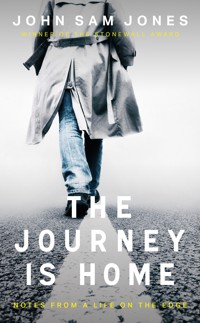
TheJourney isHome
Notes from a life on the edge
John Sam Jones
“Not everything that is faced can be changed, but nothing can be changed until it is faced.” – James Baldwin
1
Until one day in June
Before meeting Jupp I’d lived for three years in California, so the idea of living abroad didn’t deter me from falling in love with him. We discussed the possibility of moving to hisHeimat, more in the early years, but he’d always wind up those conversations with, ‘I’m comfortable here… I’ve always felt welcome here… I’m happy here with you… there’s no reason to move away – and besides, the bloated German bureaucracy stifles everyday life and the bloated middle-aged men wear pastel colours that look ridiculous… even the gay ones, who you’d think would know better.’ Thirty years, then – a decade each in Liverpool, the Wirral and Ardudwy on the northwest coast of Wales.
Until one day in June.
Over those three decades our lives, our families, our friends, our cultures and our languages – they’ve all got mixed up. His accented English is shot through with German and the odd Welsh sweet-nothing. We speak English together but I swear at him in Welsh, which always makes him laugh, taking the sting from my scorn, and sometimes I’ll echo one of his turns of phrase… we’ll often eat ‘rests’ instead of left-overs and when he’s grumpy I’ll say, ‘What’s made you soquengelisch?’ He’s learned to pronounce my family’s difficult names; to his eye some had no vowels! I’ve learned the German names of his kinfolk… and just a few phrases to get by… but languages, and grammar especially, have never been a talent I could boast about. When I’m sad, or sick, or worried, he cares for me. When he’s upset or unsettled, when he’s anxious about his work at the university or his ageing parents, or when he was grieving the death of his younger brother, I’d ‘fuss’. That’s how it’s been in our long life together… it’s what love does.
My family has lived in Barmouth, pressed between the Rhinog Mountains and Cardigan Bay, for three hundred years. In recent times tourists have discovered our beaches and castles, our hiking country and ancient standing stones, and tourism has become the life blood of the local economy. For more than a century, before the ubiquity of the family car, the railway link brought generations of west Midlands working folk to the mid-Wales coastal towns and villages for their summer holidays and family traditions of a week or a fortnight at the seaside became established. By 1962, a British Railways (Western Region) poster advertised Barmouth on station platforms throughout the United Kingdom as theQueen of the Cambrian Coast… by this time, too, many a farmstead and Victorian hovel had been vacated by locals – either moving away for work or moving into the newly built council houses (with running water, electricity and an inside toilet) – and second homes were being bought up by newly affluent city dwellers. Many an English in-comer, finding the old Welsh names too difficult, and with little regard for either the Welsh language or culture, dotted the Welsh landscape with English: ‘Sea View’ and ‘Driftwood Cottage’, ‘Ridge Crest’ and ‘Panorama Lodge’.
Of course, deep friendships were forged between the Welsh and the English, and local boys and girls ‘married out’ after holiday romances blossomed – mixing genes, sharing traditions and weaving new histories. But often, too, there were misunderstandings that festered for decades – especially when the monoglot Union flag-wavers complained that the locals only spoke Welsh to spite them and exclude them from conversation… and so developed a tendency to blame ‘the Brummies’ for all the litter on the beach, for the dog fouling along the promenade, for the drunken brawls and vomit splattered pavements – and there was often relief when they drove their cars back over Offa’s Dyke. Some in-comers have settled; few have bothered to learn the old language, but you’ll still hear Welsh spoken over the garden walls and on the quay side despite Barmouth’s reputation as ‘far-west-Birmingham’. In the cliff-top graveyard I can point out the weavers and blacksmiths, the carpenters and bakers… the great, the great-great and the great-great-great grandparents.
My husband is from a village on the edge, where the Dutch border cuts across the field behind the last row of houses’ back gardens. In the winter, the old border post, its engraved number crusted with lichen, leans awkwardly towards the Netherlands, an occasional perch for buzzards in the flat, grey landscape; in high summer the post is stranded in a golden shimmer of barley, or sometimes lost when the maize grows tall. The village was ravaged in the closing weeks of the war, first, by the Nazis seeking to defend their border, then by the allies seeking to oust the Nazis, and finally – meticulously – by the Dutch from the village on the other side who’d suffered unspeakable hardship during the occupation; they looted, believing that whatever they could carry was their due. The family homes that Jupp’s parents built – one fairly modest house at the beginning of the sixties, the other, larger and ‘architect designed’ in 1972 (reward from the lucrative contracts with the British military his father had won to service the heating, plumbing and electrics on their nearby bases) give no clue to Ernst-Peter and Jutta’s peasant origins. For centuries, Jupp’s people had worked the local baron’s land, cut wood from the forest that surrounded them to burn in their stoves, poached the baron’s hares – no one dared take one of his deer or wild boar – and scratched out a life that bent their backs and made them old before they were forty.
Our early life together, with a double income and no kids, had been more than comfortable. Even after my semi-retirement on health grounds at the age of fifty-five we were never going to starve: our house was paid-off, our home perhaps a bit too much like something out of one of those glossy magazines. Our B&B guests loved the hardwood floors and Persian carpets, the hand-made furniture from Welsh oak, the clutch of cherished original paintings, the fresh flowers on the dining table… and good wines and a choice of malt whiskies to lubricate those discussions late into the night after an evening meal or a weekend dinner party. We flew regularly around Europe, sometimes just to see friends for a night or two, or to lie for a week on a sunny beach to break the northern winter gloom; perhaps to explore a city we’d read about in one of the Saturday travel supplements… or even to catch an opera at La Fenice or the Liceu that, for some reason, hadn’t been staged in Britain. And there were books, many hundreds of them.
Of course, David Cameron hadn’t conceived that his Tory party, with its Euro-sceptics, would win a majority in the 2015 General Election. Confounding the opinion polls, they won a working majority and one of his first tasks as the new Prime Minister was to set in motion the legislation required to hold the promised referendum on membership of the European Union despite there being no considered vision for a Britain outside the EU.
It was clear to us that our lives benefitted from EU membership. We found it difficult to discuss pros and cons because Britain’s relationship with its EU partners obviously entailed details that we couldn’t begin to guess at, but which, nevertheless, touched our lives each day – safety standards of all kinds, workplace protections, food hygiene regulations, scientific and medical research, pharmaceuticals, rights to fly over one another’s territories… and what about all the EU nationals who worked in the NHS and all the multi-nationals who employed tens of thousands, if not hundreds of thousands in the UK? And didn’t we benefit directly from the peace in Northern Ireland? The IRA had often bombed targets on our side of the Irish Sea. Might a hard EU border jeopardise the Good Friday Agreement?
As an international couple who flew frequently around Europe we took ‘free movement of people’ for granted and couldn’t begin to understand what negative impact may ensue if Britain withdrew from such an agreement. Were we destined to stand in different queues at immigration and passport control? Would my husband’s residency after thirty years in the UK be questioned or made more difficult?
The Brexit debate gathered momentum. On both sides, half-truths and untruths were trotted out… both sides, unfortunately, managing to mislead and denigrate democracy. Husbands and wives disagreed; brothers and sisters argued; neighbours fell out; youngsters rolled their eyes at older people’s insularity. Immigration, due to the free movement of people within the EU, became a primary issue for many; the relatively insignificant things that are different between people becoming divisive. Many people lost sight of the reality that we share so much more in common than any particular characteristic that separates us. The ‘immigrants’ were taking our jobs… ‘they’ were claiming our generous social security benefits and sending the money home… ‘they’ were changing the nature of our society so that you were as likely to hear Polish spoken in the street as you were English; for many in Wales the irony screamed – for hadn’t England and the English sought to stamp out the Welsh language and ignore our culture for generations? It was as if the Brexit debate had granted license in some to express a latent xenophobia and a long-suppressed racism. The call to ‘take back the control’ supposedly relinquished to ‘that unelected lot in Brussels’ became a battle cry.
“I don’t like the atmosphere this is creating,” I said over supper one day.
“I’m starting to feel uncomfortable here,” Jupp said. “I’m one of these ‘immigrants’ they’re talking about.”
In the days before the referendum, standing in the supermarket check-out line – in my trolley some cheeses from France and Holland, wine and oranges from Spain, olive oil from Italy, olives from Greece, blueberries from Poland, and chocolate from Belgium – a conversation was struck up.
“I’m voting to leave,” said the woman in front of me to the man before her.
“Me too,” he said. “Too many bloody immigrants here now.”
The woman at the cash register – Branca according to her name badge – shifted in her seat. Sensing her discomfort I said,
“My husband is German so let’s just think twice before we talk aboutbloody immigrants.”
Branca smiled at me;
“I’m from Portugal,” she said, “but my kids were born here and they speak Welsh.”
“Oh, we don’t mean you, Branca,” the woman who’d started it all said.
“So who do you mean?” I asked.
“Well… the blacks and the Poles,” she said with a swagger.
“My cardiologist is a Welsh-speaking black woman from Cardiff… and without her I’d probably be dead,” I said, “…and do you not know that hundreds of Polish pilots helped the RAF win the Battle of Britain?”
Into the awkward silence my words had beckoned, the man at the front, now packing his shopping, said, “Well, we need to take back control from those unelected bureaucrats in Brussels.”
“Sounds to me as if you’ve never voted in the European parliament elections,” I said.
Fuck you, you queer bastard,he mouthed as he lifted his bags from the counter.
We were drinking gin and tonic before supper and I couldn’t decide whether I wanted to tell Jupp about the incident in the supermarket. Being called queer was something I’d learnt to shrug off after almost half a century of such name-calling, but I was unsettled by how free those two in the queue had felt to be so openly nasty. As an isolated incident it perhaps wouldn’t have taken on such significance, but every day inThe Guardian there were reports of a rise in xenophobic, racist and homophobic incidents in the weeks since the Brexiteers had begun to whip up emotions about difference – and putting the ‘great’ back into Britain. I hadn’t thought through my response, so I took a different tack.
“I don’t want to lose my European citizenship,” I said. “How long would I have to live in Germany before I could become a citizen?”
“Because we’re married I think it would be fairly automatic after three or four years,” he said. “But it won’t come to that…”
“But what if…?”
He made a long sigh, puffing out his cheeks and said, “If Britain leaves the EU you probably wouldn’t be able to have joint citizenship; Germany only grants that to other EU members… and to the Turks because of that wholeGastarbeiter history.”
“And I suppose I’d have to be able to speak German?”
“I wouldn’t worry too much about that. In three or four years, if you lived there, even with your ‘gift’ for languages and that ‘block’ you have about grammar… you’d just pick it up,” he said. “But how would you feel about giving up your British citizenship?”
It was my turn to sigh.
“You know that I’ve always thought of myself as Welsh first… so my British passport, my current ‘legal status’ as a British citizen, doesn’t really say anything about who I understand myself to be… so I’d still be just as Welsh if all the legal paperwork was German.”
“I really can’t see it coming to that,” he said, with a reassuring smile.
He took a long slug of his gin. “And I’m not sure I’d choose to settle in Germany… God, all those men in lime green three-quarter shorts and baby-blue tee shirts.” He shook his head. “And all that formality… when I worked at the university all of the Germans involved in the triple diploma used toSieone another – it was alwaysHerr Doktor this andFrau that – as if we didn’t have first names. Maybe we could go to Portugal or Spain?”
Our house went up for sale less than a week after the Brexiteers celebrated their victory in the referendum… so deep was our disappointment, so bitter our sense of having been betrayed. We calculated, with retirement lump-sums, pensions, savings and what we hoped to get for the house, that we could live – all be it frugally – for thirty years… and if either of us were to reach ninety we’d have to find a rich young man to care for us! The estate agent valued the house at a lower price than we’d hoped, despite our protestations about the location, the views over the estuary to Cadair Idris, the renovations and the lucrative B&B turn-over… but we pitched it higher believing we could always drop the price if we needed to.
We flew to Majorca for a few days – to scout – and realized that Palma and the communities close-by were too expensive; in-comers, mostly Germans, had forced the prices up, just like the English had forced up the prices in the scenic parts of rural Wales. Back home, a couple from the West Midlands came to view the house; they seemed interested.
After a long weekend with friends in Barcelona we concluded that the smell from the drains in the summer heat made for an unappealing prospect but that Vilanova, close to Sitges was very doable.
We agreed to sell to ‘cash buyers’ from Stratford who wanted a holiday home. They offered the asking price without a quibble and we swallowed our reservations about selling to English second-homers. Our next-door neighbour for four years, Barmouth’sPlaid Cymru County Councillor, had sold to an English family the year before and somehow this made it alright for us to do the same… but, on reflection, that’s such a feeble justification. Neither of us liked the couple buying our house, but it would be a quick sale and we took it as a sign that fate was with us and that turning our backs on Brexit Britain was the right thing to do.
A short trip to the eastern Algarve, to Tavira, where we’d been on holiday many years before, didn’t live up to our memories and we realised that the influx of tourists in the summer months would make for uncomfortable living.
The exchange and completion dates on our house were set – it had taken nine months from that day in June. And during these months Jupp’s younger brother died.
Gerd’s death was very sudden. The headaches had lasted only a few days, but they were severe and wouldn’t abate. His family doctor sent him for a scan to the local hospital. There was something there… so he was transferred to the university hospital in Aachen where they diagnosed a tumour on the brainstem. He didn’t regain consciousness from the surgery and died slowly after all the machines were switched off. Only fifty-three when he died, Gerd was the son who’d stayed at home. He’d married, had children, taken over the family business, been bankrupted and been divorced… but he had been a thoughtful and caring son to his ageing parents, and they, in turn, had come to depend on him, especially once his father’s Alzheimer’s had become apparent.
From the church on the village square it’s almost a kilometre to the cemetery; the coffin, pushed on a gurney behind the thurible-swinging, prayer-reciting priest through the mid-September afternoon, arrived at the graveside before the square had emptied. We, the family and the priest, waited some fifteen minutes at the open grave, and still the funeral procession thronged into the well-ordered memorial garden, which surely kept at least one flower shop in business all year round. I peered into the hole, and wished that the whole process of German Roman Catholic funeral rites could be speeded up. Jupp’s mother looked both frail and haggard clinging to her demented husband’s arm and Gerd’s twenty-something children, pale and red-eyed, seemed bewildered. I wondered if all the roses on the graves around us had been on ‘special offer’, whether they wereFairtrade, and whether visiting the dead of this village had become a morbid fixation… there was not a single pot of withered flowers – so synonymous with my experience of Welsh graveyards – anywhere to be seen, and everything seemed colour-coded; if September was red roses, what might October demand? I thought, too, about the hundred or so young men, mainly deserters, who were executed in this tranquil field, in the shadow of the Nazis’ retreat; there’s no plaque to remember them by… no rose of any colour.
Jupp had been in Germany almost a fortnight by the day of the funeral; I flew in just for two nights. Before the wake, the previous evening, we looked at the house his parents had built as their first family home. It had been rented out for more than forty years; the Korsten’s pension was in property. Because of Ernst-Peter’s Alzheimer’s, all the properties had been neglected for some years and each had grown old with them without much care and attention. When the tenancy on the house had ended, some months before, there was much that needed to be done to make it habitable again… but nothing had been initiated. The place was filthy, dark and very ‘sixties’ – with no redeeming retro features… but we could make it into a comfortable home – and in the field behind the house there were alpacas and kangaroos, which were fun to watch. The morning before the funeral we opened a bank account, arranged telephone and Wi-Fi connections and registered with a health insurance company. Our move, just less than a year after Britain voted to leave the EU, was surprisingly smooth.
We fell in love in English… we’d forged our relationship over decades in English… so, in the same way that we found it difficult to speak Welsh together after Jupp had spent some weeks at Nant Gwrtheyrn when we first moved to Wales from Liverpool, shifting to German in our home life proved impossible in the first months. My grasp of the language was rudimentary and so many of the conversations we were having left no room for misunderstandings. His father’s deterioration, and the care we might offer at any particular time, were daily discussions, as was his mother’s inability to cope in some situations.
In the first weeks we were taken aback by the bureaucracy that invades every-day life. We arrived in Effeld in the early hours of a Saturday morning, so first thing on Monday we had to register our residence at the town hall.
“You’re in a Civil Partnership?” The woman who asks the question is friendly enough. I’m amazed that she can type on her keyboard with such long and elaborately decorated fingernails.
“We’re married,” Jupp says.
“That’s not possible,” she responds. “It’s not legal in this country.”
“We were married in Wales,” Jupp insists, and I wonder if we’ll have to go through the whole rigmarole of how we were ‘converted’ after the law changed in 2013, which made provision for those who’d been Civilly Partnered to gain marriage status… and why, therefore, our marriage certificate is back dated to the date of our original Civil Partnership in April 2006.
“Well, your marriage isn’t recognised in this country so there’s no box on the form that I can fill in,” she insists.
I had enough German to understand what she was saying, but not enough to express my outrage at a civil servant in an EU country telling us that our marriage wasn’t recognised by the state.
“I’ll put a tick in the Civil Partnership box,” she offers.
“But then your official registration of us as a couple will be false, because we are married,” Jupp asserts.
“It doesn’t matter,” she says dismissively. “It means the same thing.”
“No, it’s not the same thing,” Jupp persists. “We are married.”
“There’s no box for that,” she says.
“I have our marriage certificate―.”
“There’s no box,” she interrupts, impatience in her tone and dismissing the certificate with a swipe of her hand. “There’s no box.”
Jupp folds our marriage certificate with some deliberation and coaxes it back into the envelope.
“I’m very surprised that you are content to have an inaccurate registration record―.”
“I can’t help it that there’s no box,” she interrupts again. “We need to fill in the remaining details; I don’t have all day.”
So we were falsely registered.
We had some interesting dialogue, too, with our health insurance company, especially in the first months, which took a lot of time and energy. They couldn’t understand how we were funding our life in Germany as neither of us had any regular income in the country, my pension being paid in Britain, taxed in Britain and paid into a British bank account. Their regimented forms asked no questions about capital – we had transferred much of the proceeds from the sale of our house to our bank account in Germany and we certainly had enough to fund our life for many years to come – but they just wanted details of our monthly income; with a dash through the monthly income box they had no clear idea how much to charge us for our healthcare package and after many letters and telephone calls they put us on the minimum payments.
There were cultural differences too that called for some patience and re-adjustment; the dog tax, and why we had to pay more than double for a second dog, vexed us for some weeks. We get nothing for it, of course – no dog wardens, no poo-bags or bins to put them into – indeed, I quickly came to believe that because people have to pay so much, every year, to own a dog, their resentment is expressed by letting their dogs foul at will. Dog shit’s a problem. But there’s a paradox too; most of the lawns and flower borders have been stripped out of Effeld’s front plots and replaced with ugly ‘stone gardens’… chippings, pebbles, rocks of every colour and shape, laid in checkerboard patterns, yin and yang symbols, concentric circles – all to save time. And what do so many Germans do with the time they’ve saved? They spend Saturday morning on their knees scraping the moss and the weeds from between the paving stones so that the pavement in front of their house is… a pristine plinth for a dog shit sculpture.
There are times of the day when you can use noisy machinery and there are times when you can’t. Hanging out laundry on a Sunday is frowned upon – but then, few homes have a clothes line; the electric tumble dryer made clothes lines obsolete a long time ago. Shops are closed on a Saturday afternoon – and all day Sunday. The work day begins at 7:30 – so we might get an appointment at the dentist or the doctor before eight in the morning and we often receive phone calls between half seven and eight… just as we are waking up to the morning news.
I’ve become fascinated by the travel advisories on the radio in the mornings. We live in North Rhine-Westphalia, the most populated German state – almost 18 million people in an area a bit bigger than Wales – with a number of large cities and industrial conurbations. The travel news usually begins, in a very understated manner, with a statement about the state-wide traffic jams: ‘This morning there are… 473 kilometres of traffic jams; 396 kilometres of traffic jams; 242 kilometres… 197 kilometres… 583 kilometres… which is then followed, for two or three minutes… or longer, by the list of particular snarl-ups and the estimated time it will take to negotiate the gridlock. Of course, there are no speed limits on GermanAutobahnen – drive as fast as you like… but just don’t get caught up in the congestion if you want to arrive at your destination in reasonable time! And drive as close as you can to the vehicle in front of you… and don’t use your indicators, especially when coming off a roundabout. On minor roads there are no central cat’s eyes, though the edge of the carriageway is marked. As someone who learned to drive on narrow Welsh roads edged with irregular dry stone walls, I always positioned my car towards the central edge of the lane; without cat’s eyes, that’s impossible here and I find driving at night disorientating.




