


Erhalten Sie Zugang zu diesem und mehr als 300000 Büchern ab EUR 5,99 monatlich.
- Herausgeber: The History Press
- Kategorie: Sachliteratur, Reportagen, Biografien
- Sprache: Englisch
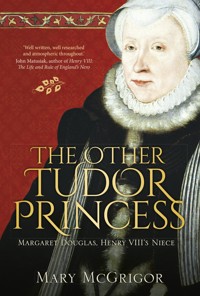
The Other Tudor Princess brings to life the story of Margaret Douglas, a shadowy and mysterious character in Tudor history – but who now takes centre stage in this tale of the bitter struggle for power during the reign of Henry VIII. Margaret is Henry's beloved niece, but she defies the king by indulging in two scandalous affairs and is imprisoned in the Tower of London on three occasions 'not for matters of treason, but for love'. Yet, when Henry turns against his second wife Anne Boleyn and declares his daughters, Mary and Elizabeth, bastards, it is Margaret he appoints as his heir to the throne. The arrangement of the marriage of Margaret's son, Lord Darnley, to his cousin, Mary, Queen of Scots unites their claim to the throne and infuriates Queen Elizabeth. Yet this match brings tragedy, as Margaret's son is brutally murdered. As Margaret reaches old age, her place in the dynasty is still not safe, and she dies in mysterious circumstances – was Margaret poisoned on the orders of Queen Elizabeth? Mary McGrigor tells this compelling and exciting part of Tudor history for the first time with all the passion and thrill of a novel, but this is no fiction – the untold story runs through the course of history, and Margaret secured the throne for her Stuart ancestors for years to come.
Sie lesen das E-Book in den Legimi-Apps auf:
Seitenzahl: 343
Veröffentlichungsjahr: 2015
Das E-Book (TTS) können Sie hören im Abo „Legimi Premium” in Legimi-Apps auf:
Ähnliche


















To my darling daughters, Lorna and Kirsty.
ACKNOWLEDGEMENTS
My deepest thanks to all those who have helped me with the book, including: Roy Summers for his beautiful photographs of the Scottish castles known to Lady Margaret in her day; Michael and Charlotte Wemyss; my godson, Adrian Gibbs, Deputy CEO at the Bridgeman Art Library Ltd; Elizabeth L. Taylor, Rights and Images Officer at the National Portrait Gallery; Ryan Clee, Photography and Licensing Assistant at the National Galleries of Scotland and Manju Nair, Finance Assistant of the gallery. Thanks also to Agata Rutkowska, Picture Library Assistant, Royal Collection Trust; Brigadier Henry Wilson; Sophie Bradshaw, General History Publisher, and Juanita Zoë Hall, Managing Editor, at The History Press. I am indepted to Archie Mackenzie for his valuable advice.
CONTENTS
Title
Dedication
Acknowledgements
Genealogy
Prologue: The Beginning
1 The Refugee
2 ‘My Niece Marget’
3 Wild as a Tantallon Hawk
4 The Battle for the King
5 Hunted as an Outlaw
6 The Cousins
7 ‘The King’s Wicked Intention’
8 So Much Destroyed by Death
9 ‘The Faithfullest Lover that Ever was Born’
10 Bargaining Counters of the King
11 The Second Lady in the Land
12 The Flemish Wife
13 The Rose with Many Thorns
14 The Fall from Grace
15 The Lennox Earldom Restored
16 The Price Paid for a Bride
17 ‘Every Day like Sunday’
18 Sadness Unforeseen
19 ‘Let a Trumpet be Blown on the Marches’
20 The Hostages
21 ‘My Derrest Douchter’
22 The Falconer Messengers
23 The Golden Boy
24 ‘A Most Victorious and Triumphant Princesse’
25 A Conspirator’s Smile
26 Disputed Inheritance
27 From England’s Court to France
28 ‘The Great Revenge that Ye might have of your Enemies’
29 Of Soothsayers and Spies
30 Arrest
31 ‘A Very Wise and Discreet Matron’
32 In Poverty and Splendour
33 A Diarist at Court
34 The Bitter Bite of Triumph
35 The Price Paid for a Marriage
36 ‘For Want of Good Counsel’
37 Broken Down with Grief
38 The Father’s Story
39 ‘My Ears have been so Astounded’
40 Memorial for a Son
41 Regent of Scotland
42 The Sniper’s Bullet
43 The Lennox Jewel
44 A Boy Unrestrained
45 Connivance of Mothers
46 Once More Imprisoned for Love
47 My Jewel Arbella
48 Poison?
49 Disputed Inheritance
Bibliography
Plates
Copyright
GENEALOGY
PROLOGUE
THE BEGINNING
Late one evening in August 1515, darkness was falling on Linlithgow Palace, shading the sides of the courtyard from the naked eye. Within it a small group was gathered, a party of well-armed men and several women. One of the women was obviously with child, evident despite the cloak she wore. The party moved quietly from the courtyard barely visible in the deepening dusk. Outside horses were waiting, one with a pillion behind the saddle onto which the pregnant woman was lifted. A tall young man stood beside her as she was helped from the ground, then quickly mounted himself to lead the party from the castle. The sentries stood aside to let him pass, well briefed on what was about to happen.
Riding hard, they had covered a scant 3 miles towards the City of Edinburgh when the Lord Chamberlain, Lord Home, met them with a party Queen Margaret later described as ‘hardy, well-striking fellows’. The men were to escort her to her husband, the Earl of Angus’ castle of Tantallon, who was waiting for her on the east coast of Scotland, near what was then the ferry port of North Berwick.
Twenty-six-year-old Margaret, the daughter of Henry VII of England, had married nineteen-year-old Angus just a year after her first husband, King James IV, had died in the dreadful scrimmage of Flodden. The marriage in itself had been one reason why the leaders of the Scottish nobility had summoned John, Duke of Albany, to come to Scotland as regent.
John was the son of Alexander, brother of James III, who had become domiciled in France after his exile from Scotland. When Alexander was killed in an accident, his French wife Anne de la Tour d’Auvergne raised their only child alone. More French than Scottish, John was nonetheless heir to the throne of Scotland after James IV’s two sons.
Albany, as he was always entitled, landed at Dumbarton in May 1515. He was at first on good terms with Margaret but held the opinion that her husband was an incompetent youth. Having immured herself with the two little princes of her previous marriage, Margaret surrendered them to the care of Albany before publicly announcing that she was ‘taking her chamber’ and entering confinement until the birth of her child by Angus was born.
The subterfuge had been clever. Playing on the fact that she was known to have suffered greatly during the births of her previous children, she had managed to convince her attendants that she was now so ill that Angus had to be summoned to her side. It was he who had asked Lord Home to help them, knowing as he did that Albany, having accused Home of being responsible for the death of James IV at Flodden, was now an avowed enemy.
Escorted by Lord Home and his men, Margaret and Angus reached Tantallon, the red sandstone fortress of the Red Douglasses, dominating the cliffs above the North Sea opposite the Bass Rock.
There they waited with ever increasing impatience for a rider bringing a summons from King Henry VIII, Margaret’s brother, to come to his court in England.
The summons never came. Home, seizing the chance to raid some of Albany’s property in the Queen’s name, was declared an outlaw. He too fled to Tantallon, joining Margaret and Angus until they all fled for his own land on 23 September. There, in Coldstream Nunnery, Home’s mother came to Margaret’s aid for she was now genuinely exhausted and seriously ill.
At last King Henry’s invitation arrived. A message was sent to Lord Dacre who at once sent an escort to take Margaret across the Border to his family home of Morpeth Castle. Fires were lit and comforts of every kind prepared by members of the household who were told of her imminent arrival. The distance to Morpeth was some 50 miles. Margaret was carried in a litter, which although most carefully handled, jolted her arthritic hip. Towards the end of their journey, when they were only 14 miles from the town of Rothbury, Margaret felt a familiar pain. Her bearers, hearing her cry out that she could go no farther, turned to their mounted escort for advice. It was plain they could not reach Morpeth, another 20 miles on from Rothbury. In such a state of emergency there was only one alternative: Lord Dacre owned the outlying fortress of Harbottle, a medieval castle strategically built on a mound overlooking the River Coquet. A stark stone building, used primarily as a prison, it had long needed repair. The roof leaked above walls running with damp. It was certainly no place for any woman, particularly one of royal blood, to give birth.
But it was at least shelter from the wind and the driving rain. In the present situation there was no alternative other than to carry Margaret, now shrieking in agony, into the cold bare tower.
1
THE REFUGEE
‘Women! A plague to mankind and the royal ones the worst of the lot.’ Thomas, Lord Dacre, Warden of the Marches on the English side and terror of all those in his thrall, was driven to desperation by the screaming within his castle walls. Queen Margaret was bad enough. The agony of her long labour combined with the pain in her hip had kept her yelling for three days or more; now, on top of Margaret’s screams, the furious bawling of a hungry infant was driving him out of his mind.
‘For God’s sake find a wet-nurse,’ he roared at his terrified servants, one of whom had the temerity to remind him that the commotion upstairs in the draughty, mouse-infested castle with its leaking roof, was partly his own fault. On the fugitive queen’s arrival, he had forbidden her ladies to come within its walls.
Lord Dacre was at his wits’ end, faced with an unexpected emergency such as he had never met before. War had just broken out again between England and Scotland and now, in early October, taking advantage of the ensuing confusion, rustlers were lifting cattle, fat on summer grass. He had just come in from a hard day’s riding trying to track them down, and had been looking forward to an evening’s rest before the fire in his castle of Morpeth when a man on a horse, streaked with sweat from hard galloping, had appeared with the news that the Queen of Scots had arrived at the Border fort of Harbottle. Obviously in labour, she seemed on the point of death.
She had remained thus for forty-eight hours until, to the intense relief of every man and woman within the castle, she had given birth to an infant, which (with hair the colour of the Red Douglasses) had proved to be a girl. Named after her mother, she had been baptised the very next day, the usual custom at a time when infant mortality was so great as to be expected rather than merely feared. Her godfather was Cardinal Wolsey, for whom one of the men in the castle had stood proxy.
Two days later, on 10 October, Queen Margaret, still extremely weak, had dictated a letter to the Duke of Albany saying that ‘she had been forced, for fear and danger of her life, to depart from Scotland to the realm of England’.1
Lord Dacre was afterwards accused of failing to report the birth of his niece to Henry VIII; had he done so, the messenger would surely have been either killed or captured as soon as the portcullis was raised. Raiding parties from just over the border in Scotland were seen by the sentries from the battlements, and rumours had already reached the castle that the Regent Albany, who had seized all the queen’s clothes and jewellery as well as anything worth lifting from her husband’s castle of Tantallon, was advancing on Harbottle with 40,000 men.
As sentries reported that men on horseback could be seen coming from the north, mounting to the battlements, Lord Dacre recognised to his great relief, the standard of the queen’s husband, the Earl of Angus, riding at the head of them. Beside him was Lord Home, together with several other so-called ‘rebel lords’.
Despite having little on which to feed them after living in a virtual state of siege, Lord Dacre allowed them to enter the fortress. Once within its walls, they signed a covenant binding them to free Margaret’s two little sons, James V and his brother Alexander Duke of Ross, from the regent, whose power would then be given to the queen. The signatures of her husband Angus, Earl of Douglas; the Earl of Arran, head of the house of Hamilton; and Lord Hume, are all appended to this document, called a bond, which is dated 15 October 1515. 2
Despite the discomfort of Harbottle, where the wind found its way through every crack in the uncovered walls, Queen Margaret was too ill to travel until the beginning of November. Then with a strong escort, she moved on to the Castle of Morpeth, Lord Dacre’s family home.
No greater contrast could be found than that between the castles of Harbottle, comfortless in every aspect, and Morpeth. The latter fortress, although built a mere hundred years later than the former, on a hill overlooking the River Wansbeck, was nonetheless as luxurious as any building of its day. A curtain wall contained the gatehouse beyond which, in the centre of the courtyard, rose the Great Tower. The rooms, so unlike the damp cold chambers of Harbottle, were hung with tapestries and warmed with fires. In the dining hall on the first floor, the table gleamed with silverware, which sparkled in the light thrown by candles from sconces on the walls.
Revelling in the newfound comfort, Margaret was further overjoyed by presents of lengths of velvet and cloth of gold sent by her brother Henry with an envoy, Sir Christopher Gargrave. Delighted, she summoned seamstresses: Margaret was inordinately fond of new gowns. The gifts included baby clothes, thoughtfully provided by Queen Catherine of Aragon, now pregnant with what she and the king hoped most fervently would prove to be a son.
The winter went by at Morpeth as Queen Margaret gradually regained her strength. In February news came from England that Queen Catherine had borne a daughter, so far her one surviving child.
Slowly the days lengthened, and the roads, in a spell of dry weather, became open to travel; at the beginning of April a cavalcade from England arrived. This time it included William Blackwall, a gentleman of the bedchamber and the clerk of the King’s Spicery. He came with silver vessels for use on her journey. There were drinking cups and probably some pots and a kettle that could be heated on a wood or charcoal fire. In addition, Queen Catherine sent her equerry, Sir Thomas Parr, with her own favourite white pony, carrying a specially padded pillion on which her sister-in-law, riding behind a groom, would have almost as much comfort as had she been carried in a litter. Her baby Margaret, together with her nurse, travelled in the latter way.
When preparations for the journey were complete, Angus, whom King Henry had specifically included in his sister’s invitation to his court, suddenly disappeared to Scotland. He claimed that he had gone to make his peace with the regent, but most people knew, some tittering behind their hands, that he was returning to his mistress, Janet Stewart, daughter of the Laird of Traquair.
Notes
1 Strickland, A., Lives of the Queens of Scotland and English Princesses, Vol.II, p.125
2Ibid. p.127
2
‘MY NIECE MARGET’
Smothering her anger at his desertion (she is claimed never to have forgiven him), Queen Margaret made her journey to London in slow stages. Mortified as she was by her husband’s behaviour, it was at least some consolation that at each and all of her resting places she found herself royally received. She is known to have stopped at Stony Stratford in North Buckinghamshire, the ancient market town where the ford of the Roman road of Watling Street crosses the Great Ouse. From there, on 27 April, she wrote to her brother, sending the letter with a fast rider to warn him of her approach.
Two days later she reached Enfield, almost within sight of London. Here she stayed in Enfield Palace, the palatial Middlesex home of Sir William Lovell, speaker of the House of Commons and Lord Treasurer of the Household under Cardinal Wolsey’s administration. Her brother King Henry, himself a frequent visitor, drawn by the luxury of the house as well as the political importance of Lovell, had requested him to receive his sister for a visit of four days.
Queen Margaret reached Tottenham Cross on 3 May, which by the Gregorian calendar would have been 12 May, on a reputedly beautiful morning. This was then the station to which all processions from the north gates in London and elsewhere in the British Isles converged. There, as was pre-arranged, she waited until a gorgeous concord appeared to the sound of trumpets and a great clattering of horses’ hooves.
Preceded only by his standard bearer, the flag with the arms of England unfurling in the breeze against the sky, Henry headed the procession. Distinguished by his height and his spectacular apparel (a velvet cloak falling from his shoulders above the intricately worked steel breastplate he always wore for safety, even on such occasions), Henry was still the handsome prince on that day of his reunion with his eldest sister. He would, however, have been stouter than when she had last seen him, as chroniclers on his succession so rapturously described.
Having embraced her, his first words to Margaret were reputedly, ‘Where is my Lord Angus?’ Whereupon, told of his sudden, unexplained disappearance, he slapped his thigh exclaiming, ‘Done like a Scot!’
Instantly, his anger vanished as his sister held out the baby, by now six months old. Raising her high in his arms, he called her his little Marget, his special name for her which he would always continue to use.
Queen Margaret rode into the city of London on a pillion behind Sir Thomas Parr, while behind, in the following procession, came her baby in the horse litter, held securely by her nurse. It was six in the evening before they reached Baynard’s Castle, made ready for her by her brother. This was the mansion built on land reclaimed from the Thames, on a site just east of what is now Blackfriar’s Station. It was reconstructed as a royal palace by Henry and Margaret’s grandfather, Henry VII, and had been given to Catherine of Aragon. However, despite the splendour of her surroundings, Margaret was eager to leave. Within days she was boarding a barge from the wharf that took her, with her attendants and tiny daughter, down the Thames to Greenwich Palace.
Rebuilt by her father, Henry VII, using no less than 600,000 bricks fired by his own brickmakers in Greenwich, this was now not only the largest but also the most modern palace in Europe. It was here only three months earlier on 18 February that the little Princess Mary, Margaret’s niece and her brother’s only surviving child, had been born.
His sister Margaret and her baby daughter were warmly welcomed by Queen Catherine, now grown stout and matronly but still possessing a soft voice with a charming Spanish inflection. Catherine cried out with delight at sight of little Margaret, now crowned with the small tight curls of glorious red-gold hair so indicative of her Tudor descent. Catherine’s own daughter, Mary, five months younger than Margaret, was small in comparison and as dark as she was fair. The two infants shared a nursery, thus beginning, although neither was aware of it at the time, a friendship which would last throughout their lives.
In the palace was yet another infant, this time a little boy named Henry, born only on 11 March. He was the son of Henry’s youngest and favourite sister, the Princess Mary; despite his fondness for Mary, he had used her as a political pawn, sending her to France to marry Louis XII, a man thirty-four years older than herself. Before leaving, however, she had made her brother promise that in the event of her husband’s death (which in fact happened after only eighty-two days, supposedly after consummating his marriage with his young bride) she might marry whom she chose. Subsequently, while still in France, she had secretly married Charles Brandon, Duke of Suffolk with whom, although he was again much older than herself, she had long been in love. Henry, who in fact had sent Suffolk to fetch her, although officially protesting, had forgiven them; a formal marriage ceremony had taken place in Greenwich Palace only a few days before her elder sister, Margaret, the former Queen of Scotland, had arrived.
Princess Mary, renowned both for her sweet face and equally lovable temper – she had nursed the French king devotedly during their brief marriage – greatly loved children. She is known to have been particularly fond of her little niece Margaret, to whom later she was to be almost a second mother. Now, although the Duchess of Suffolk, she was still known as the French Queen.
Evidence of the presence of King Henry’s wife and his two sisters being together at Greenwich in May 1516 is found in the illustration on the front page of one of his music books, kept in the Harleian Collection. Below the arms of England are shown the badges of Henry VIII and Catherine of Aragon, the rose and the pomegranate, while opposite them are the daisy, called a marguerite, and a marigold denoting Mary.
Henry himself played with the children, tossing his little ‘Marget’ in the air. Otherwise he was occupied in arranging entertainments including a tournament in his sister Margaret’s honour, in which he played a leading part, knocking over a burly knight called Sir William Kingston together with his horse!
Queen Margaret, meanwhile, although estranged from him, was still corresponding with her husband, Angus, urging him to do everything possible to help the English army to cause destruction on the Scottish Borders. Lord Dacre asked Cardinal Wolsey to get what information he could from her to aid him in a scheme to overthrow the regent, while she is claimed to have given secret information about Scotland to the English Council. Albany himself, having threatened to visit Henry’s court, thought better of it. However, he did return the large collection of Margaret’s jewels and court dresses (which had been taken from Tantallon Castle) with the Master of Graystock College, whom Dacre allowed to cross the Border.
During the season of Advent, Queen Margaret was moved to Scotland Yard – so called because kings of Scotland had once stayed there – within a court below Charing Cross. Later she went to Windsor Castle, before returning to Baynard’s Castle, now stacked with presents from Henry (jewels, plate, tapestry and horses) which had to be taken back to Scotland.
Soon afterwards her brother urged her return. It was possible he was exasperated by her constant demands for money, yet Henry VIII was also famously devoid of scruples in using members of his family for political reasons. Word had reached England that the Regent Albany, due to his wife’s illness, was about to return to France; Henry realised an opportunity to use Margaret as a diplomat – the widow of national hero James IV and revered for his sake if not her own – to effect a unity with England and end the ruination of continued war.
In the spring of 1517 she began her journey northwards, stopping for a time in York. Then she moved on to stay once again with Lord Dacre at Morpeth. Here she waited until news came that the Duke of Albany, hastening to return to France where his wife was dying, had sailed on 7 June. Travelling farther north to the border, the queen was met at Berwick by her husband, the Earl of Angus. The earl escorted her and their little daughter, now eighteen months old, to the palace of Holyrood below Edinburgh Castle, no longer in hostile hands.
3
WILD AS A TANTALLON HAWK
Reaching Edinburgh, Queen Margaret immediately demanded to see her son James V, now a boy of nearly six. But he was rushed off to Craigmillar Castle at once on the excuse that Margaret or one of her attendants might be carrying the dreaded plague, or sweating sickness, which was rampant in England. At Craigmillar she was eventually allowed to see him but only for short amounts of time.
Writing to her brother King Henry, she reported her son to be in good health while taking the opportunity to suggest to him that he should seize the goods of merchants trading by ship with England to reimburse the income of her estates, which she claimed she had not received. It would seem that in her first infatuation she had made over the life-interest of the royal estates in Ettrick – part of her settlement at the time of her marriage to King James – to Angus.
Now, however, they were at loggerheads: their furious quarrels culminating in abduction when Angus seized their small daughter who was then only 3 years old. He took her to his castle at Tantallon, that massive rose-coloured fortress towering above the estuary of the Firth of Forth, defiant of bombardment, a landmark from afar against the sky.
For little Margaret, Tantallon was a haven. In his castle, mainly used as a barracks, her father found Douglas ladies to look after her. Amongst them were the wives of his brother George and his cousin Archibald. These chatelaines took care of the little girl, robbed of the mother who, unbeknown to her at the time, she would never see again.
It was from these Douglas women, proud as they were of their heritage, that she heard the story of the castle and the men who had made it one of the greatest bastions of the time.
William, the 1st Earl of Douglas, had been the founder in about 1350 almost 120 years before. He had chosen an almost impenetrable site above cliffs that only a madman would attempt to climb. Making certain of its safety, he had surrounded his castle with a massive curtain wall, 50ft high. Towers at each end of the rectangle were pierced with arrow slits through which archers could train their arrows on approaching foes from all directions. Finally, for extra security, a deep ditch had been dug to surround the walls.
William had taken no chances, carefully weighing up every eventuality that might possibly occur. Foremost, and most obvious, had been that of prolonged siege. Before even finding an architect, he had summoned a water diviner who, with a forked twig of hazel, had pinpointed the existence of a spring. Once water had been located and reached by drilling through the rock, a well in the courtyard had been surrounded by a stone wall.
It was Earl William who, having ambushed and killed his godfather, also named William Douglas, had tyrannised the Borders. The 3rd Earl, known for his ferocity as Archibald the Grim, had been followed by the heroic ‘Black Douglas’, famously hacked to pieces by the Saracens while carrying the heart of Bruce on a crusade to Spain.
Then had come the dreadful story of the ‘Black Dinner’. The young King James II, only 10 years old at the time, had been greatly excited when the 14-year-old William Douglas and his brother David – to him men of the world – had come to dine at Edinburgh Castle. The little king, sitting at the head of the table spanning the length of the great hall, had grown sleepy, dazed by the effects of red wine, the heat from the fire and the clamour of voices. He had not understood the significance when, just as the dinner was ending, the head of a black bull, a portent of death, was carried in by the Chancellor, Sir William Crichton, and laid before the Douglas boys. He had cried out terrified as the brothers were hauled from the room. His pleas to spare them had gone unheeded: after being given a mock trial, they were executed on the castle hill.
Their great uncle, avaricious for their land and titles, had been their killer. Known as James the Gross for his bloated size, he was the 7th Earl. Meanwhile James II, dubbed ‘Fiery Face’ for a birthmark that matched his temper, had nursed his hatred of the Douglasses, whose power threatened his own. James the Gross had been succeeded by his son William on whom the king had wrought revenge. Summoned to Stirling under a safe conduct, William had been warmly received. A banquet had followed at which both had heavily imbibed. Then, drawing him into an alcove, James had asked William to forgo his alliance with the Earls of Crawford and Ross. William, haughty in his cups, had refused and James, uncontrolled in fury, had stabbed him above his steel corselet with a dagger in the throat. He had not actually killed him, but the Master of Gray, one of his bodyguards, had the murder of a nephew to avenge and had finished him off with an axe.
The murdered William’s brother James, the 9th Earl, had been exiled and forfeited after King James’ cannons had destroyed his castle’s walls. The last of the Black Douglass earls, his lands and titles had then devolved upon George Douglas, 4th Earl of Angus.
It was George’s son, Archibald, born in Tantallon in 1449, who was notorious for hanging James III’s favourites over the Bridge of Lauder and was famously known thereafter as ‘Bell the Cat’.
Archibald’s son George (Margaret’s grandfather) had been killed in the melee at the Battle of Flodden, thus Margaret’s father, the red-haired Archibald, had become the 6th Earl as a very young man.
During the daytime, the castle echoed with noise as the men of the garrison and the servants tramped up and down the stone stairs. The family, as was then normal, dined in the great hall at about midday, but when Angus himself was absent, his little daughter, with her aunts in attendance, most likely kept to their apartments in the first floor of the main tower.
At night the sounds abated as the occupants settled down to sleep, the family in the upstairs bedrooms, the rest of the household on the floor by the fire of the great hall and elsewhere throughout the house. Upstairs, in the quiet of the night, the little girl, lying in one of the few beds, snuggled under a down filled quilt and listened to the cries of sea birds above waves crashing on the rocks.
But sometimes there were other sounds frightening and dreadful to hear. Deep in the foundations of the castle, buried into the cliff, prisoners in the dungeon groaned and screamed for help. Some of them, so the legend runs, were cast adrift on rafts and left to the mercy of the tides, which took a few to the Bass, where sometimes monks dragged them on to land. Others were simply carried to their deaths at sea.
Standing in the courtyard today it is hard to imagine what life in Tantallon Castle must have been like nearly 500 years ago for a little girl of 3.
It would be nice to think of her playing, like so many other children then and now, on the sands near the rock formation called St Baldred’s Boat. However, it is more probable that because of the threat of abduction by the Regent Albany’s and her mother’s men, she was kept within the safety of the castle; she was probably allowed, in fine weather, to play in the courtyard or under surveillance close by.
In the spring and summer months, there was always the diversion of the colony of gannets, diving into the sea like arrows from their sanctuary on the Bass Rock. Later, when the chicks were hatched, men climbed down the rock, held by ropes from above, to collect the fledglings, which when smoked were a much-prized delicacy to eat.
Before John Duke of Albany left Scotland in May 1517, a commission of regency had been given to a confederacy consisting of the Archbishops of Glasgow and St Andrews; the earls of Angus, Huntly, Arran and Argyll; and Seigneur Antoine d’Arces, de la Bastie, Albany’s Scottish Agent. There were French garrisons in the castles of Dunbar, Dumbarton and Inchgarvie, the island in the Forth from where the Queen’s Ferry was guarded. Hardly had Albany set sail before de la Bastie was murdered in a fracas with the Homes. Arran, a son of James III’s sister Mary who had married Lord Hamilton, a first cousin of the regent, then took over as head of the council, supported by Argyll, Huntly and James Beaton, Archbishop of Glasgow. However, this alliance was overruled by Angus, who, seeing the chance to win control, joined forces with the Homes and other dissident Borderers. With them, apparently to the joy of the populace, he drove the Hamiltons out of Edinburgh.
So complete was his predominance that in March 1520 Arran openly declared that ‘he sould nocht cum within the toun quhill my Lord Chancelor [Beaton] maid ane finall concord betuix him and the nychbouris thairof.’1
This was the incident known thereafter as ‘Cleanse the Causeway’. So fraught was the situation that in the following October it was decreed that the Provost of Edinburgh must be neither a Douglas nor a Hamilton and should always be accompanied by four stout halberdiers. Further to this it was suggested that to heal the rift between the families Angus’ little daughter Margaret should marry Arran’s son.
Margaret, probably not even told of this marriage brokerage, was still at Tantallon when on 19 November 1521 Albany returned from France. Coming ashore in the Gareloch, he rode to Linlithgow where – to what must have been to his and most people’s great surprise – he was warmly welcomed by Queen Margaret. Brazenly, they rode together at the head of a procession from Linlithgow to Edinburgh, displaying rather more than friendship, or so King Henry was told.
Soon tongues were wagging as they began an adulterous affair; this was all the more scandalous because while the queen was known to be estranged from her husband, Albany was still married to his ailing wife, his first cousin Anne de la Tour d’Auvergne, daughter of his mother’s brother, who had given her his sister’s name.
Queen Margaret’s brother, King Henry, to whom while she was at his court in England she had constantly misnamed the regent, now sent an envoy to harangue her on the evils of divorce. His hypocrisy is almost unbelievable seen in the light of what was to come.
But Henry, as ever, had a motive, in this case his wish to keep Angus in Scotland as the leader of the so-called ‘English Party’, which he had by then become. Henry’s wife, Catherine of Aragon, more sympathetic to her sister-in-law, sent priest Father Bonaventura to advise Queen Margaret to endure her misfortunes as best she could.
Lord Dacre, however, knew her only too well; in writing to Cardinal Wolsey, he called Margaret’s conduct scandalous. In a further letter to Queen Margaret herself, he accused her of over familiararity with Sir James Hamilton, an illegitimate son of Arran and a notorious womaniser with whom she had ridden alone, at dead of night, from Edinburgh to her palace of Linlithgow.
Albany arrived bringing not only a force of soldiers but also a large sum of money from France, sent by King Francis I, to induce the Scottish Council to support the Aulde Alliance. Angus, who had been in Edinburgh, opposed his wife’s determination to divorce him and took refuge in Tantallon or, it is said, in a church somewhere on the Borders.
From whichever place he was in hiding, he sent his uncle Gavin Douglas, the Bishop of Dunkeld, to King Henry to suggest his willingness to head an alliance against Queen Margaret and the regent if support from England could be gained. Gavin Douglas, ageing and in poor health, took ten days to reach the English Court. Henry, however, wasted no time in writing to the Scottish Council to denounce the divorce of his sister and, with the threat of renewed war, demand the dismissal of Albany.
Gavin Douglas died shortly afterwards, his illness aggravated by the stress of travelling in mid-winter. Angus, bereft of his support, supposedly tried to become reconciled to his wife; on the pretext that she was showing him forgiveness, she prevailed upon Albany to send him to France as an ambassador, on the promise that his now known treachery would be forgiven.
The story that Angus and his brother George, unconscious after consuming drugged wine, were put aboard a ship for France bears no credence. However, both are known to have been in or around the French Court for a period of about three years. Angus apparently took his daughter Margaret with him. Nothing is heard of her in Scotland during that time. That she went to France seems likely in view of the fact that she was later known to speak fluent French. She was certainly not with her mother, as is proved by a letter the queen wrote from Edinburgh on 25 November 1524 in which, amongst many complaints against her husband, she adds that ‘he would not suffer our own daughter to remain with us for our comfort’.2
It was shortly after this that the Regent Albany, having quarrelled with Queen Margaret again, finally returned to France. On news of his departure, Angus came back to Scotland with his daughter. This is proved by a letter from Catherine of Aragon to her mother begging that she would not disparage ‘the fair daughter she had by my Lord Anguish [sic]’, whose legitimacy was under question.3 Queen Margaret responded, not to Catherine but to Margaret’s godfather Wolsey, writing that because she had made a legal marriage to Angus, their daughter could not be called illegitimate. The edict was endorsed by Archbishop Beaton in a clause of Queen Margaret’s divorce, finally granted in 1528.
By its terms Angus retained the custody of his daughter, by then 13 years old. Despite having contributed nothing towards the costs of her upbringing, her mother nonetheless promised her as a bride to the Earl of Moray as a means of achieving his allegiance.
On his return from France in 1524, Angus is known to have stayed first at his castle of Boncle, from where he could escape to England across the border. From there he wrote to Queen Margaret, still technically his wife, to try to make reconciliation. This was a mere formality: word had reached him that, despite her looks being ruined by smallpox, Queen Margaret had found a new lover in the form of Harry Stewart, a brother of Lord Avondale and one of her own guard. On his letter being returned unopened, as he had expected, he took the action he had already planned.
Margaret now lived largely at Tantallon Castle. Her father, chief of the Red Douglasses, saw to it that she was treated as a princess, which, as the daughter of the Queen of Scotland, she was entitled to be. Her biographer Agnes Strickland, on the evidence of a letter from Lord Eure to Cardinal Wolsey, states that it was at this time that Margaret, aware of her own importance, developed the ‘imperious manner’ she afterwards maintained throughout her life.
Certainly, from all that is known of her, it appears that Margaret inherited her father’s stature rather than her mother’s, who was small and, in later years, stout. Slim and with striking colouring, she was taller than most women of her time.
Haughty she may have been but Margaret was certainly a young Amazon, riding a horse with perfect balance, with a falcon carried on her wrist. The bird was one of her famous Tantallon hawks, bred specifically for hunting and famed as far as England for their power and beauty in flight. Margaret rode with her father, an expert horsemen and falconer himself. Together they raced over the gently rising ground above Tantallon, Margaret loving the thrill of it, her red hair streaming in the wind. Before them, hounds, noses to the turf, flushed birds from reeds and long grass. At sight of one rising for the sky, she would free her hawk from its jesses to let it fly in pursuit. She was, so her father claimed, as good a rider and falconer, if not better, than most of his men.
Notes
1 Donaldson.G., The Edinburgh History of Scotland, Vol.III, p.35
2Ibid., Vol.I, p.167
3Ibid., Vol.II, p.251
4
THE BATTLE FOR THE KING
Yet Angus was seldom at Tantallon. King Henry had brought him back from France expressly to head the English Party in Scotland against the French.
On 1 August 1524, King James, now 12 years old, was present at the council that brought Albany’s governorship officially to an end. On 5 August James signed a letter to his ‘derrest and richt inteirlye weilbelufit uncle, the king of Inglande’, telling him that he had ended the control of Albany ‘under quhais governans oure realme and lieges hes bene richt evill demanyt’.1 Following this, in September, arrangements were made for a Scottish embassy to go to England to conclude a treaty of peace. King Henry actually paid for 200 soldiers as a bodyguard for the young king of Scotland, and having done so, he sent two English residents to Edinburgh.
Despite this ostentatious display of concern for the security of his nephew, Henry met strong opposition in Scotland. Forming up against him were James Beaton, Archbishop of St Andrews and five of his bishops. They, along with Archibald Campbell, 4th Earl of Argyll; Argyll’s cousin George Gordon, de facto Earl of Moray; and John Stuart, 3rd Earl of Lennnox, the grandson of James II, remained loyal to the Aulde Alliance with France. Along with the Bishop of Aberdeen, Beaton was actually imprisoned for his intransigence but his nephew David, arriving from France, brought new hope to the Francophiles with a message of support from King Francis.




