


0,49 €
Niedrigster Preis in 30 Tagen: 1,99 €
Niedrigster Preis in 30 Tagen: 1,99 €
Mehr erfahren.
- Herausgeber: Booksell-Verlag
- Kategorie: Gesellschafts- und Liebesromane
- Sprache: Englisch
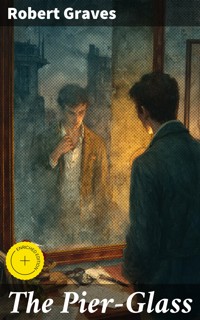
In "The Pier-Glass," Robert Graves crafts a haunting narrative that intertwines themes of love, betrayal, and self-identity through the lens of a young man's contemplative journey. Set against a richly textured backdrop, Graves employs a lyrical and often introspective style, blending poetic elements with philosophical musings. The novel's exploration of the human psyche reflects the tumultuous post-World War I era, capturing both the disillusionment and search for meaning that defined the time. The pervasive motif of reflection in the titular pier-glass serves as a metaphor for the protagonist's quest to reconcile his inner conflicts with the external world. Robert Graves, a prominent poet and novelist, drew from his own experiences as a soldier and a scholar to inform his narrative. His diverse influences, ranging from the classic literary canon to his fascination with mythology and psychoanalysis, converge in this work, allowing him to probe deeply into the complexities of consciousness and relationships. Graves's poignant exploration of the self can be seen as a response to the fragmentation of identity experienced by many in the aftermath of the war, as well as a reflection of his evolving literary voice. I highly recommend "The Pier-Glass" to readers interested in a thought-provoking examination of post-war identity and existential musings. Graves's masterful prose and the novel's rich symbolism invite readers to engage with profound questions, making it a significant contribution to early 20th-century literature. This book is essential for anyone seeking to understand the intricacies of human emotion and the search for clarity in a chaotic world. In this enriched edition, we have carefully created added value for your reading experience: - A succinct Introduction situates the work's timeless appeal and themes. - The Synopsis outlines the central plot, highlighting key developments without spoiling critical twists. - A detailed Historical Context immerses you in the era's events and influences that shaped the writing. - An Author Biography reveals milestones in the author's life, illuminating the personal insights behind the text. - A thorough Analysis dissects symbols, motifs, and character arcs to unearth underlying meanings. - Reflection questions prompt you to engage personally with the work's messages, connecting them to modern life. - Hand‐picked Memorable Quotes shine a spotlight on moments of literary brilliance. - Interactive footnotes clarify unusual references, historical allusions, and archaic phrases for an effortless, more informed read.
Das E-Book können Sie in Legimi-Apps oder einer beliebigen App lesen, die das folgende Format unterstützen:
Veröffentlichungsjahr: 2019
Ähnliche














The Pier-Glass
Table of Contents
Introduction
A tall mirror in a quiet room returns our faces slightly altered, and in that subtle distortion Robert Graves frames The Pier-Glass, a meditation on how perception refracts experience and how the self, scrutinized by memory and desire, multiplies into overlapping, uneasy reflections.
The Pier-Glass endures as a classic because it crystallizes a transitional moment in twentieth-century poetry: the turn from battlefield testimony toward a more inward, psychologically precise lyric. Graves achieves a rare balance of lucidity and depth, marrying disciplined craft to a restless probing of consciousness. The book’s magnetism lies in its restraint; it neither declaims nor mystifies, yet leaves reverberations that outlast its pages. Its influence is felt less as a school than as a standard of integrity in postwar verse, demonstrating how a poet can reinvent his voice without abandoning clarity, musical line, or the ethical pressure of remembered experience.
Written by Robert Graves, a British poet and novelist who served in the First World War, The Pier-Glass belongs to the early 1920s, when writers across Europe reassessed art’s relation to truth after catastrophe. The book is a compact collection of poems whose central preoccupation is the act of looking: at oneself, at others, and at the past. Without relying on narrative continuity, Graves arranges discrete lyrics that test what the mirror of art can disclose. His purpose is not confession for its own sake, but the measured pursuit of accuracy in feeling, where emotion is clarified by form and reflection becomes a method of knowledge.
The title’s object, a tall mirror mounted between windows, supplies the book’s governing image: a surface that both reflects and reframes. In these poems, rooms and corridors, panes and shadows, become instruments for inquiry. The mirror never lies; it simply insists on angle, context, and light, reminding us that truth is relational. Graves uses this domestic emblem to explore the riddles of memory and self-regard, suggesting that every recollection contains a faint refraction, and every self-portrait depends on where one stands. The result is a poised, often haunted poise between intimacy and distance, immediacy and formality.
Stylistically, Graves advances a modern sensibility without abandoning metrical tact or plain-spoken diction. Where many contemporaries pursued radical fragmentation, he refines continuity, trusting cadence and image to carry complexity. Classical poise and conversational immediacy cohabit his lines, allowing a reader to move through layered ideas without obstruction. The craft is visible but unostentatious: stanza shapes hold emotion steady; images recur like motifs in chamber music; tonal control supplies the book’s quiet authority. This commitment to exactness helped secure Graves’s reputation as a poet of conscience and measure, and gives The Pier-Glass its durable clarity within a crowded modernist landscape.
The war’s pressure is everywhere and almost nowhere: rather than recounting battles, the poems register aftermath—the vigilant listening, the mistrust of simple narratives, the sudden shifts of time that accompany a return to ordinary life. The mirror’s distortions become a way to name psychological displacement, while its steadiness suggests an ethical demand for accuracy. Graves’s poise does not erase pain; it organizes it, setting private turbulence within frames the reader can hold. In this, the collection marks a passage from witness to appraisal, from shock to shaped remembrance, showing how art can both honor and test the claims of memory.
Alongside memory’s severe accounting runs another current: the scrutiny of love. The pier-glass reflects tenderness and suspicion in equal measure, revealing how desire magnifies features we wish to praise and the flaws we wish to deny. Graves examines intimacy as a theater of perception, where misreadings and recognitions alternate like shifts of light. His love lyrics neither idealize nor scorn; they measure. That steadiness—felt as an insistence on proportion—lets readers see how affection, pride, shame, and fidelity contend inside the same gaze, and how the self discovers its shape against another’s patiently observed presence.
The book’s imagery is luminous yet spare. Windows, stairwells, half-lit thresholds, and polished glass recur not as decorations but as instruments of thought. Even when the subject is interior, the poems lean on palpable objects, giving the argument of feeling a tactile ground. This concrete clarity allows Graves to stage ambiguities without blurring them. The reader meets sharp edges and exact surfaces, then notices how small variations in angle produce new meanings. In this way, The Pier-Glass offers a disciplined education in attention: it teaches patience, the ethics of looking closely, and the humility to accept what careful looking reveals.
In Graves’s body of work, The Pier-Glass stands as a hinge between the candid immediacy of his wartime lyrics and the later, more openly mythic or visionary modes he would explore. Its reticence is purposeful, guarding against rhetoric while preserving heat. The collection shows a poet consolidating strengths—clarity of image, tonal control, skeptical intelligence—into a stable instrument he will continue to sound in later decades. Readers who trace his career often return to this book to witness that consolidation, noting how its methods anticipate subsequent developments while retaining the crispness and moral pressure of the earlier, battlefield-adjacent poems.
Within literary history, the book answers a question central to the postwar era: how can poetry be truthful without succumbing to either raw confession or esoteric opacity. Graves’s solution—a lucid lyric that keeps difficulty inside the measured line—offered an alternative path within modernism. Its influence registers as example rather than doctrine, encouraging poets to wed formal discipline to analytic candor. The Pier-Glass shows that innovation need not announce itself loudly; it can reside in precision, proportion, and the hard work of saying exactly what one means, no more and no less, while respecting the mind’s layered, refractive processes.
Contemporary readers will find in these poems a remarkably current concern with mediation. The pier-glass anticipates today’s questions about curated images and self-presentation, urging a stricter standard of self-scrutiny than mere performance supplies. Graves’s insistence on angle, context, and light translates cleanly into a world of screens and snapshots. Yet the book’s appeal is not topical. It lies in the pleasure of line, the tact of understatement, and the relief of meeting a voice that believes clarity is not the enemy of complexity. The poems invite rereading because they reward attention without exhausting mystery.
To approach The Pier-Glass is to encounter themes of memory, love, identity, and truth, worked through with exacting craft and a conscience sharpened by history. Its mirror is not a gimmick but a discipline: a way to keep looking until likeness and knowledge meet. That discipline, carried by supple music and spare, luminous imagery, explains the collection’s lasting appeal. It remains relevant because it models a responsible imagination—one that tests itself, measures its claims, and honors the world by seeing it truly. Readers leave it steadier and more exacting, newly attuned to the delicate labor by which insight is earned.




