


29,99 €
Mehr erfahren.
- Herausgeber: tredition
- Kategorie: Sachliteratur, Reportagen, Biografien
- Sprache: Englisch
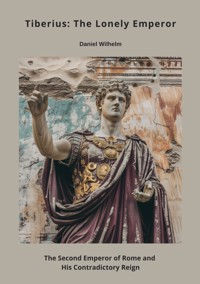
Tiberius, Rome’s second emperor, remains one of the most enigmatic figures of antiquity. From his celebrated military career to his reluctant ascension as Augustus' adopted heir, Tiberius ruled the mightiest empire of his time while grappling with personal struggles, familial intrigues, and the heavy burden of expectation. In Tiberius: The Lonely Emperor, Daniel Wilhelm takes readers on a captivating journey through the life of this contradictory ruler. With keen insight, he explores Tiberius' reclusive leadership style, his complex relationships with Rome’s elite, and his ambivalent approach to power. Wilhelm unveils how Tiberius brought stability and order to the empire while sowing seeds of distrust and conflict through isolation and suspicion. This book reveals the intricate personality of a man whose reign left a lasting mark on the Roman Empire and whose legacy continues to intrigue historians to this day. A must-read for anyone eager to uncover the hidden depths of Roman history.
Das E-Book können Sie in Legimi-Apps oder einer beliebigen App lesen, die das folgende Format unterstützen:
Seitenzahl: 218
Veröffentlichungsjahr: 2024
Ähnliche



















Daniel Wilhelm
Tiberius: The Lonely Emperor
The Second Emperor of Rome and His Contradictory Reign
Origins and Early Life
Family Background and Ancestry
The intricate tapestry of Tiberius Caesar's ancestry not only laid the foundation for his imperial career but also deeply influenced his personality and political maneuvers. His family background is an illuminating reflection of Rome's transition from Republic to Empire, where aristocratic lineages interwove with burgeoning political structures. Understanding the ancestry of Tiberius requires delving into both branches of his family tree: the Claudii and the Livii Drusi.
The Claudian Lineage
The paternal line of Tiberius stems from the distinguished Claudii, one of Rome's most ancient and patrician families. The Claudii traced their roots back to Attius Clausus, who supposedly migrated from Sabine territory into Rome around 504 BCE. This migration story symbolizes the blend of Roman and earlier Italic peoples, underscoring the political acumen and adaptability of the Claudian lineage, which managed to uphold esteem and influence across the tumultuous Republic. Their reputation was, however, marred by a notorious pride and obstinance that were as celebrated as they were criticized in Roman society. Tacitus notes, "The Claudii, whether in times of peace or war, always acted with obstinacy towards the people" (Tacitus, Annals).
Notable among Tiberius’s ancestors was his father, Tiberius Claudius Nero, a staunch ally of Julius Caesar and later aligned with Mark Antony before ultimately reconciling with Augustus. Such strategic alliances and shifts characterized the political savvy of the Claudian house—an inheritance of calculated pragmatism that Tiberius would demonstrate throughout his reign.
The Influence of Livia Drusilla and the Julii
On his maternal side, Tiberius was linked to the Livii Drusi, a plebeian family that had climbed the social hierarchy through military and political prowess. His mother, Livia Drusilla, was a formidable matron whose second marriage to Augustus seamlessly integrated Tiberius into the very nucleus of imperial power. Livia’s influence was profound; she embodied the virtues of Roman matrona while adeptly navigating the male-dominated political sphere. The historian Suetonius remarks upon her influence, stressing that "Livia's opinion held great weight in state matters" (Suetonius, Lives of the Caesars).
The marriage of Livia to Augustus connected Tiberius, albeit indirectly, to the Julian family, which claimed descent from Iulus, the son of Aeneas, linking their legacy mythically to Venus herself. This Roman mythology lent an additional layer of prestige and divine favor to Tiberius's lineage. Although Tiberius himself was not a direct Julian, his position as Augustus's stepson placed him within the Julio-Claudian dynasty’s inner circle, a vital aspect of his eventual ascension to power.
Political Implications of Ancestry
The interplay between Tiberius’s Claudian bloodline and the Julian connections shaped his strategic outlook and personal disposition. While his Claudian heritage furnished him with a robust sense of aristocratic pride and traditional values, the Julian association immersed him in the environments of innovation and imperial ambition. This dual legacy equipped Tiberius with a pragmatic approach to statecraft, balancing conservative values with the necessities of an evolving imperial system.
The ramifications of such a distinguished lineage were manifold. Tiberius’s public image and legitimacy as emperor rested partly on these ancestral narratives. They offered him both a shield and a critique, as his reign was often compared to the esteemed forebears whose virtues he was expected to emulate. The weight of expectation perhaps contributed to Tiberius’s reserved character, a ruler consistently aware of his powerful heritage and its implications.
In summation, as we trace the threads of Tiberius's ancestry, it becomes clear that his family background was more than mere lineage; it was an intricate framework through which we can interpret the decisions, demeanor, and the enduring enigma of his reign. This dual heritage cast a long shadow over his governance, influencing both his personal psyche and his strategies as one of Rome’s most complex and enigmatic emperors.
Birth and Early Environment
Navigating the early life of Tiberius Caesar requires a nuanced understanding of the social, political, and familial currents of late Republican Rome. Born on November 16, 42 BCE, Tiberius came into a world on the cusp of monumental transformation. His birth occurred in the aftermath of Julius Caesar’s assassination and during the years of fierce civil wars that plagued the Roman Republic. Thus, the early environment in which Tiberius found himself was one defined by both uncertainty and opportunity.
Tiberius was born to Tiberius Claudius Nero and Livia Drusilla, members of the Roman patrician class with a recorded ancestry that integrated into the Republic’s elite. The Claudian family boasted a prominent lineage, claiming descent from the Sabine king, Attius Clausus, who, according to legend, migrated to Rome in the early days of the city’s foundation. This distinguished ancestry granted young Tiberius a substantial pedigree, entrenching him within the upper echelons of society from the onset of his life. Such a background provided not only prestige but also positioned him as a potential political player in Rome’s intricate power dynamics.
His birthplace, believed to be in the politically significant city of Rome itself or in the nearby territory of Praeneste, was amidst the turmoil of the Liberators' civil wars following the demise of Julius Caesar. The political climate of Rome during this era was complex, with allegiances shifting frequently, and ambitious leaders vying for power after Caesar’s fall. These tumultuous times imprinted upon the young Tiberius a caution and reserve that would later characterize his reign as emperor.
The sociopolitical backdrop during Tiberius’s formative years played a critical role in shaping his outlook and demeanor. His father, Tiberius Claudius Nero, initially sided with the republicans, notably Brutus and Cassius, against the forces of Mark Antony and Octavian (later Augustus). This alignment necessitated a temporary exile for the family to parts of Sicily and later Greece, regions sympathetic to the anti-Caesarian faction. These experiences of displacement and the associated undercurrent of danger arguably instilled in Tiberius an enduring sense of wariness and strategic prudence.
Tiberius’s mother, Livia Drusilla, also exerted a profound influence on his early environment. Livia, known for her intelligence, political astuteness, and ambitious nature, soon found herself as a central figure in a significant political realignment. By 38 BCE, she divorced Tiberius’s father and married Octavian, a move that would dramatically alter young Tiberius's trajectory. His mother’s marriage to the future Augustus cemented Tiberius’s position within the newly rising Julio-Claudian dynasty. However, this also represented the complexities of Roman familial politics, as it required young Tiberius to navigate a new family structure and the potent influence of his stepfather.
The early environment of Tiberius was, therefore, a tapestry of elite Roman culture, political turbulence, and strategic familial alliances. It imbued in him an acumen for political survival that would later guide his own strategies as emperor. The displacement and realignments of his family's fortunes exposed him to the fragile nature of power, fostering an understanding of the necessity for adaptability in Rome’s ever-changing political landscape. Thus, by the time Tiberius emerged from childhood, he already encompassed the qualities of both a seasoned participant and a cautious observer of Rome's imperial stage—a dichotomy that would remain at the core of his enigmatic personality throughout his life.
These early influences rendered Tiberius a complex figure, balancing the legacies of both the Claudian and Julian lineages. As Robert Graves aptly described in I, Claudius, “There was never any duality more Roman than that of the aristocratic Claudian and the populist Julian bloods warring in the veins of a man who never wished to be Emperor.” These formative years planted the seeds of the restrained, often reluctant leader that history would later recognize—a man whose life began in a time of reconstruction from chaos, and whose whose reign would later navigate the complex legacy of Augustus's Rome.
Childhood and Education
Understanding the early life and education of Tiberius Caesar is crucial to comprehending the development of a man who would become one of Rome's most complex and enigmatic emperors. Born into a world of political strife and family intricacies, Tiberius's formative years laid a foundation that would influence his leadership style and personal demeanor.
From the outset, Tiberius was enveloped in the illustrious, yet tumultuous, ambiance of the Julio-Claudian dynasty. His education was not merely a private affair but a matter of state importance. It was meticulously designed to prepare him for future roles in the Roman political and military hierarchy. His instruction encompassed areas considered critical for any Roman aristocrat destined for leadership, including oratory, rhetoric, law, and military strategy.
Under the watchful eyes of his mother, Livia Drusilla, herself an influential figure with a sharp intellect, Tiberius was instilled with values and disciplines characteristic of his lineage. Livia ensured that her son was surrounded by the finest tutors and mentors of the time, recognizing the necessity of intellectual rigor paired with strategic acumen. Among these mentors, respected scholars and statesmen alike contributed to his breadth of knowledge, embedding in him the skills requisite for sagacity in public life.
In his youth, Tiberius was subjected to the rigors of rhetorical training. Rhetoric was not a mere academic exercise but a vital instrument of persuasion and leadership, indispensable for any potential leader of the Roman Empire. The education he received from these exceptional tutors honed his ability to articulate, negotiate, and assert his perspective with eloquence, qualities that would remain pivotal throughout his tenure as emperor.
Despite receiving such a prestigious education, Tiberius often displayed a reserved nature. Historical accounts suggest that he did not relish the spotlight, preferring instead the solitude of academic reflection. His preference for scholarly endeavors over the pageantry of political life can be seen as a harbinger of the introspective and reclusive characteristics that later defined his reign. Tacitus, in his Annals, noted how Tiberius shunned the superficial veneer of sociopolitical interactions in favor of a more profound, albeit introverted, engagement with governance.
The role of intellectual pursuits in Tiberius's development is essential to understanding his disposition as a ruler. He was a man of intense contemplation, which, while it may have impeded immediate charisma, endowed him with a long-term strategic foresight. This ability to foresee potential outcomes and strategize accordingly marks the complexity of his character and governance style.
Moreover, Tiberius's educational experiences cannot be decoupled from his interaction with the Julio-Claudian dynasty. Exposure to the intricate dynamics of internal family politics from an early age may have shaped Tiberius's diplomatic approach to managing the often convoluted affairs of state. As emperors were often required to navigate the precarious balance of power among Rome's elite, the political acumen formulated during his education was indispensable.
In conclusion, Tiberius Caesar's childhood and education were backbones of his later capabilities as an emperor of Rome. The balanced amalgamation of intellectual rigor, strategic preparation, and inherent introspection provided him with the tools necessary to lead the vast empire. This foundation, although not without its challenges, fostered a ruler who was both enigmatic and effective, leaving an indelible mark on the annals of Roman history.
Tiberius and the Julio-Claudian Dynasty
The complex tapestry of Roman aristocracy is never more vividly illustrated than in the formation and evolution of the Julio-Claudian dynasty, the fountainhead from which Tiberius Caesar would spring. This illustrious lineage was not merely a blend of influential families but a monumental confluence of political power, societal stature, and familial ambition—a triad that would come to shape the Roman Empire's destiny.
The Julio-Claudian dynasty was birthed from the union of two potent lineages: the Julii, famed through Julius Caesar, and the Claudii, an ancient patrician family with a storied history embedded deeply in the Republic. The unification of these families set the stage for the emergence of a new form of governance, steering Rome from Republic to Empire under the skillful guidance of Augustus, formerly known as Octavian. Central to this narrative was the interplay of marriages, adoptions, and alliances—a common practice among Roman nobility ensuring consolidation of power and influence.
Tiberius himself was a pivotal figure within this dynastic milieu. Born Tiberius Claudius Nero in 42 BCE, his patrilineal connection to the Claudii was solidified through his father, Tiberius Claudius Nero, a nobleman tasked with critical roles during his time. However, it was the maternal line through Livia Drusilla that forged a more potent path, linking him directly to the Julian line once she became the wife of Augustus. This marriage was not merely personal but a strategic bond that intertwined the two families' fates, making Tiberius both a pawn and a player in Rome’s expansive political theatre.
Augustus's adroit political acumen further secured the dynasty's foundational stone, employing adoptions and marriages as mechanisms to bind and secure his power base. In the case of Tiberius, his eventual adoption by Augustus was not only an enhancement of his prospects but also a necessity for Augustus, who needed a reliable heir to prolong the dynasty's dominance. Tacitus, in Annals (1.3), remarks on the ascension of Tiberius, noting, “Augustus considered the prospect of the young Gaius and Lucius with expedient optimism, yet the nascent might of Tiberius echoed intrigue and necessity.” This strategic maneuver embedded Tiberius's trajectory within the core of Roman governance, all the while enveloped by familial expectations and imperial ambition.
The legacy of the Julio-Claudian dynasty, however, was not solely built on familial alliances but on distinct personalities who left indelible marks through varying reigns—each with their hue of despotism, reform, or neglect. Within this dynastic progression, Tiberius’s rule marked by austerity and retreat—a baffling divergence from Augustus’s largely celebrated expansionist vision—epitomizes the enigmatic character of a dynasty transfixed between continuity and personal vendetta.
Amidst these politic dynamics, Tiberius's role encapsulates the profound impact of the Julio-Claudian lineage: ensuring stability through a precarious balance of power maneuvers and familial loyalty, while often shadowed by internal tensions and public intrigues. It is through this intertwined fabric of lineage, alliance, and strategic positioning that Tiberius’s ascent can be most accurately understood, not merely as a consequence of his own actions but as a masterstroke within the intricate chessboard of the Julio-Claudian dynasty’s familial politics.
While reflections on Tiberius often oscillate between his earlier military might and later reclusiveness, the influence of the Julio-Claudian dynasty remains a crucial frame, providing not just an understanding of his path to power but of the larger transference of Rome's political structure—each step bolstered by strategic familial alignments careening on the precipice of its enduring imperial legacy.
Influence of His Mother, Livia Drusilla
Livia Drusilla was a formidable figure in the Roman Empire, playing a pivotal role in shaping the life and reign of her son, Tiberius Caesar, Rome's second emperor. Born into the prominent Claudian family in 58 BCE, Livia's marriage to Augustus in 38 BCE significantly elevated her influence and prestige within Roman society. Her reputation for intelligence, political acumen, and, at times, manipulative behavior, has been both lauded and criticized in historical accounts.
Livia's influence on Tiberius began early in his life and was a defining aspect of his development. As Tiberius' mother, she played an essential role in his upbringing, instilling in him a sense of duty, discipline, and the importance of family legacy. Livia's own connections and power base within the Roman political sphere provided Tiberius with access to an influential support network.
The marriage of Livia to Augustus, the future first emperor of Rome, further intertwined Tiberius' life with the Julio-Claudian dynasty. Livia's support for Augustus was unwavering, and she exercised considerable influence in Rome’s political machinations. Tacitus, in his Annals, noted Livia’s strategic ability to align herself with power: "Nothing was hastened except in the interests of Augustus or to promote her own family." Her ambition and strategic foresight were invaluable in navigating the complex political terrain of Rome—qualities she likely imparted to her son.
As Augustus consolidated power, Tiberius benefited from Livia's position beside the emperor. Her influence extended not only through familial bonds but also through her own political maneuvers, creating alliances that would support Tiberius' rise. Tacitus and Suetonius both describe Livia as a formidable presence, suggesting that her reputation for political manipulation may have stemmed from both strategic necessity and genuine political skill.
Livia's influence on Tiberius’ character and ruling style has been a topic of considerable debate among historians. Some suggest that her stern and controlling nature left Tiberius withdrawn and suspicious—a sentiment echoed by Suetonius in his work, The Twelve Caesars, where he describes Tiberius as having been "imprisoned by Livia's decrees." Her approach to governance emphasized prudence and caution, traits that were evident in Tiberius' later rulership and decision-making processes.
Furthermore, Livia's role in Tiberius' first marriage to Vipsania Agrippina illustrates her strategic vision. The union was intended to strengthen ties with influential Roman families and secure Tiberius' political prospects. While the marriage was largely seen as politically motivated, Livia's influence was a critical factor, setting the stage for Tiberius' future political alliances.
As Augustus' health declined, Livia continued to wield influence in the imperial family, advocating for Tiberius as Augustus’ successor. Her dedication to her son's ascension was tireless. According to both Tacitus and Cassius Dio, Livia's political acumen and maneuverings were instrumental in ensuring Tiberius' eventual adoption by Augustus and his position as heir apparent.
Livia's legacy, therefore, is intricately linked to Tiberius' rise and the shaping of his reign. Her influence was not merely a backdrop to Tiberius' life but a driving force that helped define his path to the throne and his actions as emperor. The complexities of their relationship offer insight into the intersections of familial loyalty and political ambition within the highest echelons of Roman society.
In conclusion, the influence of Livia Drusilla on Tiberius' life and reign was profound. Her position as a matron of the Julio-Claudian dynasty, combined with her political shrewdness, significantly impacted Tiberius’ upbringing, his early alliances, and ultimately, his ascension to the imperial throne. Livia's legacy, therefore, extends beyond her time, leaving an indelible mark on Roman history through the emperor she helped shape.
First Marriage and Political Alliances
Tiberius Caesar's ascent into Roman political life and his subsequent place in history were significantly shaped by his strategic marital alliances. The tale of his first marriage offers a glimpse into the complex interplay of personal relationships and political maneuverings inherent in the late Roman Republic period. This chapter delves into how Tiberius's first matrimonial union served not merely as a personal union but as a calculated move echoing the grand chessboard of Roman politics.
Born Tiberius Claudius Nero in 42 BCE, he was initially destined for a life led away from the political zenith. However, his mother, Livia Drusilla, imparted in him the knowledge and shrewdness necessary for navigating the treacherous waters of Roman aristocracy. Early in his life, Tiberius was betrothed to Vipsania Agrippina, the daughter of Marcus Vipsanius Agrippa, whom Augustus regarded as his most trusted military commander and political ally. This marriage, orchestrated around 19 BCE, was laden with political significance and marked a pivotal turn in Tiberius's fortunes.
The union was emblematic of the intricate alliances binding Rome's elite families. The Agrippa family was indispensable to Augustus’s regime, a fact that was underscored by the latter’s reliance on Agrippa's military and diplomatic acumen. Marrying into the Agrippa family positioned Tiberius closer to the epicenter of power, simultaneously strengthening Augustus’s consolidation of authority through familial ties. Vipsania Agrippina, reputed for her virtue and intelligence, was an integral part of this alliance, combining familial loyalty with political pragmatism.
Prior to marrying Vipsania, Tiberius's social and political standing was significant yet not preeminent. The marriage to Vipsania significantly elevated his status within the Roman political structure. The couple’s relationship was reportedly harmonious, and it resulted in the birth of a son, Drusus Julius Caesar, who was destined to contribute to the Julio-Claudian Dynasty. This alliance with Vipsania symbolized not only a joining of households but a symbiosis of political purposes, benefitting the ambitions of Tiberius and the strategic interests of Augustus.
The depth of this political maneuvering, however, came to a head with Tiberius's compulsory divorce from Vipsania following Agrippa's death in 12 BCE. Augustus commanded Tiberius to marry Julia the Elder, Agrippa’s widow and Augustus's own daughter. This decision, though purportedly to secure the continuing loyalty of Tiberius, reveals Augustus’s intent to further entrench familial alliances that perpetuated the stability of his regime.
Roman historian Suetonius chronicled the impact of this forced separation, noting Tiberius's profound sorrow and alleged sightings of Tiberius trailing Vipsania in public long after their separation, eyes filled with remorse and longing ("Suetonius, The Twelve Caesars, Tiberius, 7"). Despite the emotional turmoil sparked by his coerced separation from Vipsania, Tiberius dutifully adhered to Augustus's directive, reflecting his deference to the emperor's wishes and his readiness to subordinate personal affections to political necessity.
While the union with Vipsania was dissolved, its impact on Tiberius's trajectory was indelible, having enhanced his standing with key military figures and lent him credibility among Rome’s politically influential citizens. Moreover, it demonstrated the complexity of Tiberius’s character: a general capable of both great loyalty and cold detachment in pursuit of higher power and political stability.
The narrative of Tiberius's first marriage provides a microcosmic insight into broader Roman societal norms where personal desires were frequently outweighed by political obligations. The decision to bind Tiberius with Vipsania was more than a familial arrangement; it was a calculated alignment intended to cement strategic alliances crucial to Augustus's consolidation of power, shaping the destiny of the Roman Empire and leaving a lasting imprint on Tiberius's life and reign.
Military Training and Early Achievements
In the annals of Roman history, Tiberius Caesar stands as one of the most enigmatic figures, known for his austere demeanor and complex relationships. His military training and early achievements played a crucial role in shaping both his character and his prowess as a leader.
Tiberius' military career began at a young age, reflecting the martial tradition of his family. Born into the JuliiCaesares, with a mother, Livia Drusilla, who wielded significant influence in Roman politics, Tiberius was well-positioned to embark on a military path. The political landscape of Rome during Tiberius' youth was heavily influenced by the principles of virtue and duty towards the state, values deeply embedded in his upbringing.
Tiberius' first significant military engagement occurred in 20 BC, when he was entrusted with a diplomatic mission to negotiate with Parthia over the return of the Roman standards lost by Marcus Crassus at the Battle of Carrhae in 53 BC. Not only did this mission require diplomatic finesse, but it also necessitated a demonstration of Rome's military might. Tiberius succeeded, showcasing his capacity for leadership and strategic thinking. As ancient sources, such as Suetonius, highlight, "Tiberius set out to the East, and, through a mixture of fear and awe, compelled the Parthians to return the standards, making Rome whole again."
Further establishing his military credentials, Tiberius was appointed as a commander in the Alpine regions, particularly tasked with subduing rebellious tribes such as the Raeti and Vindelici. His campaigns in these harsh terrains highlighted his ability to adapt to new environments and employ innovative combat tactics. Tacitus, in his Annales, emphasizes Tiberius' prowess, noting, "The fierce campaigns in the Alps were relentless, yet Tiberius not only conquered but ingrained Roman culture and order, forging peace through strength."
By 15 BC, Tiberius, alongside his brother Drusus, was sweeping through the Alps with precision, consolidating Roman authority. Philosopher and historian Cassius Dio records that "Tiberius and Drusus marched through the Alpine slopes like a tempest untamed, their campaigns extending the shadow of Rome deep into Germania."
Tiberius' role during the Saturninus Revolt in 22 BC further exemplified his growing military and political acumen. His efforts in swiftly quelling the uprising in Gaul acquainted him with the challenges of governance and the interconnected nature of military force and political stability within the empire.
Throughout these early military ventures, Tiberius was not only gathering accolades but building the foundation for his future as emperor. These experiences would later influence his military reforms during his reign, marked by a cautious and defensive approach to expansion, a stark contrast to the aggressive campaigns of his predecessor, Augustus. It was this period of military training and achievement that furnished Tiberius with the essential skills and insights that would characterize his reign, preparing him for the heavy burdens of leadership in Rome’s burgeoning empire.
In conclusion, Tiberius' military training and early accomplishments laid the groundwork for his role as emperor. His early martial experiences imparted crucial lessons in leadership, strategy, and governance, facets that he would carry into his complicated yet impactful tenure as the ruler of Rome. They crafted the image of a leader who understood both the necessity of military might and the intricate balance required to maintain an empire as vast and varied as Rome's.
Relationship with Augustus
The relationship between Tiberius and his adoptive father, Augustus, is a nuanced tapestry of calculated political strategies, personal dynamics, and shifting alliances. To understand the enigmatic characterization of Tiberius’s reign, one must delve into the intricate political fabric woven by Augustus's ambition and Tiberius’s consequential adaptation to the imperial expectations placed upon him.
When considering Augustus's role as the architect of the Roman Empire, it's important to recognize his shrewdness in matters of succession. Augustus's lack of a biological heir lent a particular weight to his relationship with Tiberius, whom he adopted formally. This political maneuver was part of Augustus’s broader strategy to ensure the continuation of his dynastic lineage, which had been a tumultuous journey, rife with the premature deaths of prospective heirs such as Marcellus, Gaius, and Lucius, the grandsons of Augustus.
Prior to his adoption, Tiberius was already integrated into the imperial family through his mother, Livia Drusilla, who was a linchpin in the Julio-Claudian dynasty. Livia's influence cannot be understated, as she maintained an intimate partnership with Augustus while tirelessly promoting her own progeny. Scholars like Anthony A. Barrett, in "Livia: First Lady of Imperial Rome," argue that Livia's political acumen may have significantly swayed Augustus's decision to adopt Tiberius as his heir.
Augustus, aware of Tiberius’s military prowess and administrative capabilities, cultivated him for leadership roles that would stabilize the empire's vast frontiers. According to Tacitus, in his seminal work, "Annals" (I.3), Augustus appreciated Tiberius’s skills, indicating a bond strengthened by mutual recognition of governance and military imperatives, rather than familial closeness. This adoption institutionalized Tiberius as the successor, a gesture that fortified the perception of an orderly transition within the Roman state.
However, the relationship was not entirely devoid of tension. Tiberius was guileless in expressing his dissatisfaction with Augustus’s often overwhelming political mechanisms. His temporary withdrawal from public life to the island of Rhodes can be seen as an act of seeking autonomy—or, perhaps, respite—from the intense demands placed upon him as the presumptive heir. This period of seclusion highlights the complexities underpinning their relationship, seen by historians as a subtle protest against Augustus's strategies. Suetonius, in "The Twelve Caesars," underscores the ambiguity of such retreats, positing them as a significant aspect of Tiberius's character (Suetonius, Tiberius XII).
Despite such frictions, Augustus and Tiberius managed to project unity and stability, which were foundational to the legitimacy of Rome's imperial identity. Upon Augustus's death in 14 AD, Tiberius ascended to the throne without open contestation, demonstrating the former emperor's successful establishment of a durable imperial frame. The continuity Augustus envisioned was seemingly realized, albeit at the cost of Tiberius's oft-debated personal satisfaction with such a public life.
In essence, the relationship between Augustus and Tiberius was emblematic of the fundamental Roman principle of Pietas – a loyalty not simply to family, but to the state, its traditions, and its future. Though marked by personal challenges and complex political nuance, this relationship was seminal in setting the precedent for succession that would shape the Roman Empire’s imperial doctrine for centuries to come.
Consequently, while Augustus's sagacious governance undoubtedly laid the groundwork for the empire's prosperity, it was Tiberius's handling of their intricate relationship that underscored his reign—a poignant reminder of the perennial struggle between individual aspiration and public duty inherent within the exercise of Roman imperial power.
Rise to Power
Early Influences and Family Background
The ascent to power of Tiberius Caesar, one of Rome's most complex and enigmatic emperors, is deeply rooted in his early influences and family background. Understanding his formative years is crucial to comprehending the foundation upon which his later decisions and leadership style were built. Born in 42 BC to Tiberius Claudius Nero and Livia Drusilla, Tiberius' childhood was marked by the political turbulence of the waning Roman Republic, which indelibly shaped his character and perspective on governance.




