


Erhalten Sie Zugang zu diesem und mehr als 300000 Büchern ab EUR 5,99 monatlich.
- Herausgeber: IMM Lifestyle Books
- Kategorie: Sachliteratur, Reportagen, Biografien
- Sprache: Englisch
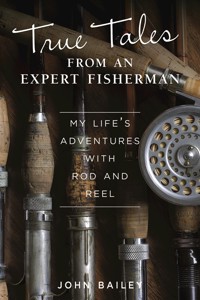
This remarkable collection of personal fishing tales from around the world is the perfect gift for any angler whose aspirations take him or her beyond the riverbank. In ten hugely entertaining and well-illustrated fishing tales, internationally renowned author, photographer, and angler John Bailey recounts some of the best and worst aspects of his worldwide pursuit of fish. Bailey shares his horrifying brushes with espionage and death in the world's most remote and inhospitable places, and introduces readers along the way to a motley array of characters, as well as an immense variety of fish! Written with great energy, enthusiasm, and respect for the wild, True Tales from an Expert Fisherman is a singular record of one man's lifelong passion for fishing.
Sie lesen das E-Book in den Legimi-Apps auf:
Seitenzahl: 316
Veröffentlichungsjahr: 2018
Das E-Book (TTS) können Sie hören im Abo „Legimi Premium” in Legimi-Apps auf:
Ähnliche


















Published 2018—IMM Lifestyle Books
www.IMMLifestyleBooks.com
IMM Lifestyle Books are distributed in the UK by Grantham Book Service, Trent Road, Grantham, Lincolnshire, NG31 7XQ.
In North America, IMM Lifestyle Books are distributed by Fox Chapel Publishing, 903 Square Street, Mount Joy, PA 17552, www.FoxChapelPublishing.com.
© 2001, 2018 by IMM Lifestyle Books
Produced under license.
This book is an updated and revised edition of Trout at Ten Thousand Feet, first published in 2001.
No part of this publication may be reproduced, stored in a retrieval system or transmitted, in any form or by any means, electronic, mechanical, photocopying, recording or otherwise, without the prior written permission of the publishers and copyright holders.
Print ISBN 978-1-5048-0087-7
Library of Congress Cataloging-in-Publication Data
Names: Bailey, John, 1951– author.
Title: True tales from an expert fisherman / John Bailey.
Other titles: Trout at ten thousand feet
Description: Updated and revised edition. | Mount Joy : IMM Lifestyle Books, 2018. | “This book is an updated and revised edition of Trout at Ten Thousand Feet, first published in 2001 by New Holland Publishers (UK) Ltd.”
Identifiers: LCCN 2017054194 | ISBN 9781504800877 (paperback)
Subjects: LCSH: Bailey, John, 1951– | Trout fishing—Anecdotes.
Classification: LCC SH687 .B275 2018 | DDC 799.17/57—dc23
LC record available at https://lccn.loc.gov/2017054194
We are always looking for talented authors. To submit an idea, please send a brief inquiry to [email protected].
Printed in Singapore
10 9 8 7 6 5 4 3 2 1
In Appreciation
Appreciation? Acknowledgements? I’m not sure about these words, I guess accomplices is a far better term. In fact, this book isn’t really mine at all but rather the story of countless men and women who’ve had such an impact on my life for nearly half a century. And the world’s best dog of course . . . but more of him shortly.
In the early days, I can’t help believing my parents colluded more than they should have done with my fishing career. And I’ll always blame my grandmother for inspiring me with mighty tales of derring-do performed by my late grandfather. On the literary side, Bernard Venables and B.B. have both got a lot to answer for. Their evocative prose carried me away to magical fishing lands when, in reality, I’d got far more important things to do. Or so it seemed to everyone who ever taught me.
In a fundamental, guts-of-my-life way, I’d like to thank Reelscreamer, who has nourished every piscatorial ambition of mine even if he hasn’t actually cast a fly on the water himself now for nearly twenty years. I’d like to thank Maddie, a spaniel of enormous angling ability, for all my success in Scotland. Truly. And for bringing Christopher along who’s a good cook and even better company. Johnny Jensen certainly plays a central role: as you’ll see, he’s been responsible for many of the messes I’ve got myself in. Thank you Peter Smith. I guess you’ll never know how sane you’ve kept me over the past fifteen years.
In Scotland, I’d like to thank the Heaths, the Hetts, all the Johns, and the Barbers for frequent shelter given from the storm. Mention must be made of a certain Dutchman who so frequently allowed me use of his most magical estate. Thank you Dennis and thank you Norrie. I’m praying for you.
In Greenland, I’d like to thank Sexy Morten, less sexy Niels, the Swedish pilots who appeared with beer one night, the musk ox that spared me, and Johnny for his impersonation of Basil Fawlty. Thank you Mick and Simon for keeping me laughing for three weeks and Stuart for deciding to pack at three o’clock one morning. Thank you James for slipping off the glacial ice and not knocking your head clean off.
Let’s take Russia, Siberia, Kazakhstan, and all those far-flung, ruinous states together. Thank you Sasha for saving my life and Mr. Mochanov—wherever you are now—for not thinking it worth taking. Thank you Michael, Uncle, and my dear German friend Bernd . . . but I still think Michelle Pfeiffer is the most beautiful woman in the world, whatever you say. Thank you Niels Ortoft for showing that a three hundred-pound fish can be caught on a salmon fly, and thank you Pasha for the fact that I’m not lingering now in an Iranian jail. Thank you to Michael for organizing a few eastern calamities and to Olav and Christian who made them quite fun. Thank you Georg for cooking lenok trout almost before they’d been landed and Gennardi for showing me your bottom-of-the-garden dunny. Thanks to Brian Pilcher and Keith Musto for providing me with clothing that has saved me from frostbite many times.
In Mongolia, I must thank Petr (two of them in fact), the Mighty Radim, and our own Friar Tuck, Jan, even though one of his farts occasioned an earthquake. I’d like to embrace all the fellow Mongolian travellers—Rob, Phil, Leo, Simon, Ade, Phil, Chris, Ian . . . you’re just too numerous to mention but I love you all. Thank you Gamba for being invariably manic and my Mongolian brother Batsokh for just about everything. Thank you Ennisch for dreams and the Red Baron for flying me and then crashing me in stomach-churning safety. Frank, we are all thinking of you. Always. And Dave, thanks for lending me that rod for the past five years. Or is it six?!
In India and outlying lands, I’d like to thank Keith for introducing me to cards and Simon to whisky. I’d like to thank John Edwards for always setting such a fine, well-dressed example and, way back, Linda, Dinesh, Peter, Paul, John, George . . . we only needed Ringo! Joe will have to do instead. A hundred and seven “thank yous” to the Boys of Nepal and down in the south, Bola and Suban—that was the best month of my life. Thank you Alan for that smile of yours: bigger than the Indian sun.
I’d like to thank the Norfolk wild bunch—Billy T, the beloved man of three halves, Joe, Ching, Bernie Bishop, who rescued me from a life of sprout picking with lascivious women, and Geoff Crowe for showing me how life should be lived.
On Acklins I’d like to thank Roger, my fellow carnival queen and gently calming influence. Thank you Tony, Philip, and Magnus especially, for maintaining rigorous standards. Amos, Elvis, and Fidel, please don’t forget us.
On the Baltic, I’d like to thank Michael for being so gentle and Johnny for catching the biggest fish ever . . . as usual. Up in North Uist I’d like to thank Maddie for sniffing out the big ones and looking after Christopher. Thank you Christopher for letting me play Perfect Day. Elsewhere around the New World, I’d like to thank Big Bob and brother Wayne, everybody I met in New Zealand because you just can’t find more generous people anywhere. The same goes for America but let me especially thank John Hemmingway for taking an interest. For the rest, in no particular order, let me thank Paul for providing both inspirations and warnings, all at Launce Nicholson’s tackle shop, and Simon whose luck with women and cards is extraordinary. Not that he’s ever exploited either, Sally, I promise.
Lest this should seem heavily biased toward the male, let me say that women figure every bit as large. Thank you Sue for constant, “alluring” advice. Hats off to Shirley for proving what wimps men are. God save Carol for working with me at all hours and trying to stop me worrying and to several hundred cooks doing a brilliant best in impossible kitchens with food you wouldn’t even recognize as edible. Thank you to Charlotte for lending me Johnny—I told you I’d bring him back. And thank you, dearest Joy. As you will read, this book is so much about you.
Finally, I would like to thank Mohammed and all the staff at La Roseraie, Morocco for the sanctuary provided to complete what the above gang have given me to say. And apologies to the unmentioned many who have contributed to the wreck of a man I am today.
Prologue
A Return to Altitude!
Hearing that Trout was being taken up again, being polished, reshaped, and rejuvenated by a new US publisher, astonished me. Astonished isn’t perhaps the right word. Shocked is better. First off, the news took me back to the book that I had dipped into over the last sixteen years but not reread properly since I had put the pen down. Yes. I’d written it in ink on paper in a retreat in Morocco, in sight of the Atlas Mountains. Wonderful. Call that work? The visa in one of my expired passports tells me that the first (and only) draft took me twelve days in October 2000 to complete. I wrote in some sort of trance, breathing in the memories from the fifty-odd expedition diaries I had taken out there in hand luggage. Most of the book was there, then, at least half written for me already and only in need of fleshing out and tidying up.
Perhaps because Trout was drawn from diaries written out in the field, generally in the wilderness, always by water, it seems to me now extraordinarily personal. I don’t think I have ever written so revealingly about my hopes, fears, strengths, and weaknesses. There was a full-on truth to Trout that for me now is its power. I sound immodest. Trout, though, is not a part of me or my work anymore, really. Going back to it was like reading a book by another author entirely. Blimey, did I, me, JB, do all these things, catch all those fish, travel to all those places? I suppose I must have. Most, some, of the diaries are still with me, after yet another separation and a series of house moves, and they back up in exquisite detail what the book describes. Here I go again, telling the world what I’m like, what my life is up to but I guess Trout was written in the voice of one travelling angler to another, like you’d tell things to a mate in the bar late one evening. I don’t think, looking back, I “glammed” things up much, if at all. There was no real need to. The tales were pretty glamorous as they were, being lived out in ways more than glamorous enough for me.
My travelling and angling life continued at full tilt for approximately seven years after Trout was published, coincidentally twenty years after it had first begun. I have still travelled to a degree in the last ten years but without the backbreaking intensity of those earlier decades. In part that is because the world has changed a lot, and generally not for the better. Also I have changed; I won’t comment whether for the better or not.
I wrote in the first incarnation of Trout that I was prepared to put up with any hardship but naked human aggression and the fear of a bullet in the brain. Two post-Trout incidents nearly brought that fear to pass and they left mental scars. The first of these events took place in April 2004. You can Google things much more easily and thoroughly now than you could in 2000, so if you care to look up the name “Veerappan,” it will save me time and trouble setting the scene.
The barest bones are that Veerappan was a Robin Hood type, an outlaw, a man who operated in the jungles of southern India roughly between the 1970s and October 2004, the time of his death. I’d actually met him briefly in 1991, on the banks of the River Cauvery, and was impressed with him. He came from village stock but had become a totem figure for many of the river people. In some ways, he was a hero. Initially, he stood for the rights of the poor and opposed the destruction of the jungles and the traditional way of life. However, I suppose power does corrupt. Certainly by the late ’90s, Veerappan and his ever-increasing army of desperados had become a force to reckon with. Veerappan and his men had become deeply involved with poaching and forest destruction. In many areas, even the villagers were turning away from them. The gang had also become embroiled in several murders, often of police but also of army personnel and even politicians. Veerappan was increasingly a loose cannon.
Time for reflection, time for pause.
By 2004, Veerappan was cornered, dangerous, and snarling. In the early part of that year, four of his gang had been captured and were sentenced to death, due to be hanged sometime in April. Veerappan had sworn that unless these men were released, he would capture four tourists to the Cauvery region and hang them in retaliation. That was the standoff when I arrived completely unwittingly with a group in late March of that year. I’d walked into an inferno.
I sensed something was wrong by the feel of the spookily empty camp. The guides that I had known and loved for years were tense, edgy, and to a man failed to look me in the eye. Greetings were rushed and lukewarm. There was none of the generosity that had traditionally greeted my arrival. I was worried from the start.
It didn’t help that I had with me the only group that I ever led abroad that I really couldn’t abide. They probably don’t speak highly of me, I guess, because we were completely opposite types. They had ignored all my advice regarding tackle and clothing and arrived on the Cauvery woefully ill equipped. Their attitude toward the camp staff I found deplorable, and their high-handedness was already ruining the trip. It was then that I found out about Veerappan’s threat. It was then, too, that I found out that Veerappan and his men were camped just a few kilometers away on the other side of the river, deep in the jungle. As there were no other tourists within many kilometers, it could only be our group that Veerappan would target.
It was almost impossible to get the anglers out and back to Bangalore. I felt the best bet was to hunker down and see it through. There was a small army detachment around the camp, and I felt that trusting this was our best chance. However, on two nights consecutively, there was spasmodic gunfire, odd sniping taking place between both the soldiers and Veerappan’s men. It was a situation that could potentially and easily end in our deaths.
I’m not proud of the fact that I got several of my guides to sleep around my own hut! It wasn’t an act of supreme courage I’m forced to admit. However, I knew Veerappan wouldn’t harm my boys at all and they might talk him out of harming me. I felt the fact that we had met some thirteen or fourteen years previously might also stand well in my defense. As it was, we saw it through and left the river intact.
I know I don’t come out of this one well but in my defense I had been shot half to death by events in 2003 or perhaps 2002 that took place in Mongolia. I’ve lost my passport for this particular period and the accompanying diary, too, so it seems you will have to bear with some vagueness for once. However, it’s a chilling tale that I am unlikely to forget any part of.
I’d led my group to my usual camp on the usual river in northwest Mongolia. I’d arranged for the majority of the party to go off with the armed guards a long way upriver for two days, leaving me and Leo alone in the camp with Sara, the manager, and the rest of the camp girls. The morning the men left, I went off downriver to explore some new pools I had heard about on a small tributary. It was a glorious September morning with an achingly blue sky and acres of burnished, golden forest. I was in my element. This was the type of morning that had drawn me back to Mongolia over and over again. However, my peace would soon be demolished. In the far distance, I saw two very obvious western-style tents and I made my way toward them, intrigued, as this was a most unusual sight. After perhaps forty minutes, I arrived in the clearing where they were pitched and noticed that horses’ hoofprint marks were all around. I unzipped one tent, nothing. Unzipping the second revealed the sight, though, that I will forever remember. A wave of lazy, fat flies hit me in the face, closely followed by an appalling stench. There were two bodies lying on bloodstained sleeping bags, their heads largely blown away. I reeled. I retched, I will always remember.
I have dear departed Leo to thank for this shot. It shows me and Sara, on the left, the night that the brigands hovered around our camp. Sara is looking typically calm and collected while I am doing my best to look rugged and tough. Fortunately my heroism wasn’t called into account!
I sat alone, trembling in that awesome Mongolian silence trying to think things through. This was a horrific murder and I felt passionately sorry for the bodies inside. But, of course, shortly after that came the wave of fear for me and for those in the camp. I quickly retraced my steps and found myself on the familiar river heading upstream to our huts where Sara met me wide-eyed with fear.
She told me that around mid-afternoon, and it was now five p.m., five horsemen had appeared and stationed themselves around the camp, each about a hundred and fifty meters distant. This in itself was terrifying because, in Mongolia, it’s a common tradition that travellers always call into a settlement to exchange pleasantries, gifts, stories, and news. Also, looked at through binoculars, Sara could see that all the men were heavily armed. It was shatteringly, blindingly obvious that this was the gang that had murdered the bodies that I had discovered.
His last words to Sara and me were that we were to expect an attack at dawn.
I told Leo what I had found. What a man, what a bear of a man. It was now that his experience as a Dutch paratrooper kicked in. He explained to Sara and me that we had to make the camp look bustling, full of life. We had to keep lights shining, doors banging, and the noise from our cabins flowing. We had to sing and shout and pretend the site was fully manned.
Darkness fell. Every half hour, Leo made a tour of the encampment with huge swords in scabbards at his back. After each of these perilous walks, he would come back into our cook tent, down a beer, and listen for any intrusion from the outside while we still kept up the pretense that there were many of us, whistling, shouting, and banging on tables.
At one a.m., after Leo’s tenth tour of the camp, the beer got the better of him and he sank onto his bench. His last words to Sara and me were that we were to expect an attack at dawn. We sat there together. The stove was losing its heat and the rest of the staff were asleep on their own benches. It no longer seemed possible to keep up the ruse of activity, so we prayed, holding hands, waiting for our fate.
The gray light of dawn began to ignite into the usual explosion of colors that herald a Mongolian morning. The sky once again looked as though it were going to be limitlessly blue and smoke rose from the river as the sun began to poke its head over the mountains. We were alive. Looking carefully through the binoculars, I also realized we were alone. Sometime in the night, the brigands had pulled off and it looked as though we were safe, at least for the time being. We had sent one of the lads upstream for help and a couple of days later an army detachment arrived, along with the rest of the fishing group, and an arsenal of old guns. We were safe now for sure, and it was later revealed that the killers were from a Siberian tribe that had crossed the border in the hope of booty. They were caught, hanged, and that was their summary end. Not for me, though. To this day, I’m still haunted by that night.
My last trip to Mongolia took place in 2006 and that one was marred only by the indignities of carsickness. Therefore, my memories are generally very fond of the country and its wonderful people, but I have no desire to return. Between 2001 and 2006, the world had become a crueler, more heartless place than it had been. Or at least, I realized this change more clearly. 9/11 in large part had killed off the Boy’s Own, gung-ho world that I had written about initially in Trout. For sure, the countries and continents I described had always had their tough guys and their dangers but not the coldblooded assassins that have been the demons of the world we now inhabit.
I’d had foretastes of this change, of course. I’d experienced and written about the religious and racial problems in Kashmir but never fully understood the burning ferocity and hatred behind them. Even the Balkan wars of the 1990s I didn’t really grasp like we all would now after years of exposure to suicidal bomb terror. After 9/11 and after all the horrific incidents since, it is no longer as easy to laugh at danger as it was last century. But enough of all this. I’d simply say that I hung up my rod travel tube at the time that was right for me. Angling and travel will continue, but perhaps not always to the places that once seemed so safe.
To this day, I’m still haunted by that night.
I wouldn’t want any reader of this new edition of Trout to think that everything since the initial book came out has been doom and gloom. Far from it. Perhaps it’s like any nation’s newscast that tends to concentrate on the lurid and dramatic rather than the everyday, humdrum, good stuff? Anyway, this book had only just gone to press in 2001 when an extraordinary episode opened up for me down in India, in the south that is. First up, I caught my big fish. I’d probably been due this after some fifteen years of annual travel to the subcontinent but there are no guarantees in a fishing life, especially a life fishing for big fish, and mahseer are no exception to this rule. In fact, because a big mahseer is such a difficult beast to land, sometimes seemingly impossible, claiming a big one feels a near impossibility. You might have your chances but that doesn’t mean to say you will convert any of them.
I’d fished with Anthony for many years and I think we knew each other well. Our relationship hadn’t always been the easiest, I’ll be completely honest. There were times when the stress of leading a group of anglers got to me, I’ll admit, and I could be shirty on very rare occasions. I was never proud of this and I’m not now but, I guess, there were some small excuses and Anthony very much had a mind of his own, which is why I loved him. There’s the case of the turtle. Turtles can always come along on baits meant for mahseer and initially they give a very good impersonation of the fish itself. Soon, however, if you’re experienced enough, you begin to recognize the fight of a turtle for what it is: a dour, plodding affair that quickly gives the game away.
This particular morning, I’d landed a turtle of some thirty or forty pounds, and Anthony became very agitated during the final stages of the fight. He fell on it in the shallows with a whoop of triumph, removed the hook, which could always be a dangerous operation, and then began to tie the poor creature up like some living parcel. I watched all this in silence broken only when he began to carry it upriver as though it were a suitcase. That turtle, I informed Anthony, would be going back. No, he informed me equally forcibly, it would not.
The remaining day was a tensely silent standoff. Every hour or so, I sluiced the turtle with water, would look at Anthony and tell him to release it. Anthony, in his turn, would look at me and either refuse to reply or shake his head vehemently. The turtle, too, kept grimly quiet.
Sundown was approaching and the fate of the turtle still stood precariously in the balance. This would be a real test between angler and guide, between two old friends. I mentioned Anthony’s tip to him at the end of the expedition. He was not swayed. I mentioned the guides I might choose to take the following year in his place. He glowered. I mentioned the name of the Indian camp manager who should have been the ultimate authority but who was little more than nominally in charge. Anthony shrugged. In the end, for the sake of the turtle, I simply appealed to our long-standing affection and friendship. I told him that I would hold it a deep, personal favor if he would release the miserable looking beast. Head cocked to one side, Anthony nodded and in a trice produced his knife and the turtle was free. It took two hesitant steps, looked at Anthony first, then at me, smiled, and shot off into the Cauvery River. Anthony and I embraced after a stony eight hours and made our way back to camp and to a beer each.
A couple of days after the turtle event, Anthony was the first of us to notice that on our homeward journey each night, our coracle would pass a massive mahseer in the shallow, very quick water above the long and dangerous Kengal Rapids. For three nights, we looked at this fish as we sped over it and down the foaming white water. On the fourth night, Anthony decided that we’d have our crack.
As Anthony made it wholly plain, to let the fish go down the rapids would be a catastrophe.
First, Anthony waited until every single coracle had moved over the lip of the Kengal Rapids and headed off back to camp, a mile downstream. He then moved us into position, some twenty-five yards above the monster’s lair. We had already respooled with new line, a new hook, and caught the perfect bait, a small brown fish, a chilwa, around five inches long. Anthony had also screwed the clutch on my multiplier as tight as it could possibly go with a pair of pliers. Both of us, pulling together, found it impossible to take even an inch of line off the reel, so jammed it was. This, Anthony explained, was absolutely necessary. If the fish took and if the strike were successful, to yield even an inch of line to the mahseer could court disaster. As Anthony made it wholly plain, to let the fish go down the rapids would be a catastrophe. We would not be able to land it unless we followed it and that potentially could be terminal. I got the message.
I guess we cast out about 5:45 p.m. It’s inevitable that you are nervous in these situations. You know that a massive angling test might well be coming your way. It’s not just an angling test, of course. In a bizarre, overinflated sort of way, it’s a test of your manhood. If you hook a fish like this in a terrifying environment, you have to prove your mettle and show that you are up to the job. If I lost the fish or wimped out, or performed badly, I knew I’d lose face, not just with Anthony but throughout the camp, throughout that spectrum of Indian fishing where I had become known.
A minute or two before six p.m. the line tightened dramatically and then pulled with volcanic force. This was it. I struck and stood up in the coracle in one fluid movement. It was like hooking a bull elephant. Anthony screamed not to give line, not an inch, not a nail’s breadth. The fish, a mighty one, exploded on the surface in violently flowing water only four feet deep. This frantic fishing tug-of-war continued for ten whole minutes. It was touch and go. Anthony continued to tighten the clutch with those pliers and force me to hammer my thumb to the spool every time it lurched and groaned. Bits of me were coming apart. My thumb looked as though it had been in a mincer. Pieces of skin decorated the rod butt and blood spattered the spool. So compressed was the rod that the line was actually chewing away at the handle, sending pieces flying into the river. When Anthony wasn’t tightening the reel, he had his arms round my waist, both of us pulling against the fish, neither of us making any apparent impact.
Wow. Anthony with my big mahseer. He put it between the big 90s and around 110. I’ve looked at it every way I can since then and for me, the jury is still out. I am well aware that the cynics would say that Anthony was thinking about the size of his tip but, in all the years that I fished with him, I’d never caught him out on weights when we actually checked fish against the scales.
After a near quarter of an hour, the fish began to swim upstream. This was what we had been praying for; this was the window we had fought to open. It was all over very quickly now. The mahseer came to our feet, almost willingly it seemed, and its head came out of the water, just at the rod tip. That head was immense. It was as golden as the setting sun and it looked as big, too. Anthony, I remember even now, actually physically gasped. There was a bit of a tussle around a marginal rock but then the stringer went in and the fish was secured. We were shattered. Physically and emotionally just gone, spent. We sent a couple of the boys downriver to bring back a few of the anglers for photographs and to act as witnesses. It is a regret of mine now that we didn’t send them further on, to the camp and to return with the scales. At the time, I maintained the conceit that weights weren’t really important. I’ve changed my mind now. Today, I think that if you catch a historic fish you kind of owe it to history to record its weight properly. How big was that mahseer, by far my biggest? Anthony at the time put it between forty-five and fifty kilograms. If he were right, that means the fish was well into the high nineties and perhaps even edging toward a hundred and ten or so. I just don’t know and I never will but it was the fish that I had been after, after a string of fifties, sixties, and seventies. To this day, I’m happy to think that I actually did achieve three-figure fame out there on the Cauvery, even if history will never record it and I will never know for sure.
Catching that fish, though, did give me a certain amount of swagger when it came to moving downriver to a camp new to me, at Bush Betta. At the time, this stretch of river was seen as the big boys’ water, that part of the Cauvery River where the water was at its most dangerous, its most exhilarating. Rumor had it that the river channeled there between towering rocks forming foaming cauldrons of vicious, lethal water. Nobody but an experienced mahseer angler, or a fool, would attempt the water of Bush Betta.
Saad Bin Jung was the master of Bush Betta. I don’t know how to describe him now. Charisma. Wisdom. Jungle lore. Generosity. Humor. And a deep-seated cunning. I’m not sure that I ever quite, wholly trusted Saad Bin Jung and I wouldn’t say that I do now. However, were he to walk into any room, I’d immediately spring up to embrace him. I think.
At the time, I maintained the conceit that weights weren’t really important. I’ve changed my mind now.
What is for sure is that Saad ran the most brilliantly eccentric Heath Robinson camp there has been anywhere this century. The whole place spoke of madcap adventure and exoticism. There was never ever a dull moment. You never knew what Saad was going to come up with next but you knew that it would push you and it would probably be dangerous. This was not a place for the weakhearted and some of the time, all of us faced a fisherman’s death full in the face.
Fishing at Bush Betta was always a hazardous affair, always made more difficult, if at all possible, by that outlandish camp owner, Saad Bin Jung. This is the type of dizzying fishing that you face there, staring down into the so-called Goat’s Leap.
Saad also laid on a glittering array of guests for us, partners in fishing who raised the tempo and the glamour. Tseem was one such. This is a very long time ago but I will never forget her that first night in camp. Let’s just say that the warmth, the luster, the heady mystery of that velvety night was reflected in her every pore and skittered down every finger length of her black, shimmering hair. It was during Tseem’s stay that we mounted a huge expeditionary force to a reputed mahseer lake in the hills. Saad summoned every porter, every elephant, every mule in the district and we set off pre-dawn to make the climb to 3,000 feet. We arrived about two p.m. to find a vast, shallow, mud-filled puddle around five acres in extent. In the skim of water left, there was nothing but snakes, turtles, and a fish perhaps six inches long. Heads rolled, but then the whole camp always ran on a wing and a prayer. It was all about smoke and mirrors and living life by a thread. That’s what made Saad so captivating, life at the camp so addictive.
One of the much smaller fish to come from the Bush Betta stretch. Still, it delighted Zoha, Saad’s charming daughter, at the time.
Much later, I went to a quite different camp, this time in the foot of the Himalayas run by the completely excellent and upright Misty Dhillon. While you could never accuse Misty of a single underhand deed, that did not detract from the magnificence of the camp and its setting. During my first trip with Misty, we were dropped off at the roadhead, facing a walk of around a mile and a bit to the campsite. This, I still think, was one of the most entrancing walks I have ever taken. The sun had lost its heat and was sinking fast, filling the valley with a benign, golden sheen. It was quite wondrous. We passed through uncut, sweet-smelling meadows, through hamlets, deep into woodland and then out onto the plain toward the river that we could hear clamoring beneath the mountains that climbed from it. Our small cottages stood in the distance, almost as though painted there by Constable. It was an eerie mix of England and the East. Rather like Misty’s fishing.
Arguably, I would put Misty Dhillon at the very top of any list of fly anglers I have ever witnessed at work. He was simply magic at it. There was not an aspect of fly-fishing that Misty fell down upon. His strategies were perfect. His casting was uncanny. His ability to read the water and interpret the body language of the northern mahseer was fantastically mesmerizing. I could, of course, talk about the glory of the camp and the food and the staff. I could mention the heart-chilling excitement of fishing within Corbett Park, within casting range of man-eating tigers. I could describe the cricket match between us anglers and the camp staff. All these things made time with Misty memorable but, at the last, it was fishing with the world’s best fly angler that made the experience for me.
Anybody reading Trout will know that India and Mongolia, among all the special places in the world, were perhaps my most beloved of all. Some years after the initial publication of Trout happened, on the Shiskid River in northwestern Mongolia, like many great days, it was all about a walk with a fishing rod. Greatest friends JG and Ping Pong (don’t ask) and I decided to walk the fifteen miles or so from the Tengis camp down to the Chanagai camp. We took ten hours to do it, fishing all the way. It was just one of those moments in time that will never be surpassed for the scenery, the silence, the company and, sadly, the complete lack of fish. We did, however, come across a monster.
It was in one of these channels that we saw a vast shoal of grayling and native trout, pursued by an enormous taimen.
At its best, Saad’s water could be legendary. This is a shot from a friend’s group in the early part of the century.
About halfway between the camps, the great Shiskid River subdivided between a scattering of islands with relatively narrow, shallow, and crystal-clear channels running between them. It was in one of these channels that we saw a vast shoal of grayling and native trout, pursued by an enormous taimen. It was a monster. Ping Pong already had a rod made up, with his very best lure attached. This was to be the moment of truth.
Misty Dhillon fishing in the Himalayas. His casting truly is poetry in motion.
Ping Pong managed to overcast the lure by a good twenty yards firmly into a tree in the middle of the island opposite.
JG took over the hunt with his own rod. First attempted cast and he managed to create a huge bird’s nest at the reel.
Seasoned Mongolia traveller as I was, I took my rod from its quiver. I managed to smack my lure against an exposed rock in midstream so hard that it shattered instantly.
The three of us were left without lures, without a hope, and without a taimen. The fish wallowed off into the main river and that, for this day at least, was the end of our taimen test.




