


Erhalten Sie Zugang zu diesem und mehr als 300000 Büchern ab EUR 5,99 monatlich.
- Herausgeber: The Lilliput Press
- Kategorie: Sachliteratur, Reportagen, Biografien
- Sprache: Englisch
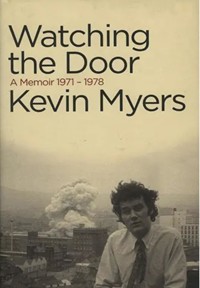
As an Irish Catholic raised in Leicester, fresh from University College Dublin with a first in History, Kevin Myers is sent north to work for the Belfast bureau of RTE News. There he covers the increasingly vicious conflict erupting in the city as the IRA campaign begins. Reporting too for Dublin's Hibernia, the London Observer and NBC Radio for North America, Kevin Myers becomes the eyes and ears for an uncomprehending world, chronicling the collapse of Northern Irish society, from internment to the La Mon bombing. Raw, candid and courageous, Watching the Door documents the deeds of loyalist gangs, provos, paratroopers, politicians, British agents and an indomitable citizenry, forming a remarkable double portrait of a divided society and an emergent self – a witness to humanity, and inhumanity, on both sides of a sectarian faultline. In his wonderfully vivid, trenchant, first-hand account of life on the streets of Belfast during the height of the Troubles, a young Kevin Myers witnesses the blood fueds and chaos of a people on the brink of civil war. His descriptions of violence, counter-violence and emotional free-fall, combine humour with reflection, eros with thanatos; they render history in the making. By interweaving the political and the personal in a tale at once self-deprecating, poignant and sexually buoyant, Watching the Door is a coming-of-age story like no other. It is evocative and passionate, and it records a pivotal time in Ireland's recent past, blending articulacy with savage indignation in a classic of modern reportage.
Sie lesen das E-Book in den Legimi-Apps auf:
Seitenzahl: 453
Veröffentlichungsjahr: 2006
Das E-Book (TTS) können Sie hören im Abo „Legimi Premium” in Legimi-Apps auf:
Ähnliche

















Watching the Door
A Memoir 1971–1978
Kevin Myers
Contents
Title PageDedicationPrefacePrologueOneTwoThreeFourFiveSixSevenEightNineTenElevenTwelveThirteenFourteenFifteenSixteenSeventeenEighteenNineteenTwentyA chronology of the main events in Northern Ireland covered by this bookCopyright
To my friend the great David McKittrick, who told us almost all.
Preface
WHY WRITE about events that occurred so long ago, at such a terrible time in our country’s history and in a place few outsiders even now really want to visit? The answer is simple. This was a defining period of my life, and the secrets that it disclosed have been locked within me ever since. I saw murder face to face and heard the keening of bereaved and broken hearts. I witnessed the bloody chaos that results when the tribe is exalted over the individual, and when personal morality is abandoned to the autonomous ethos of some imagined community, independent of God and law. Moreover, the publication, in 1999, of David McKittrick’s majestic Lost Lives* provided me with both the moral compulsion and the documentary material to set my fingers to the keyboard.
The resort to violence in Irish life is still celebrated by people who call themselves constitutional politicians. It is my hope that those who read through these pages will understand something of the reality of what violence does. This is why I have related the names of so many victims. Their deaths were the result of the failure of politics, but more crucially for me, each death formed a tiny brick in the edifice that was my earlier life. Their tragedy was my income. That is how I made my living, the beetle in the sarcophagus.
My sarcophagus had initially been the Protestant state for a Protestant people, which mirrored the Catholic state for a Catholic people that was the Irish Republic. However, such simplifications mislead. Senior judges and police officers in both Northern Ireland and the Republic were of the minority faiths. Contrary to subsequent fable, Catholics enjoyed the same voting rights as Protestants, but gerrymandered constituencies diluted their voting power. Most of all, Northern Ireland oozed a smug Unionist sense of power, and it was that which most riled Catholics. However, nothing about that state, or the conditions of its minority, justified the murderous calamity that befell its inhabitants during the years I write about, and those that followed.
This book is also about a naive young man in pursuit of the adrenaline of war and that cocktail of hormones accompanying love and sex. During the 1970s I behaved like young men have always wanted to, and always will. I have been as frank about this as possible. The truth does not, as the battle hymn of another republic declares, make us free, but at least it enables us to see where evil lies a little more clearly. If anyone finishes this narrative with a slightly sharper moral eyesight about the wickedness and folly of political violence on this island, then what follows will not have been wholly in vain.
I owe an unpayable debt to the many people who feature in this account of my life in Belfast. But for the purposes of this book, I want to thank my editor at The Lilliput Press, Mary Cummins, and of course Rachel, my wife, my rock and my love at all times.
* David McKittrick, Seamus Kelters, Brian Feeney and Chris Thornton, Lost Lives (Mainstream Publishing; Edinburgh 1999).
Prologue
July 1972
DRIVING SLOWLY up Shaw’s Road, Belfast, on a rare and lovely summer’s day: the sun radiant, the sky a Corsican blue. To the left, in the distance, an army foot patrol coming downhill towards me, threading its way in incongruous olive-fatigues past an urban-jungle barricade of ancient, burnt-out cars, dodging the bottles and bricks from clusters of shrieking children. Much closer and to the right, behind a block of flats and invisible to the soldiers, an excited group of feral teenage males seethed like primates. Farther to the right, a bucketing car skidded to a halt, the din of its arrival concealed by the noise of the riot.
I stopped, put on the handbrake and watched. The soldiers continued to advance in a single green faltering line. The car-driver leapt out and opened the boot, a triumphant Santa Claus at the back of his summer sleigh, to reveal his presents – a Garand semi-automatic rifle, a couple of M1 carbines, some handguns. They were distributed, in no apparent order, and the teenage gang instantly and intuitively dispersed to their various firing positions.
I had chanced upon an IRA ambush. Slowly, I drove off right, within the lee of the flats, from where I could still see most of the soldiers. They were stumbling forward, sweating, confused and clearly reluctant – outsiders from England, barely out of their teens and in a strange and hostile place. Stones whistled past their ears as capering children taunted them.
Directly in front of me was a bone-thin lad with an M1 carbine and his back to the wall. He was wearing a blue plaid shirt and blue jeans cut off above the ankles, and his dank, unwashed hair hung in curls. He stuck his nose around the corner, so he could peer right, towards the soldiers who still remained within sight. His head came back and he waited, his back rigid against the wall. His lips moved, as if he were counting. I opened my car door and stole sidewards, and kneeling, turned on my tape recorder.
The foot patrol drew closer, through shimmering heat waves rising from tarmac thinly puckered with the acne scars of recent vehicle fires. The air reeked – the rancid smell of burnt rubber and seared steel now as ubiquitous in Belfast as coal dust in a mining town. From nearby hills came the rattle of pebbles in a drum, echoes of gunfire from odd skirmishes around the city. The IRA ceasefire had ended a couple of days before, and bloodshed had vigorously resumed, as if making up for lost time. In nearby Ballymurphy, paratroopers had gunned down half a dozen people, one by one, each casualty a lure for the next vain-helper, who in turn had been shot, the icing on their cake a priest they finished off as he administered the last rites to their penultimate victim.
There was no mercy on the streets that hot July day. The boy in front of me peered around the corner again, and drew back. The soldiers were still not quite close enough. He was good. He looked around, checking his rear, seeing but certainly not registering me as an enemy, then he cocked his weapon and swiftly turned, stepping sharply leftwards to give himself a clear field of fire from his right shoulder.
His carbine barked – bang! bang! bang! bang! – prompting supporting fire from the other, now invisible youngsters. The lead soldier collapsed in the middle of the road, falling vertically, his bones turned to water, and the rest of the patrol vanished behind cremated cars, rubble, lamp posts, anything. In front of me, the gunman had returned to cover, his back to the wall. From not far away, children whooped at the sight of the motionless heap in the middle of the road. The wounded man’s fellow soldiers did not return fire. They had no visible targets, other than the infants mocking their fallen comrade.
A second soldier began to crawl from cover towards the body, triggering a fresh though undisciplined fusillade from my boy and half a dozen other positions, bullets striking in little puffs all around the soldier. His leg jerked, an arterial leap of blood from his thigh a moment later confirming the hit.
Two squaddies down; yet still no return fire from the rest of the foot patrol, apparently paralysed where they lay huddled under cover. The first soldier was hit several more times: with each strike, his body appeared to be plucked, as if by a large invisible bird, while the children exulted. This had the makings of a real massacre. Now even the gunmen were cheering, the lad in front of me almost out of hiding, brandishing his carbine like an Arapaho at his war dance.
Suddenly, a large Humber armoured car, a ‘Pig’, came lumbering down the hill, its 120 horse-power Rolls-Royce engine roaring angry defiance, a mother elephant charging towards her endangered calves. My boy-gunman instantly withdrew from the edge of the wall, shouting an order that mysteriously carried some kind of authority over the ambush’s backing track of childish yells. The shooting stopped as soldiers deployed around the Pig.
The ambush party was already throwing its weapons into the car boot, before dispersing, civilians once again. Simultaneously, squaddies took the two casualties by feet and shoulders and unceremoniously chucked them into the back of the Pig, the bodies landing like sides of warm beef. The rest of the patrol crammed in after them, the Pig bellowed, its exhaust belched a puff of smoke and fire, and roared up the road.
On the ground, sitting in a pool of blood, lay a soldier’s helmet. Children rushed over to examine it. One boy of about twelve scooped it up with a long stick, whirling it above his head as he pranced in the blood. Then, like an Orange band-leader, he yanked the stick upwards, sending the helmet even higher.
It fell vertically and he caught it expertly on his head, as if he’s been practising for this moment all his young life, still dancing in the blood of the stranger from England. This other stranger watched for a while, turned the tape recorder off, got into his vehicle and drove away, with almost no emotion at what he had seen.
From home I filed a report for Australian radio, for whom I freelanced, but did not make one for RTÉ, my employer. How could I have explained my entirely accidental presence at the ambush? Or my failure to have prevented it? To have intervened or warned the soldiers of the ambush, would have been to have taken sides – and probably cost me my life.
I care about this now. I didn’t then. After just over a year in Belfast, I thought I was the hard man. In those fifteen months, I had seen enough death and, like so many Belfast people, thought I was inured to it.
How in the name of God had I come to this?
Watching the Door
One
IT IS NEVER the ambition of a wise person who knows anything about the place to live and work in Belfast and I was no exception. My family history had sniffed at the city, and had positively fled from it. During the Second World War my father, an out-of-work GP in Dublin, had been offered a share in a practice on the Antrim Road, which reaches from Carlisle Circus to the north of the city, beneath the shadow of the Cave Hill. He went up for an interview with a Jewish doctor called Glasgow, but that short trip alone was enough to convince him that Belfast was too bitter and divided a place in which to raise a young family. Instead he opted to work in wartime England, where he lived alone for some months before being joined by my mother and the first instalment of the Myers family. On the Liverpool ferry they were given U-boat drill: then my mother and the three children with all their luggage plus one dog travelled endlessly, almost the length of England, from Merseyside to Exmouth in Devon, through night and day, in a series of blacked-out, slow-trains full of troops, pausing in sidings from one dusk to the next, before trundling off into the dark again towards distant Devon.
Two years after the war the second half of the Myers family arrived in England, this time by childbirth, and in Leicester, where my father had found a practice. I was the first-born of this group, named after my uncle, Captain Kevin Teevan, RAMC, attached West African Field Force, a volunteer in the fight against fascism, who had died on active service in Africa.
Families defy stereotyping. The Teevans, for example, were not inclined to wear the uniform of the Crown, being constitutionally republican, and Kevin’s older brother Tom within a few years became the Irish Attorney General. My father – though I did not know it until long after his death, and nor indeed did my mother until I told her – had in his very distant youth, between 1919‒21, been in the IRA. In the adulthood that I remember, he was an ardent Tory with a Dublin accent who even cheered when RAF Vickers Valiant bombers attacked Port Said in Egypt in 1956. The only references that I remember him making to the IRA were ones of utter loathing: as I later discovered, he truly knew the beast of which he spoke. Moreover, he spent the last years of his life a weeping melancholic: was he simply the victim of some hereditary chemical imbalance in the brain – or was he haunted by some terrible deed he had performed in the service of an organization that now, all these decades later, remained faithful to its remorseless agenda?
Far from being raised a republican, I had not even been raised in any real sense as Irish, just Catholic, although Ireland remained a constant drumbeat to my heart from over the horizon, not least because I so adored my aunts and uncles in Dublin. One Christmas, when I was fifteen, I found a corner of our dining room where my transistor could get RTÉ’s Athlone signal. I triumphantly told my father, who cast his eyes distantly, as he often did to conceal his impatience. ‘A fat lot of good that will do you.’
He was, as I say, a troubled man, and I was an adolescent boy. On the last day of my school holiday we had a disagreement, over what I cannot say. He knocked me down, and then kicked me as I lay on the floor. His foot was slippered, he did not kick me hard, and most of all, I inwardly knew that something unwonted and terrible was happening in his heart. I loved my father then and he loved me – I love him still – and this was a ghastly, troubled aberration by a good and kindly man. However, at the time, it was not an easily forgiven aberration, and that afternoon my mother drove me to my boarding school with a studious absence of goodbyes between father and son.
A couple of weeks later, asleep in the fifth-form dormitory, a hand upon my shoulder wakes me. A priest, Father Moss, is whispering. I blink, and try to make sense of what he is saying to me in tones of low urgency: ‘Kevin? Can you hear me? Get up and get dressed. Your father’s unwell.’
Actually, he wasn’t: by this time he was dead. A heart attack, our farewells now and forever an unfinished business. Thus was I introduced to the elaborate rituals of death and grief and guilt in that bitter winter of 1963: ‘Dies Irea dies illa’ chanted the choir in the church in front of the coffin, while I stoically performed the duties of altar boy, witless with shock. Then to the cemetery: that vicious winter the entire world seemed an ice field, a small rectangular corner of which had been opened up to admit my father’s body. The marl lay in frozen mounds, from which with our fingernails we scraped our small, icy burial-tokens, and cast them onto the coffin below.
My father’s death threw my teenage life into chaos; I was broken with grief, and what had been a promising academic career at Ratcliffe came to nothing. I studied fresh A levels at a technical college in Leicester, but I did poorly again: my results came through that summer when I was earning £10 a week wielding a broom for Leicester Corporation Cleansing Department. There wasn’t a college in the land – even one offering diplomas in street sweeping – which would have accepted me. At my mother’s suggestion I enquired of University College Dublin if it had any places for such wretches as me. By an extraordinary stroke of luck, at a time when the demand for university places was the highest ever, the quota for foreign students – which I technically was – at UCD remained mysteriously unfilled: so possessing the bare minimum of requirements, I squeaked in to read Social Studies – in which I was as interested as I was in Mandarin.
I did not feel I was coming home when I arrived in Dublin. I was very English in accent and manner, and I knew how that seemed when my taxi driver overcharged taking me to my digs. I challenged him and he was unable to explain the fare. He apologized, and I then tipped him. Why? Very simply: I wanted to be accepted.
I was an outsider, and remained one, made more so by my aloofness in manner, my supercilious speech and my utter loneliness within. That first year in Dublin my few friends were non-Irish, and my personality did not invite affection from the general student body. I did not choose to be arrogant, but that was how I appeared.
After my first year, I changed courses to pure History. I found I loved medieval Irish history but utterly loathed seventeenth-century history, and wrote only one paper on it over the next two years. This century was the very antithesis of the optimism I sought: its darkness, its cruelties, its conclusions for the peoples of Europe were quite unspeakable. But it was to the preserved version of the seventeenth century, pickled in the drumlins of Ulster, that I was destined to return.
Before, that, however, I had a personality-transforming visit to the USA. Working one summer with poor children from the ghettoes of Philadelphia knocked a lot of the edges off me. Then I hitch-hiked across the States, meeting people whose opinions about the war, then at its height in Vietnam, I despised, but who were good and honest. I learnt then that what you think or say does not make you a better person, only how you behave. Two dozen states or more felt the fall of my foot, as for weeks on end I tramped across North America, my nightly resting place being my sleeping bag in ditches. In my nomadic solitude I knew great happiness, in my daily adventures I found courage and inspiration.
I returned to Ireland a changed young man, and in a time of great change, as across the world young people were being radicalized. I was emphatically of that generation, accepting almost in toto the emerging dogmas of the New Left. We believed capitalism caused racism, sectarianism, class barriers, hunger and Third-World poverty, and we rapidly created the theological texts to justify the tenets of the new global religion, drawing on the existing gospels of Marx, Engels and the Russian revolutionaries, with the new epistles coming from the USA and France.
We accepted the Marxist fantasy that the historic dynamic came from the organized working class: we believed the patronizing myth that the proletariat embodied the holy grail of a better society, and all that was required was for the working class to see in themselves the truth that was so evident to us. In essence, this meant that working-class movements were of themselves necessarily good things.
The summer of 1969 was warm and as usual I was full of lust, and avoiding studying for my finals in September with an unremitting distraction in girls, of whose company and bodies I could not get enough. But far greater forces at work in the North were to interrupt my endocrinal safaris. For nearly a year, there had been regular civil rights marches demanding an end to discrimination against the minority population of Catholics – who are also in this account known as ‘nationalists’, a roughly synonymous term – by the all-Protestant unionist government there. These had often ended in riots, which seemed serious enough at the time: a few hours of stone-throwing and car-burning.
But in August 1969 serious communal violence between nationalists and the police, the RUC, flared in Derry in the westernmost part of Northern Ireland. The usual two-hour skirmish turned into a full-scale battle without apparent end: finally, after two days of petrol bombs and baton charges, it seemed the revolution was coming to Ireland! It was too good a chance to miss. A friend and I – bidden as much by a desire to experience the heady drama of rioting and lawlessness as by any political principle – decided to go north to ‘help’ the nationalists.
We hitched to Newry. Beyond it, lining the hill on the Banbridge Road outside the town that August evening, stood a silent army of B Specials, the Protestant police reserve that was so detested and despised by Catholics. Black hats, black tunics, black coats, black trousers: black, black, black. We passed them, half expecting to be stopped, hauled off into a ditch, beaten, shot. Those genuinely were our thoughts, however absurd, as we walked that silent gauntlet, hearing the odd clink of an invisible Lee Enfield rifle or a Sterling sub-machine gun. In truth, they were probably frightened country boys, as fearful of Newry as we and Newry were of them.
We got a lift to the Falls Road in Belfast, where – two ridiculous figures – we began to look for some headquarters to report to, even as people with closed, set faces hurried homewards, the air electric with terror. So we offered our services to strangers: ‘Good evening sir. My friend and I have just hied from Dublin post haste to proffer some assistance. Would you be so good as to tell us – where do we go for riot duty?’
‘Where do youse go? Home, is where youse go, the pair of youse! Get ye back to Dublin. Get out of here. The guns are coming out the night and there’s nothing youse can do, unless you’ve got some guns. Have youse uns got some fuckin’ guns, aye? Of course youse fuckin’ haven’t. Youse are childer, wee childer. Get you on out of here while youse still fuckin’ can. Belfast isn’t fuckin’ Derry. We do it with guns here, so we do.’
Next we saw a young man wearing a Connolly Youth badge, which identified him as a young republican activist. Naturally, we gallantly offered him our services in the forthcoming street disorders. Had he any preferences? Instead he began to snarl.
‘There’ll be no rioting here the night. See them peelers? See them come up this road? They’ll not be fuckin’ met with fuckin’ stones, I’m telling ye.’
The subsequent nationalist dogma is that the IRA resorted to guns only in a surprised response to a violent and wholly unexpected police invasion of the Falls. Well, I would not argue with a conviction now clung to with a religious vehemence: the forecast of imminent gunbattles was so convincing that we decided to forgo riot duties in Belfast and instead take our finely honed guerrilla skills west across the province to Derry, where the embattled nationalists would without doubt joyfully fall on their knees in gratitude at our arrival.
But then we found that all trains to Derry had been cancelled, and the last remaining train out of the city before the station closed down for war was to Ballymena. Now we showed our encyclopaedic knowledge of the Troubles in which we were so keen to participate: was that, we asked the ticket seller, on the way to Derry?
She didn’t want to let us go anywhere, but a vibrant sense of calamity was descending on the city, she really wanted to get home, and after a will-I-won’t-I-pause, we got tickets for the train to Ballymena. Once there, guided by a signpost near the station that said ‘Londond’y’, we started down a deserted country road, giddy with ignorance and terror, while B Specials’ Shorland tenders rumbled through the night.
After we’d walked several miles in the pitch dark, a baker’s van stopped and the driver greeted us.
‘Boys a boys, such a night to be out,’ he carolled. ‘Where are youse going the night, boys?’
‘Londonderry,’ I said in my English accent.
‘Londonderry? Hop in boys, hop in.’
It was midnight, the North was falling apart, and this cheery, fat, bald, middle-aged unionist baker was giving lifts to complete strangers determined to add to his province’s woes. There were Specials’ roadblocks a couple of miles ahead, he said, with warnings to look for strangers: best we should hide amid his buns and baps in the back.
‘And boys, help yisselves,’ he chortled merrily. ‘Lads like you is always hungry.’
Famished, we obeyed him as he prattled through the window behind him about his business, twice a week over to the Mull of Kintyre to sell his bread. His economic community was Dalriada, that ancient kingdom defined by the shores of Antrim in Ireland, the western seaboard of Argyll and Bute in Scotland, and the scattered archipelago in between: this was a world of which I knew nothing, yet here I was, anxious to turn it upside down. We arrived at the roadblock. Would he turn us in?
‘Ach, what about you, Mervyn, Wilbur, Cecil?’ he bellowed with hearty Protestant cheer. In the back, would-be Fenians paused, mid-bun, waiting for betrayal. None came, and finally the van rumbled on.
He dropped us off, and we continued our journey through the darkest night I had ever known. Now the silence seemed infinite, and when we spoke our voices seemed to boom to the heavens, across which shooting stars raced. Finally, after much wandering, houselights and a statue of the Virgin Mary in a window told us we were in nationalist territory. There were voices within. We tapped on the door. It was three in the morning, yet after we had explained our mission, more pathological hospitality awaited us.
‘Agh come in boys, come in! Faith, youse must be starving. Will ham sangwidges do ye? Have ye heard? Wild bad it is in Belfast, wild bad, a dozen dead. Armagh the same. Specials everywhere. Towns and villages burning all over the place. More tea? Have another sangwidge, agh go on …’
Finally, a couple of hours’ sleep, sort of, on the carpet, before hitching on to Derry, where the British army had deployed overnight and the RUC was gone. Baffled Yorkshiremen stood in a strange city about a strange duty and were the heroes of the hour to the Bogsiders. Tea at street corners, officers with street-maps scratching their heads, coils of barbed wire everywhere.
So, we had missed the fighting in Derry. The Troubles were over now. We caught the bus back to Dublin, where a few days later I sat my finals. I was then called in for an interview – I presumed to assess whether I should be allowed a pass degree rather than a failure. Instead, I had got a first.
I left University College Dublin without interest in anything very much, except sex and socialism. Ireland’s first current affairs magazine, Nusight, had just opened. I knocked on the door. And though I knew nothing about journalism, had no shorthand and couldn’t even type, I was offered a job.
Nothing that I ever did with the magazine had any merit, but it did reintroduce me to Northern Ireland. On assignment in Belfast, I stayed in a hotel called The Elsinore on the Antrim Road, not far from Carlisle Circus. It was a vile hotel; apart from the Holiday Inn in Sarajevo whose joys I experienced over twenty years later, it remains the worst I have ever stayed in. Another guest was a veteran of the Great War, a Protestant who had returned to his native city from Canada, and who still wheezed from the gas poisoning he had suffered in 1917. Intuitively, he was utterly despondent about Belfast’s future.
‘This is my last visit,’ he gasped sadly in Canadian-Ulster. ‘This place is doomed. Spent my life’s savings on this trip. I’d have never come back had I known.’ He was talking rubbish, of course, I thought. A couple of days later I stood on Granaghan Hill in the foothills of the Sperrins, not far from the market town of Maghera with a country solicitor and nationalist called Kevin Agnew. He gestured grandly all around him, over much of Northern Ireland visible from that point. ‘We’re in for a twenty-year war, and when it’s over this will all be a wasteland,’ he said with bloodthirsty gusto. ‘But at least it’ll be our wasteland.’
I returned happily Dublinward. Nusight folded shortly afterwards, and my article on the North never appeared. But at least my visit had taught me one thing: never to go near Belfast. So I mooched around with no money, but that didn’t matter initially. Dublin was a delightful city for the young of my stratum, for we were free and quite sexually active. But even to the easily contented, which I was, poverty over time is a burden. The freelance writing I dabbled in as I claimed the dole of £3 10 s. a week was not enough to live on. I was dossing in some friends’ flat, my life without shape or future. Something had to change.
A friend in RTÉ told me that the newsroom was advertising for a news-reporter in Belfast. Well, I couldn’t possibly get the job, and certainly didn’t want it – having seen enough of Belfast – but I applied, almost purely as preparation for some future job application. And though possessing not a single journalistic skill, or experience of broadcasting, or the least morsel of knowledge which would have qualified me in any way for the job – rather in the serendipitous manner in which I had become a student in UCD – to my astonishment I was appointed as junior reporter in the Belfast bureau of RTÉ News.
Two
Dublin, Saturday morning, 28 February 1971
I AWOKE on the settee in Dublin’s Pembroke Road. On the radio, the Edwin Starr song, ‘War’, reverberated through the flat. ‘War, what is it good for. Absolutely nothing. Say it again …’
The news came on, with the familiar voice of RTÉ’s Northern correspondent Liam Hourican. ‘Belfast this morning is a city of fear,’ he declaimed: but he could get away with both the cliché and the faux-solemnity, for his gravelly gravitas conveyed extraordinary power.
Two RUC detectives had been shot dead during rioting in Ardoyne in north Belfast the previous night. Not long before, the first British soldiers had been killed in Northern Ireland. The campaign for civil rights within the state had been elbowed aside by the emergence of atavistic tribal forces aiming to overthrow that state. In other words, as in every decade since 1916, yet another IRA military campaign to achieve a united Ireland by force of arms was under way, and in the spirit of it’ll be all over by Christmas, I was now desperate to get up to the North before the Troubles ended.
This was the impatience of youth, not the judgment of a young man with a first class honours in History. From that I should have learnt that there is in Irish republicanism an energy and a sense of time that are unlike anything normal organizations can conceive of. Republicanism is an almost autonomous state with an internal folklore that embraces and indoctrinates those admitted to its mysteries. Suffering, either inflicted or endured, is a keynote to its ethos.
So that day, after two months’ semi-training, I impatiently and ignorantly went North with a camera crew as an RTÉ journalist to report on the opening stages of yet another campaign to expel the British from Ireland. And, apart from the prescient Kevin Agnew, no one had the least idea of the decades of sorrow that lay ahead.
Ulster is the runt of the Ice Age. Ireland, like Britain, was once part of the Eurasian land mass, and our common destiny was initially shaped by simple glaciation. First of all, the weight of ice upon the original mountain mass which covered this part of the world pressed the once towering peaks into plains.
Then, the ice withdrew towards the Arctic, retaining a last glacial redoubt in the northern part of Ireland. A generous central plain came into existence in what we now call the province of Leinster, just south of the ice ramparts: but an unyielding ice field lay across most of what is Ulster, for thousands of years.
The world was warming, the ice melting, the seas rising. Britain and Ireland became separate from Europe, the two islands like twins conjoined at nose and toe, enclosing a vast freshwater lake. The twins danced their insular gavotte together before the Atlantic finally broke in and turned the lake into a separating sea. The days of the ice colony in Ireland were coming to an end: the deep frozen garrison in the north was obliged to withdraw from its border ramparts. It did so reluctantly, doing the glaciate equivalent of an army salting the land it is surrendering to the enemy, its bergs gouging deep trenches across the frontier it had defended against the assaults of the new warmth for so long. The result was the creation of a line of hillocks that run across the northern third of the island. They are called drumlins, droim, Irish for ‘ridge’ and lin from the English ling ‘being like’. This etymologically appropriate word, mixing Irish and English, in essence describes where English rule ended and Irish rule began, or vice versa. From that division rose the boundary between northern and southern Ireland.
It is hard for outsiders to exert their authority over such a terrain and its disparate peoples. The Normans had tried and failed. Foreign armies can be endlessly harassed in the clefts running between the myriad array of hills: every high point conquered reveals another half a dozen ahead requiring similar conquest. Each conquered peak requires a garrison; each garrison requires supplies; each supply route is vulnerable to ambush. Moreover, the land is poor. So what outsider would freely choose to try to govern such largely unproductive acres from afar?
My first job in Belfast that Saturday afternoon was to go to RUC headquarters to introduce myself and to collect photographs of the two dead officers. My taxi driver was a cheerful, saturnine man, with a peculiarly Belfast complexion, as if coal dust ran in his veins: his skin was white, but a sub-cutaneous dark resided under it. His name was Tommy McIlroy, and he was the first example of the strange truth-drug relationship that I was to have with so many Belfast people: uninhibitedly, he told me things.
He was overjoyed at the previous night’s killings: overjoyed. He repeatedly addressed me by name.
‘The war’s coming, and it’s going to be serious, Kevin. Very fucking serious, you better believe it,’ he declared happily. ‘The Provies have got fresh gear coming from America, Kevin, and they’re making claymore mines. Claymore mines! Brilliant! Kevin, listen here, there’ll be people dying in this town who’ve never fucking died before.’ His eyes shone at the thought.
As we approached RUC headquarters, he rearranged his facial features into a facsimile of an undertaker’s: grave, expressionless, but touched with a light dusting of grief as if, even in his hard-bitten professional capacity, he found this a deeply saddening occasion.
A round-faced police officer met me in the lobby with photographs of Cecil Patterson and Robert Buckley. His expression was genuinely grave, but his eyes were friendly. His name was Harry McCormack. He shook my hand. It was nice to meet me; any help he could give me, he would. What a friendly city Belfast was turning out to be!
Tommy’s mournful mien was unbroken until we got a reasonable distance from the police headquarters. ‘Give me that there,’ he said, once we were stopped at traffic lights. His eyes once again sparkling, he took the pictures of the two dead officers and gazed at them avidly, almost as if they were a particularly tasty item of pornography. ‘Brilliant,’ he breathed. ‘Fucking brilliant. And just think. There’s loads more where that there come from, so there is. You know who done that? I’d say Martin Meehan done that. Or Paddy McAdorey. Two of the best fucking men in Ardoyne.’
Neither name meant anything to me. But in the course of a single taxi journey, I had learnt a great deal. And so it continued to be throughout my time in Belfast. People kept on telling me things. They even appeared to like me and trust me.
How very strange.
I stayed in the Wellington Park Hotel for a couple of nights, before moving into Miss Cuthbertson’s bed and breakfast nearby. At that time I didn’t drink or smoke and she liked that, but Mabel Cuthbertson liked my English accent even more, as – I was to discover – unionists often would. She twittered and purred as she served me breakfast. She favoured pastel colours and a purple eyeshadow throughout the week. But on Sunday mornings, however, she became an essay in Calvinist beige and Knoxian brown, topped with one of those strange Ulster Protestant felt hats, which sported a small, startled bird on her scalp and a little fencing mask over her face. She would then depart for a couple of hours of dire ecstasy and jubilant terror in a fundamentalist mission hall, before returning, her eyes glowing, her lips slightly parted.
One day I had to do a story about housing conditions in Ballymurphy, in west Belfast, a candidate for the much coveted Le Corbusier Trophy for Vilest Housing Estate in Europe & Possibly the Entire World. Tommy McIlroy drove me through its streets; it was mesmerizingly dreadful.
Ballymurphy was built just after the war and was a miracle of forward thinking. Intended to be a slum from its first day, it had instantly realized this heroic ambition. Although it was outside the city on the side of the Black Mountain, upon whose broad flanks space was almost boundless, it imitated in meanness and misery the conditions in the horrific Victorian slums its new residents had come from: tiny streets, shoe-box rooms, damp walls, wet-rot, scurvy, rickets and impetigo, all as standard Corporation-issue.
That evening, having eaten in the Presbyterian Total Temperance Restaurant – its menu and wine list a model of brevity – I returned to my bed and breakfast. Mabel Cuthbertson asked me how my day had been, and I wandered off into a rant about the horrors of Ballymurphy, and the sins of the unionist government in building it, and the numerous imperfections of the Northern Ireland state. As an exercise in youthful arrogance, it was utter perfection.
‘It’s all very well for outsiders like you to complain,’ she finally said, a long spine of ice connecting her words, ‘but the people up there really don’t want to work. They want to live off the state, have babies and drink. Do you know they chopped up their doors for firewood when they first moved in? And kept coal in their baths?’
I replied initially with a meaningful silence before raising a supercilious eyebrow of disdain. ‘Opinions such as those’, I murmured finally, ‘are precisely the reason why this wretched place is the way it is.’
She did not bid me good night: she could have been forgiven for drawing her sword and running me through. Next day I began a serious search for a flat.
My broadcasting career was not meteoric. On neither radio nor television did I possess much presence. What I had, however, was an amazing nose for danger. Or maybe it had for me. Either way, we became firm friends in the coming years, starting soon after my arrival in the city, when Tommy or another driver, Bob Moon, the only Protestant in the taxi company RTÉ used, would leave me off on the Falls Road for the evening’s entertainment of minor rioting.
That’s what I did, night after night: I would watch the riots, which invariably erupted around the junction of the Falls Road and Leeson Street. On one such night, in the full glow of a burning car, a figure materialized right beside me. He nodded agreeably. ‘What about ye,’ he said, smiling, then shoulder to shoulder with me, drew a Browning pistol and opened fire on a group of soldiers thirty yards away. Ten rounds rapid: bang! bang! bang! bang! bang! bang! bang! bang! bang! bang!
Oh here, this was not on. Probably as astounded as I was, the soldiers didn’t begin to return fire until the final click! announced – to me anyway – that this first phase in the proceedings was over, to be followed immediately by the next act – the soldiers’ furious fusillade in reply. By which time I had taken the short route to New Zealand.
The gunman didn’t drop down, or crawl for cover, but – amazingly – he actually ran away into the dark, as if in a cartoon: exit, pursued by bullets. If he wanted to stay alive, this street-fighter was definitely going to have to improve his departure strategies.
The war that was emerging from the red bricks of this city had already taken a terrible turn. Ten days after the Buckley and Patterson murders, three off-duty Scottish soldiers, two teenage brothers and their friend, had been lured from a Belfast pub and shot dead as they urinated along a country lane.
These killings, breathtakingly evil even by the standards of all that followed, caused much quiet satisfaction amongst republicans. Scottish soldiers were presumed to be Protestant and Glasgow Rangers’ supporters. British soldiers simply had what was coming to them, and if it was delivered by foul means, so be it. War was foul. For a real war was already taking shape in people’s minds – most especially in the greater Falls Road area, which had experienced catastrophic evictions of Catholics by rampaging loyalist, Protestant mobs two years before, the night I had prudently fled Belfast.
The houses of west Belfast were squalid. Tiny, lightless kennels, they reeked of coal smoke and sour milk. They had no bathrooms, merely outside privies, and their inhabitants washed in hip-baths in their kitchens. Perhaps the most striking and heroic feature of the people here was that, amid such chronic deprivation, how clean they actually managed to be.
One of the minders of the Holy Flame of Republicanism was Proinsias Mac Airt, who lived in Clonard just off the Falls. His real name was Frankie Cards, which he had gaelicized into the present confection, apparently unaware of its preposterousness; for that vital sense of the ludicrous, which provides an intellectual and aesthetic censor in other societies, had been genetically excised in the creation of Northern Ireland society.
His home was a minuscule brick hovel, with barely more than eyeholes for windows, and he was sitting before a couple of coals glumly glowing in the fireplace when I met him. He was a bachelor and daily communicant; his rosary beads lay coiled at his hand. He was, unquestionably, a virgin and even in his rampant teens had probably drowned his lusts in prayer. Indeed, in his unworldly simplicity, he was almost saintly – aside, that is, from the small matter of his adoration of violence. The only way Ireland would be free, he told me, with ghastly if genuine sanctimony, was by the gun and human sacrifice.
The Protestants didn’t seem to want that, I suggested. He sadly addressed the ashes with a thoughtful silence before turning to me: ‘Ah well, these poor Protestants must learn the error of their ways, through the twin forces available to the men of the Republic – the moral force of our noble republican sacrifices and the holy force of the gun. There’s no other way.’
He sighed, and then readdressed the fireplace with his unspoken thoughts.
When Prionsias referred to the Republic, he was speaking of that fleeting entity declared in the 1916 Rising in Dublin. That Republic remained as real and as vital as it had been at the moment of its declaration. It lived within him, awaiting incarnation beyond his flesh: a reverse of the Catholic sacrament of communion. Listening to him talking about the Republic, which had been momentarily seized before being lost, it was as if his Ireland had died on the cross, and we were waiting for its return on a somewhat delayed third day.
In a sane society this lunatic muttering morbidly into a few cooling cinders would not have been taken as anything other than a candidate for special care; in the asylum of Northern Ireland he was being hailed as a prophet. People welcomed the message that there was a cure to all their woes: a united Ireland, achieved by the purifying flame of war. That’s what he believed; after the shocking trauma of the summer of 1969 – and the enduring humiliations of the previous fifty years – so too did many Northern Irish nationalists.
But though the Provisional IRA seriously wanted war, it didn’t know what the coming war would consist of. Nor did anyone. The British army certainly didn’t. I got to know some of its press officers. They were decent young men of the kind I had gone to school with, and they laughingly dismissed any notion of the IRA ever mastering the technology of Tommy’ s claymore mines. They were usually without nuance or subtlety: their favourite word for the street-rioters was yobs, as if that somehow reduced the problem they faced to one of youthful delinquency and public disorder.
Brigadier Frank Kitson, one of the most important military thinkers of the time, had already identified the gravity of the insurgency threat that could be posed by terrorists within common-law jurisdictions and reported by a free media, but one bright mind cannot alter the habits and instincts of an organization the size of the British army.
Moreover, its sure public-relations touch was exemplified by its new crowd-control device, a large armoured vehicle with huge horizontal barriers built across the nose. It was officially called a ‘Paddy-Pusher’. The road to war is paved with many materials, but surely one of the most important is stupidity.
I found somewhere to live, sharing an unkempt ground-floor flat with a university lecturer called Peter Doherty, whose real income came from gambling. With a home of my own, I was able to move all my belongings from my friend’s flat in Dublin. So great were the divisions between the two parts of the island that all incoming luggage was impounded by customs and carefully searched: from the appearance of my bags they had been systematically ransacked, and some items broken. Meanwhile, in the reverse direction, baggage going into the Republic was carefully sifted by customs for condoms and copies of Playboy, which were immediately confiscated. Two states, two civilizations, two sets of intolerance, together bound for a common destiny of war.
The house was on Eglantine Avenue, in the university area, where the Victorians had built whopping great copies of the tiny lightless hovels their ambitious owners had originally escaped from. These buildings had large rooms, but opened almost directly onto the street: in the back were not gardens but tiny yards, almost perfect imitations of the dank spaces that had once housed the slum-privies of their first inhabitants’ childhoods. It was as if they and their city could never quite distance themselves from their roots.
My early work for RTÉ was undemanding. I covered the near-daily rioting and did some broadcasting, but for the most part compiled reports to be read by newsreaders. So with time to spare, some six weeks after I arrived, I began to study The Belfast Telegraph for titbits, trying to discern a pattern in the bric-a-brac of violence.
One Friday afternoon I noticed a single paragraph story, a filler: the previous night a military police mobile patrol had been halted by a line of youngsters in the Markets area, who had pelted their vehicle with stones.
This sounded wrong. Riots were things I knew about. Rioters didn’t stand in lines: soldiers did. The stone-throwers were clearly an organized come-on for soldiers. Behind them, I guessed, gunmen lay in wait. That evening I sat in the RTÉ office in the centre of the city, monitoring army radio traffic on VHF, as one could in those days. A military police patrol reported that it had been again attacked by a line of stone-throwers in the Markets, and asked for a regular unit to investigate. The bait again.
I called an RTÉ taxi, and by chance one arrived almost instantly. I just told the driver to go to the Markets. We cruised down Cromac Street, now totally unlit – as much of Belfast was rapidly becoming – then, suddenly, a volley of shots, screams, more shooting: in the dark we didn’t know where. The driver, in panic, turned right, then left, down the narrow Victorian streets, hovels crowding round us in his darting headlights. He turned left again, more shooting and then we were in Cromac Square, and directly beneath the only lit street light stood an army Land-Rover, perfectly exposed in the otherwise blacked-out square.
‘Jesus,’ said my driver. ‘I’m getting the fuck out of here.’
‘No,’ I said. ‘There’s a man down.’
The army vehicle’s passenger door was open, and a soldier lay slumped on the ground. Nervously, my driver drew alongside him. The soldier had radio headphones on his ears, which had been disconnected from the radio, thereby disabling it. The vehicle was out of contact with base. Feet away, I could see the soldier had been hit in the groin. He said nothing but looked at me directly, and by the light of the lamp above, he died.
‘Christ mate, get us a fucking ambulance,’ screamed a soldier hiding behind the vehicle. ‘For fuck’s sake!’ A soldier lying at the back of the jeep fired half a dozen shots into the surrounding dark, and began to cry.
I wanted to get out and help the wounded soldier, but I knew that was futile. He was doomed and even if he wasn’t, how could I treat a gunshot wound?
The taxi driver now declared: ‘Fuck this, I’m getting the fuck out of here.’ The car moved away, leaving the soldiers in the dark. I said, ‘Radio for an ambulance.’
‘I’m radioing for fucking nothing. That there’s none of my fucking business, and I’m not interfering.’
We went directly to his taxi depot in the city centre, where I asked the girl on the switch to send an ambulance to the square. She refused. ‘If you don’t, I fucking will,’ I said.
‘It’s all right, the lads’ll be away by now,’ said a waiting driver calmly. ‘I’ll make the call.’
I took a cigarette from a driver – an untipped Gallagher’s Green – inhaled deeply, and it fell from my trembling lips. Some time later, I returned to the flat I was sharing with Pete. It was Friday. A card school playing for unbelievable stakes – deeds for houses often changed hands – was as usual underway in the sitting room. I told the players about the killing. Not an eye flickered from their cards. I went to my bedroom, and after a while shaking, I wept.
The dead soldier’s name was Robert Bankier, of the Royal Green Jackets. He was my age, twenty-four, from Ipswich, and was married with two children. I have since seen a fair number of people die in my life, but I remember him most faithfully. I remember his face, I remember his eyes, I remember the stricken cry of his mates.
I remember that I had had an intuition about what was going to happen, and did nothing to prevent it.
There was and is no resolution to my moral dilemma: should I have told the army about my suspicions, when their intelligence officers were being paid to make the prediction I had privately made? If I had done, might I not have thereby enabled the army to launch a counter-ambush, possibly killing the IRA men? And anyway, it was an amateur hunch. Yet, that does not ease the guilt I still feel about his death, about poor young Mrs Bankier being woken with the news in the army base in Germany where she lived, as I had been once been woken eight years before, and about those two fatherless Bankier children, in whose lifelong fatherlessness I was and shall remain forever passively complicit.
Yet I have to accept that the shooting of Robert Bankier provided a break from the ennui that filled my young life. In the early 1970s nothing opened – shops, pubs, cinemas, supermarkets, even chip shops – on Sundays in Belfast. In the morning people hurried to their churches and their chapels. In Catholic churches priests would patter irreverently through the Mass. Protestants were more measured and demotic. As I later discovered during my one visit to Martyrs’ Memorial church, Ian Paisley would endlessly proclaim upon the virtues of the circumcised, pronouncing each syllable with a measured and sibilant relish, shircumshished, while his women worshippers shuddered beneath their hats and silently groaned at his repeated references to the male organ.
But all good things must come to an end, and by noon the churches had emptied, the really brilliant part of the day now over as an unutterable boredom set in. I would stand in RTÉ’s bureau eleven storeys up in the centre of a lifeless city, watching nothing happen, for hour after hour after hour, smoking the cigarettes which in desperation I had taken up. Because the truth is that, for the most part, nothing did happen in Belfast.
I was friendless in the city, alone amid the mists of its brooding memory, its vapours of hatred. I had no one to speak to about Robert Bankier, and so I started to write to an American woman with whom I’d had a brief affair in Dublin. Audrey was unlike any Irishwoman I’d met. She would chucklingly describe how, after I had scrambled out of her bed and gone off to a training course in RTÉ, she would lie there thinking over the sex we’d hurriedly seized before my departure, pleasuring herself for much of the morning. That, she once told me as she sat in the bath and I washed her hair, was in a funny way as good as sex with me: I became her fantasy, she said, and with that fantasy she could do anything. Anything, Kevin, she said, sinking into the bath, anything.




