


Erhalten Sie Zugang zu diesem und mehr als 300000 Büchern ab EUR 5,99 monatlich.
- Herausgeber: The History Press
- Kategorie: Sachliteratur, Reportagen, Biografien
- Sprache: Englisch
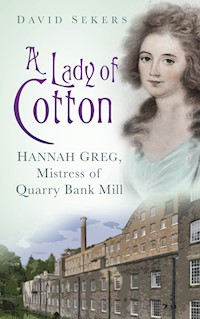
In 1789 Hannah Lightbody, a well-educated and intelligent young woman of means, married Samuel Greg and found herself at the centre of his cotton empire in the industrial heart of England. It was a man's world, in which women like Hannah were barred from politics, had few rights and were expected to be little more than good, dutiful wives. Struggling to apply herself to household management, Hannah instead turned her attention to the well-being of the cotton mill workers under her husband's control. Over the next four decades she fought to improve the education, health and welfare of cotton girls and pauper apprentices at the mill. Her legacy helped turn the north-west into the pioneering heart of reform in Britain. Here, the story of Hannah's remarkable life is told for the first time.
Sie lesen das E-Book in den Legimi-Apps auf:
Seitenzahl: 429
Veröffentlichungsjahr: 2013
Das E-Book (TTS) können Sie hören im Abo „Legimi Premium” in Legimi-Apps auf:
Ähnliche


















Preface and Acknowledgements
Family papers unseen for generations, preserving their voices unheard and their stories unread: these are treasures dreamt of by historians. Faced with such a prize, they first have the task of forging the pieces together to form a narrative, and then they have the delicate responsibility of interpreting it. The universe of Hannah Greg as she saw it, emerges here from just such a collection of manuscripts, largely in her own words, including a vivid diary she wrote in the years before and just after her marriage.1
However, family papers rarely tell the whole story. Inevitably, personal papers, especially those constructed to inform later generations, tend to omit anything scandalous or scurrilous. Passions and family rows seem to be hidden from us, and although we hear about some of the major incidents in characters’ lives, we rarely hear their daily laughter. It is also a limitation that inevitably, here, we see the picture from Hannah’s viewpoint. Records to illustrate the lives and thoughts of Hannah’s less literate contemporaries – the mill workers and apprentices, for example – hardly survive. Where I think it could be helpful I therefore provide information to describe some of the context and background of issues, personalities and places that Hannah encountered.
Some important questions remain, however. Might the Gregs’ paternalism have been seen as condescension by some of Gregs’ workforce? How can we, in our godless age, fully appreciate the role of religious faith in the Gregs’ time? Attitudes in society have always evolved, and I have tried to show how public opinion altered during the Greg’s lifetime, so that the Gregs’ views (on the employment of children, for example) that might have seemed advanced when they were young, seemed outmoded a generation later.
The one-sidedness of the existing evidence might tempt an imaginative writer to amplify the narrative by conjuring up some fictitious personalities, or by attributing imaginary thoughts and emotions to historical figures. Historical fiction is a temptation that I have resisted, but readers may want to use their imaginations to look beyond the surviving written record, and peer creatively into the hearts and minds of the subjects of this book. Those who are interested in exploring more of the historical context of the period and of Hannah’s life and activities are invited to look at my website, which presents additional information in the form of essays and notes.2
I have been lucky to have lived and worked close to the history of the Greg family, and met several descendants while living in the village of Styal in the 1980s, when it still retained much of the character of an Industrial Revolution factory community. There were many residents who could trace back their descent through generations of workers at Quarry Bank Mill and even through mill apprentices. Although the National Trust had long been the landlord, a direct descendant of the Gregs who still lived nearby was a leading figure in the village. This was Mrs Kate Jacks, a senior member in the Unitarian Norcliffe Chapel, who was also a wise and supporting voice for many of the elderly tenants. Often dressed informally, her appearance – with her small stature, stout shoes, quiet voice and her cigarettes – hardly conveyed her personal authority in village matters. But she commanded respect, and was able to speak up for the tenants, to keep an eye on their well-being, and to see that the familiar standards in the village were being maintained by the landlord. No one resisted her suggestions. We have only one description of Hannah’s appearance: ‘Her small active figure was to be seen everywhere and her energy was as widely directed as it was untiring’: a description that might have been written for Kate Jacks, even in her old age.3
Kate Jacks had great pride and interest in her family’s history, and it was she who suggested to me that Hannah Greg’s pioneering work in this factory community deserved fuller recognition. From the outset she supported the project to convert the mill into a working museum, and made available many family papers. Her descendants, Diana Edward, Kitty Gore and Kath Walker, also generously lent or gave family papers to the National Trust, and I am grateful to them, and to Emily Janes and Michael Janes and other members of the Greg family for permission to quote from them. I also owe particular thanks to Nick Lightbody, Dr Tim Paine and Jenny Smith for generously providing access to their collections of family papers. It is thanks to their foresight and generosity that so many of these papers survive to convey the voices of their antecedents.
The archive at Quarry Bank Mill also houses papers left by the Trust’s original benefactor, the late Alec Greg, who gave the whole property to the National Trust in 1939 and who generously supported the museum project at its inception. Dr Mary Rose was the first to write a comprehensive history of the Mill, and this has been an invaluable point of reference. I am also grateful to Jonathan Hudleston, the historian of the Hodgson family, for agreeing to let me quote from his work, and to Sheila Ormerod and Esther Galbraith, other historians of the Greg and Lightbody families.
Some of the family papers in the hands of Kate Jacks, which were subsequently lost, were the basis of short articles on Hannah and Samuel Greg, written by Peter Spencer, and I am grateful to his widow Rosemary Spencer for permission to quote from his work. Lt Col T.H. Pares has kindly provided information on John Pares and his family, as well as permission to quote from his family papers on loan to the Derby Record Office.
I am grateful to generations of staff at Quarry Bank Mill for their continuing support and advice: Eleanor Underhill, Amanda Lunt and Alkestis Tsilika of the present generation; Josselin Hill, Caroline Hill, Adam Damer and Eric Wilkin among former employees. The brunt of many of my requests and enquiries has been helpfully borne by the volunteers, Bridget Franklin and Ann Rundle in particular.
I would also like to thank James Rothwell, the former curator of the National Trust north-west region, Grant Berry, National Trust Publications Manager, and my editor at The History Press Lindsey Smith.
The editors of the Journal of Enlightenment and Dissent, who published an essay on Hannah Greg and my edition of the Diary of Hannah Lightbody, have kindly given their permission for me to quote from these publications. I have continued to receive valuable advice and illuminating suggestions from Dr Martin Fitzgerald, Dr David Wykes and Gina Luria Walker in the field of Dissenting History. David Howman has kindly provided information on the Liverpool abolitionists, and Alex Kidson and Mrs F. Spiegl on images of Liverpool and its leading citizens. I am indebted to Lionel Burman for his wide-ranging information and guidance on aspects of cultural history in Liverpool and beyond, and for his steady encouragement since this biography was conceived.
I am grateful likewise to the staff of the following institutions and libraries: London Library, Liverpool University (Special Collections), Liverpool Maritime Museum, Liverpool Record Office, Greater Manchester County Record Office, British Library, Dr Williams’s Library, London Borough of Hackney Archives, Derbyshire Record Office.
Finally, my thanks to Judith Mirzoeff and to my long-suffering wife, Simone, who have been constructive critics of several versions of this text.
Notes
1. When quoting from manuscript material I have retained, wherever practicable, the original spelling and punctuation.
2.www.davidsekers.com.
3. W.R. Greg, Enigmas of Life (London, 1891), Memoir xi. He added of his mother that she put ‘duty first, then self-culture’.
Contents
Title
Preface and Acknowledgements
Introduction
List of Illustrations
One
The formation of her mind:Hannah’s family background and upbringing
Two
‘Melancholy and admiration’:Hannah’s experience of the Enlightenment and the Industrial Revolution in the north-west
Three
‘A history of my own heart’:Hannah the diarist, 1787–90
Four
‘The differing changes that await you’:courtship, marriage and Manchester family life in revolutionary times,1789–98
Five
‘The diffusion of knowledge and morals’:Hannah as teacher and preacher, 1798–1810
Six
‘Tending to the happiness of the human race’:Hannah’s role in the factory community, 1810–20
Seven
‘The lady of the valley’:cosmopolitan and convivial hospitality at Quarry Bank, 1820–28
Epilogue
How should Hannah Greg be remembered?
Abbreviations
Bibliography
Plates
Copyright
Introduction
Manchester was already an established centre for the textile trade when, towards the end of the eighteenth century, a number of enterprising merchants built large water-powered mills in some of the surrounding river valleys. They equipped them with the newly invented spinning machinery, and in very little time became large employers, making significant profits from the fibre of fashion: cotton.
These mill masters had little choice but to recruit, train and house workers from far afield. While some masters treated their workers shamefully, it was not uncommon for others to care for them, believing this could be a form of enlightened self-interest. Many of the leading masters and merchants were Dissenters, members of a marginalised religious sect noted for business acumen and networks of commercial connections.
Within decades, steam power enabled these cotton entrepreneurs to locate their mills in towns. Employment grew and cotton manufacturing became a cornerstone of Britain’s Industrial Revolution; but working and living conditions deteriorated sharply, especially during trading slumps. Poverty, starvation, epidemics and misery reached unprecedented levels and drew public attention to industrialisation and its inhuman consequences.
Hannah Greg’s lifetime (1766−1828) corresponded with this Industrial Revolution, and with a sequence of equally massive social and political upheavals. It was on the eve of her marriage that the French Revolution reached its first climax with the storming of the Bastille. The rejoicing of radicals and reformers in Hannah’s circle was soon replaced with concern, and then dejection, as the government went to war with France and attacked groups such as the Dissenters who were slow to swear loyalty to the Church and the State. Their freedom of expression and talk of reform were supressed; for three decades Hannah and her circle felt ostracised and marginalised.
Brought up in a climate of Enlightenment, learning and a sense of progress, Hannah was by birth and by inclination a positive believer in society changing for the better. Her Dissenting faith supported this; but what part was she to play now that the climate had changed? And what scope was there for a woman to make the most of her intellectual gifts and education? Would marriage be a constraint, and if so, what sorts of compromise would it entail? Would the political climate inhibit or even expunge Hannah’s convictions about making society fairer and politics less corrupt? What chance was there for her to assist the community of mill workers and apprentices on her doorstep at Quarry Bank, or the masses of the poor and starving in the textile districts?
The Gregs emerged from three difficult decades with their convictions intact. Hannah’s marriage had become companionable, although at a price, as convention still inhibited the expression of her views if they were at variance with those of her husband. Hannah had to manage a large family and household before devoting her remaining energies to her writing or to helping the poor in her community. But in overcoming these challenges, she matured and left her mark as a pivotal figure both in the factory community and at the salon that she created at her home.
Would she live to see the outcome of the long-term ideals that she and Samuel shared, and would the reformers whom they had covertly supported achieve social and political change? In the end, the large industrial towns did win the battle for fair political representation; municipal government was modernised; corruption at elections all but eliminated. Dissenters were permitted to hold office, Unitarianism was officially tolerated, and many Dissenters were elected to Parliament and on to reformed local councils. Then the long battle for free trade was won, and Manchester soon became internationally famous for its liberal economic philosophy.
Hannah’s children and many of her friends’ children contributed to or shared in these triumphs, but Hannah did not live to see them. Before her death she had very deliberately imbued her children with her beliefs, and indeed throughout her life she saw education as the wisest investment to make the world a better place. When young she thought that intellectual learning would be sufficient, but it was a sequence of unexpected setbacks that provided her most memorable lessons in life. Overcoming them helped her acquire a degree of wisdom.
List of Illustrations
here
Tylston, Lightbody and Greg family tree.
here
Map 1 Liverpool in the late 1790s, from William Moss’s Liverpool Guide.
here
Map 2 The River Bollin flowing north-west, Quarry Bank House and mill near the centre, and the factory community of Styal to the north.
One
The formation of her mind:
Hannah’s family background and upbringing
Fatherless
Even though she had been aware of her father’s frail health, nothing can have prepared Hannah Lightbody for his death. While only 11 years old and at boarding school, she was cut off from her family and deprived of their affection and solace. She witnessed neither his death nor his funeral, so she had to find her own way, over time, to come to terms with this loss. It was the first of several trials that would mould Hannah’s character.
Adam Lightbody died in Bath on 30 March 1778 at the age of 52 and was buried at Weston. Earlier in the month he had travelled there from his Liverpool home with his wife and elder daughters and had been ‘taking the waters’ when his condition deteriorated. He had been suffering, they understood, from gout. Bathing was recommended to alleviate the symptoms, but it is possible that Adam was actually suffering from respiratory or heart problems, which at that time were sometimes diagnosed as a form of gout.
It was a consolation, as the elder daughter explained, that her father had died peacefully, without pain and expressing his faith in eternal salvation. Two days before he died, she recorded, he was ‘pretty certain he should not recover, gave us some directions relating to affairs at Liverpool, and discovered not the least regret at the thought of never returning thither.’1
His youngest daughter Hannah was at her boarding school in Ormskirk some 10 miles north of the family home in Liverpool when her headmaster, the Rev. Henry Holland, gave her the devastating news. She was told that she may not attend the funeral in Bath; her mother said that she must stay at school until the family returned home to Liverpool in early April. As a result she was not allowed out to accompany the family’s minister, Dr Yates of Kaye Street Chapel, when he hurried down from Liverpool to Bath to preach the funeral sermon. Hannah had to bear her grief, unconsoled by any relations, for almost a fortnight.
Meanwhile, the rest of the family were joined at the funeral by cousins and acquaintances and then returned slowly from Bath, retracing their steps and recalling their mood of optimism and happiness not long before as they had travelled south hoping for a cure.
Then in early April Mr Holland took Hannah home to Liverpool to join in the family’s rituals of grief and mourning, participating in the formal receptions for friends and relations, who had each been sent the black gloves and ribbons that convention required. They included her father’s numerous cousins and nephews, some prominent merchants, several physicians and a bevy of ministers from the various Dissenters’ chapels where Adam had worshipped. The relatives living in Scotland were not expected to attend, but the occasion demonstrated how firmly the Lightbody family was integrated into the mercantile and social life of this flourishing town.
The elder sisters provided what comfort they could for their mother. All three sisters inherited an equal share of the Lightbody inheritance, to be held in trust until their 21st birthdays. This may have been a benefit for the elder two, whose marriage prospects were perhaps enhanced, but becoming an heiress cannot have been of any great comfort to Hannah, who was then returned to school.
It is hard to imagine a lonelier prospect than that facing Hannah back at boarding school. Even though some of her older cousins, the Nicholson boys, had been at the same school a few years before her, it was an environment deprived of family affection. Of the friends that she made there, the girl she liked most contracted a fever a few years later and died. She was cut off from her sisters, who were six and eight years older and had each other for company. Hannah probably admired and envied them, but hardly considered them as her close companions.
The Rev. Henry Holland’s school may have been spartan, but it had high academic standards. As Hannah grew up she became studious and observant, but also withdrawn and undemonstrative. She had a tendency to draw attention to herself by worrying about her health. While it would be misleading to make claims or allowances for Hannah based on the early loss of her father – family tragedies and personal setbacks were familiar occurrences among all levels of society – this event may nevertheless help to explain her introspection and her faith, if not her determination. Determination and indeed ambition were characteristic traits of her father’s family.
Hannah’s family background
In the seventeenth century the Lightbodys were prominent textile merchants in the Presbyterian community of Dumfries. By the middle of the eighteenth century, Adam Lightbody and his brothers had built on Scottish family connections in Liverpool to establish a successful business partnership there. They soon achieved respectability and status in their Liverpool community as a result of steady ambition and perseverance. By the time Hannah was growing up, they were well established and financially secure and, as a mark of their status, Adam signed his will as Adam Lightbody Esquire. He remains a shadowy figure, but his daughter Hannah was conscious of his standing as a merchant and as a reputable citizen.2
Hannah’s mother, Elizabeth Lightbody, may well have been the more gifted and caring member of the family. She was born Elizabeth Tylston on 17 July 1735, the great-granddaughter of Philip Henry. This Dissenting minister and preacher based in Chester was among the 2,000 ejected from their ministry in 1662 for refusing to conform to the prescribed Anglican liturgy. He was particularly noted for his integrity and courage, and quickly became a figurehead among Dissenters, who were now excluded from official posts and prevented from taking university degrees. His descendants were proud of his example and seem to have been considered as one of the aristocratic families of Dissent.3 As John Tylston put it in a letter to his betrothed, Katharine Henry, Hannah’s grandmother:
I prize you more for the sake of your virtuous education than if both of the Indies were your portion … and you are more dear to me upon the account of your excellent and religious parentage than if all your veins were filled with Royal blood.4
Elizabeth inherited from her forebears a strong current of religious belief and Dissenting faith. Among them were women of strong character and conviction, several of whom wrote diaries that were handed down, read and discussed, providing moral and ethical as well as religious reflections. So it is perhaps not surprising that Elizabeth was devout, as well as cultivated, articulate, modest and quietly benevolent. She belonged to a family tradition that saw women as powerful partners in a marriage, who were encouraged to have minds of their own, and to perform roles in society independently of their husband’s work (see plate 1).
Experiencing two stillborn sons and one surviving only a few weeks, Elizabeth had her own bereavements and disappointments to endure, but her positive view of religion was a comfort, contrasting with the bleaker tenets of non-conformity such as Calvinism. She was well versed in the Bible, and was fond of aphorisms, a practice soon adopted by her daughter Hannah.
Elizabeth had a lively and enquiring mind, was widely read and well travelled. She was befriended by many leaders of Dissent in London and north-west England, and on friendly terms with its intellectual elite, especially at the time of the heyday of the Warrington Academy5, when its intellectual vigour spilled over into Liverpool, giving Elizabeth and her Nicholson cousins the chance to participate in some of the boisterous social life of the younger tutors and students. Among these friends was Mrs Anna Barbauld, an acquaintance possibly dating from the 1760s when, as a young poet, Anna was growing up in the academy.6
The Lightbodys and their eldest daughter went on a tour to Scotland in about 1768, calling in on Adam’s relatives, and possibly also their businesses. Elizabeth’s journal reveals some of the wide curiosity and culture that her daughter Hannah was to inherit. On hearing a preacher whose theological position did not match her own, she noted: ‘cd not help wish his doctrine tend’d more to make them happy & give a more worthy idea of the Goodness of the Deity.’ At the Duke of Argyle’s she sees‘the manufacture of Cambric which they bring to great no. people & have the yarn from France’.The great masterpieces of art were also admired: in Edinburgh they ‘went to see a great number of fine paintings – of Raphael’s & many of Rubens & other great masters’,and she made an extensive list of the great pictures seen at Hamilton Palace.7
Further evidence that Elizabeth had an enquiring mind is provided by her membership of the Liverpool Library (there were few female subscribers at that time), and by her presence among the Octonian Society, a select group who met to discuss literature and philosophical issues in each other’s homes. She was a caring and compassionate person, and perhaps her most remarkable legacy is the record of her benevolence to the poor. Her will demonstrates her devotion and concern for many good causes, and in her lifetime her subscriptions to the poor house and the dispensary (which provided medical help for the poor) were no doubt frequent and generous (though anonymous).
In the mid-1790s, when living on her own in Duke Street, partially blind and infirm, Elizabeth employed a Mrs Seaward of Denison Street to be her housekeeper. She brought with her a young daughter Catharine – also known as Kitty – to help her to attend to the needs of some of the poorest people in the town. Elizabeth taught Kitty to read, and Kitty recalled many years later how this inspired her:
The old Lady would say to me: ‘Catharine, I am going out’ and then she would be carried out in her Sedan. She was too lame to walk, & could not very easily get into her carriage. I used to take a little basket & walk by her side. We would stop at a cellar, into which she sent me to see how the poor woman was & when I had come out again, she would say: ‘how does she look? Is there any fire in the grate? Is there any coal in the house?’ Then she would send me for anything that was wanted.8
Kitty recalled that her mistress believed in discipline, neatness and order. She also believed that even the poorest had innate potential that they could develop. Learning to read would give them access to the riches of the Bible, and this would be a source of guidance and comfort to them. She brought up her daughter Hannah with these convictions, and took her, too, on similar visits to the poor in Liverpool.
Elizabeth Lightbody’s surviving letters confirm her caring, maternal cast of mind. Having lost several children in childbirth, suffered illness and feared the epidemics that carried off children indiscriminately among her family and friends, she became all the more attached to her three daughters and the growing numbers of grandchildren.
Her daughters were Elizabeth (born 1758), Agnes (born 1760) and Hannah (born 1766). We know nothing about the education of the two elder girls. Both seem to have been affectionate daughters, good wives and mothers as well as competent housekeepers for their respective husbands. After Adam’s death, his widow had the sole responsibility for Hannah’s education and for ensuring that, in time, the three co-heiresses (as they were called) found suitable husbands. (See p. 14 for a family tree.)
The first two did well, both marrying in 1781. Elizabeth married Thomas Hodgson in November – when he was 44 years old, twenty-one years her senior. He was a self-made merchant, born and brought up at Caton near Lancaster.9 She died suddenly in a diphtheria epidemic in 1795 at the age of 37, followed a few weeks later by the death of her infant son. Elizabeth Lightbody’s younger daughter Agnes married John Pares on 15 March 1781.10 The second son of Thomas Pares, John Pares (born 1749) like his father was a leading hosiery manufacturer and merchant, living in The Newarke, a large medieval house and warehouse in the historic centre of Leicester.
Hannah’s school and circle in London
With her two elder daughters married, Elizabeth Lightbody’s thoughts turned to the next phase of the upbringing of her youngest daughter, Hannah. By the end of 1782 she was 16, a serious child with an appetite for reading and learning, and ready to leave her school at Ormskirk. In some Dissenting circles at that time it was a fresh but important aim to educate daughters as well as sons. Many agreed with the liberal thinker John Locke,who was in favour of giving daughters ‘an education almost as rigorous as their brothers’, so as to develop their potential, while recognising the limited opportunities for women to apply their learning. This view was in contrast to most of the rest of society, where it was the convention that a girl’s education would end at the age of 15 or 16. A minority might then be sent to a boarding school in or near London where many had been established since the seventeenth century to cater mainly for the daughters of ambitious parents in the provinces.
The popular curriculum for girls in these schools appeared to focus on social accomplishments such as deportment, music, dancing, needlework and drawing. The expectation would be that such skills would be more refined and no doubt more fashionable if they were attained in the metropolis. Even this syllabus was apparently regarded as a form of over-education, since once married a woman would have little time or opportunity to demonstrate her prowess in the diverse artistic talents recently acquired. And were she to undertake anything more stretching, then questions might be raised about her marriageability.
By the 1780s the wife’s role within marriage was widely recognised as one of companionship. An over-educated or bookish female mind was regarded with suspicion and even hostility, and seen as an impediment to mastering the disciplines of household management, and thus was a deterrent to prospective husbands. It was the frequent subject of mockery in novels, cartoons and plays (for example in Sheridan’s The Rivals).
As for bluestockings − women who were learned in classical languages, philosophy or science − they were regarded by many men as an aberration, a betrayal of their gender, and by most other women as unbecoming. Real intellectual distinction in a woman was regarded as odd and disadvantageous.
It was evident that by the age of 16 Hannah was studious and had a good mind that she wanted to cultivate, but there were no suitable schools for her in or near Liverpool. It was also clear that she was unlikely to develop her potential by staying at home with her widowed mother. The solution to these quandaries came in advice that Elizabeth received from her cousins in London. Thomas Rogers was a wealthy banker living at Newington Green, bringing up his six children after his wife had died in 1776. Several of his daughters had been educated at the nearby school at Fleetwood House in Stoke Newington, and it seems that he recommended it and offered Hannah hospitality in his home nearby, with cousins of a similar age as a surrogate family.11 She was duly sent off to London, probably returning home rarely over the following three years. A portrait of Hannah may date from this period: it shows a serious, observant face, pale brown eyes, a mouth that betrays a sense of humour and auburn hair in ringlets falling around her neck (see plate 2).
Miss Elizabeth Crisp and her sister Sarah had started the boarding school at Fleetwood House in 1772, using a part of the large old building standing in its own grounds just off Stoke Newington High Street. In the new year of 1783 when Hannah started as a pupil there at the age of 16, her first impressions would have been of the scale and age of the building. This imposing mansion built in Queen Elizabeth’s time had sixty or seventy rooms, with a large garden and 98 acres of land. In the upper part of the house there was said to be a little room used for hiding persecuted non-conformists during the reign of Charles II. There is a record of seats being arranged in the Newington Chapel for the pupils of Miss Crisp’s school, in 1792, which suggests that the school provided education specifically or solely for the daughters of Dissenters.
Stoke Newington at this time was little more than a single street, bordered by parkland, leading down to the New River. Rambles in the ancient landscape and lush countryside were not discouraged and it is likely that Hannah first discovered her love of walking, nature and the open air in this north London village. A party of schoolgirls, which could perhaps have included Hannah, were glimpsed enjoying the romantic environment on the edge of the village on a summer’s evening in 1785 by the youthful poet Samuel Rogers. He recorded the magic of the moment in some rather wistful lines inscribed: ‘To a Party of Young Ladies who were sitting on a bench in Queen Elizabeth’s Walk at Eight o’ clock last Thursday Night,’composed on Saturday, 14 May 1785:12
Evening had flushed the clear blue sky
The birds had sung themselves to sleep,
When I presumed, I don’t know why,
In Old Queen Bess’s walk to peep.
And there was she; her belles and beaux
In ruffs and high crowned hats were there!
But soon as you may well suppose,
the vision melted in the air.
When hark! Soft voices, thro’ the shade,
Announced a little fairy train.
And once, methought, sweet music played,
I wished to see, but wished in vain.
The school provided the girls with the usual accomplishments such as deportment and dancing as well as sewing and music. Hannah played the piano and could compose. But the curriculum went much further: it seems to have included French, some mathematics, history, religion, literature, the classics (including classical philosophy, morals and ethics), the history of art, geography, as well as English and foreign literature. Hannah was probably also taught debating, which was becoming an accomplishment acceptable among women. By the time she left in 1786 at the age of 20, she had blossomed into a star pupil, to judge by the warm welcome given her on her return visit in the winter of 1787/88. At first, however, she was homesick, as she recalled almost forty years later when writing to her granddaughter who, it was reported, had ‘returned to school in distress’. Hannah wrote: ‘I remember well that, when I used to go to school, a letter was most valuable to me soon after I arrived.’13
Hannah’s first letter home, dated Sunday 16 February, was addressed to her mother who was staying with her married daughter Agnes in Leicester. It is all the more poignant for being formal:
Dear Mama, You will be surprised perhaps at the date of this but you shall hear how I got here; yesterday Miss Mitchell and Miss Rogers came for me before dinner; and desired I might stay till Monday; my Governess gave me leave, and I made no objection: ’tis only a pleasant walk from Stoke Newington. I long very much to hear how you got home, and how you found all our dear friends there … I stood in the stocks yesterday and doubt not that by the means of those and dancing I shall in time hold up my head. Doctor Price called here last night, he was not well enough to preach today. The compliments of this family attend you … Do not forget what pleasure your Letters give me always. I remain
Your affectionate & grateful
H Lightbody14
It seems that Hannah was not happy learning deportment, a ritual accomplishment that she found pointless. But as she was of less than average height, a sedentary reader of books and (as far as we can tell) self-deprecatory by nature, it is likely that lessons in deportment taught her to hold her head high, to appear confident and to make the most of her looks.
Hannah’s upbringing was largely in the hands of her able teachers, but she also owed much to the Rogers family who provided a second home for her, with the companionship of cousins, a father figure in Thomas Rogers, and another cousin, Miss Mitchell, who looked after them all as well as taking care of the household.
For several decades the villages of Stoke Newington and Newington Green in north London had been a centre for writers, academics and especially for Dissenters, a reputation well known to Hannah’s mother. Dissenters had first arrived in the mid-seventeenth century and established various ‘academies’ on the Green, where Daniel Defoe and Samuel Wesley (the composer) were among the students. Isaac Watts (1674−1748), the hymn writer, lived at Fleetwood House and then at the Green. Their chapel was built on the Green in 1708 and still stands.
In the 1780s Thomas Rogers was a leading light among the Rational Dissenters in London15 and a major figure in the formation of the new Dissenting academy, Hackney New College.16 His house at Newington Green was next door to Dr Price’s, the polemical writer who has been called the ‘first and original left-wing intellectual in British history’,17 a man of great energy and vision who seems to have combined actuarial brilliance, erudition and industry with personal charm. They met for weekly discussions at dinner, and their houses would have been full of progressive debates about the education of men and women, of freedom of worship, and modern ideas about education, politics and society. Hannah’s arrival in this milieu coincided with unprecedented intellectual and political vitality. It was probably there that Hannah got to know of Price’s protégée, Mary Wollstonecraft, who was then starting up a school of her own nearby. Hannah also seems to have met many of the leading educators, radicals and reformers who wanted the wrongs in society righted.18
How much of this climate of intellectual and political ferment rubbed off on Hannah? It is impossible to say with any certainty, but she knew Price and many of his circle well enough to call on them when visiting London a year after leaving school. Spending weekends and vacations with the Rogers family exposed her to many lively discussions with such intellectuals, and to debates with her cousins, the Rogers children, too. It is also clear that by the time she returned to Liverpool at the age of 20, she had formed firm ideas of the value of a woman’s mind. She had no doubt that she was entitled to develop it by study. And she believed, in accordance with the teaching of Price and Dr Joseph Priestley, that mankind was capable of attaining perfection. Though not won over, it seems, by their revolutionary ardour, her sense of social injustice nevertheless had been awakened. She may not have been a true bluestocking, but there is no indication that she preferred frivolous pursuits to the life of the mind. Yet one question remained: was her education going to be an advantage, as she returned to life at home with her mother in Liverpool? She had developed poise and self-confidence in the company of adults, and remained an avid reader, at times withdrawn and contemplative, at other times enthusiastic and voluble. But how would these attributes be met with in Liverpool society?
Returning home at a propitious time
Back in Liverpool, Hannah’s mother was alone, but occupied with supporting her two elder daughters as the first grandchildren were born. Both Thomas Hodgson and John Pares were aware of the exceptional climate for business investment following the end of the American War of Independence. Far-sighted entrepreneurs wanted to grasp this opportunity. It would later be seen as the start of a new Industrial Revolution.
John Pares was in an advantageous situation, as since 1778 at Calver Mill in Derbyshire he had gained practical experience of the demand for cotton yarn and of the profitability of cotton spinning using Arkwright water frames. He was now prepared to challenge Arkwright’s patents (which were punitively costly) and prepared to invest with a team of experienced businessmen in another spinning mill.
Since 1773 Thomas Hodgson had also been thinking of diversifying his business investments away from the Africa trade. He and his brother-in-law John Pares agreed to invest in a new cotton-spinning mill in his home village of Caton in 1784. His partners included Isaac Capstick, Hodgson’s sister’s husband.
Unknown to Hannah and her family, a young Irish textile merchant called Samuel Greg, who was based in Manchester, was pursuing a similar goal. He spent part of 1783 riding around the countryside in the environs of Manchester in search of a suitable site to erect a cotton-spinning mill of his own. He had a sound knowledge of the markets, having worked for several years for his uncles who were prominent merchants, arranging the weaving and distribution and export of linen, wool and cotton mixtures. He had become a partner in the firm when one uncle had retired, and had benefited from the rise in value of stocks that he had acquired, following the end of the American War of Independence.
The site he chose was at Quarry Bank in the valley of the River Bollin near Wilmslow, 9 miles south of Manchester. He arranged to lease it from the Earl of Stamford, and began building a modest-sized spinning mill. He engaged a mainly local workforce, some expertise to train them, leased some local farm-workers’ cottages to house them and started the operation in 1784. By the time it was making its first profits a few years later, Greg had become a highly successful and thriving businessman. He was still an eligible bachelor.
1 Map of Liverpool in the late 1790s, from William Moss’s Liverpool Guide.
Notes
1. Elizabeth Lightbody (jnr) to Robert Lightbody, 4 April 1788, QBM GLB 1.170.
2. Her grandfather, also called Adam (1677−1731), was the first to have prospered. He lived at Conheath, Caerlaverock, and followed in his father’s footsteps as a merchant. After his first wife’s death he married Agnes Nicholson, from the neighbouring village of Blackshaw in Dumfriesshire. In addition to the three children from his first wife, Adam Lightbody had five more: in order of seniority, William, Adam, James, Thomas and Robert. But most of them were still young when their father died in 1731, leaving Agnes with eight children to support. One of Agnes’s brothers, John Nicholson (c.1692–1754) offered his sister a lifeline, undertaking to support three of her five Lightbody boys in Liverpool and set them up in the linen trade. By the time their mother Agnes died in 1748, these Lightbody boys, like the Nicholsons, had become prominent and successful Liverpool merchants, part of a powerful and successful group of émigré Scots based in Liverpool. When their uncle, John Nicholson, died childless in 1754, he provided for his three Liverpool nephews William, Adam and Robert Lightbody to inherit his considerable estate. Robert, William and Adam Lightbody are listed as trading from Dale Street in 1766. Hannah’s uncle William (1715–83), the eldest of this generation of the Lightbodys, seems to have been the first to have made his own fortune. His marriage to Anna Brooks (1723–77), the daughter and heiress of one of the leading merchants and citizens of the town, bolstered his fortune further. Adam’s career and fortune were more modest. By 1774 Adam was living at 1 Paradise Street, next to his brother Robert who inherited No 2 from Robert Nicholson.
3. Hannah’s great-great-grandfather was Philip Henry (1631–96). His stoical tenacity, stirring sermons and care of his flock were legendary. His son Matthew Henry (1662−1714), wrote about him and published a famous commentary on the Bible.
4. Letter in Paine collection, dated 20 November. 1686.
5. Anna Laetitia Aikin (1743−1825), daughter of John Aikin, moved to Warrington in 1758, where she published her first book of Poems which was admired by Elizabeth Lightbody.Shemarried the Rev. Rochemont Barbauld in 1774.
6. The Academy founded at Warrington in 1757 was among the most successful and influential of the institutions founded to educate Dissenters. Several of Hannah’s Liverpool friends and cousins had been educated there and several of the leading tutors were friends of her mother’s. After it closed down in 1786, Manchester New College was founded to take its place.
7.Diary of a journey to Scotland,Elizabeth Lightbody, c.1760, Paine collection.
8. Paine collection. See Chapter 5 for further reference to Kitty Wilkinson (née Seaward) and her later achievements. See also Herbert R. Rathbone, (ed.), Memoir of Kitty Wilkinson (Liverpool, 1927) and Winifred R. Rathbone The Life of Kitty Wilkinson (Liverpool, 1910).
9. Thomas Hodgson (1737−1817), with his brother John (1735−1813), had left home at Caton near Lancaster in the 1750s to make a career at sea under Miles Barber, the noted local Africa merchant. They probably moved to Liverpool with Barber after 1765. Thomas was stationed off the Gambia as Barber’s agent, returning in 1773 suffering from ill health, when he established an independent partnership with his brother. Their first ships were aptly named Two Brothers and Caton. When he married Elizabeth, he was involved in the Africa trade as a merchant and investor, owning the station on the Isle de Los as late as 1793. Between 1771 and his retirement in 1796, he had been involved in more than fifty slaving ventures. A number of his ships were lost, and he seems not to have made his fortune in this business. In 1784 he established the Caton cotton-spinning mill with Thomas Gardom and his brothers-in-law John Pares and Isaac Capstick. He died in his retirement at Caton a respected figure.
10. Thomas Pares senior (1716−1805) was among the most prominent lawyers, merchants, manufacturers and financiers of the East Midlands hosiery trade, investing in land and grand houses and estates (his wife was a second cousin of the Earls of Stamford). Like Thomas Hodgson, John Pares (1749−1833) was an Anglican. He had leased a site at Calver as early as 1778 with John Gardom to build a spinning mill there, subscribing to and then challenging Arkwright’s restrictive patents on the new cotton-spinning machinery. In 1784, he was a major backer of the Caton Mill, which his brother-in-law Thomas Hodgson was to manage. This able and dynamic businessman was also a regular visitor to Liverpool in the 1780s and 1790s, where he was a director of the Liverpool Assurance Office. He was a director of Heygate and Pares, hosiers in the City of London, and went on to found Pares Bank in Leicester.
11. Martha Rogers was then 17, Maria 21 and Sarah 20. Since the death of their mother a decade earlier they and their brothers Daniel, Thomas and Samuel were all looked after with great skill and dedication by another loyal cousin, Mary Mitchell. See P.W. Clayden, The Early Life of Samuel Rogers (London, 1887).
12. London Borough of Hackney Archive, D/F/ SHI/19.
13. HG to granddaughter Bessy Rathbone, 11 February. 1823, LU RP XII. 2, and HG to daughter Bessy Rathbone, 19 February. 1823, LU RP VI. 1.13.
14. HG to Mrs Lightbody; QBM GLB 1.495.
15. Thomas Rogers (1734/35-93). He was a Dissenting Deputy, that is, a representative of his area, and a member of the Society of Constitutional Information. Later, at the end of the 1780s, he would be active on the London Committee for the Repeal of the Test and Corporation Acts, and become the chairman and a leading player in the New College, Hackney.
16. In its short life, Hackney New College became the most advanced of all the Dissenting academies, a hive of intellectual enquiry and radical thinking. Staff and pupils later had close links to the radical movements developing in the 1790s such as The Society of the Friends of the People and The Society for Constitutional Information, and with leading politicians of revolutionary France.
17. The epithet comes from J.G.A. Pocock, Radical criticisms of the Whig order in the age of revolution,in Margaret and James Jacob(eds), The Origins of Anglo-American Radicalism (New York, 1991), 48. Richard Price (1723-95), philosopher, theologian, mathematician, actuary and pamphleteer, was a founder member of the Society for Constitutional Reform (1780) and when the Society for Commemorating the Revolution in Great Britain (known as the Revolution Society) revived its activities, Price played a prominent part in its proceedings. He was well known to Hannah and her mother.
18. Mary Wollstonecraft (1759–97) gave up her school in 1785. Hannah probably knew her later writing, but it is not known whether or not they met.
Two
‘Melancholy and admiration’:
Hannah’s experience of the Enlightenment and the Industrial Revolution in the north-west
Hannah’s Liverpool
In 1786, after several formative years in London, Hannah returned to her family home in Liverpool at the age of 20, more confident and better informed than when she left. She might have been expected to view the town of her birth with a critical perspective, sharpened by the sophisticated culture of the metropolis, but this was not the case. Hannah looked back on her youth in Liverpool as a golden age, and she long acknowledged how much the town meant to her. What did she see in it?
It is not in fact hard to discern the aspects of the town that appealed so greatly to her at that time. She loved its commercial vitality, the constantly improving urban scene, its rural hinterland and especially its culture. There was then a climate of optimism as advancements in medicine, science and technology were matched by progress in commerce and faith in the improvement of the fabric of society.
Hannah loved striding round the town and out into the surrounding countryside, her favourite walks often taking her past familiar landmarks and inspiring views. Stepping out of her front door in Paradise Street, she stood in the commercial centre of the town between Church Street and Lord Street, surrounded by the large family homes of the merchants, which at that time still stood adjacent to their counting houses and warehouses. Perhaps this quarter was no longer quite as elegant as it had been; the flotsam and jetsam of a busy seaport had always been perceptible, but now the surrounding streets had become an area peopled with small traders as well as merchants. The old Town Dock was only 100 yards away, and beyond it on either side east and west stood the complex of warehouses, timber yards and the building site where the large Kings Dock and Queens Dock were under construction (see map here).
The whole complexion of the place was nautical. The docks, however, were stupendously grand, the inner one – Town Dock – lying in the centre was filled with a forest of masts; besides this were three very large docks linked via flood gates, intermixed with dry docks for repairing; the lower dock had a fine, wide quay on its outer side, which made for an agreeable walk, being lined with trees on either side.
This was the Parade, a favourite promenade with fine views across the River Mersey to the shore of Wales.
Turning north, along Castle Street towards the elegant Exchange building, Hannah would enter the town centre, still medieval in scale, cramped and overcrowded. The great majority of houses were:
in middling and lower style, few rising above that mark; the streets were long, narrow, crooked and dirty. You scarcely saw a well-dressed person, nor half a dozen gentlemen’s carriages; few of the shops appear so well as in other great towns.1
The congestion was exacerbated by the street-widening schemes under way in the old heart of the town. At the focal point of this commotion stood the Exchange, the hub for brokers, some senior merchants, insurers, just a few banks, and the Common Council. To reach the site of the Lightbody linen warehouse, Hannah would turn right, inland, to wander up Dale Street, a fashionable area with fine shops.
Heading uphill and out of town, Hannah would pass sail-makers, blacksmiths, coopers and crate-makers, all businesses connected with the port. Behind the prosperous facades, immigrants clustered in side streets and overcrowded courts, many of them families drawn in from the hinterland as well as from Scotland and Ireland, looking for employment as the town’s trade expanded. They would find homes wherever they could, often in unsanitary cellars. As the density of housing and traffic diminished, from a brow looking back over the town Hannah could see ropewalks spread out from the town centre, while terraces of new housing invaded the surrounding fields.The plumes of smoke from the distant sea shore came from the factories making salt, sugar, glass and pottery.
Leaving the charming hillside village of Everton to her left, it would take Hannah barely half an hour along the country lane to reach Wavertree, the straggling village where William Lightbody bought a number of houses and parcels of land following the enclosure of the common. Hannah’s mother liked her small house there; Hannah too appreciated the country air and rural surroundings. Returning towards the town, she often took the route through Toxteth Park, Lord Sefton’s great estate. Its meadows and hedges were an oasis for wildlife and there were extensive views over the Mersey estuary and Otterspool. The country lane westwards back to Paradise Street passed Park Chapel, the original chapel for the Dissenting community, and then St James’s church standing on the edge of the built-up area, before dropping down to the old Town Dock.




